http://dx.doi.org/10.4236/jamp.2013.15013
Adaptive Piecewise Linear Controller for Servo
Mechanical Control Systems
Tain-Sou Tsay
Department of Aeronautical Engineering, National Formosa University, Yunlin, Taiwan Email: [email protected]
Received September 18, 2013; revised October 18, 2013; accepted October 27, 2013
Copyright © 2013 Tain-Sou Tsay. This is an open access article distributed under the Creative Commons Attribution License, which permits unrestricted use, distribution, and reproduction in any medium, provided the original work is properly cited.
ABSTRACT
In this paper, an adaptive piecewise linear control scheme is proposed for improving the performance and response time of servo mechanical control systems. It is a gain stabilized control technique. No large phase lead compensations or pole zero cancellations are needed for performance improvement. Large gain is used for large tracking error to get fast response. Small gain is used between large and small tracking error for good performance. Large gain is used again for small tracking error to cope with disturbance. It gives an almost command independent response. It can speed up the rise time while keeping robustness unchanged. The proposed control scheme is applied to a servo system with large time lag and a complicated electro-hydraulic velocity/position servo system. Time responses show that the proposed method gives significant improvements for response time and performance.
Keywords: Piecewise Linear Controller; Nonlinear Controller; Adaptive Gain; Servo System
1. Introduction
This template Gain and phase stabilized are two conven- tional design methods for feedback control systems. They can be analyzed and designed in gain-phase plots to get wanted gain margin (GM) and phase margin (PM) or gain crossover frequency
cgselected for switching. An adaptive switching algorithm is used. There is no discontinuous connection between two systems. Therefore, there is no chattering problem. Gain scheduling has been used successfully to control nonlinear systems for many decades and in many differ- ent applications, such as autopilots and chemical proc- esses [8-10]. It consisted of many linear controllers for operating points to cope with large parameter variations. This concept will be expanded for response time and performance. Operating points are replaced by fast re- sponse and good performance conditions and interpola- tion for gain evaluation is replaced by an adaptive switching point. It is determined by the filtered command tracking errors. Nonlinear controllers syntheses using inverse describing function for use with hard nonlinear system have been developed for several researchers [11-14]. They are complicated but effective for nonlinear systems. In this paper, a simple three segments piecewise linear controller is proposed. It is easy to analyse and design. Furthermore, it gives an almost reference input independent response.
and phase crossover frequency
cp
[1,2]. The gain crossover frequency isclosely related to the system bandwidth (or rise time). The phase margin is closely related to performance (or peak overshoot). In general, fast response time and good performance can not be obtained simultaneously for some feedback control systems. For example, the altitude control system of the airframe with altitude and altitude rate feedbacks needs large altitude loop gain for fast re- sponse time and low altitude loop gain for good robust- ness. It is in conflict with another. A simple and effective way to solve this problem and better results for those of linear controllers is generally expected. This is the mo- tivation of this paper. Variable structure control is a switching control method for feedback control systems [3-7]. It gives good performance and robustness for cop- ing with system uncertainty. But it suffered from chat- tering problem and state measurements. In this paper, a fast response system and a good performance system are
cant improvements for response time and performance.
2. The Adaptive Piecewise Linear Controller
2.1. Piecewise Linear Nonlinearity
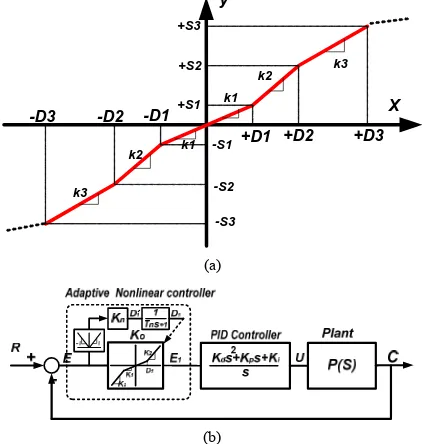
Figure 1(a) shows piecewise linear description of the symmetrical nonlinearity. Piecewise linear segments
i i
y y are in the form of
1 1
y Kx
1
x
1
(1)
1
12
; i
i i j j j
j
y K x K K D i
(2) 1 1
y K (3)
1
12
; i
i i j j j
j
y K x K K D i
(4)Now, the problem is to determine the values of switch points Di and gains Ki between Di and Di1 for the wanted responses time and performance. For illus- trating purpose, two switching points D1, D1 and two gains K1, K2 will be used to illustrate the advan-tage of the proposed piecewise linear controller; i.e.,
three segments are discussed. In this work, switching points 1 and 1 are not fixed and will be deter- mined by the absolute value of the command tracking error of feedback control systems. The control configura- tion of the industry process using the piecewise linear nonlinearity and PID controller is shown in Figure 1(b). The finding of will be discussed in the next subsec- tion.
D
D
1
D
+D1 -D1
+D2
-D2 +S1
-S1 +S2
-S2 k1
k3 k2
+S3
-S3 -D3
+D3 X y
k2
k3
k1
(a)
(b)
Figure 1. (a) Piecewise linear description of an adaptive gain; (b) Control configuration of the industry process us-ing PID controller.
2.2. Gain Adapting Using the Piecewise Linear Nonlinearity
The loop gain of the closed-loop system can be adapted by the piecewise linear linearity. Considers a second or-der numerical example described by
1
2
G s s s
(5)
It is closed with a loop gain K. Then the closed-loop
transfer function is
2 2K T s
s s K
(6)
Poles locations and natural frequency
n for two loop gains
K K1, 2
are given below:1 0.500; poles : 0.2929, 1.7071
K ;
2 10.00; poles : 1.0 3.0; n 3.1623;
K j
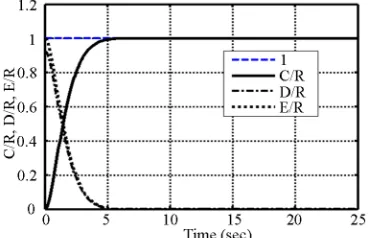
They are an over-damped and an under-damped sys-tems. Time responses are shown in Figure 2 for KK1 (small-dot-line) and K K2 (large-dot-line) in which R represents the reference input and C represents the plant
output.
The strategy for gain switching is (1) large gain
K2 for large tracking error to get fast response and (2) small gain
K1 for small tracking error (E) to get good per- formance. It is a variable structure system and can be achieved by selecting a proper switching point 1 of the piecewise linear controller shown in Figure 1(a). For example, the optimal switching point 1 is selected as 0.525 for R = 1 to get both fast response and goodper-formance. Large gain
D
D
K2 is used for E D1 and small gain
K1 is used for E D1. Step response is shown in Figure 2 (solid-line) also for R = 1. It showsthat adaptive gain can give a good result for fast response and good performance.
However, it is not true for R is equal to 5, 10 and 50, respectively. Those step responses are shown in Figure 3. Naturally, another switching point D1 for R = 5, 10 and
Figure 2. Time responses for K1 = 0.5, K2 = 10 and adaptive
[image:2.595.66.277.476.698.2] [image:2.595.333.515.579.710.2]50 can be selected for getting good performance. They are 2.625, 5.250 and 26.250 for R = 5, 10 and 50, respec-
tively. They are true for step responses from zeros to 5, 10 and 50 only. Another possible way for the switching point can be dependent on the tracking error (E). A pos-
sible switching rule for D1 is found as D10.925E for good performance. Figure 3 shows time responses for R = 1, 5, 10 and 50, respectively. It can be seen that
the switching rule gives an input command (R)
inde-pendent results. However, they are slower than results shown in Figures 2 and 4.
One possible way to speed up the time response is enlarging the large gain phase in the beginning. A low-pass filter D s
Kn
T sn 1
for the absolutetracking error (E) to get is used. Figure 5 shows
faster response is get for 1
D
n
K 1.0445 and Tn 1n.
The switching point 1 is shaped for speed up the re-sponses while keeping performance unchanged. Figure 6 shows input independent responses for R = 1, 5, 10 and
50. Note that the natural frequency
D
n for K K2 is used to find Tn. Therefore, it is needed to find Knonly.
The design procedures for the proposed method using the adaptive piecewise linear controller can be deduced as:
[image:3.595.323.536.407.713.2]Step 1: Selecting two loop gains for fast response and good performance, respectively.
Figure 3. Time responses for R = 1, 5, 10, 50 using D10.925E of the illustrating example.
Figure 4. Time responses for R = 1, 5, 10, 50 using D1 =
0.525 of the illustrating example.
In general, high loop gain
KK2
for fast re-sponses and low gain
K K1
for good performance. The rise time
Tc of the system using high gain meetsthe design specification. The peak overshoot of the sys- tem with low gain meet the design specification.
Step 2: determining parameters of low-pass filter
n
n 1
D s K T s to find the optimal switching point
1. The natural frequency
D
n for the high gain sys-tem
KK2
is used to find Tn. The natural fre-quency
n is close related to the rise time. Another parameter n can be found by the optimization methodusing performance index formulated by integration of the absolute error (IAE) and integration of the square error (ISE) or on-line parameterized method [15,16]. The it-eration rule for finding
T
n
K is formulated as
j
1
n n
G kTT G kT Mpc Mps ;
(7)
n n
K G kTT (8)
where Mps is the specification of the Peak point; Mpc is the peak point found using Kn Gn
kT ; T issimulation period of one step response; and k is the
step responses.
th
k
[image:3.595.80.265.416.535.2]The proposed control scheme will be applied to a servo system with large transportation lag and a compli-
Figure 5. Time responses for R = 1 using D s
=
1
n n
K T s of the illustrating example.
[image:3.595.81.265.583.708.2]cated electro-hydraulic velocity/position servo system.
3. Numerical Example
Example 1: Consider a stable plant has the transfer function [16,17]
2e 1 s G s s
(9)
It is a second order dynamic plus a pure time delay (SOPDT). In this example, a PID controller with pa-rameters
1.1953; 0.5942; 0.7338;
p i d
K K K
is designed first. And then low gain 1 is se- lected and high gain 2 is selected for the sys- tem is just in the sustaining oscillating condition. The oscillation frequency is
0.50
K
2.587
K
1.57
n 08 rad s
. Time
re-sponses using low gain
K1
2.587; 0.5 1.1385; n n K
and high gain are shown in Figure 7. They show an over-damped system and a zero-damped system. Now, applying the proposed control scheme to the system us- ing
K2 2.5870.5
1 2
The
000; 0.6366;
K K T
n
K is found by following on-line computing
rule:
20.9 0.1
n n
G kTT G kT Mpc Mps
; (10)
n n
K G kTT (11)
with Gn
0 0.5, T 25 seconds and Mps1.001. The found Gn
kT
are
0 0.5; 1.0794; 2 1.1365; 3 1.1385; 4 1.1385;
n n n
n n
G G T G T
G T G T
nG kT is converged to be 1.1385 within three pe-
riod simulations. The time response is shown in Figure 7 also. It can be seen that the proposed method can give fast response and good performance simultaneously. It is
Figure 7. Step responses for constant gains (K = 0.5 & 2.587) and adaptive gain with D1 of Example 1.
the combination of over-damped and zero-damped sys- tems with 1. Zero-damped system is used for fast re- sponses and over-damped system is used for good per- formance. Naturally, it is input command (R)
independ-ent also.
D
Simulation results of the proposed method and four other methods are presented for comparisons. They are Ziegler-Nichols method [18,19] for finding PI and PID compensators, Tan et al. [20,21] for finding PID com-
pensator and Majhi [17] for finding PI compensator. Pa- rameters of five found compensators are given below:
1) Proposed Method:
1.1953; 0.5942; 0.7338;
p i d
K K K
0.5000; 2.587; 1.1385;
K1 K2 Kn Tn0.6366;
1.240
K
2) ZN(PI): p and Ki 0.251.
3) ZN(PID):
1.6367, 0.4187 and 0.5972
p i d
K K K .
4) Tan’s (PID):
0.620, 0.5636 and 0.1705
p i d
K K K
0.864 and 0.3653
K K
.
5) Majhi’s (PI): p i .
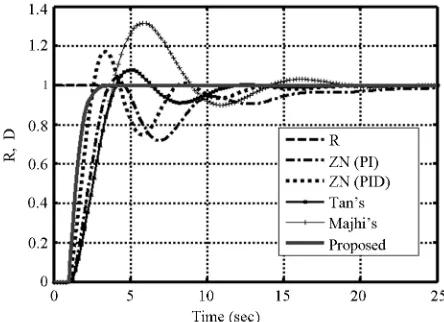
Time responses are shown in Figure 8. Gain/phase margins, phase/gain crossover frequencies, Integral of the Square Error (ISE), and Integral of the Absolute Error (IAE) are given in Table 1. From Table 1 and Figure 8, one can see that the proposed method gives faster response, better performance, and better robustness than those of other methods presented. Note that the proposed mrthod can provide a simple way to improved the system that has been controlled.
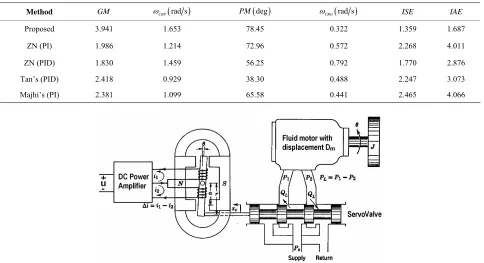
Example 2: Consider an electro-hydraulic velocity/po- sition servo control system [22] shown in Figure 9. The relation between the servo spool position Xv and the
input voltage u is in the form of
2 2 2 1v v
v v v
X K
G s
u s s
v (12)
where Kv is the valve gain, v is the damping ratio of
[image:4.595.311.533.556.717.2]the servo valve and v is the natural frequency of the
[image:4.595.59.290.568.710.2]Table 1. The gain/phase margins, phase/gain crossover frequencies, ISE and IAE of Example 1 using different methods.
Method GM CRPrad s PM deg CRGrad s ISE IAE
Proposed 3.941 1.653 78.45 0.322 1.359 1.687
ZN (PI) 1.986 1.214 72.96 0.572 2.268 4.011
ZN (PID) 1.830 1.459 56.25 0.792 1.770 2.876
Tan’s (PID) 2.418 0.929 38.30 0.488 2.247 3.073
[image:5.595.58.542.100.363.2]Majhi’s (PI) 2.381 1.099 65.58 0.441 2.465 4.066
Figure 9. Block diagram of the electro-hydraulic system. servo valve. In general, Equation (12) can be approxi-
mated by XvK uv for large v. The relation between
the valve displacement XV and the load flow rate QL
is governed by the well-known orifice law [22]
7 2
t
3.5 10 N m
o
; 3.3 10 m rad5 2 t
V ;
11 2
t
2.3 10 m s N tp
C
; Dm 1.6 10 m rad5 3
;
3 2
5.8 10 Kg m s
J ; Bm0.864 Kg m s rad ;
L V J S V L V s
Q X K P sign X P X K (13)
0.4; v
v 628 rad s.
where Kj is a constant for specific hydraulic motor;
is the supply pressure;
S
P PL is the load pressure and;
s
K is the valve flow gain which varies at different oper-
ating points. The following continuity property of the servo valve and motor chamber yields
The control configuration for velocity and position servo control of the considered system is shown in Fi- gure 11, in which inner loop and outer loop adaptive nonlinear controllers are included.
Design results of the velocity control loop are dis- cussed below:
4
L m tp L t o
Q D C P V PL; (14)
1) Inner loop PI controller where m is the volumetric displacement; tp is the
total leakage coefficient; t is the total volume of the
oil; o
D C
V
is the bulk modulus of the oil; and is the velocity of the motor shaft. The torque balance equation for the motor is in the form of
The PI controller is first found by the optimization toolbox of MATLAB for minimized the integration of absolute errors (IAE), integration of square errors (ISE) and zero peak overshoot. Parameters of the PI controller are 1.127 10 3
p
K and . Time re-
sponses of the controlled system using the found PI con- troller are shown in Figure 12.
3.9632 i
K
m L m L
D P JB T ; (15)
where Bm is the viscous damping coefficient and TL
is the external load disturbance which is assumed to be dependent upon the velocity of the shaft. The mathe- matical model of the considered system is shown in Fig-ure 10. System parameters are given below:
2) Parameters of inner loop adaptive nonlinear controller
Low gain
K11
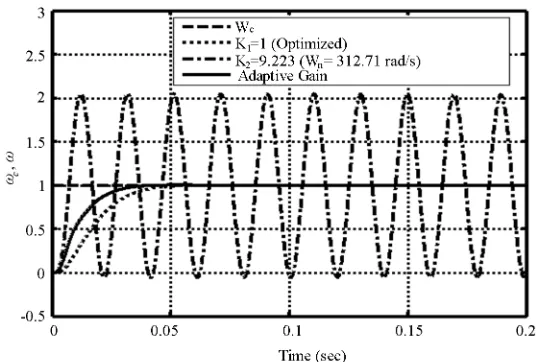
and high gain are selected. The low gain case is the optimized result and the high gain case is the controlled system in the sustain-ing condition
K2 9.223
7 2
2.3 10 m s
s S V L
K P sign X P ; 312.71 rad s
n
. The
7 2
t
1.4 10 N m
S
P ; Kv0.5 m v; is found by Equations (8) and (9) using n312.71 rad s gives Tn0.003182. Kn2.281.00189
ps
Figure 10. Mathematic model of the electro-hydraulic system.
Figure 11. Control configuration of velocity and position servo control system.
Figure 12. Time responses of velocity control system for low gain
K11
and high gain
K29.223
and adaptive gain.Time responses for low gain, high gain and adaptive gain are shown in Figure 12. Rise times of the optimization method and the proposed method are 0.0202 sec and 0.0124 sec; respectively. It shows the proposed method can give faster response than that of controlled by the optimized method. The Gain gain/phase margins, phase/gain crossover frequencies, and rise times are given also in Table 2. It gives controlled system using two methods have same robustness while Figure 12 shows the proposed method gives faster response.
Design results of the position control loop are dis- cussed below:
1) Outer loop PI controller
The PI controller are first found by the optimizations toolbox of MATLAB for minimized the integration of absolute errors (IAE), integration of square errors(ISE) and zero peak overshoot. Parameters of the PI controller
are 18.506Kp and Ki 0.3666. Time responses of
the controlled system using the found PI controller are shown in Figure 13.
2) Parameters of outer adaptive nonlinear control-ler
Low gain
K11
and high gain are selected. The low gain case is the optimized result and the high gain case is the controlled system in the sustain-ing condition
K2 7.877
n 91.95 rad s
. The 91.95 rad s gives Tn0.001 .
n 0875 K 13.5
n is
found by Equations (8) and (9) using Mps e
responses for low gain, high gain, and adaptive gain are shown in Figure 13. Rise times of the optimization method and the proposed method are 0.0513 sec and 0.0334 sec; respectively. It shows the proposed method can give faster response than that of controlled by the optimized method. The Gain gain/phase margins, pha-
Table 2. Gain/phase margins, phase/gain crossover frequen- cies and rise times.
Method GM cp Hz
PM
(deg.) cg Hz
Rise Time (sec)
Optimization 9.05 50.03 69.35 8.13 0.0202
Adaptive Gain 9.19 49.73 69.35 8.13 0.0124
Figure 13. Time responses of position control system for
, and adaptive gain.
[image:7.595.59.286.418.477.2]K11 K27.877
Table 3. Gain/phase margins, phase/gain crossover fre-quencies and rise times.
Method GM cp Hz
PM
(deg.) cg Hz Rise Time (sec)
Optimization 8.35 47.19 52.14 8.91 0.0513
Adaptive Gain 8.39 47.22 51.09 8.71 0.0334
se/gain crossover frequencies and rise times are given also in Table 3. It gives controlled system using two methods have same robustness while Figure 13 shows the proposed method gives faster response.
4. Conclusions
The proposed adaptive piecewise linear controller has been shown that provided controlled systems are refer-ence input independent and both good performance and fast response were obtained simultaneously. Three seg-ments piecewise linear controller provided a switching algorithm for low gain and high systems; i.e., low gain
for performance and high gain for response time. The switching points were dependent on the command track-ing errors. There are zero-damped ones used in Example 1 and 2 to get fast responses in large tracking error phases.
Two servo control system examples were designed and comparisons were made with famous on-line computing and control methods and optimization method. They have
illustrated better performance and fast response of the proposed method than those of other mentioned methods.
REFERENCES
[1] B. C. Kuo and F. Golnaraghi, “Automatic Control Sys- tems,” 8th Edition, John Wiley & Sons, Inc., Hoboken, 2003.
[2] R. C. Dorf and R. H. Bisop, “Modern Control Systems,” 7th Edition, Pearson Education Singapore Pte, Ltd., Sin- gapore, 2008.
[3] V. I. Utkin, “Variable Structure Systems with Sliding Modes,” IEEE Transactions on Automatic Control, Vol. 22, No. 2, 1977, pp. 212-222.
http://dx.doi.org/10.1109/TAC.1977.1101446
[4] G. Bartolini, E. Punta and T. Zolezzi, “Simplex Methods for Nonlinear Uncertain Sliding-Mode Control,” IEEE Transactions on Automatic Control, Vol. 49, No. 6, 2004, pp. 922-933. http://dx.doi.org/10.1109/TAC.2004.829617 [5] J. Y. Hung, W. Gao and J. C. Hung, “Variable Structure
Control: A Survey,” IEEE Transactions on Industry Elec- tron, Vol. 40, No. 1, 1993, pp. 2-22.
http://dx.doi.org/10.1109/41.184817
[6] G. Bartolini, A. Ferrara, E. Usai and V. I. Utkin, “On Multi-Input Chattering-Free Second Order Sliding Mode Control,” IEEE Transactions on Automatic Control, Vol. 45, No. 9, 2000, pp. 1711-1717.
http://dx.doi.org/10.1109/9.880629
[7] S. R. Vadali, “Variable-Structure Control of Spacecraft Large-Angle Maneuvers,” Journal of Guidance, Control, and Dynamics, Vol. 9, No. 2, 1986, pp. 235-239. http://dx.doi.org/10.2514/3.20095
[8] M. Corno, M. Tanelli, S. M. Savaresi and L. Fabbri, “De- sign and Validation of a Gain-Scheduled Controller for the Electronic Throttle Body in Ride-by-Wire Racing Motorcycles,” IEEE Transactions on Control Systems Te- chnology, Vol. 19, No. 1, 2011, pp. 18-30.
http://dx.doi.org/10.1109/TCST.2010.2066565
[9] R. A. Nichols, R. T. Reichert and W. J. Rugh, “Gain Sche- duling for H-Infinity Controllers: A Flight Control Ex- ample,” IEEE Transactions on Control Systems Technol- ogy, Vol. 1, No. 2, 1993, pp. 69-79.
http://dx.doi.org/10.1109/87.238400
[10] T. A. Johansen, I. Petersen, J. Kalkkuhl and J. Ludemann, “Gain-Scheduled Wheel Slip Control in Automotive Brake Systems,” IEEE Transactions on Control Systems Tech- nology, Vol. 11, No. 6, 2003, pp. 799-811.
http://dx.doi.org/10.1109/TCST.2003.815607
[11] J. H. Taylor and K. Strobel, “Nonlinear Compensator Synthesis via Sinusoidal-Input Describing Functions,” Pro- ceedings of American Control Conference, Boston, 1985, pp. 1242-1247.
[12] R. D. Colgern and A. Jonckheere, “H Control of a Class of Nonlinear Systems Using Describing Functions and Simplicial Algorithms,” IEEE Transactions on Automatic Control, Vol. 42, No. 5, 1997, pp. 707-712.
http://dx.doi.org/10.1109/9.580883
Methodology for Multivariable Nonlinear Systems with Application to Aerospace,” ASME Journal of Dynamic and System Measurement Control, Vol. 126, No. 3, 2004, pp. 595-604. http://dx.doi.org/10.1115/1.1789975
[14] A. Nassirharand and H. Karimi, “Nonlinear Controller Synthesis Based on Inverse Describing Function Tech- nique in the MATLAB Environment,” Advances in En- gineering Software, Vol. 37, No. 6, 2006, pp. 370-374. http://dx.doi.org/10.1016/j.advengsoft.2005.09.009 [15] W. K. Ho, T. H. Lee, H. P. Han and Y. Hong, “Self-Tun-
ing IMC-PID Controller with Gain and Phase Margins Assignment,” IEEE Transactions on Control System Tech- nology, Vol. 9, No. 3, 2001, pp. 535-541.
[16] T. S. Tsay, “On-Line Computing of PI/Lead Compensa- tors for Industry Processes with Gain and Phase Specifi- cations,” Computers and Chemical Engineering, Vol. 33, No. 9, 2009, pp. 1468-1474.
http://dx.doi.org/10.1016/j.compchemeng.2009.05.001 [17] S. Majhi, “On-Line PI Control of Stable Process,”
Jour-nal of Process Control, Vol. 15, No. 8, 2005, pp. 859-867.
http://dx.doi.org/10.1016/j.jprocont.2005.04.006
[18] J. G. Ziegler and N. B. Nichols, “Optimum Setting for Automatic Controller,” Transactions of ASME, Vol. 65, 1942, pp. 759-768.
[19] K. J. Ǻström and T. Hägglund, “Revisting the Ziegler- Nichols Step Responses Method for PID Control,” Jour- nal of Process Control, Vol. 14, No. 6, 2004, pp. 635-650. http://dx.doi.org/10.1016/j.jprocont.2004.01.002
[20] K. K. Tan, T. H Lee and X. Jiang, “Robust On-line Relay Automatic Tuning of PID Control System,” ISA Transac- tions, Vol. 39, 2000, pp. 219-232.
[21] K. K. Tan, T. H. Lee and X. Jiang, “On-Line Relay Iden- tification, Assessment and Tuning of PID Controller,” Journal of Process Control, Vol. 11, No. 5, 2001, pp. 483- 486. http://dx.doi.org/10.1016/S0959-1524(00)00012-3 [22] H. E. Merritt, “Hydraulic Control System,” John Wiley,