Facial Expression Recognition using Gabor Wavelet
Mahesh Kumbhar
ENTC SVERI’S COE (Poly), Pandharpur, Solapur, India
Manasi Patil
ENTC SVERI’S COE, Pandharpur, Solapur, India
Ashish Jadhav
ENTC SVERI’S COE (Poly), Pandharpur, Solapur, India
ABSTRACT
Facial expression recognition (FER) has good applications in different aspects of day-to-day life. But not yet realized due to unavailability of effective expression recognition techniques. This paper discusses the application of Gabor filter based feature extraction by using feed-forward neural networks (classifier) for recognition of four different facial expressions from still pictures of the human face. The study presented here gives simple method in facial expression recognition. The study presented here gives 72.50% recognition of facial expression for the entire database of JAFEE. In this study the Japanese Female Facial Expression (JAFFE) database used which contains expressers that expressed expressions.
Keywords
PCA, GABOR, FER, JAFFE.
1.
INTRODUCTION
Facial expressions provide an important behavioral measure for the study of emotions, cognitive processes and social interaction and thus automatic facial expression recognition systems can provide a less intrusive method to apprehend the emotion activity of a person of interest. With the availability of low cost computational devices, automatic facial recognition systems can be used in different applications such as identifying suspicious persons or theft in airports, railway stations and other places as precautions against terrorism attacks.
It is acknowledged that automatic recognition of facial expres- sions from face (color and gray-level) images is complex in view of significant variations in the physiognomy of faces with respect to head pose, environment illumination and person-identity [7]. Even the normal color (and gray-level) face images exhibit considerable variations, and contain redundant information (among pixels) in intensity for describing facial expressions. A direct use of a (color or gray-level) face image has not been successful in expression recognition in spite of normalization techniques to achieve illumination, scale and pose invariance. The implication is that appropriate features are needed for facial expression classification, as, in fact, evidenced by the observed human ability to recognize expressions without a reference to facial identity [8, 9].
During the past two decades, facial expression recognition has attracted a significant interest in the scientific community, as it plays a vital role in human centered interfaces. Many applications such as virtual reality, video-conferencing, user profiling and customer satisfaction studies for broadcast and web services, require efficient facial expression recognition in order to achieve the desired results [10,11]. Therefore, the impact of facial expression recognition on the above-mentioned application areas, is constantly growing. Several research efforts have been performed regarding facial
expression recognition. The facial expressions under examination were defined by psychologists as a set of six basic facial expressions (anger, disgust, fear, happiness, sadness and surprise) plus the neutral state [12]. In order to make the recognition procedure more standardized, a set of muscle movements known as Facial Action Units (FAUs) that produce each facial expression, was created, thus forming the so-called Facial Action Coding System (FACS) [13]. These FAUs are combined in order to create the rules governing the formation of facial expressions, as proposed in [14]. A survey on the research made concerning facial expression recognition can be found in [15, 16]. Many approaches have been reported regarding facial expression recognition (direct or based on FAU recognition). These approaches can be distinguished in two main directions, those that use texture information (e.g. pixels intensity) and the rest that use geometrical or shape-based information (e.g. feature node displacements).
2.
LITERATURE REVIEW
This paper introduced a multi-posed face detection and expression identification system which is more robust than the other proposed face detection system and facial expression system. This system is based on hybrid-boost multi-class learning algorithm as well as three decision rules which generates higher detection rate and lower false alarm rate. The experimental results show that the system has better performance than the others using Harr-like feature or Gabor feature [1].
types of features shows that Gabor wavelet coefficients are much more powerful than geometric positions [4].
This paper introduced an idea to develop a feature vector which consists of three types of facial variations and is robust against the expressional changes in the human faces in real environments. Since the training set consists of the facial expressions information of a person, it can recognize the person even under various expressions. A Bayesian Network (BN) classifier is efficient to train and classify. However the benchmarked database consists of only frontal view of faces. This technique is capable of working in real time environment. This system is a constituent of HRI system. It can keep the person identity information even under the presence of facial expressions which could originate under human machine interaction scenarios [5].
Facial feature extraction attempts to find the most appropriate representation of the face images for recognition. There are mainly two approaches: holistic template-matching systems and geometric feature-based systems. In holistic systems, a template can be a pixel image or a feature vector obtained after processing the face image as a whole. In the latter, principal component analysis and multilayer neural networks are extensively used to obtain a low-dimensional representation. In geometric feature-based systems, major face components and/or feature points are detected in the images. The distances between feature points and the relative sizes of the major face components are computed to form a feature vector. The feature points can also form a geometric graph representation of the faces. Feature-based techniques are usually computationally more expensive than template-based techniques, but are more robust to variation in scale, size, head orientation, and location of the face in an image [6].
3.
METHODOLOGY
3.1
FER System
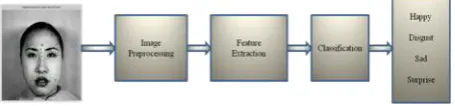
[image:2.595.52.280.575.628.2]A practical facial expression recognition system is shown in Figure 1 below. The Recognition process begins by first acquiring the image using an image acquisition device like a camera. The image acquired then needs to be preprocessed such that environmental and other variations in different images are minimized. Usually, the image preprocessing step comprises of operations like image scaling, image brightness and contrast adjustment and other image enhancement operations. In this study, an existing image database of human facial expressions is used to train and test the performance of the classifier.
Fig 1: Facial expression recognition technique overview.
3.2
Image Preprocessing
In science, image processing is form of processing. The image is input for this system, such as a photograph or video frame;
the output of image processing will be either an image or a set of characteristics or parameters related to the image. Most image-processing techniques use the two-dimensional signal and applying standard signal-processing techniques to it. Image processing usually refers to processing. Figure 2 shows example of image processing with scaling and contrast control.
Fig2: Image Processing for Facial Expression Recognition using GUI Model.
3.3
Feature Extraction
In order to recognize facial expressions from frontal images, a set of key parameters that best describe the particular set of facial expression needs to be extracted from the image such that the parameters can be used to discriminate between expressions. This set of parameters is called the feature vector of the image and the amount of information extracted from the image to the feature vector is the single most important aspect of successful feature extraction technique.
Fig3: Selection of Fiducial points.
3.4
Two D Gabor Function
A 2-D Gabor function is a plane wave with wave-factor k, restricted by a Gaussian envelope function with relative width σ:
Ψ (k, x) = k2/σ2
Table 1. Analysis of four expressions
Fig4: 40 Different Gabor Filter.
3.5
Principal component analysis
PCA is a technique used to lower the dimensionality of a feature space that takes a set of data points and constructs a lower dimensional linear subspace that best describes the variation of these data points from their mean. PCA is a linear transformation commonly used to simplify a data set by reducing multidimensional data sets to lower dimensions. By using PCA, dimensionality reduction in a data set can be achieved while retaining those characteristics of the data set that contribute most to its variance, keeping lower order principal components and ignoring higher-order ones. PCA has the distinction of being the optimal linear transformation keeping the subspace that has largest variance. Unlike other linear transforms, PCA don’t have a fixed set of basis vectors. Its basis vectors depend on the data set. In this study, length of feature vector can change from 1280 to a desired length. The length of feature vector is variable we can take the length of the feature vector such as 10, 20 up to 1280 to improve the recognition rate.
3.6
Classifier
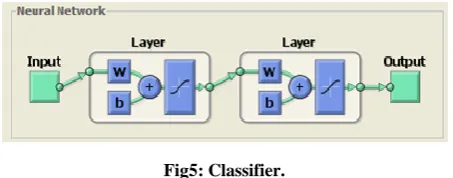
The back-propagation algorithm has emerged as the workhorse for the design of a special class of layered feed-forward networks known as multilayer perceptrons (MLP). A MLP has an input layer of source nodes and an output layer of neurons; these two layers connect the network to the outside world. In addition to these two layers, the multilayer perceptron usually has one or more layers of hidden neurons,
because these neurons are not directly accessible. The hidden neurons extract important features contained in the input data.
Fig5: Classifier.
By using the feed-forward neural networks (32 input, 2 hidden layers, 40 to 60 hidden neurons and four outputs) we can classify the input images such as happy, disgust, sad and surprise.
4.
RESULT
Detailed implementation of above steps leads to obtain following results where one sample image has been selected randomly. Processing is done on the same image for obtaining best feature representation. Then feature points are selected as shown in figure 3. A discrete set of Gabor kernels is applied to image. Convolution of real Gabor with Image is taken over selected fiducial points to generate feature vector. Length of feature vector is reduced by using PCA. Reduced feature vector is applied to NN classifier to get the results shown in Figure 6.
From below example of image the output window of Facial Expression Recognition using GUI Model generates the message “Recognized facial expression is Disgust”. Results obtained with this procedure for randomly selected images are around 72.50% which has been demonstrated with following Table 1and Figure no. 7.
Emotions
Result for 4 Emotions
1 2 3 4 5 6 7 8 9 10 Total
Disgust sad disgust disgust sad sad disgust disgust disgust disgust disgust 7
Happy happy happy surprise happy happy surprise happy happy happy surprise 7
Sad sad disgust sad sad disgust sad sad sad disgust sad 7
Surprise surprise happy surprise surprise happy surprise surprise surprise surprise surprise 8
Fig6: Facial Expression Recognition using GUI Model (Example).
Fig7: Percentage Result of 4 Class FER System.
5.
CONCLUSION
This system avoids difficulties in facial expression recognition (FER) due to the variation of facial expression across the human population. It can analyze facial expression feature extraction methods. Classifier will compare the facial expression & classify. So in this way we can conclude that we can recognize facial expressions by using Gabor wavelet with 72.5% results.
6.
ACKNOWLEDGMENT
We wish to express our deep sense of appreciation & profound gratitude to Dr. B. P. Ronge, (P.H.D.) Principal of SVERI’s COE Pandharpur, Prof. S. M. Mukane (P.H.D.) Head of Electronics and telecommunication dept. Prof. Mrs. M. M. Patil (P.H.D.) our guide and P.G. coordinator of Electronics & Telecommunication dept. for inspiring & in flinching guidance throughout the course of investigation. This work is an outcome of their constant encouragement, great interest parental care & support without which the work would not have taken place.
7.
REFERENCES
[1] Hsiuao-Ying Chen, Chung-Lin Huang,, Chih Ming Fu. Hybrid-boost learning for multi-pose face detection and facial expression recognition. Electrical Engineering Department, National Tsing-Hua University, Hsin-Chu, Taiwan. (2007).
[2] Wenfei Gu, Cheng Xiang, Y.V. Venkatesh, Dong Huang, Hai Lin Facial expression recognition using radial encoding of local Gabor features and classifier synthesis Department of Electrical and Computer Engineering, National University of Singapore, Singapore 117576, Singapore.( 2011).
[3] Yongzhao Zhan and Gengtao . Zhou. Facial Expression Recognition Based on Hybrid Features and Fusing Discrete HMMs. School of Computer Science and Telecommunication Engineering, Jiangsu University, Zhenjiang 212013, Jiangsu, China (2005).
[4] Zhengyou Zhang, Feature-Based Facial Expression Recognition: Sensitivity Analysis and Experiments with a Multi-Layer Perceptron. International Journal of Pattern Recognition and Artificial Intelligence (IJPRAI). (1998).
[5] Zahid Riaz, Christoph Mayer, Matthias Wimmer, Michael Beetz, Bernd Radig A Model Based Approach for Expressions Invariant Face Recognition. Department of Informatics, Technische Universitat München.(2000). [6] R. Chellappa, C. Wilson, and S. Sirohey. Human and
machine recognition of faces: A survey. Proceedings of the IEEE, 83(5):705–740, May (1995).
[7] B. Fasel, J. Luettin, Automatic facial expression analysis: a survey, Pattern Recognition 36 (2003) 259–275. [8] N. Costen, T.F. Cootes, G.J. Edwards, C.J. Taylor,
Automatic extraction of the face identity-subspace, Image Vision Computing 20 (2002) 319–329.
[9] A. Samal, P.A. Iyengar, Automatic recognition and analysis of human faces and facial expressions: a survey, Pattern Recognition 25 (1) (1992) 65–77.
[10] A. Pentland, T. Choudhury, Face recognition for smart environments, IEEE Comput. 33 (2) (2000) 50–55. [11] M. Pantic, L. Rothkrantz, Toward an affect-sensitive
multimodal human–computer interaction, Proc. IEEE 91 (9) (2003) 1370–1390.
[12] P. Ekman, W.V. Friesen, Emotion in the Human Face, Prentice-Hall, New Jersey, 1975.
[13] T. Kanade, J. Cohn, Y. Tian, Comprehensive database for facial expression analysis, in: Proceedings of IEEE International Conference on Face and Gesture Recognition, 2000, pp. 46–53.
[14] M. Pantic, L.J.M. Rothkrantz, Expert system for automatic analysis of facial expressions, Image Vision Comput. 18 (11) (2000) 881–905.
[15] M. Pantic, L.J.M. Rothkrantz, Automatic analysis of facial expressions: the state of the art, IEEE Trans. Pattern Anal. Mach. Intell. 22 (12) (2000) 1424–1445. [16] B. Fasel, J. Luettin, Automatic facial expression analysis:
a survey, Pattern Recognition 36 (1) (2003) 259–275.
AUTHOR’S PROFILE
Prof. Kumbhar M. A. from Pandharpur, Dist. Solapur. State: Maharashtra, India have completed B.E. (Electronics) from Shivaji university, Kolhapur, State: Maharashtra, Country: India. And M.E. (Electronics & Telecommunication Engineering) in Solapur University, Solapur, State: Maharashtra, Country: India.
He is working as an HEAD OF DEPARTMENT in Shri Vithal Education and Research Institute’s College of Engineering (Poly), Pandharpur, Maharashtra, India. He has published papers entitled “Facial Expression Recognition Based on Image Feature”, In International conference on communication and broadband networking (ICCBN 2012), Vol. 1, No. 2, July 2012 ISSN: 2010-3743.
Engineering) in Shivaji University, Kolhapur, State: Maharashtra, Country: India. Presently pursuing Ph.D. from WCE Sangli.
She is working as an ASSOCIATE PROFESSOR in Shri Vithal Education and Research Institute’s College of Engineering, Pandharpur, Maharashtra, India. She has to her credit a publication of about 15 papers in international, national journals and conferences. She has guided numerous students for graduation and Post graduation. She is a life member of Indian Society for Technical Education. Her areas of interest are Image Processing, Pattern Recognition and Machine Learning.
Mr. Ashish Jadhav from Pandharpur, Dist. Solapur. State: Maharashtra have born on 5th April 1987 and completed B.E.