A Tree based Approach for Generating
Association Rules
N.K. Sharma
Assistant Professor Engineering College UjjainUjjain, M.P., India
R.C. Jain, PhD.
DirectorS.A.T.I. Engineering College Vidisha, M.P., India
ABSTRACT
The FP-tree algorithm is one of the fastest techniques for generating frequent item set for association rule mining. Extracting frequent item set and generating association rules are two major challenges in a large student admission database. The same is tried to present in this paper with the help of sample data set.
General Terms
Data mining, Knowledge Discovery, Association Rule(s)
Keywords
Frequent Item Set, A-priori, P- tree, FP-Tree, Data set
1.
INTRODUCTION
Data mining has been considered as a promising field in the intersection of databases, artificial intelligence, and machine learning. Association rule mining has a wide range of applicability. Knowledge discovery from warehouses or databases is a significant area for researchers. There are many emerging fields like Online Transactions, Web Navigation, e-commerce, e-businesses and statistics where data is being collected and stored at rapid speed; this data is also being used for mining and knowledge discovery. In this modern era new tools and techniques are needed for a new generation to extract constructive information from collecting data. At some stage, making useful data with the help of new methods and techniques is the main concern of the KDD. There are various sources of data which may be in different form so the imperative task KDD process is to make data more abstract, more compact and more useful that make data into one form. Pattern discovery or pattern extraction is the core process data mining [1] [9] [10] [11].
1.1 Data mining and knowledge discovery in
the real world
The main KDD application areas include Marketing, e-Business, e-Banking, Forensic Investigation, Auto Mobiles, Telecommunications and internet. Two of them have been described [2] [3].
Marketing & e-Business: In marketing & e-business, different customer groups and purchasing behavior of the customer are analyzed finding patterns such as, If a customer buys any particular item like A and also likely to buy B stuff and C stuff. Such blueprints are important to increase the business [1].
Forensic Investigation: Forensic Investigation is the application of sciences and technologies to investigate facts of interest in relation to criminal or civil law [Wiki]. Forensic
investigation is also used for collecting legal evidence from the different sources related to crime place.
2.
ASSOCIATION RULES
Association rule(s) is/are a way to find out close relationship(s) among large data sets from information repository. In other word association rules are if/then statements that help uncover relationships between the huge amount of data in a relational database or other information repository like warehouse [ref]. An example of an association rule would be "If a student accesses a particular web page like scheme of the course then he/she is more likely (85%) to also will access the syllabus page of the course."
Association rules are made by analyzing data for frequent if/then patterns and using the criteria support and confidence to identify the most important relationships. In data mining, association rules are useful for analyzing and predicting customer behavior.
2.1
Association rules generation
An association rule represents a close relationship in the form of AB. It means "if event A takes place then B likely occurs". Association rules are generated using two parameters one is support and another one is confidence. Association rules are generated using user-defined minimum support and minimum confidence. To generate association rules there are three steps
Finding all frequent patterns
Calculate support and confidence for each item or patterns
Generate association rules from frequent patterns
3.
DATA TRANSFORMATION
Data transformation is an integral part of data mining and knowledge discovery. Transforming data allows for an increased understanding of the data and discovery of new and interesting relationships between features. There are various steps/methods required for data transformation. U. Fayyad, G.P. Shapiro and P. Smyth explain the two important steps/methods i.e. data cleaning and data access in [1] [9] as follows:
teams in 1996, including the Seattle Supersonics, which reached the NBA finals.
Finally, a novel and increasingly important type of discovery is one based on the use of intelligent agents to navigate through an information-rich environment. Although the idea of active triggers has long been analyzed in the database field, really successful applications of this idea appeared only with the advent of the Internet. These systems ask the user to specify a profile of interest and search for related information among a wide variety of public-do-main and proprietary sources. For example, FIREFLY is a personal music-recommendation.
Data access: Uniform and well-defined methods must be created for accessing the data and providing access paths to data that were historically difficult to get to (for example, stored of-line). Once organizations and individuals have solved the problem of how to store and access their data, the natural next step is the question, what else do we do with all the data? This is where opportunities for KDD naturally arise.
A popular approach for analysis of data warehouses is called online analytical processing (OLAP), named for a set of principles proposed by Codd (1993). OLAP tools focus on providing multidimensional data analysis, which is superior to SQL in computing summaries and breakdowns along many dimensions. OLAP tools are targeted toward simplifying and supporting interactive data analysis, but the goal of KDD tools is to automate as much of the process as possible. Thus, KDD is a step beyond what is currently supported by most standard database systems.
4.
EXISTING ALGORITHMS
4.1
AIS Algorithm
AIS (Agrawal, Imielinski, and Swami) algorithm was the first algorithm suggested for mining association rule in [5]. It pays attention on enhancing the worth of databases together with needed functionality to process decision support queries. The AIS Algorithm candidate item sets are generated and counted on the way as the database is read by the program. After reading a transaction, it is finding out which of the item sets that were found to be larger in the previous pass are contained in this transaction. New candidate item sets are generated by extending these large items sets with other items in the transaction .In this algorithm only one item consequent association rules are generated. “The main drawback of the AIS algorithm is too many candidate item sets that finally turned out to be small are generated, which requires more space and wastes much effort that turned out to be useless”. At the same time this algorithm requires too many passes over the whole database [5] [6].
4.2
SETM Algorithm
The SETM algorithm was inspired by the desire to use SQL to compute large item sets [7]. The SETM algorithm also produces candidates on the-way based on transactions read from the database. It generates and counts each candidate item set that the AIS algorithm generates. It stores a copy of the candidate item set mutually with the TID of the generating transaction in a sequential structure. SETM
number of transactions in which the candidate Item set is present [4].
4.3
A-priori Algorithm
A-priori is a great well known approach for association rule mining was first proposed by Agrawal in 1994. The existing AIS is now a simple approach that needs numerous passes over the database, generating many candidate item sets and storing counters of each candidate while most of them make to be not frequent. Apriori is more proficient during the candidate generation process for these reasons:
a) Apriori employs a special candidate generation technique and a new pruning technique. In the process of finding frequent item sets.
b) Apriori avoids the effort wastage of counting the candidate item sets that are known to be infrequent. Due to this the number of left over candidate item sets ready for further support checking that way it becomes lesser, which considerably decreases storage requirements [6] [7].
There are few weaknesses of a-priori algorithm which makes the task tedious.
If item set is bigger than a lot of frequent patterns are generated. It takes more time to generate frequent patterns.
Long patterns are generated if the support threshold is low or minimum.
Repeated database scans costly
4.4
FP-Tree
FP-Tree (Frequent Pattern Tree) Algorithm was evolved as a solution to overcome the disadvantages of Apriori algorithm. FP-Tree, frequent pattern mining, is another advance technique in the development of association rule mining, which reduces the two restrictions of the Apriori algorithm. The frequent item sets are generated with only two passes over the database and without any candidate generation process. FP-Tree was introduced by Han et. al in 2000. The omission of the candidate generation process and few passes over the database, FP-Tree is faster than the Apriori algorithm. The process of generating patterns consists two sub processes: constructing the FT-Tree, and generating frequent patterns [8].
4.5
PARTITION
The PARTITION algorithm tries to deal with two major limitations of formerly specified algorithms. The first issue with the previous algorithms is that the number of passes over the database is not known in advance. Apriori-TID tries to avoid this issue by buffering the database, but then the data base size is limited by the size of main memory. The second problem lies with pruning the database in afterward passes, i.e. removing unnecessary parts of the data. AIS and Apriori are not well fitted for this problem. This issue has been described in PARTITION algorithm.
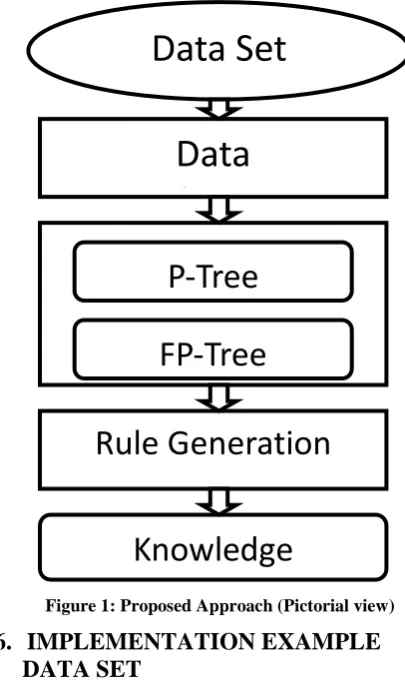
Algorithm PTREE( )
Input: A transaction database DB and a minimum support threshold.
Output:A pattern tree
Step1: Construct a P-tree P and obtain the item frequency list L
(1) P Root (2) L Empty
(3) For each transaction T in the transaction database
i) Sort T into Ti in alphabetic order. Here in each
sorted transaction T = Ti, such that t is the first
item of the transaction and is the remaining item in the transaction.
ii) INSERT (Ti , P) iii) Update L with item in Ti
INSERT (Ti , P) BEGIN
FOR each of P’s child node N
IF (t.Name = N.Name)
THEN
N.freq N.freq+1 IF (Ti is not empty)
THEN Insert ( )
ENDIF
RETURN
ENDIF
N’.Name t.Name \\Create a new N’
N’.freq 1 P.childList N’ IF (Ti is not empty)
THEN INSERT ( , N’)
ENDIF
RETURN
END \\ end of function insert
Step 2: Restructure the initial P-tree P
(1) Pnew Root
(2) For each path from the root to a leaf in the initial P-tree
repeat
i) The common support of each item in Pi is that
of the node next to the last branching node. If there is no branching-node in Pi, the common
support of each item is the actual support of each item in Pi.
ii) Get a sub-path Pi’ from with the common
support for every item
iii) Sort Pi’ according to L
iv) Insert the sorted ’ into the new P-tree, by calling function ( ’, Pnew )
- ’ untill ( = Φ)
Now, below specified is an algorithm to generate FP-Tree from obtaining P-Tree.
ALGORITHM FPTREE ( )
Input: A P Tree P, Item Frequency List L, and the minimum support threshold α
Output:An FP Tree
1. Frequent Item List FL Φ
2. For each item i in L a. IF (i.freq >= α)
Add i to the FL.
3. Sort FL by frequency in descending order.
4. Invoke CHECK (P).
CHECK (N)
BEGIN
FOR (each child C of the node N)
IF C ϵ FL
THEN
CHECK(C)
ELSE
Delete C (along with sub-tree starting from C)
END IF
END FOR
RETURN
END
Figure 1: Proposed Approach (Pictorial view)
6.
IMPLEMENTATION EXAMPLE
DATA SET
[image:4.595.57.260.72.418.2]To expound the effectiveness of the approach specified above a Student counseling data set has been considered(SCDS), with three attributes, namely RollNo, Student_Choice and Branch_ID. Similarly Brnch_ID consists of branch ID and college name. Following Tables show Student Admission Data Set (SADS). Relational view of the same is being illustrated below.
Table 1: Student Choice Data Student Choice Data Roll No Student Choice_
Sequence
Branch_ ID
1001 1 4
1002 2 2
1003 3 6
1004 4 11
1005 5 7
1006 6 9
Table 2: Branch ID Generation
Branch ID Generation Branch _
ID COLLEGE_NAME BRANCH
1 C1 CS
2 C1 IT
3 C1 EC
4 C2 CS
5 C2 IT
[image:4.595.317.541.85.220.2]Above specified data is then treated with the said approach and transactional data set is obtained and same for above given data is obtained and expounded below.
Table 3: Transactional Data Set
Transactional Data Set
Transaction_ID Item1 Item2 Item3 Item4
T1 1 1 1 1
T2 1 0 1 1
T3 1 1 0 1
T4 1 0 1 1
T5 1 0 1 1
T6 1 0 1 1
7.
RULES GENERATED AND RESULT
ANALYSIS
7.1
Rules Generated
[image:4.595.313.544.284.443.2]Rules are generated by taking minimum support is 75% and minimum confidence is 80%. The generated rules are shown in Table 4 below:
Table 4: Rules Generated
Rule Confidence
C1 -> C3 83.33333
C3 -> C1 100
C1 -> C4 100
C4 -> C1 100
C3 -> C4 100
C4 -> C3 83.33333
C1, C3 -> C4 100
C4 -> C1, C3 83.33333
Data Set
Data
Transformation
Rule Generation
Knowledge
Extraction
P-Tree
Generation
[image:4.595.314.514.531.751.2]7.2
Result Analysis
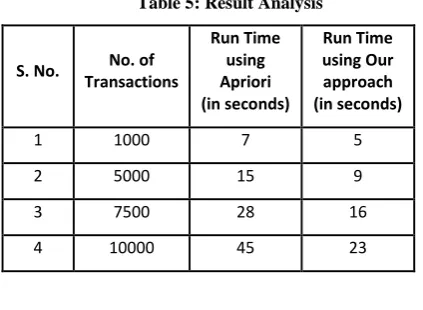
[image:5.595.52.264.133.288.2]Depending on the number of transactions the run time is calculated using Apriori algorithm as well as our approach and the comparison is expounded below:
Table 5: Result Analysis
S. No. No. of
Transactions
Run Time using Apriori (in seconds)
Run Time using Our approach (in seconds)
1 1000 7 5
2 5000 15 9
3 7500 28 16
4 10000 45 23
8.
CONCLUSION
For mining association rule there founds a common drawback of various scans over the database in every algorithm, this drawback can be overcome by introducing data transformation approach. FP-tree algorithm which is derived by P-tree generation algorithm has been used to extract interesting patterns and to develop significant relationships among variables stored in a huge dataset.
The mined association rules reveal various factors for admission in professional courses like student’s college and branch choices, place, past placement status, available infrastructure etc. The approach is based on real time data used for admission in various engineering institutions; the same can be improved when approached with other techniques.
9.
ACKNOWLEDGEMENTS
Our sincere thanks to our college Mr. Manoj Yadav, Software Consultant in Bhopal, Madhya Pradesh, Indiafor the immense support you have provided us for publishing this paper.
10.
REFERENCES
[1] Usama Fayyad, Gregory Piatetsky-Shapiro, and Padhraic Smyth, “From Data Mining to Knowledge Discovery in Databases”, AAAI, 1996.
[2] Andreas Mueller, “Fast Sequential and Parallel Algorithms for Association Rule Mining: A Comparison”, 1995.
[3] Agrawal, R., and Psaila, G. 1995. Active Data Mining. In Proceedings of the First International Conference on Knowledge Discovery and Data Mining (KDD-95). Menlo Park, Calif.: American Association for Artificial Intelligence.
[4] M-S Chen, J Han and P. S. Yu, Data Mining : An Overview from a Database Perspective, IEEE Tran. On Knowledge and Data Engg., December,1996.
[5] R. Agrawal, T. Imienski and A. Swamy, Database Mining : A Performance Perspective, IEEE Tran. On Knowledge and Data Engg., December,1991.
[6] Rakesh Agrawal, and Ramakrishnan Srikant, “Fast Algorithms for Mining Association Rules”, Proceedings of the 20th VLDB Conference Santiago,Chile,1994.
[7] M.Houtsma and A.Swami. Set-oriented Mining of Association Rules. Research Report RJ 9567, IBM
Almaden Research
Center,SanJose,California,October1993.
[8] Qiankun Zhao and SouravS. Bhowmick, “Association Rule Mining: A Survey”, Singapore.
[9] U. Fayyad, G.P. Shapiro and P. Smyth, The KDD Process for extracting Useful Knowledge from Volumes of Data, Communication of the ACM, Nov., 1996.
[10] T. Imielinski and H. Mannila, A Database Perspective on Knowledge Discovery, Communication of the ACM, Nov., 1996.