Munich Personal RePEc Archive
Characteristic function approach to the
sum of stochastic variables
Figueiredo, Annibal and Gleria, Iram and Matsushita, Raul
and Da Silva, Sergio
Federal University of Santa Catarina
2006
Online at
https://mpra.ub.uni-muenchen.de/1984/
Characteristic function approach to the
sum of stochastic variables
Annibal Figueiredo
a, Iram Gleriab*, Raul Matsushitac, Sergio Da Silvada
Department of Physics, University of Brasilia, 70910-900 Brasilia DF, Brazil
b
Department of Physics, Federal University of Alagoas, 57072-970 Maceio AL, Brazil
c
Department of Statistics, University of Brasilia, 70910-900 Brasilia DF, Brazil
d
Department of Economics, Federal University of Santa Catarina, 88049-970 Florianopolis SC, Brazil
Abstract
This paper puts forward a technique based on the characteristic function to tackle the problem of the sum of stochastic variables. We consider independent processes whose reduced variables are identically distributed, including those that violate the conditions for the central limit theorem to hold. We also consider processes that are correlated and analyze the role of nonlinear autocorrelations in their convergence to a Gaussian. We demonstrate that nonidentity in independent processes is related to autocorrelations in nonindependent processes. We exemplify our approach with data from foreign exchange rates.
Keywords: Central limit theorem; characteristic function; reduced variables; autocorrelation
1 Introduction
The problem of the limit of sums of random variables attracted great interest in the second
half of the 19th century and the first one of the 20th century. At the time mathematicians
extending Bernoulli’s and Moivre-Laplace’s theorems were also pioneering the modern theory of the sum of random variables.
Hot topics in the research agenda included searching for general conditions under which the sum of random variables converges to a Gaussian. Liapunoff, Lindberg, and Levy are among those who contributed to clarify the problem.
Liapunoff suggested his statistical moments approach (Liapunoff, 1900); Lindberg came up with his convolution technique (Lindberg, 1922), and Levy focused on the classic approach to the characteristic function (CF) (Levy, 1924, 1929).
Levy not only analyzed the convergence of sums of random variables but also extended the classic approach to consider infinite first and second moments. He also examined the role of stable distributions in characterizing the limits of sums of random variables. In particular, he put forward ‘extraordinary laws’ to show how his stable distributions (today’s Levy-stable distributions) play a role similar to that of the Gaussian when the second moment is infinite.
* Corresponding author.
Levy’s central limit theorem settles the conditions under which sums of random variables converge to a Levy-stable distribution. Here the Gaussian collapses to a special case of the entire family of Levy-stable distributions.
Roughly Levy’s approach can be seen as an application of Kolmogorov’s triangular scheme (Gnedenko and Kolmogorov, 1954), which encompasses previous results in terms of limit theorems. In what follows we will discuss the triangular scheme in greater detail since it helps to put our results in this paper into perspective.
A triangular arrangement of random variables takes the form
( ) ( ) ( ) ( ) 1 2
( , ,..., ); 1, 2,...,
n n n n
n
x x x n
= = ∞
X (1)
where the random variables xi(n)(i=1,…,n) are defined in the same probability space so as to satisfy two properties. (1) Random variables x1(n),…,x(nn) are independent for every n,
and (2) for all ε∈R, it holds true that
{
( )}
1
lim sup 1 i n ( ) 0
n→ ∞ ≤ ≤i n − f ε = , where
) (n i
f is the CF
of xi(n). These are the conditions of independence and infinitesimality respectively. We consider sum sequence
( ) ( ) 1 ...
n n
n n n
S =x + +x +a (2)
that is related to the nth row of the triangular arrangement in Eq. (1) (the an is a constant of fine tuning).
Our problem is to examine the limit of the distribution of Sn assuming the
probability distributions of variables (n)
i
x (i=1,…,n) to be known. If the limit of the
distribution of Sn does exist, we are able to tackle the problem of its slow convergence.
Here our two main tasks are to characterize the class of each possible limit of sums in Eq.
(2), and to devise convergence criteria for sum Sn as a function of the properties of the
distributions of xi(n) (i =1,…,n).
Kolmogorov hypothesized that the class of possible limits of Sn matches the class
of Finetti’s (Finetti, 1929) infinitely divisible distributions. Kolmogorov’s student Bavly
(Bavly, 1936) confirmed the hypothesis to the case where second moments of xi(n)
(i=1,…,n) are finite. And a broader proof was presented soon afterwards (Khintchine,
1938). (A comprehensive discussion can be found elsewhere (Zolotarev, 1990)). And Gnedenko and Kolmogorov (Gnedenko and Kolmogorov, 1954), and Levy (Levy, 1937) are primers on the classic theory of the sum of random variables.)
Another key question is to address the conditions for sum Sn to converge to a
Levy-stable distribution under the independence and infinitesimality conditions (Feller, 1935), (Feller, 1937). Lindberg-Feller condition is currently known as the central limit theorem. Yet this condition is valid only for sums satisfying independence and infinitesimality.
independence and infinitesimality. He showed convergence of Sn to a Gaussian without relying on infinitesimality (Levy, 1937). Unfortunately this finding made negligible impact on literature.
From the mid-1960s to the 1970s and 1980s, Russian mathematician Zolotarev made a significant breakthrough (Zolotarev, 1965, 1997). He examined convergence of the sum of random variables without relying on the classic assumptions. Zolotarev dubbed ‘non-classic’ the limit theorems lacking the independence and infinitesimality conditions. His work gave rise to a broader theory of the existence of limits in sums of random variables. The infinitesimality condition was left out and asymptotic independence was assumed (Zolotarev, 1990). One key result is his Theorem 5 (at page 131) showing necessary and sufficient conditions for convergence of sums of random variables.
Our own work in this paper elaborates further on such a non-classic framework. Yet our interest goes beyond theory in that we also devise applications to the statistical analysis of actual time series.
Our previous work is motivated by Mantegna and Stanley’s (Mantegna and Stanley, 1994, 1995). We show the general approach of the CF to the sum of random variables to be useful to tracking convergence in time series of financial returns (Figueiredo et al., 2003).
And also how correlations are key in curbing convergence to the Gaussian (Figueiredo et
al., 2004). We put forward that Mantegna and Stanley’s truncated Levy flights can be
explained by linear and nonlinear autocorrelation in data. Moreover we show how departures from infinitesimality are related to financial volatility in that they can explain lack of convergence to the Gaussian (Figueiredo et al., 2005).
In particular, our aim in this paper is to develop a general technique to approaching convergence without relying on independence and infinitesimality. Our technique belongs to the class of non-classic methods that are based on the analysis of empirical CFs
(Feuerverger, 1977, 1981). An important role is played by a function ( )ω z univocally
associated with a reduced distribution, which is the canonical form of Levy’s CF (Levy, 1924). We confine ourselves to the analysis of processes with finite second moment, thereby rendering it useful for applications.
This paper departs from Zolotarev’s in two ways. (1) We propose theorems without relying on infinitesimality (like him); the latter is replaced with volatility change in the sum. (2) We put forward general results that alow one to gauge the effect of autocorrelations in convergence without imposing any specific functional form to the CF.
Indeed we are able to reckon the part of function ( )ω z that is exclusively related to the
autocorrelations.
Employing the canonical form of the CF allows one to get fruitful results based solely on classic theory. And using function ( )ω z enables one to devise statistical gauges of the distance of a given distribution to the Gaussian. What is more, the convergence rate of an actual process can be measured and then compared to that of an independent and identically distributed (IID) one.
2 Existence of limits in the sum of random variables
consider these variables to be sorted such that mi( )n ≥ m( )jn for i > j and ,i j =1, ...,n .
We define the reduced variable as ( )
) ( ) ( ) (
n i
n i n i n i
m x
x = −µ and can then rewrite the sum in Eq. (2)
as
( ) ( ) 1
n
n n n n i i
i
S a m x
=
− =
∑
(3)where an now stands for the mean of Sn .
One of the most important issues concerning the sequences of sums given by Eq. (3)
is related to convergence of the probability distribution of Sn as n → ∞ . To answer this
question we apply the CF method as developed by Levy in his 1924 seminal work (Levy, 1924). The method consists in calculating the CF of the reduced variable
n n
n
n
S a S
M
−
= (4)
where Mn is standard deviation of Sn. Assuming variables ( )n
i
x to be statistically
independent one has
2 ( ) 2 1
( )
n n
n i
i
M m
=
=
∑
(5)For a reduced random real variable (i.e. one with zero mean and unit variance), its CF is (Levy, 1922)
( )
2
1 ( ) 2
( ) , ( ) ( ) ( ), (0) 0
z z Iz
R I
z e e ω z z I z
ψ = 〈 〉 = − + ω =ω + ω ω =
Denoting ( )ψ z =ψR( )z +IψI( )z yields
2
2 2
2 ln 2
, arctan I, R
R I
z
z z
ψ ψ ψ
ω ω
ψ ψ
− −
= = −
For Gaussian distributions one has ω(z)=0 for all z∈R. Function ( )ω z uniquely
determines the distribution function of a given reduced variable. The CF of reduced variable xi( )n is
( )
2 ( )
1 ( )
( ) 2
( )
n i
z z n
i z e
ω
ψ = − + (6)
( )
2
1 ( ) 2
( ) n
z z
n z e
− +Ω
Ψ = (7)
where
∑
= = Ω n j n n j n j n n j n z M m M m z 1 ) ( ) ( ) ( )( ω (8)
In the framework of the classic central limit theorem one condition for the CF in (7) to
converge to a Gaussian (lim n
( )
0n→∞Ω z = ) is precisely the infinitesimality hypothesis
(referred to in Section 1). It states that
{ }
( ) 1max ,
0
lim in
n i n n
n
n→∞M = µ = ≤≤ m
µ
Yet infinitesimality does not hold for mi( )n . As a consequence, if we wish to track
asymptotical behaviour, we need to develop tools capable of evaluating limit distributions for sums Sn without relying on infinitesimality.
As observed, Zolotarev and co-workers (Zolotarev, 1990) established the conditions
for convergence of sum Sn in a non-classic limit theorem. Inspired by the works of
Zolotarev, and using Levy’s CF formalism, we state a theorem as follows.
Theorem 1. Consider the sum in Eq. (2) and assume
(1) ( ) lim n i i n n m M λ →∞
= to exist for all i∈N. And
(2) i( ) lim i( )n
( )
nz z
ω ω
→∞
= to exist for all i∈N.
Thus lim n( ) ( )
n
z z
→∞
Ψ ≡ Ψ too exists and can be written as
2
(1 ( )) 2
( ) z
z
z e− +Ω
Ψ = (9)
Such a limit defines the limit distribution’s CF for Sn. And function Ω( )z is given by
1
( ) i i( i )
i
z λ ω λz
∞
=
Proof. Define the sequence of random variables y y1, 2,...,yn such that (1) the means of y y1, 2,...,yn are zero,
(2) the standard deviation of yi is λi, and
(3) reduced variables yi/λi have a CF given by ( )
2
1 ( ) 2
( ) i
i
z z
z e ω
φ = − +
Then let us consider the sum y1+y2+ +... yn =Yn, and its reduced variable
1 2
, ...
n
n n n
n
Y
Y σ λ λ λ
σ
= = + + + . It is clear that lim n 1
n→∞σ = . According to a Kolmogorov`s
(Kolmogorov, 1921) theorem, variable Yn converges in probability to a finite value. Its CF
is given by (9) and (10). Thus the series in (10) converges to all z, and is continuous in the
neighborhood of the origin. According hypothesis (1) and (2) the function Ωn(z), given by
Eq. (8), converges to the function given in Eq. (10), then we conclude that sequence in Eq. (7) converges for all z and its limit is continuous around the origin. Thus, according to
Levy’s continuity theorem, we conclude that the distribution of Sn Mn converges to a
well-defined limit distribution.
Now we move on to define an identically distributed reduced process (IDRP) as one in which ωi( )n( )z =ω( ),z i=1,...,n. In this case the stochastic variables
) (n i
x have the same
reduced distribution.
Since the )(n)(z
i
ω s are the same, then hypothesis 2 of Theorem 1 holds. We assume
hypothesis 1 to hold as well. Considering Eq. (6) yields
2
(1 ( ))
( ) 2
( ) ( )
z z n
i z e z
ω
ψ = − + ≡ψ (11)
If ψ( )z is analytic, then all statistical moments of the distribution are finite. As a result, one gets Taylor expansion
( )
2 1 2 3 3 3 4 4 4 ( )
( ) 1 ...,
2! 3! 4!
p n
p i
z I z I µ z I µ z X
ψ = + + + + µ = 〈 〉 (12)
Function
ω
( )z =ω
R( )z +Iω
I( )z in Eq. (11) can also be expanded in series to produce2 4 2
2 4 2
1 3 2 1
1 3 2 1
( ) ... ...
( ) ... ...
p
R p
p
I p
z K z K z K z
z K z K z K z
ω
ω
−−
= + + + +
= + + + + (13)
. K , K , K , K 6 4 2 3 4 5 3 3 4 2 3 1 360 1 24 1 36 1 12 1 60 1 6 1 12 1 4 1 3 1 µ µ µ µ µ µ µ + − − = + − = − = − = (14)
Now we expand function Ω( )z = ΩR( )z + ΩI I( )z in Eq. (10) in series
2 4 2
2 4 2
3 2 1
1 3 2 1
( ) ... ( ) ... p R p p I p
z L z L z L z
z L z L z L −z −
Ω = + + +
Ω = + + + (15)
So
2 2
1 1
( ) ( ), ( ) ( )
R i R i I i I i
n n
z λ ω λ z z λ ω λ z
∞ ∞
= =
Ω =
∑
Ω =∑
(16)Substituting Eq. (13) in Eq. (16) and comparing the output with Eq. (15) produce
2 1
, lim , 1
p i
p p i i
n n
n
m
L K p
M λ λ ∞ + → ∞ =
=
∑
= ≥ (17)Thus one gets an expression for the CF of IDRPs with analytical distributions of xi(n).
What if this condition is not fulfilled? Here xi(n) will have infinite moments. To examine this case we first show that the CF in Eq. (11) can be expanded in terms of the finite moments of the distribution.
3 Another theorem on the existence of limits to the sum of random variables
Now we consider that a variable xi(n) has finite moments up to order 4. Its kurtosis will be denoted by Ki( )n and its skewness by Si( )n . The reduced variable’s CF satisfies
2 ( )
(1 ( ))
( )( ) 2 , (0) 0 n
i
z z n
i z e i
ω
ψ = − + ω = (18)
and
( ) ( )
( ) 2 ( )
( ) ( )
3 12
n n
n i i n
i i
S K
z I z z z
ω = − − +ρ (19)
( )
( ) 2
2
( )
( ) ( ), 0, 0
n
n i
i
z
z O z z
z
ρ
ρ = → →
The CF of reduced variable Sn can be obtained using Ωn( )z . From Eq. (19) we can write
( )
2 ( )4 3 ( )
( ) 2 ( )
4 3 2 ( )
1 1 1
1 1
12 3
n n
n n n
i
n i n i i
n i i i n
i n i n i n n
m
m m m
K z I S z z
M M M ρ M
= = =
Ω = − − +
∑
∑
∑
(20)At this point we make the samehypotheses 1 and 2 of Theorem 1, apart from the fact that
now we replace functions ωi(n)(z) with functions ρi(n)(z) and consider an extra hypothesis as follows.
(3) Both series
4 4 1 i i i n m K M ∞ =
∑
and3 3 1 i i i n m S M ∞ =
∑
converge.Thus we can state another theorem.
Theorem 2. If the sum of random variables in Eq. (2) is such that hypotheses 1−3 hold, then there exists a distribution F (associated with the reduced variable) that is the limit of
the process as n→∞.
4 Limits to the sum of random variables when the variance follows a formation law
Now we reckon functions Ω(z) and Ωn(z) to processes following a formation law in the
second moment. We consider two cases in IDRPs, namely
(1) Exponential law:mi( )n ≡mi = AeBi,A>0,B∈ ℜ, and (2) Power law: mi( )n ≡mi = AiB,A>0,B∈ ℜ.
4.1 Analysis of the exponential law
To fully understand lim i
n n m M →∞
, we need to evaluate Mn. For
Bi i
m =Ae ,
2 2 1 2 0 B i i m e r m
+ = ≡ > (21)
holds. Here Mn is given by
(
)
2 2 2 1
1 1 ...
n n
Taking the sum in Eq. (22) yields
2 2 1
1 1
n
n
r
M m
r
−
=
−
(23)
We assess two possibilities, namely
(1) lim n (1 )1/ 2 0
n
n
r M
µ
→∞
= − >
, if 0<r <1
and
(2)
1 2
1
lim n
n n
r
M r
µ
→∞
= −
, if r >1
where n max
{
i, 1,...,}
i
m i n
µ = = . Thus according to Theorem 1, sum variable Sn presents a
limit distribution function that fails to be Gaussian.
4.2 Analysis of the power law
Now we turn to the power law. It is appropriate to introduce function
( , ) 1 2r 3r ... r,
Z n r = + + + +n r∈ℜ (24)
We can then write
2 2 2 2
, ( , ), 2
r
i n
m = A i M =A Z n r r= B (25)
We consider the cases r< −1 and r≥ −1. Calculations (not shown) for r< −1 take account of the fact that
1
lim lim
( , ) n
n n
n
M Z n r
µ
→∞ →∞
=
(26)
where
0
1 1
lim ( , ) ( ) lim 0, ( )
( ) n
r
n n p
n
Z n r r r
M r p
µ
ξ ξ
ξ
∞
and ξ( r ) is Riemman’s zeta function. Thus the limit distribution fails to be Gaussian and
lim n
n→∞M has a finite value.
For case r≥ −1, we have lim n 0
n n
M
µ
→∞ = , and the limit distribution function is
Gaussian.
4.3 Characteristic function of identically distributed reduced processes
Now we tackle the problem of determination of the CF in IDRPs. We take the case of an analytical CF. If the CF is analytic, function ( )ω z can be expanded in series as in Eqs. (13)
and (15). Considering these equations we have
2 1 p n i np p i n m L K M + = =
∑
. Our task is tocalculate an expression for
2 1 p n i i n m M + =
∑
.We again illustrate our case with exponential and power laws. As for the exponential law one has
2
1 2
2 1
2 2
1 ( )
p i p B i i p i m
m m r r e r R
m + − + + = = → = =
(28)
Thus sum m1p+m2p+ +... mnp is geometric and accordingly
2
1 2 1
1 ...
1 n p
p p p p
n
p
R
m m m m
R
+ −
+ + + =
−
(29)
Using Eq. (23) for Mn yields
2 2 2 1 1 1 p n p p n r M m r + + − = −
(30)
And from Eqs. (29) and (30) one gets
(
)
(
)
2 2 2 2 2 2 2 2 1 1, 0 1
1 1
p
p n
np p p p
n
r r
L K r
r r + + + + − −
= < <
− −
and
(
)
(
1)
11 1 1 2 2 2 2 2 2 2 2 > − − − − = + + + + r , r r r r K L p n p n p p p
np (32)
As n→∞ function Ω( )z becomes
( ) p p
p p
i even i odd
z L z I L z
= =
Ω = ∑ + ∑
where
2 2
2 2
2 2
2 2
(1 ) ( 1)
lim , 0 1, lim , 1
1 1
p p
p n np p p p n np p p
r r
L L K r L L K r
r r
+ +
+ +
→∞ →∞
− −
= = < < = = >
− −
(33)
As for the power law, it can be shown that
2
2 2 2 2 2 2
1
2
( , ) , ... ,
2 p
p p p p p
n n
p
M A Z n r m m A Z n r
+
+ = + + + + + = + +
(34)
and then one gets
2 2 2 , 2 ( , )
np p p
p
Z n r
L K
Z n r
+
+
= (35)
Thus as n→∞ function Ω( )z is either
2 2,
2 2
lim , 1
p np p p
n
p r
L L K r
r ξ ξ + →∞ +
= = < −
(36)
or
lim 0 ( ) 0, 1
p np
n
L L z r
→∞
In the latter case the process will reach the Gaussian regime. For the distinct processes defined by r =2B >−1 there will be different ‘convergence speeds’, as measured by Lnp
in Eq. (35).
Now we will examine the asymptotic behavior of both Mn and the terms in the
expansion of Ωn. Our approach relies heavily on analysis of Z(n,r). It can be shown that
1
( , ) ( ) 1
( , ) log 1
( , ) 1
1 r
Z n r r r
Z n r (n) r
n
Z n r r
r
ξ
+
→ < −
→ = −
→ > − +
(38)
As for the analytical IDRPs with second moment mi =m1ir/2, we consider results
for five distinct values of r.
(1) For 1r <− , using Eqs. (35) and (38) one can show that a process converges to a
non-Gaussian distribution where variance Mn and the asymptotic terms in the series of
n
Ω are
( )
(
(
)
)
( )
( )1 / 2
1 2 / 2
2 /
, ,
n np p p
p r
M m r L K p N
r ξ ξ ξ − + +
→ → ∈ (39)
(2) For 1r =− , a process converges to a Gaussian distribution where the variance
and the asymptotic terms in the series of Ωn are
(
)
1 / 2(
(
)
)
11 log , 2 / 2 (log ) ,
n np p
M → m n L → K ξ p+ n − p∈N (40)
(3) For −1<r<0, a process converges to a Gaussian where the variance and the
asymptotic terms in the series of Ωn are
(
)
( )(
)
1 / 2 1
1 / 2
( 2 ) / 2 / 2
( 2 ) / 2
( 2 )( 1) / 2
( 2 ) / 2
( 2 )( 1) / 2
1
2( 1)
, ( 2) / 2 1
2 ( 2)
log
( 1) , ( 2) / 2 1
( 2) / 2
( 1) , ( 2) / 2 1
r n p p np p p
np p p r
p
np p p r
m
M n
r
r
L K n p r
p r
n
L K r p r
n
p r
L K r p r
n ξ + + − + + + + + + → + +
→ + > −
+ +
→ + + = −
+
→ + + < −
(41)
(4) For r =0 (IID process) the second moment is the same for all i, i.e.
1
m m i → i =
∀ . The process converges to a Gaussian with the variance and asymptotic
terms in the series of Ωn given by
1 / 2 / 2
1 , ,
p
n np p
M → m n L → K n− p∈ N (42)
(5) For r >0, one has
(
)
( )( 2 ) / 2
1 / 2 / 2
1 , 2( 1) ,
1 2 ( 2)
p
r p
n np p
m r
M n L K n p N
r p r
+
+ + −
→ → ∈
+ + + (43)
At this point some remarks are worthwhile. As for r >−1 the cumulative standard
deviation Mn is governed by power law n(r+1)/2 as n→∞. And a logarithm law holds for 1
− =
r . The process then bifurcates into two ones, namely (1) convergence to a Gaussian
(r >−1), and (2) no convergence (r <−1). In the latter situation the second moment has a
saturation value at 1 / 2
1 ( )
m ξ r .
As for the power laws in r≥0, Lnp (which defines the series for Ωn( )z ) shows an
asymptotic decay with same power law n−p/2. This process thus converges at the same
pace to the Gaussian regime as n approaches infinity. But the process can show distinct
transient behavior at the onset of aggregation. A large transient phase means a slow
convergence, suggesting that Ωn( )z varies sluggishly. This kind of behavior can be
observed in truncated Lévy flights (TLFs) (Mantegna and Stanley, 1995).
4.4 A class of nonidentically distributed processes
Now we consider a class of stochastic processes with finite fourth moment. We assume every ( )n ( )
i z
ω to be distinct for alternative i. If the fourth moment is finite one has
( ) 2
( ) ( ) ( )
12 3
n i i
i i
K S
z z z I z z
ω =ω = − − +ρ (44)
where ∀ ⇒i ρi( )z =o z( 2), i.e. i( )2z 0
z
ρ →
when z→0. The power laws we take are
/ 2 3 / 2 2
1 , 1 , 1 , , , , 1, 1 0
r y x
i i i
m =m i S =S i K =K i r x y∈ℜ S K ≥ (45)
In such cases
2 2
( )
12 3
n n
n
K S
z I z o z
where
3 4
3 4
1 1
,
n n
i i
n i n i
i n i n
m m
S S K K
M M
= =
= =
∑
∑
(47)Employing Eqs. (21) and (36) yields
(
)
(
)
1/ 2
1 1 3/ 2 1 2
, 3( ) / 2 , 2( )
( , ) , ,
( , ) ( , )
n n n
Z n r y Z n r x
M m Z n r S S K K
Z n r Z n r
+ +
= = = (48)
The IDRP calculated in this section encompasses that of previous section, where x=0 and
0
y= . And the suggested formulas are suitable for description of a class for which
, i
m =m ∀i, i.e. an IID process where x=0,y=0, and r=0.
Now we examine the asymptotic behavior of the above processes. We take into account the standard deviation, skewness, and kurtosis, as defined in Eq. (48). We consider the evolving laws in Eq. (45) with r> −1,y>0 and x>0.
As n→∞ then
(
)
( )1 / 2 1
1 / 2
3 / 2
( 3 1) / 2 1
2
2 1 1
1
2( 1)
2 3( )
( 1)
2( ) 1
r n
y n
x n
m
M n
r
r
S S n
r y
r
K K n
r x
+
−
−
→ +
+ →
+ +
+ →
+ +
(49)
Quantities Mn, Sn, and Kn follow power laws of distinct exponents. It is intriguing (1) that Mn depends only on r, which describes the evolution of mi, (2) that Sn depends on y,
which shows how skewness Si evolves over time, and (3) that Kn depends only on x,
which gives the evolution of kurtosis Ki.
Note that for 0< y<1/3 one has Sn →0 as n→∞. If y =1/3 then the skewness approaches a finite value and the limit distribution will fail to be Gaussian. For
3 1/
y > one has Sn →∞ as n→∞, i.e. a limit process at an infinite distance from the Gaussian.
A similar analysis can be delivered to the kurtosis. As , n→∞
0 1/ 2 0
1/ 2 1/ 2
n
n
n
x K
x K C
x K
< < → →
= → →
> → → ∞
After a threshold value at bifurcation point ½, the third and fourth moments diverge. The bifurcation parameters are then x = 1/2and y = 1/3.
4.5 Probability of return to the origin and scaling properties of statistical moments
Now we sketch an explanation for asymptotic laws in the ‘probability of return to the origin’ of TLFs (Mantegna and Stanley, 1995). First we introduce the concept of asymptotic Ω-stability.
Definition 1. There exists an n0 such that, for all n>n0, function Ωn is nearly constant.
The notion captures the idea of a process whose CF approaches a threshold. This is equivalent to Ωn( )z = Ω( ),z ∀ >n n0. Thus Pn(0) becomes
( )
2
1 1 ( ) 2
1 constant
(0) z z
n
n n
P e dz
M M
∞ − +Ω
−∞
=
∫
= (51)Once we have learned the asymptotic laws governing Mn (from the cases studied here), the
asymptotic laws for Pn(0) end up known. For the exponential law one has
(
)
(
)
1/ 2 1
1/ 2 1
1
(0) for 1,
1
(0) for 1
n
n n
C r
P r
m
C r
P e r
m
−
−
= <
−
= >
(52)
And for the power law it holds that
( )
1
1/ 2 1
1/ 2
(1 ) / 2 1
(0) constant, for 1
(0) for 1
(log )
(1 ) 1
(0) for 1
n
n
n r
C
P r
m r
C
P r
m n
C r
P r
m n
ξ
+
= = < −
= = −
+
= > −
(53)
1/ 1/ 2
1/ (1 ) / 2 1
constant (0)
(1 ) 2
, , 1
1 n
n
r
D P
M n
C r
D n n r
m r
α
α + α
= = ⇒
+
= = ⇒ = > −
+
(54)
i.e. 0α > . If −1<r <0 then 2<α <∞. If r =0 then α =2. And if r >0 then 2
0<α < . The latter case is that of a TLF. The probability of return in the remaining
cases still scales with n, but surely they cannot converge to the TLF.
For the asymptotic stable processes the evolution of moments 〈Snp〉 is entirely
determined by the evolution law of dispersion Mn. To see this remember that a CF of Sn
is
( )
2
2 3
1 ( )
2 3
2
3 0
( ) 1 ...,
2! 3!
z z n
I I
z e− +Ω z K z n n
Ψ = = + + + ∀ > (55)
And that the CF of Sn is
2 3
2 2 3 3
3
( ) ( ) 1 ...
2! 3!
n n n n n
I I
z M z M z M K z
Ψ = Ψ = + + + (56)
These two equations produce
2 3
2 2 3 3
( ) 1 ...,
2! 3!
p p
n n n n p n
I I
z S z S z S K M
Ψ = + 〈 〉 + 〈 〉 + 〈 〉 = (57)
Thus the evolution law of Mn fully determines other moments’ motion laws.
5 Example
This section employs some of the results in previous sections to examine a financial time
series, namely the Brazilian real–US dollar exchange rate. We take returns Z rather than
raw data as our stochastic variable, i.e. Z∆t(t)=Y(t+∆t)−Y(t) where Y(t) is a rate at day t.
Returns xi are ranked, i.e. m1≥m2 ≥ ≥... mn. We define vector Xn =
(
x x1, 2, ...,xn)
andpermutation operator P such that
(
)
1, ... n
n i i
PX = x x with ( , ...,i1 in) being any
permutation of (1, ..., )n . Sum variable is
(
)
1 ... n
n i i n
X =x + +x =S PX .
Then we define an event as an n-dimensional, real vector generated by the following
Definition 2. To create event E we first select vector Xn and permutation operator P,
and then build up another vector in which the k th component is randomly generated by a
number from the distribution of
x
ik .The event is a realization of vector Xn followed by a permutation of any of its
components. The sum of N events E i=
(
E Ei1, i2,...Ein)
is defined as1
( ) ...
i i i in
S =S E =E + +E . For N large enough, sequence S S1,, 2,...,SN presents the same
distribution as that of sum variable Xn.
For series of events E E1, 2,...,EN, a list of N'=nN numbers can be obtained, i.e.
1,..., n, n 1,..., 2n,..., (N 1)n 1,..., nN
u u u + u u − + u
=
u (58)
where u1=E11,u2 =E12,...,un =E1n,un+1=E21. Eq. (58) can be thought of as an n-periodic stochastic process. If a period is known with certainty, Eq. (58) can be used to produce list
1
[U ,...,UN]
=
U , where U1= + +u1 ... u Un, 2 =un+1+ +... u2n,..., and so on. How to get the
standard deviations mi? One is aware by the very nature of the process that they are not
ordered. Besides, it is not generally possible to evaluate the standard variation of a stochastic variable from a single measure. But such problems can still be overcome (see (Figueiredo et al. 2005).)
We then employ such a routine to the 15-minute spaced Brazilian real-US dollar
rate from year 2002 (Fig. 1). Using Eq. (58) we get list u from this set of data. The list is
made up of N′ = 6140 numbers. Then we get list U from a ‘daily’ set of data, which is
built up as follows. A ‘day’ is considered to have 20 data points from the original 15-minute series. So the process’ period is n = 20. Since N′ = nN, list Uends up with 307 numbers.
The skewness and kurtosis of the two lists are
( ) 3.0653, ( ) 114.4593
( ) 1.5288, ( ) 19.3846
Sk K
Sk K
= =
= =
u u
U U (59)
As can be seen, the hypothesis of an IID is promptly discarded because
1/ 2 1/ 2
1 1
( ) ( ) 3.0653 0.6854
20
1 1
( ) ( ) 114.4593 5.2965
20
Sk Sk
n
K K
n
= = =
= = =
U u
U u
(60)
So we evaluate whether the process above can be explained in terms of our
suggested IDRP. To apply the technique summed up in (Figueiredo et al., 2005) we take N
(
)
(
)
3 3 1 3/ 2 2 2 1 4 4 1 2 2 2 1 ...( ) ( ) 1.3497
...
...
( ) ( ) 25.6804
... n n n n m m Sk Sk m m m m K K m m + + = = + + + + = = + + U u U u (61)
which is in good agreement with experimental data.
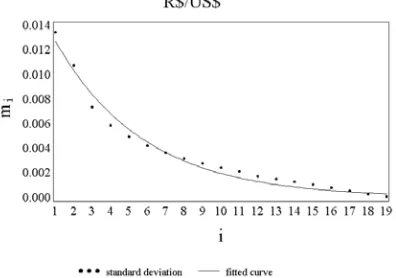
Now we examine whether there is a law governing the standard deviations in Fig. 2. First we try out exponential law mi = Ae−Bi. Fig. 3 displays the data in Fig. 2 together with
Bi
i Ae
m = − . Using this exponential law it can be shown with some algebra that
(
)
(
) (
)
(
)
(
)
(
(
)
)
3 2 3 2 3/ 2 3/ 2 2 2 2 2 2 1 1 ( ) ( ) 1 1 1 1( ) ( ) , 1
1 1 n n n B n r r Sk Sk r r r r
K K r e
r r − − − = − − − −
= = <
− −
U u
U u
(62)
Eq. (62) and B (Table 1) together yield
( ) 1.3086
( ) 23.9674
Sk
K
= =
U
U (63)
which is in agreement with the experimental data.
Power laws mi = Ai−B and mi =(A+iB)−1/C are presented in (Figueiredo et al.
2005). Table 2 sums up results. So the best fit is found with the assumption of an IDRP together with the exponential law describing second moment’s behavior.
6 Characteristic function approach to the sum of autocorrelated variables
So far only independent stochastic variables have been considered. Now we tackle the
problem of the sum of nonindependent variables (Figueiredo et al., 2004). Here we restrict
ourselves to sequence xi( )n =xi. We denote the moments of order p of xi and Sn as p
ip xi
µ = 〈 〉 and p np Sn
ν = 〈 〉 respectively. The CFs of xi and Sn are
2
2 (1 ( 2 )) / 2
( )
Ix zi i z i i zi
z
e
e
µ ω µ
ψ
= 〈
〉 =
− +(64)
2
2 (1 ( 2 )) / 2
( )
IS zn n z n n zn
z
e
e
ν ν
− +Ω
Ψ
= 〈
〉 =
(65)respectively.
The existence of a CF in sum variable as n→∞ is assured by Levy’s continuity
theorem. As for independent variables it holds that Ψn( )z =ψ1( )...z ψn( )z . Yet this does not extend to autocorrelated processes where
1
( ) ( ) ( )... ( )
n z Cn zψ z ψn z
Ψ = (66)
Written ( )C zn as
( )
2 2
2 ( )
2
( )
n nz
C W z
n
C z
=
e
− − + , (67)The CF in Eq. (66) then becomes
2 1 / 2 2 2 2
1
( ) ( ) / 2
( )
n
n i i i n
i
z z W z
n z e
ν µ ω µ
=
− + +
∑
Ψ = (68)
After writing the CF of the reduced variable as
(
)
2(1 (1)( ) ( 2 )( ) / 2) 2( ) / z n z n z
n z n z νn e
− +Ω +Ω
Ψ = Ψ = (69)
one gets
(
)
(1)
2 2 2
1 2 1
( ) /
n
n i i i n
i n
z µ ω z µ ν
ν =
Ω =
∑
(70)and
(
2)
2 )
2 (
/ 1
)
( n n
n
n z =ν W z ν
Ω (71)
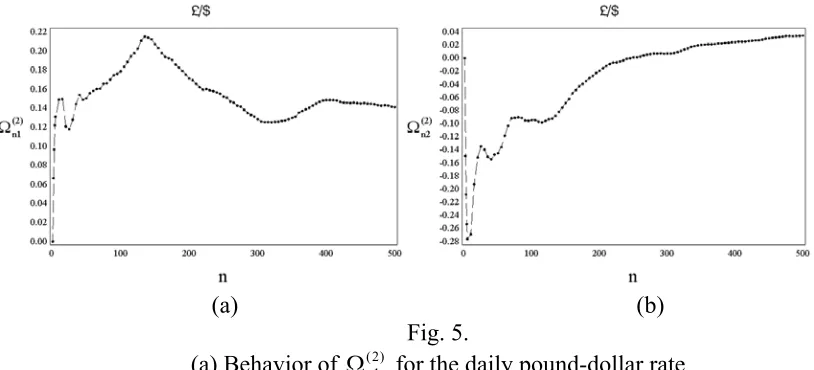
Function )Ω(n1)(z matches that for uncorrelated series, i.e. as n → ∞ it approaches zero. And term Ω(n2)(z) is related to the existence of autocorrelations. This term gives sum
variable’s CF, which can be used to obtain its PDF as n→∞.
6.1 Autocorrelation and convergence
Now we put forward an expression for Ω(n2)(z) containing only statistical moments.
2 3 4 4
2 3 4
( ) 1
( )
n n n n
C z
= +
C z
+
C z
+
C z
+
o z
, (72)) (z
Wn can be extended to Wn(z)=IWn1z+Wn2z2+o(z2). Comparing equal order terms produces
(
)
(
)
(
)
(
(
)
)
2 2 2 3 3 3
4 4 4 2 2 2
1
,
2 3!
1 1
4! 2!2!
n n n n n n
n n n n n n n
I
C C
C
ν σ ν σ
ν σ σ ν σ γ
= − − = − − = − − − + (73) where 1 1 2 2 2 2
1 1 1 1
n n n n
n i j i j
i j i i j i
x x
γ − µ µ −
= = + = = +
=
∑ ∑
=∑ ∑
〈 〉〈 〉 and np ip iσ =
∑
µ . It can also be shown that(
)
(
)
21 3 3 2 2 2 4
1 1
, 2
3 4
n n n n n n n
W = ν −σ W = ν −σ − C (74)
That renders a distribution suitable for practical purposes. First we define nonlinear autocorrelation term
(
1 1)
1 1 2
... 1
... ... k ... k
i k i k
k n
p p
p p
k n i i i i
i i
p p p x x x x
=
〈 〉 =
∑
〈 〉 − 〈 〉 〈 〉 (75)where p p1 2...pk are positive integers, and i1 ≠ ≠ ≠i2 ... ik.
Using Eq. (69) it can be shown that Ω = Ω(2)n I (2)n1z+ Ω(2)n2z2, where
( 2 ) 3 3
1 3 / 2 3 / 2
2 2
2
( 2 ) 4 4 2
2 2 2
2 2
2 2
111 3 12 1 , 3 6 1 1 1 12 4
( 1 / 12)( 1111 6 112 4 13 3 22 ) /
n n n n
n
n n
n n n n
n
n n
n n n n Rn
ν σ
ν ν
ν σ γ σ
ν ν
ν
− 〈 〉 + 〈 〉
Ω = =
− −
Ω = − + −
= − 〈 〉 + 〈 〉 + 〈 〉 + 〈 〉 +
(76)
so Ω(2)n1 and Ω(2)n2 are functions of third- and fourth-order correlations respectively.
We conclude that, although linear autocorrelations play a key role in a distribution convergence, it is still necessary to take the nonlinear autocorrelations into account to fully characterize a process. Although that is arguably well known in literature for long, our novel technique presents formulas capturing the nonlinear terms explicitly.
6.2 Example
period from 1 April 1971 to 30 December 2005. As before, we take single returns rather than raw data.
Fig. 4a displays kurtosis behavior, and Fig. 4b that of skewness. These are the
leading terms in the expansion of Sn. Curves of IID processes are shown for comparison.
The skewness is clearly bounded by real values. This limits (2)
1
n
Ω and prevents convergence
to the Gaussian regime. (Figs. 5a and 5b show Ω(n21) and Ω(n22) respectively.) Further details can be found elsewhere (Figueiredo et al., 2004).
7 Relating identically distributed reduced processes to autocorrelated ones
Section 5 dealt with IDRP behavior, and Section 6 examined the sum of autocorrelated variables. The purpose of this section is to relate IDRPs to autocorrelated processes.
Nonidentity of a process is entirely determined by average values µi1,i=1,...,N and
standard deviations µi2,i=1,...,N. We define a reduced random generator (RRG) with
zero mean and unit standard deviation. Every xi obtained in an IDRP are then given by
2 1
i i r i
x = µ G +µ , where Gr is a random choice from a reduced distribution g(x) of zero
mean and unit standard deviation. Time series from an IDRP can be obtained as follows. First we pick a particular RRG, say Gr. Secondly we choose µi1,i=1,...,N to track how
the mean evolves over time. And finally we select µi2,i=1,...,N to capture standard
deviation’s time evolution.
Time series obtained from an IDRP generator can then be theoretically evaluated. We take a particular RRG derived from a truncated Cauchy (TC) distribution, i.e.
1 2
2
1 1
( ) 1
0 or
A
L x L
f x x
x L x L
− ≤ ≤
= +
< − >
(77)
with 0L1,L2 > and
( )
arctan( )
L . arctan1
2 1 +
=
L A
Defining a random generator associated with x with distribution function f(x) is a
well-known problem. We can relate x to, say, y (which is uniformly distributed within
interval [0,1] ), and use the property of probability conservation to show that
( )
( )
( )
(
1 2 1)
tan arctan arctan arctan
x= L + L y− L (78)
Since y is uniformly distributed within [0,1], x is distributed in [−L1,L2] with a TC. Then
reduced variable x =
(
x−µ1)
µ2 has a TC distribution. A TC RRG of α =1 can be( )
( )
( )
(
1 2 1)
12
tan arctan arctan rand() arctan
r
L L L
G µ
µ
+ − −
= (79)
where rand() stands for a uniform random generator within [0,1]. Thus to fully characterize an IDRP generator we should first set µi1 and µi2 (i =1,2,…,N).
7.1 Example
We again take the time series from the daily changes of the British pound−US dollar rate to
illustrate our case. The heart of our technique is as follows. We divide such a sequence into equal, non-overlapped time periods. Then we compute the means and standard deviations of these periods. For instance, defining a p-sized period as a sequence of p days
means the series of 8780 days will have np periods of p days that are consecutive and
non-overlapped (np×p=8780). We then calculate (for each of these periods) the means and
standard deviations using the pound-dollar series.
Once p and np are characterized, we are ready to define IIDR random generator
( )
µi2 Gr +Aµi1,i=1, 2, 3,...,8615 (80)where A is a real number within [0,1]. The µi1 and µi2 are given by
11 21 31 ... p1
µ =µ =µ = =µ =first-period mean,... (81)
and
12 22 32 ... p2
µ = µ = µ = = µ =first-period standard deviation,... (82)
If 0A= then we discard weekly mean’s time evolution. In this case the generator
produces a zero mean for all time periods and gets nonstationary in second moments. If 1
=
A the generator is able to mimic the actual time series since it presents the same mean
profile.
Now we compare the properties of the pound-dollar rate with the IDRP RRG of µi1
and µi2 as above. We show how time evolution of the two series’ moments are similar if
one selects appropriate A L, 1, and L2.
If 0A= time evolution of a week’s mean is discarded. In this case the generator
will feature a zero mean forever and second moments will be nonstationary. If A=1 the
When comparing the statistical properties of the pound-dollar time series with those of an RRG (obtained with µi1 and µi2) we realize that moments over time of the two series are similar (as long as we calibrate using appropriate A L, 1, and L2). Thus an identically distributed process with autocorrelations can be obtained from an independently, yet nonidentically distributed, random generator.
Both symmetric (L1 = L2) and asymmetric (L1 ≠ L2) cases are considered. For
robustness, the routine is repeated twenty times to take mean values. In every case we pick a different seed for the uniformly distributed generator. Outcomes for processes with
20
=
p (trading months of 20 days) are also considered.
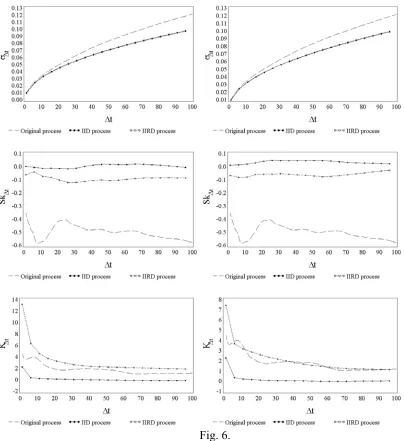
Fig. 6 displays a symmetric RRG. We get L1 =L2 from maximum likelihood
estimates. Kurtosis behavior in the IIDR process is very similar to actual value. This suggests that kurtosis behavior can be explained in terms of the time evolution characterizing the RRG. Skewness behavior is not that clear-cut, however. This is
somewhat expected because the generator is symmetric, and A = 0. Standard deviation
behaves as if the process had a Hurst exponent of ½.
8 Concluding remarks
This paper approaches the issue of the sum of stochastic variables and take independent processes that are identically distributed in their reduced variables as well as autocorrelated processes that are identically distributed. We extend the classic central limit theorem that features finite variance.
The paper also examines cases where a formation law for series’ variance is present. Our suggested reduced variable (that is independent and identically distributed) seems to fit
well a financial data set sampled from the intraday Brazilian real-US dollar rate of year
2002. We find the reduced variable together with an exponential law to mimic the series’ volatility behavior. And we also find the reduced variable to fail reaching zero as sample size approaches infinity.
We too investigate the role of nonlinear autocorrelations in the dynamics of convergence to a Gaussian. We find sluggish convergence to be due to the nonlinear autocorrelations.
Thus some features of the nonlinear autocorrelations can be rationalized in terms of an independently distributed, reduced process. Information about the autocorrelations is already encompassed in mean and standard deviation’s time paths. This is in line with the fact that a process is independent but not identically distributed. Nonidentity satisfactorily explains slow convergence to the Gaussian regime as well as greater-than-½ Hurst exponents. And it is possible to observe a non-IID behavior of skewness and kurtosis even when the Hurst equals ½.
Nonconvergence to a Gaussian is thus explained by departures from the infinitesimality hypothesis of independently distributed, reduced processes.
Acknowledgements
References
Bavly, G. M. (1936) Über einige Verallgemeinerungen der grenzwertsätze der Wahrsheinlichkeitrenchnung, Sbornik., 1, 917-930.
Feller, W. (1935) Über den Zentralen Grenzwertsatz der Wahrsheinlichkeitrenchnung,
Math. Zeitshirift, 40, 521-529.
Feller, W. (1937) Über den Zentralen Grenzwertsatz der Wahrsheinlichkeitrenchnung,
Math. Zeitshirift, 42, 301-312.
Feuerverger, A. and Mureika, R. (1977) The empirical characteristic function and its applications, The Ann. of Statist., 5, 88-97.
Feuerverger, A. and McDunnough, P. (1981) On the efficiency of empirical characteristic function procedures, J. R. Statist. Soc. B, 43 (1), 20-27.
Figueiredo, A., Gleria, I., Matsushita and R., Da Silva, S. (2003) On the origins of truncated Levy flights, Phys. Lett. A, 326, 51-60.
Figueiredo, A., Gleria, I., Matsushita, R. and Da Silva, S. (2004) Levy flights,
autocorrelation, and slow convergence, Physica A, 337, 369-383.
Figueiredo, A., Gleria, I., Matsushita, R. and Da Silva, S. (2005) Financial volatility and independent and identical distributed variables, Physica A, 346 (2005), 484-498.
Finetti, B. (1929) Sulla funzione a incremento aleatorio, Tai. Acad. Naz. Lincei., 6,
163-168, 325-329, 548-553.
Gnedenko, B. V. and Kolmogorov, A. N. (1954) Limit distributions for sums of
independent random variables, Reading: Addison-Wesley.
Khintchine, A. J. (1938) Limit laws for sums of independent random variables, Moscow:
ONTI.
Kolmogorov, A. N. (1921) Über die summen durch Zuffal bestimmter unabhängiger Gröβen, Mathematishe Annalen,99, 309-319.
Levy, P. (1922) Sur la loi de Gauss, C. R. Acad. Sc., 174, 1682-1684.
Levy, P. (1924) Théorie des erreurs. La loi de Gauss et les lois exceptionelles, Bull. Soc.
Math. France, LII, 49-85.
Levy, P. (1929) Sur quelques travaux relatifs à la théorie de errers, Bull. Soc. Math. France,
Liapunoff, A. M. (1900) Sur une proposition de la théorie dês probabilités, Bull. De L´Acad. Des Sciences St. Petersbourg, 13, 359-386.
Lindberg, J. W. (1922) Eine neue herleitung des Exponentialgesetzes in der
Wahrsheinlichkeitrenchnung, Math. Zeitschrift, 15, 211-225.
Mantegna, R. N. and Stanley, H. E. (1994) Stochastic process with ultraslow convergence to a Gaussian, the truncated Levy flight, Phys. Rev. Lett., 73, 2946-2949.
Mantegna, R. N. and Stanley, H. E. (1995) Scaling behavior in the dynamics of an economic index, Nature, 376, 46-49.
Zolotarev, V. M. (1990) Reflections on the classical theory of limit theorems, Theory
Probab. Appl., 36 (1), 124-137.
Zolotarev, V. M. (1965) On the closeness of distributions of two sums of independent
random variables, Theory Probab. Appl., 10 (1965), 519-526.
Zolotarev, V. M. (1997) Modern theory of summation of random variables, Modern
Probability and Statistics, Utrecht: VSP.
Estimated Value ± Standard Error IIDR
Exponential lawmi = Ae−Bi
A = 0.0156 ± 0.000599
B = 0.2070 ± 0.0101
IIDR
Power law B
i Ai
m = −
A = 0.0149 ± 0.000899
B = 0.7711 ± 0.0521
IIDR
Power law mi =(A+iB)−1/C
[image:27.612.81.432.85.233.2]A = 4.2267 ± 1.3063 B = 0.4973 ± 0.3191 C = 0.3607 ± 0.0807 Table 1. Estimated models
Experimental Data IID IIRD Exponential Law Power Law Power Law
Skewness 1.5287 0.6854 1.3497 1.3086 1.4296 1.3493
Kurtosis 19.3846 5.7230 25.6804 23.9674 31.0246 25.5359
Table 2. Skewness and kurtosis of experimental data under alternative assumptions
[image:27.612.78.533.288.333.2]Fig. 1. Brazilian real-US dollar 15-minute spaced returns for year 2002
Fig. 2. Standard deviations mi against i
Fig. 3. Fitting exponential law Bi
i Ae
[image:28.612.210.408.454.593.2](a) (b)
Fig. 4. Behavior of kurtosis (a) and skewness (b) for daily returns of the pound-dollar rate Curves for an IID process are shown for comparison
(a) (b)
Fig. 5.
[image:29.612.87.494.286.471.2]Fig. 6.
Scaling in standard deviations (upper panel), skewness (mid panel) and kurtosis (lower panel) of daily observations of the pound-dollar rate
The IIRD process on left plots is generated with P = 5, A = 0, and symmetric case L = L1 =
L2
The maximum likelihood estimate of L is 7.52