RSA Public Key Cryptosystem using Modular
Multiplication
G.A.V.Ramachandra Rao
Dept. of computer science & Technology
Sri Chaitanya Engineering College Visakhapatnam, India
P.V. Lakshmi
Dept. of Information Technology GIT, GITAM University,
Visakhapatnam, India
N. Ravi Shankar
Dept. of Applied Mathematics GIS, GITAM University,
Visakhapatnam, India
ABSTRACT
In the rapid development of contemporary information technology, security has become important technique in many applications including Virtual Private Network (VPN), electronic commerce ,secure internet access etc. The security of public key encryption such as RSA scheme relied on the integer factorization problem. The security of RSA algorithm is based on a positive integer n, because each transmitting node generates pair of keys such as public and private. Encryption and decryption of any message depends on positive integer n. Where, the positive integer n is the product of two prime numbers and pair of key generation is depend on these prime numbers. In the paper [11], an algorithm for modular multiplication for public key cryptosystem is presented. This method is based on the following two ideas: (i) The remainder in regard to n can be constructed from the remainder with modulus (2n+1) and the remainder with modulus (2n+2). (ii) It often happens that 2n+1can easily be factorized, even if n is a prime number or n is difficult to be factorized into prime factors. The changed modulus value will be stated, which might be the one of the modulus factor i.e., (2n+1). Even if the hacker factorizes this new modulus value, they can’t be searched out the original decryption key (d). Incapability to find the original decryption key, the factorization is insignificant. This proposed method helps to overcome the weakness of factorization found in RSA.
General Terms
Remainder multiplication, RSA Cryptosystem.
Keywords
Pubic key cryptosystem; modular multiplication; RSA Cryptosystem; modulus factor
1. INTRODUCTION
With the rapid development and the increasing popularity of the Internet technology, e-commerce application has also developed rapidly. The main issue related to reliable communication is security. The confidential communication in which online banking, t r a n s a c t i o n s through ATM, business transactions using credit card and debit card etc. need security, because majority of transaction is held through IP cloud. An internet protocol cloud (IP Cloud) is an internet protocol network used to carry data traffic. In IP cloud the data is open and there is chance of being hacked. The essential requirement in security is to hide information from hackers. To secure information different kinds of crypto graphic techniques are used like message authentication code, symmetric and asymmetric cryptography, digital signature, hash function etc. [5]. There are number of methods introduced to secure the
data communication in IP cloud or over the Internet. The hackers are so well-groomed that they can approach the information. To secure the information over an unsafe channel first public key cryptography was presented by Diffie and Hellman [4]. They introduced a protocol f o r exchanging information over an unsecure channel. After this different public key cryptosystems were introduced but the most known and suitable for both encryption and signing is RSA algorithm. This algorithm is planned to be the first great development in public key cryptography systems. However, RSA algorithm is secured only if long key strategy is kept [6, 10]. Rao et al.[11] proposed a new modular multiplication method to reduce the computational time of RSA cryptosystem. Rao et al.[12] proposed a novel Modular Multiplication Algorithm and its Application to RSA decryption.
This paper proposes an effective method to choose the modulus value to protect it from factorization risks of original RSA algorithm. The reason behind this circumstances is that the modified modulus factor (Mf)
i.e., (2n+1) is false and value of encryption key (e) and decryption key (d) depend upon actual modulus (n). It also increase limit of plain text more than actual modulus value up to changed modulus factor " Mf " .
Experimental results verify that the proposed scheme improves the security of RSA algorithm.
The rest of this paper is organized i n six sections. Section 2 presents remainder multiplication algorithm. Section 3 presents computational complexity of each method, Section 4 briefly discusses RSA methodology and its limitations. Section 5 presents our proposed s c h e m e to improve the security in RSA algorithm. Section 6 gives the comparison between RSA and proposed scheme. The conclusion and future work are presented in Section 7 .
2. REMAINDER MULTIPLICATION
ALGORITHM
In this section, the Remainder Multiplication method [11] is explained with an example. Let
y = xu mod n (1) Then y can be expressed as follows:
y1 ≥y2 y ≡ 2y1- y2 (mod n) (2)
y1 < y2 y ≡ 2y1- y2 + 2 (mod n). (3)
The positive integers (2 n + 1) and(2 n + 2) are decomposed into products of mutually prime factors. Let
1
1
2 1
m i i
n p
Volume 80 – No5, October 2013
2
1
2 2
m i i
n q
(5) Assuming that moduli (2n + 1) and (2 n + 2) are decomposed as above, the next algorithm receives x such that 0 ≤ x ≤( 2n – 1)2, and outputs y = xu mod
1
1,..., m
p p
Algorithm mulmod(x, p, y)
Input : x, u, 0 ≤ x ≤ ( 2n -1)2, 0 ≤ u ≤ ( 2n -1)2
,p =
p
1...
p
m1
Output: y = xu mod
1
1... m
p p
Step 1 : Calculate xi = x mod pi, ui = u mod pi , i = 1, . . . ,
m1.
Step 2 : Calculate ai = xi ui , i = 1, . . . , m1.
Step 3 : Calculate ai = ai mod pi, i = 1, . . . , m1.
Step 4: Calculate y by Chinese remainder theorem (a, p, y) The algorithm mulmod is used. y1 = xu mod (2n+ 1) and y2 =
xu mod (2n+ 2) are obtained by mulmod (x, p, y1) and
mulmod (x, q, y2) , respectively.
Example 1:
Consider the RSA cryptography example in the paper [1].Let n = 1386 and X = x2 .Then 2n+1 = 2773 = 47 59 and 2n+2 = 2774 = 38 73.When x = 920 , y1 = X mod (2n+1)
=846400 mod 2773 = 635 and y2 = X mod (2n+2)= 846400
mod 2774 = 330. In this case, y1 ≥ y2. Applying Eq.(2), y ≡
2(635) - 330 + (mod 1386) ≡ 1270 - 330 mod (1386) ≡ 940 ( mod 1386) ≡940 is obtained. This agrees with the result of direct calculation of 9202 mod 1386 = 940.
Example 2: consider the same RSA cryptography as in example-1 Let n = 1386 as preliminary computations 2n+1 and 2n+2 are decomposed. i.e 2n+1 = 2773 = 47 59 and 2n + 2 = 2774 = 38 73. Let p1 = 47 ,p2 =59 ,q1 = 38 , and q2 =
73. As the exponentiation computation assume that x = 920 and y = x2 mod n is to be calculated.
The computation procedure for mulmod (920, (4759),y1) is
shown in the following. Step 1 : x1 = 920 mod 47 = 27
x2 = 920 mod 59 = 35
Step 2 : a1 = 27 2 = 729
a2 = 35 2
= 1225 Step 3 : a1 = 729 mod 47 = 24
a2 = 1225 mod 59 = 45
Step 4 : Solving the following system of congruence equations y1 = 635 (in Example 1) is obtained and y1 ≡ 24
mod 47 and y1 ≡ 45 mod 59. Similarly y2 = 330 is obtained
and y2 ≡ 26 mod 38 and y2 ≡ 38 mod 73 from mulmod
(920,(38 73),y2) from y1 = 635 and y2 = 330 hence y1 ≥ y2
then apply the equation
Y ≡2y1-y2+(mod n) implies Y ≡ 2 (635) - 330+ (mod 1386) .
Therefore, Y ≡ 940 mod 1386 = 940 is obtained. It was already seen in Example 1.
3. EVALUATION OF COMPUTATIONAL
COMPLEXITY
By the consideration of security, the bit length of modulus should be 8192 bits in order to make the operations secure.
We will calculate the total number of operations for each method.
3.1 Traditional Method
The total number of decryption operation for traditional method can be represented as :
MODE (d, n) = 1.5 × l(d) [M(l(n)) + 2 Mod (l(n)) +1]
= 1.5 × 8192[M (8192) + 2 Mod (8192) +1] = 4573200384 clock cycles.
3.2 Hwang et al Method
In this method the total number of operations is given by: 4 MODE (d/4, n/4) + 8MODE (d/8, n/8) + 4[A(2048) +
2M(2048) + Mod(2048)] + 4[A(1024) + 2M(1024) + Mod(1024)] + 2[A(4096) + M(4096) + Mod(4096)] + A(4096) + 2M(4096) + Mod(4096) = 618359917 clock cycles.
3.3 CRT Method
In this method, the bit length of two distinct primes is equal. So, the total number of decryption operation for this method can be expressed as:
2 MODE(d/2, n/2) + 3 A (4096) + 2M (4096) + Mod (4096) =
1480580885 clock cycles.
3.4 Rao et al. Method
In this method the total number of operations is given by 8 MODE (d/8, n/8) + 16 MODE (d/16, n/16) + 4[A (256) + 2M
(256) + Mod (256)] + 4[A (128) + 2M (128) + Mod (128)] + 2[A (512) + M (512) + Mod (512)] + A(512) + 2M (512) + Mod(512) = 2715648 clock cycles.
The notations are used for the above computational complexity of operations are
(3.4.1)
MODE (d, n) denotes the computational complexityof modular exponentiation (xy modn).
(3.4.2)
M (x), A(x) and Mod(x) denotes the computationalcomplexity of multiplication, addition and modulus operations with the bit length of operand is x.
(3.4.3)
l (x) denotes the bit length of x.(3.4.4)
SH denotes shift operator.Table II from [12] shows the computational complexity of multiplication ,modulo and addition operations. The clock cycles for the above three operations using different bit lengths and the values are listed in the Table II.
Table II The clock cycles for M(x), Mod(x), and A(x) Bit
Length
MUL
MOD
ADD
8192 76171 147998 256 4096 24963 47759 128 2048 8107 15136 64 1024 2595 4657 32
512 811 1362 16
256 243 363 8
128 67 80 4
64 15 11 2
[image:3.595.58.298.441.587.2]32 1 1 1
Figure -1 depicts the performance and time complexity of the above methods .
Fig. 1 shows the Time Complexity of each method.
4. RSA METHODOLOGY AND ITS
LIMITATIONS
RSA is a commonly adopted public key cryptosystem which was proposed by Rivest, Shamir and Adleman in 1977 at Massachusetts Institute of Technology (MIT),[1]. The security of RSA rests on the exertion to factorize the big numbers of modulus. The size of modulus value is 1024 bits while the recommended length is 2048 bits as 640 bits key is not secure [7]. RSA uses two pairs of related keys (public key) ku = {e ,n }for encryption and (private
key) kr ={d, p,q} for decryption. Let's consider how these keys are generated and RSA works.
RSA cryptosystem:
Step 1: p and q are two relatively prime and large random numbers.
Step 2: A positive integer n is defined as a product of p and q. Step 3: Eulers value of φ (n) = ( p −1) (q −1).
Step 4: Choose e such that 1 < e <φ (n) and gcd (e,φ (n)) = 1 Here, d is computed by d = e-1 mod φ (n)
Step 5: In RSA e and n are public keys and d and (p, q) are private keys so the plaintext M is encrypted by:1 < M < n and C = Me mod n.
Step 6: And the cipher text C is decrypted by M = Cd mod n In RSA, by choose a suitable value for “e” such that 3 and 17 will improve the speed of encryption procedure, but will cause more computational complexity on decryption side [8]. Resultantly, this situates on mathematically unstable ground like other cryptographic techniques . Different restrictions could be observed and several successful attacks are developed to break this algorithm [3].The major topic is related to its factorizing. If the process factorization should be done then whole algorithm is broken. Also, mathematically attacks can get the information about RSA keys by other resources [2]. Therefore its security relax on unconfirmed suppositions. RSA has no more guarantees that the secrets it guards will remain secure. Its center has decrepit every bother, the best minds of cryptography has work out [2].
5. PROPOSED METHOD (PMD)
The proposed scheme su gges ts a modification in RSA algorithm to resolve the s u b j e c t o f RSA factorization. This scheme solves this problem by changing actual modulus value "n" into false modulus "Mf" illustrates the procedure of generating
fake modulus "Mf" and various steps of proposed
approach are enumerated as under:
Step l: In first step choose two prime numbers p and q. In the third step selects the value of "e" and select "d" such that [e.d mod φ(n)]=1
Step 2: The second step toward this approach is to compute (possible values of e) such that (p-1) and (q-1) are relatively prime. gcd[e,φ(n)]=1,where 1<e < φ(p,q).
Step 3:In the third step selects the value of "e" and select "d" such that [e. d mod φ(n)]=1
Traditional method Hwang et al. Method CRT Method Rao et al Method
Estimation
4.573200384E9 6.18372205E8 1.480580885E9 1.89812126E8
Simulation
(8192 bits)
Volume 80 – No5, October 2013
Step 4: In this step, finds the "Ge" Where "Ge" is the modulus factor which are multiplied by "2n+1" and produce false modulus " Mf ". The new modulus " Mf " is used in place of actual modulus "n" and do the process of encryption and decryption.
Step 5: In this step approach calculates "Mf" that is the product of modulus factor "n" and "Ge" as
Mf = Ge = (2n+1) (6) Where "Mf" = false modulus factor value, n =
product of two prime numbers p and q also "Ge" = modulus factor of n.
Step 6: Public key ku = {e, Mf} and private key = {d, Mf}
EXAMPLE 1:Here, we present an example-1 for the proposed
modified method (PMD) in RSA encryption and decryption. We have used artificially small parameters to clarify the concept. However, the method is applicable in general to all suitable selected parameters.
1) Select two prime numbers p and q such that p = 71 and q = 37
2) Calculate n = p*q = 71 * 37 = 2627 (7) 3) Calculate φ(n) = (p-1)*(q-1) = 70 * 36 = 2520 (8) Next we calculate “e” such that gcd[e,φ( n ) ] = 1 , w h e r e
1 < e < φ( p , q ) a n d e i s t h e c o - p r i m e t o φ( n ) 4 ) If e = 29 then d = 869
5) Then select Ge = (2n+1) = 5255 (already explained in
modular multiplication algorithm one of the factor) = 5255 = 5*1051 = product of prime factors
6) For different value of e and Ge is different then Mf = Ge =
(2n+1)= Mf = (2n+1) = 5255
7) Public key ku = {29, 5255} and private key = {869,5255} 8) Now plain text = M where o ≤ M ≤ 2n -1 and ciher text = c = Me mod Mf and the Decipher as M= Cd mod Mf
The encryption and decryption process are done by using the modulus factor and the results are listed in the Table III.
Table III: Proposed method(PMT) Encryption and Decryption process
Plaintext (M)
Encryption Decryption
36 3629 mod 5255 = 2326
2326869 mod 5255 =36 42 4229 mod 5255 =
2267
2267869 mod 5255 =42
920 92029 mod 5255 = 2030
2030869 mod 5255 =920
2630 263029mod5255 = 2870
2870869 mod 5255 =2630
5253 525329 mod 5255 = 908
908869 mod 5255 = 5253
EXAMPLE -2: We have used artificially small parameters to clarify the concept. Select two prime numbers p and q such that p = 7 and q = 11 and n = 77 , Ф(n) = 60. If e = 13 then d = 37. Then select Ge = (2n+1) = 155 (already explained in
modular multiplication algorithm one of the factor) = 155 = 5*31 = product of prime factors.
For different value of e and Ge is different then Mf = Ge =
(2n+1) = 155 . Now Public key ku = {13, 155} and private
key = {37,155} and the plain text = M where o ≤ M ≤ 2n-1 and ciher text = c = Me mod Mf and the Decipher as M= Cd
mod Mf
The encryption and decryption process are done by using the modulus factor and the results are listed in the Table IV.
Table IV : Proposed method (PMT) Encryption and Decryption process
Plaintext (M) Encryption Decryption
15 1513 mod 155 = 120 12037 mod 155 =15 36 3613 mod 155 = 36 3637 mod 155 =36 99 9913 mod 155 = 99 9937 mod 155 =99 135 13513 mod 155 = 145 14537 mod 155 =135 146 14613 mod 155 = 106 10637 mod 155 =146
6. PERFORMANCE COMPARISON
BETWEEN PROPOSED METHOD
(PMT) & RSA
In this two main problems have been discussed related to RSA and it has been shown that these can be overcome by using the proposed method.
Problem of factorization: If anyone i s able to factorize the modules(n) in RSA, can easily decrypt the message.However, in our case the result produced by "Ge" will produce false modulus "Mf". This is
publically announced. If anyone tries to factorize the "Mf", he can't find out the original value of decryption
key, because it is a false value, and result produced by its will not give accurate result.
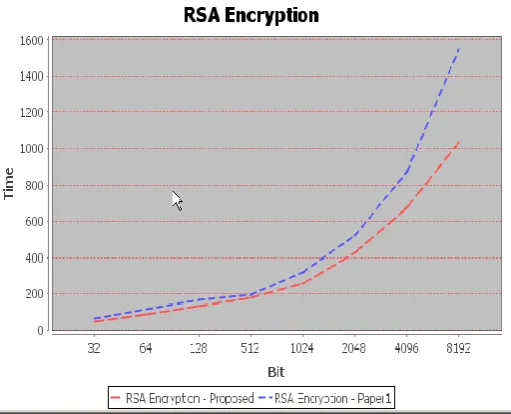
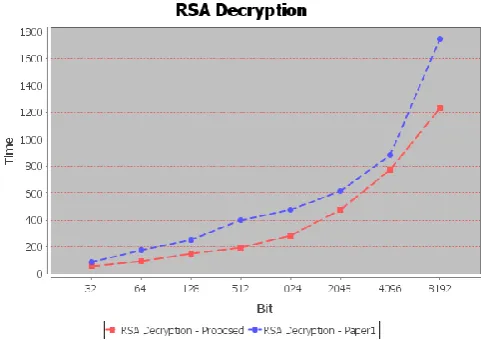
Figure-2 and Figure 3 represent the comparison results between RSA and the proposed method (PMT) ,to find the inverse with the help of public key pair. In RSA use KU ={ e ,n} and in PMT use KU = { e ,Mf }.
[image:4.595.318.574.469.676.2]Fig .3: The performance of RSA Decryption and the proposed method (PMT).
Elimination of plain text: According to RSA, it will not be larger than the modulus (n) value is 0 ≤ M ≤ 2n-1. Also, in the proposed method no extra calculation is n e e d e d . Once the “ Ge" is f o u n d , the remaining algorithm works
like R S A. Extra burden with much more c o mp u t at i o n complexity is needed by hacker t o break up the proposed method and the table - 5 shows the comparison between RSA and PMT.
Table V: Comparison between RSA and proposed method (PMT)
RSA PMT
Publicly announced original modulus
Publicly announced false modulus
e and d computed from publicly announced modulus
e and d computed from publicly secret modulus Limit of plain text is 0≤m<n Limit of plain text is
0≤m<Mf
Only two possible factors are required to factorize modulus p*q or q*p
Only two factors are required to factorize modulus p*q or q*p
The strength of variables are only two p and q
The strength of variables are only three p and q and Ge
7. CONCLUSION
In this paper, the RSA algorithm is examined to reduce its boundaries. The proposed method g e t s b e t t e r the security risk and limitation on sending plaintext. The major disadvantage of RSA is factorization; if the hackers factorize the modulus (n), then whole RSA security device will be opened from this key of factorization. In the proposed method, we publically declare the value of "Mf" which is totally false. This method
makes it more expansive for hackers to find the unique value of modulus (n). And the prospect work is related to continuation of "Ge". It may be discover that how to define
exactly these special numbers and what may be the principle to select them most correctly.
8. ACKNOWLEDGEMENTS
The authors would like to thank the referees for providing very helpful comments and suggestions.
9. REFERENCES
[1] R.Rivest, A.Shamir, and L.Adleman, "A Method for Obtaining Digital Signatures and Public-Key Cryptosystems," vol. 21 (2), pp.120-126, 1978. . [2] S.Robinson,"Still Guarding Secrets after Years of
Attacks, RSA Earns Accolades for its Founders," SIAM News, Vol. 36, Number 5, June 2003.
[3] M.Frunza,and L.Scripcariu ,"Improved RSA Encryption Algorithm for increased Security of Wireless Networks” Signals, Circuits and Systems,2007,ISSCS 2007, International Symposiumon. Vol.2. IEEE,2007
[4] D.Lerch Hostalot, "Factorization attack on RSA," hakin9 3/2007. www.en.hackin9.org
[5] Al Hasib, Abdullah, and Abul Ahsan Md Mahmudul Haque. "A comparative study of the performance and security issues of AES and RSA cryptography." Convergence and Hybrid Information Technology, 2008. ICCIT'08. Third International Conference on. Vol. 2. IEEE, 2008.
[6] J. M. Jordan, and P. J. Flinn, "Using the RSA Algorithm for Encryption and Digital Signatures," July 9, 1997.
[7] Fahn, R., and M. J. B. Robshaw. Results from the RSA Factoring Challenge. Technical Report TR-501, Version 1.3, RSA Laboratories, 1995.
[8] Hwang, R. J., Su, F. F., Yeh, Y. S., & Chen, C. Y. (2005, March). An efficient decryption method for RSA cryptosystem. In Advanced Information Networking and Applications, 2005. AINA 2005. 19th International Conference on (Vol. 1, pp. 585-590). IEEE.
[9] B.Schneier "Applied cryptography protocol, algorithms, and source code in C" 2ndedition, John Wiley&sons,Inc,1996.
[10]Koblitz, Neal. "Elliptic curve cryptography." Mathematics of Computation 48,177 (1987).
[11]Rao, GAV Rama Chandra, P. V. Lakshmi, and N. Ravi Shankar. "A New Modular Multiplication Method in Public Key Cryptosystem." International Journal of Network Security 15.1 (2013): 23-27.
[12]Rao, GAV Rama Chandra, P. V. Lakshmi, and N. Ravi Shankar, "A Novel Modular Multiplication Algorithm and its Application to RSA Decryption", IJCSI International Journal of Computer Science Issues, Vol. 9, Issue 6, No 3, November 2012.
![Table II from [12] shows the computational complexity of multiplication ,modulo and addition operations](https://thumb-us.123doks.com/thumbv2/123dok_us/8063153.777049/3.595.124.524.74.169/table-shows-computational-complexity-multiplication-modulo-addition-operations.webp)