Chapter 7
Managing Underperformance in the HSE: the Performance Improvement Plan (PIP)
In this Chapter you will learn;
¾ What is meant by underperformance? ¾ How to avoid underperformance
¾ The 4 Stages of a Performance Improvement Plan
The purpose of this Chapter is to assist managers and individuals address the issue of underperformance to the benefit of the individual involved and the service generally. This Chapter contains a step-by-step guide for the individual and the manager to address underperformance. This Chapter should be read in conjunction with Chapter 6 Engagement and Feedback.
7.1 Introduction
The HSE needs a structured approach to identifying and managing incidents of underperformance. Unchecked underperformance impacts negatively the individual concerned, on the moral of fellow employees, the efficiency of the service and is a risk to service users. When underperformance is not addressed the performance of effective employees is liable to deteriorate and public monies are wasted.
Early identification and management of underperformance is of benefit to the employee concerned and their colleagues. When left un-checked the problem may intensify and is more difficult to address and correct as the underperformer may come to believe that they are performing to the acceptable standard.
There is significant input required from the manager to identify and address underperformance. While some managers may feel uncomfortable in addressing underperformance they must realise that by accepting low standards of performance they are licensing low standards of performance throughout the service they manage. When underperformance is addressed in a constructive and professional manner it can result in performance improvements in both the individual and team. Research has shown that early intervention is the best way once the difficulties have been identified.
7.2 What is underperformance?
Underperformance is an ongoing failure to meet the standards of performance or behaviour reasonably expected from an employee at the level at which they are employed. It is a measure of reasonable expectancy in terms of employee contribution, effort and achievement that are the
V3
41
required standard for the role and level within the organisation. It is consistent deviation from standards associated with the role and grade.
Single incidents or very short periods of poor performance which are out of character for an individual do not fall into the category of underperformance that is being addressed in this Chapter. These short term incidents should be addressed through normal formative feedback and monitored to ensure that they are exceptional occurrences. Should these incidents develop into a trend then the individual’s behaviour should be addressed using the process set out below.
7.3 Conditions required for satisfactory performance
Satisfactory performance is dependant on the individual having a clear understanding of the purpose and scope of their role, the reporting relationships, responsibilities, accountability, priorities and objectives associated with their role. They must be clear on the standards of performance and behaviour required and posses and demonstrate the knowledge, skills and competencies required to fulfill the functions of the role. Satisfactory performance is also dependant upon the individual’s acceptance of the requirements of the role, personal motivation, ability and commitment to delivering to the required level.
Ongoing performance is maintained and supported by maintaining the clarity of purpose of the role, setting and monitoring targets, providing the appropriate guidance, feedback and supporting the professional and personal development of the individual.
7.4 The Performance Improvement Plan (PIP)
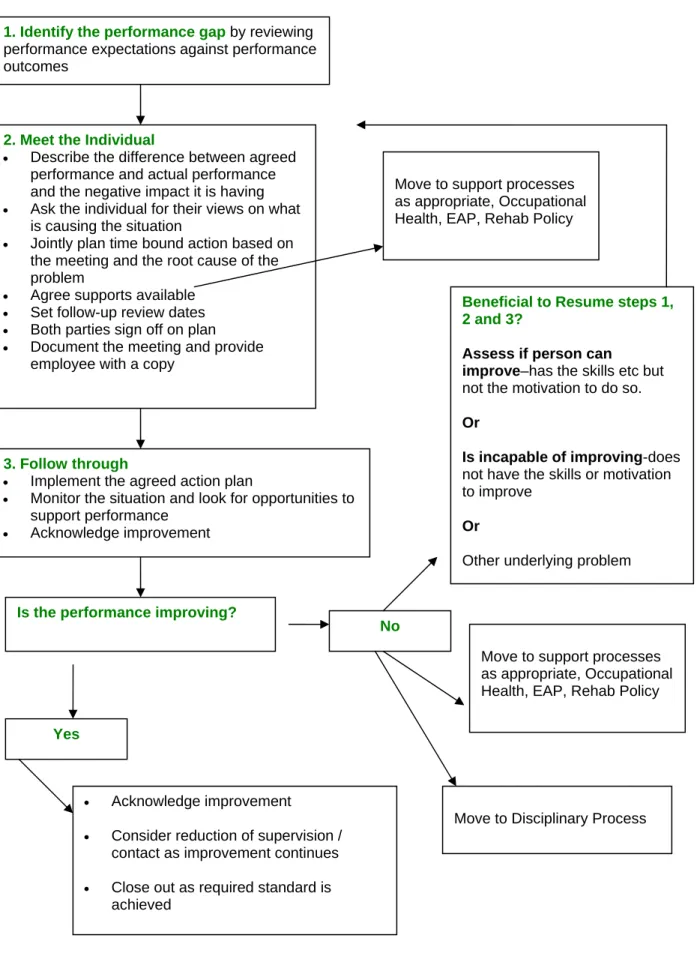
A Performance Improvement Plan (PIP) is a time bound process designed to address in a formal manner underperformance issues. The process is represented in Diagram 7.1 below.
The Performance Improvement Plan (PIP) is designed to facilitate constructive discussion, within the supervisory relationship, between an individual and his or her manager and to clarify the performance area(s) to be improved. This process requires constructive discussions between a manager and their direct report where performance problems are identified. It is implemented, at the discretion of the manager, when it becomes necessary to help an individual staff member improve his or her performance.
When an individual is engaged in the PIP process, activities under the normal PRC cease. During the PIP the focus is on identifying and addressing the cause of the underperformance and providing additional supervision and supports if required.
Once the manager is confident that the sources / reasons for underperformance have been addressed, she / he can then recommend the individual re-engage in the PRC.
If performance does not improve following the use of the Performance Improvement Plan (PIP) consideration should then be given to moving to other supportive or corrective processes, e.g. EAP, Occupational Health, Disciplinary Process, etc.
7.5 Managing underperformance through a Performance Improvement Plan (PIP)
Underperformance must be addressed in a structured and timely manner. Addressing underperformance is a managerial responsibility that should be actioned as required to address performance issues that are not being improved through normal formative feedback.
The structured approach to managing underperformance consists of a number of steps: A. Identify the performance gap
B. Meet the individual staff member - identify the facts C. Action plan to address underperformance
• Acknowledge improvement
• Consider reduction of supervision / contact as improvement continues
• Close out as required standard is achieved
1.Identify the performance gap by reviewing
performance expectations against performance outcomes
Yes
Is the performance improving? 2. Meet the Individual
• Describe the difference between agreed performance and actual performance and the negative impact it is having
• Ask the individual for their views on what is causing the situation
• Jointly plan time bound action based on the meeting and the root cause of the problem
• Agree supports available
• Set follow-up review dates
• Both parties sign off on plan
• Document the meeting and provide employee with a copy
Beneficial to Resume steps 1, 2 and 3?
Assess if person can
improve–has the skills etc but not the motivation to do so.
Or
Is incapable of improving-does not have the skills or motivation to improve
Or
Other underlying problem 3. Follow through
• Implement the agreed action plan
• Monitor the situation and look for opportunities to support performance
• Acknowledge improvement
No
Move to support processes as appropriate, Occupational Health, EAP, Rehab Policy
Diagram 7.1 Managing Underperformance
Move to support processes as appropriate, Occupational Health, EAP, Rehab Policy
Move to Disciplinary Process
A. Identify the performance gap
The performance gap should be identified by reviewing performance expectations and perceived current unacceptable performance. Before raising the performance gap with an individual the manager should satisfy him/her self that the following have been discussed with the employee:
• the purpose and scope of their role
• the responsibilities, accountability, priorities and objectives associated with the role
• the skills, knowledge, competencies and effort required and
• the standards of performance and behaviour required
• the reporting relationships
If the above have not been discussed with the individual the manager must immediately rectify the situation and discuss these requirements with him / her. If the above have been discussed then the manager must inform the individual of his / her concerns and arrange a review meeting with the individual to formally discuss the performance concerns.
The manager should agree in advance the date and time of the meeting and outline in advance the objectives of the meeting which are to;
• clarify the standards of performance expected
• discuss the perceived performance gap
• examine possible causes of the underperformance
• agree a PIP to improve the situation
If the individual is already participating in the Performance Review Cycle (PRC) the manager and individual should be able to communicate with a higher degree of clarity about specific expectations.
B. Meet the individual staff member - identify the facts
Having set the scene and restated the objectives of the meeting the manager should:
• Describe what level of performance is expected
• State the current performance issue(s). Feedback should be specific and factual and should describe the underperformance and the impact underperformance has had on service delivery, colleagues and the unit.
V3
45
• Ask the individual for their views on the examples cited and on what could be causing the situation. Try to surface and identify the reason(s) why required standards are not being achieved.• Discuss what emerges to fill in gaps in information or differences in perspective
C. Action plan to address underperformance
Having identified what the issue(s) is the manager and individual should discuss how they may be resolved. This should involve;
• Clarify what needs to be improved. Be specific and cite examples.
• State the level of work performance expectation and that it must be performed on a consistent basis.
• Clarify employee goals and actions required to improve performance including targeted dates.
• Identify skills, knowledge or attributes to be employed or developed and agree a learning and development plan with targeted dates. Identify employee’s responsibilities in the plan.
• Specify the support and resources you will provide to assist the employee. (E.g. clarifying role expectations, learning and development, coaching, EAP etc.).
• Clarify expected results – identify the measure (quantity, quality, time) that will be used to evaluate progress.
• Discuss in a clear, non threatening manner the consequences if performance does not improve.
• Agree the plan for providing feedback to the employee. Specify meeting times, with whom and how often. Specify the measurements that are to be considered in evaluating progress. Set up the ‘check in’ dates.
The details of the specific underperformance(s), items that contribute to the underperformance, the performance standards to be achieved, the supports available and the timescales involved must be recorded in the Performance Improvement Action Plan. A copy of the completed plan should be held by both manager and the individual.
D. Monitor
The manager is expected to monitor and provide feedback to the individual on a regular basis regarding his or her performance against the Action Plan and may take additional action as warranted.
The individual is expected to monitor their own actions and provide feedback to the manager on his or her performance against the Action Plan.
Performance Improvement Action Plan
V3
47
Performance Improvement Action Plan
Your Name Your Grade
Your position title Service Years in current role Your PMC meeting dates: Meeting 1: Meeting 2: Meeting 3: Manager’s Name Manager’s Job Title / Grade
Performance Issue(s): - List the specific performance issues discussed
Performance Requirements - Identify the performance level required that must be performed on a consistent basis
Goals And Action Plans – identify activities the employee will initiate to improve performance with targeted dates
Skill / Knowledge/Competency Development Required- identify requirements to meet work performance expectations with targeted dates
Changes Needed- identify the changes required to meet work performance expectations with targeted dates
Support and Resources– identify the support and resources that will be provided to assist the employee to develop the skill / knowledge/competency with targeted dates
Expected Results - list measurements (e.g. quantity, quality, time) to evaluate progress
Feedback Plan – identify ‘check in’ dates to review progress by the employee and manager
Employee Signature: Date:
Supervisor Signature: Date: