An Oracle Technical White Paper June 2012; Revised September 2012
2UDFOH¶V
Sun Server X3-2 and
Introduction ... 3
System-Level Architecture: Sun Server X3-2 with Four 2.5-Inch Disks and System-Level Architecture: Sun Server X3-2L with Eight 2.5-Inch Disks and Overview of Sun Server X3-2L with Eight 2.5-Inch Disks and DVD19 System-Level Architecture: Sun Server X3-2L with Twenty-Four 2.5-Inch Disks System-Level Architecture: Sun Server X3-2L with Twelve 3.5-Inch Disks Sun Server X3-2 and Sun Server X3-2L ... 4
Comparing the Sun Server X3-2 and Sun Server X3-2L... 6
Choice of Operating Systems and Virtualization Environments ... 9
The Intel Xeon Processor E5-2600 Product Family Advantage ... 9
Intel Core Microarchitecture... 10
Intel Xeon Processor C600 Platform... 11
Architecture of the Sun Server X3-2 and Sun Server X3-2L ... 11
Overview of Sun Server X3-2 Common Core Features ... 11
DVD... 12
Overview of Sun Server X3-2 with Four 2.5-Inch Disks and DVD 12 System-Level Architecture: Sun Server X3-2 with Eight 2.5-Inch Disks 13 Overview of Sun Server X3-2 with Eight 2.5-Inch Disks... 13
System-Level Architecture: Sun Server X3-2 with Four 3.5-Inch Disks 13 Overview of Sun Server X3-2 with Four 3.5-Inch Disks... 14
Overview of the Sun Server X3-2 Enclosure... 14
Overview of Sun Server X3-2L Common Core Features... 17
DVD... 18
... 19
Overview of Sun Server X3-2L with Twenty-Four 2.5-Inch Disks . 20 ... 20
Overview of the Sun Server X3-2L Enclosure... 21
System Platform ... 23
Memory Subsystem... 24
I/O Subsystem... 25
RAS Features... 31
Oracle ILOM Service Processor and System Management ... 32
Oracle ILOM Service Processor ... 32
Oracle System Assistant... 38
Oracle Enterprise Manager Ops Center... 39
Enterprise-Class Software Support... 40
The Oracle Solaris Operating System... 40
Oracle VM Environments... 41
Linux Environments ... 42
Microsoft Windows Environments... 42
VMware Environments... 42
Introduction
2UDFOH¶VQHZSun Server X3-2 and Sun Server X3-2L systems utilize the latest Intel Xeon processor E5-2600 product family CPUs, enabling 33% more processing power than the previous generation of servers1 while remaining within the same physical and
environmental footprint. In order to maintain a balanced architecture, the storage
capabilities have also been significantly enhanced with the introduction of higher capacity SAS-2 capable conventional hard disk drives (HDDs) and SATA-2 solid-state drives (SSDs). Higher memory density with increased memory frequency in the new server line also provides higher memory performance.
The ability to choose a suitable configuration of processing capacity, memory
configuration, and appropriate storage capacity together with the expandability offered by high bandwidth PCIe generation 3 connectivity provides extreme flexibility for hosting a wide variety of applications on the Sun Server X3-2 and Sun Server X3-2L systems.
1 The Intel Xeon processor E5-2600 product family CPUs support up to eight CPU cores, compared to the previous generation Intel Xeon processor 5600 series CPUs, which supported up to six cores.
Sun Server X3-2 and Sun Server X3-2L
The Sun Server X3-2 and Sun Server X3-2L each have three different base configurations with different disk density and CD/DVD components, but with a similar system board design. The Sun Server X3-2 provides up to two Intel Xeon processor E5-2600 product family processors and supports up to 512 GB of memory using 32 GB 1066 MT/sec low-voltage registered DIMMs. The Sun Server X3-2 offers dense I/O for a 1U server with four PCIe 3.0 slots (one internal slot for a SAS-2 HBA and three externally accessible slots for general use), four onboard 10 GbE ports, and six USB 2.0 ports (four externally accessible and two internal to the system).
In addition to the shared components, the Sun Server X3-2 offers the following three base configurations.
The Sun Server X3-2 model with a DVD-ROM provides four 2.5-inch drives supports up to four 2.5-inch SAS HDDs and SATA SSDs along with a DVD-ROM that supports the following format options:
x DVD-R/RW
x DVD+R/RW
x CD-R/RW
x CD+R/RW
Figure 1. Front view of Sun Server X3-2 with four 2.5-inch drives and DVD-ROM.
The Sun Server X3-2 with eight 2.5-inch drives supports up to eight 2.5-inch SAS HDDs and SATA SSDs.
Figure 2. Front view of Sun Server X3-2 with eight 2.5-inch drives.
The Sun Server X3-2 with four 3.5-inch drives supports up to four 3.5-inch SAS HDDs.
Figure 3. Front view of Sun Server X3-2 with four 3.5-inch drives.
The Sun Server X3-2L provides up to two Intel Xeon processor E5-2600 product family processors and currently supports up to 512 GB of memory using 32 GB 1066 MT/sec
voltage registered DIMMs. The Sun Server X3-2L provides robust I/O for a 2U server with six!
PCIe 3.0 slots, four onboard 10 GbE ports and six USB 2.0 ports (four externally accessible, two
internal to the system).!
In addition to the shared components, the Sun Server X3-2L offers the following three base
configurations.!
The Sun Server X3-2L with a DVD-ROM provides eight 2.5-inch drives that support up to eight!
2.5-inch SAS HDDs and 2.5-inch SATA SSDs along with a DVD-ROM that supports the!
following format options:!
x DVD-R/RW!
x DVD+R/RW!
x CD-R/RW!
x CD+R/RW!
Figure 4. Front view of Sun Server X3-2L with eight 2.5-inch drives and DVD-ROM.
The Sun Server X3-2L with twenty-four 2.5-inch drives supports up to twenty-four 2.5-inch SAS HDDs and 2.5-inch SATA SSDs. This enclosure also has two disk slots on the chassis rear for an additional two 2.5-inch SAS HDDs or SATA SSDs.
Figure 5. Front view of Sun Server X3-2L with twenty-four 2.5-inch drives.
The Sun Server X3-2L with twelve 3.5-inch drives supports up to twelve 3.5-inch SAS HDDs. This enclosure also has two disk slots on the chassis rear for an additional two 2.5-inch SAS HDDs or SATA SSDs.
Figure 6. Front view of Sun Server X3-2L with twelve 3.5-inch drives.
Comparing the Sun Server X3-2 and Sun Server X3-2L
Integrating and optimizing open compute, storage, networking, and software technologies from
across OrDFOH·VSRUWIROLRWRGHOLYHUKLJK-performing, efficient, and scalable systems, the open
network system approach has become the de facto standard for system design. Following the same design approach, the Sun Server X3-2 and Sun Server X3-2L systems leverage earlier chassis design work and further improve system effectiveness by delivering improved operational efficiencies and optimized data center value.
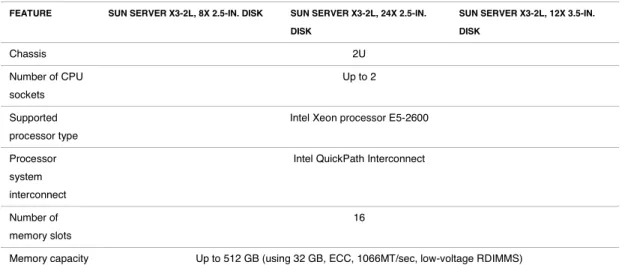
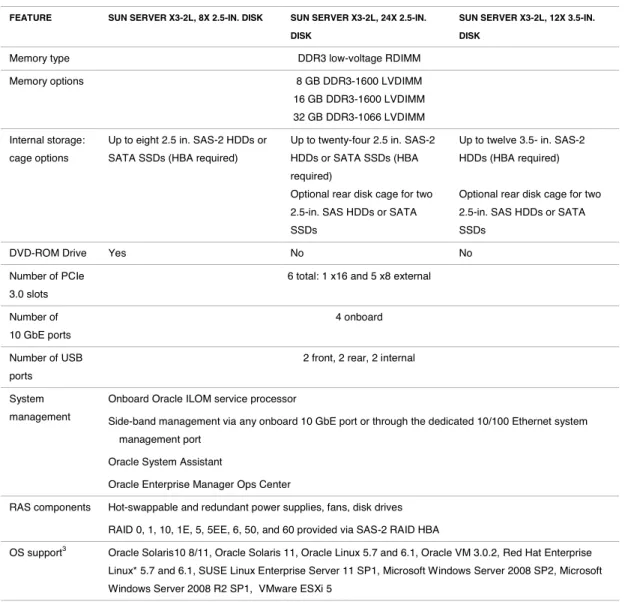
The six models are described in Table 1A and Table 1B. Table 1A compares the three different Sun Server X3-2 model servers and Table 1B compares the three different Sun Server X3-2L model servers.
TABLE 1A. SUN SERVER X3-2 COMPARISONS
FEATURE SUN SERVER X3-2, 4X 2.5-IN. DISK SUN SERVER X3-2, 8X 2.5-IN. DISK SUN SERVER X3-2, 4X 3.5-IN. DISK
Chassis 1U
Number of CPU Up to 2
sockets
Supported Intel Xeon processor E5-2600
processor type
Processor Intel QuickPath Interconnect
system interconnect
Number of 16
memory slots
Memory capacity Up to 512 GB (using 32 GB, ECC, 1066MT/sec, low-voltage RDIMMS)
Memory type DDR3 low-voltage RDIMM
Memory options 8 GB DDR3-1600 LVDIMM
16 GB DDR3-1600 LVDIMM 32 GB DDR3-1066 LVDIMM
Internal storage: Up to four 2.5-in. SAS-2 HDDs or Up to eight 2.5-in. SAS-2 HDDs Up to four 3.5-in. SAS-2 HDDs cage options SATA SSDs (HBA required) or SATA SSDs (HBA required) (HBA required)
TABLE 1A. SUN SERVER X3-2 COMPARISONS
FEATURE SUN SERVER X3-2, 4X 2.5-IN. DISK SUN SERVER X3-2, 8X 2.5-IN. DISK SUN SERVER X3-2, 4X 3.5-IN. DISK
Number of PCIe 4 total: 1 x16 external, 3 x8 (2 external, 1 internal) 3.0 slots
Number of 4 onboard
10 GbE ports
Number of USB 2 front, 2 rear, 2 internal ports
System Onboard Oracle Integrated Lights Out Manager (Oracle ILOM) service processor
management Side-band management via any onboard 10 GbE port or through the dedicated 10/100 Ethernet system
management port
Oracle System Assistant
Oracle Enterprise Manager Ops Center
RAS components Hot-swappable and redundant power supplies, fans, disk drives
RAID 0, 1, 10, 1E, 5, 5EE, 6, 50, and 60 provided via SAS-2 RAID
OS support2
Oracle Solaris10 8/11, Oracle Solaris 11, Oracle Linux 5.7 and 6.1, Oracle VM 3.0.2, Red Hat Enterprise Linux* 5.7 and 6.1, SUSE Linux Enterprise Server 11 SP1, Microsoft Windows Server 2008 SP2, Microsoft Windows Server 2008 R2 SP1, VMware ESXi 5
* Support for Red Hat Enterprise Linux is planned to be available shortly after product release.
TABLE 1B. SUN SERVER X3-2L COMPARISONS
FEATURE SUN SERVER X3-2L, 8X 2.5-IN. DISK SUN SERVER X3-2L, 24X 2.5-IN. SUN SERVER X3-2L, 12X 3.5-IN.
DISK DISK
Chassis 2U
Number of CPU Up to 2
sockets
Supported Intel Xeon processor E5-2600
processor type
Processor Intel QuickPath Interconnect
system interconnect
Number of 16
memory slots
Memory capacity Up to 512 GB (using 32 GB, ECC, 1066MT/sec, low-voltage RDIMMS)
2 Please refer to http://www.oracle.com for the most up to date information on supported versions of Operating Systems for each platform.
x
TABLE 1B. SUN SERVER X3-2L COMPARISONS
FEATURE SUN SERVER X3-2L, 8X 2.5-IN. DISK SUN SERVER X3-2L, 24X 2.5-IN. SUN SERVER X3-2L, 12X 3.5-IN.
DISK DISK
Memory type DDR3 low-voltage RDIMM
Memory options 8 GB DDR3-1600 LVDIMM
16 GB DDR3-1600 LVDIMM 32 GB DDR3-1066 LVDIMM
Internal storage: Up to eight 2.5 in. SAS-2 HDDs or Up to twenty-four 2.5 in. SAS-2 Up to twelve 3.5- in. SAS-2 cage options SATA SSDs (HBA required) HDDs or SATA SSDs (HBA HDDs (HBA required)
required)
Optional rear disk cage for two Optional rear disk cage for two 2.5-in. SAS HDDs or SATA 2.5-in. SAS HDDs or SATA
SSDs SSDs
DVD-ROM Drive Yes No No
Number of PCIe 6 total: 1 x16 and 5 x8 external 3.0 slots
Number of 4 onboard
10 GbE ports
Number of USB 2 front, 2 rear, 2 internal ports
System Onboard Oracle ILOM service processor
management Side-band management via any onboard 10 GbE port or through the dedicated 10/100 Ethernet system
management port
Oracle System Assistant
Oracle Enterprise Manager Ops Center
RAS components Hot-swappable and redundant power supplies, fans, disk drives
RAID 0, 1, 10, 1E, 5, 5EE, 6, 50, and 60 provided via SAS-2 RAID HBA
OS support3 Oracle Solaris10 8/11, Oracle Solaris 11, Oracle Linux 5.7 and 6.1, Oracle VM 3.0.2, Red Hat Enterprise
Linux* 5.7 and 6.1, SUSE Linux Enterprise Server 11 SP1, Microsoft Windows Server 2008 SP2, Microsoft Windows Server 2008 R2 SP1, VMware ESXi 5
* Support for Red Hat Enterprise Linux is planned to be available shortly after product release.
As Tables 1A and 1B show, the systems share numerous features, including the following: Two Intel Xeon processor E5-2600 product family processors
3 Please refer to http://www.oracle.com for the most up to date information on supported versions of Operating Systems for each platform.
x Integrated memory controller supporting up to 1,600 megatransfer-per-second (MT/sec)
registered DDR3 memory modules (memory is organized in four channels per processor with two DIMMs per channel)
x Multiple point-to-point Intel QuickPath Technology²based interconnects
x Intel Turbo Boost Technology mode and Hyper-Threading Technology capabilities,
depending on the CPU model
x Intel C602J chipset
x Large-capacity internal storage, including support for SSDs and HDDs
x Intel Integrated I/O for PCIe 3.0 connectivity directly to the processor die
x PCIe 3.0 expandability
x Built-in quad 10 GbE support
x An onboard Oracle ILOM service processor for system management
x Enterprise-class RAS features, including redundant, hot-swappable power supplies, fans, and
drives
x Support for multiple operating systems
Choice of Operating Systems and Virtualization Environments
To optimize flexibility and investment protection, the Sun Server X3-2 and Sun Server X3-2L
support a choice of operating systems3, including the following:
x Oracle Solaris
x Oracle Linux
x Red Hat Enterprise Linux
x SUSE Linux Enterprise Server
x Microsoft Windows Server
The systems also support virtualization using Oracle VM or VMware ESXi. Support for Red Hat Enterprise Linux is planned to be available shortly after product release.
The Intel Xeon Processor E5-2600 Product Family Advantage
Oracle has worked closely with Intel Corporation to bring to market a broad server family based on the latest Intel Xeon processor technology. In the Sun Server X3-2 and Sun Server X3-2L, systems engineering expertise combines with processor design proficiency to emphasize
performance, quality, reliability, and eco-responsibility. Engineers have optimized system performance and availability under Oracle operating systems.
The Sun Server X3-2 and Sun Server X3-2L incorporate Intel Xeon processor E5-2600 product family processors, which incorporate a faster Intel QuickPath Interconnect compared to the
previous generation·Vtwo-socket platform, the Intel Xeon microarchitecture, and PCIe 3.0
integrated on the processor die. Each server incorporates a very similar motherboard populated with two processors, enabling the system to deliver short response times and high throughput for performance-hungry applications. Compatible with a legacy of IA-32 software, these 64-bit processors support a large volume of existing 32-bit applications as well as emerging 64-bit applications.
Intel Core Microarchitecture
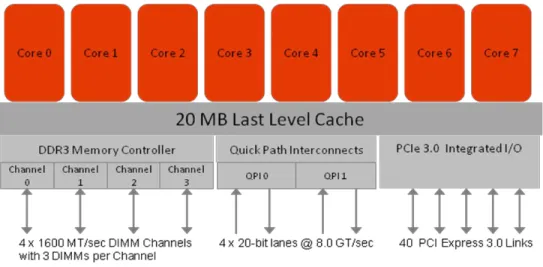
With this latest introduction, Intel continued with a 32 nm manufacturing process but increased the core computing power from six processor cores to eight processor cores and increased cache into the die.
Figure 7. The microarchitecture employed by the Intel Xeon processor E5-2600 product family offers significant innovations over previous designs.
The new Intel Core microarchitecture is extremely modular, enabling a range of implementations to meet a variety of application needs and price points. The Sun Server 2 and Sun Server X3-2L are available with CPUs that feature four, six, or eight cores, up to 20 MB of shared last-level cache, as well as Intel Turbo Boost Technology and Hyper-Threading (HT) Technology. For more information on the latest Intel Xeon processor E5-2600 product family CPUs, please
Intel Xeon Processor C600 Platform
The Sun Server X3-2 and Sun Server X3-2L share very similar motherboard designs and, thus, the same Intel C600 Series chipset platform. The processors interface to each other over Intel QuickPath Interconnect technology interconnects. In previous generations, PCI expandability was handled with a separate IOH chipset. In the new platform, PCI expandability is integrated directly on the processor die. The CPU interfaces with an Intel C602J I/O Controller Hub, enabling expandability and high I/O throughput. Each Intel Xeon Series platform is designed to match processor performance with memory capacity, I/O expandability, and interconnect bandwidth.
Architecture of the Sun Server X3-2 and Sun Server X3-2L
The Sun Server X3-2 and Sun Server X3-2L are designed to provide best-in-class performance along with unprecedented expandability and low power consumption. This section details physical and architectural aspects of the systems, highlighting similarities and differences among the server designs.
The six server models share very similar motherboard architecture. The main difference is the Sun Server X3-2L provides six PCIe 3.0 slots while the Sun Server X3-2 provides four PCIe slots (1 internal, 3 external).
Overview of Sun Server X3-2 Common Core Features
The Sun Server X3-2 system models share the following major components across three chassis:
x Two Intel Xeon processor E5-2600 product family processors
x Up to 512 GB of memory (using 32 GB registered dual inline memory modules [RDIMMs])
populated in 16 registered RDIMM slots³8 GB, 16 GB, or 32 GB low-voltage RDIMMs are
supported
x Four onboard 100/1,000/10,000 Mb/sec Ethernet RJ45 ports
x Three external low-profile PCIe 3.0 slots (one 16-lane slot and two 8-lane slots)
x One internal low-profile PCIe 3.0 slot (8-lane) for the required SAS-2 HBA card
x Six USB 2.0 ports (2 front, 2 rear, and 2 internal)
x An onboard Oracle ILOM service processor
x Two hot-swappable, high-efficiency power supply units (PSUs) for N+1 redundancy
x Four hot-swappable, variable-speed fan modules (for N+1 redundancy), each containing two
System-Level Architecture: Sun Server X3-2 with Four 2.5-Inch Disks and DVD
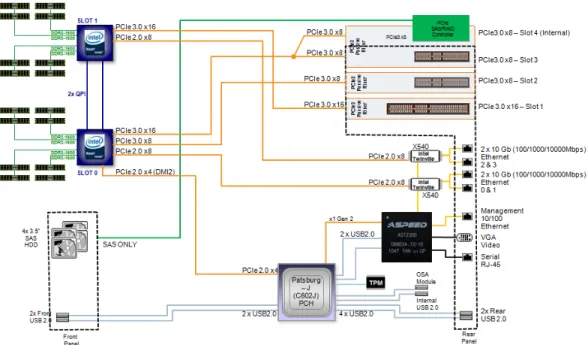
To gain an understanding of the architecture of the Sun Server X3-2 system with four 2.5-inch disks and DVD+/-RW, see the following system-level block diagram (Figure 8).
Figure 8. This block diagram depicts the Sun Server X3-2 system with four 2.5-inch disks and DVD+/-RW, including the required SAS-2 HBA on internal PCIe slot 4.
Figure 8 depicts the standard configuration with a required SAS-2 HBA card that supports four internal SAS HDDs and SATA SSDs. The SATA DVD and USB devices are controlled by the Intel C602J I/O controller.
Overview of Sun Server X3-2 with Four 2.5-Inch Disks and DVD
The Sun Server X3-2 system with four 2.5-inch disks and DVD+/-RW includes the following major components in addition to the shared components of the Sun Server X3-2:
x Four internal 2.5-inch SAS-2 HDDs or SATA SSDs
System-Level Architecture: Sun Server X3-2 with Eight 2.5-Inch Disks
To gain an understanding of the architecture of the Sun Server X3-2 system with eight 2.5-inch disks, see the following system-level block diagram (Figure 9).
Figure 9. This block diagram depicts the Sun Server X3-2 system with eight 2.5-inch disks, including the required SAS-2 HBA on internal PCIe slot 4.
Figure 9 depicts the standard configuration with a required SAS-2 HBA card that supports eight internal SAS-2 HDDs or SATA SSDs. System management service processor and USB
connectivity is controlled by the Intel C602J I/O controller.
Overview of Sun Server X3-2 with Eight 2.5-Inch Disks
The Sun Server X3-2 system with eight 2.5-inch disks includes eight internal 2.5-inch SAS-2 HDDs or SATA SSDs in addition to the shared components of the Sun Server X3-2.
System-Level Architecture: Sun Server X3-2 with Four 3.5-Inch Disks
To gain an understanding of the architecture of the Sun Server X3-2 system with four 3.5-inch disks, see the following system-level block diagram (Figure 10).
Figure 10. This block diagram depicts the Sun Server X3-2 system with four 3.5-inch disks, including the required SAS-2 HBA on internal PCIe slot 4.
Figure 10 depicts the standard configuration with a required SAS-2 HBA card that supports four internal 3.5-inch SAS-2 HDDs. System management service processor and USB connectivity is controlled by the Intel C602J I/O controller.
Overview of Sun Server X3-2 with Four 3.5-Inch Disks
The Sun Server X3-2 system with four 3.5-inch disks includes four internal 3.5-inch SAS-2 HDDs in addition to the shared components of the Sun Server X3-2.
Overview of the Sun Server X3-2 Enclosure
The Sun Server X3-2 system·Venclosure is designed to occupy 1U in a standard 19-inch rack.
Table 2 provides system dimensions and weight.
TABLE 2. SUN SERVER X3-2 SYSTEM DIMENSIONS AND WEIGHT
DIMENSION UNITED STATES INTERNATIONAL
Height Width 1.71 in. (1U) 17.2 in. 42.6 mm 436.5 mm Depth Weight 29.0 in. 39.9 lb. maximum 736.6 mm 18.1 kg maximum
Sun Server X3-2 Rear Perspective
The three Sun Server X3-2 system configurations share the same rear panel. Figure 11 shows the rear view of the Sun Server X3-2.
Figure 11. The rear view of the Sun Server X3-2 system showing WKHVHUYHU¶VH[WHUQDOIHDWXUHVDQd connections.
The external rear features and connections include the following:
x 5HDUVWDWXVLQGLFDWRUOLJKWVZKLFKUHSRUW´ORFDWRUµZKLWH´VHUYLFHUHTXLUHGµDPEHUDQG
´DFWLYLW\VWDWXVµJUHHQIRUWKHV\VWHPDQGFRPSRQHQWV
x Two USB ports
x Two power supply units (for N+1 redundancy) with integrated fans, with each power supply
having a single, independent AC plug
x Rear power-supply indicator lights, showing the status of each hot-swappable power supply
x Four 100/1000/10000Base-T, RJ45 copper, autosensing Ethernet ports
x Three PCIe 3.0 slots, in which low-profile cards can be installed from the rear panel
x Two management ports (one 10/100Base-T Ethernet port, one RJ45 serial port) for default
connections to the service processor, with any one of the four onboard Ethernet ports also being configurable as a shared system management port
x VGA video port with an analog HD-15 VGA connector on the rear panel
Sun Server X3-2 Front Perspectives
The Sun Server X3-2 system has three different storage configurations;; this requires three different front disk cages.
Figure 12 shows the front view of the Sun Server X3-2 system with four 2.5-inch disks and DVD+/-RW.
Figure 12. The front view of the Sun Server X3-2 system with four 2.5-inch disks and DVD showing the serveU¶V external drive, DVD, and connection features.
The front external features and connections include the following:
x 6WDWXVLQGLFDWRUOLJKWVZKLFKUHSRUW´ORFDWRUµZKLWH´VHUYLFHUHTXLUHGµDPEHUDQG
´DFWLYLW\VWDWXVµJUHHQIRUWKHV\VWHPDQGFRPSRnents
x Four 2.5-inch SAS-2 HDDs or SATA SSDs (using the required SAS-2 HBA) with all HDD
and SSD devices inserted through the front panel
x One slim-line SATA DVD+/-RW
Figure 13 shows the front view of the Sun Server X3-2 system with eight 2.5-inch disks.
Figure 13. The front view of the Sun Server X3-2 system with eight 2.5-inch disks showing WKHVHUYHU¶VH[WHUQDO drive and connection features.
The front external features and connections include the following:
x Status indicator lights, whicKUHSRUW´ORFDWRUµZKLWH´VHUYLFHUHTXLUHGµDPEHUDQG
´DFWLYLW\VWDWXVµJUHHQIRUWKHV\VWHPDQGFRPSRQHQWV
x Eight 2.5-inch SAS-2 HDDs or SATA SSDs (using the required SAS-2 HBA) with all HDD
and SSD devices inserted through the front panel
x Two USB ports
Figure 14 shows the front view of the Sun Server X3-2 system with four 3.5-inch disks.
Figure 14. The front view of the Sun Server X3-2 system with four 3.5-inch disks showing WKHVHUYHU¶VH[WHUQDO drive and connection features.
The front external features and connections include the following:
x 6WDWXVLQGLFDWRUOLJKWVZKLFKUHSRUW´ORFDWRUµZKLWH´VHUYLFHUHTXLUHGµDPEHUDQG
´DFWLYLW\VWDWXVµJUHHQIRUWKHV\VWHPDQGFRPSRQHQWV
x Four 3.5-inch SAS-2 HDDs (using the required SAS-2 HBA) with all HDD devices inserted
through the front panel
x Two USB ports
Overview of Sun Server X3-2L Common Core Features
x Two Intel Xeon processor E5-2600 product family processors
x Up to 512 GB of memory (using 32 GB registered dual inline memory modules [RDIMMs])
populated in 16 registered RDIMM slots³8 GB, 16 GB, or 32 GB low-voltage RDIMMs are
supported
x Four onboard 100/1,000/10,000 Mb/sec Ethernet ports
x Six external low-profile PCIe 3.0 slots (one 16-lane slot and five 8-lane slots)
x Six USB 2.0 ports (2 front, 2 rear, and 2 internal)
x An onboard Oracle ILOM service processor
x Two hot-swappable, high-efficiency power supply units (PSUs) for N+1 redundancy
x Four hot-swappable, variable-speed fan modules (for N+1 redundancy), each containing two
counterrotating, low-vibration fans operating under environmental monitoring
System-Level Architecture: Sun Server X3-2L with Eight 2.5-Inch Disks and DVD
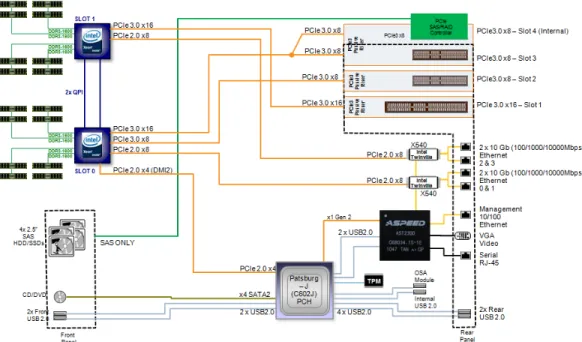
To gain an understanding of the architecture of the Sun Server X3-2L system with eight 2.5-inch disks and DVD+/-RW, see the system-level block diagram in Figure 15.
Figure 15. This block diagram depicts the Sun Server X3-2L system with eight 2.5-inch disks and DVD+/-RW, including the required SAS-2 HBA on PCIe slot 6.
Figure 15 depicts the standard configuration with a required SAS-2 HBA card that supports eight internal SAS-2 HDDs or SATA SSDs. SATA devices, such as the CD/DVD drive, and USB connectivity is controlled by the Intel C602J I/O controller.
Overview of Sun Server X3-2L with Eight 2.5-Inch Disks and DVD
The Sun Server X3-2L system with eight 2.5-inch disks and DVD+/-RW includes the following major components in addition to the shared components of the Sun Server X3-2L:
x Eight internal 2.5-inch SAS-2 HDDs or SATA SSDs
x One internal SATA DVD+/-RW-ROM
System-Level Architecture: Sun Server X3-2L with Twenty-Four 2.5-Inch Disks
To gain an understanding of the architecture of the Sun Server X3-2L system with twenty-four 2.5-inch disks, see the following system-level block diagram (Figure 16).
Figure 16. This block diagram depicts the Sun Server X3-2L system with twenty-four 2.5-inch disks, including the required SAS-2 HBA on PCIe slot 6.
Figure 16 depicts the standard configuration with a required SAS-2 HBA card that supports twenty-four internal 2 HDDs or SATA SSDs and two optional rear-accessible 2.5-inch SAS-2 HDDs or SATA SSDs. System management service processor and USB connectivity is
Overview of Sun Server X3-2L with Twenty-Four 2.5-Inch Disks
The Sun Server X3-2L system with twenty-four 2.5-inch disks includes the following major components in addition to the shared components of the Sun Server X3-2L:
x Twenty-four internal 2.5-inch SAS-2 HDDs or up to twenty-four SATA SSDs
x Two rear-accessible 2.5-inch SAS-2 HDDs or SATA SSDs
System-Level Architecture: Sun Server X3-2L with Twelve 3.5-Inch Disks
To gain an understanding of the architecture of the Sun Server X3-2L system with twelve 3.5-inch disks, see the following system-level block diagram (Figure 17).
Figure 17. This block diagram depicts the Sun Server X3-2L system with twelve 3.5-inch disks, including the required SAS-2 HBA on PCIe slot 6.
Figure 17 depicts the standard configuration with a required SAS-2 HBA card that supports twelve internal 3.5-inch SAS-2 HDDs and two optional rear-accessible 2.5-inch SAS-2 HDDs or SATA SSDs. System management service processor and USB connectivity is controlled by the Intel C602J I/O controller.
Overview of Sun Server X3-2L with Twelve 3.5-Inch Disks
The Sun Server X3-2L system with twelve 3.5-inch disks includes the following major components in addition to the shared components of the Sun Server X3-2L:
x Twelve internal 3.5-inch SAS-2 HDDs
x Two rear-accessible 2.5-inch SAS-2 HDDs or SATA SSDs
Overview of the Sun Server X3-2L Enclosure
The Sun Server X3-2L system·Venclosure is designed to occupy 2U in a standard 19-inch rack.
Table 3 provides system dimensions and weight.
TABLE 3. SUN SERVER X3-2L SYSTEM DIMENSIONS AND WEIGHT
DIMENSION UNITED STATES INTERNATIONAL
Height Width 3.45 in. (2U) 17.52 in. 87.6 mm 445.0 mm Depth Weight 29.0 in. 70 lb. maximum 736.6 mm 31.8 kg maximum
Sun Server X3-2L Rear Perspective
The three Sun Server X3-2L system configurations share the same rear panel. Figure 18 shows the rear view of the Sun Server X3-2L.
Figure 18. The rear view of the Sun Server X3-2L system showing WKHVHUYHU¶VH[WHUQDOIHDWXUHVDQG connections.
The external rear features and connections include the following:
x Rear sWDWXVLQGLFDWRUOLJKWVZKLFKUHSRUW´ORFDWRUµZKLWH´VHUYLFHUHTXLUHGµDPEHUDQG
´DFWLYLW\VWDWXVµJUHHQIRUWKHV\VWHPDQGFRPSRQHQWV
x Two rear-accessible 2.5-inch SAS-2 HDDs or SATA SSDs available only on the 24x 2.5-inch
x Two power supply units (for N+1 redundancy) with integrated fans, with each power supply
having a single, independent AC plug
x Rear power-supply indicator lights, showing the status of each hot-swappable power supply
x Four 100/1000/10000Base-T, RJ45 copper, autosensing Ethernet ports
x Six PCIe 3.0 slots, in which low-profile cards can be installed from the rear panel
x Two management ports (one 10/100Base-T Ethernet port, one RJ45 serial port) for default
connections to the service processor, with any one of the four onboard Ethernet ports also being configurable as a shared system management port
x VGA video port with analog HD-15 VGA connector on the rear panel
Sun Server X3-2L Front Perspectives
The Sun Server X3-2L system has three different storage configurations;; this requires three different front disk cages.
Figure 19 shows the front view of the Sun Server X3-2L system with eight 2.5-inch disks and DVD+/-RW.
Figure 19. The front view of the Sun Server X3-2L system with eight 2.5-inch disks and DVD showing the VHUYHU¶VH[WHUQDOdrive, DVD, and connection features.
The front external features and connections include the following:
x Status indicator lights, which UHSRUW´ORFDWRUµZKLWH´VHUYLFHUHTXLUHGµDPEHUDQG
´DFWLYLW\VWDWXVµJUHHQIRUWKHV\VWHPDQGFRPSRQHQWV
x Eight 2.5-inch SAS-2 HDDs or SATA SSDs (using the required SAS-2 HBA) with all HDD
and SSD devices inserted through the front panel
x One slim-line SATA DVD+/-RW
x Two USB ports
Figure 20. The front view of the Sun Server X3-2L system with twenty-four 2.5-inch disks showing WKHVHUYHU¶V external drive and connection features.
The front external features and connections include the following:
x 6WDWXVLQGLFDWRUOLJKWVZKLFKUHSRUW´ORFDWRUµZKLWH´VHUYLFHUHTXLUHGµDPEHUDQG
´DFWLYLW\VWDWXVµJUHHQIRUWKHV\VWHPDQGFRPSRQHQWV
x Twenty-four 2.5-inch SAS-2 HDDs or SATA SSDs (using the required SAS-2 HBA) with all
HDD and SSD devices inserted through the front panel
x Two USB ports
Figure 21 shows the front view of the Sun Server X3-2L system with twelve 3.5-inch disks.
Figure 21. The front view of the Sun Server X3-2L system with four 3.5-inch disks showing WKHVHUYHU¶VH[WHUQDO drive and connection features.
The front external features and connections include the following:
x 6WDWXVLQGLFDWRUOLJKWVZKLFKUHSRUW´ORFDWRUµZKLWH´VHUYLFHUHTXLUHGµDPEHUDQG
´DFWLYLW\VWDWXVµJUHHQIRUWKHV\VWHPDQGFRPSRQHQWV
x Twelve 3.5-inch SAS-2 HDDs (using the required SAS-2 HBA) with all HDD devices inserted
through the front panel
System Platform
The Sun Server X3-2 and Sun Server X3-2L are based on the Intel Xeon processor E5-2600 product family, which includes the following:
x Intel Xeon processor E5-2600 product family processors. The motherboard of the Sun
Server X3-2 and Sun Server X3-2L LQFOXGHVWZRSURFHVVRUVRFNHWV7KHVHFWLRQHQWLWOHG´The
Intel Xeon Processor E5-2600 Product Family AdvantageµGHVFULEHVWKHSURFHVVRUPLFUR
architecture.)
x Intel C602J I/O Controller Hub. The C602J enables additional I/O functionality, including
internal and external USB ports and the SATA DVD/RW device. The C602J connects to the Aspeed AST2300 service processor via USB (for virtual devices), PCI (for video), and LPC (serial port).
Memory Subsystem
The integrated memory controller and multiple DDR3 memory channels per processor help provide high bandwidth for memory-intensive applications. The Sun Server X3-2 system can be populated with DDR3 registered ECC low-voltage DIMM modules in 8 GB, 16 GB, or 32 GB capacities. The Sun Server X3-2L system can be populated with DDR3 registered ECC low-voltage DIMM modules in 8 GB or 16 GB capacities.
Each processor features an integrated memory controller, which means that the systems adhere to a NUMA memory architecture in which the memory controller on one processor can access local as well as remote memory. The integrated memory controller supports DDR3 memory in
four speeds³800 MT/sec;; 1,066 MT/sec;; 1,333 MT/sec;; and 1,600 MT/sec³although Oracle
qualifies and offers only 1,066 MT/sec and 1,600 MT/sec RDIMMs.
:KHQFRQILJXULQJV\VWHPPHPRU\LW·VLPSRUWDQWWRQRWHWKDW',MMs might run at speeds
slower than their individually rated speeds, depending on the CPU type, the number of DIMMs per channel, and the type of memory (speed, rank, and so on). The speed at which memory is actually running is set by system BIOS at startup, and all memory channels will run at the fastest common frequency.
Memory Population Guidelines
Each processor features four memory channels, each of which supports two RDIMM slots, enabling as many as 16 RDIMMs per system in a fully populated system. Memory slots in each channel are color-coded to simplify identification:
x Blue represents slot 0.
x White represents slot 1.
As a general rule for optimizing memory performance, DIMMs should be populated in sets of two, one per channel per CPU, starting with the slot farthest from the CPU socket (in slot 0, the blue slot). Fill the blue slots first followed by the white slots starting with slot 0 of processor 0 and then slot 0 of processor 1. Ideally, each channel should be populated with equal-capacity DIMMs and (if possible) with the same number of identical DIMMs (which helps make memory performance more consistent). In general, it is better to first populate quad-rank (QR) DIMMs,
which would be furthest from the processor, followed by dual-rank (DR) DIMMs and/or
single-rank (SR) DIMMs.4
Optimizing Memory for Bandwidth
Configurations with optimal memory bandwidth can be achieved with the Performance class of Intel Xeon processor E5-2600 product family processors and memory components that run at 1,600 MT/sec. To optimize a configuration for bandwidth, populate one or two SR or DR DDR3 1,600 MT/sec DIMMs per channel .The use of QR DIMMs limits the maximum memory speed to 1,067 MT/sec when a single or two channels are populated.
I/O Subsystem
With built-in headroom to expand systems and scale applications, the Sun Server X3-2 and Sun Server X3-2L feature expandability through a PCIe 3.0 expansion bus, internal storage options, four onboard Intel 10 GbE network interface controllers (NICs), and integrated USB
capabilities.
As shown in the block diagrams for the systems, the Intel C602J I/O Controller provides connectivity for system USB ports, the internal USB port, and the SATA DVD/RW device. Two USB ports go from the C602J to the rear panel, two USB links are routed to the internal USB port, and two additional USB ports are routed from the C602J to the front panel.
The C602J also includes a SATA interface to connect the internal SATA DVD/RW drive on the Sun Server X3-2 and Sun Server X3-2L.
System Network Interfaces
Each Intel Xeon processor E5-2600 product family processor has eight PCIe 3.0 lanes that interface with an Intel X540 10 GbE (Twinville) controller. Each controller supports two onboard 100/1,000/10,000 Mb/sec Ethernet ports. Multiple onboard 10 GbE connections promote flexibility and enable configurations that support network interface failover.
The four 10 GbE ports are numbered in sequence from right to left on the rear panel. Each port autonegotiates its link connection, and LEDs above the port indicate the speed of the established link. The Ethernet interfaces also support PXE boot for booting over the network.
The Sun Server X3-2 and Sun Server X3-2L feature the ability to configure any one of the four
onboard 10 GbE SRUWVIRU´VLGHEDQGµPDQDJHPHQWVHHWKH´Oracle ILOM Service Processor
4 ´5DQNµUHIHUVWRWKHQXPEHURIPHPRU\FKLSVD',00PRGXOHKDVFRQQHFWHGRQDQ\JLYen data line.
DQG6\VWHP0DQDJHPHQWµVHFWLRQ:KHQFRQILJXUHGDVDPDQDJHPHQWSRUWRQHRIWKHRQERDUG
Ethernet interfaces has two MAC addresses and requires two IP addresses (one for data and one for management). In this configuration, the two IP addresses need to be on the same subnet. Just like the AST2300 service processor on the motherboard, the two Intel X540 10 GbE
FRQWUROOHUVDUHSRZHUHGIURPD´VWDQGE\µSRZHUVRXUFHIURPthe system power supplies. Even
when power to the server is turned off, the side-band management interface remains active to enable remote management.
PCIe 3.0 Expansion Bus
The Sun Server X3-2 and Sun Server X3-2L include PCIe 3.0 expansion slots that can
accommodate low-profile cards rated at 25 watt maximum. PCIe 3.0 doubles the interconnect bit rate over the previous PCIe Gen 2 by increasing the signaling rate to 8 Gb/sec from 5 Gb/sec and by using 128/130 bit encoding instead of 8/10 bit encoding.
On the Sun Server X3-2 system models, three right-angle risers plug directly in to the
motherboard to enable PCI 3.0 expansion. The first two PCIe slots use single-slot 1U risers, but the riser used in PCIe slot 3 is a dual-slot 1U riser allowing external access to the upper PCIe port (PCIe port 3) and internal-only access to the lower PCIe port (PCIe port 4) on the riser. PCIe port 4 is reserved for the internal SAS-2 storage HBA in system configurations where local disks are used.
On the Sun Server X3-2L system models, no risers are used, and PCIe cards are installed vertically. PCIe slot 6 is reserved for the internal SAS-2 storage HBA in system configurations where local disks are used. Cards can be compliant with Revision 1.0a, 2.0, or 3.0 of the PCIe Card Electromechanical Specification.
On the Sun Server X3-2 system models, the PCIe 3.0 slots are numbered left to right with slots 3 and 4 using the same riser card, but only slot 3 is externally accessible. Slot 1 uses one x16 mechanical riser and has 16 electrical lanes to CPU 1. Slot 2 uses one x16 mechanical riser but with only eight electrical lanes. Slot 3 uses the dual-slot riser for PCIe ports 3 and 4. The dual-slot riser is x16 mechanical/electrical but is split for the two PCIe ports to x8
mechanical/electrical. Slots 2 and 3 have electrical lanes to CPU 0. The risers are keyed to insert correctly into the motherboard.
The six slots on the Sun Server X3-2L system models are numbered left to right across the bottom (slots 1 to 3) and then left to right across the top of the rear panel (slots 4 to 5). See Figure 18, which shows the rear panel of the Sun Server X3-2L system. Unlike the Sun Server X3-2, no risers are used in the Sun Server X3-2L system models. The PCIe cards are inserted directly on the system board.
Integrated Storage
The Sun Server X3-2 and Sun Server X3-2L offer large internal storage capacities for SAS HDDs and can also accommodate SATA SSDs. The servers differ, however, in the number and type of internal storage devices supported. Table 4A and Table 4B summarize the differences.
TABLE 4A. STORAGE CHARACTERISTICS OF THE SUN SERVER X3-2 SYSTEM MODELS
SUN SERVER X3-2, 4X 2.5-IN. DISK SUN SERVER X3-2, 8X 2.5-IN. DISK
SUN SERVER X3-2, 4X 3.5-IN. DISK
Number of device slots
4 8 4
Device form factor 2.5 in. drive 2.5 in. drive 3.5 in. drive
Maximum number 4 8 4
of internal SAS x 300 GB 10K RPM x 300 GB 10K RPM x 600 GB 15K RPM HDDs
x 600 GB 10K RPM x 600 GB 10K RPM x 3 TB 7.2K RPM
Maximum number 4 8 0
of internal SATA x 100 GB eMLC SSD x 100 GB eMLC SSD SSDs
x 300 GB eMLC SSD x 300 GB eMLC SSD
TABLE 4B. STORAGE CHARACTERISTICS OF THE SUN SERVER X3-2L SYSTEM MODELS
SUN SERVER X3-2L, 8X 2.5-IN. DISK
SUN SERVER X3-2L, 24X 2.5-IN. DISK
SUN SERVER X3-2L, 12X 3.5-IN. DISK
Number of front device slots
8 24 12
Device form factor 2.5 in. drive 2.5 in. drive 3.5 in. drive
Maximum number of internal SAS HDDs 8 x x 300 GB 10K RPM 600 GB 10K RPM 26 (24 front + 2 rear) x 300 GB 10K RPM x 600 GB 10K RPM 14 (12 front + 2 rear) x 600 GB 15K RPM x 3 TB 7.2K RPM Maximum number of internal SATA SSDs 8 x x 100 GB eMLC SSD 300 GB eMLC SSD 26 (24 front + 2 rear) x 100 GB eMLC SSD x 300 GB eMLC SSD 2 rear x 100 GB eMLC SSD x 300 GB eMLC SSD
2.5 inch HDDs or SSDs. Table 4B shows the 2U Sun Server X3-2L system can house as many as twenty-four 2.5-inch internal HDDs. At the present time, the Sun Server X3-2 and Sun Server X3-2L can support a maximum of 8 SATA SSDs.
A PCIe SAS-2 RAID HBA card is required in all configurations to support internal storage options and to implement RAID. Internal mixing of SATA and SAS devices is supported (but not within a RAID volume).
Available Devices
The following devices are available for the Sun Server X3-2 and Sun Server X3-2L (at the time of this writing):
x SAS HDDs:
x 2.5-inch SAS-2 disks: 300 GB 10K RPM and 600 GB 10K RPM
x 3.5-inch SAS-2 disks: 600 GB 15K RPM and 3 TB 7.2K RPM
x SATA SSDs:
x 2.5-inch eMLC SFF SATA SSDs: 100 GB
x 2.5-inch eMLC SFF SATA SSDs: 300 GB
Solid-State Drives (SSDs)
Flash technology provides an economical alternative to hard disk drives and can dramatically enhance application I/O performance while also operating with significantly better energy efficiency. The Sun Server X3-2 and Sun Server X3-2L support flash technology in the form of SSDs.
SSDs use a drive form factor and are directly inserted into drive bays specific to the Sun Server
X3-2 and Sun Server X3-2L7KHVHUYHUV·RSHUDWLQJV\VWHPDQG%,26YLHZ66'VDVVWDQGDUG
SATA drives.
Optimizing Performance with SSDs and Sun FlashFire Technology
Oracle Solaris ZFS recognizes different media types and optimizes data placement to maximize system throughput. Hybrid Storage Pools in Oracle Solaris ZFS automatically place data on the most-appropriate storage media to optimize performance and manage costs. Oracle Solaris ZFS
can transparently cache data on SSDs and 2UDFOH·V6XQFlashFire technology without requiring
applications to be modified.
Drive Cage Design
The impressive storage density of the Sun Server X3-2 and Sun Server X3-2L is attributable partly to innovative drive carrier designs that facilitate effective airflow above and below each drive. Drives are inserted into a disk tray and cable-free disk backplane that increase reliability
and serviceability. The carrier includes an ejection handle that simplifies drive removal (drives are hot-pluggable when disk mirroring is configured). Drive status lights indicate Ready to Remove, Fault, and Status.
In all six systems, the disks plug in to a server-specific backplane board. In the Sun Server X3-2L system, twelve and twenty-four disk models, an LSI SAS-2 expander device facilitates large internal storage capacities. On the Sun Server X3-2L system models, eight ports on the SAS expander connect to the SAS-2 HBA, supporting switched connections for as many as 26 SAS or SATA devices.
To minimize the effects of drive or fan vibration, dampening material was added to the servers·
drive cages and the fan modules and decks were designed with a floating spring mechanism that helps isolate fan vibration. In addition, fan modules containing two contrarotating fans were specified to help reduce the amplitude of fan vibration.
Disk Controller and I/O RAID Options
The Sun Server X3-2 and Sun Server X3-2L support the following options for disk controllers:
x Sun Storage 6 Gb SAS-2 PCIe HBA. This low-profile card has two four-port SFF-8087
connectors and enables hardware RAID levels 0, 1, or 10. The card is available in two versions: one with internal connectors and one with external connectors.
x Sun Storage 6 Gb SAS-2 PCIe RAID HBA. Based on Adaptec and Intel technology, this
HBA is an eight-channel, low-profile card with two four-port SFF-8087 connectors, and it supports 6 Gb/sec SAS-2 and hardware RAID levels 0, 1, 1E, 5, 5EE, 6, 10, 50, and 60. The card is available in two versions: one with internal connectors and one with external
connectors. This HBA includes 256 MB of DDR2 onboard memory and a battery-backed write cache for 72-hour backup, which helps deliver protected, high-availability storage. Two cables, each with four lanes (at 6 Gb/sec), are wired from the SAS adapter to the disk backplane to control the internal HDD and SSD drives and provide high bandwidth. For the Sun Server X3-2, the four SAS links from the HBA connect directly to the SAS/SATA devices. This
is also true for the Sun Server X3-2L ZLWKHLJKWµGULYHV. In the case of the Sun Server X3-2L
system models, twelve and twenty-four disk configurations, the four SAS links connect to the SAS expander, which provides connections to individual disks in the drive cage.
DVD Assembly
A slim form factor SATA DVD/RW assembly is available as an option for the Sun Server X3-2 system with four 2.5-inch disks and the Sun Server X3-2L system with eight 2.5-inch disks. The assembly provides an internal DVD+/-RW device connected to one of the SATA host
Power Supplies
Engineered for high availability as well as low energy consumption, the Sun Server X3-2 and Sun
Server X3-2L are configurHGZLWKWZRKLJKO\HIILFLHQW´3ODWLQXPµVWDQGDUGUHGXQGDQW
hot-swappable AC PSUs, each with separate power cords. The second power supply in the systems enables N+1 redundancy, supplying continuous power to the systems if a single power supply fails.
The PSUs differ between systems, with the Sun Server X3-2 system models using 600W PSUs and the Sun Server X3-2L system models requiring 1,000W PSUs. As shown in Table 5, the power supplies are highly efficient, with an efficiency rating of at least 87 percent at 100 percent load.
TABLE 5. POWER SUPPLY UNIT COMPARISON
SYSTEM MAXIMUM OUTPUT POWER MAXIMUM AC INPUT CURRENT
MAXIMUM POWER SUPPLY EFFICIENCY
Sun Server X3-2 600 W At 100 V AC and 600 W output: 7.2 A
At 600 W (100%) load: 91%
Sun Server X3-2L 1,000 W At 100 V AC and 1000 W output: 12.0 A
At 1000 W (100%) load: 91%
Each PSU features a nonremovable internal fan that supplies independent PSU cooling. Three light indicators display power supply status information (AC, Fault, and OK).
The Sun Server X3-2 and Sun Server X3-2L PSUs connect directly to the system board, providing power to all major system components, unlike previous generations that required a power distribution board (PDB) to provide a connection between the PSU and components.
Fan Assemblies
The server enclosures are designed for efficient front-to-back airflow. Variable-speed fans run under the control of the onboard service processor, which monitors processor temperatures, DIMM temperature, PCI-Express I/O card air temperature, and numerous other temperature sensors in the chassis. Based on these readings, the fans operate at the lowest speeds possible to
provide sufficient cooling³conserving power use, prolonging fan life, and reducing acoustical
noise.
Fan assemblies differ between the Sun Server X3-2 and Sun Server X3-2L. The Sun Server X3-2 system models house four hot-swappable fan modules, with each module containing two 40 mm counterrotating fan pairs (four rotors total). In the Sun Server X3-2L system models, there are four hot-swappable fan modules, with each module accommodating a single 80 mm
Each fan module is configured to counterrotate to reduce vibration modes, and the fan modules do not contain any additional components. A green status light for a fan module indicates proper operation, whereas an amber light indicates a fan fault. The system can tolerate the loss of any individual fan rotor, to ensure continued operation while service for the system can be scheduled. The fans are also hot-swappable, which means that it is possible to remove a module with a failed fan and insert a new fan module without shutting down the system. On the top of the chassis, a fan access door enables servicing of the fans with the chassis pulled only partially out of the rack. This simplifies cable management during fan replacement.
Rack Mounting
The Sun Server X3-2 and Sun Server X3-2L can be mounted in the following racks:
x Third-party ANSI/EIA-310-D-1992 or IEC 60927²compliant racks in a 19 in./482.6 mm
panel-width series
x 2UDFOH·VSun Rack II 1042 and Sun Rack 1242
The Sun Server X3-2 and Sun Server X3-2L can be rack-mounted in the either the Sun Rack II 1042 or the Sun Rack 1242. The Sun Rack 1242 provides added depth to the rack. As a part of their chassis, the Sun Server X3-2 and Sun Server X3-2L feature slide rail release levers. Pulling
GRZQRQWKHVHOHYHUVXQORFNVWKHUDLOV·VOLGLQJPHFKDQLVPVRWKHFKDVVLVFDQEHSXOOHGRXWRIWKH
rack for easier servicing.
The following options are available to simplify rack mounting:
x Tool-less rack kit. As the name implies, this rack-mounting kit snaps into certain Oracle and
third-party racks without requiring the use of any tools.
x Cable management arm. The cable management arm supports and protects cables as the
server slides in and out of the rack.
The slide rail kit includes hardware for mounting it to rack rails with either 6 mm threaded holes,
#10²32 threaded holes, #10 clearance holes, or square unthreaded holes per ANSI/EIA
310-D-1992 or IEC 60927 standards. Note that not all third-party racks are compatible with the slide rail kit. Rack density varies widely, depending on the systems installed, power distribution (in-cabinet or external), the power source (single-phase or three-phase), and whether redundant power is required.
RAS Features
The Sun Server X3-2 and Sun Server X3-2L are engineered for hardware failure prevention, near-continuous operation, fast recovery, and easy serviceability. For these systems, reliability,
availability, and serviceability features (commonly referred to as RAS features) include the following:
x Hot-swappable redundant components. Mirrored disks, redundant fan modules, and
redundant PSUs can be quickly and easily changed out, increasing system uptime.
x Accessible components for improved serviceability. Front-accessible, hot-swappable disk
drives can be replaced quickly. Fan modules and power supply units can be replaced even if a system has not been completely removed from the rack.
x A variety of RAID options. These options enable customers to balance storage capacity,
availability, and cost. The LSI-based Sun Storage 6 Gb SAS-2 PCIe HBA with internal connectors supports RAID 0, 1, 1E, and 10E, and the Sun Storage 6 Gb SAS-2 PCIe RAID HBA supports RAID 0, 1, 10, 1E, 5, 50, 5EE, 6, and 60 and also features a battery-backed disk write cache.
x Indicator LEDs on the front and back of the chassis. Easily visible LEDs enable
problems to be identified and isolated easily. Diagnostic LEDs are also included on the motherboard to aid in locating a failed component, such as a DIMM or CPU.
x Oracle ILOM capabilities. Standard on all new Oracle servers as of 2012, the integrated
Oracle ILOM service processor provides powerful tools for local or remote system management, simplifying administrative tasks, reducing the number of onsite personnel
needed, and lowering overall operational costs. (See the next section³´Oracle ILOM Service
3URFHVVRUDQG6\VWHP0DQDJHPHQWµ³IRUPRUHRQWKHVHUYHUV·V\VWHPPDQDJHPHQW
capabilities.)
Oracle ILOM Service Processor and System Management
Like many other Oracle servers, the Sun Server X3-2 and Sun Server X3-2L feature a built-in hardware-based service processor that enables remote server monitoring, system management, and task automation capabilities that are consistent across much of the Oracle server product line.
Oracle ILOM Service Processor
The Sun Server X3-2 and Sun Server X3-2L embed an Aspeed AST2300 chip as the onboard service processor (that is, the baseboard management controller, or BMC). The Aspeed AST2300 combines a graphics controller and a service processor into a single chip, saving space and power. It uses two USB ports for virtual devices and one PCIe x1 link for video to connect to
the Intel &-,2&RQWUROOHU6HHWKHV\VWHPEORFNGLDJUDPVLQWKHHDUOLHU´Architecture of the
Sun Server X3-2 and Sun Server X3-2LµVHFWLRQ
The Oracle ILOM service processor provides lights-out management, which can help
organizations simplify system management. The service processor runs independently of the host platform, executing a robust, security-hardened operating system.
x Full remote keyboard, video, mouse, and storage (RKVMS) access via redirection over IP,
eliminating the need for local KVM
x Monitoring and reporting of environmental, power, hardware, BIOS, and operating system
events
x Backup and restoration of BIOS configuration
x Remote power control, diagnostics, virtual media attachment and upgrades of the system
BIOS and service processor software
x System configuration information retrieval
x User-configurable serial console access through a physical port or redirected over IP
x Java-enabled remote console access across a secure Web connection
x Multilevel role-based access with support for RADIUS, LDAP, and Microsoft Active
Directory Service lookup of authentication data
x Simple Network Management Protocol (SNMP) V1, V2c, and V3 support
For system management operations, the Aspeed AST2300 uses these connections:
x Two USB ports for virtual devices (both ports are routed directly on the motherboard
between the AST2300 and the C602J)
x One SVGA video port for local video output
Management functions provided by the service processor are implemented by Oracle ILOM 3.1 system management software. This software provides an Intelligent Platform Management Interface (IPMI 2.0) baseboard management controller, platform control agents, diagnostics software, and RKVMS functionality. Many other Oracle servers incorporate these features, providing organizations with a single, consistent, and standards-based management interface. Secure access to the service processor and associated Oracle ILOM software functions takes several forms:
x Intuitive browser-based user interface (BUI) over SSL
x Distributed Management Task Force (DMTF) command-line interface over Secure Shell
(SSH)
x Redirection of the platform console, keyboard, mouse, and video to the Oracle ILOM
Remote Console application
x SNMP v3 interfaces, providing easy integration with Oracle Enterprise Manager Ops Center,
or third-party applications from companies such as HP and IBM
Optimizing Management Flexibility
Although system management tools can play an important role in streamlining operations, organizations must consider the best approach for each environment. Executing management
software directly on the host (with or without use of a service processor) is known as in-band
management. Using a dedicated Ethernet or serial port to execute administrative tasks
independently of the host is known as out-of-band management. Sharing a single 10 GbE port for
host and service processor network connectivity is called side-band management, which is enabled in
these servers through a connection between the Ethernet controllers and the service processor (see Figure 22). Table 6 presents a comparison of these management strategies.
Figure 22. The Oracle ILOM service processor supports side-band management.
TABLE 6. COMPARISON OF IN-BAND, OUT-OF-BAND, AND SIDE-BAND MANAGEMENT
STRATEGY CHARACTERISTICS BENEFITS IDEAL USE CASES
In-band x It relies on operating x Use of a single network x Heterogeneous system±resident software. connection and switch environments to provide a
x Management tasks utilize platform compute
port minimizes cost and complexity.
common administrative tool across all platforms
Out-of-band x It utilizes a dedicated x It provides continuous x Environments with Ethernet or serial port for access to management compute- or bandwidth-administrative traffic. capabilities even when intensive applications
x Management tasks the host is disabled. x Projects with complex execute on an x Management tasks do not management independent service consume host resources. requirements or high processor. x Increased security is a
result of physically
levels of administrative burden
separating management traffic and server data.
Side-band x The host and service x It provides continuous x Cost-sensitive processor share a access to management environments 10 GbE port and are each capabilities even when
assigned an independent the host is disabled. MAC and IP address. x Management traffic uses
x Management tasks part of the server data execute on an bandwidth.
independent service x It requires only one switch processor. port, lowering
implementation costs.
x It minimizes processing overhead on the host.
The Sun Server X3-2 and Sun Server X3-2L offer extensive flexibility in that they support all
three of these strategies³in-band, out-of-band, and side-band management. Organizations can
choose a single management method or use in-band management in tandem with out-of-band or side-band management approaches.
The Sun Server X3-2 and Sun Server X3-2L provide out-of-band management across a dedicated 10/100 Mb Ethernet port or an RS-232 serial port on the Oracle ILOM service processor. Side-band management is supported over one of the four 10GbE interfaces shared between the host and the service processor. With a side-band management approach, both the platform and the service processor get a unique MAC address and IP address for the shared physical Ethernet port. When configured, side-band management can provide all the benefits of out-of-band management, at a considerable cost savings, by eliminating the need to consume a switch port for both management and platform connections.
In-Band Server Management
In-band server management enables organizations to take advantage of industry-standard protocols and applications across all data center platforms. The Sun Server X3-2 and Sun Server
v3 standards. One of the following two options enables these OS-resident platform management functions:
x IPMI with a keyboard-controller-style (KCS) interface and an IPMI kernel driver
x SNMP agents
Out-of-Band and Side-Band Management
Out-of-band and side-band management approaches support the completion of administrative tasks without placing an unnecessary burden on the host. This administrative strategy is desirable for performance-intensive environments. Although in-band management works only as long as the host operating system is up and running, out-of-band and side-band management are fully functional even when the host is powered off. For side-band management to work even when the host is shut down, the two dual-10 GbE (Twinville) controllers operate with standby power, much like the service processor.
Although out-of-band and side-band approaches differ with respect to network connectivity, these methods offer comparable capabilities and benefits:
x Based on serial port redirection (serial-over-LAN), serial port connectivity to the Oracle
ILOM service processor provides direct console access to the command-line interface (CLI) and to the system console stream. The CLI is designed to follow the DMTF Command Line Protocol.
x Utilizing Ethernet connectivity, administrators can access a Web interface or a CLI. An SSH
session is required to access the CLI, and the Web interface supports both secure (HTTPS) and nonsecure (HTTP) access. Secure access is the default configuration for Web-based access.
Remote Keyboard, Video, Mouse, and Storage
The Oracle ILOM service processor provides access to keyboard, video, mouse, and storage remotely over IP. Remote video display is accomplished through the Java Web Start software known as the Oracle ILOM Remote Console. Setting up a system as a remote console means downloading the Oracle ILOM Remote Console software from the Oracle ILOM service
processor to the target machine.5 From this point on, the Oracle ILOM Remote Console
executes locally. Because the Oracle ILOM Remote Console does not run locally on the server, it
5 The Oracle ILOM Remote Console requires the installation of Java Runtime Environment 5.0 or higher on the management console. If IPv6 is used, Java Runtime Environment 7.0 or higher is required.
does not put overhead on the host. A single instance of the Oracle ILOM Remote Console can open multiple sessions, enabling management of several remote servers simultaneously.
The Oracle ILOM Remote Console software can be used to redirect the BIOS and setup screens as well as all other platform video output. A true remote video view of the management console is provided by handling of the input and output to and from virtual devices and the server. The SVGA display provides resolutions as high as 1,600 × 1,200 pixels with integrated video compression on the Aspeed AST2300 service processor.
The two USB 2.0 ports connected to the Oracle ILOM service processor enable the remote keyboard, mouse, and storage functions. The Oracle ILOM Remote Console software captures keyboard, mouse and floppy/CD/DVD input on the management console and redirects it over IP to the Oracle ILOM service processor. Keyboard, mouse, and storage inputs are then transmitted over the USB ports to the server. The Sun Server X3-2 and Sun Server X3-2L interpret these inputs as originating from locally connected USB devices, which are referred to as
´YLUWXDOµGHYLFHV
The Oracle ILOM Remote Console can also be used to boot the remote server from a local device. A virtual device can be a local physical device or an image file. The Oracle ILOM Remote Console can redirect several types of devices as virtual devices:
x DVD+/-RW
x Floppy
x USB flash disk drives
x CD/DVD-ROM image (.iso files)
x Floppy image (.img files)
Intelligent Platform Management Interface (IPMI)
IPMI refers to the industry-standard interface for autonomous monitoring, logging, recovery, and inventory control features implemented in hardware and firmware. The key differentiation of intelligent platform management is that these functions are independent of the main CPU, BIOS, and OS. There are two major components of platform management: the baseboard management controller (BMC) and system management software (SMS). Intelligent platform management facilitates enterprise-class management for high-availability systems.
The Oracle ILOM service processor provides autonomous sensor monitoring and event logging. Typical sensor-related events include out-of-range temperatures or voltage and fan failures. When an event occurs, it is noted in the system event log and made available to the system management controller. The system management controller is powered by power supply standby voltage and functions even when the server is powered down or the operating system has
In modern systems, IPMI provides a hardware-level interface specification for monitoring and control functions. It defines a standard, abstract, message-based interface between the BMC and SMS and a common set of commands for operations such as accessing sensor values, setting thresholds, logging events, and controlling a watchdog timer. IPMI messages can be used to communicate with the BMC over serial and LAN interfaces, so taking software designed for in-band (local) management and reusing it for out-of-band (remote) management simply means changing the low-level communications layer.
SNMP
Simple Network Management Protocol (SNMP) provides remote access for monitoring and controlling network devices and for managing configurations, statistics collection, performance, and security on a network. SNMP is a network management protocol used almost exclusively in TCP/IP networks. The Sun Server X3-2 and Sun Server X3-2L provide SNMP Management Information Bases (MIBs) for managing and monitoring the servers with any SNMP-capable network management system, such as HP OpenView Network Node Manager (NNM), Tivoli, CA Unicenter, or IBM Director. The MIB data describes the information being managed, reflects current and recent server status, and provides server statistics.
The Oracle ILOM service processor supports SNMP v1, v2c, and v3. SNMP v3 is enabled by default;; v1 and v2c are disabled by default. SNMP sets can be enabled and disabled and are disabled by default. SNMP traps can be generated from within the service processor. An IPMI-specific trap called a platform event trap (PET) can also be generated. The following SNMP MIBs are supported:
x The system group and the SNMP group from the RFC1213 MIB
x SNMP-FRAMEWORK-MIB
x SNMP-USER-BASED-SM-MIB
x SNMP-MPD-MIB
x ENTITY-MIB
x SUN-PLATFORM-MIB
Oracle System Assistant
Oracle System Assistant is a new utility that assists in the installation and configuration of the Sun Server X3-2 and Sun Server X3-2L and is included by default on these servers. The Oracle System Assistant bootable utility can be initiated either from the Oracle ILOM interface or by selecting the Oracle System Assistant utility through the BIOS boot menu. Oracle System Assistant helps with the following system configuration, installation, and ongoing maintenance operations:
x Install software release updates
x Configure Oracle ILOM networking
x Configure storage RAID
x Installation of operating systems with Installation Assistant for Oracle VM, Oracle Linux,
Red Hat Linux, SUSE Linux, and Microsoft Windows
Oracle Enterprise Manager Ops Center
Oracle Enterprise Manager Ops Center, which is included with the Sun Server X3-2 and Sun Server X3-2L under a support contract, is a highly scalable data center management platform. It provides organizations with fluid systems lifecycle management and automation processes. The capabilities of Oracle Enterprise Manager Ops Center can help organizations simplify
management of data center requirements, such as server consolidation, compliance reporting, and rapid provisioning. This management platform helps provision and administer both physical and virtual data center assets in environments that include Sun Server 2 and Sun Server X3-2L as well as other Oracle and non-Oracle hardware running Oracle Solaris, Linux, and Microsoft Windows operating systems.
Oracle Enterprise Manager Ops Center provides a single console to facilitate the following key capabilities within globally dispersed heterogeneous IT environments:
x Oracle Cloud Management. Oracle Enterprise Manager Ops Center provides all
management functions for Oracle VM Server for x86 with direct communication to the Oracle VM Server for x86 Manager.
x Server discovery and inventory management. Oracle Enterprise Manager Ops Center
automatically scans and identifies servers across the network, even when the servers are powered off, enabling faster deployment and management of IT assets.
x Firmware and bare-metal server provisioning. Oracle Ops Center Provisioning and Patch
Automation delLYHUVDXWRPDWLF´KDQGVRIIµLQVWDOODWLRQRIEDUH-metal operating systems, RPM
packages, and firmware, bringing new efficiencies to IT departments.
x Patch management and updating. Oracle Ops Center Provisioning and Patch Automation
provides up-to-date patch management tools for Red Hat Linux, SUSE Linux, and Oracle Solaris, offering organizations greater control over data center plans and minimizing downtime. In addition, unique patch simulation capabilities remove uncertainty from the software update process.
x Management and monitoring. Oracle Ops Center Provisioning and Patch Automation
securely and remotely manages users and heterogeneous data center assets and proactively resolves problems by monitoring critical parameters, improving the security and stability of