WILL GRILLIETTE
Abstract. This paper unifies different notions of simplification for graphs into a single universal construction on a comma category, given the familiar conditions of faithfulness, regularity, and existence of an adjoint. Specifically, this construction unifies the passage of a directed multigraph to a simple digraph, the passage of a set-system hypergraph to a simple set system, and the passage of an incidence hypergraph to a simple incidence structure.
Moreover, this universal construction has a natural dual, a “cosimplification”. This dual process unifies the removal of isolated vertices and loose edges for quivers and incidence hypergraphs, as well as the passage of a set-system hypergraph to a set system when using antihomomorphisms.
1. Introduction
In graph theory, each type of graph has a notion of “simple” and “simplification”, where parallelisms are removed [JK93, Wil89]. As shown in [GR19], many categories of graphs can be represented as comma categories. Thus, the goal of the paper is to unify these simplification processes into a single universal construction that can be applied to more general contexts. Specifically, the simplification of a multigraph will be a left adjoint to the natural inclusion into the category of multigraphs.
Please be aware that “simple” in this paper will be allowing loops. Without loops, the respective irreflexive categories will not have a terminal object [BMSW08, p. 7]. Moreover, the right adjoint to the vertex functor creates a complete graph with loops [GR19, p. 4, 6]. As these universal objects have loops, loops and 1-edges will be allowed in “simple” graphs.
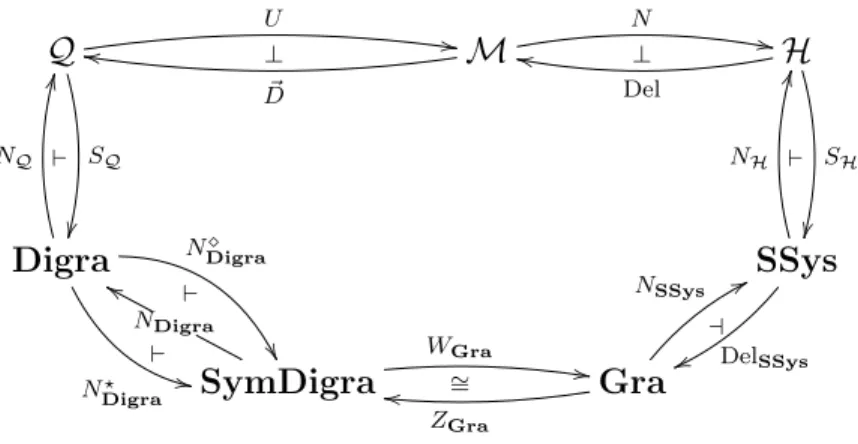
Section2defines asimple object of a comma category and devises a generalized simpli-fication process for a comma category satisfying certain criteria: regularity, faithfulness, and an adjoint. Section 3 intertwines the full category of simple objects with functor-structured categories in [AK80,Kat63,KP72,Sol13], which are more simply defined than comma categories. Section4 applies these constructions and successfully recovers simpli-fication operations for quivers, set-system hypergraphs, and incidence hypergraphs. Sec-tion 5 completes the diagram started in [GR19, p. 3] by explicitly connecting symmetric digraphs to simple graphs.
With simplification represented as a universal construction, one can naturally dualize the concept, creating “cosimplification”. Section 6 gives examples of this concept in
2020 Mathematics Subject Classification: 05C20, 05C65, 18A25, 18A40, 18D35.
Key words and phrases: quiver, set system hypergraph, incidence hypergraph, incidence structure, simple graph, antihomomorphism.
©Will Grilliette, 2020. Permission to copy for private use granted.
1
the context of quivers and incidence hypergraphs, deleting isolated vertices and loose edges. Section 7 considers set systems with antihomomorphisms, previously discussed in [HN79, p. 60]. This category naturally connects graph theory to topology and measure theory, as the preimage requirement for antihomomorphisms is identical to continuity and measurability. In this context, “cosimplification” becomes the traditional simplification of a graph.
2. Simple Objects & Simplification
Throughout this section, let A F //C oo G B be functors, G := (F ↓G) be the comma category, and Aoo P G Q //B be the canonical projections. In graph theory [D¨75, Theorem 1], a graph is simple if it has no parallel edges, i.e. if the incidence function is one-to-one. In a general comma category, the following definition is taken for a “simple” object.
2.1. Definition. An object (A, f, B) ∈ ob(G) is simple if f is monic in C. Let SG be
the full subcategory of G consisting of simple objects, and let SG N //G be the inclusion functor. A routine check shows that SG is a replete subcategory of G.
A common pratice in the study of simple graphs is to regard homomorphisms as func-tions between the vertex sets [HN79, p. 53], as the map of edges is uniquely determined. This fact carries over to simple objects in a general comma category, provided the functor
F is faithful.
2.2. Proposition. Assume F is faithful. If (A, f, B)
(φ,ψ)..
(ϕ,χ)
0
0(A0, f0, B0) ∈ G satisfy that G(ψ) =G(χ) and (A0, f0, B0) is simple, then φ =ϕ.
Proof. Notice that f0 ◦F(φ) = G(ψ)◦f = G(χ)◦f = f0 ◦F(ϕ). As f0 is monic,
F(φ) =F(ϕ). AsF is faithful, φ=ϕ.
2.3. Corollary. Assume F is faithful. A morphism (A, f, B) (φ,ψ)//(A0, f0, B0) ∈ SG
is uniquely determined by ψ.
In order to “simplify” an object of a comma category to a simple object, motivation is taken again from graph theory. In [BL86, D¨75], the simplification process is achieved by a quotient operation, tacetly using the image factorization. A simple graph itself can be regarded as a subgraph of a complete graph [Kun98, p. 316].
The complete graph is realized through a right adjoint to the vertex functor, and this right adjointQ? is guaranteed to exist in a general comma category whenF admits a right adjoint [GR19, Definition 1.11]. To embed into such a “complete” object, A is assumed to be regular to ensure an image factorization. Under the above conditions, a “simplified” object can be constructed.
2.4. Definition.Assume that A is regular, and that F admits a right adjoint F? with
counit F F? θ //id
C . For (A, f, B) ∈ ob(G), there is a unique A
ˆ f // F?G(B) ∈ A such that θG(B) ◦ F ˆ
f = f. Let A efˆ////ranfˆ // mfˆ //F?G(B) ∈ A be an image
factorization of f. Defineˆ S(A, f, B) := ranfˆ, θG(B)◦F
mfˆ , B and η(A,f,B) := efˆ, idB
. By the commutative diagram below, η(A,f,B) is an epimorphism in G from
(A, f, B) onto S(A, f, B), and
mfˆ, idB
is a monomorphism in G from S(A, f, B) into Q?(B). F(A) f F(fˆ) (( F(efˆ) // Franfˆ F(mfˆ) F(mfˆ) // F F?G(B) θG(B) F F?G(B) θG(B) G(B) G(idB) / /G(B) G(idB) / /G(B)
By standard results, mfˆis monic in A, so preservation of monomorphisms by F and
monic θ are sufficient to ensure that both S(A, f, B) and Q?(B) are always simple.
2.5. Lemma.Let Abe regular, and assume thatF preserves monomorphisms and admits
a right adjoint F? with a monic counit F F? // θ //
idC. Then,
S(A, f, B) (mfˆ,idB) //Q?(B) ∈ SG for all (A, f, B)∈ob(G).
As one would expect, the simplification of a simple object is trivial under the condition that F is faithful.
2.6. Lemma.Let A be regular, and assume that F is faithful and admits a right adjoint
with counit F F? θ //idC . If (A, f, B)∈ob(SG), then η(A,f,B) is an isomorphism.
Proof.As θG(B)◦F
ˆ
f=f is monic, Ffˆis monic. AsF is faithful, ˆf is monic. As
Moreover, the faithful condition yields a universal property: any map into a simple object factors through the simplification. With the conditions in Lemma 2.5, SG is a reflective subcategory of G.
2.7. Theorem.LetA be regular, and assume thatF is faithful and admits a right adjoint
with counit F F? θ //id C . If (A, f, B) (φ,ψ) // N(A0, f0, B0) ∈ G, there is a unique S(A, f, B) ( ˆ φ,ψˆ) / /(A0, f0, B0) ∈ G such that φ,ˆ ψˆ◦η (A,f,B) = (φ, ψ).
Proof.Let Aoo p1 R p2 //A ∈ Abe a kernel pair of ˆf, and A
efˆ //
ranfˆ ∈ A be a coequalizer of p1 and p2. As ˆf◦p1 = ˆf◦p2, there is a unique ran
ˆ
f mfˆ //F?G(B) ∈ A
such that mfˆ◦efˆ= ˆf. For n= 1,2, observe that
f0 ◦F (φ◦pn) =G(ψ)◦f◦F (pn) =G(ψ)◦θG(B)◦F ˆ f ◦pn .
As ˆf ◦p1 = ˆf ◦p2, the equalities above yield f0 ◦F (φ◦p1) = f0 ◦F (φ◦p2). As f0 is
monic,F (φ◦p1) =F (φ◦p2). As F is faithful,φ◦p1 =φ◦p2. By the universal property
of ran
ˆ
f
, there is a unique ran
ˆ f φˆ / /A0 ∈ A such that ˆφ◦e ˆ f = φ. Consider the diagram below. F(A) f F(fˆ) (( F(efˆ) / /F ranfˆ F(mfˆ) F(φˆ) / /F (A0) f0 F F?G(B) θG(B) G(B) G(idB) / /G(B) G(ψ) //G(B 0) Notice that f0◦F φˆ◦F efˆ = f0 ◦F(φ) =G(ψ)◦f =G(ψ)◦θG(B)◦F ˆ f = G(ψ)◦θG(B)◦F mfˆ ◦F efˆ .
Since efˆis epic and F is cocontinuous,F
efˆ
is epic, giving that
f0◦F φˆ=G(ψ)◦θG(B)◦F
mfˆ
.
Thus,φ, ψˆ is a morphism in G from S(A, f, B) to (A0, f0, B0). By construction,
ˆ
and uniqueness follows from Proposition 2.2.
2.8. Corollary. Let A be regular, and assume that F is faithful, preserves
monomor-phisms, and admits a right adjoint with a monic counit F F? θ //idC. If
(A, f, B) (φ,ψ) //N(A0, f0, B0) ∈ G, there is a unique S(A, f, B) ( ˆ φ,ψˆ) / /(A0, f0, B0) ∈ SG such that Nφ,ˆ ψˆ◦η (A,f,B) =
(φ, ψ). Consequently, SG is a reflective subcategory of G.
3. Relationship to Structured Categories
Consider the case when A = C and F = idA. Letting B G //A be any functor, the
comma categoryG:= (idA ↓G) would consist of objects (A, f, B), where A
f //
G(B) ∈ A, like a generalized coalgebra as in [Rut00].
If (A, f, B) is in the full subcategorySG of G consisting of simple objects, then (A, f) represents a subobject of G(B) in A. Moreover, as idA is faithful, Corollary 2.3 shows
that a morphism inSG is determined uniquely by itsB-coordinate. Indeed,SG seems to generalize the functor-structured categories discussed in [AK80, Kat63, KP72, Sol13], a connection which will be made explicit.
With the notation above, let A=Set be the category of sets with functions. Letting
Spa(G) be the category of G-spaces with G-maps, the following pair of functors are defined to form an equivalence between SG and Spa(G).
3.1. Definition.For (B, α) ψ //(B0, α0) ∈Spa(G), define
Com(B, α) Com(ψ) //Com (B0, α0) ∈ SG by
• Com(B, α) := (α, ια, B), where ια is the inclusion map of α into G(B);
• Com(ψ) :=ψ, ψ˜ , where ψ˜(x) :=G(ψ)(x). For (A, f, B) (φ,ψ)//(A0, f0, B0) ∈ SG, define
Sp(A, f, B) Sp(φ,ψ) //Sp (A0, f0, B0) ∈Spa(G)
by
• Sp(φ, ψ) :=ψ.
Routine calculations show that both Com and Sp define functors, and that SpCom =
idSpa(G). All that remains is to demonstrate a natural isomorphism between ComSp and
idSG, which is constructed below using the set-theoretic image factorization.
3.2. Definition.Given (A, f, B) ∈ob(SG), define qf : A //αf by qf(x) :=f(x), and
let ζ(A,f,B):= (qf, idB) and ζ := ζ(A,f,B)
(A,f,B)∈SG.
A quick check shows thatζ is a natural transformation fromidSG to ComSp. Sincef is
one-to-one for (A, f, B)∈ob(SG),qf is bijective, showing thatζ(A,f,B) is an isomorphism.
Moreover, note thatSet is regular and thatidSet satisfies the conditions of Corollary2.8,
giving the result below.
3.3. Theorem.Let B G //Set be a functor. Then, Spa(G)is equivalent to the
reflec-tive subcategory of simple objects within (idSet ↓G).
4. Examples
4.1. Quivers & Digraphs.Let E be the finite category drawn below.
1 s ( ( t 6 60
The category Q := SetE is the category of directed multigraphs, or quivers, as seen in [BL86, p. 2]. Let ∆ :Set //Set×Set be the diagonal functor with its right adjoint ∆?. The category Q1 := (idSet↓∆?∆) is the category of quivers as seen in [BM08, Kna11].
The isomorphism between Q and Q1 follows from the universal property of the product
inSet within the diagram below for each Q=V~(Q), ~E(Q), σQ, τQ
∈ob (Q). ~ E(Q) σQ v v τQ ( ( ∃!~Q ~ V(Q) V~(Q)×V~(Q) π1 ~ V(Q) o o π2 ~ V(Q) / /V~(Q)
4.2. Definition.For a set X, let X X×X
π1 X
o
o π2
X //
X ∈Set be the coordinate pro-jections. For Q φ //Q0 ∈ Q, define WQ(Q)
WQ(φ) // WQ(Q0) ∈ Q1 by • WQ(Q) := ~ E(Q), ~Q, ~V(Q) , where~Q(e) := (σQ(e), τQ(e)); • WQ(φ) := ~ E(φ), ~V(φ).
For Q φ //Q0 ∈ Q1, define ZQ(Q) ZQ(φ) // ZQ(Q0) ∈ Q by • ZQ(Q) := ~ V(Q), ~E(Q), π1~ V(Q)◦~Q, π 2 ~ V(Q)◦~Q ; • ZQ(φ) := ~ V(φ), ~E(φ).
Routine calculations show that WQZQ =idQ1 and ZQWQ =idQ.
Let SQ1 be the full subcategory of Q1 of simple objects, and SQ1
NQ1 //
Q1 be the
inclusion functor. By Corollary 2.8, NQ1 admits a left adjoint SQ1 with the following
action on objects: SQ1 ~ E(Q), ~Q, ~V(Q) =ran (~Q), m~Q, ~V(Q) , where ran (~Q) = n ~Q(e) :e∈E~(Q) o and m~Q(v, w) = (v, w).
Let Digra := Spa(∆?∆), which is the category of “directed graphs” and “digraph
homomorphisms” from [Hel79, p. 122]. Letting Digra
ComQ , , SQ1 SpQ m
m be the functors defined in Definition 3.1, Theorem3.3 gives an equivalence.
Setting all of the above categories and functors in line together yields the following progression from digraphs as spaces, to directed graphs as objects of a comma category, to quivers as objects of a functor category.
Digra ComQ ' ,,SQ1 SpQ m m NQ1 > ++Q1 SQ1 l l ZQ ∼ = ++Q WQ k k
Therefore, the following result is an immediate consequence.
4.3. Theorem.The category Digra is equivalent to the reflective subcategory of simple
quivers within Q. Moreover, Digra is complete and cocomplete with limits performed by passing to Q and then applying the simplification.
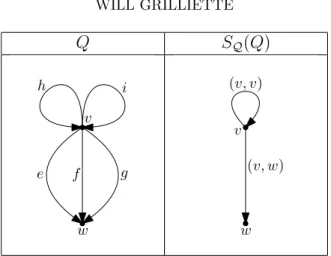
To reduce notation, letNQ :=ZQNQ1ComQ and SQ := SpQSQ1WQ. Figure1gives an
example to illustrate that SQ does indeed remove parallelisms in a quiver.
4.4. Set-System Hypergraphs & Set Systems. Let
P
: Set // Set be theco-variant power-set functor. The category H := (idSet↓
P
) is the category of set-systemhypergraphs from [D¨75, p. 153-154].
Let SH be the full subcategory of H of simple objects, and SH NH1 //
H be the inclusion functor. By Corollary 2.8, NH1 admits a left adjoint SH1 with the following
action on objects:
Q SQ(Q) v w f g h i v w v v) v w)
Figure 1: Simplification of a quiver where ran (G) ={G(e) :e ∈E(G)} and mG(A) =A.
Let SSys := Spa(
P
). An object G of SSys consists of a set V(G) and a family of subsets βG ⊆P
V(G), which is precisely a “set system” or “hypergraph” as defined in[HN79, p. 53]. A morphism G f //H ∈ SSys is a “hypergraph homomorphism” as defined in [HN79, p. 53]. Letting SSys
ComH
+
+SH
SpH
l
l be the functors defined in Definition 3.1, Theorem 3.3 gives an equivalence.
Setting all of the above categories and functors in line together yields the following progression from set systems as spaces to set-system hypergraphs as objects of a comma category. Moreover, the limit properties of SSys are inherited fromH.
SSys ComH ' ,,SH SpH l l NH1 > ++H SH1 l l
4.5. Theorem.The category SSys is complete and cocomplete with limits performed by
passing to H and then applying the simplification.
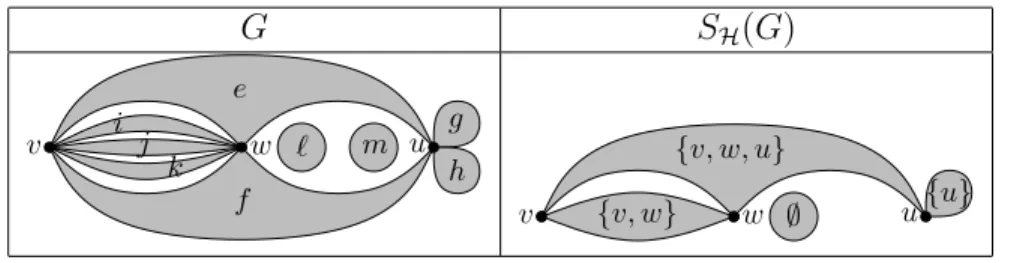
To reduce notation, let NH := NH1ComH and SH := SpHSH1. Figure 2 gives an
example to illustrate thatSHdoes indeed remove parallelisms in a set-system hypergraph.
4.6. Incidence Hypergraphs & Incidence Structures.Let D be the finite
cate-gory drawn below.
0oo y 2 z //1
This categoryR :=SetD is the category of incidence hypergraphs from [GRR20,GR19]. The category R1 := (idSet↓∆?) is isomorphic to R via the diagram below, for each
G SH(G) e f g h i j k m v w u v w u fv w ug fug fv wg
Figure 2: Simplification of a set-system hypergraph
G= ˇV(G),Eˇ(G), I(G), ςG, ωG . I(G) ςG u u ωG ) ) ∃!ιG ˇ V(G) π Vˇ(G)×Eˇ(G) ˇ V(G) o o πE(G)ˇ / /Eˇ(G)
4.7. Definition.For a sets X and Y, let X oo πX X×Y πY //Y ∈ Set be the
coordi-nate projections. For G φ //G0 ∈ R, define WR(G)
WR(φ) // WR(G0) ∈ R1 by • WR(G) := I(G), ιG, Vˇ(G),Eˇ(G) , where ιG(i) := (ςG(i), ωG(i)); • WR(φ) := I(φ), Vˇ(φ),Eˇ(φ) . For G φ //G0 ∈ R1, define ZR(G) ZR(φ) // ZR(G0) ∈ R by • ZR(G) := ˇV(G),Eˇ(G), I(G), πVˇ(G)◦ιG, πEˇ(G)◦ιG ; • ZR(φ) := ˇV(φ),Eˇ(φ), I(φ) .
Routine calculations show that WRZR=idR1 and ZRWR=idR.
Let SR1 be the full subcategory of R1 of simple objects, and SR1
NR1
/
/R1 be the
inclusion functor. By Corollary 2.8, NR1 admits a left adjoint SR1 with the following
action on objects: SR1 I(G), ιG, Vˇ(G),Eˇ(G) = ran (ιG), mιG, Vˇ(G),Eˇ(G) ,
where ran (ιG) ={ιG(i) :i∈I(G)} and mιG(v, e) = (v, e).
Let IStr := Spa(∆?), which is precisely the category of incidence structures and
incidence-preserving homomorphisms from [BL86, p. 7-8]. Letting IStr
ComR,,
SR1
SpR
l
l be
G SR(G) z x v w u e f g h i jj2 kk2 k3 m m2 n p p2 p3 q q2 z x v w u e f g h v e) v f) u e) u f) u h) w e) w f) u g)
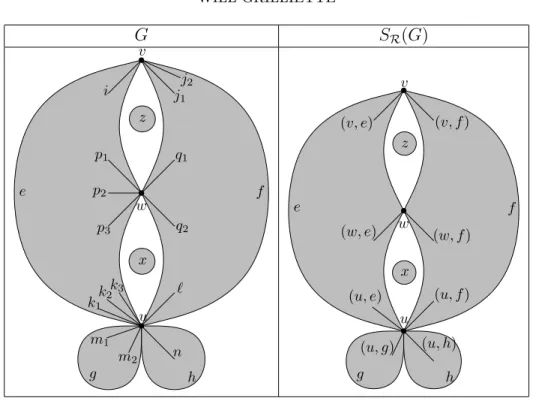
Figure 3: Simplification of an incidence hypergraph
Setting all of the above categories and functors in line together yields the following progression from incidence structures as spaces, to incidence hypergraphs as objects of a comma category, to incidence hypergraphs as objects of a functor category.
IStr ComR ' ,,SR1 SpR l l NR1 > ++R1 SR1 l l ZR ∼ = ++R WR k k
Therefore, the following result is an immediate consequence.
4.8. Theorem. The category IStr is equivalent to the reflective subcategory of simple
incidence hypergraphs within R. Moreover, IStr is complete and cocomplete with limits performed by passing to R and then applying the simplification.
To reduce notation, letNR :=ZRNR1ComRandSR := SpRSR1WR. Figure3gives an
example to illustrate thatSR does indeed remove parallelisms in an incidence hypergraph.
Please note that unlike SQ and SH, which remove parallel edges, SR removes parallel
incidences.
5. Simple Graphs & Symmetric Digraphs
Let Gra be the full subcategory of SSys consisting of all conventional graphs, and let
directly analogous to the deletion adjunction from [GR19, Definition 2.32] and can be directly replicated.
5.1. Definition.Given a set system H, define a graph
DelSSys(H) := V(H), βDelSSys(H)
, where βDelSSys(H) :={A∈βH : 1≤card(A)≤2}. Let DelSSys(H)
jH //
H ∈SSys be the canonical inclusion homomorphism from DelSSys(H) into H.
5.2. Theorem.If NSSys(G)
φ //
H ∈ SSys, there is a unique G φˆ //DelSSys(H) ∈ Gra such that jH ◦NSSys
ˆ
φ=φ. Thus, Gra is a coreflective subcategory of SSys.
Equivalently, one could repeat the work of Section 4 to show that Gra is equivalent to the reflective subcategory of simple objects in the category M of multigraphs. The details of this argument are omitted for brevity.
On the other hand, [Hel79, p. 123] states that a simple graph can be viewed as a digraph
G, where (v, w)∈ αG if and only if (w, v) ∈αG, i.e. when αG is a symmetric relation on
~
V(G). Under this definition, simple graphs would be regarded as a subcategory ofDigra. The relationship is directly analogous to the associated digraph adjunction from [GR19, Definitions 2.35 & 2.36]. Let SymDigra be the full subcategory of Digra consisting of all symmetric digraphs, and let SymDigra NDigra //Digra be the inclusion functor.
5.3. Definition. Given a digraph G, define NDigra (G) :=
~ V(G), αNDigra (G) , where αN Digra(G) :={(v, w) : (v, w)∈αG or (w, v)∈αG}. Let
G κG//NDigraNDigra (G) ∈Digra
be the canonical inclusion homomorphism of G into NDigra (G).
5.4. Theorem.If G φ //NDigra(H) ∈Digra, there is a unique NDigra (G)
ˆ
φ //
H ∈
SymDigra such that NDigra
ˆ
φ◦κG =φ. Thus, SymDigra is a reflective subcategory
of Digra.
However,NDigraalso admits a right adjoint by swapping the connective “or” to “and”.
As the symmetric closure is the smallest symmetric digraph containing a given digraph, this “symmetric interior” is the largest symmetric subdigraph within the given digraph. The universal property is routine to check.
5.5. Definition. Given a digraph G, define NDigra? (G) :=
~ V(G), αN? Digra(G) , where αN?
Digra(G) := {(v, w) : (v, w)∈αG and (w, v)∈αG}. Let NDigraN
?
Digra(G)
νG//
G ∈
5.6. Theorem.If NDigra(G)
φ //
H ∈Digra, there is a unique G φ˜ //NDigra? (H) ∈
SymDigrasuch thatνG◦NDigra
˜
φ=φ. Thus,SymDigra is a coreflective subcategory of Digra.
To reconcile the viewpoints of unordered pairs and symmetric relations, one defines the “corresponding symmetric digraph” of an undirected graph by following [Hel79, p. 123], associating (v, w) and (w, v) to {v, w}. This construction yields a functor, which is an isomorphism between SymDigra and Gra.
5.7. Definition.For G φ //G0 ∈SymDigra, define
WGra(G) WGra(φ) // WGra(G0) ∈Gra by • WGra(G) := ~ V(G), βWGra(G) , where βWGra(G) :={{v, w}: (v, w)∈αG}; • WGra(φ) :=φ.
For G φ //G0 ∈Gra, define ZGra(G)
ZGra(φ) // ZGra(G0) ∈SymDigra by • ZGra(G) := V(G), αZGra(G) , where αZGra(G)={(v, w) :{v, w} ∈βG}; • ZGra(φ) :=φ.
Routine calculations show that ZGraWGra=idSymDigra and WGraZGra=idGra.
Consequently, the conventional category of simple graphs exists as a coreflective sub-category of SSys, but also as a reflective and coreflective subcategory of Digra. There-fore, both digraphs and set systems can be considered natural extensions of classical graph theory, as can general quivers and set-system hypergraphs. Interestingly, one can quickly show that NSSys does not preserve products, so it cannot admit a left adjoint. The
ex-istence of both right and left adjoints to NDigra seems to indicate that simple graphs
are more closely related to digraphs than to set systems, despite the natural definitional relationship betweenGra and SSys.
The diagram in Figure 4 seats these categories and functors together with those dis-cussed in [GR19], giving a visual representation of these relationships.
6. Cosimple Objects & Cosimplification
All of the definitions and results of Section 2 can be dualized, giving rise to “cosimple” objects and a “cosimplification” operation.
Q U -SQ M N , , ~ D ⊥ m m H Del ⊥ l l SH Digra NQ ` K K N Digra ` N? Digra ` , , SSys NH ` J J DelSSys v v SymDigra NDigra f f WGra --Gra NSSys a 7 7 ZGra ∼ = n n
Figure 4: Functorial diagram for Digra, SSys, & Gra
6.1. Definition.An object(A, f, B)∈ob(G)is cosimple iff is epic in C. LetT G be the
full subcategory of G consisting of cosimple objects, and let T G J //G be the inclusion functor. A routine check shows that T G is a replete subcategory of G.
6.2. Definition.Assume that B is coregular, and that G admits a left adjoint G with
unit idC δ //GG . For (A, f, B) ∈ ob(G), there is a unique GF(A)
˜ f // B ∈ B such that G ˜ f ◦δF(A) = f. Let GF(A) ef˜//// coran ˜ f / /mf˜ // B ∈ B be a coimage factorization of f˜. Define T(A, f, B) :=A, G ef˜ ◦δF(A),coran ˜ f and ϑ(A,f,B):= idA, mf˜ . F(A) F(idA) // δF(A) F(A) F(idA) // δF(A) F(A) f GGF(A) G(ef˜) G(f˜) ( ( GGF(A) G(ef˜) / /G coranf˜ G(mf˜) / /G(B)
6.3. Theorem. Let B be coregular, and assume that G is faithful and admits a left
adjoint with unit idC δ //GG . If J(A, f, B)
(φ,ψ) // (A0, f0, B0) ∈ G, there is a unique (A, f, B) ( ˜ φ,ψ˜) / /T (A0, f0, B0) ∈ G such that ϑ (A,f,B)◦ ˜ φ,ψ˜= (φ, ψ).
6.4. Corollary. Let B be coregular, and assume that G is faithful, preserves
epimor-phisms, and admits a left adjoint with an epic unit idC δ //GG. If
J(A, f, B) (φ,ψ) //(A0, f0, B0) ∈ G, there is a unique (A, f, B) ( ˜ φ,ψ˜) / /T (A0, f0, B0) ∈ T G such that ϑ (A,f,B)◦N ˜ φ,ψ˜= (φ, ψ). Consequently, T G is a coreflective subcategory of G.
As the proofs are merely the categorical duals of those found in Section 2, the details will be omitted in favor of examples. Note thatSetis coregular, that the diagonal functor ∆ admits both a left adjoint ∆ and a right adjoint ∆?, and all three are faithful. Thus,
the operator T can be constructed for both Q1 and R1. Unfortunately, the unit of each
adjunction is not epic, so T does not yield a cosimple object in either category.
6.5. Example.A cosimple object in Q1 would be a quiver, where there is directed edge
for every ordered pair of vertices, i.e. a loaded quiver. Therefore, with the exception of the initial object, a quiver is cosimple in Q1 if and only if it is injective with respect to
monomorphisms [Gri12, Proposition 3.2.1]. The functor ∆?∆ admits a left adjoint ∆∆ with unit δX : X //∆?∆∆∆(X) by δX(x) := ((0, x),(1, x)), which is not epic. For
Q∈ob (Q1), the output ofTQ1 is • V T~ Q 1(Q) = n σQ(e) :e∈E~(Q) o ∪nτQ(e) :e∈E~(Q) o , • ET~ Q 1(Q) = E~(Q), • ~TQ1(e) =~Q(e).
As seen in Figure 5, TQ1 has removed all isolated vertices from the quiver. Moreover,
TQ1(Q) is not injective, so it is not cosimple in Q1.
6.6. Example.A cosimple object inR1 would be an incidence hypergraph, where there
is an incidence for every vertex-edge pair. Therefore, with the exception of the initial object, an incidence hypergraph is cosimple inR1 if and only if it is injective with respect
to monomorphisms [GR19, Proposition 2.3.2]. The functor ∆? admits a left adjoint ∆ with unit δX :X //∆?∆(X) by δX(x) := (x, x), which is not epic. For G∈ ob(R), the
output of TR1 is • V Tˇ R 1(G) ={ςG(i) :i∈I(G)}, • ETˇ R1(G) ={ωG(i) :i∈I(G)}, • ITR1(G) =I(G), • ιTR1(i) =ιG(i).
As seen in Figure 6, TR1 has removed all isolated vertices and loose edges from the
Q TQ1(Q) v w u x y z f v u y f Figure 5: Action of TQ1 G TR1(G) v w u x e f g h i j k v u x e f i j k Figure 6: Action of TR1
7. Set-System Hypergraphs with Antihomomorphisms
Moreover, all of the definitions and results of Section 3 can be dualized, giving rise to the functor-costructured categories of [Sol13, Definition 21]. As the proofs are merely the categorical duals of those found in Section 3, the details will be omitted in favor an illustrative example.
Let
Q
:Set //Setopbe the contravariant power-set functor. DefineP := (Q
↓idSetop)with domain functor ˆV :P //Set and codomain functor ˆE :P //Setop. An object G
of P consists of two sets, ˆE(G) and ˆV(G), and a function
Q
Vˆ(G)oo G Eˆ(G) . Hence, Gis a set-system hypergraph as in H.
However, the morphisms of P are quite different from those in H. A homomor-phism G ϕ //G0 ∈ P consists of two functions, ˆV(ϕ) : ˆV(G) //Vˆ (G0) and ˆE(ϕ) :
ˆ E(G0) //Eˆ(G), such that G◦Eˆ(ϕ) =
Q
Vˆ(ϕ)◦G0.Q
VˆOO(G) G o o QVˆ(ϕ)Q
VˆOO(G0) G0 ˆ E(G)oo ˆ E(ϕ) ˆ E(G0)Indeed, ˆE(ϕ) maps edges of G0 to edges of G, rather than the reverse inH. A morphism of P will be termed an antihomomorphism of set-system hypergraphs for reasons that will be illuminated shortly.
Let T P be the full subcategory of P of cosimple objects, and T P JP1 //
P be the inclusion functor. By Corollary 6.4, JP1 admits a right adjoint TP1 with the following
action on objects: TP1 ˆ V(G), G,Eˆ(G) =Vˆ(G), eG,coran (G) , where coran (G) = n G(f) :f ∈Eˆ(G) o
and eG(A) = A. Thus, cosimplification in P
removes parallelisms, like simplification in H.
Let Anti := Cospa(
Q
). An object G of Anti consists of a set ˆV(G) and a family of subsets βG ⊆Q
Vˆ(G), a set system. A morphism Gf //
G0 ∈ Anti is a function f : ˆ
V(G) //Vˆ(G0) such thatf−1(A)∈β
G for allA∈βG0, which is an “antihomomorphism”
of set systems as defined in [HN79, p. 60]. As such, the categoryTopof topological spaces and the category Meas of measurable spaces are both replete subcategories of Anti.
Letting Anti
CoCom++ P
T P
CoSpP
l
l be the functors defined in the dual of Definition 3.1, the dual of Theorem 3.3 gives an equivalence. If JTop and JMeas are the inclusion functors of TopandMeas intoAnti, respectively, each admits a right adjoint given by generating a topology orσ-algebra from the set system [Fol99, Propositions 2.1 & 4.9]. Let Γ and Σ be
the functors from Anti to Top and Meas, respectively, which generate the appropriate structure. Setting all of the above functors and categories in line together yields the following progression from topological and measurable spaces, to set systems as spaces, to set-system hypergraphs with antihomomorphisms.
Top JTop $ $ Anti CoComP ' ,, Σ ⊥ s s Γ ⊥ d d T P CoSpP l l JP1 ⊥ ++P TP1 l l Meas JMeas 33
References
[AK80] J. Ad´amek and V. Koubek. Cartesian closed functor-structured categories.
Comment. Math. Univ. Carolin., 21(3):573–590, 1980.
[BL86] Richard T. Bumby and Dana May Latch. Categorical constructions in graph theory. Internat. J. Math. Math. Sci., 9(1):1–16, 1986.
[BM08] J. A. Bondy and U. S. R. Murty. Graph theory, volume 244 ofGraduate Texts in Mathematics. Springer, New York, 2008.
[BMSW08] R. Brown, I. Morris, J. Shrimpton, and C. D. Wensley. Graphs of morphisms of graphs. Electron. J. Combin., 15(1):Article 1, 28, 2008.
[D¨75] Willibald D¨orfler. Set-systems and their automorphisms. In Recent advances in graph theory (Proc. Second Czechoslovak Sympos., Prague, 1974), pages 153–166, 1975.
[Fol99] Gerald B. Folland. Real analysis. Pure and Applied Mathematics (New York). John Wiley & Sons, Inc., New York, second edition, 1999. Modern techniques and their applications, A Wiley-Interscience Publication.
[GR19] Will Grilliette and Lucas J. Rusnak. Incidence hypergraphs: The categorical inconsistency of set-systems and a characterization of quiver exponentials, 2019.
[Gri12] Will Grilliette. Injective envelopes and projective covers of quivers. Electron. J. Combin., 19(2):Paper 39, 15, 2012.
[GRR20] Will Grilliette, Josephine Reynes, and Lucas J. Rusnak. Incidence hyper-graphs: Injectivity, uniformity, and matrix-tree theorems, 2020.
[Hel79] Pavol Hell. An introduction to the category of graphs. In Topics in graph theory (New York, 1977), volume 328 of Ann. New York Acad. Sci., pages 120–136. New York Acad. Sci., New York, 1979.
[HN79] Pavol Hell and Jaroslav Neˇsetˇril. Cohomomorphisms of graphs and hyper-graphs. Math. Nachr., 87:53–61, 1979.
[JK93] Jerzy Jaworski and Micha lKaro´nski. On the connectivity of graphs generated by a sum of random mappings. J. Graph Theory, 17(2):135–150, 1993. [Kat63] Miroslav Katˇetov. Allgemeine Stetigkeitsstrukturen. In Proc. Internat.
Congr. Mathematicians (Stockholm, 1962), pages 473–479. Inst. Mittag-Leffler, Djursholm, 1963.
[Kna11] Ulrich Knauer. Algebraic graph theory, volume 41 of De Gruyter Studies in Mathematics. Walter de Gruyter & Co., Berlin, 2011. Morphisms, monoids and matrices.
[KP72] L. Kuˇcera and A. Pultr. On a mechanism of defining morphisms in concrete categories. Cahiers Topologie G´eom. Diff´erentielle, 13:397–410, 443, 1972. [Kun98] Joseph P. S. Kung. A geometric condition for a hyperplane arrangement to
be free. Adv. Math., 135(2):303–329, 1998.
[Rut00] J. J. M. M. Rutten. Universal coalgebra: a theory of systems. volume 249, pages 3–80. 2000. Modern algebra and its applications (Nashville, TN, 1996). [Sol13] Sergey A. Solovyov. Categorically algebraic topology versus universal
topol-ogy. Fuzzy Sets and Systems, 227:25–45, 2013.
[Wil89] Steve Wilson. Cantankerous maps and rotary embeddings ofKn. J. Combin.
Theory Ser. B, 47(3):262–273, 1989.
Department of Mathematics Texas State University San Marcos, TX