Analysis of Security Code Review Effectiveness
Anne Edmundson
Cornell University
Brian Holtkamp
University of Houston-Downtown
Emanuel Rivera
Polytechnic University of Puerto Rico
Adrian Mettler
University of California, Berkeley
David Wagner
University of California, Berkeley
Abstract
With the rapidly increasing number of web applications, developers should be concerned with web security vul-nerabilities. It is essential in the development process to detect and correct these vulnerabilities before they are re-leased to the public. This research aims to quantify the effectiveness of software developers at security code re-views as well as determine the variation in effectiveness among web developers. We hired 30 developers to con-duct a manual code review of a small web application. The web application supplied to developers had 6 known vulnerabilities, including three different types: Cross-Site Scripting, Cross-Cross-Site Request Forgery, and SQL In-jection. Our preliminary findings are: 1) none of the sub-jects found all confirmed vulnerabilities, 2) more experi-ence does not necessarily mean that the review will be more accurate or effective, 3) self-reported understand-ing of the codebase is not indicative of how well the sub-jects could find the vulnerabilities, and 4) certain vulner-abilities went unnoticed by all reviewers.
1
Introduction
With the wide spread adoption and reliance on the inter-net, more people are using web applications for everyday life. With such a large user base, web applications have become a prime target for malicious users with the intent to steal information or damage the application. Unfor-tunately, it is fairly common for these applications to be susceptible to attacks. These vulnerabilities may arise due to poor programming practice or lack of knowledge about web security. The result is web applications that are susceptible to attack.
In this study we focus on the manual code review of web applications for security. We hire web developers with varying amounts of security experience to conduct a security code review of a simple web application. In this preliminary study, we collect data from ten web
velopers hired through an out-sourcing website. The de-velopers are asked to perform a line-by-line code review of the application and submit a report of all security vul-nerabilities found. Our main contributions are:
• We quantify the effectiveness of developers at secu-rity code review.
• The results of our analysis could be used to calcu-late the optimal number of independent reviewers to hire to achieve a desired level of confidence.
• We measure the extent to which developer demo-graphic information can be used to predict effective-ness at security code review.
These results may help hiring managers and develop-ers in determining how best to allocate resources when securing their web applications.
2
Goals
In this work, we conduct an exploratory analysis of software developers effectiveness in conducting security code review. We have three focus areas: the degree of variation among software developers, if and how we can predict the effectiveness of different software developers based on their demographics, and the optimal number of reviewers.
2.1
Effectiveness
Our research will measure how well developers conduct security code review. The following is one question that will be addressed by this research.
• How effective are developers at security code re-view?
2.2
Variation in Effectiveness
This study will quantify how developers vary in effec-tiveness; we want to answer the following questions re-garding differences in developers’ effectiveness.
• Are some developers significantly more effective than others?
• Is there significant variation in code review effec-tiveness between developers?
• How much variation is there between developers?
2.3
Optimal Number of Reviewers
Depending on the answers to the questions posed in Sec-tion 2.1, we want to determine the best number of review-ers to hire. Intuitively, if more developreview-ers are hired, then a larger percentage of vulnerabilities will be found, but we want to determine the point at which an additional re-viewer yields insignificant results. This would be useful for determining the best allocation of resources (money) in the development of a web application. Specifically, we will address the following questions to find the optimal number of reviewers.
• What is the degree of overlap between vulnerabili-ties found by multiple code reviewers?
• Will multiple independent code reviewers be signif-icantly more effective than a single reviewer?
• If multiple independent code reviewers are signif-icantly more effective than a single reviewer, how much more effective?
2.4
Predicting Effectiveness
We also want to discover what affects developers effec-tiveness. In particular, we study whether there is any re-lationship between effectiveness and any of the factors in{application comprehension, self-assessed confidence in the review, education level, experience with code re-views, certifications, experience in software/web devel-opment, experience in security, confidence as a soft-ware/web developer, confidence as a computer/web se-curity expert, most familiar programming languages}. Finding a relationship could lead to predicting which de-velopers will be most effective at security code review.
Knowing if there is a significant difference between hiring developer X and hiring developer Y to conduct a security code review would be helpful to any engineer or manager creating a web application. This information may provide some insight into what criteria or factors to consider when hiring a security code reviewer.
3
Experimental Methodology
To assess developer effectiveness at security code re-view, we first identified our application with a number of security vulnerabilities. Then, we hired 30 develop-ers through an outsourcing site and asked them to per-form a manual line-by-line security review of the code. After developers computed their review, we asked them to tell us about their experience, qualifications, and an-swer other questions. We then counted how many of the known vulnerabilities they found.
3.1
Anchor CMS
We had reviewers review an existing web application, Anchor CMS. Anchor CMS is a small content man-agement system. It is an open-source web application, is written in PHP and JavaScript, and uses a MySQL database. There are currently four release versions of Anchor. We chose not to use the latest version. Instead, we had reviewers review the third release, version 0.6. This version had more vulnerabilities while still having comparable functionality to the latest version.
To prepare and anonymize the code for review, we modified the Anchor CMS source code in two ways. First, we removed the Anchor name and all branding. To generate a generic CMS that wouldn’t be searchable online, we renamed it TestCMS. We did not want de-velopers to view Anchor CMS’s bug tracker or any pub-licly reported vulnerabilities; we wanted to ensure they reviewed the code from scratch with no preconceptions. Our anonymization included removal of the title “An-chor,” all relevant images and logos, and all instances of Anchor in variable names or comments.
Once the code was anonymized, we modified the code in two ways to increase the number of vulnerabilities in it. First, we took one vulnerability from Anchor version 0.5 and forward-ported it into our code. After this modi-fications, the web application had 3 Cross-Site Scripting vulnerabilities and no Cross-Site Request Forgery pro-tection throughout the application.
Second, we carefully introduced two SQL injection vulnerabilities. To ensure these were representative of real SQL injection vulnerabilities naturally seen in the wild, we found similarly structured CMS applications on security listing websites (SecList.org), analyzed them, identified two SQL injection vulnerabilities in them, adapted the vulnerable code for Anchor, and introduced these vulnerabilites into TestCMS. The result is a web application with 6 known vulnerabilities. Our proce-dures ensure that these vulnerabilities should be reason-ably representative of the issues present in other web ap-plications.
person who is not a registered user of the web applica-tion. Additionally, these vulnerabilities are solely from the PHP source code in the application; for this reason, we do consider problems such as Denial of Service at-tacks or insecure password choice to be in the scope of this project. While these were not included in the list of 6 known vulnerabilities, we did not classify them as in-correct vulnerabilities; they were placed in their own cat-egory. We recorded an incorrect vulnerability as a case where a developer reported a specific vulnerability at a certain location, when in fact there was not a vulnera-bility at the specified location. Lastly, vulnerabilities in the administrative interface were not considered for this study.
3.2
oDesk
oDesk is an outsourcing site that can be used to hire free-lancers to perform many tasks, including web program-ming, development, and quality assurance. We chose oDesk because it is one of the most popular such sites, and because it gave us the most control over our hiring process; oDesk allows users to post jobs (with any spec-ifications, payments, and requirements), send messages to users, interview candidates, and hire multiple people for the same job. We used oDesk to publicize our study, hire developers that met our requirements, and pay our subjects for their work.
3.3
Subject Population and Selection
We recruited subjects for our experiment by posting our job on oDesk. We specified that respondents needed to be experienced in the PHP scripting language in order to comprehend and work with our codebase. Addition-ally, they should have basic web security knowledge. We screened all applicants by asking them about how many times they have previously conducted a code review, a security code review, a code review of a web application, and a security code review of a web application. We also asked four multiple-choice quiz questions to test their knowledge of PHP and security. Each question showed a short snippet of code and asked whether the code was vulnerable, and if so, what kind of vulnerability it had. We accepted all respondents who scored 25% or higher on the screening test.
3.4
Task
We gave participants directions on how to proceed with the code review, an example vulnerability entry, and the TestCMS codebase. The instructions specified that no automated code review tools should be used. Also, the developers were told to spend 12 hours on this task; this
number was calculated based upon a baseline of 250 lines of code per hour [17]. We designed a template that par-ticipants were instructed to use to report each vulnera-bility. The template has the following sections for the developer to fill in accordingly:
1. Vulnerability Type 2. Vulnerability Location 3. Vulnerability Description 4. Impact
5. Steps to Exploit
The type and location would give us basic information about the vulnerability. The template included Vulner-ability Description and Impact sections in order to deter developers from using automated tools; it would be more challenging to successfully fill out these sections if a tool was used as opposed to a manual review. The last sec-tion, Steps to Exploit the vulnerability, would help make sure developers do not report only exploitable vulnera-bilities as opposed to any possible security errors in the code.
The developers were asked to review only a subset of the code given to them. In particular, we had them review everything but the adminstrative interface and the client-side code. They reviewed 3500 lines of code in total. We specified our interest only in exploitable vulnerabilities.
3.5
Data Analysis Approach
Before the study, we scoured public vulnerability databases, Anchor’s bug tracker, and other sources to identify all known vulnerabilities in TestCMS. This gives us ground truth that we use to evaluate responses from the participants. We analyze each participant’s report and evaluate the accuracy and correctness of all bugs they re-ported. No participant found any valid, exploitable vul-nerability that was missing from our ground truth. The results of this analysis enable us to assess if the popu-lation could properly review the code and find security vulnerabilities.
3.6
Threats to Validity
oDesk Population. As stated previously, we hired de-velopers through the oDesk outsourcing website. This limited our population to registered oDesk users, instead of the desired population of all web developers. Using oDesk may have biased our results if the population on oDesk is not representative of the population of web de-velopers. On the contrary, oDesk does provide a service that is used when hiring freelancers in the web develop-ment community; therefore, we assume it is reasonable
to believe a web developer hired on an outsourcing site is comparable to a web developer hired through other meth-ods.
Artificial Vulnerabilities. The original source code of Anchor version 0.6 had only three vulnerabilities, two XSS and one CSRF. As mentioned in Section 3.2, we introduced two SQL Injection vulnerabilities. Adding these artificial vulnerabilities creates a flawed codebase where the developer didn’t make a flaw. These artificial vulnerabilities can bias the results since it may make the code review easier or harder than reviewing the origi-nal application. The changes made to the codebase were modeled after vulnerabilities found in other CMSs. This minimizes the artificiality of the codebase by ensuring that web developers have naturally made this mistake be-fore.
Security Experts vs Web Developers. We hired 30 reviewers for this study, where some were specialized in security while others were purely web developers. De-spite the use of a screening test, it is possible that web developers guess correctly or that the questions used vul-nerabilities that were significantly easier to detect than those in an application. In this case, web developers would be at a disadvantage. Security experts have a bet-ter understanding of the attacks, how they work and how attackers can use them. On the other hand a web devel-oper may have some understanding of how the attacks work, but they may not be as prepared as security ex-perts. This could bias our results when measuring vari-ability; on the contrary, this is a realistic scenario when hiring someone to conduct a security code review.
Difficulties of Anchor Code and Time Frame. The design of Anchor’s source code proves to be challeng-ing to understand. It is neither documented well nor is it structured well. With the 12 hours that the reviewers had, results might not be the same as if the code was de-signed in a different way. The developers may not find all the vulnerabilities or they may give us many false-positives. It has to be assumed that each reviewer ded-icated the amount of time indded-icated and that this was a sufficient amount of time to analyze the code.
4
Results
With our population of 30 subjects, we were able to de-termine the relative effectiveness of their review by tak-ing the ratio of reported vulnerabilities with our con-firmed vulnerabilities. With this we were able to quantify their reports and compare it to demographics in question and provide us with a convenient score for how well the report covered our codebase’s vulnerabilities.
4.1
Effectiveness
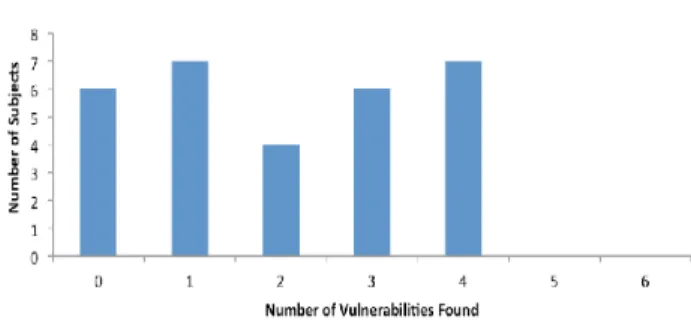
Our initial findings provided us with the opportunity to find how many vulnerabilities were found and what specific vulnerabilities were found most and least com-monly. One out of the three Cross-Site Scripting vulner-abilities were found by the majority of subjects, while fewer subjects found the the lack of Cross-Site Request Forgery protection. Table 1 shows the fractions of developers that reported the corresponding vulnerabili-ties. The average number of correct vulnerabilities found were 1.497 with a standard deviation of 2.033.
Cross-Site Scripting 1 .40 Cross-Site Scripting 2 .70 Cross-Site Scripting 3 .20
SQL Injection 1 .37
SQL Injection 2 .20
Cross-Site Request Forgery .17
Table 1: The fraction of developers that reported the cor-responding vulnerability.
Figure 1: The number of vulnerabilities found by indi-vidual developers. Note that none found all six vulnera-bilities.
While the average number of correct vulnerabilities found is relatively low, this is not indicative of the to-tal number of vulnerabilities reported by each developer. The average number of reported vulnerabilities is 10.822 with a standard deviation of 8.7. Figure 2 shows the fractions of vulnerabilites reported that were correct.
4.2
Optimal Number of Reviewers
In order to determine the optimal number of reviewers, we simulated hiring various numbers of reviewers. For a single trial, if the combination of hired developers re-ports all vulnerabilities, then this trial is assigned a value of 1.0. If the combination of hired developers does not
Figure 2: The fraction of reported vulnerabilities that were correct.
report all vulnerabilities, then this trial is assigned a value of 0.0. We conducted 1000 trials and take the average of all trials; this yields the probability of finding all vul-nerabilities with a certain number of reviewers. Figure 3 shows the trend of finding all vulnerabilities based on the number of developers hired.
Figure 3: A graph showing the probability of finding all vulnerabilities depending on the number of developers hired.
4.3
Demographic Relationships
Figures 4 - 6 show the relationships between the number of correct vulnerabilities reported and developer experi-ence with software development, web development, and computer security, respectively.
4.4
Limitations of Statistical Analysis
A major limitation of our statistical data is that the ex-periment was performed with only 30 subjects. A small sample, such as this, may not be representative of an en-tire population.
Figure 4: A scatterplot of the relationship between ef-fectiveness and years of experience in software develop-ment.
Figure 5: A scatterplot of the relationship between effec-tiveness and years of experience in web development.
Figure 6: The relationship between effectiveness and years of experience in computer security.
5
Related Work
While there has been no previous research studying the effectiveness of developers at security code review, there have been many studies regarding the evaluation and ef-fectiveness of code inspections. Our discussion of related work falls into three categories: code review effective-ness, methods of detecting web security vulnerabilities, and a comparison of manual code reviews to static anal-ysis tools.
Code Review Effectiveness. One of the largest drawbacks to conducting code inspections is the time-consuming and cumbersome nature of the task, there-fore there have been many studies investigating general code inspection performance and effectiveness [5, 4, 16]. Les Hatton conducted two different experiments; the first found a relationship between the total number of defects in a piece of code and then number of defects found in common by teams of inspectors [14]. The authors gave the inspectors a program written in C with 62 lines of code; the inspectors were told to find any parts of the code that would cause the program to fail. From this re-search, the authors were able to predict the total number of defects. While this differs from our study, future work that applies Hatton’s experiment to code reviews for se-curity vulnerabilities would be useful. Hatton’s second experiment found that checklists had no significant ef-fect on the efficiency of a code inspection [7]. Simi-larly, an interesting experiment would test this relation-ship on code inspections solely for security vulnerabili-ties. Other studies have discovered if there are relation-ships between specific factors, such as review rate or the presence of maintainability defects, and the performance of code inspections [1, 6]. These experiments were car-ried out on software and the inspectors were not limited to security vulnerabilities; our work includes a more spe-cific task as well as different set of code.
Detection of Web Security Vulnerabilities. Most current techniques for detecting web security vulnera-bilities are automated tools for static analysis. Despite this, there has been work that has compared different tools due to their differences. One study showed that black-box web application vulnerability scanners do not perform well when detecting advanced and second-order forms of Cross-Site Scripting and SQL Injection [3]. While it is more time-consuming, this may be reme-died by manual code inspection. Additionally, there have been many publications evaluating and proposing new automated tools for detecting web security vulnerabili-ties [18, 13, 12, 10, 8, 11]. Our work focuses less on detecting all of the web security vulnerabilities in a web application and more on how effectively code reviewers can detect vulnerabilities, the variation, and what factors affect this.
Manual Code Review vs. Static Analysis Tools.
While ongoing research studies are advancing code in-spection efficiency and static analysis tool accuracy, some studies are comparing the different techniques. Ca-pers Jones showed that no single method from {formal design inspection, formal code inspection, formal quality assurance, formal testing}was efficient in detecting and removing defects; the combination of all four methods yielded the highest efficiency. When only one method was used, the highest efficiency for removing defects was due to formal design inspection followed by formal code inspection [9]. Another study compared the effec-tiveness of other methods of code review: code reading by stepwise abstraction, functional testing, and structural testing. They found that when the experiment was per-formed with professional programmers, code reading de-tected more faults than either functional or structural test-ing; this was applied to software written in a high-level language, but not a web application [2]. When we con-ducted our experiment we did not specify how the de-velopers should review the code as long as they did not use any automated tools. More recent research has in-vestigated this comparison in the context of web applica-tion; they also limited their scope to security vulnerabil-ities. While manual source code review was found to be more effective than automated box testing, black-box testing discovered vulnerabilities not found through the manual source code review [15].
6
Conclusion
We hired 30 subjects to perform a security code review of a web application that has been confirmed to have se-curity vulnerabilities. The subjects analyzed the code and completed a report based off of a vulnerability re-port template provided to them. This ensured their un-derstanding on how to recreate the exploit and proof of where it is found in the code. A post-completion sur-vey offers us data about their personal experience in web programming and security and their self-efficacy of the report they submitted.
Our results revealed that years experience offered little in the way of determining how well a subject was able to complete the code review and that their own opinion of how well they performed showed no correlation of how effective their report was.
In future work, we plan to expand the experiment to more subjects allowing for a bigger sample to further re-fine our statistics and provide more data to increase con-fidence in our results.
7
Acknowledgments
This work was supported in part by TRUST (Team for Research in Ubiquitous Secure Technology), which re-ceives support from the National Science Foundation (NSF award number CCF-0424422). Special thanks to Aimee Tabor and the TRUST program staff.
References
[1] ALBAYRAK, ¨OZLEM AND DAVENPORT, DAVID. Impact of maintainability defects on code inspections. In Proceedings of the 2010 ACM-IEEE International Symposium on Empiri-cal Software Engineering and Measurement(2010), ESEM ’10, pp. 50:1–50:4.
[2] BASILI, V.,ANDSELBY, R. Comparing the effectiveness of soft-ware testing strategies.Software Engineering, IEEE Transactions on SE-13, 12 (dec. 1987), 1278 – 1296.
[3] BAU, J., BURSZTEIN, E., GUPTA, D.,ANDMITCHELL, J. State of the art: Automated black-box web application vulnerability testing. InSecurity and Privacy (SP), 2010 IEEE Symposium on
(may 2010), pp. 332 –345.
[4] BIFFL, S. Analysis of the impact of reading technique and in-spector capability on individual inspection performance. In Soft-ware Engineering Conference, 2000. APSEC 2000. Proceedings. Seventh Asia-Pacific(2000), pp. 136 –145.
[5] FAGAN, M. E. Design and code inspections to reduce errors in program development. IBM Systems Journal 15, 3 (1976), 182 –211.
[6] FERREIRA, A.L.ANDMACHADO, R.J.ANDCOSTA, L.AND
SILVA, J.G.ANDBATISTA, R.F.ANDPAULK, M.C. An ap-proach to improving software inspections performance. In Soft-ware Maintenance (ICSM), 2010 IEEE International Conference on(sept. 2010), pp. 1 –8.
[7] HATTON, L. Testing the Value of Checklists in Code Inspections.
Software, IEEE 25, 4 (july-aug. 2008), 82 –88.
[8] HUANG, Y.-W., YU, F., HANG, C., TSAI, C.-H., LEE, D.-T.,ANDKUO, S.-Y. Securing web application code by static analysis and runtime protection. InProceedings of the 13th in-ternational conference on World Wide Web(2004), WWW ’04, pp. 40–52.
[9] JONES, C. Software defect-removal efficiency. Computer 29, 4 (apr 1996), 94 –95.
[10] JOVANOVIC, N., KRUEGEL, C.,ANDKIRDA, E. Pixy: a static analysis tool for detecting web application vulnerabilities. In Se-curity and Privacy, 2006 IEEE Symposium on(may 2006), pp. 6 pp. –263.
[11] KALS, S., KIRDA, E., KRUEGEL, C.,ANDJOVANOVIC, N. Se-cubat: a web vulnerability scanner. InProceedings of the 15th international conference on World Wide Web(2006), WWW ’06, pp. 247–256.
[12] KIEYZUN, A., GUO, P., JAYARAMAN, K.,ANDERNST, M. Au-tomatic creation of sql injection and cross-site scripting attacks. InSoftware Engineering, 2009. ICSE 2009. IEEE 31st Interna-tional Conference on(may 2009), pp. 199 –209.
[13] LAM, M. S., MARTIN, M., LIVSHITS, B.,ANDWHALEY, J. Securing web applications with static and dynamic information flow tracking. InProceedings of the 2008 ACM SIGPLAN sym-posium on Partial evaluation and semantics-based program ma-nipulation(2008), PEPM ’08, pp. 3–12.
[14] LES HATTON. Predicting the total number of faults using parallel code inspections. http://www.leshatton.org/ wp-content/uploads/2012/01/Inspect2005.pdf, May 2005.
[15] MATTHEWFINIFTER ANDDAVIDWAGNER. Exploring the Re-lationship Between Web Application Development Tools and Se-curity. InProceedings of the 2nd USENIX Conference on Web Application Development(June 2011), USENIX.
[16] MCCARTHY, P., PORTER, A., SIY, H.,ANDVOTTA, L.G., J. An experiment to assess cost-benefits of inspection meetings and their alternatives: a pilot study. InSoftware Metrics Symposium, 1996., Proceedings of the 3rd International(mar 1996), pp. 100 –111.
[17] OWASP FOUNDATION. Code Review Metrics.https://www. owasp.org/index.php/Code_Review_Metrics, 2010. [18] WASSERMANN, G.,ANDSU, Z. Sound and precise analysis of
web applications for injection vulnerabilities. InPLDI ’07 Pro-ceedings of the 2007 ACM SIGPLAN conference on Program-ming language design and implementation(June 2007), vol. 42, pp. 32–41.