Representatives
For Release on DeliveryExpected at 10:30 a.m. EDT
Tuesday, March 24, 2009
PRIVATE PENSIONS
Conflicts of Interest Can
Affect Defined Benefit and
Defined Contribution Plans
Statement of Charles A. Jeszeck, Acting Director
Education, Workforce, and Income Security
What GAO Found
Why GAO Did This Study
Education and Labor Committee, House of Representatives
Conflicts of interest typically exist when someone in a position of trust, such as a pension
consultant, has competing professional or personal issues. Such competing interests can make it difficult for pension plan fiduciaries and others, in general, to fulfill their duties impartially and could cause them to breach their duty to act solely in the interest of plan participants and beneficiaries. The proliferation of consulting work and the complexity of business
arrangements among investment advisors, plan consultants, and others have increased the
likelihood of conflicts of interests for both defined benefit (DB) plans, where investment risk is largely borne by the plan sponsor and defined contribution (DC) plans, where such risk is largely borne by the participant. Given the potential financial harm conflicts of interest may pose to DB and DC plans, GAO was asked to report on (1) the effects
undisclosed conflicts of interest may have on the financial
performance of DB plans, and (2) the vulnerabilities that conflicts of interest may pose for DC plan participants. GAO interviewed a variety of experts, reviewed the Department of Labor’s (Labor) legal and regulatory authority and analyzed government and
industry data associated with terminated plans.
What GAO Recommends
GAO is not making
recommendations at this time but has ongoing work.
GAO’s analysis of available data on pension consultants and plans revealed a statistical association between inadequate disclosure and lower investment returns for ongoing plans, suggesting the possible adverse financial effect of such nondisclosure. Specifically, our econometric analysis using ongoing defined benefit (DB) plans and Securities and Exchange Commission (SEC) study data on pension consultants registered as investment advisers, who adequately disclosed their conflicts of interest and those who did not,
detected lower annual rates of return for those ongoing plans associated with consultants that had failed to disclose significant conflicts of interest. These lower rates generally ranged from a statistically significant 1.2 to 1.3
percentage points over the 2000 to 2004 period.Since the average return for the ongoing plans that used consultants who did not have significant disclosure violations was about 4.5 percent, the model implies that the
average returns for ongoing plans that used consultants who failed to disclose significant conflicts was 3.2 to 3.3 percent for the period. Because many factors can affect returns, and data as well as modeling limitations limit the ability to generalize and interpret the results, this finding should not be considered as proof of causality between conflicts and lower rates of return, although it suggests the importance of detecting the presence of conflicts among pension plan consultants. GAO’s analysis of data from a 2005 SEC staff report examining 24 registered pension consultants, including 13 that failed to disclose significant conflicts in conjunction with other sources of data also showed that, in 2006, these 13 consultants had over $4.5 trillion in U.S. assets under advisement, which included private DB and DC plan assets. Conflicts of interest can have adverse effects on both DB and DC plans. Our study focused exclusively on DB plans and less information exists on the extent or nature of conflicts of interest in the DC plan environment. However, because the risk of investment is largely borne by the individual participant in DC plans, participants are vulnerable to any decision, including those
involving conflicts of interest, that could result in higher fees or other outcomes that can lower investment returns for participants. Given the multiplicity of parties involved in today’s 401(k) plan arena, many
opportunities exist for business arrangements to go undisclosed. Problems may occur when pension consultants or other companies providing services to a plan also receive compensation from other service providers. Without disclosing these arrangements, service providers may be steering plan sponsors toward investment products or services that may not be in the best interest of participants. Labor has published proposed regulations to improve the information disclosed about the various business arrangements among service providers. However, those proposed regulations are currently awaiting review and approval by the new Secretary of Labor. We are currently
conducting a review of Labor’s revisions to the Form 5500 Schedule C, which could provide some information to Labor about previously undisclosed business arrangements.
Mr. Chairman and Members of the Committee:
I am pleased to be here today to discuss how conflicts of interest can affect participants in private pension plans. As you know, a conflict of interest in a pension context typically exists when someone in a position of trust, such as a pension consultant, has competing professional or personal interests. Competing interests can make it difficult for a plan’s fiduciaries, in general, to fulfill their duties impartially and could cause them to breach their duty to act solely in the interest of plan participants and beneficiaries. The degree of challenge to sound pension sponsorship posed by financial conflicts of interest is largely a consequence of the changes experienced by financial markets over the last 30 years. In fact, the pre-ERISA world of 1974 never anticipated the multiplicity and complexity of financial instruments that have expanded both investment opportunities and risks for plan fiduciaries.
Regulators and others have analyzed how conflicts of interest have affected defined benefit (DB) plan performance. Congressional interest in how fees affect 401(k) plans has focused attention on business
arrangements or conflicts of interest between plan sponsors and third party providers that can increase the fees charged to 401(k) participants. DB and defined contribution (DC) plan fiduciaries use the variety of service providers that have become available to help them assess choices. While conflicts of interest are not necessarily inherent in the provision of such financial services, the prevalence and the proliferation of consulting work and the complexity of business arrangements among investment advisers, plan consultants, and others have increased the potential for such conflicts to occur.
My comments today are based on findings from several recent reports1
.My remarks focus on (1) the effects undisclosed conflicts of interest may have on the financial performance of DB plans and (2) vulnerabilities that conflicts of interest may pose for DC plan participants.
1
Defined Benefit Pensions: Conflicts of Interest Involving High Risk or Terminated Plans Pose Enforcement Challenges, GAO-07-703 (Washington, D.C.: June 28, 2007); Private Pensions: Changes Needed to Provide 401(k) Plan Participants and the Department of Labor Better Information on Fees GAO-07-21, (Washington, D.C.: November 16, 2006); and
Private Pensions: Fulfilling Fiduciary Obligations Can Present Challenges for 401(k) Plan Sponsors, GAO-08-774 (Washington, D.C.: July 16, 2008).
Before I discuss our key findings, some background on the U.S. pension landscape would be useful. Today, roughly half of all American workers participate in employer-sponsored pension plans. Private sector pension plans are classified as either DB or DC plans. DB plans provide, generally, a monthly retirement income for the life of the participant that is based on salary, years of service, and age at retirement, regardless of how the plan’s investments perform. With DB plans, the risk of poor investing or low rates of return fall largely on the plan sponsor. In contrast, benefits from DC plans are based on the contributions to and the performance of the investments in individual accounts, which may fluctuate in value. One type of DC, or individual account, plan is the 401(k) plan. Unlike DB plans, the risk of low rates of return under DC plans falls largely on the individual participant.
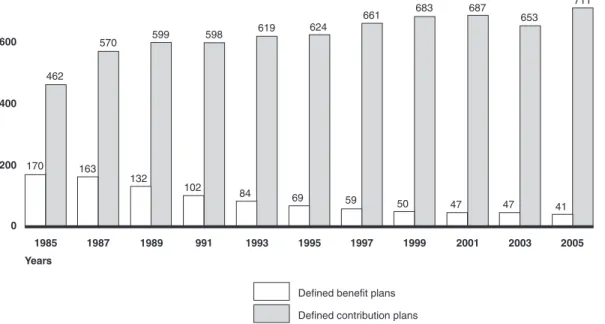
Over the last several decades the number of DC plans has continued to increase, while the number of traditional DB plans has declined. Today, DC plans account for the majority of private sector retirement plans and participants.
Figure 1: Comparison of Defined Benefit Plans with Defined Contribution Plans, 1985 and 2005.
Plans (thousands)
0 200 400 600 800
2005 2003
2001 1999
1997 1995
1993 991
1989 1987
1985
Source: U.S. Department of Labor (1985-2003 data); Investment Company Institute (2005 estimates).
Years
Defined benefit plans Defined contribution plans 170
462
163 570
132
599 598 619 624
661 683 687 653
711
102 84
69 59 50 47 47
Meanwhile, the financial services industry and the DB pension system have also changed significantly since the 1970s. The globalization of financial markets, as well as technological and international regulatory changes, has facilitated the development of new financial instruments and the complexity of investment opportunities.2
Consequently, the financial services industry has responded to the growing need for assistance with managing, investing, transferring, settling, valuing, and holding pension assets. In 2005, over 81 percent of large public/government plans used an investment consultant and 42 percent of private pension plans did so.3
As of October 31, 2005, there were more than 1,800 SEC-registered
investment advisers that indicated on their Securities and Exchange Commission (SEC) registration forms that they provide pension consulting services.4
These firms vary widely from small one-person operations to large organizations employing hundreds. Some firms only provide pension consulting, while others may have started as pension consultants, but then added additional business operations such as brokerage and money management.
A conflict of interest is typically a situation in which someone in a position of trust, such as a pension plan trustee or investment adviser, has
competing professional or personal interests. Such competing interests can make it difficult for a plan’s fiduciaries, in general, to fulfill their duties impartially and could cause them to breach their duty to act solely in the interest of plan participants and beneficiaries. Having a conflict in and of itself does not constitute a breach of fiduciary duty. However, given the potential of financial harm to plan sponsors and participants, questions have been raised about the extent and nature of these conflicts of interest.
2
GAO, Financial Regulation: Industry Changes Prompt Need to Reconsider U.S. Regulatory Structure, GAO-05-61 (Washington, D.C.: Oct. 6, 2004).
3
For consultant usage information, see Thomson Nelson, Annual Report of Pension Fund Consultants 2006 (New York, N.Y.: 2006).
4
For information on SEC’s pension consultant examination, see SEC, Speech by SEC Staff: Conflicts of Interest in Pension Consulting, (Washington, D.C.: Dec. 5, 2005),
Although no complete information is available on the prevalence of conflicts of interest, pension plan consultants assisting significant numbers of pension plan sponsors may have such conflicts as a result of their affiliations or business arrangements with other firms which could affect the advice they provide to these sponsors. SEC, through its
examination and enforcement, has identified potential conflicts of interest among money managers that could result in harm to clients, including pension plans. A May 2005 study by SEC staff on conflicts of interest among pension consultants registered as investment advisers revealed that 13 out of the 24 consultants examined that had provided services to
sponsors of pension plans, including ongoing DB and Pension Benefit Guaranty Corporation (PBGC)-trusteed DB plans, had failed to disclose significant ongoing conflicts of interest to their pension fund clients.5
Inadequate Disclosure
of Conflicts of
Interest by Pension
Consultants are
Associated with Rates
of Return for DB
Plans
These ongoing conflicts took a number of different forms. For example, SEC found that 13 pension consultants or their affiliates had conflicts of interest because they provided products and services to pension plan advisory clients, money managers, and mutual funds on an ongoing basis without adequately disclosing these conflicts. SEC staff also found that the majority of pension consultants examined had business relationships with broker-dealers that raised a number of concerns about potential harm to pension plans. For example, in certain directed brokerage arrangements, a pension consultant may convince a pension plan client to direct their money manager to place plan trades through a broker-dealer that was affiliated with the consultant as a means for paying advisor fees a plan owed to its consultant using a portion of the brokerage commission paid on such trades. These arrangements raised concerns that plans might not have received the best price for each trade—or “best execution”—because the directions given to a plan’s money manager by the plan may have restricted the money manager’s ability to select a broker-dealer that was the best able to execute a trade. These arrangements raised the additional concern that consultants might be overpaid because the plan did not always know when the fee had been paid in full, as brokerage
commissions were being used to pay the fee rather than checks drawn on the plan’s checking account.
5
See U.S. Securities and Exchange Commission, Office of Compliance Inspections and Examinations, Staff Report Concerning Examination of Select Pension Consultants
(Washington, D.C.: May 16, 2005.) The report’s findings were based on a 2002 to 2003 examination of 24 pension consultants. See
These consultants also had extensive relationships with DB pension funds. In particular, they:
• had over $4.5 trillion in U.S. assets under advisement, including private DB and DC plan assets, as well as public pension plan and other types of assets as of 2006;6
• provided advisory services to 36 percent (9 out of 25) of the largest plan sponsors, in terms of claims, currently trusteed by PBGC since 2000;7
• provided advisory services to 14 percent (12 out of 86) of the plan
sponsors that were trusteed by the Pension Benefit Guaranty Corporation (PBGC) in 2005; and
• provided advisory services to 24 percent (1,009 out of 4,203) of the sponsors of ongoing DB plans between the years 2000 and 2004.
Using data from the SEC conflicts of interest study and ongoing DB pension data, we conducted an analysis that revealed a statistical
association between inadequate disclosure and lower investment returns for ongoing plans, suggesting the possible adverse financial effect of undisclosed conflicts. Specifically, we conducted an econometric analysis on pension consultants in the SEC study, both those that adequately disclosed their conflicts of interest and those who did not.8
We found lower annual rates of return for those ongoing plans associated with consultants who had failed to disclose significant conflicts of interest, with lower rates generally ranging from a statistically significant 1.2 to 1.3 percentage points over the 2000 to 2004 period, depending on the different
Association between
Inadequate Disclosure of
Conflicts and Lower Rates
of Return
6
Pensions and Investments periodical’s list of Top 25 consultants ranked by U.S. institutional, tax exempt assets, 2006. 9 of the 13 consultants made the list of Top 25 consultants.
7
We constructed this analysis so that we looked at plan sponsors rather than plans. For example, PBGC’s 25 largest trusteed sponsors since fiscal year 2000 had a total of 67 plans and comprised 70 percent of the total claims against the agency between 1975 and 2006.
8
Our analysis is based on a data set we constructed by matching SEC consultant data with financial information compiled from the Form 5500 database on 1,111 plans over 5 years. Of those, 983 were associated with the 13 consultants identified by the SEC as having provided services to DB plans that had serious disclosure problems, while 39 were associated with 11 consultants that either were in compliance or had minor inadequacies with disclosure and another 89 that were associated with both types of consultants. A complete discussion of our econometric approach, including model specification, variables used, data sources, estimation techniques, and limitations, is provided in appendix II in
model specifications tested.9
Since the average return for the ongoing plans that used consultants who did not have significant disclosure violations was about 4.5 percent, the model implies that the average returns for ongoing plans that used consultants who failed to disclose significant conflicts was 3.2 to 3.3 percent for the period. We did not find significant differences in returns for those plans that had associations with both types of consultants. As of year-end 2004, our sample of ongoing plans represented assets of $183.5 billion for these plans, and average assets were $155.3 million.
While the results suggest a negative association between returns and plans that are associated exclusively with pension consultants with significant undisclosed conflicts of interest, they should not be viewed necessarily as evidence of a causal relationship. These results, like those of most studies, should be understood in of the context of their modeling and data
limitations. Although the analysis controlled for plan size, funding level, performance of asset markets, differences in plan fiscal years, and other key variables, other unknown, omitted factors could have influenced the results of our analysis. While this result gives an indication of the potential harm conflicts of interest may cause in the aggregate, these results cannot be generalized to the population of pension consultants since the
consultants examined by the SEC were not selected randomly. In addition, while these findings are consistent with the views of the experts we interviewed concerning the adverse effect that complex service–provider-related conflicts of interest can have on pension plans, we cannot rule out the possibility that some other differences between the plans could explain the differences in estimated returns.
Regardless of any global statistical relationships, a detailed audit would be needed to uncover a conflict of interest in any one plan. Independent experts and officials stated that though a typical first step to identify harm related to a conflict of interest is to examine a plan’s investment returns, determining whether any financial harm is caused to an individual pension plan by a conflict of interest requires a detailed forensic audit to identify any accrued harm from a conflict of interest. Such audits are fairly elaborate requiring at a minimum, 5 years worth of service-provider-specific documents including contracts with the plan sponsor, fees
9
These include an ordinary least squares specification with time-fixed effects and various random-effect and fixed- effect model specifications. “Fixed-effects” helps to control for the potentially large number of unmeasured forces that can explain the difference in plan returns. See appendix II in GAO-07-703.
charged, payment and other financial transactions between service providers and those involving plan fiduciaries.
Financially costly as conflicts of interest might be in the DB plan context, their risk is largely borne by the plan sponsor and not the participant. In most instances, the benefits of DB plan participants are not affected by fluctuations or even long term declines in a fund’s rate of return. Plan sponsors must pay for the benefits they have promised to their employees, increasing contributions to the plan as necessary to cover those benefits. In the event that a plan sponsor of an underfunded plan goes bankrupt, insurance provided by the PBGC will pay most benefits promised to participants.10
While our study focused on DB plans, conflicts of interest can affect DC plans. Because the risk of investment is largely borne by the individual participant in DC plans, participants are vulnerable to any decision, including those involving conflicts of interest which could result in higher fees that can lower investment returns for participants. For example, research by one industry group showed that 36 percent of responding sponsors either did not know the fees being charged to participants or mistakenly thought no fees were charged at all. A registered investment advisor (RIA) told us that if a “free” 401(k) plan has been selected by the sponsor, it was unlikely that sponsor used an RIA to examine the
underlying fee structure, and, as a result, a sponsor may select an
arrangement that reduces an employer’s fees at the expense of the higher embedded fees paid by participants, which we were told may involve a fiduciary breach under certain circumstances.
In prior work,11
we also found that some plan sponsors do not understand their service providers’ revenue sharing arrangements or may be unaware of potential conflicts of interest. For example, a service provider that assists a plan sponsor in selecting investment options for the plan may also be receiving compensation from mutual fund companies for
Participants Could Be
More Vulnerable to
Potential Adverse
Effects of Conflicts of
Interest in DC Plans
such as 401(k) Plans
10
PBGC also faces long term financial challenges. GAO, Pension Benefit Guaranty Corporation: Long-Term Financing Risks to Single-Employer Insurance Program Highlight Need for Comprehensive Reform, GAO-04-150T (Washington, D.C.: Oct. 14, 2003), GAO, Defined Benefit Pensions: Plan Freezes Affect Millions of Participants and May Pose Retirement Income Challenges, GAO-08-817 (Washington, D.C.: July 2008).
11
GAO, Private Pensions: Fulfilling Fiduciary Obligations Can Present Challenges for 401(k) Plan Sponsors, GAO-08-774, (Washington, D.C. July 2008).
recommending their funds. The service provider may not disclose this business arrangement to the plan sponsor, and as a result, participants may have more limited investment options and pay higher fees for these options than they otherwise would. These limitations and higher fees could translate into lower rates of return on participants’ accounts and ultimately could result in reduced retirement income.
Given the multiplicity of parties involved in today’s 401(k) arena, many opportunities exist for business arrangements to go undisclosed. Problems may occur when pension consultants or other companies providing
services to a plan also receive compensation from other service providers. Without disclosing these arrangements, service providers may be steering plan sponsors toward investment products or services that may not be in the best interest of participants. In addition, plan sponsors, being unaware, are often unable to report information about these arrangements to Labor on Form 5500 Schedule C.
SEC also identified certain undisclosed arrangements or conflicts of interest in the business practices of pension consultants in its study. Plan sponsors pay pension consultants to give them advice on matters such as selecting investment options for the plan and monitoring their
performance and selecting other service providers, such as custodians, administrators, and broker-dealers.12
In its report, SEC highlighted concerns that these arrangements may provide incentives for pension consultants to recommend certain mutual funds to a 401(k) plan sponsor and create conflicts of interest that are not adequately disclosed to plan sponsors. Plan sponsors may not be aware of these arrangements and thus could select mutual funds recommended by the pension consultant over lower-cost alternatives. As a result, participants may again have more limited investment options and may pay higher fees for these options than they otherwise would.
Finally, significant differences in ways that advisers and other providers are compensated may have important implications for the sponsor’s oversight, including identifying potential conflicts of interest. Experts noted that a sponsor may opt for what appears to be a “free” 401(k) plan (with no record keeping fees for the employer) without understanding that
12
Office of Compliance Inspections and Examinations, Staff Report Concerning
Examinations of Select Pension Consultants (U.S. Securities and Exchange Commission: May 16, 2005)
the providers’ compensation may be passed on to participants by
embedding fees in the plan’s investment options. In other cases, specific fees that are considered to be “hidden” may mask the existence of a conflict of interest. Hidden fees are usually related to business
arrangements where one service provider to a 401(k) plan pays a third-party provider for services, such as record keeping, but does not disclose this compensation to the plan sponsor. For example, a mutual fund normally provides record-keeping services for its retail investors, i.e., those who invest outside of a 401(k) plan. The same mutual fund, when associated with a plan, might compensate the plan’s record keeper for performing the services that it would otherwise perform, such as maintaining individual participants’ account records and consolidating their requests to buy or sell.13
Without disclosing these business arrangements, service providers may be steering plan sponsors toward investment products or services that may not be in the best interest of participants. In addition, plan sponsors may not know what entity is receiving the compensation and whether or not the compensation fairly represents the value of the service being rendered. If a plan sponsor does not know that a third party is receiving these fees, they cannot monitor them, evaluate the compensation in view of services rendered, and take action as needed to protect the interest of plan
participants.
Labor has proposed regulations to improve the information disclosed to plan fiduciaries about the various business arrangements among service providers.14
Labor’s proposal would provide (in order to qualify for the contracting or reasonable arrangements exemption to ERISA’s prohibited transactions provisions) that any contract or arrangement to provide services to an employee benefit plan would have to require the service provider to disclose the compensation it will receive, directly or indirectly, and any conflicts of interest that may arise in connection with its services to the plan.15
Labor believes that in order to satisfy their ERISA
Labor Has Proposed
Regulations to Address
Conflicts of Interest Issues
but the Regulations Have
Not Been Finalized
13
These fees are known as subtransfer agent fees.
14
72 Fed. Reg. 70,988-71,005 (Dec. 13, 2007).
15
29 U.S.C. §§ 1001-1461. ERISA is the primary federal law governing the sponsorship and operation of private sector employee pension plans, including DB plans. Among various statutory exemptions to ERISA’s prohibited transactions is one for contracting or making reasonable arrangements for services necessary for the operation of the plan if no more than reasonable compensation is paid for those services. 29 U.S.C. § 1108(b)(2).
obligations, plan fiduciaries need information on all compensation to be received by the service provider and any conflicts of interest that may adversely affect the service provider’s performance under the contract or arrangement.
Labor’s proposal would also require that service providers specify whether they will provide services to the plan as a fiduciary, either as a fiduciary under ERISA or as a fiduciary under the Investment Advisers Act of 1940.16
Service providers would have to disclose any financial or other interest in transactions involving the plan in connection with the contract or
arrangement. The proposal also defines a reasonable contract or
arrangement as one that would require the service provider to disclose its relationships with other parties that may give rise to conflicts of interest.17
If the relationship between the service provider and this third party is one that a reasonable plan fiduciary would consider to be significant in its evaluation of whether an actual or potential conflict of interest exists, then the service provider would have to disclose the relationship.
Finally, Labor recognizes that service providers may have policies or procedures in place to manage real or potential conflicts of interest. For example, a fiduciary service provider may have procedures for offsetting fees received from third parties (through revenue sharing or other indirect payment arrangements) against the amount that it otherwise would charge a plan client. Accordingly, the proposed regulation would provide that a reasonable contract or arrangement would require service providers to state whether or not any such policies or procedures exist and, if so, to provide an explanation of these policies or procedures and how they address conflicts of interest. Labor views this requirement as an
16
15 U.S.C. §§ 80b-1 – 80b-21. SEC regulates certain money managers and pension
consultants under the Investment Advisers Act of 1940 (Advisers Act), which requires those firms meeting certain criteria to register with the commission as investment advisers. Regulations under the act permit pension consultants to plans having an aggregate value of at least $50,000,000 to register with SEC. 17 C.F.R. § 275.203A-2(b) (2008). According to SEC, investment advisers have a fiduciary obligation under the Advisers Act to provide disinterested advice and disclose any material conflicts of interest to their clients. When an adviser fails to disclose information regarding material conflicts of interest, clients are unable to make informed decisions about entering into or continuing the advisory relationship.
17
Specifically, service providers would be obligated to describe any material financial, referral, or other relationship it has with various parties (such as investment professionals, other service providers, or clients) that creates or may create a conflict of interest for the service provider in performing services pursuant to the contract or arrangement put cite in. 72 Fed. Reg. 71,005.
opportunity for service providers to educate plan fiduciaries about how they address potential conflicts of interest.
At this time, Labor’s proposed regulations are awaiting review and approval by the new Secretary of Labor. We are currently conducting a review of Labor’s revisions to the Form 5500 Schedule C, which could provide some information to Labor about previously undisclosed business arrangements.
Conflicts of interest can adversely affect both DB and DC plan designs, with the primary difference being in who bears the cost of their potentially adverse effects on their rate of return. The threat posed to participants in account based retirement plans like 401(k)s, now the primary plan design in the United States, is quite direct. Since workers largely bear the risk of investment under this plan design, any factor, any decision that reduces the account’s rate of return can have potentially irreversible consequences for the participant’s retirement income, depending on her age and personal circumstances.
The recent national and worldwide economic turmoil has amplified the enormous complexity risk workers face with respect to their retirement security. In this uncertain environment, fiduciaries of all plan types must utilize a variety of service providers to help themselves and plan
participants assess choices. While conflicts of interest are not necessarily inherent in engaging service providers, the likelihood that conflicts of interest exist has significantly increased over the years given the complexity and nature of business arrangements among investment advisers, plan consultants, and others. To the extent that financially harmful conflicts of interest exist, they pose a potential threat to the investment confidence of sponsors and participants and to the retirement security of employees.
As we have noted in past reports, updating regulations to better reflect the potential impact of undisclosed business arrangements among 401(k) service providers will help Labor provide more effective oversight of 401(k) plans and likely result in reduced fees for 401(k) plan participants. Without such changes, Labor will continue to lack comprehensive
information on all fees being charged directly or indirectly to 401(k) plans and 401(k) plan participants’ returns are likely to be potentially affected by some conflicts of interest.
Concluding
Observations
Mr. Chairman, this completes my prepared statement. I would be happy to respond to any questions you or other members of the subcommittee may have at this time.
Charlie Jeszeck (202) 512-7215
In addition to the above, Tamara E. Cross, Kimberley M. Granger, Joseph Applebaum, Lawrance Evans Jr., Gene Kuehneman, Monica Gomez, and Craig Winslow made important contribution to this report.
GAO Contacts
Staff
This isa work of the U.S. government and is not subject to copyright protection in the United States. The published product may be reproduced and distributed in its entirety without further permission from GAO. However, because this work may contain copyrighted images or other material, permission from the copyright holder may be necessary if you wish to reproduce this material separately.
GAO’s Mission
The Government Accountability Office, the audit, evaluation, and investigative arm of Congress, exists to support Congress in meeting its constitutional responsibilities and to help improve the performance and accountability of the federal government for the American people. GAO examines the use of public funds; evaluates federal programs and policies; and provides analyses, recommendations, and other assistance to help Congress make informed oversight, policy, and funding decisions. GAO’s commitment to good government is reflected in its core values ofaccountability, integrity, and reliability.
The fastest and easiest way to obtain copies of GAO documents at no cost is through GAO’s Web site (www.gao.gov). Each weekday afternoon, GAO posts on its Web site newly released reports, testimony, and
correspondence. To have GAO e-mail you a list of newly posted products, go to www.gao.gov and select “E-mail Updates.”
The price of each GAO publication reflects GAO’s actual cost of
production and distribution and depends on the number of pages in the publication and whether the publication is printed in color or black and white. Pricing and ordering information is posted on GAO’s Web site,
http://www.gao.gov/ordering.htm.
Place orders by calling (202) 512-6000, toll free (866) 801-7077, or TDD (202) 512-2537.
Orders may be paid for using American Express, Discover Card,
MasterCard, Visa, check, or money order. Call for additional information. Contact:
Web site: www.gao.gov/fraudnet/fraudnet.htm
E-mail: [email protected]
Automated answering system: (800) 424-5454 or (202) 512-7470
Ralph Dawn, Managing Director, [email protected], (202) 512-4400 U.S. Government Accountability Office, 441 G Street NW, Room 7125 Washington, DC 20548
Chuck Young, Managing Director, [email protected], (202) 512-4800 U.S. Government Accountability Office, 441 G Street NW, Room 7149 Washington, DC 20548