Sharif University of Technology
Scientia IranicaTransactions B: Mechanical Engineering www.scientiairanica.com
Analytical solution for large amplitude vibrations of
microbeams actuated by an electro-static force
M. Baghani
a;, A. Asgarshamsi
band M. Goharkhah
aa. School of Mechanical Engineering, College of Engineering, University of Tehran, Tehran, P.O. Box 11155-4563, Iran. b. School of Mechanical Engineering, Sharif University of Technology, Tehran, Iran.
Received 24 April 2012; received in revised form 7 February 2013; accepted 11 May 2013
KEYWORDS Nonlinear; Vibration; Micro-beam; Variational iteration method.
Abstract. An analytical study using Variational Iteration Method (VIM) is carried out in order to investigate the vibrations of electro-statically actuated double-clamped and simply-supported microbeams. Eects of applied voltage and residual axial load on the nonlinear natural frequency and deection of the microbeams are studied. It shows that pre-compression in microbeams increases the amplitude of deections for a specic applied voltage. Also, an increase in pre-tension motivates the microbeam to show more nonlinear behavior in an applied voltage. Predicted results are compared with the experimental data available in the literature and also with numerical results which shows a good agreement. It is concluded that the second order approximation of the VIM leads to highly accurate solutions which are valid for a wide range of vibration amplitudes.
© 2013 Sharif University of Technology. All rights reserved.
1. Introduction
Electrostatically actuated microbeams are often en-countered in high precision applications and microelec-tromechanical systems (MEMS) such as signal ltering, resonant sensors and mass sensing [1]. An electrostat-ically actuated microbeam comprises a beam-shaped element and a xed rigid plate electrode. When the applied voltage to the microbeam exceeds a critical value, which is called pull-in voltage, the resulting electrostatic force may lead to the instability and vibration of the system [2,3].
It should be noted that the governing equations of vibration of these systems are essentially nonlinear. Generally, in a given nonlinear problem, it is often dicult to nd an analytical solution, unless a number of dierent simplifying assumptions is considered. Oth-erwise, application of dierent numerical techniques is unavoidable. However, it is hard to have a com-plete and indispensable understanding of a nonlinear
*. Corresponding author. Tel.: +98 21 61114020 E-mail address: [email protected] (M. Baghani)
problem out of these numerical results. In addition, numerical diculties appear if a nonlinear problem has singularities or multiple solutions.
Vibrations and natural responses of MEMS have been the subject of several analytical studies in the past. Azrar et al. [4] developed a semi-analytical approach to the nonlinear dynamic response problem, based on Lagrange's principle and the harmonic bal-ance method. An analytical method for determin-ing the vibration modes of geometrically nonlinear beams under various edge conditions was presented by Qaisi [5]. Gou and Zhang [6] investigated nonlinear vi-brations of thin beams, based on sextic cardinal spline functions and a spline-based Dierential Quadrature Method (DQM). Also, Kung and Chen [7] used the DQM to calculate the natural frequencies of a xed-xed shaped beam. They considered the eects of the mid-plane stretching, axial residual stress and electrical eld fringing.
Moreover, pull-in instability has been a subject of study in analysis of electrostatic beams. Zhang and Zhao [8] studied the pull-in instability of mi-crostructures under electrostatic loadings. They used
the Taylor series to expand the electrostatic loading term in the one-mode analysis method to derive the analytical solution. Zhang et al. [9] presented an analytical method for the snap-through and the pull-in instabilities of an arch-shaped beam under electrostatic loading. Because of the Taylor series expansion error, they introduced a compensated form of the Taylor series expansion on the electrostatic loading term, and modied the solution.
Nonlinear modal analysis approach based on in-variant manifold method was utilized to obtain the nonlinear normal modes of a clamped-clamped beam for large amplitude displacements by Xie et al. [10]. Nayfeh and Nayfeh [11] obtained the nonlinear modes and natural frequencies of a simply-supported Euler-Bernoulli beam resting on an elastic foundation with distributed quadratic and cubic nonlinearities, using the method of multiple scales and the invariant man-ifold approach. Also, Nayfeh and Younis [12] and Younis and Nayfeh [13] used perturbation technique to solve the nonlinear problem of MEMS. Pirbodaghi et al. [14] used the rst-order approximation of the homo-topy analysis method to investigate the nonlinear free vibration analysis of Euler-Bernoulli beam. Moghimi Zand et al. [15] have used homotopy analysis method to nd semi-analytic solutions to the vibrations of double-clamped microbeams subjected to suddenly applied step voltages. They have considered the eect of mid-plane stretching and residual stress in their analysis.
Among several analytical methods, Variational Iteration Method (VIM) is one of the most accurate and ecient methods of studying vibrations of nonlin-ear systems [16]. In [17], this method was employed to analyze the large amplitude free vibration and post-buckling of unsymmetrically laminated composite beams on elastic foundation, and the accuracy of the method was investigated. Recently, Baghani [18] employed a modied version of VIM in solving a nonlinear boundary value problem. He analytically studied the size-dependent static pull-in voltage of mi-crocantilevers, using the modied couple stress theory. He also showed that the results predicted by VIM are in excellent correspondence with the numerical results, as well as the experimental data. Baghani et al. [19] also employed this method to investigate the nonlinear response for free vibration of a conservative oscillator. The main objective of this paper is to use the VIM to study the vibrations of electrostatically actuated double-clamped and simply supported microbeams. Analytical expressions for the nonlinear fundamental natural frequency and deection of these microbeams are obtained using the VIM. The eects of the applied voltage and residual axial load on the nonlinear natural frequency and deection of the microbeams are studied. Results are compared with those available from the literature and also with the results of numerical study,
to show the performance of the proposed analytical solution.
The paper is organized as follows: In Section 2, the mathematical problem formulation is developed. Section 3 deals with a brief introduction to the VIM. Results of the mathematical solution for both double-clamped and simply supported microbeams are re-ported in Section 4. The obtained results are compared with the numerical results, as well as the experimental data available in the literature. We nally present a summary and draw conclusions in Section 5.
2. Problem formulation
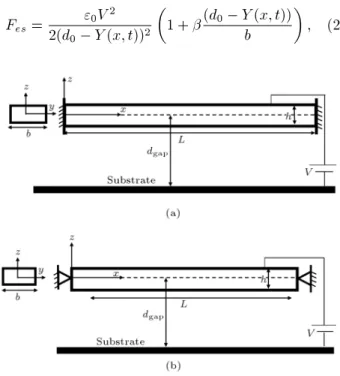
Schematics of double-clamped and simply supported microbeams are shown in Figure 1(a) and (b), respec-tively. Employing von-Karman nonlinearity concept for mid-plane stretching, the deection of both types of microbeams resulted from electrostatic force can be obtained using the following relation:
Ytt+bhEIYxxxx (Nibh+ Ns)Yxx=bhb Fes; (1)
where b and h are width and thickness of the mi-crobeam, respectively; is the density; I is the moment of inertia of the cross-section about the z-axis; subscripts x and t stand for derivative with respect to the location and time, respectively; E is the eective Young's modulus of the beam, and Fes is the
electrostatic force induced from the applied voltage V between the microbeam and the substrate plate. Fes is
expressed as:
Fes = "0V 2
2(d0 Y (x; t))2
1 + (d0 Y (x; t))b
; (2)
Figure 1. Schematic of the microbeams: (a) Double-clamped; and (b) simply supported.
where "0is the vacuum permittivity; d0is the air initial
gap. is a parameter describing the eect of fringing eld due to the nite width of the beam, and depends on the type of the microbeam. Also, in Eq. (1), Ni is
the residual axial load and Nsis the axial load resulted
from mid-plane stretching, which is given by:
Ns= Ebh2L L
Z
0
Y2
xdx: (3)
The boundary conditions for a double-clamped mi-crobeam can be written as:
Y (0; t) = 0; Yx(0; t) = 0;
Y (L; t) = 0; Yx(L; t) = 0: (4)
Also, for a simply supported beam, the boundary conditions are as follows:
Y (0; t) = 0; Yxx(0; t) = 0;
Y (L; t) = 0; Yxx(L; t) = 0: (5)
And the initial conditions are:
Y (x; 0) = 0; Yt(x; 0) = 0: (6)
In order to solve the dierential Eq. (1), subject to the boundary and initial conditions (4), (5) and (6), method of separation of variables is applied in which the deection of the beam is expressed as:
Y (x; t) = (x)w(t); (7) where w(t) is a function of time and (x) is the rst eigenmode, which satises the boundary con-ditions. For double-clamped and simply supported microbeams, (x) is given by Eqs. (8) and (9), respec-tively.
(x) = sin (L x) sin(x) cosh(L)cos(L) cosh(L)
+cos(x) sinh(L) sinh(x) cos(L)cos(L) cosh(L)
sinh (L x) + cosh(x) sin(L)
cos(L) cosh(L) ; (8)
(x) = sin(x); =
L: (9)
In Eq. (8), is calculated based on linear vibration of the beam [8]. Substituting Eqs. (8) and (9) in Eq. (1)
and using the Taylor expansion of Fes, we have [15]:
T (Y ) = Ytt+bhEIYxxxx
1 bh
0
@Ni+Ebh2L L
Z
0
Y2 xdx
1 A Yxx
"0bV2
2bh
1 d2
0+
2Y d3
0 +
3Y2
d4 0 +
4Y3
d5 0 +
5Y4
d6 0 +
"0V2
2bh
1 d0+
Y d2
0+
Y2
d3 0+
Y3
d4 0 +
Y4
d5 0+
= 0:
(10) Using the Galerkin method, the governing equation of motion is obtained as follows:
wtt+w+Q+Rw2+Sw3+Gw4+Jw5+P w6=0:
(11) Coecients ; Q; R; S; G; J and P are presented in Appendix A.
3. The method of solution
In this method, the studied problem is initially approx-imated with possible unknowns. Then, a corrected functional is constructed using a general Lagrange multiplier, which can be identied optimally via the variational theory [16]. To illustrate the basic idea of the method, we consider the following general nonlinear system:
L[w()] + N[w()] = g(); (12) where L is a linear dierential operator, N is a nonlinear analytic operator, and g() is an inhomogeneous term. The basic character of the method is to construct a correction functional for the system as follows:
wn+1(t) = wn(t)
+ Z t
0 (t) fL[wn()] + N [ ~wn()] g()g d;(13)
where (t) is a general Lagrange multiplier which can be identied optimally via the variational theory. Also, wn is the nth approximate solution, and ~wn represents
a restricted variation, i.e. ~wn= 0.
3.1. Implementation of the VIM in Vibrations of double-clamped and simply supported micro beams
In view of Eq. (12), the governing Eq. (11) can be rewritten as:
d2w(t)
where:
L[w] = d2dtw(t)2 + 2w;
N[w] =fw(t) + Q + Rw(t)2+ Sw(t)3+ Gw(t)4
+ Jw(t)5+ P w(t)6g 2w; g(t) = 0:
(15) The correction functional can be constructed in the form:
wn+1(t) =wn(t) +
Z t
0 (t)
" d2w
n()
d2
+ 2w
n() + N[ ~wn()]
#
d: (16)
In Eq. (16), ~wn is considered as a restricted variation,
i.e. ~wn = 0, hence N[ ~wn()] = 0. Calculating the
variation of Eq. (16) and noting that N[ ~wn()] = 0,
the following equations will be produced:
wn+1(t) =wn(t) +
Z t
0 (t)
"
d2wdn2()
+ 2w
n() + [ ~wn()]
# d;
wn+1(t) =wn(t) + dwdn()
t
0
d() d wn()
t
0
+
t
Z
0
"
wn()d 2()
d2 +2()wn()
# d;
wn+1(t) =wn(t) +
dwdn()
=t
d()
d wn()
=t
+
t
Z
0
"
wn()d 2()
d2 +2()wn()
# d:
(17) Separating the coecients of wn()j=t and
dwn()
d =t and also wn()j=t in the integral of
Eq. (17) leads to the following stationary conditions: 8
> > < > > :
d2()
d2 + 2() = 0
( = t) = 0 1 d()d
=t = 0
(18)
The Lagrange multiplier, therefore, can be identied as:
() = !1 sin !( t): (19) On the other hand, by taking into consideration the relation:
t
Z
0
sin !( t)
d2w n()
d2 + !2wn()
d
= !wn(t) + !wnjt=0cos !t + dwdtn
t=osin !t:(20)
Eq. (20) can be recast as:
wn+1(t) =wnjt=0cos !t + dwdtn t=o
sin !t !
+!1
t
Z
0
sin !( t)fN[wn()]gd: (21)
Considering the initial conditions w(0) = 0 and _w(0) = 0, the correction functional is further reduced to:
wn+1(t) =!1 t
Z
0
sin !( t)fN[wn()]gd: (22)
As an initial guess, w0(t) is assumed to be:
w0(t) = !Q2(cos(!t) 1): (23)
Expanding N[w0(t)], we arrive at:
32!12N[w
0()] = [ 120SQ3!6 32Q!10
420JQ5!2+ 792P Q6+ 64RQ2!8
+ 32Q!12+ 224GQ4!4] cos(!)
+ [240JQ5!2 16RQ2!8 495P Q6
+ 48SQ3!6 112GQ4!4] cos(2!)
+ [ 90JQ5!2+ 32GQ4!4 8SQ3!6
+ 220P Q6] cos(3!) + [ 4GQ4!4
+ 20JQ5!2 66P Q6] cos(4!)
+ [12P Q6 2JQ5!2] cos(5!)
+ [ P Q6] cos(6!) + [(252JQ5!2
32Q!12 462P Q6 48RQ2!8
By taking into consideration the relation: 1
!
t
Z
0
sin !( t)fcos(n!t)gd
= 8 > < > :
cos(n!t) cos(!t)
!2(n2 1) n 6= 1
t sin(!t)
2! n = 1
(25)
to avoid secular terms in the next iterations, the coecient of the cos(!) in N[!0()] must be vanished.
The rst approximation of the frequency is obtained as follows:
120SQ3!6 32Q!10 420JQ5!2+ 792P Q6
+ 64RQ2!8+ 32Q!12+ 224GQ4!4= 0: (26)
From Eqs. (23) and (25), for n = 1, the rst-order approximate solution is obtained as:
w1(t) = c1cos(!t) + c2cos(2!t) + c3cos(3!t)
+ c4cos(4!t) + c5cos(5!t) + c6cos(6!t) + c7;
(27) where coecients ci's are given in Appendix B.
Substituting Eq. (27) in Eq. (22), an expression similar to Eq. (24) is obtained. Then, by setting the coecient of cos(!) to zero, a higher order approxi-mation for the frequency is obtained, which is given in Appendix C. Also, the deections of microbeams are calculated up to the second order approximation.
4. Results and discussion
Variational Iteration Method (VIM) is applied to study the nonlinear frequency and deection of electrostati-cally actuated double-clamped and simply supported microbeams. Expressions for the frequency and de-ection of the micro beams up to the second order approximation are obtained. Also, the deection of the micro beams is calculated numerically, using 4th order Runge-Kutta method.
4.1. Double-clamped microbeam
The procedure explained in previous section is ap-plied to study the vibrations of a double-clamped microbeam. In order to demonstrate the accuracy of the VIM, values of nonlinear frequency !NL of
four dierent isotropic double-clamped microbeams with lengths of 210, 310, 410 and 510 m have been obtained, and compared with previous works, which are summarized in Table 1.
The parameters of the microbeam are as follows: Thickness = 1.5 m,
Width = 100 m, Initial gap = 1.18 m,
Residual axial load = 0.0009 N, = 2332 kg/m3,
"0= 8:854 10 12F m 1
Eective Young's modulus = 166 GPa.
In Table 1, !0 is the linear frequency calculated
from the initial guess, and !1 and !2 are the values
obtained from the rst and the second iterations, respectively.
It can be observed that the results obtained from the VIM and those reported by [2,7,15] are in a good agreement. Table 1 also shows the advantage of using this method from the convergence view point. As shown, only a few iterations are required to calculate the results with appropriate accuracy.
Variations of the linear and nonlinear frequencies obtained from the rst and second iterations with the applied voltage for dierent values of residual axial load are illustrated in Figure 2. These values are also compared with the results of [15] where a good agreement is observed. It is shown that for values of voltage lower than 10 V, the dierence between the linear and nonlinear frequencies is almost negligible. For higher values of voltage, eect of nonlinearity is dominant and has caused the linear frequency to diverge from the nonlinear solution. Also, for voltages greater than a critical value, no real solution can be found for the problem. It should be noted that the
Table 1. Nonlinear frequencies at dierent beam lengths and comparison with the previous works results and experimental data.
Length (m)
Ref. [2]
Ref. [7] Ref. [15] Present study
Measured Calculated !0 !1 !2
210 322.05 324.7 324.7 324.78 322.4036 322.3534 322.3534 310 163.22 164.35 163.46 163.16 161.9797 161.9549 161.9549 410 102.17 103.8 103.7 103.42 101.6387 101.5353 101.5354
Figure 2. Variation of natural frequencies with voltage for a double-clamped microbeam with L = 210 m and dierent values of residual axial load.
Figure 3. Eect of residual axial load on deection of the double-clamped microbeam at x = L=2 with L = 210 m at 19 V.
values of frequency obtained from the rst and second iterations are very close in whole studied interval of voltage, which implies the high rate of convergence in the VIM. It is also observed that pretension in microbeams results in increase of nonlinear frequency. Figure 3 shows the eect of residual axial load on deection of the microbeam at x = L=2. Results of the VIM obtained at 19 V for a microbeam with L = 210 m are compared with the numerical results of 4th order Runge-Kutta method. A good agreement is observed even at this relatively high voltage. Also, it can be seen that precompression increases the am-plitude of deections for a specic applied voltage. 4.2. Simply-supported microbeam
The VIM is applied to analyze the vibration of a simply supported microbeam actuated by an electrostatic force. The dierence between the solutions obtained for double-clamped and simply supported beams is due
to the dierent boundary conditions, which results in dierent expressions for (x).
Figure 4 depicts the variation of linear and non-linear frequencies of the simply supported microbeam with respect to the applied voltage. As observed in this gure, the values of frequencies fall to zero at higher voltages, called pull-in voltage. In such voltages, the instability occurs which should be considered as an important issue in design procedures [18].
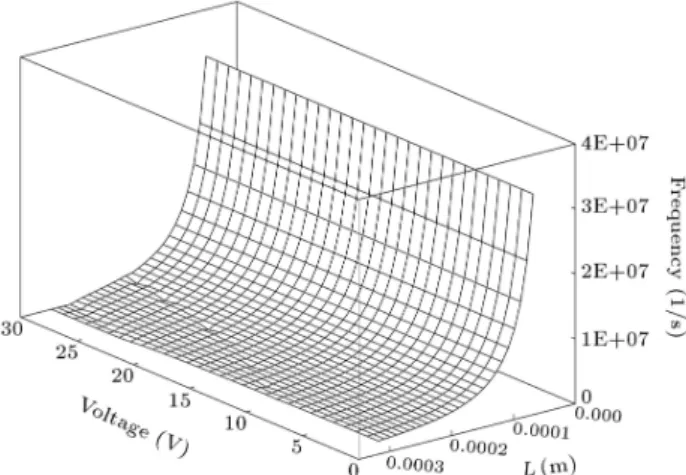
Figure 5 shows the deection of the microbeam at x = L=2 with length L = 210 m for dierent axial loads at voltage 10. The slight dierence between the results of current study and that of the numerical study is due to the applied relatively high voltage, which is close to the value of the critical voltage. We also investigated the eect of beam length (L) and voltage (V ) on the nonlinear frequency in Figure 6 where the residual axial load is zero. As shown, at smaller beam lengths, the value of frequency increases. This increase is much more signicant at beam lengths smaller than L = 100 m.
Figure 4. Variation of natural frequency with voltage for a simply supported microbeam with L = 210 m and dierent values of residual axial load.
Figure 5. Eect of residual axial load on deection of the simply supported microbeam at x = L=2 with L = 210 m at 10 V.
Figure 6. Eect of beam length (L) and voltage (V ) on the nonlinear frequency where the residual axial load is zero.
5. Summary and conclusion
Variational Iteration Method (VIM) has been applied to study the vibrations of electrostatically actuated double-clamped and simply supported microbeams. The geometrical nonlinearity has been modeled using von-Karman's assumptions. Galerkin's decomposition method has been used to obtain the nonlinear ordinary dierential equation of motion. Analytical Expressions for the nonlinear natural frequency and deection of these microbeams have been obtained using the VIM. The eects of the applied voltage and residual axial load on the nonlinear natural frequency and deection of the microbeams have been studied. It is shown that by increasing the applied voltage, higher iterations are required to nd the results accurately. It is also con-cluded that pretension in microbeams results in higher values of nonlinear frequency. Also, precompression in microbeams increases the amplitude of deections for a specic applied voltage. Having a higher rate of convergence and high accuracy, VIM is shown to be an ecient method for studying the behavior of nonlinear systems.
References
1. Batra, R.C., Porri, M. and Spinello, D. \Vibrations of narrow micro-beams predeformed by an electric eld", Journal of Sound and Vibration, 309, pp. 600-612 (2008).
2. Tilmans, H.A.C. and Legtenberg, R. \Electrostatically driven vacuum-encapsulated polysilicon resonators. Part II. Theory and performance", Sensors and Ac-tuators: A. Physical, 45, pp. 67-84 (1994).
3. Nathanson, H.C., Newell, W.E., Wickstrom, R.A. and Davis, J.R. \The resonant gate transistor", IEEE Trans. Electron Devices ED-14, pp. 117-133 (1967).
4. Azrar, L., Benamar, R. and White, R.G. \Semi-analytical approach to the non-linear dynamic
re-sponse problem of s-s and c-c beams at large vibration amplitudes. Part I: General theory and application to the single mode approach to free and forced vibration analysis", Journal of Sound and Vibration, 224, pp. 183-207 (1999).
5. Qaisi, M.I. \Application of the harmonic balance principle to the nonlinear free vibration of beams", Applied Acoustics, 40, pp. 141-151 (1993).
6. Gou, Q. and Zhang, H. \Nonlinear vibration analysis of beams by a spline-based dierential quadrature method", Journal of Sound and Vibration, 269, pp. 413-420 (2004).
7. Kuang, J.H. and Chen, C.J. \Dynamic characteristics of shaped micro-actuators solved using the dierential quadrature method", Journal of Micromechaics and Microengineering, 14(4), pp. 647-655 (2004).
8. Zhang, Y. and Zhao, Y. \Numerical and analytical study on the pull-in instability of micro-structure under electro-static loading", Sensors and Actuators A, 127, pp. 366-380 (2006).
9. Zhang, Y., Wang, Y. and Li, Z. \Analytical method of predicating the instabilities of a micro arch-shaped beam under electro-static loading", Microsystem Tech-nologies, 16, pp. 909-918 (2010).
10. Xie, W.C., Lee, H.P. and Lin, S.P. \Normal modes of a nonlinear clamped-clamped beam", Journal of Sound and Vibration, 250(2), pp. 339-349 (2002).
11. Nayfeh, A.H. and Nayfeh, S.A. \Nonlinear normal modes of a continuous system with quadratic nonlin-earities", Journal of Vibration and Acoustics Transac-tion ASME, 117(2), pp. 199-205 (1995).
12. Nayfeh, A.H. and Younis, M.I. \Dynamics of MEMS resonators under superharmonic and subharmonic ex-citations", Journal of Micromechaics and Microengi-neering, 15, pp. 1840-1847 (2005).
13. Younis, M.I. and Nayfeh, A.H. \A study of the nonlinear response of a resonant micro-beam to an electric actuation", Nonlinear Dynamics, 31, pp. 91-117 (2003).
14. Pirbodaghi, T., Ahmadian, M.T. and Fesanghary, M. \On the homotopy analysis method for non-linear vibration of beams", Mechanical Research Communi-cation, 36(2), pp. 143-148 (2009).
15. Moghimi Zand, M., Ahmadian, M.T. and Rashidian, B. \Semi-analytic solutions to nonlinear vibrations of micro-beams under suddenly applied voltages", Jour-nal of Sound and Vibration, 325, pp. 382-396 (2009).
16. He, J.H. \Variational iteration method for autonomous ordinary dierential systems", Applied Mathematics and Computation, 114, pp. 115-123 (2000).
17. Baghani, M., Jafari-Talookolaei, R.A. and Salarieh, H. \Large amplitudes free vibrations and post-buckling analysis of unsymmetrically laminated com-posite beams on nonlinear elastic foundation", Applied Mathematical Modelling, 35, pp. 130-138 (2011).
18. Baghani, M. \Analytical study on size-dependent static pull-in voltage of micro-cantilevers using the modied couple stress theory", International Journal of Engineering Science, 54, pp. 99-105 (2012).
19. Baghani, M., Fattahi and Amjadian, A.M. \Applica-tion of the varia\Applica-tional itera\Applica-tion method for nonlinear free vibration of conservative oscillators", Scientia Iranica, 19(3), pp. 513-518 (2012).
Appendix A
Coecients required for determining Eq. (11) are presented as follows:
Q = 2Md"0V2
0
b d0 +
ZL
0
dx;
M = bh
L
Z
0 2dx;
R = 2Md"0V23
0
3b d0 +
ZL
0 3dx;
= M1
L
Z
0
EI xxxx Ni xx b"0V 2
d3 0
"0V2
2d2 0
! dx;
G = 2Md"0V25
0
5b d0 +
ZL
0 5dx;
S =2ML1
L
Z
0
Ebh xx L
Z
0 2 xdx
+"0L2dV42 3
0
4b d0 +
! dx;
P = "0V2 2Md7
0
7b d0+
ZL
0 7dx;
J = 2Md"0V26
0
6b d0+
ZL
0 6dx:
Appendix B
Coecients required for determining Eq. (27) are presented as follows:
1344014c
1=134640P Q6+ 26880Q12
13440Q10 + 17920RQ28
27300SQ36+ 44688GQ44
76440JQ52;
1344014c
2=2240RQ28+ 69300P 6
6720SQ36 33600JQ52
+ 15680GQ44;
1344014c
3=4725JQ52 1680GQ44
11550P Q6+ 420SQ36;
1344014c
4= 560JQ52+112GQ44+1848P Q6;
1344014c
5= 35JQ52 210P Q6;
1344014c
6= 12P Q6;
1344014c
7= 26880Q12 58800GQ44
+ 105840JQ52 194040P Q6
20160RQ28+ 33600SQ36
+ 13440Q10:
Appendix C
A higher order approximation for the frequency based on Eq. (27), is given as:
10Jc5
1+ (5Jc5+ 25Jc3)c41+ (70Jc22+ (80Jc4
+ 160Jc7+ 32G)c2+ 60Jc23+ 80Jc3c5
+ 60Jc2
4+ (40Jc7+ 8G)c4+ 48Gc7+ 60Jc25
+ 120Jc2
7+ 12S)c31+ ((150Jc3+ 90Jc5)c22
+ ((360Jc7+ 240Jc4+ 72G)c3+ 240Jc4c5
+ (24G + 120Jc7)c5)c2+ 30Jc33+ 90Jc23c5
+ (60Jc2
4+ (360Jc7+ 72G)C4+ 48Gc7
+ 60Jc2
5+ 120Jc27+ 12S)c3+ 30Jc24c5
+ (360Jc7+ 72G)c5c4)c21+ (30Jc42+ (24G
+ 120Jc2
4+ (240Jc7+ 48G)c4+ 96Gc7
+ 240Jc2
7+ 120Jc25+ 24S)c22+ ((48G
+ 240Jc7+ 240Jc4)c23+ (360Jc4c5+ (480Jc7
+ 96G)c5)c3+ 60Jc34+ (240Jc7+ 48G)c24
+ (96Gc7+ 240Jc27+ 120Jc25+ 24S)c4
+ (240Jc7+ 48G)c25+ 160Jc37+ 16R + 48Sc7
+ 96Gc2
7)c2+ 30Jc43+ 60Jc33c5+ (150Jc24
+ (24G + 120Jc7)c4+ 96Gc7+ 240Jc27
+ 120Jc2
5+ 24S)c23+ (240Jc24c5+ (240Jc7
+ 48G)c5c4+ 60Jc35+ (96Gc7+ 240Jc27
+ 24S)c5)c3+ 30Jc44+ (96Gc7+ 240Jc27
+ 150Jc2
5+ 24S)c24+ 30Jc45+ (96Gc7
+ 240Jc2
7+ 24S)c25+ 32Rc7+ 80Jc47
+ 48Sc2
7+ 64Gc37)c1+ (20Jc3+ 20Jc5)c42
+ ((24G + 120Jc7+ 80Jc4)c3+ 60Jc4c5
+ (40Jc7+ 8G)c5)c32+ (30Jc33+ 120Jc23c5
+ (90Jc2
4+ (240Jc7+ 48G)c4+ 48Gc7+ 60Jc25
+ 120Jc2
7+ 12S)c3+ 90Jc24c5+ (240Jc7
+ 48G)c5c4+ 30Jc35+ (48Gc7+ 120Jc27
+ 12S)c5)c22+ ((24G + 120Jc7+ 60Jc4)c33
+ (180Jc4c5+ (24G + 120Jc7)c5)c23+ (60Jc34
+ (240Jc7+ 48G)c24+ (180Jc25+ 24S + 240Jc27
+ 96Gc7)c4+ (240Jc7+ 48G)c25+ 160Jc37+ 16R
+ 48Sc7+ 96Gc27)c3+ 60Jc34c5+ (24G
+ 120Jc7)c5c24+ (60Jc35+ (96Gc7+ 240Jc27
+ 24S)c5)c4)c2+ 20Jc43c5+ (10Jc24+ (24G
+ 120Jc7)c4+ 10Jc25)c33+ (60Jc24c5+ (240Jc7
+ 48G)c5c4+ 30Jc35+ (48Gc7+ 120Jc27
+ 12S)c5)c23+ ((24G + 120Jc7)c34+ 30Jc24c25
+ ((240Jc7+ 48G)c25+ 160Jc37+ 16R + 48Sc7
+ 96Gc2
7)c4)c3+ (24G + 120Jc7)c5c34
+ ((24G + 120Jc7)c35+ (160Jc37+ 16R
+ 48Sc7+ 96Gc27)c5)c4= 0:
Biographies
Mostafa Baghani received his BS degree in Mechan-ical Engineering from University of Tehran, Iran, in 2006, his MS and PhD degrees in Mechanical Engineer-ing from the Department of Mechanical EngineerEngineer-ing at Sharif University of Technology, Tehran, Iran, in 2008 and 2012, respectively. He is now an assistant professor in School of Mechanical Engineering, University of Tehran. His research interests include solid mechanics, nonlinear nite element method and shape memory materials constitutive modeling.
Mohammad Goharkhah received his BS and MS degrees in Mechanical Engineering from University of Tehran, Iran. Mr. Goharkhah is currently a PhD student at the same university. Mr. Goharkhah's research interests include optical measurement tech-niques, study of heat transfer in various equipments and nanouid heat transfer.
Abolhassan Asgarshamsi obtained his BS degree in Mechanical Engineering from University of Tehran, Iran, in 2006, and his MS degree in the same eld from the Department of Mechanical Engineering at Sharif University of Technology, Tehran, Iran, in 2009. Mr. Asgarshamsi is currently a PhD student at the same university. His research interests include optimization of turbomachinery systems and study of heat transfer in various equipments.