ISSN: 2252-8938, DOI: 10.11591/ijai.v7.i2.pp83-89 83
Improvement of Power Quality Using Fuzzy Controlled
D-Statcom in Distribution System
B. Santhosh Kumar1, K. B. Madhu Sahu2, K. B. Saikiran3, C. H. Krishna Rao4
1,2,4Department of Electrical and Electronics Engineering, AITAM Engineering College, AP, India
3Department of Electrical and Electronics Engineering, IIT Patna, Bihar, India
Article Info ABSTRACT
Article history: Received May 21, 2017 Revised Jan 31, 2018 Accepted Feb 27, 2018
This paper investigates the problems associated with distribution system in terms of delivery of clean power and their solutions. Power quality has become a major issue in the present power system network. The network has mostly inductive nature. This draws more reactive power. This causes harmonics and voltage unbalance problems. So maintain the proper operation of interconnected power system, we are using one of the facts devices such as fuzzy controlled D-statcom. It provides suitable compensation and there by maintain proper power factor and also reduces harmonic contents. The simulation is taken out by MATLAB/SIMULINK and the result shows the effectiveness of GA (Genetic algorithm) simulation. Optimized Fuzzy controlled D-STATCOM for improvement of power quality.
Keyword: D-Statcom Fuzzy logic
Fuzzy logic controller pi controller
Total Harmonic Distortion (THD)
Copyright © 2018 Institute of Advanced Engineering and Science. All rights reserved.
Corresponding Author: B. Santhosh Kumar,
Department of Electrical and Electronics Engineering, AITAM Engineering College, AP, India.
Email: [email protected]
1. INTRODUCTION
Modern power system is a complex dynamic inter connecting network, where large number of generating stations and their loads are connected to gather by means long over head power lines and finally in contact with distribution networks power distribution. D-Statcom is a shunt connected FACTS device. It is a reactive source that can be controlled and it is capable of absorbing or generating reactive power. D-Statcom consists of coupling transformer, voltage source converter, DC energy storage device and necessary control circuits.
A distribution compensator (DSTATCOM) can mitigate several power quality problems. It injects harmonic and reactive components of load currents to make source currents balanced. Sinusoidal and in phase with load voltages. In voltage control mode. It regulates load voltage at a constant value. Distribution systems are facing severe power quality problems. Such as poor voltage regulation. High reactive power and harmonics current burden.non linear loads (computers, smps, rectifier) which degrades the power quality which degrades the causing a number of disturbances e.g. heating of home appliances, noise etc in power systems due to harmonics. These nonlinear loads along with reactive power loads such as fan, pump, motors etc increase the burden on the power system. These loads draw lagging power factor currents and therefore give rise to reactive power burden in the distribution system. Excessive reactive power demand increases feeder losses and reduces active power flow capability in the power system. Sometimes their unbalance can worsen the system performance like affecting the active power flow capability of lines and operation of transformers. Therefore restoring the system for better functionality becomes a matter of concern for the utilities. To compensate the harmonics and reactive power due to non-linear load, a Distribution static compensator (D-STATCOM) is used.
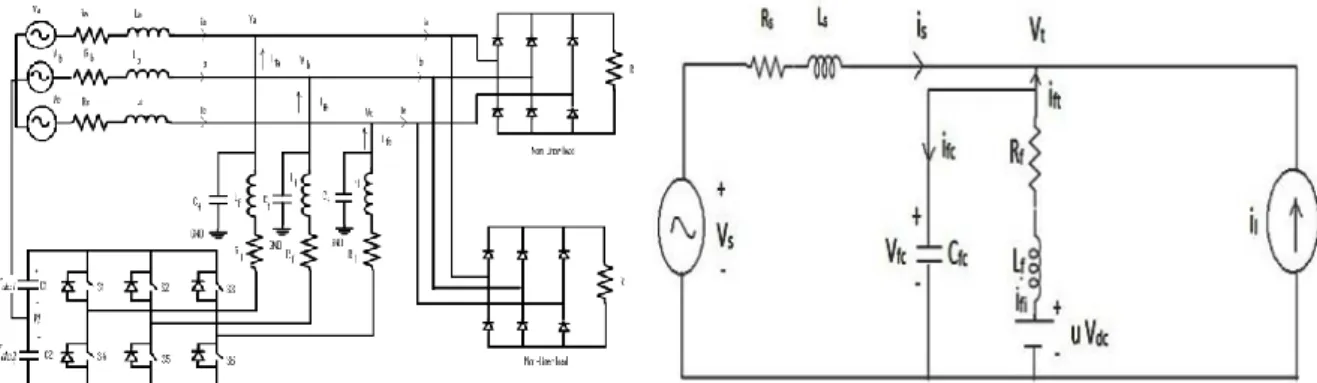
Power distribution system should provide reliable flow of energy at smooth sinusoidal voltage at the required magnitude level and frequency. In order to have high degree of power quality to at all customers hence power quality the degree of voltage quality. Power quality is a set of electrical boundaries that allows equipment perform in its specified manner. Voltage sag and voltage swell are the common power quality issues. Voltage sag is defined as a decrease in voltage to between 0.1 and 0.9 p.u. in Rms voltage for duration of 0.5 cycles to 1 minute. This harmonic current is more responsible for distorting the currents & voltages, increasing the power loss and generates heat on transformers and networks, and causing disoperation of electronic equipment, minimize the life expectancy. In order to enrich these power quality issues in distribution system. Figure 1 shown circuit diagram of the DSTATCOM compensated distribution system and Figure 2 shown single phase equivalent circuit of DSTATCOM
Figure 1. Circuit diagram of the DSTATCOM compensated distribution system
Figure 2. Single phase equivalent circuit of DSTATCOM
2. CONTROL ALGORITHM
2.1. Instantaneous d-q Theory
Instantaneous d-q Theory was initially proposed by Akagi. This theory is based on the transformation of three phase quantities to two phase quantities in d-q frame and the Instantaneous active and reactive power is calculated in this frame. Sensed inputs Va, Vb and Vc and ia, ib and ic fed to the d-q controller
and these quantities are processed to generate reference commands which are fed to a hysteresis based PWM current controller to generate switching pulses for D-STATCOM.
The system terminal voltage are given Va= Vmsin(wt)
Vb= Vmsin(wt-1200) (I)
Vc= Vmsin (wt-2400)
And the respective load currents are given as Ia= Imsin(n(wt)-θan))
Ib=Imsin(n(wt-1200)-θbn)) (II)
Ic=Imsin(n(wt+1200)-θcn))
In a, b and coordinates a, b and c axes are fixed on the same plane apart from each other by 1200.
These vectors can be transformed into d-q coordinates using Clarke’s transformation as follows.
c b a q dV
V
V
V
V
2
3
2
3
0
2
1
2
1
1
3
2
c b a q d i i i i i 2 3 2 3 0 2 1 2 1 1 3 2Where d and q axes are the orthogonal coordinate’s .conventional instantaneous power for three phase circuit can be;
P=VdId+VqIq (III)
P=VaIa+VbIb+VcIc (IV)
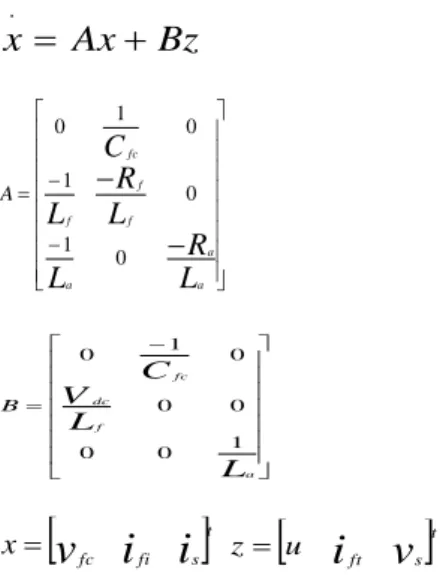
The State space equation for the circuit shown in Figure 2 are given by;
Bz
Ax
x
. (1) L R L L R L C a a a f f f fc A 0 1 0 1 0 1 0 L L V C a f dc fc B 1 0 0 0 0 0 1 0
ts fi fc
i
i
v
x
ts ft
v
i
u z
The general time Domain solution state vector x (t) given by
d Bz t x t t x t t A t Ae
t
e
( ) ( )0
0 ( )
0 ) (
(2)2.2. Fuzzy Logic Controller
Figure 3 show block diagram of fuzzy control based ac voltage controller. Following linguistic values:
NEB - Negative big. NES - Negative small. POS - positive small. POB - Positive big.
Figure 4 shown fuzzy logic rulebase. The above linguistic quantification has been used in this Paper to specify a set of rules or a rule-base. The rules are formulated from practical experience. For the FLC with two inputs and four linguistic values for each input, there are42 = 16 possible rules with all combination for
the inputs. The tabular representation of the FLC rule base (with 16 rules) of the fuzzy control based DC voltage regulator is shown in Figure 5.
The conversion of a fuzzy set to single crisp value is called defuzzification and the reverse process of fuzzification. The member ship functions to be employed for the inputs are of the triangular type where the membership functions for the outputs are singletons. The membership functions for the inputs and the output of the fuzzy controller for the DC voltage regulator as shown Figure 6 and Figure 7.
Figure 3. Block diagram of fuzzy control based ac voltage controller
Figure 5. Fuzzy logic controller Figure 6. Member ship function ship for input 1
Figure 7. Member ship function ship for input 2
2.3. Total Harmonic Distortion
The total harmonic distortion (THD) is used to define the effect of harmonics on the power system voltage. It is used in low-voltage, medium-voltage, and high voltage system. It is expressed as a percentage of fundamental and is defined. According to IEEE-519 the permissible limit for distortion in the signal is 5%.
1 50
2 2
) (
I I curent
THD h
h
(3)
2.4. Power Factor
The ratio of average power to the apparent power is called as power factor Power factor= p/s where p=Average power and s=Apparent power.
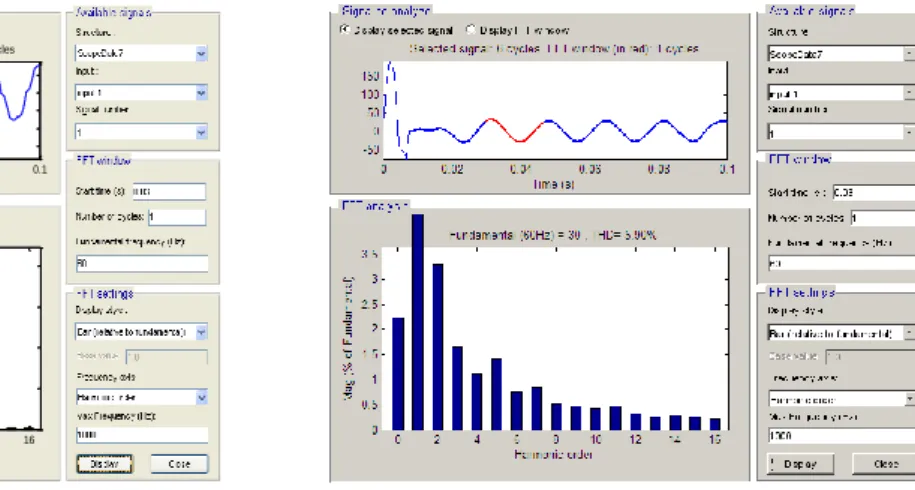
The load voltage harmonic analysis, using Fast Fourier transform (FFT) of power GUI window by simulink, as shown in Figure 8. It can be seen, without compensation implementation in system total harmonic distortion (THD) of load voltage is 9.38%. The load voltage harmonic analysis, using Fast Fourier transform (FFT) of power GUI window by simulink, as shown in Figure 9. It can be seen, with compensation of D-Statcom implementation in system total harmonic distortion (THD) of load voltage is 5.90%.
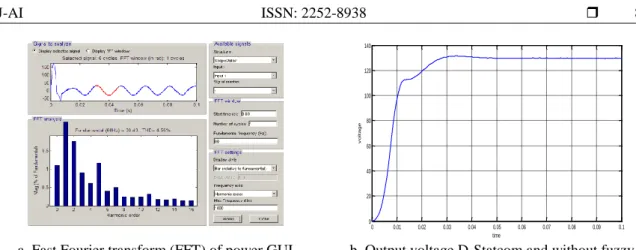
The load voltage harmonic analysis, using Fast Fourier transform (FFT) of power GUI window by simulink, as shown in Figure 10. It can be seen, with compensation of D- Statcom with fuzzy control logic implementation in system total harmonic distortion (THD) of load voltage is 4.55%.
Figure 8. FFT analysis without D-Statcom Figure 9. FFT analysis with D-Statcom
0 0.02 0.04 0.06 0.08 0.1
-60 -40 -20 0 20
Selected signal: 6 cycles. FFT window (in red): 1 cycles
Time (s)
0 2 4 6 8 10 12 14 16
0 2 4 6 8
Harmonic order Fundamental (60Hz) = 30.92 , THD= 9.38%
M
a
g
(
%
o
f
F
u
n
d
a
m
e
n
ta
a. Fast Fourier transform (FFT) of power GUI window by simulink
b. Output voltage D-Statcom and without fuzzy controller
c. circuit of FFT
Figure 10. FFT analysis with fuzzy controller
System parameters:
Supply voltage: 98Vrms(L-N), 50Hz, three phase balanced Source impedance: Rs=0.1Ω ,Ls=0.004H
Nonlinear load: Three phase full bidge diode rectifier with load (RL=8.6Ω) DC storage Capacitor Cdc=0.0047F
DC Link voltage Vdc=100V
Table 1 shown comparison between D-Statcom and with fuzzy controlled D-Statcom. Figure 11 shown output voltage D-Statcom and with fuzzy controller.
Table 1. Comparison between D-Statcom and with fuzzy controlled D-Statcom Comparisons Without D- Statcom D-Statcom. (pi controller) D-Statcom (fuzzy controller)
THD of source current 9.38% 5.90% 4.55%
Figure 11. Output voltage D-Statcom and with fuzzy controller
0 0.01 0.02 0.03 0.04 0.05 0.06 0.07 0.08 0.09 0.1 0
20 40 60 80 100 120 140
time
v
o
lt
a
g
e
0 2 4 6 8 10 12
x 104 0
20 40 60 80 100 120 140
time in seconds
v
o
lt
a
g
3. CONCLUSION
This paper presented the design of fuzzy controller for a DSTATCOM to develop Quality and lively performance of a distribution power system. Comparison study of the Controlled and the optimal fuzzy logic controlled DSTATCOM for improving power quality and lively Performance of a distribution power system has been simulated using SimPower system in MATLAB/simulink environment. The simulation results obtained in MATLAB/SimPower systems show that the fuzzy logic controlled DSTATCOM provides enhanced system lively response and hence improve power quality and stability for the distribution power system.
4. FUTURESCOPE
Reactive power compensation and harmonics mitigation with fuzzy controller based D-Statcom is more efficient use in further for distribution power systems. It can be further extend Neuron-fuzzy loop controller based D-Statcom in power distribution system.
REFERENCES
[1] M. Bollen, Understanding Power Quality Problems. Piscataway, NJ, USA: IEEE, 2000, ch. 1, pp. 1–35.
[2] H. Fujita and H. Akagi, “Voltage-regulation performance of a shunt active filter intended for installation on a power distribution system,”IEEE Trans. Power Electron., vol. 22, no. 3, pp. 1046–1053, May 2007.
[3] A. Ghosh and G. Ledwich, “Load compensating DSTATCOM in weaken systems,” IEEE Trans. Power Del., vol. 18, no. 4, pp. 1302–1309,Oct. 2003.
[4] A. Elnady and M. Salama, “Unified approach for mitigating voltage sag and voltage flicker using the DSTATCOM,” IEEE Trans. PowerDel., vol. 20, no. 2, pt. 1, pp. 992–1000, Apr. 2005.
[5] S. Rahmani, A. Hamadi, and K. Al-Haddad, “A Lyapunov-functionbasedcontrol for a three-phase shunt hybrid active filter,” IEEE Trans.Ind. Electron., vol. 59, no. 3, pp. 1418–1429, Mar. 2012
[6] M. K. Mishra and K. Karthikeyan, “A fast-acting dc-link voltage controller for three-phase DSTATCOM to compensate ac and dc loads,”IEEE Trans. Power Del., vol. 24, no. 4, pp. 2291–2299, Oct. 2009.
[7] M. K. Mishra, A. Ghosh, A. Joshi, and H. M. Suryawanshi, “A novel method of load compensation under unbalanced and distorted voltages,”IEEE Trans. Power Del., vol. 22, no. 1, pp. 288–295, Jan. 2007.
[8] M. K.Mishra, A. Ghosh, and A. Joshi, “Operation of a DSTATCOMin voltage control mode,” IEEE Trans. Power Del., vol. 18, no. 1, pp.258–264, Jan. 2003.
[9] A. Jain, K. Joshi, A. Behal, and N. Mohan, “Voltage regulation with STATCOMs: Modeling, control and results,”
IEEE Trans. Power Del. vol. 21, no. 2, pp. 726–735, Apr. 2006.
[10]R. Gupta, A. Ghosh, and A. Joshi, “Switching characterization of cascaded multilevel-inverter-controlled systems,”
IEEE Trans. Ind. Electron., vol. 55, no. 3, pp. 1047–1058, Mar. 2008.
[11]P. Mitra and G. Venayagamoorthy, “An adaptive control strategy for DSTATCOM applications in an electric ship power system,” IEEE Trans. Power Electron. vol. 25, no. 1, pp. 95–104, Jan. 2010.
[12]A. Yazdani, M. Crow, and J. Guo, “An improved nonlinear STATCOM control for electric arc furnace voltage flicker mitigation,” IEEE Trans.Power Del., vol. 24, no. 4, pp. 2284–2290, Oct. 2009
BIOGRAPHIES OF AUTHORS
B. Santhosh Kumar received his B.Tech Degree in Electrical & Electronics Engineering from Aditya institute of engineering and technology, Tekkali, East Srikakulam, A.P, and India in 2011. Currently perusing M.Tech in Aditya Institute of Technology &Management, Tekkali, and Srikakulam, India. His research interest, Power electronics and Drives.
K. B. Madhu Sahu received the B. E. Degree in Electrical Engineering from college of Engineering. Gandhi Institute of Technology & Management, Visakhapatnam, India in 1985 and the M. E Degree in power systems from college of Engineering, Andhra University and Visakhapatnam in 1998. He obtained his Ph. D from Jawaharlal Nehru Technological University. Hyderabad. He has 27 years of Experience. Currently he is working as a professor & Principal in the Department of Electrical & Electronics Engineering, AITAM, Tekkali, and Srikakulam, Andhra Pradesh. His research interests include gas insulated substations, high voltage engineering and power systems. He has published research papers in national and conferences.
K. B. Sai Kiran received his B. Tech degree in Electrical Engineering from Indian institute of technology, Patna, Bihar and India in 2016. His research interests are power systems and Power electronics and Drives.
Sri.CH. Krishna Rao obtained B. Tech Degree in Electrical and Electronics Engineering from College of Engineering, GMRIT Rajam and Srikakulam Dt. He also obtained M. Tech in Power Electronics and Electric Drives from ASTIET Garividi, Vizianagaram. He has 13 Years of Teaching Experience. Presently he is working as associate professor in the Department of Electrical & Electronics Engineering, A.I.T.A.M, Tekkali, and Srikakulam, Andhra Pradesh. He has published number of papers in journals, national and international conferences. His main areas of interest are power electronics, switched mode power supplies, electrical drives and renewable energy sources.