ISSN 1479-4403 41 ©Academic Conferences Ltd
Learning and Knowledge Sharing?
Karin Tweddell Levinsen
Copenhagen Business School, Institute of Informatics, Denmark [email protected]
Abstract: It is often stressed that the pedagogic models and approaches of Collaborative Online Learning support a learner’s shared knowledge building within collaborating groups of learners, the individual construction of knowledge and the formation of an ongoing learning Community of Practice. Based on a recent case study of a Danish Master’s programme, this paper will demonstrate that the emerging collaborative practice displays tendencies contrary to the generally accepted assumptions. The outcome is not only based on the models and their attributes, it is also affected by the emerging practice itself and the interaction among the participants during a course. From this perspective, it is relevant to look at which possibilities and obstacles teachers encounter when they try to detect slowly emerging tendencies that may lead to major misinterpretations of the subject matter and marginalize or even exclude students from participating in the learning Community of Practice. In conclusion, the case study will identify the slowly emerging tendencies that may be detected and observed at an early stage and thus indicate areas in on-line learning environments that require special attention.
Keywords: Collaborative on-line learning, Knowledge construction, Communities of practice, Emerging practice, Proaction, e-Learning
1. Introduction
In the literature of Collaborative Online Learning, it is often stressed that this pedagogic approach supports the learner’s shared knowledge building within collaborating groups of learners as well as the individual construction of knowledge. Collaborative Online Teaching also supports the formation of an ongoing learning Community of Practice (Benbunan-Fich and Hiltz 1999, Bullen 1998, Dirckinck-Holmfeld 2002, Garrison 1997, Harasim et al 1997, Koschmann 1996, Laurillard 2002, Stacey 1999). In recent years, the challenge of improving the outcome of Collaborative Online Learning has become an increasingly important issue (Cecez-Kecmanovic and Webb 2000). In this connection, the design of virtual learning environments and the implied roles of teachers and students are considered key factors (Ó Murchú and Sorensen 2004, Powers and Guan 2000) along with the support and coordination of the collaborative learning process (Carell et al 2005, Dillenbourg 2002, Weinberger et al. 2004), intervention in terms of feedback (Zumbach and Reimann, 2003) and mediation (Sorensen 2002, Salmon 2003).
The focus of improvement has been concentrated on how to design environments, how to model students’ and teachers’ activities and how to intervene in discussion fora (mediation, coaching, scaffolding etc.). To some extent, it might appear as if the processes of knowledge construction and the formation of Communities of Practice are considered to be the inevitable outcome of the collaborative educational models based on
constructivist learning theory owing to these models’ inherent attributes and qualities.
A recent case study of the Danish Master’s programme in ICT and Learning (MIL) based on collaboration and constructivist pedagogy demonstrates that the emerging collaborative practice displays tendencies contrary to the generally accepted assumptions. The study identifies how the students slowly develop convergent, goal-oriented and cooperative (division of labour) strategies rather than divergent, explorative and collaborative (integrating) strategies. It also demonstrates how the changes in the students’ strategies may lead towards reproductive learning and a surface approach rather than reflective knowledge construction and deep learning.
The paper argues that the outcome of ongoing processes staged within the framework of collaborative e-Learning models is not only based on the models and their attributes. The outcome is also affected by the emerging practice it self and the interaction among the participants during a course. From this perspective, it becomes vital to look at the possibilities and obstacles encountered by teachers in their efforts to obtain the necessary knowledge to decide whether and how to support the learning process though intervention such as mediation, coordination, scaffolding, coaching, etc.
1.1 The missing link in improving collaborative on-line learning
To some degree, teachers may pay close attention to ongoing discussions (Salmon 2002, Sorensen 2002) to secure that learners participate, that contributions add value to discussions and that discussions do not develop in undesirable directions. It is much more demanding for teachers to detect slowly emerging tendencies, e.g. students’ gradual internalisation of misunderstandings, which eventually may lead to major misinterpretations of the subject matter (Laurillard 2002, p. 25) or social constructions in the emerging learning Community of Practice that may marginalize or even exclude students from participating in the community (Wenger 1998 p. 100 ff.). However, the problem of detecting slowly emerging tendencies in on-line learning environments is rarely touched upon in the literature.
In contrast to classroom teaching, slow tendencies cannot be observed directly in on-line environments at the early stages of their development (Hayles 1999, Orngreen and Levinsen 2005). When they finally manifest themselves, the process has often been going on for so long that it takes more resources than normally required to solve the problems and coach the students (Levinsen and Orngreen 2003). In other words, the invisibility of slowly emerging tendencies is a strain on the teachers’ ability to coach and facilitate collaborative learning. Neither the collaborative e-Learning models nor the Learning Management Systems available (Gerosa et al 2005, Levinsen 2005, Reffay and Chanier 2003) provide teachers with a clue as to where they should focus their attention.
2. Research
A study was made to explore how individual students with their expectations and backgrounds influenced socialisation and learning in a class of 53 students – mature adults – during their first semester in 2002 on MIL. There were two data sources. The students completed two questionnaires, one at the very beginning of their studies and another after one year. The questionnaires were supplemented by eight qualitative interviews with students in the early summer 2003.
2.1 Presentation of the case - Master’s programme in ICT and learning
The Danish Master’s programme in ICT and Learning (MIL) is an “old” (4 years) on-line programme of 2 years duration. The form is blended mode – on-line and seminars - based on
variations of constructivist pedagogy. The first semester begins with an on-line introduction to the LMS. During the semester, the class meets twice at weekend seminars. At the first seminar, the class is subdivided into 10 working groups. Each group has a private group space in the LMS. During the semester, the groups participate in two parallel courses, known as module M1 and M2. The M1 subject area includes learning theory and collaborative on-line learning. The students discuss the curriculum and are organised by the teacher into various collaborative constellations concerning roles and tasks. The students are evaluated on their qualitative and quantitative participation in the discussions (Sorensen and Takle 2003), which take place in the M1 public discussion fora. M2 deals with human computer interaction and visual design of interactive learning applications. The M2 teachers expect the students to organize knowledge sharing in the public M2 discussion forum while working on their assessments in their private group spaces. The teachers offer fixed periods of guidance. The students are evaluated by means of written assignments at the end of each M2 sub-course. The final assignment is the design and user test of an e-Learning application interface.
3. Research methodology
3.1 MIL – A critical case study
MIL must be seen as a successful construction, well functioning and a general source of inspiration for other on-line master programmes. In the evaluation surveys, the students express an overall satisfaction, the percentage of accomplishment is relatively high and the admission of new students is stable. Therefore, the study of MIL falls within the definition of Flyvbjerg’s critical case study as a case that produces strategic understanding in relation to a general problem (2001). According to Flyvbjerg, critical cases may be more or less probable, and they are used to either confirm or disconfirm assumptions in relation to social processes in contextually dependent, floating environments. MIL is identified as a less probable critical case study, where interpretations are based on the assumption that if e-Learning aspects in practice turn out to be either (not) applied to MIL or problematic, we may expect the same to be relevant under analogue circumstances. Therefore, the reader must bear in mind that individual and collective adjustments to and negotiation of MIL’s ongoing social construction are not in any way inherently wrong and that MIL by no means is malfunctioning. MIL is a less probable critical case study, which in a specific
time and context has shown tendencies that may develop in unwanted directions under similar pedagogic designs and under more strained conditions, including e.g. less mature, experienced or competent students, pressure from the outside such as budget cuts, the EU Bologna-process harmonization, etc.
4. Questionnaires
In the first round, all 53 students received a questionnaire (Q1) on-line. In the second round,
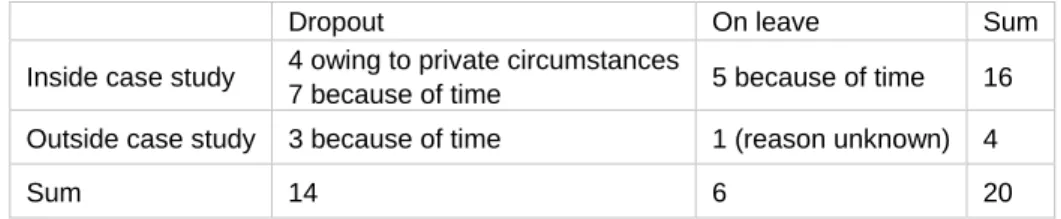
only students who had accepted to participate in the case study received a questionnaire (Q2). Table 1 distinguishes between answers from study active students and from participants in the case study. During the period, the number of study active students decreased to 33, as 20 students either resigned or took a leave.
Table 1: Return frequency of questionnaires.
Q1 Answers Q2 Answers
All students All active students Students in the case study Sum of answers 43 out of 53 15 out of 33 15 of 27
Response rate 81% 45,5 % of all 55,6 % of potential
The two questionnaires covered 30 questions distributed between 6 themes, thus complementing each other. The first three themes in Q1 dealt with factual questions about the students’ previous knowledge of MIL and MIL’s LMS while Q2 asked about the students’ lived experience of being on-line students; the on-line collaboration; and MIL’s pedagogic design. The last three themes in Q1 focused on 1) the students’ impression of their own experience and level of competence in relation to on-line communication, collaboration and the subject matter; 2) the students’ expectations to MIL, their fellow students and the social context of the study (MIL, family, job); 3) “how would you act if”-questions about scenarios dealing with conflict and problem solving and decision-making. Q2 dealt with follow up questions. The questionnaires were made as tables in Microsoft Word, and therefore the input-slots for answers allowed the respondents to use freestyle text. The respondents could choose to elaborate their answers, which all of them did. The questionnaires were analysed using Grounded Theory in Atlas’s (software designed for Grounded Theory Analysis).
A series of questions in Q1 supplemented with information from the students’ personal presentation page in the LMS made it possible to divide the class into three subgroups, 21 novices, 18 experienced and 4 undetermined, according to their competencies as interacting agents in virtual learning environments based on on-line collaboration.
4.1 Interviews
Eight students among the 15 Q2 respondents agreed to participate in a qualitative, explorative
interview (duration 1 hour) conducted as an open conversation framed by a question-guide. The interviews aimed at producing a more in depth narrative of the students’ own impressions and experiences during the first semester supplemented by questions about some of the themes from the questionnaires. As the interviewed students represented all the working-groups, but one, and they often referred to their group, some of the information from the interviews can be extended to all active students, thus compensating for the lower percentage of answers in Q2.
4.2 Findings
4.2.1 Time as an ultimate barrier
Students enrol in MIL with different views on what to expect. All students mention independency of time and space, which is also stressed on MIL’s homepage: “The net-based teaching allows you – from your own computer – to communicate independently of time and place with teachers, tutors, fellow students and administration. Teaching and collaboration are based on flexible, net-based communication ensuring that you will not feel isolated as an on-line student.” (Authors translation from http://www.hum.aau.dk/mil/ 2005, headline: New MIL student?).
Of course, space independency has a high priority for students living abroad, but in general, time-flexibility mattered more to students living in Denmark. Out of 43 students responding to Q1, 18 replied to several questions that they expected time-flexibility in on-line education to be a major advantage, which would ease their workload. For some students, time-flexibility was even crucial for completing an education at all. Although the rest
of the students (25) also saw time-flexibility as an advantage, they did not expect a decrease in workload compared to face-to-face courses. In their answers to other themes in the questionnaires, these 25 students displayed more knowledge about on-line education and experience in collaboration than the 18 time-dependent students. All the remaining 15
respondents in 2003 answered that the workload was much heavier than they originally had expected. They were also surprised to learn that on-line collaboration was not time-flexible at all. There were deadlines to assignments, fixed time-slots for specific activities, and they found that even within the group, time had to be carefully planned and coordinated.
Table 2: Dropout rate and leave-taking registered in the summer 2003.
Dropout On leave Sum
Inside case study 4 owing to private circumstances
7 because of time 5 because of time 16 Outside case study 3 because of time 1 (reason unknown) 4
Sum 14 6 20
Out of the 18 students relying heavily on time-flexibility, 10 dropped out owing to time pressure and another 5 took leave. These 15 students withdrew from MIL during the second semester. 3 students outside the case study also resigned because of time-pressure (according to the group), but as the students were outside the case study, it is not known whether they were dependent on time-flexibility from the beginning. Thus, only 3 time-dependent students out of 18 were able to adjust to the pedagogical design of collaborative on-line learning.
5. Alignment to time-pressure
Also the remaining students at MIL felt the time-pressure. In Q2, all respondents answered that MIL was more demanding than they expected and that the on-line collaborative form was time-consuming. However, they all agreed that the form also is challenging and enriching. This section gives examples of how time affected the remaining students and how they chose to deal with the time pressure both as individuals and in the emerging Community of Practice.
5.1 Adjustment of personal behaviour
The students pointed out that a coherent on-line dialogue implies formalisation and management: fixed meetings, an agenda and a chairperson. When these conditions were not met sufficiently, some students said they felt excluded from the learning process. Some had to control their inclination to comment on contributions because ”The others seem to think it is annoying (read time-consuming, author’s comment), so I try to hold back” (Q2, author’s translation). They all agreed that on-line collaboration requires discipline, language adjustment and shared conventions. Otherwise it takes too long to unravel misunderstandings or conflicts. As it is difficult to prioritize one’s efforts, most students explained that they had adopted a strict and
ordered approach to control their own time. These individual adjustments became part of the individual negotiation about the social conventions and the ongoing mutual constitution of the Community of Practice.
5.2 Adjustment of collaboration and the community of practice
The students found it easy to get used to the technical side of the LMS, and soon even inexperienced students were using alternative on-line communication tools. However, they found it demanding to adjust to the collaborative form. All students stressed that course M1 aiming at training on-line collaboration was successful. They also stressed that experienced fellow students had to support novices in moving from peripheral to full participation (Wenger 1998) in the virtual learning environment and the emerging Community of Practice. Some experienced students showed signs of fatigue towards the collaborative form and what they considered irrelevant contributions in the discussion fora. They called some fellow students chatty or
brawlers. Even though mutual responsibility and support were evident among the remaining students at MIL in 2003, this may indicate signs of strain on the mutual solidarity.
In Q2 and the interviews, most of the respondents answered that they preferred a flexible and negotiating form of collaboration. Such a form fitted the preliminary stages in each learning process where the students had to explore and negotiate the basic understanding of the subject matter. However, the time-pressure demanded a rational and controlled approach leaving little space for wondering and reflection. One respondent wrote that:”... this stuff (read: assignment, authors comment) has to be done as effectively as possible. Therefore, we have to be strictly goal-oriented” (Q2, author’s translation). Others argued that the balance between
collaboration and the time spent on immersion into the subject matter should be adjusted in favour of the latter to improve learning rather than rote learning. In the interview, one respondent said that: “It’s all about reflection, but I haven’t had time to reflect on anything” (interview, author’s translation). One consequence of dealing with the time-pressure by acting in a goal-oriented manner and getting things done was that too many contributions were weak structured and took time to read and comment on. In Q2 and the interviews, the students indicated that the drawbacks were: A time-consuming process, misunderstandings, waiting time, idling, stress, less creativity and obligation. Thus, acting rational towards time-pressure in a learning process may, under strained conditions, turn into a self-increasing process producing more and more weak structured and time-consuming contributions, resulting in more time-consuming management and entanglement of misunderstandings and conflicts.
The goal-oriented tendency can also be seen in the way students coped with the large amount of contributions in the discussion fora and the curriculum (See also Orngreen and Levinsen 2005). Both Q2 and the interviews included the question How do you cope with the contributions and the discussion fora. All the students replied that their strategies of choice were based on rejection rather than additional interests. The overriding criteria was time, which can be subdivide into sub-criteria such as:
Cost benefit choice: Available time and minimum requirements in relation to assignments and course evaluations. Mutual solidarity within the working groups. Rejection of fellow students by choice: Chatty, brawling or boring students. Contributions from other groups (Self communication, see Orngreen and Levinsen 2004).
Rejection of content by choice: Contributions that are not strictly in the student’s own interest. Theory that is not already known unless it is required.
In Innovation - and Learning Organisation Theory, it is well documented that groups and individuals who experience a situation and context as chaotic or coming out of control strive to make order and often establish an inflexible and goal-oriented alternative (Darsø 2001). The students at MIL did not create what is called destructive order. However, if the strain on the participants in collaborative on-line learning becomes too hard, tendencies as observed at MIL might turn into a
self-increasing process leading to more time-pressure, which in turn has a negative effect on the ongoing constitution of the Community of Practice. This situation may lead to lower tolerance towards novice or insecure fellow students, less time to immersion in and reflection on the subject matter, and an increasingly selective and surface approach (Entwistle 2000) to the curriculum. In other words, instead of supporting deep learning, collaborative on-line learning may lead to a surface approach to learning.
5.3 Periods of absence
One assumption about on-line collaboration in written conferences is that: ”... if somebody is absent from the learning environment in periods, it is relatively easy to stay updated on the main activities. Of course it is expected that the participants actually do exploit this option.” (Dirckinck-Holmfeld 2002b. Author’s translation). Due to the evident signs of strain on the students, I asked in the interviews how they would cope with absence e.g. due to illness: “Then I’d be in deep trouble!” (Interview. Author’s translation); “...that is really hard...you can’t stay away for 4-5 days - so being independent of time is disingenuous (Interview, author’s translation). The students argued that it was impossible to stay updated though the LMS. The only way to cope with absence was to make arrangements with the working group, e.g. ensure that they produced overviews and summaries. This is an area in which MIL has displayed a strong development of mutual responsibility in the Communities of Practice as long as the remaining students have had the energy to support the absent fellow student.
If we consider the inexperienced students’ need for support and the view on absence, it becomes clear that under strained conditions, time-pressure and the tendency towards goal-oriented behaviour may lead to cost-benefit considerations marginalizing or excluding students from the programme (see also Lawless and Allen 2003).
5.4 Towards individualisation
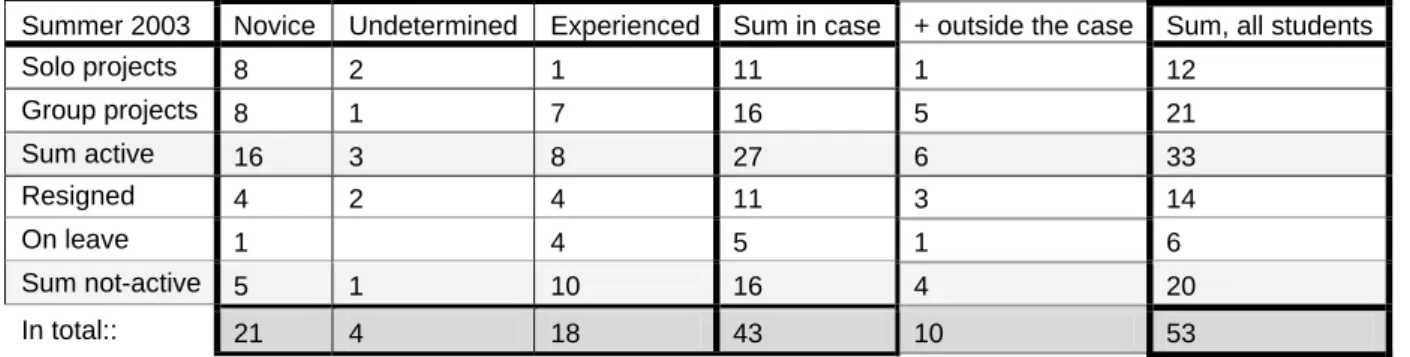
Based on the tendency towards goal-oriented strategies and their possible negative influence on social processes and the learning approach, it was interesting to see whether the combination of the students’ initial competencies and their choice on how to organize the second semester’s project and examination paper showed any patterns.
Table 3: Competence and second semester projects. The information includes basic units from MIL and the table includes all students in the class.
Summer 2003 Novice Undetermined Experienced Sum in case + outside the case Sum, all students
Solo projects 8 2 1 11 1 12
Group projects 8 1 7 16 5 21
Sum active 16 3 8 27 6 33
Resigned 4 2 4 11 3 14
On leave 1 4 5 1 6
Sum not-active 5 1 10 16 4 20
In total:: 21 4 18 43 10 53
Apart from a high frequency of solo projects (11), table 2 shows that it is not a distinct trait for novices to prefer solo projects, just as experienced students do not prefer to take leave. On the contrary, it is a distinct pattern that experienced students prefer group projects, while novices do not take leave, they resign.
Without explaining the tendency Salmon mentions that working alone is a characteristic of level 5 in her five-step model (Salmon 2002 and 2003). Perhaps, students just drop collaboration at a certain stage, or maybe the reason for the high frequency should be found outside MIL. However, it may also be interpreted as a sign of strain from time-pressure affecting the constitution of Communities of Practice over a longer period than one semester. Maybe some experienced students got hit by “virtual fatigue” (as one respondent called it), and maybe some novices never gained enough experience to counterbalance the disadvantages of on-line collaboration with the advantages of learning in a social context.
This means that teachers will benefit when coaching and facilitating collaborative learning if they are able to detect tendencies towards individualisation, virtual fatigue and marginalisation of students in the Community of Practice.
6. Conclusions
There seems to be a dilemma inherent in the design of MIL and collaborative on-line teaching in general. At the outset, MIL is flexible and in accordance with the constructivist understanding of learning and context as a basically floating and unpredictable process. At the same time, the curriculum is large and demanding, and the activities are time-consuming. As a consequence, students must work hard, and no unexpected interference must occur if they want to complete the programme and pass the evaluations. It is a paradox that the students’ individual goal-oriented compensations and negotiations in the Community of Practice increase the
time-pressure. Another paradox is that the interfering events forcing the adjustment of norms (incoherence in discussion, weak structured contributions, etc.) are likely to occur in any floating environment such as the socially constructed practice of an on-line collaborative programme. These events can neither be controlled nor planned, and the best way to cope with unpredictable, but likely to occur events, is to gain an overview providing the participants – including the teacher – with the necessary information to proact accordingly.
The analysis of MIL demonstrates that constructivist pedagogic design models for collaborative on-line education do not - as an inherent quality - support knowledge sharing and deep learning. The constructivist approach frames and supports a learning process as opposed to an Instructional design. But whether an on-line course or education tips one way or the other still depends on how you deal with the context and the slowly emerging social processes. The pedagogic design tends to promote the opposite of its intention, i.e. a rational goal-oriented approach. Moreover, if the participants are under stress, the process becomes self-increasing and enforces choices of rejection and a surface learning approach rather than an explorative, reflective and deep learning approach.
The case study has identified slowly emerging tendencies that might be vital to detect in their early stages monitoring their development. They may point to areas that require the teacher’s awareness. In his book Communities of Practice
(1998, p. 228) Wenger formulates this as follows:
”Learning cannot be designed: it can only be designed for – that is, facilitated or frustrated.”
Once, on-line learning environments have been equipped with adequate proactive teacher tools (Orngreen and Levinsen 2005), such awareness areas may enhance teachers’ awareness of potential critical manifestations during an ongoing
course and support the process of facilitating learning.
Acknowledgements
The author gratefully acknowledges the support from the HCI research group at the Department of
Informatics at Copenhagen Business School and the goodwill of the students and teachers at MIL, who invited me into their world.
References
Benbunan-Fich, R. and Hiltz, S. R. (1999) “Impacts of Asynchronous Learning Networks on Individual and Group Problem Solving: A Field Experiment”, Group Decision and Negotiation, Vol.8, pp409-426.
Bullen, M. (1998) “Participation and critical thinking in on-line university distance education”, Canadian Journal of Distance Education 13(2), pp1-32.
Carell A., Herrmann T., Kienle A. and Menold N. (2005) “Improving the Coordination of Collaborative Learning with Process Models”, Proceedings of the Computer Supported Collaborative Learning Conference – CSCL 2005, 01-04 June, Taipei, Taiwan, ISBN 0-8058-5782-6, [on-line], http://css.cscl2005.org/Threads.aspx?f=124
Cecez-Kecmanovic, D., Webb, C. (2000: “A Critical Inquiry into Web-Mediated Collaborative Learning” in Aggarwal, A. (ed.) Web-Based Learning and Teaching Technologies: Opportunities and Challenges. London: Ideal Group Publishing.
Dillenbourg, P. (2002) “Over-scripting CSCL. The risk of blending collaborative learning with instructional design” in P.A. Kirschner (Ed.), Three Worlds of CSCL. Can we Support CSCL. Heerlen: Open University Nederland, pp64-91. Dirckinck-Holmfeld, L. (2002) ”Designing Virtual Learning Environments Based on Problem Orientated Pedagogy” in
Dirckinck-Holmfeld and Fibiger (eds.) Learning in Virtual Environments, Samfundslitteratur, pp 31-54
Dirckinck-Holmfeld, L. (2002b) ”Projektpædagogiske læringsformer i virtuelle omgivelser”, i Uddannelse, læring og IT © Undervisningsministeriet 2002. [on-line], http://pub.uvm.dk/2002/uddannelse/5.html.
Darsø, L. (2001) Innovation in the Making. Samfundslitteratur. Copenhagen.
Entwistle, Noel (2000) “Promoting deep learning through teaching and assessment: conceptual frameworks and educational contexts”, Paper presented at TLRP Conference, Leicester, November 2000. [on-line],
http://www.tlrp.org/acadpub/Entwistle2000.pdf.
Flyvbjerg, B. (2001) Making Social Science Matter. Why Social Inquiry Fails and How it Can Succeed Again, Cambridge, Cambridge University Press.
Garrison, D.R. (1997) “Computer conferencing: The post-industrial age of distance education”. Open Learning, June, pp3-11.
Gerosa, M.A., Pimentel, M., Fuks, H. and Lucena, C.J.P. (2005) “No Need to Read Messages Right Now: Helping Mediators to Steer Educational Forums Using Statistical and Visual Information”, Proceedings of theComputer Supported Collaborative Learning Conference – CSCL 2005, 01-04 June, Taipei, Taiwan, ISBN 0-8058-5782-6, Available at http://www.les.inf.puc-rio.br/groupware.
Harasim, L., Hiltz, S. R., Teles, L., and Turoff, M. (1997) Learning networks: A field guide to teaching and on-line learning, 3rd ed., MIT Press.
Hayles, N. Katherine (1999) "Virtual Bodies and Flickering Signifiers". How We Became Posthuman: Virtual Bodies in Cybernetics, Literature, and Informatics. Chicago: The University of Chicago Press. pp24-49.
Lawless, N. and Allen J. (2003) ”Methods of Reducing Stress Caused by Online Collaboratin in e-Learning: A Developing Model”, in Proceedings from 2nd European Conference on e-Learning (ECEL 2003), November 2003, Glasgow, pp255-260
Levinsen, K. and Orngreen, R. (2003) "Locating Students' Competencies - A Prerequisite for Collaboration" in Proceedings from 2nd European Conference on e-Learning (ECEL 2003), November 2003, Glasgow, pp261-266. Levinsen K. (2005) “Qualifying on-line teachers - Communicative skills and their impact on e-Learning quality”. The
eighth IFIP World Conference on Computers in Education (WCCE2005), 4 – 7 July 2005, University of Stellenbosch, Cape Town South Africa 2005 (In press).
Ó Murchú, Daithí and E. Sorensen (2004) “Online Master Communities of Practice: Collaborative Learning in an Intercultural Perspective”, European Journal of Open, Distance and E-Learning, 2004/I, [on-line],
http://www.eurodl.org/index.html.
Orngreen, Rikke N. and Karin T. Levinsen (2004) ”Proactive Teacher Tools – Enabling Teachers to Proact During e-Learning Activities”. In (ed.) Dan Remenyi, 3 European Conference on e-Learning, Paris nov. 2004. pp 569 – 579. Orngreen, R, K. Levinsen (2005) “Proactive Teacher Tools for OnlineTeachers”. The eighth IFIP World Conference on
Computers in Education (WCCE2005), 4 – 7 July 2005, University of Stellenbosch, Cape Town South Africa 2005 (In press).
Powers, M., Guan, S. (2000) “Examining the Range of Student Needs in the Design and Development of Web-Based Course” in Abbey, B. (ed.): Instructional and Cognitive Impacts of Web-Based Education. London: Ideal Group Publishing.
Reffay, C. and Chanier, T (2003) “How Social Network Analysis can help to measure cohesion in collaborative distance learning”. Proceeding of Computer Supported Collaborative Learning conference, Bergen, 2003, pp343-352. Salmon, G. (2002) E-moderating: the key to teaching and learning on-line, London, Kogan Page.
Sorensen, E. K. (2002) "Designing for Collaborative Knowledge Building in Online Communities of Practice" in Hansson, H. (ed.): Eight Contributions on Quality and Flexible Learning. Report 1:2002, Swedish Agency for Distance
Education.
Sorensen, E.K., and Takle. G.S. (2003) “Learning through Discussion and Dialogue in Computer Supported
Collaborative Networks”. Society for Information Technology and Teacher Education International Conference Vol. 2003, Issue. 1, pp2504-2510.
Stacey E. (1999) “Collaborative Learning in an Online Environment”. Journal of Distance Education (ISSN: 0830-0445, [on-line] http://cade.icaap.org/vol14.2/stacey.html.
Weinberger, A., Ertl, B., Fischer, F. and Mandl, H. (2005). “Epistemic and social scripts in computer-supported collaborative learning”. Instructional Science, 33 (1), pp1-30.
Wenger, E. (1998): Communities of Practice – Learning, Meaning, and Identity, Cambridge University Press. Zumbach, J. and Reimann, P. (2003) “Influence of feedback on distributed problem based learning” in B. Wasson, S.
Ludvigsen and U. Hoppe (Eds.), Designing for Change in Networked Learning Environment. Proceedings of the International Conference on Computer Support for Collaborative Learning (June 14-18, 2003) in Bergen, Norway. Dordrecht, NL: Kluwer, 219-228.