Sharif University of Technology
Scientia IranicaTransactions A: Civil Engineering www.scientiairanica.com
Study on the failure behavior of three dierent
stabilized problematic soils
E. Aaki
a;, P. Sedighi
band A. Eslami
aa. Department of Civil Engineering, Amirkabir University of Technology, Tehran, Iran.
b. Department of Civil Engineering, Central Teharn Branch, Islamic Azad University, Tehran, Iran. Received 22 July 2012; received in revised form 4 May 2013; accepted 29 April 2014
KEYWORDS Failure criteria; Cement treatment; Shear strength; Soaked condition; Problematic soils.
Abstract. In this study laboratory testing of eectiveness of cement treatment has been made on geotechnical parameters of problematic soils encountered in southern coast line of Caspian Sea, Iran. Gorgan loess, Rasht clay, and Anzali sand were selected in this research. Addition of cement was found to improve workability and increased unconned compressive strength, and elastic modulus of soils signicantly. Triaxial test results indicated that cement treatment not only improved shear strength remarkably, but also it changed the type of failure greatly from ductile to brittle behavior. The large scale direct shear test results showed signicant improvement in shear strength and shear modulus. Besides, the brittle behavior of cement treated samples was observed. Eventually, it was found that the trend of failure envelope of cement treated samples was non-linear, and some failure criteria such as modied Grith theory, Hoek-Brown theory, and the Johnston criterion can describe the soil cement behavior satisfactorily.
c
2014 Sharif University of Technology. All rights reserved.
1. Introduction
In recent years, due to population growth, suitable land for construction has been hard to locate. For improving and optimum use of available soils, great competition among civil engineers has been created. Distribution of problematic soils, those with high moisture and low eciency pose a lot of diculties to construction projects. All improvement techniques seek an increase in density and shear strength, providing stable con-dition, reduction of soil compressibility and control ground water ow, or increasing the rate of consoli-dation [1]. The soil-cement technique has been used successfully in pavement base layers, slope protection for earth dams, as a base layer to shallow founda-*. Corresponding author.
E-mail addresses: [email protected] (E. Aaki);
[email protected] (P. Sedighi); [email protected] (A. Eslami)
tions and to prevent sand liquefaction [2-5]. Many researchers have studied eciencies of soil-cement [6-9]. A recent study has made an extensive laboratory testing of cement treatment eects on shear strength parameters and also estimating failure envelope of soils encountered in southern coastline of Caspian Sea.
2. Testing soils
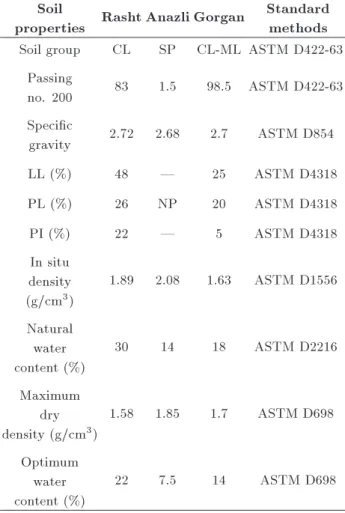
In this study, three dierent soils including Gorgan loess, Rasht clay and Anzali sand from southern coastline of Caspian Sea, have been selected as shown in Figure 1, while the sampling procedure has been conducted in the shallow depths. Soils in the northern parts of Iran are mainly classied as clay, silt, loess and sand. Due to the unique geological condition, water level in these areas is high and soils are mostly satu-rated. Table 1 presents a summary of the geotechnical properties of these soils.
Figure 1. Three dierent zones in southern coast line of Caspian Sea.
Table 1. Geotechnical properties of the testing soils. Soil
properties Rasht Anazli Gorgan
Standard methods Soil group CL SP CL-ML ASTM D422-63
Passing
no. 200 83 1.5 98.5 ASTM D422-63 Specic
gravity 2.72 2.68 2.7 ASTM D854
LL (%) 48 | 25 ASTM D4318
PL (%) 26 NP 20 ASTM D4318
PI (%) 22 | 5 ASTM D4318
In situ density (g/cm3)
1.89 2.08 1.63 ASTM D1556 Natural
water content (%)
30 14 18 ASTM D2216
Maximum dry density (g/cm3)
1.58 1.85 1.7 ASTM D698 Optimum
water content (%)
22 7.5 14 ASTM D698
3. Laboratory testing methods
Laboratory works were carried out on the mixture of soils with dierent percentages of Portland cement type II by 2.5, 5 and 8% of dry weight of soil. Laboratory tests such as standard proctor, Unconned Compressive Strength (UCS), Consolidated-Drained triaxial (CD), and large-scale direct shear tests were performed on both non-treated and cement treated
samples. Soil-cement mixtures were tested to reach an optimum ratio [10-14].
To determine the optimum moisture content and maximum dry density, series of standard proctor tests were carried out on non-treated and cement treated samples of three types of soils, based on ASTM D558 [15] and ASTM D698 [16] standards.
Unconned compressive strength test is the most common test in soil stabilization and plays a great role as an index for quantifying the soil improvement that has been carried out on the specimens based on ASTM D2166 [17]. Treated specimens were also prepared at an optimum moisture content and 95% of maximum dry density for each mixture of 2.5, 5 and 8% cement content by weight, using split mold with inner diameter and height of 5 and 10 cm, respectively. Materials were compacted in the molds in 7 equal layers to achieve desirable density, and it was carefully tried to prepare the most uniform specimens and less disturbance while bringing them out of the mold. For cohesive soils, hydraulic jacks were used to bring the samples out of the mold. However, for non-treated Anzali sand splitting the mold without disturbing the specimen was not possible. The prepared specimens divided into two series. One series of specimens was wrapped in a plastic sheet and kept for 7 days in a controlled room temperature. The second series was kept for 3 days in a humid room at a temperature of 25 degrees and then was immersed in water under soaked condition for 4 days before testing. It should be noted that the soaked condition was not applicable for the third series of non-treated specimens.
For a detailed analysis of shear strength of both natural and cement stabilized specimens, series of Consolidated-Drained triaxial tests (CD) were also conducted on all three types of samples. Conning pressure varied from 50 to 500 kPa. The diameter and height of the split mold were 3.8 and 7.6 cm, respectively. The specimens were then embedded in a triaxial chamber and backpressure was applied until saturation was reached. Specimens were consolidated until the height of water in burette did not rise. Finally, specimens were sheared at a deformation rate of 0.08 mm per minute (strain controlled condition). B values are dependent on the compressibility of soils. Cement treatment decreases the compressibility of soils signicantly. B value for cement treated sand was obtained to be about 0.7, was equal to 0.8 for cement treated loess and clay soils, and 0.9 for both non-treated loess and clay.
Direct shear test was carried out according to the ASTM D3080 [18] as a standard procedure for soil test under consolidated drained condition. Large scale direct shear apparatus with a 300 300 150 mm shear box was used in this study. This test was carried out on the non-treated and cement treated (5 and
8%) sandy soil only. Materials passed sieve No 3=400 and specimens were prepared at 95% of maximum dry density and optimum water content in a steel split mold (300 300 100) and cured for 5 days, then placed in a shear box for 48 hours in water to get full saturation. Vertical pressure was applied for 5 hours and then specimens were sheared at the rate of 0.5 mm/min. Vertical pressure varied from 50 to 200 kPa.
4. Test results and discussion
4.1. Unconned Compressive Strength (UCS) The eect of cement treatment on unconned stress-strain behavior of clay soil for unsoaked and soaked conditions is shown in Figure 2. It is observed that the peak axial stress increases signicantly due to cement treatment, but the corresponding strain decreases from approximately 3.5% to 1.5%. Eect of cement on unconned compressive strength and modulus of elasticity is shown in Figure 3 for both soaked and unsoaked condition. It is observed that the soaked samples with 8% cement content exhibit greater unconned compressive strength compared to the unsoaked samples, but the modulus of elasticity for unsoaked samples is greater compared to the soaked samples. Table 2 presents a summary of unconned compressive strength and modulus of elasticity of the all 3 types of soils for both the unsoaked and soaked conditions.
4.2. Consolidated-Drained triaxial test (CD) Deviator stress versus axial strain, and volumetric strain versus axial strain curves for non-treated and 8% cement treated Gorgan loess at dierent conning pressure are presented in Figure 4. The stress-strain and volume change of non-treated loess typically shows ductile behavior. This was also observed in the bulging
type failure. It can be seen that deviatoric stress increases with an increase in conning pressure and cement addition. By addition of 8% cement, peak deviator stress occurred at about 1.5-2% strain incre-ment and progressive softening observed up to 15%
Figure 2. Eect of cement treatment on stress-strain curves of Rasht clay: a) Unsoaked; and b) soaked. Table 2. Summary of unconned compressive strength test and modulus of elasticity of non-treated and cement treated soils.
Soil type
Cement content (%)
UCS (kPa) E (MPa)
Unsoaked Soaked Unsoaked Soaked Gorgan
loess
0 87.6 0 5.7 0
2.5 515.6 151.4 42.8 11.8
5 1480.6 1166.1 93.2 68
8 2137.4 1816.4 163.3 108.9
Rasht clay
0 112.3 0 4.3 0
2.5 367.8 75 15 0
5 1299.7 1032.6 76.1 40.3
8 1730.8 1919.5 99.3 75.2
Anzali sand
0 5 0 0 0
2.5 103.4 78.1 9 5.1
5 909.3 715.2 63.5 50.5
Figure 3. Eect of cement treatment on Rasht clay: a) Unconned compressive strength; and b) modulus of elasticity.
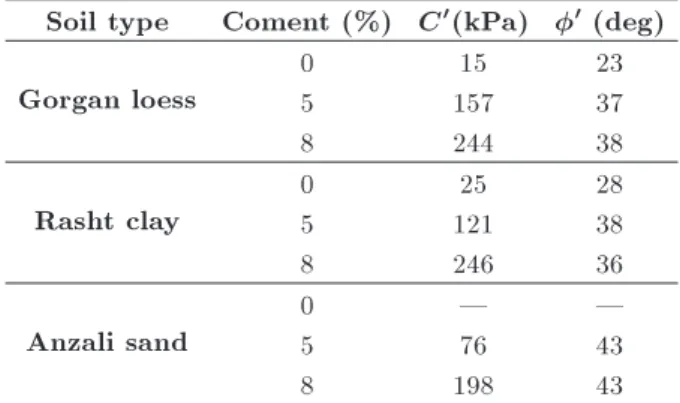
axial strain. These cement treated specimens failed with either single or double shear band (Figure 5). For specimens with 8% cement, failure strain was about 1.2-1.5% and specimens failed with splitting type at low conning pressure, and with planar type at high conning pressures. Volumetric strain-axial strain curves showed a behavior similar to Over-Consolidated (OC) soils. Initial compression up to the failure point and then expansion were observed up to 15% axial strain. Results of triaxial tests on Anzali sand and Rasht clay followed the pattern of Gorgan loess. The strength parameters of all specimens which were obtained from Mohr circles and failure envelope are presented in Table 3. Cement treatment increased the cohesion parameter remarkably, but friction angle increased initially and then decreased (or remained constant) by increasing the cement content.
4.3. Large scale direct shear test
Shear stress versus horizontal displacement curves for non-treated and 5 and 8% cement treated sandy samples for vertical pressures equal to 200 kPa are illustrated in Figure 6. It is observed that peak shear stress increases signicantly due to the cement treatment and progressive softening observed after-ward, but the corresponding shear strain decreased from approximately 3.5% (displacement = 10.5 mm) to 1.7% (displacement = 5 mm). Thus, cement treated soils exhibited brittle behavior compare to non-treated
Figure 4. Results of consolidated-drained triaxial tests for non-treated and 8% cement treated of Gorgan loess.
soils. Table 4 presents the shear strength parameters of non-treated and cement-treated samples of Anzali sand based on Mohr-Coulomb criteria. Results showed that cement treatment led to a high increase in both cohesion and friction angle parameters. It is also obvious that shear modulus corresponding to the peak
Figure 5. Double shear band failure of 5% cement treated loess.
Figure 6. Results of large scale direct shear test for non-treated, 5 and 8% cement treated Anzali sand in v=
200 kPa.
Table 3. Shear strength parameters of all three types of soils obtained from triaxial test.
Soil type Coment (%) C0(kPa) 0(deg)
Gorgan loess
0 15 23
5 157 37
8 244 38
Rasht clay
0 25 28
5 121 38
8 246 36
Anzali sand
0 | |
5 76 43
8 198 43
shear stress increased signicantly due to cement sta-bilization.
5. Failure criteria
Cement treated soils in low-conning pressure exhibit brittle failure and, at very high conning pressures,
Table 4. Shear strength parameters of non-treated and cement treated samples of Anzali sand from large scale direct shear test.
Coment content
(%) C
0(kPa) 0(deg)
0 7 34
5 122 47
8 223 51
mostly show plastic failure [19]. In other words, Mohr-Coulomb failure envelope for cement treated soils is non-linear. Results show that the Mohr-Coulomb criteria, which is presented by Terzaghi [30] and is the basic of soil mechanics development, is valid for only limited range of stresses. Using the shear strength parameters of Terzaghi equation (f = C + tan ') may lead to some anomalies [9]. Several failure criteria such as Grith theory, modied Grith, Johntson criteria and Hoek-Brown failure criterion have been suggested for predicting the failure envelope of soil-cement samples. It must be noted that application of each failure criteria depends on material type and stress conditions.
5.1. Grith and modied Grith crack theory Grith [20] proposed that the failure of brittle mate-rials is governed by the initial presence of microcracks. Under uniaxial and biaxial compression, neglecting the inuence of friction on the cracks when closed, and assuming that elliptical cracks will propagate from the points of maximum tensile stress concentration, a stress criterion is obtained as:
(l 3)2= 8t(l 3) (1)
for 1+ 33> 0
if 1+ 33< 0 then 3= t;
where 1 and 3 are the two principal stresses and t is tensile strength of material. It can be seen from Eq. (1) that the Grith stress criterion predicts a strength ratio of RG = c=t = 8 [21]. When the tensile strength test data are not available, the general approach to estimate rock tensile strength makes use of the correlation between uniaxial compressive strength, c, and tensile strength, t, and applies the generally agreed relationship of c = R:t, where R 10 [22]. Murrell [23] showed that the Grith criterion can be represented in the Mohr plane in term of shear stress and normal stress as:
2+ 4
tn 4t2= 0: (2)
To allow for the frictional resistance on initially closed cracks, McClintock and Walsh [24] proposed a modi-cation of Grith's criterion. Following Brace [25] the
modied criterion in terms of stresses, homogeneous at innity, can be written as:
l
(2+ 1)1 2
3
(2+ 1)1 2 +
= 4t; (3) where is the coecient of joint friction. Brace [25] has shown that the fracture criterion, modied to account for the eects of crack closure in compression which can be represented by a limiting Mohr envelope. This line is straight having the equation in Mohr plane and expressed by Eqs. (4) and (5):
2+ 4
tn 4t2= 0 for n< 0; (4)
= 2t+ n for n > 0: (5)
5.2. Johnston failure criterion
An extensive study by Johnston and Chiu [26] on Melbourne mudstone resulted in a new failure criterion for soft rocks, given by:
0
IN= (MB3N0 + S)B; (6)
where M and B are intact material constant, S is the arameter that accounts for strength of discontinuities of rock or soil, with S = 1 for the intact material. Also, 0
1N and 03N are eective principal stresses at fail-ure, normalized by unconned compressive strength, c.
Based on a broad range of data for clays and rocks, Johnston [27] suggested that Eqs. (7) and (8) can be used to determine the B and M parameters as:
B = 1 0:0172(log c)2; (7)
M = 2:065 + 0:276(log c)2: (8)
5.3. The original Hoek-Brown failure criterion The Hoek-Brown failure criterion is an empirical cri-terion developed through curve-tting of triaxial test data. The conceptual starting point for the criterion was the Grith theory for brittle fracture but the process of deriving the criterion was one of pure trial and error. The original Hoek-Brown criterion was proposed in [28] and is dened as:
l= 3+ p
m3c+ s2c; (9)
where m is a constant depending on the characteristics of the rock mass, s is a constant depending on the characteristics of the rock mass, c is the uniaxial compressive strength of the intact rock material, 1 is the major principle stress at failure, and 3 is the minor principle stress at failure.
The measured shear stress and normal stress values for non-treated, 5%, and 8% cement treated
from triaxial tests are shown in Figure 7. Failure envelope lines including Mohr-Coulomb (obtained from Mohr circles), Grith (Eq. (2)) and modied Grith (Eq. (5)) are also drawn in this gure. Based on the Mean Squared Error analysis (MSE), to dene coecient, it is obvious that predicted shear strength, using modied Grith theory has better agreement with measured shear strength compared with Grif-th Grif-theory. It is clear Grif-that Mohr-Coulomb criteria results for cement stabilized soil are not applica-ble.
Measured normal stresses (3 and 1) and those predicted by Johnston's theory (Eq. (6)) and also Hoek-Brown failure criterion (Eq. (9)) for non-treated and 5% and 8% cement treated specimens for all three types of soils are shown in Figure 8. Values of S parameter were determined by MSE analysis to obtain the lowest MSE value. For Hoek-Brown failure envelope m and s parameters were determined by trial and error regarding to the suggested range of values by Sjoberg [29]. It has been observed that both Johnston and Hoek-Brown criteria based on MSE analysis have a good compatibility with the cement treated test results. But Hoek-Brown cannot be used for non-treated samples under high conning pressures.
6. Conclusions
This study made an extensive laboratory testing for evaluating the eectiveness of cement treatment on shear strength parameters of soils encountered in southern coast line of Caspian Sea. Test re-sults included unconned compressive strength and consolidated-drained triaxialand large scale direct shear. Also failure envelope trend of cement treated samples was discussed by some criteria such as Mohr-Coulomb, Grith, modied Grith theory, the crite-rion suggested by Johnston, and Hoek-Brown failure criterion. According to the test results, the following conclusions can be stated:
Addition of cement led to signicant increase in unconned compressive strength and modulus of elasticity for both soaked and unsoaked samples. Also reduction in failure strain and brittle type of rupture was observed.
Triaxial test results indicated that cement treatment improved shear strength remarkably, but it changes the type of failure greatly from ductile to brittle behavior. 5% cement treated samples displayed pla-nar and 8% cement treated showed both plapla-nar and splitting type of failure according to the conning pressures.
Figure 7. Triaxial test results and predicted failure envelope using Grith, modied Grith and Mohr-Coulomb theories.
the cohesion parameters due to the adhesion and bounding among the cemented soil particles.
Conning pressure has an eective inuence on soil behavior and it is essential to perform triaxial tests
beside other simple and common tests such as UCS, CBR and DST.
Based on MSE analysis, modied Grith theory and Johnson criteria are compatible with obtained
Figure 8. Triaxial test results and predicted failure envelope using Johnston criteria and Hoek-Brown failure criterion.
results. Therefore, the achievements are suit-able for predicting the failure envelope of non-treated and cement non-treated soils. Also Hoek-Brown failure criterion can well describe the failure trend of cement treated soils, but it is not being used for non-treated soils. Moreover, using Mohr-Coulomb criteria for cement treated soils led to
a number of errors and high values of friction angles.
References
1. Moseley, M.P. and Kirsch, K., Ground Improvement, 2nd Edition, Spon Press, London (2004).
2. Ingles, O.G and Metcalf, J.B., Soil Stabilization-Principles and Practice, Butterworths Pty. Limited, Australia (1972).
3. Dupas, J.M. and Pecker, A. \Static and dynamic
properties of sand-cement", J. Geotech. Eng. Div., 105(3), pp. 419-436 (1979).
4. Porbaha, A., Shibuya. S. and Kishida, T. \State of the art in deep mixing technology", Part III- Geomaterial Characterization, Ground Improvement, J ISSMGE4, 3, pp. 91-110 (2000).
5. Thome, A., Donato, M., Consoli, N.C. and Graham, J. \Circular footings on a cemented layer above weak foundation soil", Can. Geotech., J., 42, pp. 1569-1584 (2005).
6. Uddin, K., Balasubramaniam, A.S. and Bergardo,
D.T. \Engineering behaviors of cement-treated Bangkok soft clay", Geotechnical Engineering Journal, 28(1), pp. 89-119 (1997).
7. Lo, S.R. and Wardani, S.P.R. \Strength and dilatancy of a stabilized by a cement and y ash mixture", Cana-dian Geotechnical Journal, 39(1), pp. 77-89 (2002).
8. Lorenzo, A.L. and Bergado, D.T. \Fundamental pa-rameters of cement-admixed clay - new approach", Journal of Geotechnical and Geoenvironmental Engi-neering, ASCE, 130(10), pp. 1042-1050 (2004).
9. Sariosseiri, F. and Muhunthan, B. \Interpretation of geotechnical properties of cement treated soils", Pro-ceedings of Geocongress, Washington State University, 134 (2008).
10. Mitchell, J.K. \Soil improvement-state-of-the-art re-port", Proceedings of 10th International Conference on Soil Mechanics and Foundation Engineering, In-ternational Society of Soil Mechanics and Foundation Engineering, Stockholm, pp. 509-565 (1981).
11. Schnaid, F., Prietto, P.D.M. and Consoli, N.C. \Pre-diction of cemented sand behavior in triaxial compres-sion", Journal of Geotech. Geoenviron. Eng., 127(10), pp. 857-868 (2001).
12. Consoli, N.C., Rotta, G.V. and Prietto, P.D.M.
\Yielding-compressibility-strength relationship for an articially cemented soil cured under stress", Geotech-nique, 56(1), pp. 69-72 (2006).
13. Consoli, N.C., Foppa, D., Festugato, L. and Heineck, K.S. \Keyparameters for strength control of articially cemented soils", Geotech Geoenviron Eng., 133(2), pp. 197-205 (2007).
14. Fonseca, A.V. and Consoli, N.C. \Strength properties of sandy soil-cement admixtures", Geotech. Geol. Eng., 27, pp. 681-686 (2009).
15. ASTM D558 \Standard test method for
moisture-density relations of soil-cement mixtures", ASTM In-ternational, West Conshohocken (1996).
16. ASTM D698 \Standard test method for laboratory
compaction characteristics of soil using standard eort (12,400 ft-lbf/ft3(600 kN-m/m3))1", ASTM Interna-tional, West Conshohocken (1998).
17. ASTMD 2166 \Standard test method for unconned
compressive strength of soil", ASTM International, West Conshohocken (1998).
18. ASTM D 3080 \Direct shear test od soils under consol-idated drained conditions", ASTM International, West Conshohocken (1998).
19. Abboud, M.M. \Mechanical properties of
cement-treated soils in relation to their use in embankment construction", Ph.D Dissertation, University of Cali-fornia, Berkeley (1973).
20. Grith, A.A. \Theory of rupture", Proceedings of the First International Congress for Applied Mechanics, Delft, J., Waltman Jr., 1255, pp. 55-63 (1924).
21. Cai, M. \A simple method to estimate tensile strength and Hoek-Brownstrength parameter mi of brittle rocks", 3rd CANUS Rock Mechanics Symposium, Toronto (2009).
22. Sheorey, P.R. \Empirical rock failure criteria", Rotter-dam: A.A, Balkema, 176 pages (1997).
23. Murrell, S.A.F. \Mechanical properties of non-mettalic brittle materials", London, p. 123 (1958).
24. McClintock, F.A. and Walsh, J.B. \Friction on Grith cracks in rocks under pressure", Proceedings of Fourth U.S. National Congress on Applied Mechanics, 2, pp. 1015-1022 (1962).
25. Brace, W.F. \An extension of Grith theory of
fracture to rocks", Journal of Geophysical Research, 65(10), pp. 3477-3480 (1960).
26. Johnston, I.W. and Chiu, H.K. \Strength of weathered Melbourne mudstone", Journal of Geotechnical Engi-neering, 110(7), pp. 875-898 (1984).
27. Johnston, I.W. \Strength of intact geomechanical ma-terials", Journal of Geotechnical Engineering, 111(6), pp. 730-749 (1985).
28. Hoek, E. and Brown, E.T., Underground Excavations in Rock, London Institution of Mining and Mettalurgy (1980).
29. Sjoberg, J. \Estimating rock mass strength using the Hoek-Brown failure criterion and rock mass classi-cation - A review and appliclassi-cation to the aznalcollar open pit", Internal Report 1997:02, Devision of Rock Mechanics, Lulea University of Technology, Sweden (1997).
30. Terzaghi, K., Theoretical Soil Mechanics, New York, Wiley, ISBN 978-0-471-85305-3 (1942).
Biographies
Esmail Aaki received his Bachelor and Master degrees in Engineering Geology and Geotechnics from McGill University, Canada, in 1980, and his PhD in Geotechnical Engineering from University of Newcastle Upon Tyne, U.K. in 1996. From 1980 to 1984, he was working in Geotrchnical department, Laboratory of soil mechanics, Ministry of Road and Transportation.
From 1984 to present he has been working as a member of academic sta in the department of Civil and Environmental Engineering, Amirkabir University of Technology. He is now teaching Engineering Geology, Advance Engineering Geology and Site Investigation courses. He has three published books and several journal and conference papers.
Pouya Sedighi. His biography was not available at the time of publication.
Abolfazl Eslami received his PhD degree in Geotech-nical Engineering from the University of Ottawa,
Canada, in 1997. He is an Associate Professor in Geotechnical Engineering at Amirkabir University of Technology (AUT). He was Assistant Professor in Civil Engineering Department at University of Guilan from 1997 to 2008. His research interests are mainly in deep and shallow foundations, soil modication, in-situ testing in geotechnical practice, supported and unsupported excavations. His publications are more than 15 ISI journal papers, 22 national journal papers, 30 international conference papers, 15 national confer-ence papers and 5 text books and handbooks in foun-dation engineering, deep founfoun-dation and geotechnical engineering.