ISSN: 2251-8436
ACTION OF G AND M ON Q(√m) AND
ALGORITHMIC IMPLEMENTATION FOR GROUP ACTIONS
F. AFZAL, I. S. BHATTI AND M. A. MALIK
Abstract. This paper calls for a relationship among the actions of groups G and M onQ(√m). It characterized several significant elements of G in terms of generators of M and vice versa. In this way we cultivate a correlation between the rudiments of these two modular groups. This will help us in discovering various G and M-Subsets of Q(√m). We have also generated an algorithm by using Visual Basic for calculating the congruence classes of different Moduli and manipulating the group actions.
Key Words: Mobius Groups, Quadratic Fields, Generators, Group Action.
2010 Mathematics Subject Classification: Primary: 05C25, Secondary: 11E04, 20G15.
1. Introduction
The study of groups through their actions on different sets and alge-braic structures has grown into a very worthwhile technique. Mobius groups have always been of keen attention in finding group actions on quadratic fields. G Higman familiarized coset diagrams for presenting the action of Modular groups on number fields. Qaiser Mushtaq laid Received: 6 May 2012, Accepted: 25 July 2012. Communicated by Yuming Feng and A. Yousefian Darani
∗Address correspondence to F. Afzal; E-mail: farkhanda [email protected] c
2012 University of Mohaghegh Ardabili.
the foundation and established it further. The theory of congruence was introduced by Card Friedrich Gauss (1777-1855) one of the greatest Mathematicians of all times. Although, Pierre De Fermat (1601-1665) had earlier studied number theory. Thecongruenceis nothing more than a statement of divisibility. However, it often helps to discover proofs and we realize that congruence advocates new ideas to resolve the problems that will lead us to further motivating philosophies. We have also used congruence classes to explore the action of Mobius groups on the real quadratic fields.
This paper is concerned with the investigation of real quadratic fields
Q(√m) under the actions of two important Mobius groups G and M given below:
G=hx,´ y´; ´x2= ´y3 = 1i
where ´x(α) = −α1 and ´y(α) = α−α1 are linear fractional transforma-tions.
M =hx, y;x2 =y6= 1i
where x(α) = −3α1 and y(α) = 3(1+−1α) are linear fractional transforma-tions.
The actions of groups G and M on Q(√m) have yielded certain valu-able and elegant results. G Higman and Mushtaq proved that Q∗(√n) is invariant under the action of G. Mushtaq and Aslam [12] studied an action of infinite Mobius group M on the projective real line over real quadratic field. M. Ashiq in [6] studied an action of two generator group on a real quadratic field. M. Aslam Malik and M. Riaz [11] explore proper G-Subsets ofQ∗(√n).In [3 ]the classification of the real quadratic irrational numbers (a+√n)/c of Q∗(√n) with respect to modulo3r is provided. M. Aslam Malik et al [9, 10] have studied various properties of groups G and M. Aslam et al [9] have proved that the subsetsQ000(√n)
and Q∗∗∗(√n) ofQ(√m) are M-Subsets of Q(√m)S
{∞}.
Therefore it turn out to be motivating to discover the relationship between the action of different Mobius groups. So we started with the groups G and M acting on quadratic fields. Thus we established a cor-relation among the actions of both groups.
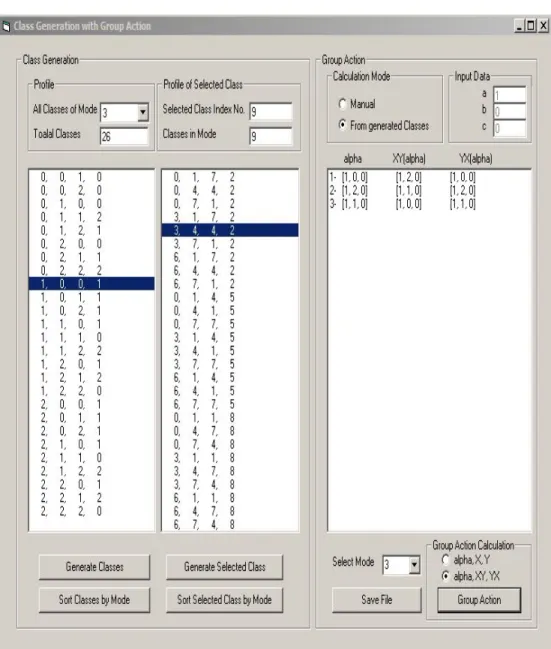
Secondly to produce the classes of different modes and to compute group actions by hand is very hectic, tedious and time consuming ac-tivity. This cumbersome activity can be resolved if computer is used for calculations. Therefore we make a computer program by using Vi-sual Basic to resolve this problem. Main interaction manual for Class Generation andGroup Action Calculations is given in Figure1. Now we have some important definitions which are required for our subsequent sections.
Definition 1.1. An algebraic integer of the form a+b(√m) where m is a square free, form a Quadratic Field and is denoted by Q(√m). If
m > 0 thenQ(√m) is called Real Quadratic Field. If m <0 then it is called Imaginary Quadratic Field.
Definition 1.2. Every Real Quadratic Irrational number can be rep-resented uniquely as a+
√ n
c with a non-square positive integer n, where
a,a2−nc and c are relatively prime integers.
Definition 1.3. If n = k2m and k > 0 be an integer then we have following definitions:
Q∗(√n) :={a+ √
n
c :a, b:=
a2−n
c , c∈Zand(a, a2−n
Q000(√n) ={α/t;α∈Q∗(√n);t= 1,3}; and
Q∗∗∗(√n) ={(a+ √
n)
c ∈Q
∗(√n) : 3|c}.
2. RELATIONS BETWEEN THE ELEMENTS OF GROUP G AND GROUP M
The following table gives images of elements of Q∗(√n) under the actions of groupG=hx,´ y´; ´x2 = ´y3= 1i
α a b c
´
x(α) (−1)/α −a c b
´
y(α) (α−1)/α −a+b −2a+b+c a
´
y2(α) 1/(1−α) −a+c c −2a+b+c
´
xy´(α) α/(1−α) a−b b −2a+b+c
´
xy´2(α) α−1 a−c −2a+b+c c
´
yx´(α) α+ 1 a+c 2a+b+c c
´
y2x´(α) α/(1 +α) a+b b 2a+b+c
The table below provides images of elements of Q∗(√n) under the actions of groupM =hx, y;x2=y6 = 1i.
α a b c
x(α) (−1)/3α −a c/3 3b
y(α) (−1)/3(α+ 1) −a c/3 3(2a+b+c) y2(α) −(α+ 1)/(3α+ 2) −5a−3b−2c 2a+b+c 12a+ 9b+ 4c y3(α) −(3α+ 2)/(3(2α+ 1) −7a−6b−2c (12a+ 9b+ 4c)/3 3(4a+ 4b+c)
y4(α) −(2α+ 1)/(3α+ 1) −5a−6b−c 4a+ 4b+c (6a+ 9b+c)
y5(α) −(3α+ 1)/3α −a−3b (6a+ 9b+c))/3 3b
xy(α) α+ 1 a+c 2a+b+c c
xy2(α) (3α+ 2)/(3(α+ 1)) 5a+ 3b+ 2c (12a+ 9b+ 4c)/3 3(2a+b+c)
xy3(α) (2α+ 1)/(3α+ 2) 7a+ 6b+ 2c 4a+ 4b+c 12a+ 9b+ 4c xy4(α) (3α+ 1)/(3(2α+ 1)) ((6a+ 9b+c))/3 (6a+ 9b+c)/3 3(4a+ 4b+c) xy5(α) α/(3α+ 1) a+ 3b b 6a+ 9b+c
yx(α) α/(1−3α) a−3b b −6a+ 9b+c y2x(α) (1−3α)/3(−1 + 2α) 5a−6b−c (−6a+ 9b+c)/3 3(−4a+ 4b+c) y3x(α) (1−2α)/((−2 + 3α)) 7a+ 6b+ 2c −4a+ 4b+c −12a+ 9b+ 4c
y4x(α) (2−3α)/3(−1 +α) 5a−3b−2c (−12a+ 9b+ 4c)/3 3(−2a+b+c)
3. SOME ELEMENTS OF GROUP M IN TERMS OF GENERATORS OF G
At first we represent the elements of group M in terms of words of elements in G. Every element of M is a word in the generatorsx, y∈M. Letx, y∈M and ´x,y´∈Gbe the generator of G. Clearly we have:
(1) x= 3(´1x), and (2) y= 3(´x1y´)´x
Thus the generators of M are represented in the form of generators of G. In addition to that we have the following identities.
Theorem 3.1. Forx,´ y´∈Gand x, y∈M we have: (1) y2 = (´xy´2)(´xy´2)(´x).
(2) y3 = 1/3(´xy´2)(´xy´)(´xy´2)(´x). (3) y4 = [(´xy´)2(´xy´2)(´x)]2. (4) y5 = 1/3(´xy´2)(´xy´)(´xy´)(´y2x´). Proof. 1) Letα∈Q∗(√n) :={a+
√ n
c :a, b:= a2−n
c , c∈Zand (a, a2−n
c , c) = 1}andG=hx,´ y´; ´x2= ´y3 = 1i. Then ´x(α) =−1/αand (´xy´2)(α) =α−1 by Table 1. We have (´xy´2)(´x)(α) =−1/α−1. Hence⇒(´xy´2)(´x)(α) =
−(α+1)/α. Since (´xy´)(α) =α/(α−1), we conclude that (´xy´)(´x)´y2)(´x)(α) =
−(α+1)/(2α+1). That is (´xy´)2(´xy´2)(´x)(α) =−(α+1)/3(2α+1). There-fore (´xy´)2(´x)´y2)(´x)(α) =y2(α). Thus we have y2 = (´xy´)2(´xy´2)(´x).
2) Since (´xy´2)(α) =α−1, and ´x(α) =−1/αwe have: (´xy´2)(´x)(α) =−1/α−1
⇒(´xy´2)(´x)((´xy´2)(´x)(α)) =−(α+ 1)/α ⇒(´xy´)(´xy´2)(´x)(α) =−(α+ 1)/(2α+ 1)by (1)
⇒(´xy´)2(´xy´)(´xy´2)(´x)(α) =−(α+ 1)/(2α+ 1)−1
⇒(´xy´)2(´xy´)(´xy´2)(´x)(α) =−(3α+ 2)/(2α+ 1) Thus 1/3(´xy´)2(´xy´)(´xy´2)(´x)(α) =−(3α+ 2)/3(2α+ 1). Now
⇒y3 = 1/3(´xy´)2(´xy´)(´xy´2)(´x).
The proofs of (3) and (4) are similar.
Following are immediate consequences of Theorem 3.1.
Corollary 3.2. For the generators x, y of M and x,´ y´of G we have: (1) y= ´yx´
(2) xy2 = 1/3(´yx´)2(´y2x´). (3) xy3 = (´y2x´)(´yx´)(´y2x´). (4) xy4 = 1/3(´yx´)(´y2x´)2. (5) xy5 = (´y2x´)3.
Corollary 3.3. For x, y∈M andx,´ y´∈Gwe have: (1) yx= 1/3(´xy´).
(2) y2x= (´xy´)2(´xy´2).
(3) y3x= 1/3(´xy´2)(´xy´)(´xy´2). (4) y4x= (´xy´)2(´xy´2)(´x)(´xy´2). (5) y5x= 1/3(´y2x´)3.
Therefore, using Theorem 3.1, Corollary 3.2 and Corollary 3.3 the action of the groupM in terms of the elements ofGcan be acquired.
4. SOME ELEMENTS OF GROUP G IN TERMS OF GENERATORS OF M
The elements of the group Gcan also be written as the words of M. Since ´x,y´ ∈ G are the generators of the group G so at first we will represent these in terms of generators x, y of M. Obviously ´x = 3x
and ´y= (3x)(3y)(3x) and follows from Tables 1, 2. Thus by the above relation we have ´y2 = [(3x)(3y)(3x)]2. Using the above identities, we can have following Theorems:
Theorem 4.1. Let x,´ y´∈Gand x, y∈M , then (1) x´y´= 3(yx)(1/3).
(3)´yx´=xy .
(4) y´2x´= 3(y2x)(1/3).
Proof. 1) Letα∈Q∗(√n). Since (yx)(α) = 1−α3(α), by Table 2, we have (yx)(α/3) = (α/3/(1−α)). So (yx)(α/3) = (13)(1−αα ). Therefore:
3(yx)(α/3) = (α/(1−α))
⇒3(yx)(α/3) = ´xy´(α)
⇒3(yx)(1/3)(α) = ´xy´(α)
⇒x´y´= 3(yx)1 3. 2) ´xy´2(α) =y5x(α) by Tables 1,2.
The proofs of (3) and (4) are similar.
Thus by knowing the rudiments of one of the groups, we can find the actions of other group. By this way, finding actions have become very tranquil. So one can implement this relationship for finding more
G-subsets and it will help in discovering properM-Subsets ofQ(√m). 5. COMPUTER PROGRAM FOR CLASS GENERATION
AND GROUP ACTION CALCULATIONS
Generation of congruence classes of different moduli and to compute Group Actions by hand is very hectic, tedious and cumbersome activity. This cumbersome activity can be resolved and lessened if computer is used for calculations. Programming language Visual Basic has a fun-damental role to surmount this task, after initial algorithm study and according to the problem requirements Visual Basic is selected to code the problem. The selection of Visual Basic is obvious due to its ease of Graphical User Interface capabilities and easy coding. The main inter-action panel of the code is show below in figure 1.
This code has two major frames. One forClass Generation and other is for Group Action. In the class generation frame, Congruence classes of different modes can be generated; classes of mode 3, 9, 27 and 81 can
Figure 1. The Manual for Class Generation and Group
be generated using this code. In the second Group Action frame, action of classes is calculated. Two methods are available for calculating the Group Action, first one is manual and the second one is from generated classes. The result of Group Action is available as alpha, X, Y and al-pha, XY, YX.
Example 5.1. To generate the classes of Mode 3, select 3 in all classes of Modepull down list and then press thegenerate classes push button, all the classes of mode 3 will be displayed in the list 1. As show in figure above all the classes of mode 3 are displayed. To display classes of mode 9 for each generated classes of mode 3. Put cursor on any parent generated class and press the generate selected classes push button, then all next level mode classes will be generated and displayed in List 2. In the figure [1, 0, 0] class of mode 3 is selected and to generated the classes in mode 9 press generate selected classpush button, all the classes of mode 9 will be displayed in List 2. Both the parent classes and child classes for example classes of mode 3(the parent class) and mode 9 (the child class) can be sorted by pressing the sort classes by mode and sort selected classes by mode push buttons respectively. Similarly all the classes of mode 9, 27 and 81 are generated as parent classes and their child classes can be generated and displayed in List 1 and List 2 respectively.
Example 5.2. If we want to calculate the Group Action of class [1, 0, 0] manually, then select the manual radio button and put the values of class [1, 0, 0] in the text boxes a, b and c. [1, 0, 0] is a class of mode 3, we can have the action of this mode 3 in mode 3, 9, 27 and 81, these modes can be selected from thepull down list button select mode. The Action of Group can be calculated as alpha, X, Y or as alpha, XY, YX, which can be selected from the Group Action calculation radio button. In the Group Action calculated shown above in the figure alpha, X, Y radio button is selected. To calculate the Group Action presses the Group Action push button. The action of class [1, 0, 0] over mode 3 is shown in
the list 3. We can also store this group action result in a file for further analysis in the file system.
Conclusion
We conclude the paper with the remarks that after having the relation-ship among elements of two Mobius groupsGandM one can find their actions in a tranquil way and more G-subsets and M-subsets can be explored with the help of this relationship. Secondly computing group actions and finding congruence classes of different moduli has become relaxed by using the algorithm presented.
Acknowledgments
The authors wish to thank the anonymous referees for their helpful com-ments. Our paper is improved after making corrections and adaptations according to referee’s guidelines.
References
[1] David I Schneider,An introduction to programming using Visual Basic 6.0, Pren-tice Hall, (1999).
[2] D.M. Burton, Elementary Number Theory, Tata McGraw-Hill publishing com-pany Limited, (2007).
[3] F. Afzal, Q. Afzal and M. Aslam Malik,A Classification of the Real Quadratic Irrational Numbers, a+
√ n c of Q
∗
(√n) w.r.t, Modulo 3r,, International Mathe-matical Forum,7(2012), 1915-1924.
[4] J.S. Rose,A Course on Group Theory, Dover Publications Inc. New York, (1994). [5] M Ashiq,Action of a Two Generated Group on Real Quadratic Fields, Southeast
Asian Bulletin of Mathematics,30(2006), 399-404.
[6] M. Aslam,Intransitive action of< y, t;y4=t4= 1>acting onQ(√n), PUJM,
35(2002), 1-6.
[7] M. Aslam, Q. Mushtaq, T. Masood and M. Ashiq, Real Quadratic irrational numbers and the group < x, y;x2 = y6 = 1 >, Southeast Asian Bulletin of Mathematics,27(2003), 409-415.
[8] M. Aslam Malik, S. M. Husnine and A. Majeed,Action of a groupM =< x, y: x2=y6= 1>on Certain Real Quadratic Fields, Punjab University Journal of Mathematics,44,(2012),1-7.
[9] M. Aslam Malik and M. Asim Zafar, Real Quadratic Irrational Numbers and Modular group Action, Southeast Asian bulletin of Mathematics,35(2011), 439-445.
[10] M. Aslam Malik and M. Riaz,G-subsets and G-orbits ofQ(√n)under action of the Modular Group, Punjab University Journal of Mathematics,43(2011), 75-84. [11] Q. Mushtaq and M. Aslam, 1997, Transitive action of a two generator group on rational projective line, Southeast Asian Bulletin of Mathematics,1(1997), 203-207.
[12] Q. Mushtaq and M. Aslam,Group Generated by Two Elements of Orders Two and six acting on R andQ(√n), Discrete Mathematics,179(1998), 145-154.
F. Afzal
School of Mathematics and System Sciences, Beihang University, P.O. Box 100191 Beijing, China
Email: f arkhanda [email protected]
I. Shaban Bhatti
School of Material Sciences and Engineering, Beihang University, P.O. Box 100191 Beijing, China
Email: imran [email protected]
M. Aslam Malik
Department of Mathematics, Punjab University, P.O.Box 54590, Lahore, Pakistan