
On the rate of growth of Cardium edule. Part I. Experimental obvservations
42
0
0
Full text
(2) 240. J. H. ORTON.. INTRODUCTION. IN continuation of the writer's work* on the rate of growth in Invertebrates generally a definite experiment was begun during 1919 to obtain detailed information on the rate of growth of the common cockle, Cardium edule. The plan of the experiment was to mark a representative collection of cockles and keep the same individuals under close monthly observa~ tion. As the cockle beds near Plymouth are regularly fished, it was regarded as essential that the marked cockles should be kept in a box, which could be closed by a lid in order tha_t there should be no doubt about recovering the same cockles during the period of the experiment. Accordingly a box, 6 feet by .~ feet § jnc_h~s by 1 foot, with an entire boarded bottom, but with the sides and top made of strong perforated zinc, with holes not more than 6 mm. in diameter, was designed and made, and fixed to stakes driven into the bed of the river (see Fig. 1, A and B). A full description of the experimental box is given on page 277. The box was entirely successful, and enabled the growth of the marked cockles to be observed. The experiment was begun under the difficult post-war conditions in August, 1919, and monthly observations were made until October, 1920, when continuous work on the problem had to be abandoned owing to the necessity of taking up more urgent work, but occasional observations were afterwards made to 1923 as opportunity arose. The essential plan of the work was to observe the rate of growth of a constant population of Cardium in the sea; to find out the significance of the concentric grooves or rings on the shells of some mollus9-of which Cardium is a convenient type-since these grooves are commonly regarded as marking a cessation of growth in the winter period; to observe the rate of growth of small and medium sized individuals from the time of marking the shells with a filemark, through summer and winter periods, while at the same time collecting as much information as possible about the general environmental conditions; and to obtain data on the growth of the shell in Cardium edule to compare with results from all ot~er regions where this species is found. THE SITE OF THE EXPERIMENTAL Box.. The site of the box was chosen on the lower part of the cockle beds in the middle of the main stream of the River Yealm, about half a mile northeast of Steer Point. The exact tide-level of the site has not been accurately * Contribution to an Evaluation of the Sea, Journ. Mar. Bio!. Assoc., Vol. X, No.2, p. 312, 1914..
(3) ". FIG.. 1.. A. B. VIEWS OF THE EXPERIMENTAL Box. Phows A. J.. Smith,. IN THE BED OF THE RIVER YEALM.. A. View of the open box showing details of the construction and the stream [nd mud fiat in the background. B. Showing the closed box and details of construction; the lid of the box is protected with wire-netting..
(4) I ..
(5) RATE. OF GROWTH. OF CARDIUlIf. EDULE.. 243. determined; it is estimated as being about 3 feet above low-water level, ordinary springs. The bed of the river where the box was fixed is of sandy gravel, and is only about 30 yards wide at this point before rising on each side into mud-banks. The box did not dry in neap tides but remained exposed at good spring tides for three to four hours, when rain had not recently fallen heavily. After recent heavy rains the box did not dry at tides rather less than ordinary spring tides, as the conformation of the estuary renders it difficult for a spate to make its way quickly out to sea. Fresh water was found running close by the box at low water even in summer in the absence of recent rains, hence cockles on the beds and in the box would experience great changes of salinity from 0 to well above 30 per mille. The cockles in the stream, which never dried, would undoubtedly experience more fresh water than those in the part of the bed which dried (see Fig. 1, p. 241) and more than those in the box. There would, however, be practically no difference in the time of exposure of cockles in the bed and in the box, as the tide at the turn rises to and submerges the beds and the box in from ten to fifteen minutes; while working on the beds it was imperative to cease work and pack up in haste as soon as the tide reached the bottom of the box. The perforations in the zinc were large enough to permit a good circula tion of water through the box, and to keep them clear of mud, which, however, accumulated in the bottom of the box to the level of the holes (4 inches) in about three months, and remained until cleared out. Besides the mud which settled in the box the young or larvre of various animals found entrance and grew to adult or a large size; for example, Nereis, Nephthys, Arenicola, Syndosmya, Scrobicularia, Mytilus, and especially the common shore-crab, Carcinus mamas, and a fair amount of the spat of Cardium edule itself, as it was hoped would be the case. The common shore-crab is a great enemy of small cockles particularly, as was unfortunately not realised in the early stages of the experiment, and about a dozen crabs at a time found sufficient food in the confined space of the box 6 feet by nearly 4 feet to grow in a short time to medium size. Balanus balanoides-and a few B. perforata-grew in profusion on the top of the inside of the box, as also did Campanularia, Bowerbankia and Alcyonidium, while a fair number of Balanus, a little Fucus and DIva, and Porphyra at times in abundance, grew on the outside of the box..
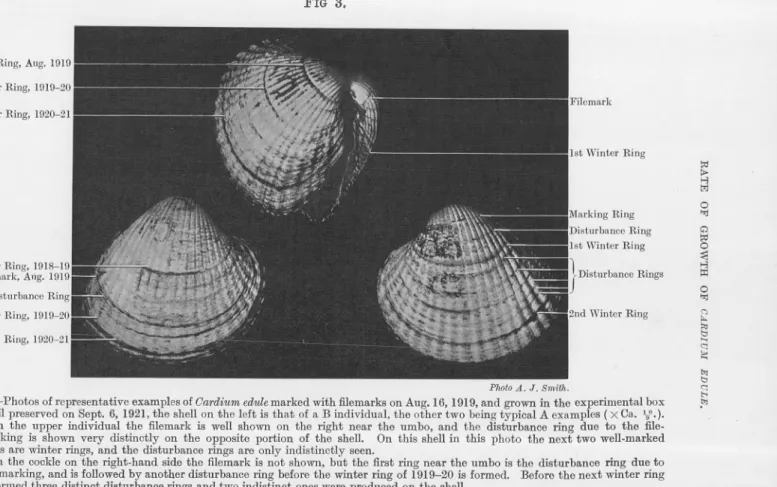
(6) --~--. 244. -. -. ~~. J. H. ORTON. THE MAIN EXPERIMENT. MATERIAL AND METHODS.. The box was fixed in the river, and the experiment begun on August 16, 1919. The beds had previously been explored and a sample of tiny cockles-with clear shells, that is, without rings of any kind, were accumu-I lated, along with a sample of medium sized cockles with one well-marked -and presumed-winter ring. Each cockle was marked with a filemark in one, two, OJ:three places, viz. anteriorly, posteriorly, and ill the median ventral line in each case, so as to cut the growing edge of the shell. By this means it would be possible to measure the subsequent growth in either length or height, or both; lengths were, however, measured mostly during the experiment, owing to the limited amount of time available at low water to obtain all the information about the bed necessary at each visit. The beds were visited monthly from August, 1919, to October, 1920-except for January-and the marked cockles taken out and measured at each visit, while the growth of similar individuals on the beds was also noted and collections made and preserved -as controls on the marked individuals-for detailed measurements later. After the first few months, when mud had accumulated in the box, the cockles had to be found by searching in the mud with one's fingers; in this way a few each time were liable to escape detection, and little ones were very difficult to find. It was soon found that the mere fact of taking the cockles out of the box, handling them, and keeping them on the improvised field-bench for an hour, a little more or less, was enough to cause the cockles to form a distinct ring on the shells (see Figs. 3 and 6, pp. 251 and 259). From these rings, which I have called" disturbance rings," it was usually possible, in the smaller individuals, to measure the amount the cockle had grown even since the last monthly visit to the box. I. THE MEASUREMENT OF THE SHELL.. The chief dimension of the shell adopted for an expression of the growth is that of the length, and is the maximum distance between tangents to the anterior and posterior borders of the shell, that is to say, the maximum dimension in an antero- posterior line. The height and width of shells have also been measured for the determination of arithmetical ratios between all dimensions, but for the preliminary discussion on the rate of growth it will be sufficient to take length as a criterion. It is essential, however, to bear in mind that a small increment in length in the larger cockles (ca. 30 mm.long) indicates a relatively large increase.
(7) RATE. OF GROWTH. OF OARDIUJI. EDULE.. 245. in total growth. The weights of shells at different sizes will also be discussed later. The measurement of length, height, and width was taken with steel Starrett right-angled calipers scaled to half a millimetre, and was read to the nearest T\rth of a millimetre by eye-estimation. These readings are probably correct to ith of a millimetre, but in the preliminary discussion the cockles are all considered in millimetre groups; for example, all cockles measuring 10.0 to 10.9 mm. are plotted in the 10 mm. group, and so on. The original size of the marked shells, and the size of disturbance and winter rings, was taken by fine Stanley dividers and read off on an ivory Stanley scale, engine-divided in !th of a millimetre. Those readings are probably reliable to only 0.4 millimetre, and have all been taken by the writer himself. THE RATE OF GROWTH OF THE MARKED CARDIUM.. The rate of growth of the marked Cardium is well shown in the series of graphs 1 to 13 in Fig. 2, p. 246, and Table I, p. 248, which give the history of the cockles surviving at each monthly visit to the box from August, 1919, to October, 1920 (except for January), and the visit on September 6, 1921. The original lengths of the cockles are shown (in mm. groups) in the bottom graph, No.1, and the successive monthly size-composition of the whole population in the thick-lined graphs 2 to 12; while in graph 13, on the right, is shown the final size-composition of this group of cockles when they were preserved on September 6, 1921. In graph No.1 the individuals are shown in two groups, A and B. Group A, of lengths upwards to 17 mm., were practically all clear-shelled, and may now be regarded as the spat of 1919; group B, of lengths 18 to 32 mm., shown by the shaded area, may now be stated to be mainly in their second summer, that is, spatted in 1918. Only one of the next larger group of Cardium, about 38 mm., was marked; but as this died soon after marking, that individual need not be further considered. In graph 1 it may be observed that the groups A and B form two well-defined peaks, between which is a wide distinct bay. If the peaks A and B be followed in graphs 1 to 12 their gradual approach and the decrease of the intervening bay is readily seen. In graph 12, and still more clearly in graph 13, the peaks are seen to become practically merged, but the shaded area still shows that the older cockles have a higher modal value than the younger ones. The approach of the peaks of the A and B groups proves that the younger cockles are catching up in growth dimensions to the older ones, and, finally, as shown in graph 13, some of the younger individuals actually outstrip all the older ones in length, and it may be added, also in all dimensions. The size-.
(8) FIG.2.. 25. 20 10. 10. 5. IS. 4. 13 AuG16.1919. 0. /'. ,. ~-. 5. 12. 0. \. ", ~ --- ,I. ~,~,. --'~-I. ~/. ~. AUfi16.191?/'~. /-- " ~. 10,. /. :t\" }'(~. \. - , - -- ,-- ,. II. SEP.15J9Z0(57). O.. .... I. 10. 5.. UJ .. 0. tOl 5. ~t~?A,. AUfi.l7.19ZO(61). I'. I. 9. JULY20.l920$~). 0. IOl5 5. JULY19. 1920 (62). 0. I~7 5. MAYZD.19Z0 (70). 0. I. 6. APR2L1920 (:j6). J5. MAlt5.19Z0(71) FEB.6.19Z0 (yZ). IOl 5. o.. 0. DEC.lOp19t!6). '~4 5. NOV.IO.1919. (84) I 00.10.1919 (99). 0. ~J. 3. 0 IOl 5 0 101 5 0. Z. Srp.IZ1919(94) I. I. 56 ;, 8910 II. AUG.l6.1919028). 12131415'61718192021222324252627. 2829}OJI JD'. '4'5'6. J7:15 }9404t 424H~45.
(9) RATE. OF GROWTH. OF CARDIUM. EDULE.. 247. EXPLANATION OF FIG. 2.. FIG. 2.-Graphs showing the successivelengths (in mm. groups)of Oardiumedulefrom mainly monthly measurements of the same individuals which were marked and kept in an experimental box at the River Yealm (Aug., 1919, to Sept., 1921). The graphs 1 to 13 are to be read from below upwards. Graph 1 shows two groups, A and B (shaded). The A group are the spat of 1919, and are not yet one summer old; the B group are mainly spat of 1918, and are nearly two summers old. The thick-lined graphs 2 to 13 show the history of the two groups after August 16, 1919 ; the B group being shaded in graphs, 1 and 5 to 13. In graphs 10, 12 and 13 the original sizes at the date of marking (of the surviving individuals at the dates given, namely, Aug. and Oct., 1920, and Sept., 1921) are shown in the broken-line graph on the left-hand side, and lettered Aug. 16, 1919, A B. In graph 13 the peaks of the graphs of the first and second winter rings of the A group (only) are shown at A' and An. The final sizes of both groups on Sept. 6, 1921, are shown in graph 13 at An' and Bn'. The figures in the brackets on the right-hand side following the dates in the graphs give the number of individuals measured on these dates.. composition of the A and B groups is shown throughout (except in graphs 2 to 4) by the shading of the latter group; where individuals of the A and B group are of the same mm. group, the sum of the individuals in that mm. group is plotted for the outline of the graph, so that the shading in the graph is only an analysis to show the history of the two original groups. Individuals of the younger group begin to climb-metaphoricallyon to the older group about April, and-as is easily seen in graphs 8 to 13 -more and more cockles attain the same size as the older cockles until most millimetre groups have, on September 6, 1921, representatives of both the origiual A and B groups. It will be remembered that it was possible in all the marked individuals to find the original size by the persistent filemark, with the assistance also of a strong disturbance ring formed at the time of marking (see Fig. 3, p. 251). In graphs 10,12, and 13 the original sizes at markingof the cockles surviving on the date of examination-are shown separately in the thin broken-line graph on the left-hand side of the same horizontal scales as are used for the increased sizes at the dates mentioned. It is possible, therefore, in these cases, to see at a glance the actual sizes of both the A and B groups in August, 1919, and on the dates given alongside the graphs. In graphs 6 and 13 are also plotted the peaks of the winter ring sizes -at younger ages-of the population surviving on April 21, 1920, and September 6,1921. The :first winter ring is shown by a broken-line graph with single short lines at right angles to the graph, and the second winter ring by pairs of short lines at right angles to the graph. This convention is adopted throughout this paper to denote sizes at the :first and second winter rings. It is instructive to follow the monthly shift to the right of the peaks.
(10) TABLE SHOWING. THE. NUMBERS. INDIVIDUALS A. 5 6 7 8 9 10 11 12 13 14 15 16 17 18 19. AND THE. DIFFERENT. No. of mm. Group.. OF OARDIUM. TYPE*. SPAT OF. AT EACH. SETTLING. IN. MM. GROUP THE. Box. t-:) ~ C1J. I.. PRESENT. IN. EACH. IN. THE. YEAR,. 1919,. I Dec.J-. I. :1. -. 0 1 1 3 3 9 6 7 10 14 4 3. - ,- ,-. 0 3 0+1 3+1 0+0 5+1 0+3 2+2 3 7 9. 1920,. AND. 1921,. ARE. THE. EACH. MARKED. SHOWN. )D20.. Sept. -. AT EACH EXAMINATION.. WITH. FIGURE.. 19H).. 0 0 1 7 7 8 12 13 21 8 9 2 1 1 2. Box. 1 1 -. 1+0 - -. 1+0 0+1 3+1 2+0 1+0 1+1 4+1 2+3 4. 8,. Feb.. Mar.. -. April. May. ---. June. 1 1 -. 1 1 1 0 0 1 3 ,2 2 1+0 1+0 3+1 3+1 3+2 I.2+1 1+3 1+2. 4. --. 4. 2 1 2+0 2+1 4+1. 1 1 0 1 1 1+0. 1 1 0 1 1 0+0. 1+4 3+1 1 3+3. 3+0 2+1. )D21.. July. -. 1 0 1 2 0 0. -. 1 -. 1 2. 1 -. -. -. -. -. Oct.. Sept.. 1 1 2 1 0 2 0 1 1 0. 1 -. 1. Aug.. 1. Sept. 6. :-<. ~ 0 !;d t-'3 0 !Z.
(11) 20 21 22 23 24 25 26 27 28 29 30 31 32 33 34 35 36 37 38 39 40 41 42 43. 1 0 1 1 1 0 3 4 7 6 6 4 1. 2 2 0 1 1 1 1 4 5 7 3 4 2. 13 13 9 4 2 1 2 1 5 6 5 2 5. 9 13 8 5 3 1 2 0 3 4 8 3 5. 9 12 10 2 6 2 2 0 2 5 7 4 4. 9 10 10 3 6 2 2 0 1 5 7 2 4. 9 8 13 3 6 1 3 0 1 5 7 2 4. 1+2 1+5 8 10 11 4 3 3 1 2 8 4 3. 3+4 1+1 0+7 1+6 13 9 6 1 3 1 6 6 3. 1+0 1+1 3+3 2+0 2+2 1+3 7 10 8 5 5 4 6. -. 0 -. 1 0 -. 1 0. 2 0 -. 2 0. 2 0. -. 1 2 0. -. -. -. 2 1 0 -. -. -. -. -. 3 3 1 1 0. -. -. -. -. -. 1 -. -. -. -. -. -. -. -. -. -. -. -. -. -. -. -. -. -. -. -. -. * Marked cockles are shown in figures thus:. -. 5; 1919 spat settled in the box thus:. 5;. 1+ 0 0+ 1 0+ 2 2+ 1 3+ 0 2+ 1 0+ 8 1+14 7 6 8. -. -. -. -. 1+ 1 0+ 2 1+ 0 1+ 1 3+ 2 1+ 5 1+14 7 9. -. -. 1+ 0 1+ 2 0+ 1 1+ 2 2+ 1 1+ 5 0+ 8 2+13. .-. 6 3 4 1 1 0 -. 8 5 4 2 1 0 -. 5 8 5 5 1 1 0 -. -. -. -. -. -. -. -. -. -. 1920 spat settled in box thus:. -. 1+ 1 1 1 1+ 0 0+3 2+ 3 1+ 4 1+11. 3 2 1+1+ 3+0+ 1+0+ 0+0+ 2+0 1+11 1+0+ 7 - 7 5 3 1 0 -. -. 0 0 0 0 2 1 0 2 9. -. -. -. 3+ 1+10. -. 0+ 7. -. 1+. -. 0+ 5. - -. 1+ 0+ 0+. 5; and 1921 spat thus: 5.. 5. i;>:I. >. >"'3 loJ 0 "'J Q i;>:I. 0. ~ 0 "'J C') I>~ t;j '"" <::1. ". O'J t;j 8 .O'J. 2 0 1 t.:) .... <C.
(12) 250. J. H. ORTON.. A and B, and increase in length shown in the following table :-. as seen at a glance from Fig. 2, and. TABLE II. PEAK B.. PEAK A. Date. 1919. Aug. 16 Sept. 12 Oct. 10 Nov. 10 Dec. 10 1920. Feb. 6 Mar. 5 April 21 May 20 June 19 July 20 Aug. 17 Sept. 15 Oct. 15 1921. Sept. 6. Position. mm. 13.0 17,0 20.5 21.0 21.0. Monthly shift. mm.. -. Total shift. mm.. -. 4.0 3'5 0,5 0.0. 4.0 7'5 8,0 8.0. 21.0 22.0 24.0 24.0 27.0 29.0 30,0 32.0 32.5. 0.0 1.0 2.0 0.0 3,0 2.0 1.0 2.0 0,5. 8,0 9,0 1l.0 1l.0 14.0 16.0 17.0 19.0 19.5. 36.5. -. 23.5. Date.. Position.. 1919. Aug. 16 Sept. 12 Oct. 10 Nov. 10 Dec. 10 1920. Feb. 6 Mar. 5 April 21 May 20 June19 July 20 Aug. 17 Sept. 15 Oct. 15 1921.. mm. 28.0 29.0 29.5 30,0 30,0. Sept. 6. Monthly shift. mm.. -. Total shift. mm.. -. 1.0 0'5 0.5 0,0. 1.0 1.5 2.0 2.0. 30,0 30,0 30,0 30,5 32.0 33,0 33,5 34,0 34,5. 0,0 0.0 0,0 0.5 1.5 1.0 0,5 0.5 0.5. 2.0 2.0 2.0 2.5 4.0 5,0 5.5 6.0 6.5. 38,5. -. 10.5. From Table II it is seen that the modal size in mm. groups of the marked Cardium are as follows :Group. End oflst Summer. A. B.. End of 2nd Summer.. 21.0 (1919) 32.5 (1920) 20.5 (1918)* 30,0 (1919). End of 3rd Summer.. End of 4th Summer.. 36.5 (to Sept. 6, 1921 only) 34.5 (1920) 38,5 to Sept. 6, 1921. only. The A group were spatted in 1919 and the B group in 1918, and the subsequent difierence in modal size at the same age is apparently due to a difierence in environmental conditions at difierent ages after birth. During 1921, it may be observed, the B group and the A group both increased their modal value 4 mm., the former growing from 34.5 to 38.5 and latter from 32.5 to 36.5 mm. In their second year of growth, however, the B group only increased to 30 from 20.5 mm. (in 1919), while the A group in their second summer, in 1920, grew from 21.0 to 32.5 mm. It is clear, therefore, that there are good and bad years for the growth of Cardium, as there are in other bivalves and in fishes. The cause of this annual variation will be discussed later. * See Fig. 10, p. 271..
(13) FIG 3;. Marking. Ring,. .<\ng. 1919. 1st Winter Ring, 1919-20 Filemark 2nd Winter Ring, 1920-21. 1st Winter Ring. ~ 0-3 l;j 0 b;j. Marking Ring Disturbance Ring 1st Winter Ring. 0 ~ 0 ::a 0-3 ~. }Disturbance. 0 b;j. 1st Winter Ring, 1918-19 FiIemark, Aug. 1919 Disturbance Ring. Rings. 2nd Winter Ring. 2nd Winter Ring, 1919-20 3rd Winter Ring, 1920-21. co i>;0 t1 .... <::1 t::::. Photo A. J. Smith.. FIG. 3.-Photos of representative examples of Cardium edulemarked with filemarks on Aug. 16, 1919, and grown in the experimental box until preserved on Sept. 6, 1921, the shell on the left is that of a B individual, the other two being typical A examples (x Ca.. )1'.). In the upper individual the filemark is well shown on the right near the umbo, and the disturbance ring due to the file. marking is shown very distinctly on the opposite portion of the shell, On this shell in this photo the next two well-marked rings are winter rings, and the disturbance rings are only indistinctly seen. In the cockle on the right-hand side the filemark is not shown, but the first ring near the umbo is the disturbance ring due to file-marking, and is followed by another disturbance ring before the winter ring of 1919-20 is formed. Before the next winter ring is formed three distinct disturbance rings and two indistinct ones were produced on the shell. In the individual on the left the filemark is on the left of the shell near the second ring from the umbo. The first ring from the umbo is the winter ring of 1918-19, and growth to the second ring was made on the beds. The second ring from the umbo is a disturbance ring, caused by the marking, and is followed closely by the winter ring of 1919-20; the line pointing to this winter ring has been abraded, and falls 3 mm. short of the ring. The ring near the border of the shell is the winter ring of 1920-21. This is one of the cockles which did not grow well in the box, and is actually smaller than the individual a year younger shown on the right.. ~ b <::1 to< !"J. 100:) <:Jt. 1-'.
(14) I ..
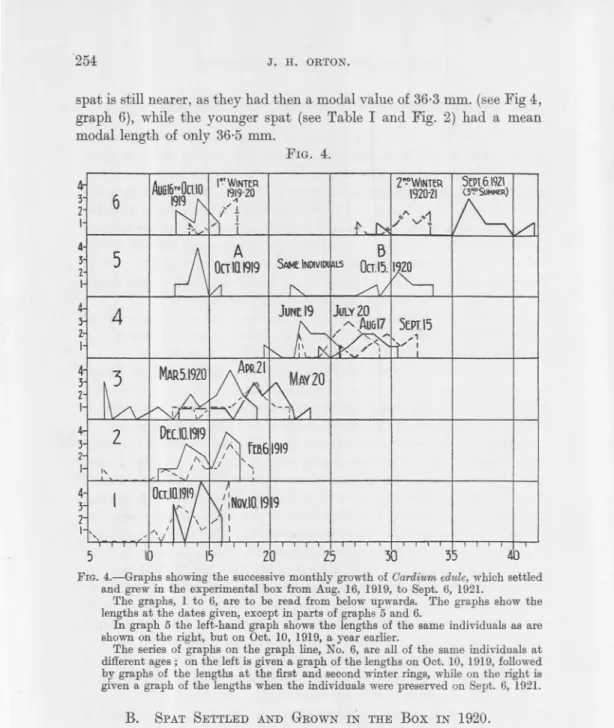
(15) RATE. A.. OF GROWTH. 253. OF CARDIUM: EDULE.. ON THE GROWTH OF OARDIUM SPATTED IN THE Box. IN 1919.. Before passing on to a consideration of the growth of Oardium in situ on the beds, it will be convenient to follow the growth of the cockles which settled and grew naturally in the box. It has been mentioned that the maximum diameter of the holes in the zinc plates built into the box was 6 mm., therefore it was possible for tiny Oardium about this size to be washed into the box, assuming that a disturbance of the bottom in the neighbourhood threw up cockle spat into a tidal current strong enough to wash them on to the box. It is conceivable that fish such as flounders, mullet, or bass foraging in the locality, or high winds, might so disturb the beds, but the probability is, no doubt, small. Tiny cockles did, however, settle in the box, and although most of these probably settled as post-Iarvre it is possible that individuals of a length not greater than 6 IllIll. might also have been washed in. The number of spat which settled in the box in 1919 is small, and their history is shown in the series of graphs, 1 to 6 in Fig. 4, p. 254. On October 10,1919, ten young Oardium were found in the box, ranging from 7 to 16 IllIll. in length, with a modal value of 14.3 IllIll. On November 10, a month later, the modal value had moved to 16.6 mm., where it remained until March 5, 1920, when the number of spat found was 16 plus 2 dead ones. Growth began soon afterwards, and by October 15, 1920, the modal value of these cockles had risen to 30.5 IllIll. Owing to the formation of a disturbance ring in October, 1919, it is possible to show the size at that time of those individuals which survived. (See the left-hand side of graphs 5 and 6.) These cockles, grown in the box since August, 1919, grew to a mean length of 28 IllIll. by August, 1920, and to 30,5 mm. by October 15, 1920. In the group of graphs shown on line 6 in Fig. 4 are shown the sizes of this surviving group respectively on October, 1919, at the winter rings of 1919-20, 1920-21-which were found to be well marked-and also when the individuals were finally preserved on September 6, 1921: the mean corresponding lengths at these times are 16,17'3 31, and 36,3 mm. respectively. Since these spat settled in August, 1919, they must be regarded as late, for Oardium begins to breed on the Yealm in March to April, as will be shown later. In Fig. 2, p. 246, are shown the sizes of the early 1919 spat-marked and grown in the box-at the winter ring of 1919-20. The modal length of this year-group is 22.2 mm., that is, 4.9 IllIll. more than that of the late spat grown in the box after August, 1919. The modal value of the early 1919 spat at the second winter ring (1920-21) is, however, 32.2 mm., while that of the late spat for the same year is 31.0 IllIll., a fact, of which many illustrations will be noticed, demonstrating how the younger individuals gradually approach in size to older ones. On September 6, 1921, the approach of the late.
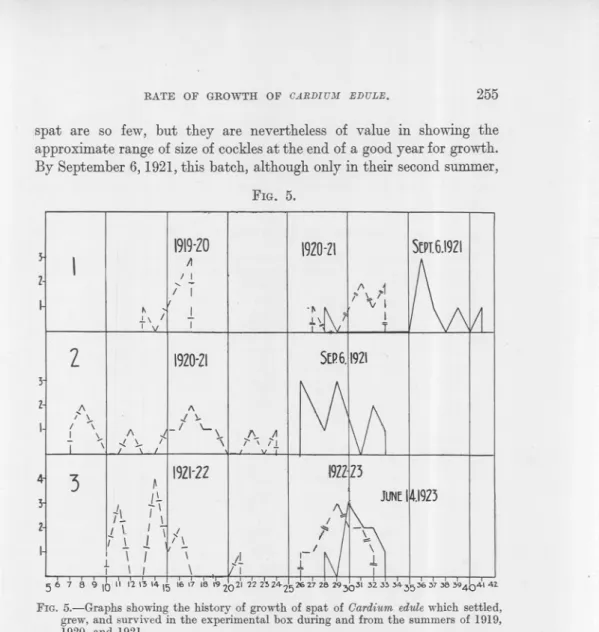
(16) 254. J. H. ORTON.. spat is still nearer, as they had then a modal value of 36.3 mm. (see Fig 4, graph 6), while the younger spat (see Table I and Fig. 2) had a mean modal length of only 36.5 mm. FIG. 4. ~ 2 I. AuiiJ6..0mo \919 I\. I. 6. 2~W'NTfR Sm6.19l1. IS:WINTfR. 1920'21. (3':"$uMMER). 19~9-2O. /' !!. ,r;... 4. 32. h". 5. 10. 15. zo. Z5. 30. '5. 40. FIG. 4.-Graphs showing the successive monthly growth of Oardium edule, which settled and grew in the experimental box from Aug. 16, 1919, to Sept. 6, 1921. The graphs, 1 to 6, are to be read from below upwards. The graphs show the lengths at the dates given, except in parts of graphs 5 and 6. In graph 5 the left-hand graph shows the lengths of the same individuals as are shown on the right, but on Oct. 10, 1919, a year earlier. The series of graphs on the graph line, No.6, are all of the same individuals at different ages; on the left is given a graph of the lengths on Oct. 10, 1919, followed by graphs of the lengths at the first and second winter rings, while on the right is given a graph of the lengths when the individuals were preserved on Sept. 6, 1921.. B.. SPAT SETTLEDAND GROWNIN THE Box IN 1920.. In July, 1920, the first spat for the year settling in the box was found at a length of 7.5 mm.; this one grew to 12.1 mm. by August 17, but then died. On September 15 six new spat were found in the box ranging from 7 to 18.0 min., and by October 15 attained 11.3 to 22.4 mm., and a little growth followed in October to November. The winter rings of the survivors of these spat measured from 7.2 to 24.5 mm., with a mean about 17.5 mm. (see Fig. 5). It is unfortunate that the numbers of these. it.
(17) --. RATE. OF GROWTH. 255. OF C.J.RDIUM BDULB.. spat are so few, but they are nevertheless of value in showing the approximate range of size of cockles at the end of a good year for growth. By September 6, 1921, this batch, although only in their second summer, FIG.. 5.. 191~. 1920-ZI. A. I. ISm6.19Z1. I I. i'. f'. -(\. 19Z0-21. A. }.. .{ l. 1\. ",_I. I \ ,,-. ,\. 3 l, 1-. I.. If .L. I. 56. T. I. Z 1\ I~. T I. ~. '-\.. I. ~ IlTII. "-, /1A. -. \.,. 1. .19ZI-22. J-. 1 1 \!~ \\ IJ I \. II '1. 7 8 9 10 II 1'2I:; 1415 i6 '7 16 '92021. '2223242526. 2728293031. 323334-3'5:36;)7:>8. 394b41 42. FIG. 5.-Graphs showing the history of growth of spat of Oardium edvle which settled, grew, and survived in the experimental box during and from the summers of 1919, 1920, and 1921. Graph 1 shows the lengths of the first and second winter rings, and at Sept. 6, 1921, of the individuals which settled in the box in 1919; similarly graph 2 shows the length of the winter rings of those which settled in the box during 1920, and at Sept. 6, 1921, and graph 3 the first and second winter rings, and size at June 14, 1923, of those which settled in the box in 1921.. which, however, was an exceptionally good one for shell-growth, had attained a mean length of about 29 mm. (see Fig. 5, graph 2), and would certainly have reached a length of 32 to 33 mm. on the average by the end of the summer, with individuals as long as 35 to 36 mm. or more at the end of 1921, if they had been allowed to live, as is shown by examination of samples from the beds. C. SPATSETTLEDANDGROWNIN THE Box, 1921-23. On October 6, 1921, a few spat were marked and left in the box, and a few unmarked tiny individuals were isolated in the box in a bottle. NEW. SERIES.-VOL.. XIV.. NO.2.. AUGUST,. 1926.. It.
(18) 256. J. II. ORTOK.. These spat were all collected on the same day on the beds, and were undoubtedly late spat of the 1921 brood. The box was not visited again nntil June 14, 1923, when everything was cleared out, and the cockles remaining were recovered and measured, and showed the following history:CARDIUMGROWN IN THE Box, 1921-23. Sizeon Sizeat 1st Autumn Sizeat 2nd Summer Sizeat Spring marking, Winter ring, growth Winter ring, growth. June 14123. growth. 1922-23 Oct.6121. 1921-22. mm. mm. mm. mm. mm. mm. mm. 1.2 5.0 29.0 15.0 30.2 9.0 14.0 4.3 14.5 and died 14.0 28.5 9,7 29.0 14.0 and died 15.0 3,5 11.5 4.0 and died 16.5 32.0 15.5 12.5 3.0 8.5 32.5 21.0 8,5 29.5 12.5 2.7 1.5 30,5 14.0 33.2 16.5 15.0 Not marked. Sizeat disturbance ring. 3.2 4.0 4.2 4.5 5.2 8.0. 14.0 11.0 14.0 10.5 11.5 -11,5. 10.8 7,0 9.8 6.0. -6.3 3.5. 31.0 26.5 31.0 30,0 27.0 28.1. 17.0 15.5 17.0 19.5 15.5 16.6. 31.8 27.7 32.2 31.6 30,8 30.2. 0.8 1.2 1.2 1.6 3.8 2.1. This interesting experiment again shows that late spat may attain commonly a length of about 29.0 mm. at the end of their second summer (see Fig. 5, No.3), and that small spat of the same year as larger ones may catch up or even surpass in size the largerones in the second or third summer. The mortality in the winter is interesting in resembling previous experience. On August 18,1923, the box was again visited to examine a few Cardium marked and left in a bottle in the box (to ensure recovery of the same individuals) on June 14, 1923, with the folloWingresult :Length at mark.. June 14.23. mm. 5.6 5.0 8.3 13.6. Increase in length. Average Length weekly growth. Aug. 18.23. mm. mm. mm. 9.0 1.0 14.6 9.8 1-1 14.8 7.6 0.8 15.9 23.2 1-1 9.6.
(19) RATE. OF GROWTH. 257. OF CARDIU]Jf EDULE.. In addition to the marked Cardium, two small individuals were again found in the box, having either settled or been washed in when tiny, and found to have the lengths 17.2 and 13.6 mm. If these spat settled as post-Iarvre, as seems most probable, their age is only nine weeks, but if they were washed into the box when less than 6 mm., a month must be added to give their maximum age as will be shown later (see discussion on age of spat, p. 273). '. D. SPATSETTLEDANDGROWNIN THE Box, 1923-25. On August 18, 1923, a few spat were marked and left in the box and recovered at a visit on March 2,1926. Only three individuals were found in the box on this date; two were marked and o'ne had no mark, and had settled in the box in 1923. Their histories* are given as follows :Atmark,Aug.18, 1923. mm. 4.5 19.0 Settled in box. 1st winterring, 2nd winter ring, 3rd winter ring, 1924-25. 1925-26, 1923-24. mm. mm. mm.t 31.5 19.2 38,6 x33.7 x27'2 33.2 25.0 38.2 x33.5 x27.5 16.8 30.6 37.6 x34'0 x29.7. These few individuals again afford evidence of small spat overtaking in size larger individuals of the same spat-year, and show that in the period 1923-24 cockles with two summers' growth attained to 30 to 33 mm. in length in the box. ON DISTURBANCE AND WINTER RINGs.. With the data so far obtained on the growth of marked individuals and those spatted in the box, it will be possible to show the average growth of cockles of different sizes and ages during the summer, but it is advisable first to consider the growth of individuals taken from the beds at different times-as controls on the experimental results. In examining samples from the beds, however, it is necessary to know what interpretation to place on the marks or rings on the shells, and the information obtained on the subject may be discussed here. It was found during the course of the experiments that practically all cockles in their first, and a fair proportion in their second, summer showed rings on the shell after each time they were taken out of the box for measurement. On June 19, 1920, a special experiment was designed * At the same time three Scrobicularia were taken from the box with lengths as follows at the respective winter rings: (A) 1st winter ring, 18.2 (?); 2nd, 34,2; 3rd, 41.6 mm. (B) 1st winter ring, 7.4; 2nd, 35,7 mm. (0) 1st winter ring, 9,6 (?), disturbance ring (?), 31,0; 2nd winter ring, 34,7 mm.. t. These measurements. shell.. rre rEspectivEly. of length,. height. cr depth,. and width. of the.
(20) 258. J. H. ORTON.. to obtain shells showing such monthly rings, which may appropriately be called" disturbance rings." Seven tiny Cardium with clean unmarked shells were collected from the beds on June 19, and placed in a large bottle in the box; the same result would have been obtained if the cockles had been placed in the mud in the box, but the individuals would have been found with difficulty owing to their smallness. They were taken out and measured on July 20 and August 17 at intervals of a month, and finally preserved on September 15, 1920. A series of graphs to show their sizes at the different date of examination is given in Fig. 11, p. 274, and a photograph of the shells is given in Fig. 6A,p. 259. On most of the shells three distinct disturbance rings were formed, although not all are shown clearly in the photograph; on one shell, however, no growth occurred after August 17, and therefore only two rings were formed. By comparing the sizes at the dates of examination with those at the disturbance rings, it is clear that the rings are produced in one or two days after the time of the disturbance, due merely to taking the shells out of the box and measuring them. This was further prpved on October 6,1921, by placing small cockles in a marked bottle, and finding good rings on the shells only on October 18, twelve days later, when a few mms.' new growth had been put on after the disturbance r~gs had been formed. It is worth while describing in some detail what was done with the cockles to cause them to make a disturbance ring on the shell. On visiting the box the lid was unscrewed and slung over the small punt, and used as a field-bench. The surface of the mud was then searched by hand for all the Cardium which could be found; the cockles were washed as found and placed on the bench. The cockles from the bottle were found by using the lid of the box to sieve off the mud with douches of water. In this way all the cockles were prepared for measurement in about half an hour. If the sun were shining, or a wind blowing, the cockles would be exposed to unusual conditions during the period they were on the bench, for a varying period of about a quarter of an hour to an hour and a half. As the EXPLANATION. OF FIG.. 6.. FIG. H.-Photos of Cardium edule, showing disturbance and/or winter rings on the shells. A. The upper seven individuals show mostly three monthly disturbance rings due merely to being taken out of the experimental box to be measured. (x Ca. t.) B. The three middle rows are samples of Cardium edule from the bed of the River Yea!m, illustrating the growth of individuals at different successive periods in their second summer in 1920 from variable sizes at the end of the first summer of growth. (x Ca. t.) The upper row were taken from the beds on April 21, the middle row on June 19, and the bottom row on August 17. The winter ring is in all cases well defined and varies in size from 8 to 23 mms. The increase in growth during 1920 is well shown, as is also the apparently larger growth by the smaller individuals of each sample. C. The lower six shells were takeIt from shifting beds of sand in Padstow Estuary, and show concentric rings which may be either disturbance or winter rings, but are indistinguishable. (x Ca. t.).
(21) FIG. 6.. A. B. c. Composite Photo-A.. J. Smith,.
(22) I ..
(23) RATE. OF GROWTH. OF CARDIUM. EDULE.. 261. cockles were measured they were generally put straight back in the mud or in the bottle in the box. The tiny cockles from the bottles were generally treated more expeditiously than the larger ones. Therefore, the actual amount of disturbance from normal conditions which produced a ring on the shell is very small. The disturbance rings, which were most clearly defined and indistinguishable from or better marked than winter rings, were those produced after the shells were marked with a file (see Fig. 3, p. 251). In these cases both small and large individuals (to 30 mm.) put on a well-defined ring. In connection with the formation of disturbance rings it is interesting to know-as was found by repeated experiments-that cockles did not move about much when put back in the box. On several occasions the marked cockles were all put back and recovered from one half of the box, while the spat grown in the box were put back and entirely recovered a month later from the other half; on two occasions two and three individuals were found to have crossed the middle line of the box. It is, therefore, established that a slight disturbance of a living cockle will cause small individuals, up to about 20 mm., almost always to form a disturbance ring on the shell, and may even cause a ring to be formed on the shell of larger individuals up to about 32 mm. When a cockle is disturbed from its secure position in the beds it probably has some difficulty in again establishing itself in a comfortable position, and one favourable for the proper discharge of the functions of feeding, respiring, and evacuating, and as it has been shown that small individuals may be growing shell at the rate of I to Ii mm. per week, a slight disturbance extending over one or two days is enough to upset the normal deposition of calcareous material at the edge of the shell. It would seem that a thinner deposition of calcareous material is produced at the edge of the shell during the disturbance, and the groove so produced when the normal thicker deposition recommences retains a puckered deposit of brown conchyolin to mark the groove definitely. The depth of the groove is probably determined by the period of cessation of a deposit of a normal thickness; in this way it seems reasonable to conclude that the greater disturbance of the economy of the cockles due to filing their shells required a longer period of recovery than the mere taking of individuals out of their nidus in the beds, and that in the former case a reduced deposition of shell material occurred for a longer period, and so produced the deeper groove. There would seem to be little doubt that the same explanation holds for the formation of winter rings, and that therefore the mode of formation of rings is the same in disturbance and winter rings. In nilld winters winter rings often become extended, or a ring or series of rings may be formed, followed by or interspersed with further normal depositions before the final winter ring is produced..
(24) 262. J. H. ORTON.. The writer has no doubt from experience that disturbance and winter rings are found in other bivalves and univalves in a similar way to that described for Oardium. There is a difference between most disturbance rings and winter rings in large cockles in that the winter rings have deeper grooves, but a heavy disturbance ring could not be differentiated with certainty from a winter ring. In large cockles, however, slight disturbances are not reflected on the shell in the same ready way as in the smaller specimens, therefore as big disturbances sufficient to produce rings on the older cockles are rare, disturbance rings are rarer on the larger than on the smaller bivalves. The same is true of the smaller cockles, except that it becomes still more difficult to distinguish between a deep disturbance ring and a winter ring. In cockles which have passed their first winter while small, i.e. below about 15 mm. in length, the first winter ring even when not well defined by a groove is often raised above the continuation of the general contour of the older shell parts, as, indeed, is often the case with the older winter rings. This feature of the shell resembles the similar one where the protoconch passes into the growth of the adult shell, and is, no doubt, due to the same cause, namely, a different orientation, or rather a fresh orientation, of the shell secreting area of the mantle edge. Where the first summer shell is not raised from the general contour of the older part of the shell, it is often, but not by any means in all cases, impossible to distinguish between a disturbance and a winter ring, and experience in producing disturbance rings, as has been described above, is helpful and probably necessary in all studies of bivalve shells in interpreting the growth-history from the shell markings. Whilst inspecting the cockle beds at Padstow, the writer found a number of shells in the large banks of soft shifting sand, which are common in that estuary. These shells show a series of rings (see Fig. 6 c), which cannot be interpreted conclusively as winter riIigs, and are considered by the writer as disturbance and winter rings indistinguishable from one another. In thes~ beds there is a great probability of cockles becoming buried temporarily in the shifting sand, and as it has been shown by experiment that disturbance rings may be produced in a few days by very little change from the normal, there is every probability of the production in buried cockles of disturbance rings as pronounced as winter rings. DISTURBANCE. RINGS. IN MYTILUS. EDULIS.. Disturbance rings can be induced in the shell of the common mussel. by the same method as was used in the case of Cardium edule, as is shown by the following experiments, which may be conveniently mentioned here..
(25) FIG. 7.. A. 8. c. PlwwA. J. Smith. FIG. 7.-Photograph of mussels (Mytilus edulis) showing the formation of disturbance rings after the shells had been marked with a file, and the animals put back in the sea to grow (x i). A. Four shells marked October 13, 1923, and put in the sea at once, and again taken out and preserved on June 23, 1924. The disturbance rings are not shown so well in this photo as on the shells. B. Three shells of the same sample as the four noted above. These were re-marked on June 26, 1924, put back in the sea, and recovered and preserved a month later, on July 26, 1924. The disturbance rings of October, 1923, are well shown on two of these shells, but those of June, 1924, although as distinct on the shells as on the three shells shown immediately below them, are not clear in the photo. C. Three shells marked July 9, 1923, put back in the sea, and again taken out and marked on September 11, 1923; and finally recovered and preserved on October 16, 1923. The two disturbance rings shown on these shells were formed in the summer period, and are shown in the photo probably as clearly as is possible by this means..
(26) I ..
(27) RATE. OF GROWTH. OF CARDIUM. 265. EDULE.. On July 9, 1923, a number of mussels were marked with a file on the edge of the shell and put into an iron-wire meshed cage in the lower part of the oyster beds in the River Yealm, more than a mile below the site of the Oardium box. These mussels nearly all put on a distinct disturbance ring at the filemark (see Fig. 7 c, p. 263). On September 11, 1923, a number of the mussels were again marked with a second filemark, and again most of the mussels were found to have put on a second disturbance ring (as is seen from Fig. 7 c), when the mussels were taken out of the cage and preserved on October 16, 1923. On October 13, 1923, a sample of mussels from the Promenade Pier, Plymouth, were filemarked and put in another compartment in the same Yealm cage. On June 23, 1924, on examining the fifty-six survivors, it was found that forty-two showed a distinct disturbance ring, while the remainder showed either an indistinct or faint one. Winter rings were also shown in addition to the disturbance rings on only a proportion of the shells, and when present were no more distinct than the disturbance rings (see Fig. 7 A, p. 263). On June 26, 1924, the mussels were all again freshly marked with a file, and again put in the cage. On July 26, when the mussels were re-examined, a new disturbance ring was found on most of the mussels at the position of the new filemark (see Fig, 7 B, p. 263). In both these experiments the mussels were transplanted from an intertidal level to a demersal one, and doubtless the severity of the change is reflected in the heavy mortality which occurred; but in the case of the second marking with the file, after the mussels had become acclimatised to the new situation, the cause inducing the disturbance ring was not severe. So that in the case of mussels as in that of Oardium, a relatively small change from the normal can result in the formation of a ring on the. shell.. .. The production of rings on the shells of the mussel and the cockle are, however, different problems, although in both cases it has been shown that a disturbance may give rise to a ring. The mussel, at Plymouth, does not always put on even a winter ring in mild winters, as has also been found to be the case in certain situations with Patella. THE. RATE. OF GROWTH. OF OARDIUM. ON THE. TO THE. EXPERIMENTAL. Box.. BEDS. ADJACENT. With the information obtained on the rate of growth of Oardium in the experimental box, and with the acquired information of the significance of the concentric grooves or rings on the shells, it is possible to examine individuals from the beds themselves with a fair certainty of reading their growth-history in their shells.. ~--. -~~--~~~-.
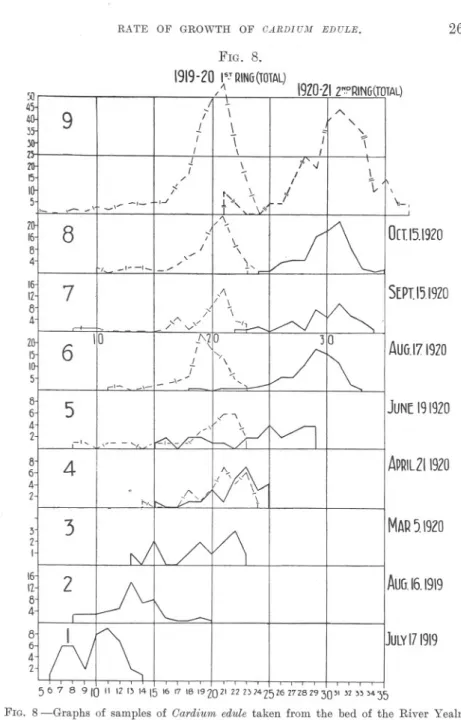
(28) 266. J. H. ORTON.. During the course of the experiments described above samples of Cardium of different sizes were frequently examined and the recent growth compared with that of the individuals in the box. It was seen that the shell-growth was very similar in the two situations, but nevertheless monthly samples were collected during 1920, and others later, and preserved for more detailed examination, accurate measurement and comparison with the marked individuals in the box. It was found from examining the experimental Cardium that a distinct winter ring was formed, and as the history of these shells was known, it was possible in these cases to distinguish the winter ring from others in nearly all cases. In cockles only one winter old, the ring became recognisable in March to April; but in individuals two winters old, the last winter ring did not become well defined, i.e. the spring growth did not become evident, before April to July. Armed with this information, with a knowledge and experience of disturbance and winter rings, and a knowledge of the range of growth in different years, it became possible to read the correct history of growth, as shown in the shell of nearly 10°% of the cockles from the beds, but an insignificant number of shells which could not be read were not recorded.. SAMPLES FROM THE BEDS IN 1920.. The sizes of monthly samples from the beds in 1920, and showing only one winter ring (that of 1919-20), are given in the series of graphs 1 to 9 in Fig. 8, p. 267. In considering samples from the beds it is essential to know the modal value of the sizes of the winter ring, in order to interpret correctly the sizes at the time of sampling, since it has been shown that smaller individuals on the average increase in length at a greater rate than larger ones. Accordingly in each case in the graphs 1 to 9 in Fig. 8, the winter rings are shown on the left-hand side on the same line of ordinates as the graph of sizes at the time of sampling. All the graphs showing sizes (as lengths) in mm. groups at the first winter ring are given as broken lines with single short lines at right angles to the graph line, thus: -1-1-; in a similar way graphs of sizes at the second winter ring are shown by a broken line with pairs of parallel short lines at right angles to the main graph line, and so on. The sizes at the time of sampling are in all graphs shown by a thick or thin continuous line. From the samples collected from the beds during 1920, the individuals with two (winter) rings as well as one ring and no ring were separated and measured, as shown in Figs. 8, 9, and 10. Special search had to be made for the O-group, which are not easy to find. A simple comparison .of the graphs in Fig. 8, with those in Fig. 2 (of the sizes of Cardium.
(29) RATE. OF. GROWTH. OF. CARDIUM. 267. EDULE.. FIG. 8.. . RING(TOTAL)19Z0'212~!'RIN(j(TOTALJ 1919-l0 I ~s:r. ;-. 9. \ \. 1. I I. \. I I ..-. ~ I ,~. ~\+ _\~. -,-. t. +,..1. /\. 8 4. \. I. \. \. 5 6 4 2. 6. }',7D I. 4 2. 3'1 2 I. 16. ". I. . ;". 1"- - 'I"rr. I. ISEPT.lS.19ZQ. u. IAUG.1719Z0. \. '\'. -\--. 5. I. ". J.. ,- _\- -. \,-,. -I,. /,A vv'. 15 I 5. 1\. OCT.I5.1920. /\ I. 10. )/. 1,. i'. 2. \. t. \ ~, 1. 7. I. '\. ..J. \. I -- ..- ,. I. r. ",. ~',. 1'. I. _'--k. I --'-. L \ "I. t,. 8 16 12. '". 1--. I. I. r:/. I. I I. IJUNE191920 I. APRIL211920. "". r-,. 3 I. 11 8 4. Z. j. I. /\. r",. A. I. I. I. 1. I. I. I. I. I. IAUG 16.1919. I. IJulY171919. MAR5.1920. 4 2 50. 7 8 910. II 12 I) 1415 16 17 18192021 22 n 242526272829. 3D}1 }2}} )435. FIG. 8 -Graphs of samples of Cardium edule taken from the bed of the River Yealm adjacent to the experimental box, for comparison with individuals of similar age grown in the experimental box. The samples taken during 1920 are composed of individuals with one winter ring for comparison with the A group of Cardium shown in Fig. 2. The sizes at the winter ring of the individuals in each sample are shown by the conventional broken-line graph, with short lines at right angles to the main graph-line. The two graphs at the top of the figure (in space 9) show the size-composition in mm. groups of all individuals at the first winter ring in 1919--20, and of these with two winter rings after the winter of 1920-21 respectively. Owing to the smallness of the samples taken with two winter rings after the winter of 1920-21, it was deemed advisable to add here the individuals of the appropriate age from the box, in order to present a representative graph of individuals living in the period 1919-21..
(30) 268. J. H. ORTON.. grown in the box) both of which show the spat of 1919, can be given in the following tabular form :Date.. Grownon the beds. Maximum Modalsize. Maximum size. size.. Partially grown in the box.. Modalsize.. 22 22 24 27 30 32 32-33. Winter ring, 1919-20 1920, Mar. 5 April 21 June 19 Aug. 17 Sept. 15 Oct. 15. 24 24 26 31 34 35 37. 21 22 23 28-29 29-30 31 31. 24 23 25 29 33 34 35. In August, September, and October the modal value of the sizes at the date of sampling is in each case, it may be noted, 10 millimetres FIG. 9. 25 20 15 10 5 4 3 2 I. ". 1915-\9/. 5. .,. /'. _-1-1-'-"'"_,/,,1. 4. 1919-Z0r. '\. A. Y, ./ 'L:. A. ..;j,. \". 1918-19.!.. 1919-20 A. "\. I I. >f. i-f.... I \. ,. /1-. /. '/. .t. \. 4--. 19\9-20. 8 6 4 2. rf'. '-', ~/.. 16 12 8 4. ",'/~. 4 3 2 I. 1918-19/' t--. I' 56. 1919-2)). \. 7 8. /'. l/\. \. f. v"i. '~'V--. j /. 9 10 \I 12 10 14 15 16 17 18 19 2021 22 20 24 25 26 27 2829 30 ~I ~2 ~o 04:;536. 37 38 ~9 40. FIG. 9.-Graphs of samples of Cardium edule, with two winter rings, from the bed of the River Yealm adjacent to the experimental box taken at successive periods during 1920 for comparison with the B group of individuals grown in the box. In each sample the sizes of the first and second winter rings are shown conventionally by the broken-line graphs with one short line and a pair of short lines respectively at right angles to the graph line. The sizes at the dates of sampling are shown by the continuous line graphs on the right in each case. At the top of the figure in space 5 are brought together all the individuals taken from the beds with a first winter ring laid down in 1918-19, and all those with two winter rings for the winters of 1918-19 and 1919-20, for comparison with the smaller samples shown in spaces 1 to 4 of the figure..
(31) RATE. OF GROWTH. OF CARDIUM. 269. EDULE.. greater than that of the winter ring sizes. The modal size of the winter ring in the August sample was, however, 19 mm. against 21 mm. in the September and October samples; but an examination of the individual records of the August sample shows that those cockles with a winter ring of 20 to 21 mm. had attained in August a size mostly of 29 to 31 mm., and were very similar in size to those grown in the box. On the whole, the results shown in the preceding table and in graphs 3 and 8 indicate that there was little difference in growth at these sizes in the box and on the beds. A similar comparison of samples with two winter rings at various dates in 1920 can be drawn up from Figs. 2 and 9. A preliminary glance at Fig. 9, p. 268 (showing cockles from the beds with two winter rings in 1920) will show that the difference in length between the modal sizes of the first (1918-19) and second (1919-20) winter rings, is, with the exception of the September sample, about 10 mm., and that on the whole cockles which grew to 19-21 mm. in 1918 increased to 29-3] mm. in 1919. The modal value at the winter rings must, however, be . considered in following the growth during 1920, as shown in the following table :PARTIALLYGROWN IN THE BOX. Modal size of 2nd winter ring (1919-20). Date.. 30 30 30 30. Sizes at date given. Modal Max. length. length.. June 19 32 Aug. 17 32-35 Sept. 15 34-36 Oct. 15 34-36. 36 37 38 38. GROWN. ON THE. Modal size of 2nd winter ring (1919-20). Date.. 31 28-31 29-30 29. June 19 Aug. 17 Sept. 15 Oct. 15. BEDS.. Sizes at date given. Modal Max. length. length.. 32 32-35 33-35 33. 35 39 38 37. The comparison of cockles with two winter rings from the experimental box and from the beds, as given in the table above, brings out the fact that there was very little difference in growth in the two situations; there is, however, an indication of slightly greater growth in the box in this case, as in others, to be noticed. A comparisonof the complete growthhistory of the Cardium in the box with a sample grown on the beds can be shown in the graphs in Fig. 10, p. 271. The original A group put in the box is shown on the top line of graphs, and compared in the second line of graphs with a sample of two-ring cockles taken from the beds on September 6, 1921, on the same day as those from the box were preserved. The two lower graphs in the same figure compare the history of the B group originally put in the box with a sample of three (winter) ringed cockles taken from the beds on the same day as the B group were preserved. The modal and maximum sizes in mm. groups at the several. ~--~---~.
(32) 270. J. H. ORTON.. corresponding winter rings and the final sizes, can be best summarised in the following tabular form;Spat-year, 1919.. 1st winter ring.. Mode. 22 Box (A group) Beds 21. Max. 24 24. 2nd winterring. 3rd winter ring. Mode. Max. Mode. Max. 32-33 37 28-31 34. Mode. Max. 36-37 43 33-35 40. 30 28-31. 37-39 35-38. Sept. 6, 1921.. 1918.. Box (B group) Beds 19-21. 26. 33 34. 34-36 33-36. 38 37. 41 40. lb is again seen from this comparison that the growth on the beds and in the box was very similar, but that there is once more an indication of rather better growth in the box. The results from the two situations may therefore be regarded as comparable, if it be remembered that growth in the box may be slightly greater on the average than on the adjacent beds. THE BREEDING PERIOD OF Oardium. edule.. Oardium edule is known to begin to breed early in the year (Johnstone),. in March to April, and during the summer. The writer has already shownt that the species matures at an early age, and during the course of the experiments observation on breeding were made by townetting over or near the beds, and by investigating the condition of the gonad from time to time. Artificial fertilisation was also attempted, but the ovarian egg of Cardium, like that of many bivalves, is not suitable for this kind of experiment without a special technique, which has not yet been devised. The egg of Oardium edule is pelagic, or rather floats freely in the water at the mercy of tidal currents; it has an ovum 80 JLin diameter, surrounded by a large, thin, clear, hydrostatic and micropylar envelope about 180 JL in diameter, in which the egg develops to a trochosphere and finally a shelled veliger. The period of the pelagic stage has not been determined, but on the analogy of the oyster,t this period may be estimated at two to four weeks. On October 13, 1919, an artificial fertilisation yielded a few revolving larvre in the egg-envelope, and it may be presumed along with the evidence of the fall of spat that Cardium was still breeding at this time. On April 21, 1920, a tow-netting taken below the cockle beds yielded a few pelagic eggs of Oardium edule in segmentation stages, and the * L.M.B.G. Memoir, II, Cardium, 1899.. t. t. Journ.. 2J;Iar.Bioi. Assoc., Vol. XII,. p. 352, 1920.. Journ. Mar. Bioi. Assoc., Vol. XIV, No.1, 1926..
(33) 271. RATE OF GROWTH OF OARDIUM EDULE. FIG. 10. 9. A. 1919-20. 8 7 6 5 4 3. I. II. A. 1920-121. 1\. 1 I. Z. 1. j '. i\,.. /. I'. -!'. \. -\. I. \. I.\' I. \-1. /-,--- "/. 6. 199-Z0 .I-1'-\. 5 4 3. '\. ". 2. I. B:l. /'. /',. /. I \. ). !. B 1918-19. 5. (1,/. 1',. /,. .,I'. A,. I. ;. ". \. 1919-20. 1\ I \. 10. 15. /I. I. !. \-. j. I I. .! '-', .../ '-'1!- /""','. 1918-19. DEDS. 5. 11919-20. ; L -'"1. 20. { 25. \/. I 30. I. 35. 40. FIG. lO.-Graphs of individuals grown in the box and on the beds of the River Yealm comparing(1) The growth of the A group put in the box with a sample of similar individuals grown on the beds, and (2) The growth of the B group put in the box with a sample of similar individuals grown on the beds. A shows the size-composition of the first and second winter rings, and on Sept. 6, 1921 of the A group of individuals put in the box on Aug. 16, 1919. B shows the size-composition of the first, second, and third winter rings, and on Sept 6, 1921, of the B group of individuals put in the box on Aug. 16, 1919. In the graph of the A group are also shown the sizes of the individuals-at the corresponding times-which settled and grew in the box. These are indicated in the graph of the lengths at the first winter ring by the part of the broken-line graph which has dots, namely, from 13 to 17 mm.; in the graph of the lengths at the second winter ring these individuals r0 plotted between the thin and the thick-lined graphs with pairs of short lines at right angles to the graph line; while in graphs of lengths on Sept. 6, 1921 (continuous line graphs), the individuals grown in the box are agaiQ shown between the thick and the thin line graphs. The history of the spat grown in the box and shown above illustrates markedly how small individuals of the same year group may grow so rapidly as to exceed in size larger individuals of the same year group. NEW. SERIES.-YOL.. XIV.. NO.2.. AUGUST,. 1926..
(34) 272. J. H. ORTON.. following day a sample of small and large adults were examined microscopically and an unsuccessful artificial fertilisation tried. The-sizi;s (lengths) of the smaller ones and the conditions of the gonad were a3 follows :Length in nnns. 15.3. 18.9 19.5 19.6 20.2 20.5 20.6 21.0 22.2 22.5. 23.7 25.0 29,2. Sex.. Condition of gonad. 00ripe sperm. 6. with sperm morulre. ripe eggswith someunripe . .. 00. some rIpe eggs; many unrIpe some ' npe sperm . 00. ripe sperm with sperm morulre " " " " 00. 6. npe eggs; many unrIpe. '6. 6. ripe eggs; fewerunripe. lipe sperm with sperm morulre. ..... 0. ". 6. " " " " 00 ripe eggs; many unripe " ". 6. ". ". ". On May 20, 1920, two of the spat which settled in the box in 1919, and therefore less than one year old, were examined; one, 23.0 mm., had ripe eggs with the egg-envelope developed, but with the nucleus still visible, the other, 18.2 mm., yielded a few ripe sperm. On July 27, 1920, tiny cockles, 17,21,20, and 18 mm. were found to have ripe and active sperm; one, 15 mm., had ripening eggs up to 28 fL; one, 18 mm., with eggs up to 30 fL,and probably larger in the gonadial tubes, while another, 21.5 mm., had almost ripe eggs, 70 to 80 fL in diameter with egg-membranes. An artificial fertilisation of the last pair did not succeed in producing embryos. On September 16, 1920, a sample of tiny spat, 14.6 to 20.5 mm., were examined and found to be mostly immature; but one, 19,2, had mature ova, and one, 18,2, mature sperm, and this pair gave one s,,'imming larva on artificial fertilisation. A successful fertilisation on October 7, 1920, yielded a few larvre, which developed into trochospheres, and later a bivalve shell, while still within the egg-membrane (see a similar development in the estuarine forms, Syndosmya alba and Cardium fasciatwn, Orton, Nature, Vol. 114, p. 244, 1924). There would seem to be no reason why Cardium was not spawning on the beds at this time as in October, 1919. Cardium edule has therefore an extended breeding period, beginning in April or March and extending to October or later. It is probable from the condition of the gonad that Cardium spawns continuously, shedding batches of ova at intervals throughout the summer. The significance of.
(35) RATE. OF GROWTH. OF CARDIUJI. EDULE.. 273. such an extended breeding period in connection with the problem ofgrowth lies in the probability of a continual fall of spat throughout the summer and neighbouring periods, and the consequent possible large range in size of the individuals of one particular year group, which may vary from ~ few millimetres to as much as 27 or 28 mm. THE. AGE. OF YOUNG. SPAT. WITH. EXPERIl\IENTAL. OBSERVATIONS.. Various experiments were made to obtain the just settled spat of a known age from tow-nettings put inside the box in a large bottle covered with coarse bolting silk and lashed to the side of the box (see Fig. 1, p. 241). It was found that little or no circulation occurred in covered bottles immersed in water, so tow-nettings were left in the bottles uncovered in the hope that advanced larvffi might settle on the bottom of the bottle and grow in situ. In this way two spat, respectively 6.8 and 2.4 mm. long, were obtained on October 15, 1920, from bottles left with tow-nettings a month earlier, on September 15. It is impossible to state dogmatically that these spat were a maximum age of one month, as it will be remembered that the perforations in the zinc plates ranged from 5,8 to 6,0 mm. in diameter, so that it would be possible for a tiny cockle, about 6 mill. long, to be washed into the box. There is, however, as will be shown, nothing improbable in a spat attaining a size of 6 mm. in a month, and it is as certain as is possible in an experiment of this kind that the spat did grow in a month. A design to use a smaller box, with smaller perforations in the zinc, inside the big one-to confirm the result-could not be carried out later. There is, however, less doubt that the 2.4 mill. spat grew in the bottle than the 6,8 mill. one from the tow-netting taken on September 15. A tiny spat, 6.5 mill., was also taken inside the box on September 12, 1919, one month after the box was laid down in the river, while on October 10,1919, two months after the box was put out, ten spat which had settled in the box were found varying in size from 12 to 16 mm. An experiment was carried out at the same time to find out how quickly the smallest cockles were growing. On September 12, a number of spat 6 to 10 mm., and eight spat below 6 mm., were put in a bottle in the box, and found on October 10,a month later, to have grown an average amount of 3 mill., while some individuals had increased nearly 6 mm. in length (see Fig. 11, p. 274) at this late period of the year. These spat continued to grow a little even into December. In 1920 a slight new growth was observable both in the cockles in the box and on the beds on March 5, but no new spat were found in the box until July 20, when a tiny individual, 7.5 mill. long, was taken. It is probable that others similar were present, but remained undiscovered.
(36) 274. J. H. ORTON.. in the mud. This spat grew to 12.1 mm. by August 17, but then died. On September 15 six new spat, having grown to a larger size, were found in the box, ranging from 7 uo 18 mm. The history of the growth of seven tiny spat from June to September has already been described (see .also Fig. 11 below); in this case, individuals 4,8 to 9.2 mm., grew to 14,7 to 20.6 mm. in three months in spite of monthly disturbances. It is probable that if these spat had been left undisturbed they would have added to their length in the same time a few millimetres more. FIG. 11. JUNE19.. JULY. 3. 1920. 20.. 1\. 2. SEPT/5 \. ;1 I I. \. \!I-'f. 8 r 6 5 4 3 2 I.. 4. 4. 567. 9. 8. 10 II. r ~. 12 0/ 13 . 'j. Nov.lQl\. ,,-. - -. 5. 6. I. A'f.. 8. (". \~ ,~<h- )(/ "'/. 'V'1/-x-><.., I Dtc.lO. 1I. """I./<:::::</L~{. 7. 1919. \. -1'''-'''''',/. 9. 19 20. 15. "1 ~. OCT. ~.. SEPTIZ.. \4. 16 17 \8. Ib. \I. \. T. 12 13 14 15 16 17 18 19 20. LClnqlhs in m.m. qroups. FIG. ll.-Graphs showing successive monthly increase in lengths of small cockles which formed monthly disturbance rings on the shell. The upper series are graphs of the successive sizes of the seven Cardium photographed for Fig. 6 A and gr nVll in 1920. The lower series gives monthly increases in length of small individuals towards the end of the growing season, showing that growth continued to November in 1919.. There is good evidence, therefore, for the statement that a post-larval cockle may grow to a length of 6 mm. in its first month of growth, and that afterwards it may add to its length at the rate of 4 to 6 mm. per month until October, and that growth afterwards will vary with the peculiar environmental conditions of that year. Thus if Cardium spawns in April and a month be allowed at this time of the year for the attainment of the post-larval stage, the April spawn might, by June, have developed to tiny cockles, 6 mm. in length. If the subsequent monthly increments in length in July to November be respectively 6, 5, 4, 4, 2, 1, ending in December, then the spat of that year would range upwards to 28 mm. in length, therefore spat might occur on the beds as follows: June, 6 mm.; July, 12 mm.; August, 17 mm.; September, 21 mm. ;.
(37) RATE. OF GROWTH. OF CARDIUJI. 275. EDULE.. October, 25 mm.; November, 27 mm.; December, 28 mm. Such spat occurred at the end of the warm year of 1921, and there can be no doubt that a continuously warm summer is favourable for shell-growth in most estuarine shell-bearing animals. THE O-GROUP OF CARDIUM AND LENGTH AT THE FIRST WINTER RING.. By using the information on the rate of growth of the tiny Cardium recorded above, it is possible to understand and assess the collections of spat made from time to time on the beds. On July 17,1919, a collection of spat, none of which showed rings on the shell, ranged in size from 6 to 14 mm., and a month later a similar collection ranged to 17 mm. ; but it is probable that larger spat were present on the beds, as only a limited time was available that day for searching for spat. These August cockles grew in the box, as we have seen, to 22 to 24 mm. by the end of the year, and similar sizes were found on the beds. In 1920, spat were found with clean shells up to 15 mm. in August and 20 mm. in October, and the 1920 spat in the box also grew to 20 mm. by October, and 24.5 mni. by the end of the growing year. On the b3ds spat 24'2 mm. were found at the end of the same growing yea~. On September 6,1921 a collection of clean shelled spat for that year showed already individuals ranging to 25 mm. with a good proportion of shells at 19 to 20 mm., so that by the end of 1921, shells would be common at 23 to 24 mm., and might easily range to 27 or 28 mm., as was subsequently found to be the case. In 1918, spat grew commonly to a size of 21 mm., as is shown by the occurrence of shells clean to the winter ring, and occasional individuals attained 26 mm. Thus from the examination of shells during the period of the experiment, it is found that in the first year of growth on the River Yealm, Cardium edule will attain a length commonly of 19 to 22 mm., with a small proportion of individuals of 25 mm., and in years of very good growth, as in 1921, of a length of even 27 or 28 mm. THE. LENGTH. OF CARDIUM. OF THE. SECOND. WINTER. RING.. The record of the growth of the marked cockles in the box during 1920, with the examination of samples in the same period from the beds, enables us to obtain unimpeachable information of growth in the second summer. The year 1920 as well as the year 1921 was good for growth of shell-material in most bivalves, so that the observations for these years will probably give records of growth close to the maximum possible for this locality. In that case they must not be regarded as average results. Cockles in the box grew from a common size of 22 mm. to 32 to 33 mm. in 1920, and from a maximum of 24 mm. to a maximum of 37 mm. On the beds individuals grew from a common size of 21 to 31 mm..
(38) 276. J. H. ORTON.. in the same time, and from a maximum of 24 to 35 mm. In 1919 the second summer cockles marked and put in the box grew by the end of their second summer to a common size of 30 and a maximum of 33 mm., while on the beds individuals of similar age grew to the same size, but were grouped about 28 to 31 mm. The year 1919 was probably near an average year. Thus in their second summer of growth (1919 and 1920), with a maximum growth-period of two summers, Cardium may attain commonly a length of 28 to 31 mm., and a possible maximum of 35 mm. THE LENGTH OF CARDIUM AT THE THIRD WINTER. RING.. The B group of cockles in the box shown in Figs. 2 and 10 continued to grow until September 6, 1921, and at the size they had then attained would not increase much more in length in their fourth summer of growth. The modal lengths at each winter ring have already been shown on page 270 and in Fig. 10 B. At the third winter ring these individuals had a modal length of 34 to 36 mm. with a maximum of 38, and those on the beds a mode at 33 to 36 with a maximum at 37. Thus in the three summers, 1918,1919, and 1920 Cardium grew commonly to a length of only 33 to 36 with a maximum near 38 mm., and this result may be regarded as near the average condition. In contrast with these years of growth, it has been noted that already in September, 1921, the A group of cockles spatted in 1919 had reached a modal length of 36 to 37 with a maximum of 43 mm., and that on the beds similar Cardium had a modal value of 33 to 35 with a maximum of 40 mm., although these cockles had not then finished their third summer of growth! These interesting facts prove that good years for growth affect younger individuals more than older ones, and in such a way that the younger ones may commonly attain the size of individuals one year older than themselves. This aspect of the work will be dealt with in more detail later. After a series of years of good growth, therefore, Cardium may attain in its third summer of growth a size commonly of 36 to 37 mm. with a maximum of 43 mm. or more. THE LENGTH OF CARDIUM AT THE FOURTH WINTER. RING.. It is now obvious that the length of Cardium at ages greater than three summers must be subject to a wide range of fluctuation dependent on the environmental influences of the early years of growth. Towards the end of their fourth summer of growth, on September 6, 1921, the B group of Cardium in the box attained commonly a length of 37 to 39 mm. with a maximum of 41 mm., while individuals on the beds growing in the same period, but unfortunately estimated from a small sample..
(39) RATE. OF GROWTH. OF CARDIUM. 277. EDULE.. showed the commonest lengths at 35 to 38 mm. and a maximum of 40 mm. and as little increase in length would be expected in this size of cockle after September, the common sizes for these four years of growth may be placed at 35 to 39 mm. with a maximum about, but probably greater than, 41 mm. In contrast to these individuals the A individuals one year younger had a modal size of 36 and a maximum of 43 mm. at the same time (see Fig. 11 for gr;1phical comparison), a result which again illustrates the greater influence of environmental conditions on the younger individuals. Thus while in average years common lengths of Cardium at the end of the fourth year range from 35 to 39 and a maximum of about 41 mm., yet after a series of good growth-years the lengths may range several mm. higher with a maximum round about 45 to 46 mm. The results so far obtained may be summarised to show the common and extreme length at the first, second, third, and fourth winter rings :No. of winter ring. 1 2 3. 4. Common lengths. mm. 19-22 28-32 33-36 35-39. Maximum lengths. mm. 24-28 35-37 38-43 41-45. Common in- Approx. ratio of yearly incre-. creasein ment to preceding yearly increment. length. mm. 9-10 4-5 2-3. 50%. 5°% 50%. In establishing the figures given above for the common lengths at each age, it may be repeated that the actual growth on the beds ha~ been followed and substantiated throughout with exact observations on the growth of a constant population of Cardium. The only occasions when personal judgment has been exercised are when deciding whether slight rings on the shells are to be interpreted as disturbance or winter rings, and in these cases the experience gained during the course of the work has probably permitted but few errors. DESCRIPTION OF THE EXPERIMENTAL. BOX.. t. The experimental box was made 6 feet by 3 feet 8 inches by 11 inches deep in overall measurements. The bottom of the box was completely boarded with boardings 6 to 8 inches by about 1 inch thick, placed between the long sides of the box for strength (see Fig. 1, p. 241, for many details of the construction). The two end bottom boards were allowed to protrude about 6 inches on each side, in order to form a projection, which could be used for attaching the box to stakes driven into the bed of the river at the corners of the box. Strong 2t-inch square.
(40) 278. J. H. ORTON.. battens were also fixed on the under side of the bottom along the length of the box and about 4 inches from the edge, and also allowed to project from the short ends of the box near the corners in order to form a fork with the projecting bottom boards, into which the head of the bed-stakes could be fitted and fastened. The sides and removable lid of the box were made of perforated zinc plates* (ca. 1'8 mm. thick) with sufficient woodwork to form a frame to which the plates could be attached. At FIG. 12.. ~. f. \. ~. FIG. 12.-Diagrammatic sections of the box across the longer axis. The thick line represents sections of the zinc plates. On the left the section is shown passing through the clamp seen in Fig. 1 B. At the top on the left is shown a section of the lid passing through the clamp. On the right at the bottom the section is drawn through the box near the end, but not through the vertical batten at the corner of the box; at the top of the section en the right the lid construction is shown where one of the screws is nearly screwed home to keep the lid tight. In the upper part of the middle of the diagram the strengthening battens in the lid (which are well shown in Fig. 1 A) are drawn in section.. the corners of the sides of the box,2l-inch square blocks of wood were used as a basis of the framework, to which 4-inch battens along the bottom and top of the sides were secured (see section of box in Fig. 12, above). The zinc plates in the sides were secured to the framework so formed by battens placed inside the sides of the box at the top and in the angle at the bottom (see Fig. 12). The upper batten on the inside of the sides of the box was fixed, so as to leave the opposing batten on the outside 1 inch higher, and so leave a ledge on the edge of the box, on to which the lid could fit snugly. The zinc plate on the lid was mounted with a pair of opposing 4-inch battens at each of the four edges, these battens being strongly nailed together with the border of the zinc plate between. The outer batten at the edge of the lid projected 1 inch beyond its opposite fellow, in order to rest on the outer batten at the top side of the box when the lid was in place. To prevent sagging of the lid two strong pairs of opposing 4-inch battens were carried across at one-third of the length from each end, and fastened to the bordering battens of the lid (see section, Fig. 12, above). Strong * Supplied by J. Staniar and Co., Manchester Wire Works, Manchester..
Figure
+4


Related documents
Cest cet aspect que nous allons maintenant analyser a partir de deux mesures de la consommation agregee d'energie, une mesure thermique, soit la fommle (I) et une mesure
But that is Marx’s exact point in discussing the lower phase of communism: “Right can never be higher than the economic structure of society and its cultural development which
Anti-inflammatory effects of the preparation were studied according to the below methods: S.Salamon– burn induced inflammation of the skin, caused by hot water (80 0 C) in white
Based on the role played by monitoring in Mogadishu’s formal security plan and in an informal neighbourhood watch scheme in Waberi district, this article uses a policy-
Experiments were designed with different ecological conditions like prey density, volume of water, container shape, presence of vegetation, predator density and time of
Patients with RH were more likely to be men, and to have higher waist circumference, increased blood levels of HbA1c, triglycerides, and serum creatinine, lower blood levels of
In addition, results of our exploratory analyses suggest that exposure to specific microbes (e.g., lactobacilli and bifidobacteria) in the maternal vaginal flora may influence
In theory, FRET is a radiationless energy transfer process, so ideally, a single emission spectrum of the output fluorophore should be observed, as illustrated in Fig.2.7
