Sharif University of Technology
Scientia IranicaTransactions B: Mechanical Engineering www.scientiairanica.com
Research Note
Adaptive critic-based neuro-fuzzy controller for
dynamic position of ships
E. Hatami
aand H. Salarieh
b;a. Department of Energy Engineering, Sharif University of Technology, Tehran, Iran. b. Department of Mechanical Engineering, Sharif University of Technology, Tehran, Iran. Received 25 April 2013; received in revised form 10 February 2014; accepted 11 August 2014
KEYWORDS Adaptive critic-based design;
Neuro-fuzzy controller; Dynamic position; Ship control.
Abstract.In this paper, three adaptive critic-based neuro-fuzzy controllers are presented for improving attitude and position control of ships. The controllers include vessel position and heading errors and their derivatives as inputs. Three critic based reinforcement learning methods evaluate the situations of the ship in terms of satisfactory achievements of the control goals. The critic agent output, namely the reinforcement signal, is a measure of the controlled system stress. The controller modies its characteristics in a way that the critic stress is decreased. The proposed controller has a simple structure and shows satisfactory transient responses and robustness to model uncertainty.
© 2015 Sharif University of Technology. All rights reserved.
1. Introduction
Dynamic Positioning (DP) system is a computer con-trolled system to automatically maintain a vessel's position and heading by using its own propeller and thrusters. This is obtained either by installing tun-nel thrusters in addition to the main screw(s), or by using azimuthing thrusters, which can produce thrust in dierent directions. Previously DP sys-tems were designed using conventional PID controllers to suppress the wave-induced motion components. Balchen et al. [1] introduced advanced control tech-niques based on optimal control and Kalman-lter theory. This work has later been modied and extended by several research groups [2-4]. Several control methodologies have been applied to the DP controller design including fuzzy logic controller [5], H1 robust controller [6], nonlinear feedback
lineariza-tion [7], backstepping controller [8], and nonlinear sliding mode controller [9]. These papers mostly
*. Corresponding author. Tel.: +98 21 66165538 E-mail addresses: ehsan hatami [email protected] (E. Hatami); [email protected] (H. Salarieh)
use model based controller, so encourage one to use non model-based control methods, such as intelligent techniques, which neither relies on an accurate descrip-tion of the plant, nor on the precise measurements. To nd possible alternatives to the classical model-based controllers, great attention has been recently paid to the topic of intelligent control of complex systems.
Fuzzy control systems use the experience, knowl-edge, and decision-making process of expert human and engineer. An expert human expresses intuitively the behavior of a fuzzy controller by means of linguistic rules. In addition appropriate fuzzy logic controller can overcome the environmental variation during operation process [10].
Neuro-controllers have also been widely used in recent years. Motivated by the fact that human control actions are regulated by the brain, articial neural networks have been designed as simplied models of human neural structures. The ability to act as universal approximators is a signicant characteristic of these nets which has made them useful for modeling nonlinear systems. A neuro controller in general, performs as a specic form of adaptive control where
the controller is in the form of multilayer neural network and the adaptable parameters are in the form of adjustable weights [11].
Some modern intelligent techniques have used neuro-fuzzy structures to combine the generalization capabilities of neural networks and decision making capabilities of fuzzy systems [12].
There are three learning methods characterized by the information source used for learning and classica-tion. These learning methods are supervised learning, unsupervised learning, and reinforcement learning [13]. Adaptive critic is a special case of reinforcement learn-ing [14] in which the condition of the controlled system is not interpreted by failure or success binary signal, instead a continuous reinforcement signal produced by the critic agent shows the degree of failure or success of control action or in other words, it shows the stress of the system under control. The controller adapts itself to reduce this stress [15-16].
In the present work, the idea of using adaptive critic-based neuro-fuzzy controller is applied to the dynamic position control of ships. Simulation results are provided to show the eectiveness of the proposed methodology.
The remaining part of this paper is organized as follows. Section 2 presents mathematical model of the ship. Section 3 describes the adaptive critic-based neuro-fuzzy controller structure and some mathemat-ical fundamentals. Section 4 presents architecture of the ship controller. In Section 5, The case study and simulation results are presented. And nally in section 6, the conclusion remarks will be given.
2. Modeling of ships
2.1. Kinematics equation of motion
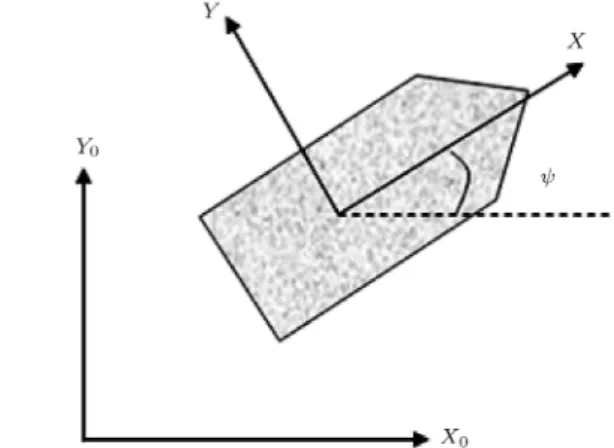
In order to explain ship motion, it is convenient to introduce two frames. The rst one is earth-xed frame that represents position and orientation of the vessel with respect to an earth-xed frame X0Y0Z0
which is expressed in the form of = [x; y; z; '; ; ], and the second one is body-xed frame that is xed to the vessel. The vessel velocities are measured relative to this frame XY Z, by v = [u; v; w; p; q; r] (see Figure 1).
To have a reliable modeling we introduce J() transformation matrix that represents the transfor-mation between the body-xed and the earth-xed velocities vectors:
_ = J()v: (1)
It should be mentioned that the transformation matrix depends on the Euler angles. We can derive J() with some mathematic operations in transformation of frames [17]:
Figure 1. Denition of the earth-xed X0Y0Z0 and the vessel-xed XY Z reference frames.
J()= 2
4c cs c c c + sss s c s s + c csc s + ss c
s cs cc
3 5 ;
(2) where s. stands for sin(.) and c. stands for cos(.). , and are Euler angles that are about X, Y and Z coordinates, respectively. Conventional ships are not equipped with actuators in roll and pitch which suggest that the roll and pitch modes should be omitted in automatic control design procedure. In fact, this is an appropriate assumption since both the rolling and pitching motions of a ship are oscillatory with zero mean and limited amplitude. Moreover, a conventional ship is metacentric stable which implies that there exist restoring moments in roll and pitch. In this paper, it is assumed that the ship is suciently metacentric stable, such that only the rotation matrix in yaw can be used to describe the kinematic equations of motion [18]. For 3 DOF, the vessel position in earth-xed frame and its velocities in body-xed frame can be represented by = [x; y; ] and v = [u; v; r], respectively. As a result of vessel motion in horizontal plane ( = 0 and = 0), the transformation matrix depends on only yaw angle and we have:
J() = J( ) = 2
4cos sin cos sin 00
0 0 1
3
5 ; (3) where J( ) is nonsingular for all . It should be noted that J 1( ) = JT( ) [19].
2.2. Low Frequency (LF) ship model
We can model a surface ship motion in horizontal plane by the model:
M _v + Dv = u + JT( )b; (4)
where u is a vector of control forces and moment that ship propulsion system provides it. M is the inertia ma-trix including hydrodynamic added inertia and D > 0
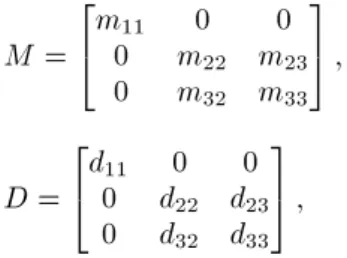
is a strictly positive denite matrix representing linear hydrodynamic damping. With considering starboard-port symmetry of ships, M and D matrixes can be written as:
M = 2
4m011 m022 m023 0 m32 m33
3 5 ; D =
2
4d011 d022 d023 0 d32 d33
3
5 ; (5)
which states that there is no coupling between the surge and the sway-yaw subsystems. In general, M will be non-symmetrical, that is m23 6= m32 due to
the properties of hydrodynamic added inertia. In fact, hydrodynamic added mass will depend on the speed of the ship and the wave frequency of encounter. However, for low-speed and zero speed applications, the inertia matrix M = MT is positive denite
and constant. In general the damping matrix D will be nonlinear. However for DP and cruising at constant speed, linear damping is a good assump-tion [17].
For describing environmental forces and moments in the ship low-frequency model due to wind, ocean currents, and unmodeled dynamics we introduce a bias term b 2 R3as [19]:
_b = T 1b + n; (6)
where T is a diagonal matrix representing time con-stant, is the excitation gain and n is a vector of Gaussian white noise.
2.3. Wave Frequency (WF) model
The WF motions are mainly due to 1st-order wave loads. Assuming small amplitudes, a linear Wave Frequency (WF) model of order p can in general be expressed as:
_ = +Xw; (7)
w= ; (8)
where 2 Rp and
w= [xw; yw; w]T is the WF
earth-xed position and heading vector, w is a vector of Gaussian white noise and , P and are constant matrices of appropriate dimensions [18].
2.4. Measurements
Only position and heading measurements are available. The measurement vector y is assumed to be a super-position of the LF and WF motions, in addition to the measurement noise v, that is:
y = + w+ v: (9)
3. Adaptive critic-based neuro-fuzzy controller 3.1. Neuro-fuzzy networks
Fuzzy set is a simple extension of the denition of a classical set in which the characteristic function is permitted to have any number between 0 and 1. A fuzzy set A in X can be dened as a set of ordered pairs:
A = f(x; A(x))jx 2 Xg ; (10)
where A(x) is called membership function for the
fuzzy set A. It maps each x to a membership grade between 0 and 1. Also a fuzzy If-Then rule (fuzzy rule, fuzzy implication, or fuzzy conditional statement) is expressed as follow:
If (x is A) then (y is B); (11) where A and B are linguistic values dened by fuzzy sets. (x is A) is called antecedent or premise, while (y is B) is called the consequence or conclusion. Fuzzy systems are made of a knowledge base and reasoning mechanism called fuzzy inference engine. A fuzzy inference engine turns fuzzy If-Then rules into a mapping from the inputs of the system into its outputs, using fuzzy reasoning methods. It means that fuzzy systems represent nonlinear mapping accompanied by fuzzy If-Then rules from the rule base. Each of these rules describes the local mappings. The rule base can be constructed either from human expert or automatic generation that is extraction of rules using numerical input-output data. There are two types of fuzzy inference system that are commonly used: Mamdani and Takagi-Sugeno-Kang (TSK). In neuro-fuzzy networks, TSK type fuzzy inference system is used. The output of each rule can be a linear combination of input variables plus a constant term or can be only a constant term. The nal output is the weighted average of each rules' output. Basic neuro-fuzzy system architecture that has two inputs x and y and one output f is shown in Figure 2. The rule base contains two TSK If-Then rules as:
Figure 2. A neuro-fuzzy structure which is equivalent to a TSK fuzzy inference system.
Rule 1: If x is A1 and y is B1, then:
f1= a1x + b1y + c1; (12)
Rule 2: If x is A2 and y is B2, then:
f2= a2x + b2y + c2: (13)
The node functions in a layer are the same as described below:
Layer 1: Every node i in this layer is a square node with a node function as:
o1;i= Ai(x) (i = 1; 2); (14)
o1;i= Bi 2(y) (i = 3; 4); (15)
where x is the input to node i, and Ai (or Bi 2)
is a linguistic label (such as small or large) asso-ciated with this node. In other words o1;i is the
membership grade of a fuzzy set Ai and it species
the degree to which the given input x satises the quantier Ai. Parameters in this layer are referred
to premise parameters.
Layer 2: Every node in this layer is labeled by II whose output is the product of all incoming signals: o2;i= ui= Ai(x)Bi(x) (i = 1; 2): (16)
Each node output represents the ring strength of a fuzzy rule.
Layer 3: Every node in this layer is labeled by N. The i-th node calculates the ratio of the rules ring strength to the summation of all rules ring strengths:
o3;i= ui=(u ui
1+ u2) (i = 1; 2): (17)
Outputs of this layer are called normalized ring strengths.
Layer 4: In this layer, every node is adaptive, due to its adjustable parameters, with a node function as:
o4;i= uifi= ui(aix + bi+ ci); (18)
where ui is a normalized ring strength from layer
3 and fai; bi; cig is the parameter set of this node.
Parameters in this layer are referred to consequent parameters.
Layer 5: The single node in this layer is labeled byP that computes the overall outputs as the summation of all incoming signals:
o5;i=
X
i
uifi=
P
iuifi
P
iui : (19)
Thus a network which is functionally equivalent to the TSK fuzzy inference system has been con-structed.
3.2. The controller structure
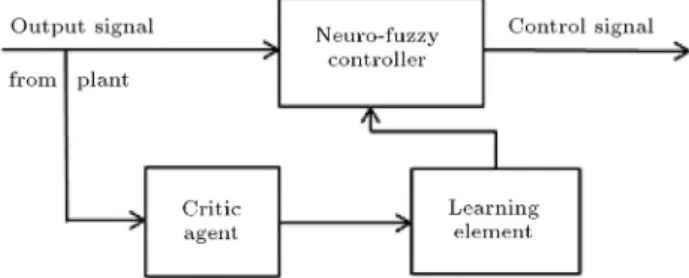
According to psychological theories, some of the main factors of human being learning are emotional signal such as satisfaction and stress. Emotion can be dened as states elicited by instrumental reinforcing stimuli, which their occurrence, termination or omission is made contingent upon the making of a response, and alter the course of future emission of that response [20]. Adaptive critic design is based on reinforcement learn-ing concept. The critic agent assesses the behavior of the control system through evaluation of plant output and provides reinforcement signal namely r. In classical reinforcement learning, there exists a reinforcement signal, R, which usually accepts binary values. For example, if R = 1, the control system has failed and should modify itself so that a reinforcement signal of value zero is achieved, i.e. the critic is fully satised in subsequent trials [21]. However, in novel or non-classical reinforcement learning methods, the reinforce-ment signal (r) is always continuous and accepts any value between -1 and 1, with r = 1 (or -1) indicating the total failure of the control system. The closer the reinforcement signal gets to zero, the better the control action. Here the system does not wait for a total failure to occur before it starts learning. Instead, it continues its learning process at the same time as it applies its control action. Generally, in a multivariable system for each output a critic is assigned. Inputs of the critic are usually error between the system's output and its desired or reference value, and its derivative, and its output is the corresponding reinforcement signal. The reinforcement signals contribute collaboratively for updating parameters of each neuro-fuzzy controller. It should be noticed that the structure of controller is like a TSK fuzzy system whose parameters are updated using the reinforcement learning. The aim of the control system is minimization of the square value of reinforcement signals. Structure of adaptive critic-based neuro-fuzzy controller is shown in Figure 3.
Let dene the error function for each controller as:
Ej= 12r2j (j = 1; 2; :::; m); (20)
where rj is the output signal of critic j, and m
Figure 3. Structure of adaptive critic-based neuro-fuzzy controller.
is the total number of outputs. The goal of the learning procedure is to minimize error signal Ej for
the adjustment of controller weights; so the steepest descent method is used as:
wi= i@E@wj
i (i = 1; 2; :::; n) (j = 1; 2; :::; m);(21)
where i is the learning rate of the corresponding
con-troller, w0
is are the tunable weights of each controller,
and n is the total number of controller parameters. In order to calculate the relative derivative of Eq. (21), the chain rule is used:
@Ej
@wi =
@Ej
@rj
@rj
@yj
@yj
@ui
@ui
@wi
(i = 1; 2; :::; n and j = 1; 2; :::; m): (22) From Eq. (21) and also the dynamic equations of the system, we have:
@E
@rj = rj (j = 1; 2; :::; m); (23)
@yj
@ui = Jji (i = 1; 2; :::; n and j = 1; 2; :::; m); (24)
where Jji is the element in the i-th column and j-th
row of the Jacobin matrix of the system, and ui is the
i-th control input. If the direction of changes of the system output with respect to the input is known we can approximate J with its sign. Also we have:
ej= y(ref)j yj (j = 1; 2; :::; m); (25)
where ej is the error produced in the tracking of the
j-th output and yref is the desired output. Let us dene
the reinforcement signal of the j-th critic as a linear combination of error ej, and derivative of error _ej as:
rj = Kjej+ Lj_ej (j = 1; 2; :::; m); (26)
where Kj and Lj are positive constants of the j-th
critic. By the chain rule and using Eq. (26), we can write:
@rj
@yj =
@rj
@ej
@ej
@yj = Kj( 1) = Kj (j = 1; 2; :::; m):(27)
From Eqs. (21) to (27), wi will be calculated as:
wi= iKjrjJji@w@ui
i: (28)
Eqs. (29) to (31) are used for updating the learning parameters, ai, bi and ci, in Eq. (14):
aijnew= aijold+ irjxPnui i=1ui
; (29)
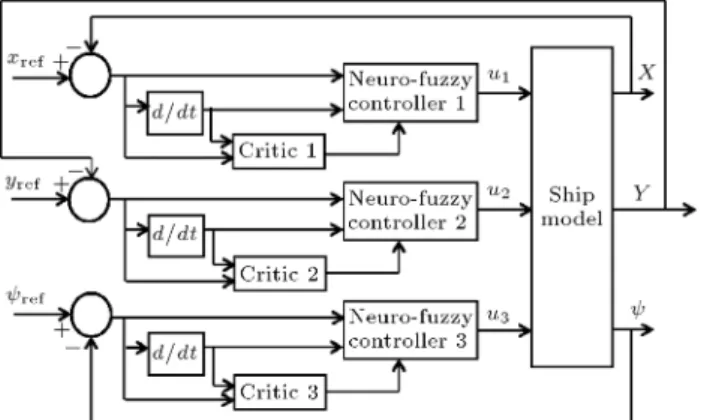
Figure 4. Structure of ACNFC for dynamic positioning of ships.
bijnew= bijold+ irjyPnui
i=1ui; (30)
cijnew= cijold+ irjPnui
i=1ui; (31)
where i, i and i are learning rates for each rule.
Here it is assumed that Kj = 1 and Jii = 1; Jji = 0,
i 6= j (instead of the Jacobian matrix its sign is used).
4. Architecture of the ship controller
Figure 4 shows the structure of the designed Adaptive Critic based Neuro-Fuzzy Controller (ACNFC) for dynamic position control of ships. This structure is made of three neuro-fuzzy controllers with three critics for control of vessel position (x; y) and heading . The inputs of each controller are the outputs0 error
signal and its derivative, and three linguistic variables (negative (N), positive (P), and zero (Z)) are used in each input in order to tune the rules, and accordingly nine rules are formed for each controller. We have considered three membership functions for each of the inputs. The sigmoid functions for the variables N and P , and the Gaussian function for the variable Z are dened, respectively as:
Fji(xi) = [1 + exp( aji(xi cji))] 1; (32)
Fji(xi) = exp
(xi cji ji )
2
; (33)
where cji is the center of function, ji is the function
variance, and ajiis the curve inection parameter. The
membership functions of the linguistic variables are shown in Figure 5.
The main section in ACNFC is the critic. Inputs of each critic are the output's error signal and its derivative, which are used to evaluate the system performance. For example, if the error signal is positive but its derivative is negative, then the performance is good. As another instance, if the error signal
Figure 5. The membership functions of the
corresponding linguistic variables of the proposed ACNFC.
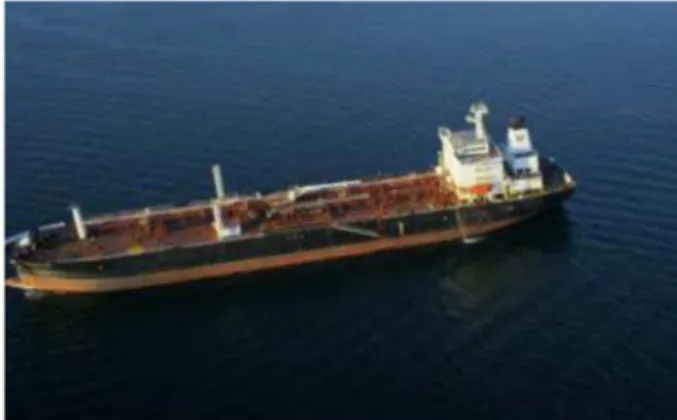
Figure 6. Moored tanker, L = 200:6 (m) [8].
and its derivative are both negative, the controller behavior will not satisfy the critic. Finally by apply-ing the stress signal to each ACNFC, The controller parameters are tuned in order to optimize the system performance by minimizing the square of reinforcement signal.
5. Dynamic position control
Consider the moored tanker shown in Figure 6. Nu-merous simulations are performed to evaluate the per-formance of controllers using MATLAB software. The case studies are based on the following non-dimensional model of the moored tanker (Bis-system) [8,17]:
M = 2
41:08250 2:05750 0:40870 0 0:4087 0:2153
3
5 ; (34)
D = 2
40:08650 0:0762 0:15100 0 0 0:0151 0:0031 3
5 : (35) The Bis-system is based on the use of the time unit dened by q Ship length
Gravity const, the mass unit dened by
m = r, and the body mass ratio m=r where r is the hull contour displacement and is the water density, as normalization variables. The method of
Table 1. Parameters of critic agents.
K1 L1 K2 L2 K3 L3
0.14 0.85 0.25 0.9 0.05 0.13
non-dimensionalization is presented completely in [17]. The bias time constants were chosen as:
T = 2
456:70 12:90 00 0 0 213:5
3
5 : (36)
Performance of the ACNFC depends on the values of learning rate and coecients of critic. The values of the coecients of critic agents are given in Table 1, they have been chosen by trial and error mechanism. It should be emphasized that the critic role is to truly evaluate the situation but indeed not needed to be so accurate. The sample time of 0.1 sec is chosen and learning rates are constant and equal to 1 = 2 =
3 = 0:35. Also the controllers initial weights are
selected randomly between [-1 1]. In the simulations measurement noise is modeled as white noise and WF motions are modeled by a 2nd-order linear model. The initial value for the position x is chosen -10, and its desired value is 0. Also the initial position y is set to -10, and its desired value is 0. Finally the set point for the heading is chosen to be -10, which is applied at instance 10 as a step function from initial value of 0. The control systems have been implemented and simulated to investigate their performance. The results show that wave ltering, positioning and tracking are performed with no visible osets, and satisfactory accuracy is obtained. The Simulation results are shown in Figures 7-9. In all of the following gures all the values represent the dierence from the corresponding steady state values. It should be noted that all values of state variables and the system parameters are non-dimensionalized according to [17]. To obtain the real values of state variables, the non-dimensional position
Figure 8. Performance of ACNFC, position y.
Figure 9. Performance of ACNFC, heading .
and time should be multiplied by the ship length and time unit dened by q Ship length
Gravity const, respectively. The
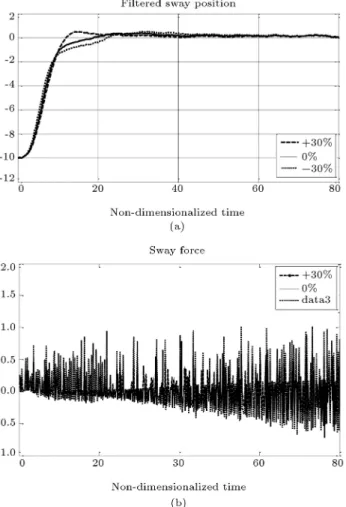
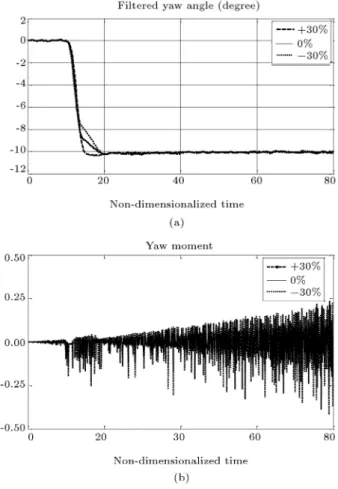
real values of forces can be obtained using the values of ship length, ship mass and the mentioned time unit. To check the robustness of the controlled system to model uncertainty, the ACNFCs are implemented
Figure 11. Performance of ACNFC wrt model uncertainties: (a) Position y; and (b) sway force.
on the ship model whose matrices in Eqs. (34) to (36) are changed 30% around their nominal values. We can see that the performance of the ACNFCs is not strongly aected and only slight deviations are visible in the control signals, position and heading response. The computer simulations are shown in Figures 10-12.
Figure 12. Performance of ACNFC wrt model uncertainties: (a) Heading ; and (b) yaw moment.
6. Conclusion
In this article three adaptive critic-based neuro-fuzzy controllers were proposed in order to control the dynamic positioning of ships. The unique aspect of this type of controller is that it uses the critic which simulates the expert operation in reality. Here we de-sign the critic instead of dede-signing the controller itself. This feature increases the degree of intelligence and robustness of the system and results in a self-tuning and adaptive controller. Learning rules are very simple and therefore the computational speed is high. Considering the simplicity of ACNFC and its independence from the model, this control method has advantage of on-line learning and control, and can be applied to a large variety of systems. The proposed controller was applied to control the position x, position y and heading angle of the moored tanker. Simulation results show that the controller has good convergence and robust performance which are concluded from the adaptive and intelligent structure of the proposed control.
References
1. Balchen, J.G., Jenssen, N.A. and Saelid, S. \Dynamic positioning using Kalman ltering and optimal control
theory", Proc. IFAC/IFIP Symp. on Autom. in O-shore Oil Field Oper., Holland, Amsterdam, pp. 183-186 (1976).
2. Fossen, T.L., Sagatun S.I. and Srenson, A.J. \Identi-cation of dynamically positioned ships", Contr. Eng. Pract., 4(3), pp. 369-376 (1996).
3. Kijima, K., Murata, K. and Furukawa, Y. \Design of dynamic positioning system for self-propulsive barge under external disturbances", Proc. IFAC Conf. on Contr. Applic.in Marine Syst., Fukuoka, Japan (1998).
4. Volovodov, S.K., Chernjaev, M.G., Kaverinsky, A.J., Volovodov, S.S. and Lampe, B.P. \Control principle for dynamic positioning of oshore drilling platforms and ships", Proc. of the 11th Symp. on Martime Elektrot. Elekt. Und. Informationstechnik., Rostoch, Germany (2004).
5. Stephens, R.I., Burnham, K.J. and Reeve, P.J. \A practical approach to the design of fuzzy controllers with application to dynamic ship positioning", Proc. IFAC Conf. on Contr. Applic., in Marine Syst., Trond-heim, Norway (1995).
6. Katebi, M.R., Grimble, M.J. and Zhang, Y. \H1 robust control design for dynamic ship positioning", IEE Proc. Contr. Theory. And Applic., 144, pp. 110-120 (1997).
7. Bertin, D., Bittanti, S., Meroni, S. and Savaresi, S.M. \Dynamic positioning of a single-thruster vessel by feedback linearization", Proc. IFAC Conf. on Ma-noeuv. and Contr. Marine Craft., Aalborg, Denmark (2000).
8. Fossen, T.I. and Grvlen, A. \Nonlinear output feed-back control of dynamically positioned ships using vec-torial observer backstepping", IEEE Trans. on Cont. Syst. Techn., 6(1), pp. 121-128 (1998).
9. Tannuri, E.A., Agostinho, A.C., Morishita, H.M. and Moratelli, L. Jr. \Dynamic positioning systems: A experimental analysis of sliding mode control", Contr. Eng. Pract., 18(10), pp. 1121-1132 (2010).
10. Von Altrock, C. and Gebhardt, J. \Recent successful fuzzy logic applications in industrial automation", in Proc. 5th IEEE international Conf., 3, pp. 1845-1851 (1996).
11. Dash, P.K., Panda, S.K., Lee, T.H., Xu, J.X. and Routray, A. \Fuzzy and neural controllers for dynamic systems: An overview", IEEE Proc. International Conf. on Power Elect. and DriveSyst., 2, pp. 810-816 May (1997).
12. Lin, C.T. and Lee, C.S.G. \Neural-Network based fuzzy logic control and decision system", IEEE Trans. Comput., 40(12), pp. 1320-1327 (1991).
13. Sutton, R.S. and Barto, A.G., Reinforcement Learning: an Introduction, MIT Press (1998).
14. Berenji, H.R. and Khedkar, P. \Learning and tuning fuzzy logic controller through reinforcements", IEEE Trans. Neural Netw., 3, pp. 724-740 (2000).
15. Fakhrazari, A. and Boroshaki, M. \Adaptive critic-based neuro-fuzzy controller for the steam generator water level", IEEE Trans. Nucl. Sci., pp. 1678-1685 (2008).
16. Khorramabadi, S.S., Boroushaki, M. and lucas, C. \Emotional learning based intelligent controller for a PWR for nuclear reactor during load following operation", Ann. Nucl. Energ., pp. 2051-2058 (2008).
17. Fossen, T.L., Guidance and Control of Ocean Vehicles, UK: John Wiley and sons (1994).
18. Fossen, T.L. and Strand, J.P. \Passive nonlinear ob-server design for ships using Lyapanov methods: Ex-perimental results with a supply vessel", Automatica., 35(1), pp. 3-16 (1999).
19. Aarset, M.F., Strand, J.P. and Fossen, T.L. \Nonlinear vectorial observer backstepping with integral action and wave ltering for ships", Proc. IFAC Conf. on Contr. Applic. in Marine Syst., Fukuoka, Japan, Japan (1998).
20. Rolls, E.D., The Brain and Emotion, Oxford Univer-sity Press (1998).
21. Lin, C.K. \Adaptive critic autopilot design of bank-to-turn missiles using fuzzy basis function networks", IEEE Trans. Syst., Man, Cybern. B, Cybern., 35(2), pp. 197-207 (April 2005).
Biographies
Ehsan Hatami received his MSc degree in energy en-gineering from Sharif University of Technology, Tehran, Iran. His research interests includes, intelligent sys-tems and control, adaptive control, nonlinear control, Kalman lters and fault detection.
Hassan Salarieh received his BSc in mechanical engineering and also pure mathematics from Sharif University of Technology, Tehran, Iran, in 2002. He graduated from the same university with MSc and PhD degrees in Mechanical Engineering, in 2004 and 2008. At present, he is an associate professor in mechanical engineering at Sharif University of Technology. His elds of research are dynamical systems, control theory and stochastic systems.