Sharif University of Technology
Scientia IranicaTransactions A: Civil Engineering www.scientiairanica.com
An experimental study of the seismic behavior of
inlled RC frames with opening
H. Tekeli
and A. Aydin
Department of Civil Engineering, Suleyman Demirel University, Isparta, Turkey. Received 11 October 2015; received in revised form 21 April 2016; accepted 2 July 2016
KEYWORDS Inll wall; Opening;
Reinforced concrete buildings;
Cyclic lateral loading; Location and size of the openings.
Abstract. Inll walls are not generally taken into account in structural analysis due to their complex behavior at seismic actions. As it is known, they increase the stiness as well as the lateral load capacity of the system. Sometimes, inll walls may have window and door openings in their planes. In the present study, behavior of Reinforced Concrete (RC) frames with inll walls, which have openings, is investigated under cyclic lateral loadings. Location and size of the openings in the inll wall are selected as investigation parameters. Test specimens are constructed and experimentally analyzed. The inll wall changes the behavior of the frames under cyclic lateral loads signicantly. Location and size openings in the inll wall are two main parameters that aect the behavior of the inll walls as well as the frame. The test results clearly show that the contribution of the inll wall to the behavior of RC frame diminishes signicantly when the opening ratio is larger than 9%. Therefore, the eect of the opening in the inll wall must be taken into account in the structural modeling when the opening ratio is larger than 9%.
© 2017 Sharif University of Technology. All rights reserved.
1. Introduction
Reinforced Concrete (RC) frames with masonry inll walls are widely used in structural systems in many parts of the world. It is known that inuence of inll walls on the behavior of frames, which are subjected to earthquake loadings, is very important in some cases. If the inll walls are uniformly distributed throughout the structure, then they usually have a benecial eect on the seismic response of the structure. On the other hand, negative eects can appear due to irregular positioning of the inll walls in plan, and especially in elevation [1]. Even with symmetric layout, irregularity can be expected due to partial failure of these walls.
*. Corresponding author. Tel.: +90 246 2111190; Fax: +90 246 2370859
E-mail addresses: [email protected] (H. Tekeli.); [email protected] (A. Aydin)
doi: 10.24200/sci.2017.4150
Inll walls have attracted the attention of many researchers since the early 1950s. A large number of researchers have studied the behavior of inlled steel and RC frames subjected to in-plane and out-of-plane lateral loads. These studies have involved both experimental and numerical analyses.
Uva et al. [2] have investigated the role of masonry inll in the seismic behavior of RC frames, pointing out some relevant questions about the sensitivity to the material parameters and the choice of the modelling approach. Chrysostomou and Asteris [3] have consid-ered the in-plane behavior and in-plane failure modes of inlled frames and presented simplied methods for predicting these failure modes. Ricci et al. [4] have analyzed the eect on the elastic period of vibration of inll contribution to lateral stiness of RC buildings. Shing and Mehrabi [5] have summarized some of the recent ndings and developments of the behavior and modelling of inlled structures. Koutromanos et al. [6] have investigated the behavior of masonry-inlled rein-forced concrete frames under cyclic lateral loading by
using nonlinear nite element models. Most of these studies have shown that use of masonry inll walls has a signicant impact not only on the strength and stiness but also on the energy dissipation mechanism of the overall structure. Celarec et al. [7] have investigated the sensitivity of the seismic response parameters to the uncertain modeling variables of the inll walls and frame. Campione et al. [8] have improved an equivalent diagonal pin-jointed strut model taking into account the stiening eect of vertical loads on the inll in the initial state. Martinelli et al. [9] have proposed a simplied procedure based on NonLinear Static (NLS) analysis for evaluating the seismic response of masonry inlled RC frames.
Amanat and Hoque [10] and Kose [11] have investigated the parameters aecting the fundamental period of RC buildings with inll walls. Asteris et al. [12] have presented a detailed and in-depth ana-lytical investigation of the parameters that aect the fundamental period of reinforced concrete structure. From the analysis of the results, it has been found that the number of stories, the span length, the stiness of the inll wall panels, the location of the soft stories, and the soil type are crucial parameters that inuence the fundamental period of RC buildings.
Pujol and Fick [13] have reported experiments on a full-scale building structure performed to address questions about the potentially positive or negative eects of masonry inll walls. The study has focused on the assumption that measures are taken to prevent out-of-plane failure of masonry panels. Tu et al. [14] have conducted shaking table tests on four full-scale single-story structures to investigate the out-of-plane behavior of unreinforced masonry (URM) panels in RC frames. They have presented an analytical model for the out-of-plane behavior of masonry panels in accordance with the rocking mechanism. Arulselvan et al. [15] have tested a frame having ve stories and three spans with a central portion inlled with brick under cyclic loading simulating seismic action. Analytical studies have been carried out as well to study the stiness, strength, and behavior of these types of frames.
Inll walls may have window and door open-ings. Asteris [16] has analytically investigated the inuence of the masonry inll panel opening on the reduction in the stiness of the inlled RC frames. A parametric study has been carried out by adopting location and size of the masonry inll panel opening as investigation parameters. Altin et al. [17] and Anil and Altin [18] have investigated the behavior of ductile Reinforced Concrete (RC) frames strengthened by addition of partial inlls under cyclic lateral loading. Steel frames with masonry inlls having openings have been tested by Tasnimi and Mohebkhah [19], and Liu and Manesh [20].
Experimental studies have been carried out by Voon and Ingham [21], Kakaletsis and Karayannis [22], Mansouri et al. [23] related to walls with openings. Voon and Ingham [21] have presented test results of eight partially grout-lled perforated concrete masonry walls subjected to cyclic lateral loading. The eight walls had variations in lintel reinforcement detailing. Test results obtained from this research indicated that the size of openings and the length of trim-ming reinforcement signicantly aected the lateral strength of perforated masonry walls. Kakaletsis and Karayannis [22] have investigated the inuence of masonry openings on the seismic performance of inlled reinforced concrete frames, designed according to the current code provisions. The investigated parameters were the shape and the size of the opening. In all the examined cases, the shear strength of columns was higher than the cracking shear strength of solid inll. The experimental results showed the signi-cance of various forms of openings in the reduction of strength, stiness, and energy dissipation capability for all the examined cases of inlled frames. Mansouri et al. [23] have presented the inuence of openings on lateral behavior of low-shear-strength masonry in-lled reinforced concrete frames. The design of the reinforced concrete frames aimed to reect common seismic design deciencies. Six half-scale single-story, single-bay frame specimens were tested under in-plane lateral loading. The aspect ratio (h=l) of inll wall was equal to 0.62. The investigated parameters were shape (window and door), size (regular and large windows), and location of the openings (eccentric and central in horizontal direction). The results indicated that presence of openings altered the failure mode, increased the damage level, and reduced ductility, strength, and stiness of the inlled frame.
The failure mechanism of an inlled frame is quite complex and depends upon a large number of factors such as the relative strength and stiness properties of the inll wall and the frame. Although the subject of inlled frames has been studied for a long time, there are still questions to be investigated and answered about their behavior and interaction with the frame. Generally, window and door openings are formed in the inll wall to satisfy architectural requirements of the buildings; however, they create various modelling diculties. In FEMA 306 [24], it is stated that \In spite of the general success of modelling inlled frames with solid panels, major diculties still remain unresolved regarding the modeling approach for inlled frames with opening". Despite all these diculties in the modeling of inll walls with and without openings, seismic behavior of inll walls is still a popular subject for experimental and numerical studies.
The seismic safety evaluation of masonry inll walled reinforced concrete buildings requires
appro-priate macro-models for inll walls that have been calibrated by experimental results. Because of lim-itation of experimental data, most of the existing models have been developed by nite element analyses and have not been veried by experimental results. Therefore, more experimental investigation is required for predicting the stiness and strength of inlled frames with openings.
The purpose of this study is to investigate the eects of inll walls with openings on the behavior of the RC frames, and improve experimental data in the literature to deal with the inll wall having opening. Thus, the macro model of inll wall having opening can be developed by using the experimental results. An experimental study has been carried out by using variables that are related to the location and size of window opening in the inll walls. In the four specimens, the opening is located in the middle of the inll wall whereas in the other four specimens, the opening is located on the upper left part of the diagonal. Openings of the inll walls are located on the diagonal of all specimens.
The design of the reinforced concrete frames in this study aims to reect common seismic design deciencies, such as insucient transverse reinforce-ments at column and beam ends, lack of transverse reinforcement at beam-column joints, and weak col-umn/strong beam connections that are encountered frequently in practice. The results of the study including failure mode, lateral load capacity, energy dissipation, and the lateral stiness of the frame with inll walls are investigated and given in gures comparatively.
2. Experimental work
2.1. Description of the test specimens
Ten test specimens are constructed with 1/3 scale and tested under cyclic lateral loading. Span length and height of the frame in all specimens are kept constant at 1500 mm and 1200 mm, respectively.
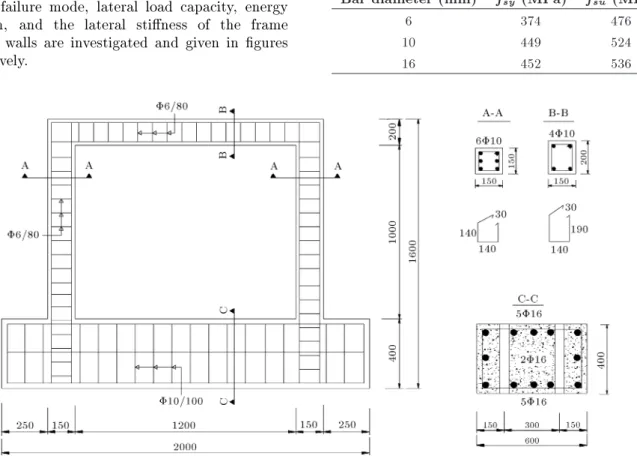
Cross sectional dimensions of columns and beams are given in Figure 1. Longitudinal reinforcements of columns and beams consist of 10-mm bars. Stirrups are provided for the columns and beams as 6-mm diameter bars with 135 hooks. Spacing between
the stirrups is 80 mm. The design of the reinforced concrete frames in this study aims to reect com-mon seismic design deciencies, such as insucient transverse reinforcements at column and beam ends, lack of transverse reinforcement at beam-column joints, and weak column/strong beam connections that are encountered frequently in practice. A typical layout of the beam and the column along with reinforcing details is presented in Figure 1. Properties of the reinforcement used in the study are listed in Table 1.
Tests for evaluation of concrete compressive strength (fc) are carried out on 150 mm 300 mm
concrete cylinders, and average strength values (fc) on
28 days for each frame are given in Table 2. Three types
Table 1. Average values of the yield stress of the reinforcing bars.
Bar diameter (mm) fsy (MPa) fsu (MPa)
6 374 476
10 449 524
16 452 536
Table 2. Location and ratio of the opening on inll wall. Specimen
ID
fc
(MPa) frame
Opening percentage%
Opening position
Specimen ID
fc
(MPa) frame
Opening percentage%
Opening position
Specimen 1 21 100 Specimen 2 20 0
Specimen 3 23 4 Specimen 4 21 4
Specimen 5 21 9 Specimen 6 21 9
Specimen 7 22 16 Specimen 8 20 16
Specimen 9 20 25 Specimen 10 22 25
of frames are constructed for the experimental tests. The rst type does not have any inll wall (bare frame), the second has a solid inll wall (without opening), and the third includes partial openings at dierent locations of the inll wall. Table 2 summarizes the properties of each specimen.
The inll walls in the frames are constructed by using 1/3 scale hollow clay tiles with dimensions of 55 mm 100 mm 100 mm after nishing the construction of the frame. The aspect ratio (h=l) of inll wall is equal to 0.83. A rough plaster is applied on both sides of the inll walls where regular masonry units are connected to each other by a regular mortar. The thickness of the plaster used at the two faces of the brick walls is 10 mm, and total thickness of inll wall is 120 mm. The inll walls are not constructed on the symmetric axis of the frame to simulate the exterior walls of the building. The mortar and plaster mixture contains one part cement, one part lime, and four parts sand according to the common construction practice. The sand used has a maximum aggregate size of 3 mm. The average compressive strengths of the mortar and plaster used in the construction of the masonry walls of the specimens are found to be around 3.5 MPa.
Openings of the inll walls are located on the diagonal of all specimens, where strut is expected to appear when the frame is subjected to a lateral load. In the four specimens, the opening is located in the middle of the inll wall whereas in the other four specimens, the opening is located on the upper left part of the diagonal (Figure 2). Ratios of the opening area to the inll wall area are selected to be 4%, 9%, 16%, and 25% where the rectangular
openings are chosen to be 240 mm200 mm; 360 mm 300 mm; 480 mm 400 mm; and 600 mm 500 mm, respectively, where dimensions represent the length and height of the opening in the x and y directions, respectively (Figure 2).
The compressive strength of the inll wall is found to be 5.0 MPa. All samples are painted with lime whitewash in order that cracking in the RC frame and in the inll wall can be observed clearly during the test.
2.2. Test setup
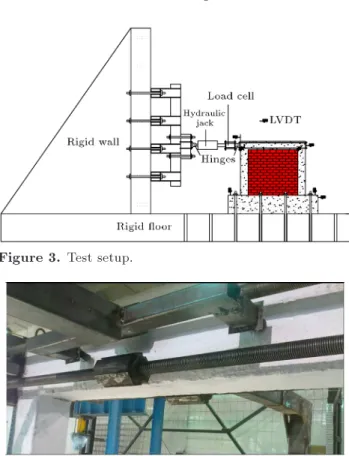
Test setup is shown in Figure 3. After the specimens have been bolted to the rigid oor by the foundation beam at the bottom, tests are carried out by applying reversed cyclic lateral loading. Each load cycle consists of push and pull loading steps. The lateral load is applied at the beam level and increases by 5 kN at each loading step. Loading in the tests is continued until the inlled frame reaches its lateral load capacity in load control manner. Then, the test is continued in displace-ment control in order to obtain the load-displacedisplace-ment curve until a decrease of 15% in the maximum load is reached. Furthermore, in order to provide a right angle (90) between the load cell and the frame during the
loading, a hinge is used as shown in Figure 3. The lateral displacements are measured by using LVDTs (Linear Variable Dierential Transformers). The lo-cations of LVDTs are also shown in Figure 3. After each loading cycle, cracks and damage mechanisms in the specimens are observed and recorded. A bracing system is employed to prevent out-of-plane movement of the specimens, as shown in Figure 4.
Figure 2. Location of the openings on the inll wall (mm).
Figure 3. Test setup.
Figure 4. Bracing system against out-of-plane movement of the specimens.
3. Experimental results
3.1. Observed damage in the specimens
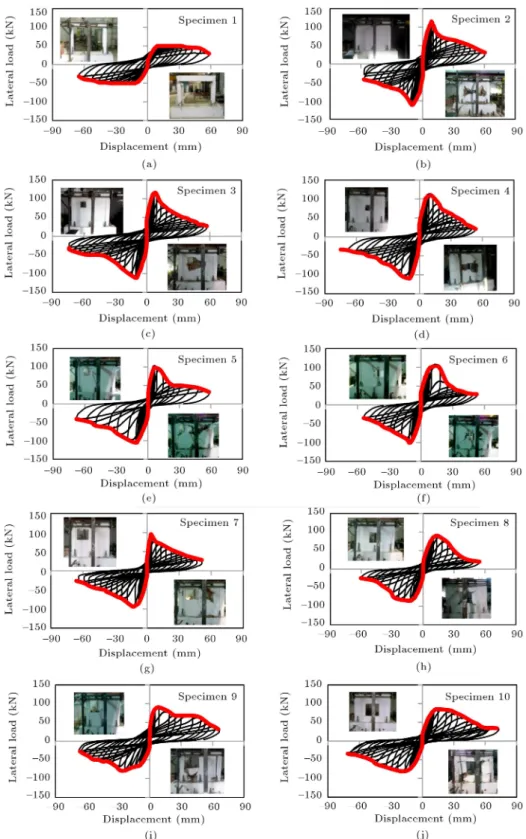
Distributions of the damage in the specimens are observed and recorded throughout the experiment. Figure 5 shows damage variations in Specimen 1 and Specimen 2. Specimen 1 represents the bare frame that has failed due to the column mechanism, i.e. due to
plastic hinges developed at both ends of the columns, as it is expected due to strong beam/weak column conguration. In Specimen 2, the separation cracks are rstly observed at the interface between the frame and the inll wall due to deformation dissimilarity. While vertical cracks are formed at the bottom and top of the inll wall, horizontal cracks are formed in the middle of the inll wall. Propagation of the horizontal cracking in the middle of the inll wall develops a diagonal crack under increasing lateral load. After the formation of a great number of hairline cracks on the inll wall, an increase in their widths is observed as well. The diagonal cracks in the inll wall are followed by shear failure at the bottom and top of the columns. This is due to the shear force applied by the strut developed in the inll wall. This fact indicates an increase in the design shear force at the columns as the horizontal component of the strut, to avoid brittle shear failure at the columns.
Crack congurations observed in all specimens with the inll walls having openings are given in Figure 6. As seen, the rst cracks occur obliquely on the corner of the openings, where a stress concentration
Figure 5. Damage observed in Specimen 1 and Specimen 2.
Figure 6. Damage observed in all specimens with the inll wall having opening.
is expected. Failure mechanisms of Specimens 3 and 4 are quite similar to that seen in Specimen 2. Probable reason for this is that the size of the opening in the inll wall is quite small.
In Specimen 5, a crack is formed from the bottom corner of the opening up to the upper corner of the frame. Later, the crack is widened under the increasing lateral load. The crack in the inll wall is extended to the column at the frame corner and causes a shear
failure at the top and bottom of the column, as observed in Specimen 2.
Cracking in the inll walls takes place outside the diagonal strip of the frame in Specimens 7 and 9, while cracking takes place along the diagonal of the frame in Specimens 6 and 8. Detailed inspection shows that cracking in Specimen 7 takes place in the area of the wall beside the opening obliquely whereas a diagonal crack is formed in the area of the inll wall under the
window opening in Specimen 9. As a result of the increase in the crack width in these specimens, the inll walls fail by losing their load carrying capacity. In Specimen 10, the starting point of the crack is at the window's corner and the crack continues horizontally towards the column. From the experiments, it is observed that the opening in inll walls changes the basic behavior of the frame and creates a new failure mechanism when the opening ratio is larger than 9%.
Generally, it is observed that the failure mech-anism of frames that include the inll walls with opening depends mostly on the location and ratio of the openings.
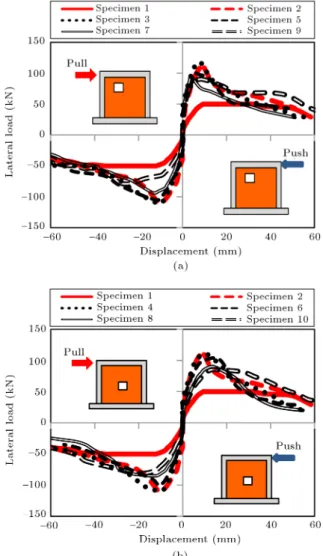
3.2. Lateral load capacity of the specimens Lateral load-displacement hysteretic curves that are obtained during the testing are illustrated in Figure 7. The tests clearly show that strength and stiness of the frames signicantly increase by the presence of inll walls. The largest lateral load capacity has been obtained 115 kN from Specimen 2, whereas the lowest lateral load capacity has been obtained 50 kN from Specimen 1. Lateral load capacity of the specimen with the solid inll wall has increased by almost 130% as compared to the specimen without inll wall. Envelope curves obtained from the lateral load-displacement hysteretic curves are shown in Figure 8. Lateral load capacities obtained from the tests are given in Figure 9 comparatively.
Lateral load capacity values in the pull and push directions are quite close to each other in the specimens (Specimens 4, 6, 8, and 10) having opening in the middle of the inll wall. In contrast, in the specimens (Specimens 3, 5, 7, and 9) having opening on the upper left part of the inll wall, the lateral load capacities in the push direction are generally larger than the lateral load capacities in the pull direction. A comparison of the two tests, which have the same ratios of opening in the middle and on the upper left part of the inll wall, yields that the lateral load capacity of the former is generally larger than that of the latter.
The lateral load capacities of Specimens 3 and 4 are almost equal to that of Specimen 2. As expected, the test results yield that as the opening ratio increases, the lateral load capacity of the specimen decreases, i.e. openings of 4, 9, 16, and 25%, lead to a decrease in the lateral load capacity of 1%, 10%, 20%, and 30%, respectively. It is worth noting that these values represent averages in dierent opening locations and dierent loading directions. The results obtained from tests show that the contribution of the inll walls to the lateral load capacity of the frame decreases signicantly when the opening ratio is larger than 9%.
3.3. Story drift ratios
Story drift ratios are obtained for the all specimens in
two dierent ways. First, story drift ratios are calcu-lated for all specimens corresponding to a lateral load capacity (50 kN) of the bare framed specimen. The highest and the lowest story drift ratios are observed in the bare frame and solid inll walled specimen by 1.1% (0.86%) and 0.1% (0.13%), respectively, under pull (push) lateral loadings. The obtained results show that the story drift ratios increase as the openings on the in-ll wain-lls increase. Second, story drift ratios correspond-ing to the ultimate load capacity of each specimen are obtained. Except the specimens with the opening of 25%, the highest value for the story drift ratio has been observed in bare frame while the lowest value has been observed in solid inll walled frame. These corresponding drift values are at the order of 0.9-1.1% (0.7-0.9%) under pull (push) lateral loadings, except for the specimens with the opening of 25%. In the speci-mens with the opening of 25%, the story drift ratio is higher than that in the bare frame under both push and pull loadings. For example, Specimen 10 (with opening of 25%) has experienced 1.4% story drift ratio and lateral stiness of 5.05 kN/mm with 80 kN of total load capacity, whereas these values for bare frame are 1.1%, 4.16 kN/mm, and 50 kN, respectively. This observation is due the fact that maximum story drift ratios are proportional to the corresponding ultimate lateral load capacities of the Specimens 10 and 1. Inll walls with openings contribute to the lateral stiness and lateral load capacity of the frames. However, if the opening in the inll wall is higher than 16%, the story drift ratio corresponding to the lateral load capacity of specimen is observed to increase with respect to the bare frame. The obtained results clearly show that the eect of openings on story drift ratios is noteworthy. Increment in the story drift ratio becomes signicant when the opening ratio is larger than 16% for both push and pull loadings. The opening becomes more eective when they are located in the middle part of the inll wall. 3.4. Stiness and energy dissipation
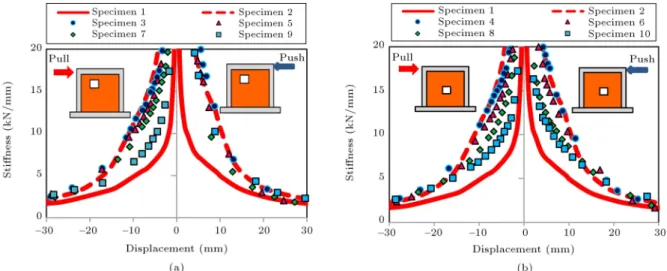
Lateral stiness of the specimens is calculated as the ratio of the lateral load to the lateral displacement at each cycle and presented in Figure 10. Specimen 2 exhibits the highest stiness among all specimens while Specimen 1 has the lowest stiness. The specimens which have openings in the middle of inll wall exhibit approximately equal stiness values for lateral loads in the pull and push directions. The results show that the stiness of the specimens decreases as the opening ratio increases. The lateral stiness for the push loading in all specimens having openings on the upper left part of the inll wall is generally larger than the stiness for the pull loading.
Energy dissipation is determined by calculating the areas inside the hysteretic load-displacement loops for each cycle, whereas the cumulative dissipated
en-Figure 7. Lateral load-displacement hysteretic curves of all specimens.
ergy is evaluated as the sum of the areas of all previous hysteresis loops; cumulative energy dissipations are depicted in Figure 11.
It is apparent from Figure 11 that the lowest energy dissipation is observed in Specimen 1 among all specimens. Among all the inll walled specimens, Specimen 2 displays the largest amount of energy.
When the opening ratio is less than 9%, the amount of the energy dissipation is almost equal to that of the solid inll walled specimen.
4. Conclusions
Figure 8. Envelope curves for all specimens.
walls having opening is investigated experimentally under cyclic lateral loadings. Location and ratio of the opening in the inll wall are selected as test parameters. RC frames with inll wall having opening are tested under reversed cyclic loading. Failure mode, lateral
load capacity, energy dissipation, and stiness of each specimen are obtained from the experimental results. The following conclusions can be derived from this study:
1. Presence of inll walls having openings changes the behavior of the frame signicantly. It also modies the failure mechanism, as opening ratio increases, especially when it is larger than 9%;
2. The obtained results have shown that inll walls lead to signicant increases in strength and stiness of bare RC frames. Lateral load capacity of the solid inll walled specimen increases by about 130% as compared to the specimen without inll wall. The test results show that as the opening ratio increases, the lateral load capacity of the specimen decreases. When the opening ratio of the inll wall is 4, 9, 16, and 25%, the lateral load capacity approximately decreases by 1, 10, 20, and 30%, respectively. Furthermore, the test results yield that the contribution of the inll wall to the lateral load capacity of the frame decreases signicantly when the opening ratio is larger than 9%;
3. Story drift ratios are obtained for all the specimens in two dierent ways. First, story drift ratios are calculated for all specimens corresponding to a lateral load capacity of the bare framed specimen. The highest and the lowest story drift ratios are observed in the bare frame and solid inll walled specimen. The obtained results show that the story drift ratios increase as the openings on the inll walls increase;
4. Second, story drift ratios corresponding to the ulti-mate load capacity of each specimen are obtained. In the specimens with the opening of 25%, the story drift ratio is higher than that in the bare frame under both push and pull loadings. This observation is due to the fact that maximum story
Figure 10. Variation of stiness depending on displacement for all specimens.
Figure 11. Energy dissipation depending on displacement for all specimens.
drift ratios are proportional to the corresponding ultimate lateral load capacities of the Specimens 10 and 1;
5. Inll walls with openings contribute to the lateral stiness and lateral load capacity of the frames. However, if the opening in the inll wall is higher than 16%, the story drift ratio corresponding to the lateral load capacity of specimen is observed to increase with respect to the bare frame. The obtained results clearly show that the eect of open-ings on story drift ratios is noteworthy. Increment in the story drift ratio becomes signicant when the opening ratio is larger than 16% for both push and pull loadings. The opening becomes more eective when they are located in the middle part of the inll wall;
6. Energy dissipation and stiness of the specimen are signicantly reduced with the increase in the ratio of the opening on the inll wall. Furthermore, the amount of energy dissipation is almost equal to that
of the solid inll walled specimen when the opening ratio is more than 9%;
7. Behaviors of the specimens under pull and push loadings are quite close to each other when the opening is located in the middle of the inll wall. However, the pull loading is generally more critical than the push loading, when the behavior of the specimen is considered, especially when the opening is located on the upper left part of the inll;
8. The test results clearly show that the contribution of the inll wall to the behavior of RC frame is greatly reduced when the opening ratio is larger than 9%. Therefore, the eect of the opening in the inll wall must be taken into account in the structural modeling when the opening ratio is larger than 9%;
9. In order to avoid brittle shear failure at the top and bottom of the columns of the frames with inll, the design shear force should increase by the horizontal component of the strut developed in the inll wall;
10. Experimental tests have shown that presence of openings signicantly changes the behavior of in-lled frames. The macro model of inll wall with opening can be developed by using the experimental results. Empirical equations can be proposed for estimating changes in lateral load capacity, energy dissipation, and the lateral stiness of inll walled frames because of the presence of openings. Acknowledgements
The study presented in this article was sponsored by the Research Project Coordination Unit of Suleyman Demirel University (SDU) under Project No. 3418-YL1-13 and Kelesoglu Construction Company. The experimental work of this study was conducted in the Structural and Earthquake Engineering Laboratory at SDU. The authors would like to thank Mr. Osman Akyurek, Mr. Metin Deniz, Mr. Necmi Kara, Mr. Emircan Hersat, Mr. Ugur Tosun, and Mr. Fatih Kaya for their assistance in conducting the experiments. References
1. Dolsek, M. and Fajfar, P. \The eect of masonry inlls on the seismic response of a four-storey reinforced con-crete frame a deterministic assessment", Engineering Structures, 30, pp. 1991-2001 (2008).
2. Uva, G., Raaele, D., Porco, F. and Fiore, A. \On the role of equivalent strut models in the seismic assess-ment of inlled RC buildings", Engineering Structures, 42, pp. 83-94 (2012).
3. Chrysostomou, C.Z. and Asteris, P.G. \On the in-plane properties and capacities of inlled frames", Engineering Structures, 41, pp. 385-402 (2012).
4. Ricci, P., Verderame, G.M. and Manfredi, G. \An-alytical investigation of elastic period of inlled RC MRF buildings", Engineering Structures, 33, pp. 308-319 (2011).
5. Shing, P.B. and Mehrabi, A.B. \Behavior and anal-ysis of masonry-inlled frames", Prog. Struct. Engng Mater., 4, pp. 320-331 (2002).
6. Koutromanos, I., Stavridis, A., Shing, P.B. and Willam, K. \Numerical modeling of masonry-inlled RC frames subjected to seismic loads", Computers and Structures, 89, pp. 1026-1037 (2011).
7. Celarec, D., Ricci, P. and Dolsek, M. \The sensitiv-ity of seismic response parameters to the uncertain modelling variables of masonry-inlled reinforced con-crete frames", Engineering Structures, 35, pp. 165-177 (2012).
8. Campione, G., Cavaleri, L., Macaluso, G. and Amato, G. \Evaluation of inlled frames: an updated in-plane-stiness macro-model considering the eects of vertical loads", Bull Earthquake Eng., 13, pp. 2265-2281 (2015).
9. Martinelli, E., Lima, C. and Stefano, G.D. \A simpli-ed procsimpli-edure for nonlinear static analysis of masonry inlled RC frames", Engineering Structures, 101, pp. 591-608 (2015).
10. Amanat, K.M. and Hoque, E. \A rationale for de-termining the natural period of RC building frames having inll", Engineering Structures, 28, pp. 495-502 (2006).
11. Kose, M.M. \Parameters aecting the fundamental period of RC buildings with inll walls", Engineering Structures, 31, pp. 93-102 (2009).
12. Asteris, P.G., Repapis, C., Tsaris, A.K. and Cavaleri, L. \Parameters aecting the fundamental period of inlled RC frame structures", Earthquakes and Struc-tures, 9(5), pp. 999-1028 (2015).
13. Pujol, S. and Fick, D. \The test of a full-scale three-story RC structure with masonry inll walls", Engi-neering Structures, 32, pp. 3112-3121 (2010).
14. Tu, Y.H., Chuan, T.H., Liu, P.M. and Yang, Y.S. \Out-of-plane shaking table tests on unreinforced ma-sonry panels in RC frames", Engineering Structures, 32, pp. 3925-3935 (2010).
15. Arulselvan, S., Subramanian, K., Perumalpillai, E.B. and Santhakumar, A.R. \RC inlled frame-RC plane frame interactions for seismic resistance", Journal of Applied Sciences, 7(7), pp. 942-950 (2007).
16. Asteris, P.G. \Lateral stiness of brick masonry in-lled plane frames", Journal of Structural Engineering, 129(8), pp. 1071-1079 (2003).
17. Altin, S., Ersoy, U. and Tankut, T. \Hysteretic re-sponse of reinforced concrete inlled frames", Jour-nal of Structural Engineering, 118(8), pp. 2133-2150 (1992).
18. Anil, O. and Altin, S. \Experimental study on rein-forced concrete partially inlled frames", Engineering Structures, 29, pp. 449-460 (2007).
19. Tasnimi, A.A. and Mohebkhah, A. \Investigation on the behavior of brick-inlled steel frames with openings, experimental and analytical approaches", Engineering Structures, 33, pp. 968-980 (2011).
20. Liu, Y. and Manesh, P. \Concrete masonry inlled steel frames subjected to combined in-plane lateral and axial loading - An experimental study", Engineering Structures, 52, pp. 331-339 (2013).
21. Voon, K.C. and Ingham, J.M. \Experimental in-plane strength investigation of reinforced concrete masonry walls with openings", Journal of Structural Engineer-ing, 134(5), pp. 758-768 (2008).
22. Kakaletsis, D.J. and Karayannis, C.G. \Experimental investigation of inlled reinforced concrete frames with openings", ACI Structural Journal, 106(2), pp. 132-141 (2009).
23. Mansouri, A., Marefat, M.S. and Khanmohammadi, M. \Experimental evaluation of seismic performance of low-shear strength masonry inlls with openings in reinforced concrete frames with decient seismic
details", Struct. Design Tall Spec. Build., 23(15), pp. 1190-1210 (2013).
24. \Evaluation of earthquake damaged concrete and ma-sonry wall buildings", prepared by the Applied Tech-nology Council (ATC-43 project) for the Partnership for Response and Recovery. Federal Emergency Man-agement Agency, Report No. FEMA-306, Washington, D.C. (1999).
Biographies
Hamide Tekeli is an Assistant Professor in the Civil Engineering Department at Suleyman Demirel
University in Isparta, Turkey. She received her PhD degree from Suleyman Demirel University in 2006. She specializes in the areas of behavior and modeling of reinforced concrete buildings. Her research focuses on experimental and theoretical studies.
Asim Aydin is an MSc student in the Civil Engi-neering Department at Suleyman Demirel University in Isparta, Turkey, and works as a Civil Engineer in the Kelesoglu Construction Company in Ankara, Turkey. His research interests include modeling of reinforced concrete structures, and repair and strengthening of earthquake-damaged structures.