Document Commentary
AIA Document A201™ – 2007 Commentary. Copyright © 2007. AIA Document A201™ – 2007. Copyright © 1888, 1911, 1915, 1918, 1925, 1937, 1951, 1958, 1961, 1963, 1966, 1970, 1976, 1987, 1997 and 2007 by The American Institute of Architects. All rights reserved. 110807
1
A201™ – 2007 General Conditions of the Contract for Construction
INTRODUCTION
An integral part of the prime owner-contractor agreement, the general conditions of the contract sets forth the responsibilities of the owner, contractor and architect during construction. Through references to A201 in owner-architect agreements and subcontracts and the flow-down of A201 into subcontracts and other lower tier agreements, the general conditions bring order to an otherwise disjointed process. On building projects in the United States, the most commonly used general conditions document is AIA Document A201, General Conditions of the Contract for Construction.
The American Institute of Architects (AIA) published the first general conditions document in 1911. A201–2007 is the sixteenth edition. Due to its long history, A201 has been widely cited in litigation conducted over nearly 100 years. The American Institute of Architects Legal Citator, 2007 (updated annually and published by Matthew Bender & Company, Inc., a member of LexisNexis Group) provides a useful guide to case law citations to A201 and other AIA agreements.
Like its predecessors, A201–2007 is the product of many years of discussions involving owners, contractors,
subcontractors, architects and engineers, as well as legal and insurance counsel, all of whom shared their recommenda-tions for how best to adapt A201–1997 to serve not only the contracting environment of 2007, but also the foreseeable future. AIA contract documents intend to serve fairly all participants in a design and construction project. Because one party’s interests may conflict with another’s, the AIA strives to balance those interests through a reasonable
apportionment of risks and responsibilities that take into account the best interest of the project. Due to a documents development process that gathers and analyzes input from across the design and construction industry, including the wide distribution of draft agreements and face-to-face debate, no one party’s interests are allowed to dominate. A201–2007 provides the basic legal framework for the contract for construction. This A201–2007 Commentary provides explanations for many of the legal concepts and industry practices influencing the wording of particular A201 provisions. Because of variations in the nature of individual projects, requirements of individual owners and variations in specific legal requirements from locality to locality, the standard form A201 document may need to be modified. For suggested modifications and supplementary conditions, see AIA Document A503™–
2007, Guide to Supplementary Conditions, available for free on the AIA’s Web site.
Changes from A201–1997
The AIA revises A201 on a ten-year schedule to ensure that it remains current with construction industry
practices and the state of the law. Accordingly, the 2007 edition includes several changes summarized below. For a comparison between A201–2007 and its 1997 predecessor, showing changes with underlining and strikeouts, see AIA Document A201 Comparison of 1997 and 2007 Editions, available for free on the AIA’s Web site. Principal changes from A201–1997 include:
Article 1: A definition of Instruments of Services is now added and the ownership and use of drawings, specifications and other instruments of services through a series of licenses is further clarified. Additionally, the parties are now urged to establish necessary protocols to govern the electronic transmission of data. This article also adds Initial Decision Maker as a defined term (refer also to Article 15).
Article 2: Following commencement of the work, the contractor may only require the owner to provide reasonable evidence that adequate financial arrangements have been made if certain enumerated conditions (of a type that would cause the contractor to have concerns about the owner’s ability to meet its financial obligations) exist.
Article 3: Since 1997, many construction projects have suffered delays due to the discovery of burial grounds, archaeological sites, and wetlands. New Section 3.7.5 addresses the owner’s and contractor’s responsibilities in the event these are not noted on the contract documents, but discovered during construction. Section 3.3.1 now clarifies the extent of the owner’s responsibility for the costs associated with owner-required means and methods of construction. Also, new requirements for the contractor to notify the owner of its proposed superintendent and provide the owner with an opportunity to reject the proposed superintendent are set out in Section 3.9.
AIA Document A201™ – 2007 Commentary. Copyright © 2007. AIA Document A201™ – 2007. Copyright © 1888, 1911, 1915, 1918, 1925, 1937, 1951, 1958, 1961, 1963, 1966, 1970, 1976, 1987, 1997 and 2007 by The American Institute of Architects. All rights reserved. 110807
2
Article 4: This article is revised to coordinate with changes to the 2007 AIA owner-architect agreements that incorporate A201–2007 and is now re-titled “Architect.” The process for making, deciding and resolving claims is substantially revised and is relocated from Article 4 to a new Article 15.
Article 7: Section 7.3.9 is now revised to provide a more efficient process for making payments to the contractor for changes to the work completed under construction change directives.
Article 9: New Section 9.5.3 allows the owner to issue joint checks, if the architect withholds certification for payment as a result of the contractor’s failure to make payments properly to the subcontractors or to lower tier subcontractors and suppliers. Section 9.5.3 now grants the owner authority to request written evidence from the contractor that the contractor has properly paid the subcontractors, etc.
Article 10: New Section 10.3.5 now adds a reciprocal indemnity provision whereby the contractor indemnifies the owner for costs and expenses related to hazardous materials the contractor brings to the site and negligently handles, except where such costs and expenses are due to the owner’s fault or negligence.
Article 11: This article deletes the optional Project Management Protective Liability insurance added in 1997 to cover vicarious liability for construction operations. To diminish the costs to the project team of third-party claims, a new Section 11.1.4 requires the contractor to add the owner, architect and architect’s consultants as additional insureds on its commercial liability coverage for claims caused by the contractor’s negligence during the contractor’s operations. The contractor is also required to add the owner as an additional insured on its commercial liability coverage for claims caused by the contractor’s negligence during the contractor’s completed operations.
Article 13: Section 13.5.1 now makes the owner responsible for the costs of tests when applicable codes, such as the International Building Code, prohibit the owner from delegating the costs. Section 13.7, establishing the time period in which the owner and contractor must institute binding dispute resolution proceedings, is amended to more closely follow state statutes of limitations or repose and to require compliance with state law.
Article 15: New Article 15 consists of revised Claims and Disputes language from Article 4 of A201™–1997. Article 15 introduces the concept of an Initial Decision Maker (IDM). Unlike the 1997 edition, A201–2007 allows for claims to be decided initially by someone other than the architect. The owner and the contractor have an opportunity to identify an IDM other than the architect in the owner-contractor agreement. If the owner and contractor do not select a third party IDM, however, the architect will serve as the IDM, thus maintaining its traditional role as the initial decider of claims. For most claims, a decision by the IDM remains a condition precedent to proceeding to mediation. As in A201–1997, mediation is a condition precedent to the method of binding dispute resolution selected in the owner-contractor agreement. While arbitration is no longer mandatory in the 2007 A201 Family of Documents, Article 15 sets forth the requirements for arbitration if it is the selected method of binding dispute resolution. Unlike in the 1997 edition, however, A201–2007 allows for consolidation of arbitrations and joinder of necessary third parties.
The A201 Family of Documents
A document family typically refers to documents written for a particular project delivery method, such as Design-Bid-Build, Construction Management or Design-Build. Documents within a particular family are crafted with common phrasing, uniform definitions and a consistent, logical allocation of responsibilities through the tiers of relationships. A201 and its associated agreements are written for construction projects in the Design-Bid-Build delivery method, also called “Design-Award-Build,” “conventional” or “traditional.” This delivery method follows a sequential process whereby the owner first retains the architect to design the project and to prepare the construction drawings and specifications. The owner then makes the construction drawings and specifications available to construction contractors and selects the contractor either by bidding or negotiation. The principal agreements in the 2007 A201 Family are listed below:
A101™–2007, Standard Form of Agreement Between Owner and Contractor (Stipulated Sum)
A102™–2007, Standard Form of Agreement Between Owner and Contractor (Cost Plus Fee, with GMP) A103™–2007, Standard Form of Agreement Between Owner and Contractor (Cost Plus Fee, without GMP) A401™–2007, Standard Form of Agreement Between Contractor and Subcontractor
B101™–2007, Standard Form of Agreement Between Owner and Architect
B103™–2007, Standard Form of Agreement Between Owner and Architect for a Large or Complex Project C401™–2007, Standard Form of Agreement Between Architect and Consultant (for use in any family) The A201 Family is augmented by a number of standard contract administration documents (G-series) used generally for processing payments to the contractor and for formalizing changes in the work.
AIA Document A201™ – 2007 Commentary. Copyright © 2007. AIA Document A201™ – 2007. Copyright © 1888, 1911, 1915, 1918, 1925, 1937, 1951, 1958, 1961, 1963, 1966, 1970, 1976, 1987, 1997 and 2007 by The American Institute of Architects. All rights reserved. 110807
3
Notices
This A201–2007 Commentary was prepared by the American Institute of Architects with the assistance of Charles R. Heuer, Esq., FAIA, for original material, and Howard G. Goldberg, Esq., Hon. AIA.
This publication does not constitute and does not offer legal or other professional service. If legal advice or other expert assistance is required, the services of a competent professional should be sought.
The American Institute of Architects, 1735 New York Ave., N.W., Washington, D.C. 20006.
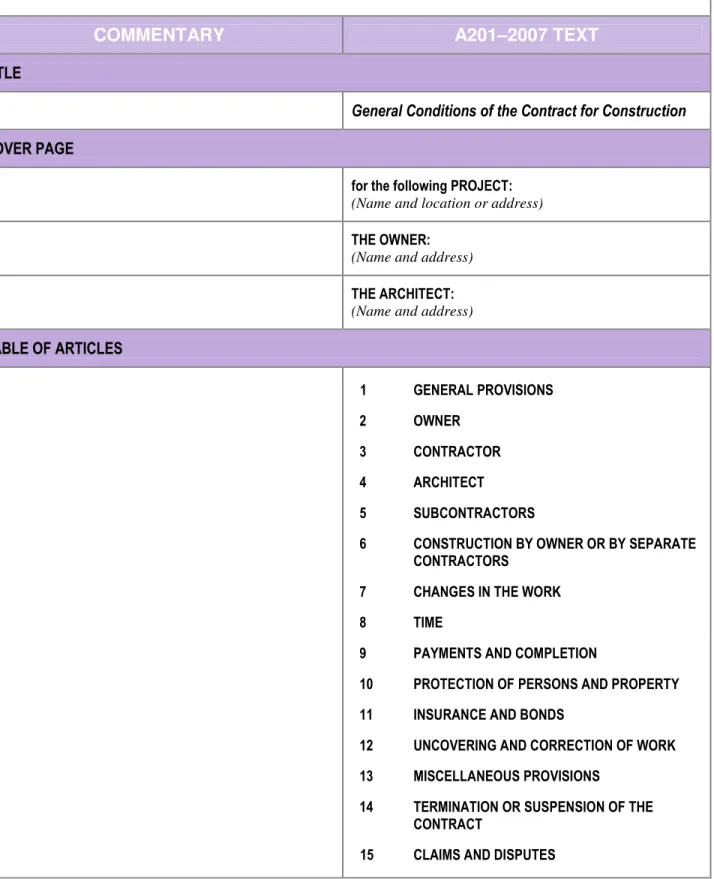
COMMENTARY
A201–2007 TEXT
TITLE
General Conditions of the Contract for Construction
COVER PAGE
for the following PROJECT:
(Name and location or address)
THE OWNER:
(Name and address)
THE ARCHITECT:
(Name and address)
TABLE OF ARTICLES
1 GENERAL PROVISIONS 2 OWNER 3 CONTRACTOR 4 ARCHITECT 5 SUBCONTRACTORS6 CONSTRUCTION BY OWNER OR BY SEPARATE CONTRACTORS
7 CHANGES IN THE WORK 8 TIME
9 PAYMENTS AND COMPLETION
10 PROTECTION OF PERSONS AND PROPERTY 11 INSURANCE AND BONDS
12 UNCOVERING AND CORRECTION OF WORK 13 MISCELLANEOUS PROVISIONS
14 TERMINATION OR SUSPENSION OF THE CONTRACT
AIA Document A201™ – 2007 Commentary. Copyright © 2007. AIA Document A201™ – 2007. Copyright © 1888, 1911, 1915, 1918, 1925, 1937, 1951, 1958, 1961, 1963, 1966, 1970, 1976, 1987, 1997 and 2007 by The American Institute of Architects. All rights reserved. 110807
4
COMMENTARY
A201–2007 TEXT
ARTICLE 1 GENERAL PROVISIONS
§ 1.1 BASIC DEFINITIONS
The Contract Documents include the listed elements, as appropriate for the project. A201 provides the General Conditions. It may be amended with Supplementary Conditions. Other Conditions refers to federal, state, local or private contract conditions; these are usually prescribed by the owner. For example, see AIA Document A201/SC, Federal Supplementary Conditions of the Contract for Construction.
The definitions used in AIA Document A201–2007 are capitalized under the conventions described in Section 1.3. They are incorporated into many of the other related AIA documents by reference to AIA Document A201– 2007. These documents include owner-contractor, owner architect, contractor-subcontractor and
architect-consultant agreements.
The Contract Documents defined here generally apply to the owner-contractor contract. In addition, specific parts of the contract documents, mainly the General Conditions (i.e., A201) are adopted (usually by reference) into other contracts. This serves to coordinate the legal relationships on the project. Some public owners require that the bidding requirements be included in the definition of the contract documents. This may create conflicts or ambiguities with the other documents that comprise the contract. This problem can be avoided if the bidding requirements are superseded when the contract for construction is awarded. If statutorily required contract language is contained in the bidding requirements, such language can be included in the supplementary conditions.
§ 1.1.1 THE CONTRACT DOCUMENTS
The Contract Documents are enumerated in the Agreement between the Owner and Contractor
(hereinafter the Agreement) and consist of the Agreement, Conditions of the Contract (General, Supplementary and other Conditions), Drawings, Specifications, Addenda issued prior to execution of the Contract, other documents listed in the Agreement and Modifications issued after execution of the Contract. A Modification is (1) a written amendment to the Contract signed by both parties, (2) a Change Order, (3) a Construction Change Directive or (4) a written order for a minor change in the Work issued by the Architect. Unless specifically
enumerated in the Agreement, the Contract Documents do not include the advertisement or invitation to bid,
Instructions to Bidders, sample forms, other information furnished by the Owner in anticipation of receiving bids or proposals, the Contractor’s bid or proposal, or portions of Addenda relating to bidding requirements.
One effect of the words entire and integrated agreement is that everything discussed as part of contract negotiations that conflicts with, is inconsistent with, or is omitted from, the written agreement is not part of the contract.
AIA Document A201–2007 and its related family of AIA documents is based on the premise that legal relationships on a construction project are comprised of two-party contractual arrangements. Thus, there are the owner-contractor contract, owner-architect contract, owner- contractor-subcontractor contracts and architect-consulting engineering contract(s). Each party to those respective contracts is deemed to be in privity only with the other party to the contract.
There is no direct contractual relationship between the architect and the contractor. The architect is in some instances entitled to enforce certain obligations of the contractor (such as indemnifying the architect for certain risks, performing warranty obligations, providing certain types of insurance and affording the architect access to the work). The architect has the right to enforce these obligations directly against the contractor regardless of whether the owner does so on its own behalf.
§ 1.1.2 THE CONTRACT
The Contract Documents form the Contract for Construction. The Contract represents the entire and integrated agreement between the parties hereto and supersedes prior negotiations, representations or agreements, either written or oral. The Contract may be amended or modified only by a Modification. The Contract Documents shall not be construed to create a contractual relationship of any kind (1) between the Contractor and the Architect or the Architect’s consultants, (2) between the Owner and a
Subcontractor or a Sub-subcontractor, (3) between the Owner and the Architect or the Architect’s
consultants or (4) between any persons or entities other than the Owner and the Contractor. The Architect shall, however, be entitled to performance and enforcement of obligations under the Contract intended to facilitate performance of the Architect’s duties.
AIA Document A201™ – 2007 Commentary. Copyright © 2007. AIA Document A201™ – 2007. Copyright © 1888, 1911, 1915, 1918, 1925, 1937, 1951, 1958, 1961, 1963, 1966, 1970, 1976, 1987, 1997 and 2007 by The American Institute of Architects. All rights reserved. 110807
5
The term Work appears throughout the A201–2007 family of documents. As a defined term and capitalized term, work is especially important (1) for describing the contractor’s obligations to provide improvements to the project, (2) for defining the scope of the property insurance required under Section 11.3, and (3) for distinguishing between the contractor’s efforts and the efforts of the owner’s other contractor(s) who may also be on the project. As a capitalized term, the word Work refers only to work performed by the contractor, not to any work performed by the owner’s own forces or by a separate contractor pursuant to Section 6.1.
§ 1.1.3 THE WORK
The term “Work” means the construction and services required by the Contract Documents, whether completed or partially completed, and includes all other labor, materials, equipment and services provided or to be provided by the Contractor to fulfill the Contractor’s obligations. The Work may constitute the whole or a part of the Project.
The term Project is broader than the term Work, and may involve separate contractors or the owner’s own forces. Each separate contract includes a scope of work that is unique to that contract.
§ 1.1.4 THE PROJECT
The Project is the total construction of which the Work performed under the Contract Documents may be the whole or a part and which may include construction by the Owner and by separate contractors.
The term Drawings does not imply representations presented only in paper format. In addition to the drawings the architect issues for bidding and/or
negotiation, drawings are also found in addenda, change orders, construction change directives, minor changes in the work, other modifications in the work, or in responses to the contractor’s requests for information.
§ 1.1.5 THE DRAWINGS
The Drawings are the graphic and pictorial portions of the Contract Documents showing the design, location and dimensions of the Work, generally including plans, elevations, sections, details, schedules and diagrams.
The Specifications are written descriptions that qualitatively define the work. It is now common construction industry practice to organize the Specifications according to the divisions of
MASTERFORMAT, a publication of the Construction Specifications Institute. Each division is further organized into a collection of custom sections which describe the general scope, products to be used and execution of the particular item of work, such as cast-in-place concrete. A library of master specification sections, known as MASTERSPEC®, a product of the AIA, is currently published and available on an annual subscription basis from www.arcom.net.
§ 1.1.6 THE SPECIFICATIONS
The Specifications are that portion of the Contract Documents consisting of the written requirements for materials, equipment, systems, standards and
workmanship for the Work, and performance of related services.
The term Instruments of Service refers to more than just drawings, specifications, models and other documents the architect creates in performing design services. Rather, instruments of service represent every embodiment of the professional services that the architect provides, regardless of form. This term underscores the fact that these
documents, whether in printed or electronic form, cannot be separated from the services the architect provides through them and through other activities on the project.
§ 1.1.7 INSTRUMENTSOF SERVICE
Instruments of Service are representations, in any medium of expression now known or later developed, of the tangible and intangible creative work performed by the Architect and the Architect’s consultants under their respective professional services agreements. Instruments of Service may include, without limitation, studies, surveys, models, sketches, drawings, specifications, and other similar materials.
The term Initial Decision Maker refers to an individual or entity that will be responsible for providing initial decisions on claims between the owner and the contractor during the course of the project and certifying termination of the agreement. The architect has traditionally
performed this service. In A201–2007, however, it is possible for another individual or entity to hold that position. In the AIA’s 2007 owner-contractor agreements that incorporate A201–2007, the owner and the contractor
§ 1.1.8 INITIAL DECISION MAKER
The Initial Decision Maker is the person identified in the Agreement to render initial decisions on Claims in accordance with Section 15.2 and certify termination of the Agreement under Section 14.2.2.
AIA Document A201™ – 2007 Commentary. Copyright © 2007. AIA Document A201™ – 2007. Copyright © 1888, 1911, 1915, 1918, 1925, 1937, 1951, 1958, 1961, 1963, 1966, 1970, 1976, 1987, 1997 and 2007 by The American Institute of Architects. All rights reserved. 110807
6
COMMENTARY
A201–2007 TEXT
have the option to name a third party initial decision maker. If the owner and the contractor do not identify a third party as the initial decision maker, the architect will serve in that role, as it has traditionally.
§ 1.2 CORRELATION AND INTENT OF THE CONTRACT DOCUMENTS
Because the contract documents are a collaborative effort sometimes involving the owner, architect and numerous consultants, there is no inherent order of precedence among those documents. For instance, a plan may show a door, a door schedule will designate the type of door and hardware, one specification section may specify the quality of door and another specification section will specify the quality of hardware. Collectively, those contract documents are used to describe that particular work item. Moreover, a pre-selected order of precedence assumes that one item is more important than another. For instance, assuming that the plans are chosen to prevail over the specifications, if the plans did not show the hinges on the door even though the specifications required them, the owner might get a hingeless door. Under these circumstances, a pre-selected order of precedence may cause an absurd result.
The contractor is expected to make reasonable inferences from the contract documents. When the documents show wall partitions covered by drywall, for example, it may be inferred that some reasonable method will be used to attach the drywall to the underlying framework.
§ 1.2.1 The intent of the Contract Documents is to include all items necessary for the proper execution and
completion of the Work by the Contractor. The Contract Documents are complementary, and what is required by one shall be as binding as if required by all; performance by the Contractor shall be required only to the extent consistent with the Contract Documents and
reasonably inferable from them as being necessary to produce the indicated results.
The contractor is responsible for allocating portions of the work to the subcontractors and others, within the limits required by the contract documents, irrespective of the organization of the specifications.
§ 1.2.2Organization of the Specifications into divisions, sections and articles, and arrangement of Drawings shall not control the Contractor individing the Work among Subcontractors or in establishing the extent of Work to be performed by any trade.
§ 1.2.3 Unless otherwise stated in the Contract Documents, words that have well-known technical or construction industry meanings are used in the Contract Documents in accordance with such recognized meanings.
§ 1.3 CAPITALIZATION
Terms capitalized in these General Conditions include those that are (1) specifically defined, (2) the titles of numbered articles or (3) the titles of other documents published by the American Institute of Architects.
§ 1.4 INTERPRETATION
In the interest of brevity the Contract Documents frequently omit modifying words such as “all” and “any” and articles such as “the” and “an,” but the fact that a modifier or an article is absent from one statement and appears in another is not intended to affect the
AIA Document A201™ – 2007 Commentary. Copyright © 2007. AIA Document A201™ – 2007. Copyright © 1888, 1911, 1915, 1918, 1925, 1937, 1951, 1958, 1961, 1963, 1966, 1970, 1976, 1987, 1997 and 2007 by The American Institute of Architects. All rights reserved. 110807
7
COMMENTARY
A201–2007 TEXT
§ 1.5 OWNERSHIP AND USE OF DRAWINGS,
SPECIFICATIONS AND OTHER INSTRUMENTS OF SERVICE
Technological advances, such as computer-aided design, have and will continue to have an impact on the
architect’s services and the manner in which they are provided. The architect’s services are reflected in instruments of service, such as drawings, specifications, electronic data or interpretive sketches which help the owner to reach the final result, a building project. Because the use or misuse of the architect’s instruments of service affects specific rights and obligations affecting the owner, the construction team and the public, the architect as a licensed professional retains ownership of, control over, and responsibility for these documents.
§ 1.5.1The Architect and the Architect’s consultants shall be deemed the authors and owners of their respective Instruments of Service, including the Drawings and Specifications, and will retain all common law, statutory and other reserved rights, including copyrights. The Contractor, Subcontractors, Sub-subcontractors, and material or equipment suppliers shall not own or claim a copyright in the Instruments of Service. Submittal or distribution to meet official regulatory requirements or for other purposes in connection with this Project is not to be construed as publication in derogation of the Architect’s or Architect’s consultants’ reserved rights.
Through its agreement with the owner, the architect grants the owner a limited license to use the architect’s instruments of service solely for use on the project. That license allows the owner, through A201, to authorize the contractor and the various subcontractors,
sub-subcontractors and suppliers to use the instruments of service solely to construct the project.
Restrictions on use of the instruments of service protect the interests of the owner, architect and architect’s consultants, and also serve to protect the public from harm that may result from their misapplication.
§ 1.5.2The Contractor, Subcontractors,
Sub-subcontractors and material or equipment suppliers are authorized to use and reproduce the Instruments of Service provided to them solely and exclusively for execution of the Work. All copies made under this authorization shall bear the copyright notice, if any, shown on the Instruments of Service. The Contractor, Subcontractors, Sub-subcontractors, and material or equipment suppliers may not use the Instruments of Service on other projects or for additions to this Project outside the scope of the Work without the specific written consent of the Owner, Architect and the Architect’s consultants.
It is common in the construction industry today for the owner, architect and contractor to utilize various forms of technology in communicating and providing services for the project. This may be as simple as using e-mail to communicate or as complex as employing building information modeling software. Regardless of the digital technology utilized, project participants should establish protocols that will govern the use of such technology. By establishing protocols, the project participants can determine, among other things, how digital information will be transmitted, what software programs are to be utilized to transmit and read the information, and what the transmitted information can be used for.
AIA Document E201™–2007, Digital Data Protocol Exhibit, allows contracting parties to define the necessary protocols regarding transmission and use of digital data, and to flow those protocols down to lower tier agreements, thus providing consistent protocols across the project.
§ 1.6 TRANSMISSION OF DATA IN DIGITAL FORM
If the parties intend to transmit Instruments of Service or any other information or documentation in digital form, they shall endeavor to establish necessary protocols governing such transmissions, unless otherwise already provided in the Agreement or the Contract Documents.
ARTICLE 2 OWNER
§ 2.1 GENERAL
The term Owner is used to designate the party contracting with the construction contractor. That person or entity may or may not actually own the land or building where the project is sited. For example, the owner may be a
§ 2.1.1 The Owner is the person or entity identified as such in the Agreement and is referred to throughout the Contract Documents as if singular in number. The Owner shall designate in writing a representative who shall
AIA Document A201™ – 2007 Commentary. Copyright © 2007. AIA Document A201™ – 2007. Copyright © 1888, 1911, 1915, 1918, 1925, 1937, 1951, 1958, 1961, 1963, 1966, 1970, 1976, 1987, 1997 and 2007 by The American Institute of Architects. All rights reserved. 110807
8
COMMENTARY
A201–2007 TEXT
tenant. If that is the case, the land or building owner may be designated as the landlord.
Because the owner may not personally take an active, ongoing role in the project, the owner is required to designate a representative with authority to make decisions that bind the owner. Having such a
representative can ensure timely decision making and keep the project moving. This representative is named in AIA owner-contractor agreements.
For certain purposes set forth in Article 4, the architect also serves as the owner’s representative. The architect is not the owner’s designated representative referred to in
Section 2.1.1.
If the owner designates more than one representative, the separate roles and functions of each individual should be clearly defined to avoid conflicts, gaps and confusion as to each individual’s proper authority to act on behalf of the owner.
have express authority to bind the Owner with respect to all matters requiring the Owner’s approval or
authorization. Except as otherwise provided in Section 4.2.1, the Architect does not have such authority. The term “Owner” means the Owner or the Owner’s
authorized representative.
State mechanic’s lien statutes require that the party seeking to assert a lien file documents stating the correct legal description of the property against which the lien claim is being asserted. If the statute is not strictly complied with, the filing may not be adequate to enforce the lien. Thus, the lien rights of the contractor,
subcontractors and sub-subcontractors may depend on the information required of the owner under this section.
§ 2.1.2 The Owner shall furnish to the Contractor within fifteen days after receipt of a written request, information necessary and relevant for the Contractor to evaluate, give notice of or enforce mechanic’s lien rights. Such information shall include a correct statement of the record legal title to the property on which the Project is located, usually referred to as the site, and the Owner’s interest therein.
§ 2.2 INFORMATION AND SERVICES REQUIRED OF THE OWNER The contractor may request that the owner provide
reasonable evidence that the owner has made financial arrangements to fulfill its payment obligations. The contractor’s right to request this information is unfettered prior to commencement of the work. Since the owner is not permitted to vary its stated financial arrangements, the contractor may only request such evidence after work commences under the conditions listed in Section 2.2.1. If those conditions are met, the contactor may have reason to believe that the owner may no longer have the ability to make payment.
The contractor should not be put in a situation where it has to finance the project. Therefore, the contractor has the right to stop the work (see Section 14.1.1.4) if the owner fails to provide reasonable evidence of its ability to make payment.
Reasonable evidence of the owner’s ability to finance the project may be a loan commitment letter from an
institutional lender, a governmental appropriation or other equally convincing documentation.
§ 2.2.1 Prior to commencement of the Work, the
Contractor may request in writing that the Owner provide
reasonable evidence that the Owner has made financial arrangements to fulfill the Owner’s obligations under the Contract. Thereafter, the Contractor may only request such evidence if (1) the Owner fails to make payments to the Contractor as the Contract Documents require; (2) a change in the Work materially changes the Contract Sum; or (3) the Contractor identifies in writing a reasonable concern regarding the Owner’s ability to make payment when due. The Owner shall furnish such evidence as a
condition precedent to commencement or continuation of the Work or the portion of the Work affected by a material change. After the Owner furnishes the evidence,
the Owner shall not materially vary such financial arrangements without prior notice to the Contractor.
§ 2.2.2 Except for permits and fees that are the responsibility of the Contractor under the Contract Documents, including those required under Section 3.7.1, the Owner shall secure and pay for necessary approvals, easements, assessments and charges required for
construction, use or occupancy of permanent structures or for permanent changes in existing facilities.
AIA Document A201™ – 2007 Commentary. Copyright © 2007. AIA Document A201™ – 2007. Copyright © 1888, 1911, 1915, 1918, 1925, 1937, 1951, 1958, 1961, 1963, 1966, 1970, 1976, 1987, 1997 and 2007 by The American Institute of Architects. All rights reserved. 110807
9
COMMENTARY
A201–2007 TEXT
It is appropriate for the owner to furnish surveys of the site because, as the owner of the land, the owner has the most knowledge of it and control over it. If the owner is a tenant, it may need to obtain the survey from the building or land owner. The contractor should be able to rely upon the surveys and not have to duplicate this effort and expense.
§ 2.2.3The Owner shall furnish surveys describing physical characteristics, legal limitations and utility locations for the site of the Project, and a legal
description of the site. The Contractor shall be entitled to rely on the accuracy of information furnished by the Owner but shall exercise proper precautions relating to the safe performance of the Work.
This provision makes explicit, with respect to the owner, that the parties will cooperate with each other and will not hinder the other’s work or progress.
§ 2.2.4 The Owner shall furnish information or services required of the Owner by the Contract Documents with reasonable promptness. The Owner shall also furnish any other information or services under the Owner’s control and relevant to the Contractor’s performance of the Work with reasonable promptness after receiving the Contractor’s written request for such information or services.
The contractor’s use of copies of the contract documents, which include the instruments of service, is governed by the use restrictions set forth in Section 1.5.2.
§ 2.2.5 Unless otherwise provided in the Contract
Documents, the Owner shall furnish to the Contractor one copy of the Contract Documents for purposes of making reproductions pursuant to Section 1.5.2.
Under the proper circumstances, the owner may stop the work. In this provision, the owner’s right to stop work relates specifically to the contractor’s failure to comply with the contract documents. This right may be exercised by the owner or the owner’s designated representative under Section 2.1.1.
§ 2.3 OWNER’S RIGHT TO STOP THE WORK
If the Contractor fails to correct Work that is not in accordance with the requirements of the Contract Documents as required by Section 12.2 or repeatedly fails to carry out Work in accordance with the Contract Documents, the Owner may issue a written order to the Contractor to stop the Work, or any portion thereof, until the cause for such order has been eliminated; however, the right of the Owner to stop the Work shall not give rise to a duty on the part of the Owner to exercise this right for the benefit of the Contractor or any other person or entity, except to the extent required by Section 6.1.3.
The owner must follow a specific procedure before undertaking and/or correcting some or all of the work under the contract. The owner must give the contractor written notice demanding correction of the problem. Upon receipt of this notice, the contractor has ten days to begin and to continue correction. If remedial action has not been undertaken by the end of this ten-day period, the owner may correct the deficiencies with the owner’s own forces. Based on a literal interpretation of this section, the owner is not required to provide additional notice to the
contractor beyond the ten-day period. The owner,
however, may decide to notify the contractor immediately before commencing work in order to avoid jurisdictional disputes at the job site.
Correcting the work is not intended to preclude the owner from pursuing other remedies such as arbitration or legal action for breach of contract or breach of a warranty. The owner and architect may also execute a change order or construction change directive deducting from the contract sum the cost of corrections, including compensation for the architect’s services in this regard.
§ 2.4 OWNER’S RIGHT TO CARRY OUT THE WORK
If the Contractor defaults or neglects to carry out the Work in accordance with the Contract Documents and fails within a ten-day period after receipt of written notice from the Owner to commence and continue correction of such default or neglect with diligence and promptness, the Owner may, without prejudice to other remedies the Owner may have, correct such deficiencies. In such case an appropriate Change Order shall be issued deducting from payments then or thereafter due the Contractor the reasonable cost of correcting such deficiencies, including Owner’s expenses and compensation for the Architect’s additional services made necessary by such default, neglect or failure. Such action by the Owner and amounts charged to the Contractor are both subject to prior approval of the Architect. If payments then or thereafter due the Contractor are not sufficient to cover such amounts, the Contractor shall pay the difference to the Owner.
AIA Document A201™ – 2007 Commentary. Copyright © 2007. AIA Document A201™ – 2007. Copyright © 1888, 1911, 1915, 1918, 1925, 1937, 1951, 1958, 1961, 1963, 1966, 1970, 1976, 1987, 1997 and 2007 by The American Institute of Architects. All rights reserved. 110807
10
COMMENTARY
A201–2007 TEXT
ARTICLE 3 CONTRACTOR
§ 3.1 GENERAL
In jurisdictions where contractors are required to be licensed, unlicensed contractors may not be permitted to file mechanic’s liens or to institute legal proceedings involving the project.
The contractor’s duty to designate a representative mirrors the owner’s under Section 2.1.1. This representative is named in AIA owner-contractor agreements. Other persons or entities authorized to represent the contractor (such as the construction
superintendent or project manager) should be identified to the owner and architect. If the contractor designates more than one representative, the separate roles and functions of each individual should be clearly defined to avoid conflicts, gaps and confusion as to each individual’s proper authority to act on behalf of the contractor.
§ 3.1.1 The Contractor is the person or entity identified as such in the Agreement and is referred to throughout the Contract Documents as if singular in number. The Contractor shall be lawfully licensed, if required in the jurisdiction where the Project is located. The Contractor shall designate in writing a representative
who shall have express authority to bind the Contractor with respect to all matters under this Contract. The term “Contractor” means the Contractor or the Contractor’s authorized representative.
The contractor’s scope of work is set forth in the contract documents. The contractor is responsible for performing all work shown and specified, unless it is specifically stated to be the work of others.
§ 3.1.2 The Contractor shall perform the Work in accordance with the Contract Documents.
The contractor cannot claim that it has been released from its obligation to perform the work in conformance with the contract documents or to correct nonconforming work because the architect has not specifically rejected that portion of the work or because the architect has approved payment for it.
§ 3.1.3 The Contractor shall not be relieved of obligations to perform the Work in accordance with the Contract Documents either by activities or duties of the Architect in the Architect’s administration of the Contract, or by tests, inspections or approvals required or performed by persons or entities other than the Contractor.
§ 3.2 REVIEW OF CONTRACT DOCUMENTS AND FIELD CONDITIONS BY CONTRACTOR
§ 3.2.1 Execution of the Contract by the Contractor is a representation that the Contractor has visited the site, become generally familiar with local conditions under which the Work is to be performed and correlated personal observations with requirements of the Contract Documents. The contractor is required to report errors and omissions
promptly in order to minimize the costs of correction. The contractor’s failure promptly to report errors and
omissions may result in liability to the contractor, pursuant to Section 3.2.4, for remediation costs that would have been avoided by prompt notice.
The contractor is not expected to engage in a professional review of the architect’s design. If professional design services are required of the contractor pursuant to Section 3.12.10, review of the architect’s design by the contractor’s design professional is required to the extent necessary for the contractor’s design professional to design those elements that the contractor is obligated by the contract documents to both design and build.
§ 3.2.2 Because the Contract Documents are
complementary, the Contractor shall, before starting each portion of the Work, carefully study and compare the various Contract Documents relative to that portion of the Work, as well as the information furnished by the Owner pursuant to Section 2.2.3, shall take field measurements of any existing conditions related to that portion of the Work, and shall observe any conditions at the site affecting it. These obligations are for the purpose of facilitating coordination and construction by the Contractor and are not for the purpose of discovering errors, omissions, or inconsistencies in the Contract Documents; however, the Contractor shall promptly report to the Architect any errors, inconsistencies or omissions discovered by or made known to the Contractor as a request for information in such form as the Architect may require. It is recognized that the Contractor’s review is made in the Contractor’s capacity
AIA Document A201™ – 2007 Commentary. Copyright © 2007. AIA Document A201™ – 2007. Copyright © 1888, 1911, 1915, 1918, 1925, 1937, 1951, 1958, 1961, 1963, 1966, 1970, 1976, 1987, 1997 and 2007 by The American Institute of Architects. All rights reserved. 110807
11
as a contractor and not as a licensed design professional, unless otherwise specifically provided in the Contract Documents.
As with the discovery of errors and omissions in Section 3.2.2, prompt notice is required in order to minimize the costs of correction. This obligation does not require the contractor to review the contract documents for the purpose of seeking out nonconformities, but only to report those nonconformities that the contractor discovers. The contractor’s failure to report promptly nonconformities that it discovers may result in liability to the contractor, pursuant to Section 3.2.4, for remediation costs that would have been avoided by prompt notice.
§ 3.2.3 The Contractor is not required to ascertain that the Contract Documents are in accordance with applicable laws, statutes, ordinances, codes, rules and regulations, or lawful orders of public authorities, but the Contractor shall
promptly report to the Architect any nonconformity discovered by or made known to the Contractor as a request for information in such form as the Architect may require.
Pursuant to Sections 3.2.2 and 3.2.3, the contractor’s duty to report arises when design errors or omissions, or nonconformities are discovered or made known to the contractor. The failure to make prompt notification, or the contractor’s failure to perform other obligations set forth in Sections 3.2.2 or 3.2.3, may result in liability to the contractor for the remediation costs that would have been avoided by prompt notice.
§ 3.2.4 If the Contractor believes that additional cost or time is involved because of clarifications or instructions the Architect issues in response to the Contractor’s notices or requests for information pursuant to Sections 3.2.2 or 3.2.3, the Contractor shall make Claims as provided in Article 15. If the Contractor fails to perform the obligations of Sections 3.2.2 or 3.2.3, the Contractor shall pay such costs and damages to the Owner as would have been avoided if the Contractor had performed such obligations.If the Contractor performs those obligations, the Contractor shall not be liable to the Owner or Architect for damages resulting from errors, inconsistencies or omissions in the Contract Documents, for differences between field measurements or conditions and the Contract Documents, or for nonconformities of the Contract Documents to applicable laws, statutes, ordinances, codes, rules and regulations, and lawful orders of public authorities.
§ 3.3 SUPERVISION AND CONSTRUCTION PROCEDURES
This section recognizes the expertise of the contractor, who determines the contract price based upon the particular construction process and sequence contemplated.
In the event the contract documents give specific instructions regarding the construction process, responsibility for jobsite safety remains with the contractor unless the contractor gives timely written notice of a particular safety concern and is instructed to proceed as specified.
§ 3.3.1 The Contractor shall supervise and direct the Work, using the Contractor’s best skill and attention. The Contractor shall be solely responsible for, and have control over, construction means, methods, techniques, sequences and procedures and for coordinating all portions of the Work under the Contract, unless the Contract Documents give other specific instructions concerning these matters. If the Contract Documents give specific instructions concerning construction means, methods, techniques, sequences or procedures, the Contractor shall evaluate the jobsite safety thereof and, except as stated below, shall be fully and solely responsible for the jobsite safety of such means, methods, techniques, sequences or procedures. If the Contractor determines that such means, methods, techniques, sequences or procedures may not be safe, the Contractor shall give timely written notice to the Owner and Architect and shall not proceed with that portion of the Work without further written instructions from the Architect. If the Contractor is then instructed to proceed with the required means, methods, techniques, sequences or procedures without acceptance of changes proposed by the Contractor, the
AIA Document A201™ – 2007 Commentary. Copyright © 2007. AIA Document A201™ – 2007. Copyright © 1888, 1911, 1915, 1918, 1925, 1937, 1951, 1958, 1961, 1963, 1966, 1970, 1976, 1987, 1997 and 2007 by The American Institute of Architects. All rights reserved. 110807
12
COMMENTARY
A201–2007 TEXT
Owner shall be solely responsible for any loss or damage arising solely from those Owner-required means, methods, techniques, sequences or procedures.
§ 3.3.2 The Contractor shall be responsible to the Owner for acts and omissions of the Contractor’s employees, Subcontractors and their agents and employees, and other persons or entities performing portions of the Work for, or on behalf of, the Contractor or any of its
Subcontractors.
§ 3.3.3 The Contractor shall be responsible for inspection of portions of Work already performed to determine that such portions are in proper condition to receive
subsequent Work.
§ 3.4 LABOR AND MATERIALS
§ 3.4.1 Unless otherwise provided in the Contract Documents, the Contractor shall provide and pay for labor, materials, equipment, tools, construction equipment and machinery, water, heat, utilities, transportation, and other facilities and services necessary for proper execution and completion of the Work, whether
temporary or permanent and whether or not incorporated or to be incorporated in the Work.
Changes in the work may be accomplished as minor changes in the work, change orders and construction change directives as set forth in Section 7.1.1. Substitutions made after execution of the agreement are changes in the work and must be made in accordance with Article 7.
§ 3.4.2Except in the case of minor changes in the Work authorized by the Architect in accordance with Sections 3.12.8 or 7.4, the Contractor may make substitutions only with the consent of the Owner, after evaluation by the Architect and in accordance with a Change Order or Construction Change Directive.
§ 3.4.3 The Contractor shall enforce strict discipline and good order among the Contractor’s employees and other persons carrying out the Work. The Contractor shall not permit employment of unfit persons or persons not properly skilled in tasks assigned to them.
This warranty is a general representation by the contractor that materials, equipment and workmanship will conform to good quality standards and the requirements of the contract documents. This general warranty is in addition to, and not in lieu of, any additional obligations (see Section 12.2 on Correction of Work) and other warranties, such as those received from product manufacturers and fabricators and forwarded to the owner by the contractor. The warranty under Section 3.5 will typically commence at the date of substantial completion (see Section 9.8.4) and continue through the period of the applicable statute of limitations or repose, whichever is shorter. The one-year correction period of Section 12.2 is a separate and distinct obligation of the contractor, and should not be confused with the contractor’s warranty obligation.
§ 3.5 WARRANTY
The Contractor warrants to the Owner and Architect that materials and equipment furnished under the Contract will be of good quality and new unless the Contract Documents require or permit otherwise. The Contractor further warrants that the Work will conform to the requirements of the Contract Documents and will be free from defects, except for those inherent in the quality of the Work the Contract Documents require or permit. Work, materials, or equipment not conforming to these requirements may be considered defective. The Contractor’s warranty excludes remedy for damage or defect caused by abuse, alterations to the Work not executed by the Contractor, improper or insufficient maintenance, improper operation, or normal wear and tear and normal usage. If required by the Architect, the Contractor shall furnish satisfactory evidence as to the kind and quality of materials and equipment.
AIA Document A201™ – 2007 Commentary. Copyright © 2007. AIA Document A201™ – 2007. Copyright © 1888, 1911, 1915, 1918, 1925, 1937, 1951, 1958, 1961, 1963, 1966, 1970, 1976, 1987, 1997 and 2007 by The American Institute of Architects. All rights reserved. 110807
13
COMMENTARY
A201–2007 TEXT
If the owner is a tax-exempt organization and intends to have its tax exemption apply to the contractor’s work, this section will need to be modified.
§ 3.6 TAXES
The Contractor shall pay sales, consumer, use and similar taxes for the Work provided by the Contractor
that are legally enacted when bids are received or negotiations concluded, whether or not yet effective or merely scheduled to go into effect.
§ 3.7 PERMITS, FEES, NOTICES, AND COMPLIANCE WITH LAWS
Under Section 2.2.2, the owner pays costs associated with approvals and permits obtained before execution of the contract that relate to project feasibility (e.g., zoning, environmental impact, and the like).
§ 3.7.1 Unless otherwise provided in the Contract
Documents, the Contractor shall secure and pay for the building permit as well as for other permits, fees, licenses, and inspections by government agencies
necessary for proper execution and completion of the Work that are customarily secured after execution of the Contract and legally required at the time bids are received or negotiations concluded.
It is the architect’s obligation to design the project so as to comply with applicable laws, codes, etc. However, many such laws and codes require the contractor to give notice to authorities having jurisdiction over the project for purposes of scheduling inspections by code officials.
§ 3.7.2 The Contractor shall comply with and give notices required by applicable laws, statutes, ordinances, codes, rules and regulations, and lawful orders of public authorities applicable to performance of the Work. Ordinarily, the contractor does not participate in the
creation of the contract documents. For this reason, the contractor is not responsible for the failure to comply with applicable law (including building codes) unless the contractor learns of such failure and proceeds with the work irrespective of that knowledge, and/or fails promptly to report it (see Section 3.2.4).
§ 3.7.3 If the Contractor performs Work knowing it to be contrary to applicable laws, statutes, ordinances, codes, rules and regulations, or lawful orders of public
authorities, the Contractor shall assume appropriate responsibility for such Work and shall bear the costs attributable to correction.
This section covers physical conditions not specifically addressed in the contract documents (type 1), and/or that differ materially from conditions that might reasonably be assumed to exist at the site (type 2). For example, bedrock may be discovered when none was expected (type 1) or the expected bedrock encountered may fracture much more readily than is typical and expected for that type of rock (type 2). If the difference between what the contractor could reasonably have expected and what it actually found were material to the required work, a claim would be appropriate.
The contractor must give notice to the owner and architect before disturbing the differing conditions and within 21 days of first observing them in order to give the architect the opportunity to investigate the conditions.
Conditions that materially differ from reasonable expectations may result in either an increase or decrease in the contract sum or contract time.
§ 3.7.4 Concealed or Unknown Conditions.If the Contractor encounters conditions at the site that are (1) subsurface or otherwise concealed physical conditions that differ materially from those indicated in the
Contract Documents or (2) unknown physical conditions of an unusual nature that differ materially from those ordinarily found to exist and generally recognized as inherent in construction activities of the character provided for in the Contract Documents, the Contractor shall promptly provide notice to the Owner and the Architect before conditions are disturbed and in no event later than 21 days after first observance of the conditions. The Architect will promptly investigate such conditions
and, if the Architect determines that they differ materially and cause an increase or decrease in the Contractor’s cost of, or time required for, performance of any part of the Work, will recommend an equitable adjustment in the Contract Sum or Contract Time, or both. If the Architect
determines that the conditions at the site are not materially different from those indicated in the Contract Documents and that no change in the terms of the Contract is justified, the Architect shall promptly notify the Owner and Contractor in writing, stating the reasons. If either party disputes the Architect’s determination or recommendation, that party may proceed as provided in Article 15.
AIA Document A201™ – 2007 Commentary. Copyright © 2007. AIA Document A201™ – 2007. Copyright © 1888, 1911, 1915, 1918, 1925, 1937, 1951, 1958, 1961, 1963, 1966, 1970, 1976, 1987, 1997 and 2007 by The American Institute of Architects. All rights reserved. 110807
14
COMMENTARY
A201–2007 TEXT
Since 1997, many construction projects have suffered delays due to the discovery of burial grounds, archaeological sites, and wetlands. Section 3.7.5
addresses the owner’s and contractor’s responsibilities in the event these are not noted on the contract documents, but are discovered during construction. The conditions discussed in Section 3.7.5 are treated differently from the site conditions in Section 3.7.4 due to the necessary involvement of governmental authorities, and the duty placed on the owner to take action. The discovery of these conditions has the potential to increase costs and cause significant delay.
§ 3.7.5 If, in the course of the Work, the Contractor encounters human remains or recognizes the existence of
burial markers, archaeological sites or wetlands not indicated in the Contract Documents, the Contractor shall immediately suspend any operations that would affect them and shall notify the Owner and Architect. Upon receipt of such notice, the Owner shall promptly take any action necessary to obtain governmental
authorization required to resume the operations. The Contractor shall continue to suspend such operations until otherwise instructed by the Owner but shall continue with all other operations that do not affect those remains or features. Requests for adjustments in the Contract Sum and Contract Time arising from the existence of such remains or features may be made as provided in Article 15.
§ 3.8 ALLOWANCES
Allowances are customarily used as an accounting device with regard to materials and equipment whose selection and cost cannot be determined precisely at the time the original bid or proposal is submitted. This could occur because the finish or level of quality has not been finally selected or because of variations expected to occur after bidding. The owner has the right to decide who shall supply items covered by allowances. The contractor, however, is not required to employ persons or entities to whom it
reasonably objects. Once employed, subcontractors under this provision have an identical status to those selected directly by the contractor.
§ 3.8.1 The Contractor shall include in the Contract Sum all allowances stated in the Contract Documents. Items covered by allowances shall be supplied for such amounts and by such persons or entities as the Owner may direct, but the Contractor shall not be required to employ persons or entities to whom the Contractor has reasonable objection.
The contractor’s overhead costs—those not specifically attributable to the items covered by the allowance—are excluded from the allowance, but are to be included in the contract sum. For example, if it is known that 1,000 square yards of carpet must be installed, costs for unloading and handling, installation and other expenses can be calculated. Given the allowance amount, overhead and profit can also be calculated. All of those elements are already included in the contract sum. The only unknown is the cost of the carpet itself, and that is the allowance figure.
§ 3.8.2 Unless otherwise provided in the Contract Documents,
.1 allowances shall cover the cost to the Contractor of materials and equipment delivered at the site and all required taxes, less applicable trade discounts;
.2 Contractor’s costs for unloading and handling at the site, labor, installation costs, overhead, profit and other expenses contemplated for stated allowance amounts shall be included in the Contract Sum but not in the allowances; and
.3 whenever costs are more than or less than allowances, the Contract Sum shall be adjusted accordingly by Change Order. The amount of the Change Order shall reflect (1) the difference between actual costs and the allowances under Section 3.8.2.1 and (2) changes in Contractor’s costs under Section 3.8.2.2.
§ 3.8.3 Materials and equipment under an allowance shall be selected by the Owner with reasonable promptness.
§ 3.9 SUPERINTENDENT
A superintendent cannot build a project alone, but an incompetent superintendent can single-handedly ruin one. For that reason, the owner and architect must insist that
§ 3.9.1 The Contractor shall employ a competent superintendent and necessary assistants who shall be in attendance at the Project site during performance of the
AIA Document A201™ – 2007 Commentary. Copyright © 2007. AIA Document A201™ – 2007. Copyright © 1888, 1911, 1915, 1918, 1925, 1937, 1951, 1958, 1961, 1963, 1966, 1970, 1976, 1987, 1997 and 2007 by The American Institute of Architects. All rights reserved. 110807
15
the contractor designate a competent and experienced superintendent. As obvious as this might seem, contrac-tors, construction managers and program managers who broker projects and use skeletal staffing are often the most likely to ignore the importance of the superintendent’s function, leaving a project’s details to their subcontractors or to the architect.
Work. The superintendentshall represent the Contractor, and communications givento the superintendent shall be as binding as if given to the Contractor.
New in A201–2007, Sections 3.9.2 and 3.9.3 further recognize the importance to the project of a qualified superintendent. The contractor is required to provide the owner and architect with a proposed superintendent’s qualifications. The architect then has an opportunity to object to the proposed superintendent (on behalf of the owner or on its own behalf) within 14 days, or request additional time to review. Failure to respond in either form, however, is deemed as notice of no reasonable objection.
§ 3.9.2 The Contractor, as soon as practicable after award of the Contract, shall furnish in writing to the Owner through the Architect the name and qualifications of a proposed superintendent. The Architect may reply within 14 days to the Contractor in writing stating (1) whether the Owner or the Architect has reasonable objection to the proposed superintendent or (2) that the Architect requires additional time to review.
Failure of the Architect to reply within the 14 day period shall constitute notice of no reasonable objection.
Once a superintendent is in place, the owner has an interest in seeing that superintendent remain to complete the project. However, the contractor may choose to relocate the superintendent to serve the interest of the contractor’s business, not the project. Requiring the owner’s consent to a change in superintendent, may discourage that practice.
§ 3.9.3 The Contractor shall not employ a proposed superintendent to whom the Owner or Architect has made reasonable and timely objection. The Contractor shall not change the superintendent without the Owner’s consent, which shall not unreasonably be withheld or delayed.
§ 3.10 CONTRACTOR’S CONSTRUCTION SCHEDULES
The contractor is required to provide the owner and architect with the contractor’s construction schedule merely for their information rather than for their approval. This is consistent with the concept that the contractor is solely responsible for the sequence and progress of the Work. Division 1 of the specifications may specify the number of days allowed to prepare the schedule, its format or specific data required to demonstrate a realistic, expeditious plan for completing the work within the parameters of the contract documents.
§ 3.10.1The Contractor, promptly after being awarded the Contract, shall prepare and submit for the
Owner’s and Architect’s information a Contractor’s construction schedule for the Work. The schedule shall not exceed time limits current under the Contract
Documents, shall be revised at appropriate intervals as required by the conditions of the Work and Project, shall be related to the entire Project to the extent required by the Contract Documents, and shall provide for
expeditious and practicable execution of the Work. The contractor is required to prepare and submit a
submittal schedule to the architect for the architect’s approval. This gives the architect and contractor the opportunity to agree on and coordinate their respective roles with respect to submittals and to allow time for adequate review. The contractor is required to provide submittals in accordance with the approved schedule under Section 3.12.5. The architect is required in Section 4.2.7 to complete its reviews in accordance with the approved schedule.
Though the requirement that the contractor submit a submittal schedule is not new, the requirement was seldom, if ever, adhered to. Added in 2007 is the
contractor’s loss of entitlement to obtain additional cost or time based on the time required for submittal review, if the contractor does not provide a submittal schedule.
§ 3.10.2The Contractor shall prepare a submittal schedule, promptly after being awarded the Contract and thereafter as necessary to maintain a current submittal schedule, and shall submit the schedule(s) for the Architect’s approval. The Architect’s approval shall not unreasonably be delayed or withheld. The submittal schedule shall (1) be coordinated with the Contractor’s construction schedule, and (2) allow the Architect reasonable time to review submittals. If the Contractor fails to submit a submittal schedule, the Contractor shall not be entitled to any increase in Contract Sum or extension of Contract Time based on the time required for review of submittals.