INSTALLATION
INSTRUCTIONS
CARE AND USE MANUAL FOR:
ISLAND RANGE HOODS
Models covered by this instructions:
SU900, SUT900, SUE900, SU901, SU902, SU903
*** BEFORE INSTALLATION ***
ENSURE THERE IS NO VISIBLE OR HIDDEN DAMAGE SUSTAINED
DURING SHIPPING
*** SHIPPING DAMAGE ***
WARNING
Thank you for purchasing a Sirius Range Hood.
Please read all the instructions in this manual before
installing the appliance.
Save these instructions for future reference.
Only use this appliance as an exhaust ventilation system for the removal of
cooking vapors.
DO NOT
use to expel flammable substances or any other
materials or vapors.
The installation procedures in this manual are intended for qualified instal
-lers, service technicians or persons with similar qualified background.
DO NOT
attempt to install this appliance yourself.
Ensure that electrical power is turned off at source before commencing in
-stallation. All electrical wiring must be properly installed, insulated and
grounded and conform to all applicable codes and standards.
Make sure all existing duct work is clean of grease build up, or duct work
should be replaced, if necessary, to avoid the possibility of a grease fire.
Check all joints on ductwork to ensure proper connection and all joints
should be properly taped. Be careful when cutting through ceilings or walls
not to damage any hidden pipes or electrical wiring. Ensure your kitchen has
sufficient air return vents to replace the exhausted air.
Fan ducts should always be vented to the outside of your home and never
into spaces within walls, ceilings, lofts or attics. Only use rigid, smooth steel
for ducting. The exhaust point of the blower requires a 6” round
connec-tion.
TABLE OF CONTENTS
3
BEFORE YOU BEGIN 4
DUCTING 4
External venting Requirements 4
Duct Run Calculation 5
ELECTRICAL 5
Electrical Supply 5
INSTALLATION 6
Applications 6
Connecting Electricity and Ducting 8
Re-Circulating Requirements 9
OPERATING PROCEDURES 10
General Advice 10
Functions 10
MAINTENANCE 12
Cleaning the Filter 12
Cleaning the Hood 12
Light Bulb Replacement 13
BEFORE YOU BEGIN: It is advisable to test run the range hood before installation.
BEFORE STARTING – please read this en-tire document and ensure you are fully conversant with the require-ments and limitations. These units weigh approxi-mately 125lbs and therefore require a
minimum of two people to install.
BEFORE YOU BEGIN
The manufacturer declines all responsi-bility in the event of failure to observe the instructions given here for installation, maintenance and suitable operation of the product. The manufacturer further declines all responsibility for injury due to negligence and the warranty of the unit automatically expires due to impro-per maintenance and/or installation.
Always fasten connections with sheet metal screws and tape all joints with
certified Silver Tape or Duct Tape. Do
not use screws to fasten ductwork to the hood, only use tape as the screws will stop the dampers from opening and your hood will not work. This hood re-quires a 6” round duct outlet. You can increase the duct size of the duct run but never decrease it. Use the shortest and most direct route possible. Always, wherever possible, reduce the number of transi-tions and turns with as few sharp angles as possible. Two staggered 45 degree angles are better than one 90 degree. Make these turns as far away from the motor exhaust as possible, with as much space between each bend.
DUCTING
(Not applicable if the range hood is used in re-circulating mode).
WARNING: Do not vent this appliance into any other ductwork, spaces between walls, ceilings, attics, garages or any
other confined space.
External Venting Requirements.
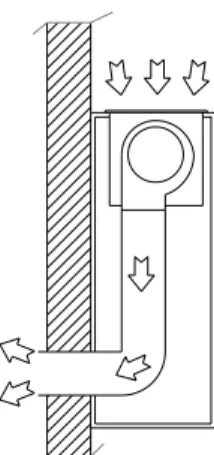
When planning new ductwork, always look for the most direct route to the ou-tside. Venting can be done through the roof or directly through the back outside wall. (See Figure 1 and 2) Only use ri-gid type metal ducting (plastic ducting is generally not permitted by code).
Flexi-ble ducting could restrict airflow by up
to 50%.
Duct Run Calculation.
The maximum duct run before effecting the performance of the hood is 100’. Cal -culate your duct run by measuring linear feet and adding the elbows, transitions and caps based on the table below.
5
Maximum Run
6” or 3 1/4 x 10” duct 100 FT
Deduct
Each 90 elbow used 15FT
Each 45 elbow used 9FT
Each 6” or 3 1/4 x 10” duct
Transition used 1FT
Each 3’1/4 x 10” to 6”
Transition used 5FT
Side Wall with damper 30FT
Roof Cap 30FT
Electrical Supply.
This appliance requires 120V/60Hz, 3amp electrical supply – ensure an
ap-propriately qualified person completes
the electrical hook-up. The connection point for the electrical supply is at the top of the unit, therefore the electrical supply must be run down from the ceiling alon-gside the ductwork.
All electrical and venting hook-ups must be in place before commencing installa-tion of the hood-fan.
ELECTRICAL
WARNING: All electrical work must be performed by a qualified electrician.
Please ensure that the appropriate electri-cal codes or prevailing loelectri-cal building co-des and ordinances are adhered to. Ensure that the electricity supply is di-sconnected at source. Do not use an ex-tension cord or adapter plug with this appliance.
This appliance must be grounded. Con-nect to a properly grounded branch circuit, protected by a 15 amp circuit breaker.
The ducting connection to the hood must be in line with the central verti-cal axis of the range hood 1” away from the back wall on which the hood is to be mounted.
Range hoods may interrupt the proper
flow of combustion gases from firepla -ces, gas furnaces and gas water heaters. To minimize the risk of drawing these lethal gases back into the home, please follow the heating equipment manufac-turers safety standards and guidelines carefully.
Refer to NFPA and ASHRAE for additional information.
SU901 32” 13/32 X 16” 3/16
SU902 10” 25/64 X 26” ½
SU903 27” 9/16 9” 15/16 X 25” 9/16
SU903 35” 7/16 9” 15/16 X 33” 7/16
If Sch31A or a Pro Liner are being used, they can be held up under the cabinet and used as a template.
If Sch31A or a Pro Liner are to be used for under cabinet application, they should be installed now.
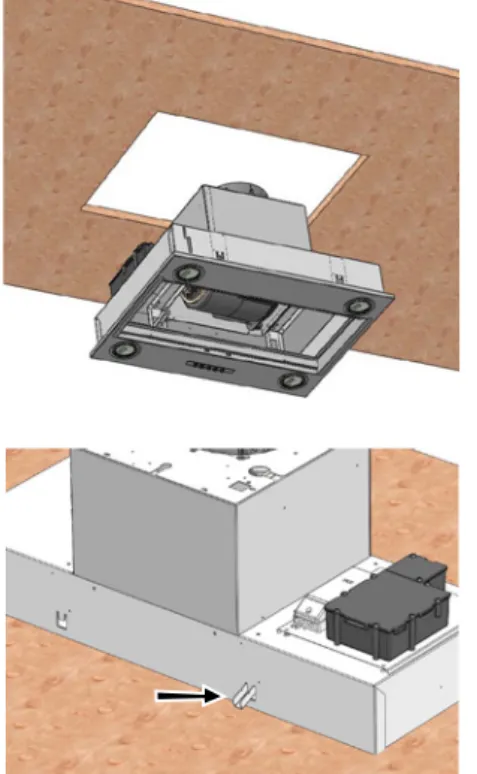
Installing a SCH31A with SU900 - SUT900 – SUE900. Hold the Sch31A un-der the cabinet and Screw it to the 4 hole locations. Make sure it lines up with the cut out in your cabinet. The power pack has pressure springs (to be adjusted) on the front and back that will “hook” onto the top surface of the underside of the hood when it is pushed up into the hole
that has been cut out (refer to figure 3).
Installing SU900 - SUT900 – SUE900 without a SCH31A. The power pack has pressure springs (to be adjusted) on the front and back that will “hook” onto the top surface of the underside of the hood when it is pushed up into the hole that
has been cut out (refer to figure 3).
INSTALLATION
Applications
The SU900 - SUT900 – SUE900 can either be installed inside a wall cabinet (provided the inside depth is greater than 11”) or used in a custom designed woo-den hood. Where installed directly into a wall cabinet, there are two options: Directly into the cabinet without any form of hood. Directly into the cabinet together with Sch31A where the Sch31A acts as a liner hood and is attached to ei-ther the underside of the cabinet or into the sides of the cabinets alongside. The SU901 can either be installed inside a wall cabinet or used in a custom de-signed wooden hood. Where installed directly into a wall cabinet, there are two options:
Directly into the cabinet or directly into the cabinet together with the adjustable Pro liners where the adjustable Pro li-ners act as a cabinet protection against the heat. The depth of the adjustable pro liners can vary from 23.5” to 25.9” ) The SU902 and SU903 can either be in-stalled inside a wall cabinet or used in a custom designed wooden hood.
Depending on which model is used, pre-pare a cut-out in the underside of the wooden hood to allow the powerpack to
fit up into the hood using the following
dimensions:
SU900 - SUT900 – SUE900 20”
10” 3/8 X 19” 19/32
SU900 - SUT900 – SUE900 27”
10” 3/8 X 26” 11/16
There are four holes on the inside of the
SUT900 to fix the unit into the edge of
the base of the wooden hood (refer to
figure 4).
7
Install the front part of the liner adjusting
it to the depth of the cabinet. (refer to fi -gure 6).
fig. 4
Installing a Adjustable Pro Liner with SU901. Once the cut out has been done install the Adjustable Pro Liner and make sure it lines up with the cut out in your cabinet. Screw it to the 4 hole locations
(refer to figure 5). fig. 5 lunedì 16 aprile 2007 SPESSORE: MATERIALE: RAGGIO PIEGA
Il presente disegno, o parte di esso non puo' essere riprodotto in nessuna forma, con Descrizione:
n° disegno:
nessun mezzo e per nessuno scopo, senza autorizzazione della proprieta'. Disegnato da: Data creazione:
lunedì 16 aprile 2007
SPESSORE: MATERIALE:
RAGGIO PIEGA
Il presente disegno, o parte di esso non puo' essere riprodotto in nessuna forma, con nessun mezzo e per nessuno scopo, senza autorizzazione della proprieta'. Disegnato da:
Descrizione:
n° disegno: Data creazione:
fig. 6
Screw it to the 3 hole locations.
Attention: be sure the cabinet has a mi-nimum thickness of 0.75” on the 4 sides.
lunedì 16 aprile 2007 SPESSORE:
MATERIALE:
RAGGIO PIEGA
Il presente disegno, o parte di esso non puo' essere riprodotto in nessuna forma, con nessun mezzo e per nessuno scopo, senza autorizzazione della proprieta'. Disegnato da:
Descrizione:
n° disegno: Data creazione:
The power pack has pressure springs (to be adjusted) on the front and back that will “hook” onto the top surface of the underside of the hood when it is pushed up into the hole that has been cut out
(refer to figure 3).
Installing SU902. The power pack has pressure springs (to be adjusted) on the front and back that will “hook” onto the top surface of the underside of the hood when it is pushed up into the hole that
has been cut out (refer to figure 3).
Installing SU903. The power pack has pressure springs (to be adjusted) on the front and back that will “hook” onto the top surface of the underside of the hood when it is pushed up into the hole that
has been cut out (refer to figure 7-8).
MANCA
LA FIGURA 9
fig. 10 fig. 7-8
Insert and Fix the 4 clamping levers as described in the pictures 9.
fig. 9
Screw carefully in order to keep the pro-duct straight.
Connecting Electricity and Ducting.
Please refer to the Electrical Supply sec-tion on page 2 for the required locasec-tion of the electrical supply.
CAUTION: Make sure the power is
tur-ned off at source. Make electrical con -nections (refer to Figure 10). Ensure that
the plastic flaps at the exhaust outlet for
the fan move freely and have not become jammed or stuck.
9
Connect the appropriate length of duc-ting to the fan exhaust point and join up with the ducting to the exterior.
Do not fix the ducting to the range hood exhaust outlet with screws-use duct tape. Use duct tape on all joints.
Re-Circulating Requirements.
If the unit is to be used in the
recircula-ting mode, fit the carbon filters after the
installation is complete (refer to Figure 11).
fig. 11
The carbon filter fits in behind the alu
-minium grease filter. Ensure that the pla
-stic tabs on the carbon filter are facing outwards otherwise it will be difficult to
remove it later for replacement.
A short length of ductwork must be connected from the exhaust outlet on the fan to wherever the air is to be exhausted.
Allow sufficient space to connect the
ductwork to the top of the exhaust
ou-tlet on the fan housing. Do not fix the
ducting to the range hood exhaust ou-tlet with screws, use duct tape. Duct tape should be used on all joints.
FUNCTION
SU900–SU901–SU902–SU903 (Fig. 12).
A: Light ON/OFF button B: Blower Speed 1 (low) or OFF C: Blower Speed 2 (medium) D: Blower Speed 3 (high) E: Blower Speed 4 (intensive) F: 10 Minute Timer
OPERATING PROCEDURES
Read all the instructions before opera-ting the appliance. Save these instruc-tions for future reference.
General Advice.
Ensure that the grease filters are in place.
Without these components, operating
blowers could catch on to hair, fingers and loose clothing. Keep fan, filters and
surfaces clean of grease and fat. Always turn hood fan ON when cooking. NEVER leave cooking unattended.
NEVER dispose cigarette ashes, ignitable substances or any foreign objects into blowers.
Cooking that generates flame is not re -commended as this hood is equipped with a thermal overload that will shut down the motor if it senses excessive heat. When frying, oil in the pan can ea-sily overheat and ignite. Heat oil slowly in an appropriately sized pot (covering the entire burner) to reduce the risk of boiling over and burning.
In the event of a range top grease fire,
observe the following:
Switch OFF the range hood. Turn off the cook top then smother flames with a close fitting lid, cookie sheet or other metal tray. If the flames do not go out
immediately.
EVACUATE AND CALL THE FIRE DEPART-MENT.
Never pick up a flaming pan – you may
be burned. DO NOT USE WATER inclu-ding wet dishcloths or towels, as a vio-lent steam explosion may occur.
fig. 12
SUE900 (Fig. 13)
A: Light ON/OFF button B: Blower Speed 1 (low) or OFF C: Blower Speed 2 (medium) D: Blower Speed 3 (high) E: Hood in operation light
11
SUT900 (Fig. 14)
Remote control
A: At every selected function, the led li ghts on accordingly.
B: To increase the speed.
C: To switch on the lights or to switch
them off.
D: ON/OFF To go from a higher speed
back to first one press twice the but ton: To switch the hood on or off
press once this button. E: To reduce the speed. F: To set the timer.
fig. 14
The led on the right side will start (eve-ry 5 seconds), the hood will work for 10 minutes at the selected speed and then
it lights automatically off. If the client in -creases or reduced the speed while the ti-mer is on, this is automatically stopped.
TECHNICAL DATA:
Alkaline battery powered: 12v mod. 23A
Operating frequency: 433.92 Mhz
Combinations: 4096
Max. consumption: 25Ma
Operating temperature: -20° : +55°C
Standard configuration.
If two cooker hoods-radio control system are installed in the same room or in the immediate vicinity, each system may af-fect the operation of the other, due to the fact that they have the same code. The-refore it will be necessary to change the code of one of the radio controls.
Generating a new transmission code.
The radio control is supplied by the ma-nufacturer with default codes stored. If you want to create a new set of codes, proceed as follows: press and hold the UP, STOP and DOWN buttons simulta-neously for 2 seconds. After the LEDS li-ght up, press the UP and DOWN buttons
within 5 seconds. The LEDS will flash 3
times to indicate that the process is
com-pleted. WARNING: This procedure
dele-tes all previously-stored codes.
Learning the new transmission code.
After changing the transmission code on the radio control, the cooker hood electronic control unit must be made to set the new code as follows: press
the main Power Off button on the coo -ker hood and then restore power to the electronic control unit. Within the next 15 seconds, press the Light button. This will ensure the control unit is synchronized with the new code.
Warning The battery should be repla-ced every year to guarantee the optimal range of the transmitter. To replace the exhausted battery, take the plastic lid off, remove the battery and replace it with a new one, observing the cor-rect battery polarities. Used batteries should be discarded in special collec-tion bins.
Cleaning the Hood.
Cleaning of the internal parts should be done with a clean damp (not excessively wet) cloth together with regular household detergent. The external stainless steel ele-ments should be cleaned with a good qua-lity foaming stainless steel cleaner. Read the manufacturers directions. Generally they recommend that the foam be sprayed onto a clean dry cloth and then applied to the stainless steel. Allow the foam to react on the surface for a few minutes and then wipe with a clean dry cloth.
On the surfaces that are exposed directly to heat from the cook-top, it is advisable to clean these on a regular basis to avoid the marks from becoming baked on. Do not under any circumstances use an abrasive type cleaner as this will scratch
and damage the stainless steel finish.
Glass components should be cleaned with a product such as Windex.
MAINTENANCE
The hood-fan should provide many years of trouble free service provided it is maintained properly.
Cleaning the Filter.
Clean the grease filter either by careful -ly hand washing, (so as not to
dama-ge the filter design) or, preferably in a dishwasher. Depending on use, the fil -ters should be cleaned at least every two weeks in a dishwasher.
If a carbon filter has been fitted this
must be replaced at least every 6 mon-ths as a minimum. Depending on coo-king style and nature of coocoo-king (greasy
foods, fry’s, curries etc) would probably
require more frequent replacement – if odors start to manifest themselves when cooking it is time to replace the carbon
filter . We suggest you retain a spare set.
These can be ordered from the supplier of your range hood.
Filter requires washing indicator: after 30 hours of use, all the buttons will
li-ght up to remind you that the grease filter
should be cleaned. Follow the
instruc-tions for cleaning filters in this booklet. Once the grease filters have been cleaned
and replaced, reset by pressing the timer button (F). Do not rely solely on this
indi-cator. Generally, the grease filter should
be washed on a regular basis to avoid
grease filter fires.
The blower should be turned on for ap-proximately 5 minutes before cooking in order to establish air currents upward through the hood. Use the low speeds for normal use and the higher speeds for strong odors and fumes.
13
Light Bulb Replacement.
(if in doubt, call 877-474-8770)
Turn blower and lights off. Make sure the
lights are cool.
Do not remove the entire fixture (socket) as this is very difficult to reinstall. Visually inspect the light fixture and esta -blish whether the unit has a smooth or “toothed” metal ring.
If smooth remove the glass blocking
ring by prying out with a sharp, soft
in-strument such as a toothpick (refer to fi -gure 15).
fig. 15
Steel instruments will scratch the surface. Be careful that the lens does not fall out.
If “toothed”, place the tip of your finger
between the lens and the ring. Making your way around the ring, gently pull outwards until a point is found where the
ring pulls off .
Replace the appropriate bulb. Check
par-ts brochure or specification sheepar-ts on
our website. Wipe both sides of the glass whilst it is out.
Three Year Limited Warranty
YOU MUST REGISTER THE PURCHASE OF YOUR PRODUCT ON LINE AT www.siriuscappe. com/usa/warranty.htm TO CONVALIDATE YOUR WARRANTY.
YOU CAN FIND THE DATA OF YOUR HOODS ON A LABEL INSIDE THE HOOD. JUST REMOVE THE GREASE FILTER TO READ IT.
WARRANTY SERVICE
To qualify for warranty service, you must notify Sirius After sale service at the email ad-dress stated below or call toll free USA 1-877-474-8770 and provide the model number, description of the fault or defect and original date of purchase. Sirius reserves the right to request proof of original purchase. Sirius will at its sole option and discretion replace products that arrive damaged through shipping, provided shipping damage is reported as stated above WITHIN 5 BUSINESS DAYS OF RECEIPT of the shipped product or products. ONE YEAR SERVICE REPAIR WARRANTY:
During the first year from date of original purchase, Sirius will, at its option, repair or repla
-ce, without charge, any product or part which is found to be defective under normal use and service.
THREE YEAR PARTS WARRANTY:
For three years from date of purchase, Sirius will provide free of charge, non-consumable repla-cement parts which are found to be defective under normal use and service.
WHO IS COVERED:
Sirius Range Hoods warrants to the original consumer purchaser of its products that such pro-ducts will be free from defects in materials and workmanship for a period of three years from the original date of purchase. There are no other warranties, express or implied, including,
but not limited to, implied warranties of merchantability or fitness for a particular purpose or
application.
WHAT IS NOT COVERED:
This warranty does not extend to filters, lamps, batteries, ducts and ductwork components. This
warranty does not cover normal maintenance and service or products or parts which have been subject to misuse, negligence, accident, improper maintenance or repair, faulty installation or installation contrary to recommended installation instructions. The warranty on glass screens is limited to manufacturing defects only and expressly excludes cracks and breakages as a result of faulty installation. Labor and associated costs associated directly with removal and re-installation are expressly excluded.
The duration of any implied warranty is limited to the three year period as specified for the
express warranty. Some states and provinces do not allow limitation on how long an implied warranty lasts, so the above limitation may not apply to you.
Sirius S.P.A.
Zona industriale Berbentina 6/A 60041 SASSOFERRATO (AN) ITALY
Sirius after sale service
Telephone (toll free): 1-877-474-8770 Email: [email protected]