Efficient Motor System Tools
sponsored by the DOE MOTOR CHALLENGE program
Stan Blazewicz Technical Project Manager U.S. Department of Energy Office of Industrial Technologies
Washington, DC
Mitch Olszewski Technical Project Manager
Oak Ridge National Lab Oak Ridge, TN
ABSTRACT
The Department of Energy's (DOE) Motor Challenge rrogram is an industry/governmenl collaborative that is working to increase the market penetration of dficienl mOlor-driven systems. In support of the program's Showcase Demonstrations, a variety of lools, protocols and databases are being developed. These lools will aid industry in the design, imr1clOentdtion, procurement, and validation of the benefits of energy efficient motor-driven systems. DOE's goal is In provide value-added products to industry to facilitate the decision-making process in maintaining and upgrading motor-driven systems and components. Tools will focus not only on energy factors, but also on produclivity, reliabilily, and capital cost reduction. The tools will be flexible enough 10 be useful and user-friendly 10 all potential
industrial end-users. It is important that the tools complement rather than compete with currently available software products. To facilitate concurrent development and future improvements, the software t001s will c0nsist of modular components.
BACKGROUND Motor Challenge
TIle Motor Challenge program was cr~a'.ed to assist industrial eud-uscrs in adopting a systems approach to the development. purchase and man;\gement of
Gilbert A. McCoy Energy Systems Engineer Washington State Energy Office
Olympia, WA
Paul Scheihing
Motor Challenge Program Manager U.S. Department of Energy Office of Industrial Technologies
Washington, DC
motors and motor-dri ven equipment that wi 11 improve indus! ri al energy effic iency, producti vi ty and environmental performance. The overall goal is to increase the market penetration of energy-efficient industrial electric motor systems. The program is built arc,und a Partnership which draws upon the diverse perspectives and needs of stakeholders 10
form coordinated marketing and deployment strategies. The program also encompasses showcase technology demonstratil1ns. an information clearinghouse, ~i technical c1at'lbase and the development of market trilnsfofmation strategies.
Showcase Demonstrations
Showcase Demonstrations are a critical component of the Motor Challenge. They will highlight specific examples of how industrial facilities can improve their energy efficiency, productivity and environmental performance by implementing efficient motor system strategies. A show~'asedemonstration team cuuld COr.SiSI llf indu~lrialm0tor system end users. eyuiprnem manLJ~'ac(lJrcrs,uti!ifles, stale energy offices and other tJrganizatiJlIs. DOE will provide technical assistance in the following areas:
-help dewlap technical tools ,md b.:st practices -prnviJc assistanCe to advise teams nn implementation and periormancc validation issues -document and disseminate case studies
-sponsor workshops to help teams exchange information
DOE will support the development of design-decision tools, best practices and guidelines on various electric motor system application tools. The Showcase Demonstration teams will provide input to DOE to ensure that the tools, protocols and procedures developed meet industry's design and decision-making needs and requirements.
Systems Approach and Electric Motor-Driven Systems
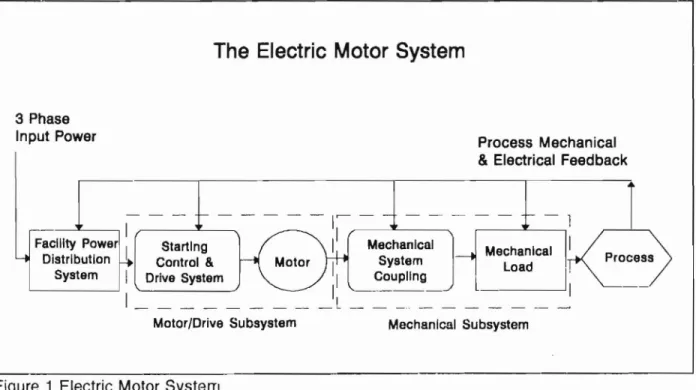
The key to fully unlocking the savings in a motor system is the systems approach. The overall efficiency of motor systems derives not just from the efficiency of individual components, but from the proper integration of these components. Although efficiency improvement opportunities for individual motor components alone are significant, the greater energy efficiency oppportunities lie in system integration. The distinction between an electric motor system and its components is made clear in Figure I. The system consists of (a) a power distribution system; (b) a starting, speed control, and electric drive system; (c) an electric motor; (d) a mechanical system coupling; and (e) a mechanical load and
process (3). DOE estimates that only 20 percent of the potential energy savings are associated with improvements in the motors' efficiencies. The remaining 80 percent can be attributed to better matching of the motor and mechanical system components (e.g., with adjustable speed drives); electrical distribution correction; and process optimization actions, such as implementing more efficient mechanical equipment with process requirements (e.g., pumps). Substantial improvement opportunities can be uncovered, therefore, when the design, control, and operations and maintenance of the driven equipment (i.e., fans, blowers, pumps, and compressors) are examined along with motors and drives. The tools that Motor Challenge is developing will exploit the !l)'stems approach to efficient motor system evaluation, design and implementation. Existing Tools-MotorMaster
MotorMaster software was created by the Washington State Energy Office (WSEO) with joint Bonneville Power Administration (BPA) and Department of Energy (DOE) funding support. Copies are distributed, along with the "Energy-Efficient Electric Motor Selection Handbook" and Electric Ideas Clearinghouse Technology Updates as part of USDOE Motor Challenge Electric Motors Kits.
The Electric Motor System
3 Phase
Input Power Process Mechanical
& Electrical Feedback
Starting Control & Drive System ---'1'---,
I
Facility Power I Distribution SystemI
,---
Mechanical System~OUPllng_J
- I
r
'--M-e-c-h-'aLn-lc-a-1--,I
.~
LoadI~~:/
LI
-
Motor/Drive Subsystem MeChanical Subsystem
Figure 1 Electric Motor System
38
The "stand alone" MotorMaster software consists of a motor price and performance database, and an energy conservation analysis report. Designed for utility auditors, facility managers, and consulting engineers, MotorMaster can be queried to identify the most efficient motor(s) for a given application, and to compute lhe energy and demand savings associated with selection of the energy efficient over a standard efficiency model.
MotorMaster includes:
-A database of performance and price information on more than 10,000 motors from all major manufacturers.
-Technical data that can help optimize a dri ve system, such as part-load efficiency and power factor, full load speed, torque, and voltage. -Purchase information: list price, warranty, catalogue number, and manufacturer's address. -Analysis features that calculate the energy savings, dollar savings. and simple payback from using a particular motor in a new purchase or retrofit application. Variables such as motor efficiency, purchase price, energy costs, hours of operation, load factor, and utility rebates are taken into account.
-Utility rebate program data, which includes minimum qualifying efficiency and rebate dollar values.
-Menus and extensive Help screens that make MotorMaster easy to learn and use
MotorMaster version 2.2 is available through the Motor Challenge Information Clearinghouse (800 862-2086).
FUTlJRE TOOL DEVELOPMENT PLANS Assumptions
In September, 1994 the Motor Challenge gathered industry experts to seek their input on tools DOE was considering supporting (I). Industry guidance resulted in the following key suggestions and/or underlying assumptions:
I) Motor Challenge tools should recognize what is important and useful to industry and take advantage
of the synergism between DOE needs and those of industry.
2) Motor Challenge tools should be complementary to, not in competition with, those that exist in the private sector
3) if Motor Challenge is successful in developing tools in accordance with these two assumptions, the private sector will supply the delivery mechanisms for Motor Challenge tools because they will represent a value added to their existing commercial products.
Industry and DOE Drivers
Industry and DOE, in general, have a differing set of drivers regarding electric motor system tools. However, there is some commonality and synergism that exists between the two sets of needs. Based on workshops with industry end-users, Motor Challenge has concluded that the primary factors influencing industry are:
I) Industrial motor decisions are not influenced heavily by energy efficiency. Energy costs are not large enough to be a determining factor in motor sysyem selection decisions. Thus energy efficiency tools are not typically highly valued by industry. 2) Industry is very interested in predictive and preventative maintenance tools since unscheduled outages are very costly.
3) Industry very rarely makes repair/replace decisions in advance. When faced with a motor that has failed the primary objective is to get production started as soon as possible. Thus the emphasis is on getting any replacement quickly rather than getting the optimal cost replacement.
4) Industry would like to use sophisticated tools for making decisions but they must be easy to use and complete the analysis automatically. In addition, the output mUSl provide top level information that can be used for decision making.
The primary DOE drivers in Malar Challenge are: I) Energy efficiency as it relates to energy resource conservation and the associated environmental enhancements.
implementation achievements; the environmental gains that are made. A reporting database that can validate industry's efforts will be one way to facilitate this recognition process.
3) Motor Challenge needs tools for validation of the energy efficiency costlbenefits for the Showcase Demonstrations.
4) DOE would like to provide industry with a set of tools that they would use to design energy efficient motor-driven systems. This would assist the Motor Challenge program in reaching its goal of improving the energy efficiency of U.S. industry's motor-driven systems.
Different End-User Types
The Motor Challenge tool plan recognizes that there are two distinct categories of potential end users. The first category uses predictive maintenance (PdM) software to monitor plant equipment and determine when corrective actions are required to prevent unscheduled downtime; The second category of end users does not use PdM (most generally because they are too small to afford the PdM packages). However, these users sometimes use preventative maintenance packages (software that optimally schedules regularly scheduled maintenance for equipment).
Plan Overview
The challenge in the software development is to provide a tool that industry will find useful and yet meet the goals of the Motor Challenge program. Recognizing the flexibility that will be required to satisfy the two categories of end-users, a modular design concept will be employed.
The tool for users who do not use PdM software will be an upgraded version of MotorMaster, called MotorMaster+. It will feature a motors inventory
database from which manufacturer
supplied/nameplate information and field data (if available) could be extracted for analysis. This tool would be designed to introduce a user to the benefits of having an inventory of motors and using software tools for plant management. It would be capable of performing motor selection analyses, providing motor repair/replace analyses for individual motors or batches of motors, and tracking energy and costs savings associated with motor retrofit actions.
The tool developcd for the PdM users will be called Motor System Expert. It will make use of the data gathering systems and inventory database components of the PdM software and provide the capability for analyzing motor systems. It would have the following capabilities:
1) System/Component Analysis - The software would provide the following design and equipment selection and analysis functions:
a) estimate the motor load and efficiency in operation using measured field data gathered by the PdM software;
b) provide a repair/replace decision for each motor system component in the inventory; c) select motor-driven system component hardware for new or retrofit applications In
an optimal, system integrated and cost effective manner; and
d) provide an estimate of overall system performance using data measured during system operation.
2) Savings Tracker - The software would track the performance of motor systems that have been modified. It will validate their performance and verify that expected savings are accruing.
3) Power Quality - Power quality is assessed using data from the PdM software and issues affecting motors and the electrical drive sy stem are noted and potential solutions suggested. In addition, adjustable speed drive (ASD) potential applications are identified and power quality issues associated with their use are detailed.
MotorMaster+ will be "stand-alone" software and will also be used as a module in Motor System Expert. Thus development of the two can proceed in parallel with the appropriate modules being integrated into the overall structure as they become available. More dctailed descriptions of the two tools is contained in the following sections.
Development of these two sets of tools will further DOE Motor Challenge goals and serve the needs of industry simultaneously. Once developed, Motor System Expert would be made available to all PdM vendors for use within their existing PdM software. Thus firms currently using PdM software will gain
40
information that will allow them to make energy efficient decisions about their motor driven systems. This information will be supplied as top level information that can be used directly by plant management to make decisions (e.g. the simple payback period for replacing a motor versus repairing it is 1.2 years).
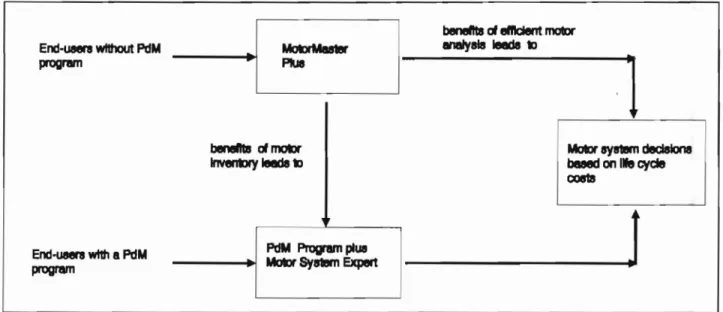
MotorMaster+ will be available through DOE and utilities at a nominal fee (or no fee) much the same as MotorMaster. Thus firms who currently do not use PdM software will benefit by getting the MotorMaster+ program that allows them to develop an inventory database of their motors and provides optimal cost solutions to motor repair/replace situations as well as design applications. Seeing the benefits from such a capability may spur them to invest in PdM systems that contain energy efficiency decision making tools or may lead them directly to motor system decisions based on life-cycle costs. This will lead to an evolution in the market as shown in Figure 2.
M OTORM ASTER+
MotorMaster is in the process of being upgraded to serve motor management functions at medium-sized and large industrial facilities. The new MotorMaster+ will feature capabilities that allow the software to serve as an effective industrial motor management too!. In particular, MotorMaster+ will contain a "Field Data Module" to serve as a field data storage
repository. The module will house motor nameplate information, identification, process and location codes; load type, operating hours and working environment descriptions; and such measured data as voltage, amperage, power factor, and speed at the load point.
The Field Data Module will be capable of printing a variety of descriptor-based sorts and to scan for motors operating under abnormal power supply conditions. Finally, the Field Data Module will be designed so that operating information can be used to estimate motor loads. MotorMaster's Compare Section will also be modified to accept inputs from the Field Data Module, automatically conduct "batch" analyses, and then summarize the costs and energy savings from changing out all motors in a given facility or process or only those motors with simple paybacks below a selected value.
New Features
MotorMaster is currently designed to analyze one motor at a time in a user-interactive mode. The analyst specifies the characteristics of the base case motor; selects a more efficient model from a ].ist; determines the value of both energy and demand savings; and prints an energy savings report. The process is then repeated for the next motor and the next.
MotorMaster+ will have the capability to analyze motors in a batch mode. AU of the motors in an
End·ueera wtIhout PdM
progrwn
I
beneftlI
at
eIIIdent rnolDr~ ftIIyala Ie8dI
m
---+~_Plue
_ _---11
End-ueera with a PdM
program
J
industrial plant--perhaps as many as I,OOO--can be analyzed at once, with energy, demand, dollar savings, and rebate entitlements summarized for all motors with simple paybacks falling below a selected cutpoint (such as 2 or 3 years). MotorMaster+ would also serve as a repository for motor nameplate and field data. The facility manager could then use the MotorMaster+ internal database as an inventory control and sorting tool.
The Field Data Module: The Field Data Module will contain nameplate, age and performance data for a corporation's motors. Typically, all motors in a given facility, or all motors greater than a minimum size, such as 5 hp will be inventoried. The Field Data Module will be equipped with "print" options such that a listing of all motors, all 25 hp motors, or all motors in a given process, department, facility or utility service territory can be displayed.
The Field Data Module will be designed to scan for and flag motors which are overloaded or operated under suboptimal power supply conditions, such as over or under-voltage or voltage phase imbalance. The Field Data Module can be queried by maintenance staff to identify those motors that are approaching the end of their predicted or expected useful life. Motor management activities are also supported as motors which have been rewound can readily be identified. The plant engineer will also be able to target conservation opportunities through listing motors in descending order of annual energy consumption or identify that subpopulation of motors with energy usage exceeding a preselected minimum value.
Motor loads will be determined within the Field Data Module by using measured information. The analyst will be given the option of using motor speed/slip characteristics, amperage measurements or kilowatt measurements to estimate load. A table of default motor efficiencies (as a function of age, load, hp, synchronous speed, and enclosure type) will be incorporated into the Field Data Module for the kilowatt measurement technique to be employed. Motor Populations within the Field Data Module will be stored ina file structure which includes corporate, facility, department, and process levels. When MotorMasters+ Compare capabilities are being used, motors within the Field Data Module can he accessed dnd analyzed either singly or in a batch mode basis. Information necessary for the analysis, such as motor design characteristics, identification number,
operating hours, load point, and efficiency at that load point are automatically communicated to the Compare analysis. Alternatively, blanket defaults for load and operating hours may be selected.
Batch Operating Capability: Industrial plant engineers may wish to examine the cost-effectiveness of a group changeout to high or premium-efficiency motors. Alternatively, the plant manager may wish to know which motors can be replaced by an energy efficient unit that has a simple payback of three years or less. MotorMaster's+ Compare algorithm will accept motor population inputs from the Field Data Module, automatically conduct an analysis and then aggregate results from changing out all motors or only those motors with simple paybacks below a "hurdle" rate.
Before the Compare-Replace Working Motor or Compare-Rewind analysis begins, the analyst must respond to several queries. Should full-load speed slip characteristics be taken into account for replacement motors driving centrifugal loads when equivalent data is available for the existing motor? Should the analysis consider a changeout to a particular brand of motor or should the savings be based upon replacement by an "average" energy efficient motor or one which is assumed to just meet NEMA energy-efficient motor standards. These types of replacement motor selection options are provided. After the Compare analysis is finalized, the "batch print" function can be called upon to provide a list of all motors that can be replaced with a simple payback below the industry's investment criteria, or a list of motors that are candidates for rewinding should they fail. Total costs, annual energy and demand savings, annual dollar savings, the serving utility rebate and the simple payback on investment are indicated. If the user desires, a life cycle cost analysis can be accessed from the Energy Savings Report screen with net present value, return on investment, benefit to cost ratio, levelized costs and cash flows quickly available for inspection.
Optimization and Replacement Motor Auto-Sizing: MotorMasters+ batch Compare analysis is also being designed to select the "best available" motor taking into account full and part load efficiency values, list price, and full-load speed/slip relationships for both the in-place and replacement motors. The "batch print'" report will then indicate the manufacturer, model number, and catalog number for each replacement motor, plus aggregate the costs and
42
savings from systematically choosing the "best available" replacement units. Best available is defined as the replacement energy-efficient motor which offers the quickest payback on investment. The Compare analysis will also deal with the issue of oversized and underloaded motors. A motor will be considered oversized if it operates at less than 40 percent load. In this case, the Compare analysis will consider replacement mOlors which are of equal size to the original motor plus units which are appropriately sized. (Due to uncertainties with respect to estimating loads, loads on replacement motors will not be allowed to exceed 85 percent.) In other words, motors sized at 100, 75, 60, and 50 hp will be considered as candidates for replacement of an existing 100 hp motor which is only loaded to 40 percent of its capability. Again, the replacement motor with the most rapid payback, taking speed/slip relationships into account will be chosen. Oversized motor replacement recommendations will be flagged on the "batch list" printout.
Savings Tracker: MotorMaster+ will also have the ability to track the performance of motors that have been replaced to validate their performance and document the energy and cost savings achieved. This information can be sent to the DOE as part of the voluntary reporting system.
Motor System Expert
Motor System Expert will be designed to be compatible with existing PdM software packages. An overall view of the tool structure is shown in Figure 3. Motor System Expert begins at the interface. This allows Motor System Expert to utilize measurements made by the PdM software. It also allows analysis resuJ ts to be transmitted to the PdM software for output to the user and to be included in the database entries.
The tool itself contains five modules. The module labeled CoordinaLOr coordinates the other modules by transferring data and calling subroutines as appropriate to the desired function. The System/Component Analysis module performs all analysis functions. These include: I) estimating field load and efficiency for the motor using measurements taken by the PdM software; 2) performing repair/replace anal yses for motors usi ng the diagnostic information generated by the PdM software and the capabilities of MotorMaster+; 3) performing
equipment selection analysis for components in motor driven systems for new or retrofit applications; and 4) performing system efficiency calculations for operating systems using data from the PdM software. Essentially, this module defines how analyses are to be performed and obtains the necessary data from the PdM data acquisition system or MotorMaster+. Pump, fan or compressor component analysis software modules may be developed for Motor System Expert or it may utilize existing analysis software on the market (e.g., PUMP-FLO from Engineered Software, Inc.).
The Savings Tracker module will be used to track the performance of systems that have been modified or retrofitted to validate their performance and document the energy savings achieved. The module will specify the frequency and duration of data collection, perform the analysis to show actual benefits accrued, and produce a report documenting the findings. From the databases top-level calculations of aggregate energy savings and environmental emission reductions could be generated to allow the option for companies to voluntarily report to DOE's electric motor system (EMS) database. The DOE database will provide for one type of public recognition mechanism. It is envisioned that industries will be able to supply the information they wish to report by selecting data entries from their savings tracker database and transmitting it to DOE electronically or by written report.
The Power Quality module can be developed in stages. Initially, it can be a relatively simple module that acts as a handbook of helpful hints. It could then be expanded to include evaluation of electrical line data to determine if power quality problems exist and suggest solutions for the problems. This module will also contain information related to adjustable speed drives (ASD). Essentially, it would walk an engineer through the design problem with a series of questions to determine if an ASD would be appropriate for the design problem.
- - - -- -
-
- - --Inventory
Measurements
Data
~
PdM
I
I
[
Interface
..~---[-Motor
Component
~~m~l
Master
Analysis
/
Plus
I ,- - - --
Savings
ICoordinator
-Pump
Tracker
IAnalysis
I
- - --ASDIPower
Fan/Blower
Quality
Analysis
Figure 3 Motor System Expert
REFERENCES
I. Oak Ridge National Lahoratory, "Proceedings of Motor Challenge Tools and Protocols Workshop Summary (lnd Future Plans", DecclYlbt'r:2, 1994. (Available through the Motor Challenge Information Clearinghouse 800-862-2086)
2. Olszewski, M., 'Motor Challenge Program Tool Development Plan", January 9, 1995.
3. U. S. Deparlmenl of Energy Office of Energy Dl'lndilJ Policy and Office of Industrial Technologies, "Efficient Electric Motor Systems for Industry", November 1991, pro 83-B4.
44