APPLICATIONS OF ORGANIC PHOTOREDOX CATALYSIS IN THE DEVELOPMENT OF ALKENE FUNCTIONALIZATION METHODS TOWARD THE SYNTHESIS OF α–
BENZYLOXYAMINO- AND HALO-LACTONES
Cortney L. Cavanaugh
A dissertation submitted to the faculty at the University of North Carolina at Chapel Hill in partial fulfillment of the requirements for the degree of Doctor of Philosophy in Department
of Chemistry.
Chapel Hill 2018
© 2018
ABSTRACT
Cortney L. Cavanaugh: APPLICATIONS OF ORGANIC PHOTOREDOX CATALYSIS IN THE DEVELOPMENT OF ALKENE FUNCTIONALIZATION METHODS TOWARD THE
SYNTHESIS OF α–BENZYLOXYAMINO- AND HALO-LACTONES (Under the direction of David A. Nicewicz)
I. Introduction To Organic Photoredox Catalysis
An overview of the photophysical and electrochemical components of organic photoredox catalysis and its applications in alkene functionalization reactions is addressed.
II. Synthesis of α-Benzyloxyamino-γ-Butyrolactones Via a Polar Radical Crossover Cycloaddition Reaction
The development of a direct catalytic synthesis of substituted α-benzyloxyamino-γ
-butyrolactones, beginning from simple oxime acids and alkenes, is discussed. The substituted O -benzyloxime acid starting materials undergo cyclization with oxidizable alkenes, via Polar Radical Crossover Cycloaddition (PRCC) reactions. The catalytic reaction is carried out using an acridinium photooxidant and substoichiometric amounts of a redox-active cocatalyst. The utility of this methodology is demonstrated through the cyclization of 3 oxime acids and 19 oxidizable olefins to generate 21 highly substituted α-amino lactone products.
III. Reversing The Regioselectivity Of Halofunctionalization Reactions Through Cooperative Photoredox And Copper Catalysis
ACKNOWLEDGEMENTS
There is no way I can thank my parents enough for their encouragement and support
throughout life, but especially through my graduate school career. I can genuinely say that none
of this would have been possible without them. I would also like to thank my twin brother
Michael for never letting me take myself too seriously and keeping me laughing through our
shared trudge through graduate school. Leaving my family to pursue my degree was a painful
decision but they have been there all along the way to keep me motivated and pushing forward. I
would like to thank you with all of my heart for that.
Thank you to my friends, at UNC and beyond, for making the tough times easier. Despite
all of its challenges, graduate school wasn’t without fun times and laughter. I am especially
appreciative to Jake Green. I couldn’t have been luckier to meet my best friend who was there
through every struggle and accomplishment I encountered. Additionally, graduate school would
have been unimaginable without my roommate Lilo who always kept me smiling.
I am grateful to my PI, David Nicewicz, for supporting me through this entire process
and giving me the opportunity to learn so much throughout my time at UNC. I owe an additional
thank you to the Nicewicz lab, past and present, for their help and camaraderie. Thank you to
Jeremy Griffin for his support on the halofunctionalization project and to Cole Cruz for helping
me survive this process.
TABLE OF CONTENTS
LIST OF TABLES ... ix
LIST OF FIGURES ...x
LIST OF SCHEMES ... xi
LIST OF ABBREVIATIONS AND SYMBOLS ...xv
CHAPTER ONE: INTRODUCTION TO ORGANIC PHOTOREDOX CATALYSIS 1.1 Introduction ...1
1.2 The Photophysical and Electrochemical Components of Photoredox Catalysis ...1
1.3 Organic Photoredox Catalysis and its Applications in Anti-Markovnikov Alkene Hydrofunctionalization ...9
1.3.1 Selecting an Effective Organic Photoredox Catalyst ...11
1.3.2 Mechanistic Insight ...14
1.4 Conclusion ...17
1.4 References ...18
CHAPTER TWO: SYNTHESIS OF α-BENZYLOXYAMINO-γ-BUTYROLACTONES VIA A POLAR RADICAL CROSSOVER CYCLOADDITION REACTION 2.1Introduction ...20
2.2Synthesis of α-Amino-γ-Butyrolactones ...21
2.3Synthesis of α-Benzyloxyamino-γ-Butyrolactones via Photoredox Catalysis ...26
2.3.1Background and Precedent ...26
2.5Experimental ...54
2.6References ...110
CHAPTER THREE: REVERSING THE REGIOSELECTIVITY OF HALOFUNCTION-ALIZATION REACTIONS THROUGH COOPERATIVE PHOTOREDOX AND COPPER CATALYSIS 3.1Introduction ... 113
3.2Halofunctionalization of Alkenes ... 116
3.3Synthesis of Halolactones ... 118
3.4Halofunctionalization Achieved Through Photoredox Catalysis ... 127
3.4.1Background and Precedent ... 127
3.4.2Results and Discussion ... 134
3.5Conclusion ... 155
3.6Experimental ... 157
LIST OF TABLES
Table 2-1. Optimization Of PRCC Conditions For The Synthesis Of
α-Benzyloxyamino-γ-Butyrolactones ...40
Table 2-2. Exploration Of Reduction Conditions To Access The Free Amine Product ...49
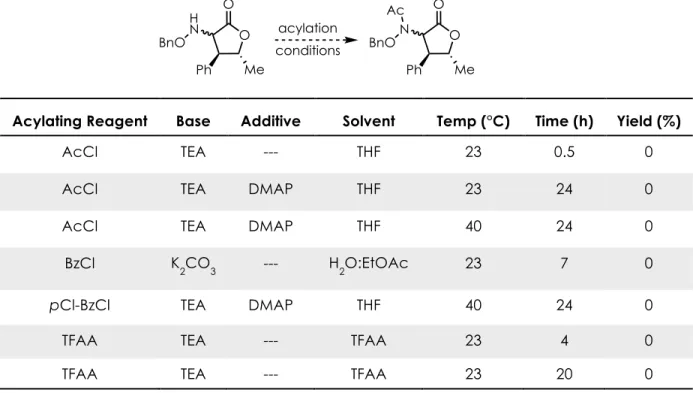
Table 2-3. Exploration Of Acylation Conditions To Access The N-Acyl Amine ...50
Table 3-1. Scope And Regioselectivity Of CSCS Catalyzed Chlorolactonization ...125
Table 3-2. Catalyst Recyclability ...125
Table 3-3. Optimization of Photoredox Mediated Anti-Markovnikov Hydroetherification ...126
Table 3-4. Optimization Of Chlorolactonization Conditions ...137
LIST OF FIGURES
Figure 1-1. Jablonski Diagram And A Simplistic View Of Excitation/ISC ...2
Figure 1-2. Single Electron Transfer Model ...3
Figure 1-3. Series Of Potentials For Various Organic Functional Groups And Catalysts ...7
Figure 1-4. Photophysical Properties Of 9-Mesityl-10-Methylacridinium Photoredox Catalyst ...13
Figure 2-1. Natural and synthetic N-acylated/sulfonylated α-amino-γ-butyrolactones ...21
Figure 2-2. Tetrahydrofuran synthesis Substrate scope ...29
Figure 2-3. Hydrogen Atom Donors And Their Corresponding BDE/pka ...31
Figure 2-4. Major Diastereomer Identification Based On 1-D NOESY NMR Analysis ...51
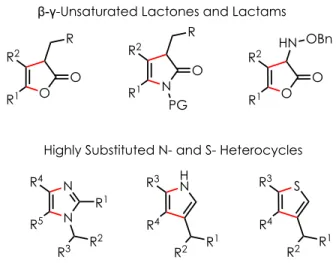
Figure 2-5. Potential Heterocycles Accessible Through PRCC With Alkyne Substrates ...53
Figure 3-1. Biologically Active Natural And Unnatural Products Exhibiting A 1,2- Oxygen/Halogen Relationship ...113
Figure 3-2. Biologically Active Β-Halo-Cyclic Ethers ...115
Figure 3-3. Proposed Catalyst-Hydantoin Complexes ...120
Figure 3-4. δ- And γ-Bromolactone Scope ...122
Figure 3-5. Stereochemical Model For Bromolactonization ...122
LIST OF SCHEMES
Scheme 1-1. Cyclization Of 1,1-Diphenylethylene via Cation Radical
Intermediate Formation ...8
Scheme 1-2. Anti-Markovnikov Functionalization Of Alkenes Via
Cation Radical Intermediate ...8
Scheme 1-3. Previous Anti-Markovnikov Hydrofunctionalization Methods
Developed By Nicewicz et al. ...11
Scheme 1-4. General Mechanism For Anti-Markovnikov Alkene
Hydrofunctionalization ...15
Scheme 1-5. Diaryl Disulfide Crossover Experiment ...16
Scheme 2-1. Cyclization Of Homoserine To Generate A Protected
α-Amino-γ-Butyrolactone ...22
Scheme 2-2. Cyclization Of Methionine To Generate A Protected
α-Amino-γ-Butyrolactone ...22
Scheme 2-3. Cyclization Of Aspartic Acid To Generate A Protected
α-Amino-γ-Butyrolactone ...22
Scheme 2-4. Acid-Mediated Lactonization Of α-Amino γ,δ-Unsaturated
Carboxylic Acid Esters ...23
Scheme 2-5. Accessing Homoserine Lactones Via Dual Organo- And
Biocatalytic System ...24
Scheme 2-6. Synthesis Of An α-Amino-γ-Butyrolactone Via An
Aza-Prins Cyclization ...25
Scheme 2-7. Aziridines Opening To Reveal α-Amino-γ-Butyrolactones Products ...25
Scheme 2-8. Acidic Hydrolysis Of Morpholinone Derivative
Toward The Synthesis Of α-Amino-γ-Butyrolactones ...26
Scheme 2-9. Tetrahydrofuran Synthesis Through PRCC Between Alkenes
And Alkenols ...27
Scheme 2-12. Abbreviated γ-Butyrolactones Substrate Scope ...32
Scheme 2-13. Synthesis Of Methylenolactocin And Protolichesterinic Acid Via PRCC ...33
Scheme 2-14. Regioselective Synthesis Of γ-Lactams Through A PRCC ...34
Scheme 2-15. γ-Lactam Scope ...35
Scheme 2-16. Amide Scope For The Synthesis Of Highly Substituted Lactams ...36
Scheme 2-17. Pyrrolidine Product Scope ...37
Scheme 2-18. Clive’s Radical Cyclization Of An O-Benzyloxime Derivative To Access An α-Benzyloxyamino-γ-Butyrolactones ...38
Scheme 2-19. Preparation O-Benzyloxime Coupling Partner ...39
Scheme 2-20. Exploration Of O-Benzyloxime Acid Scope ...42
Scheme 2-21. Alkene Scope For The Synthesis Of α-Benzyloxyamino-γ-Butyrolactone ...44
Scheme 2-22. Proposed Mechanism For The Production Of α-Benzyloxyamino-γ-Butyrolactones Via A PRCC ...45
Scheme 2-23. Hydrodehalogenation Of aβ–Bromo Substrate To Test The Reversibility Of The Radical Cyclization Step ...46
Scheme 2-24. Explanation Of Product Formation When Hydrogen Atom Donor Is Omitted ...47
Scheme 2-25. Determination Of Major Diastereomer Conformation Under Epimerization Conditions ...48
Scheme 2-26. Enamine Formation Observed Under Epimerization Conditions ...49
Scheme 2-27. O-Benzyl Amine Reduction To Generate Free α-Amino-γ-Butyrolactone ...52
Scheme 3-3. Enantioselective Iodolactonization Achieved Using A
Chiral Titanium Complex ...119
Scheme 3-4. Enantioselective Chlorolactonization ...120
Scheme 3-5. Amino-Thiocarbamate Catalyzed Synthesis Of Bormo-δ-Lactones ...121
Scheme 3-6. Enantioselective Iodolatonization Achieved Via Chiral Brønsted Acid Catalysis ...123
Scheme 3-7. Enatioselective Synthesis Of Chlorolactones Using A Novel CSCS Organocatalyst ...124
Scheme 3-8. Generation Of Bioactive Products Through The Functionalization Of Chlorolactone Products ...126
Scheme 3-9. Alkene Functionalization Demonstrating Markovnikov Selectivity ...128
Scheme 3-10. Proposed Mechanism For the Anti-Markovnikov Hydroetherification ...130
Scheme 3-11. Substrate scope for Photoredox Mediated Hydroetherification ...132
Scheme 3-12. Markovnikov Vs. Anti-Markovnikov Regioselectivity Of Hydroetherification Conditions ...133
Scheme 3-13. Intermolecular And Lactonization Variants Of Hydrofunctionalization Of Alkenes ...134
Scheme 3-14. Reversing Classical Regioselectivity Of Alkene Halofunctionalization Reactions ...136
Scheme 3-15. Copper mediated atom transfer radical polymerization ...138
Scheme 3-16. Proposed Mechanism For In Situ Strong Acid Formation ...140
Scheme 3-17. Background Reactivity Initiated By Strong Acid Formation ...141
Scheme 3-18. Diethyl Bromomalonate As A Bromine Radical Source In Atom-Transfer Radical Addition Reactions ...143
Scheme 3-19. Proposed Copper Activation Of Diethyl Bromomalonate ...144
Scheme 3-20. γ-Halolactone Scope ...146
Scheme 3-22. Identification Of Major/Minor Diastereomer Using
Epoxidation Conditions ...149
Scheme 3-23. Alkene Halofunctionalization Scope ...151
Scheme 3-24. Proposed Chlorolactonization Mechanism ...153
LIST OF ABBREVIATIONS AND SYMBOLS
α Alpha
β Beta
γ Delta
δ Gamma
λmax Lambda Max
τF Lifetime Of Fluorescence
τS1 Lifetime Of First Singlet Excited State
ϕF Quantum Yield Of Fluorescence
1D-NOESY One-Dimensional Nuclear Overhauser Effect Spectroscopy
A Acceptor
Ac Acetyl
AIBN Azobisisobutyronitrile
Alpha Alpha
Ar Aryl
ATRP Atom Transfer Radical Polymerization
BDE Bond Dissociation Evergy
BET Back Electron Transfer
Bn Benzyl
Boc tert-Butyloxycarbonyl
bpy 2,2′-Bipyridine
Bz Benzoyl
CV Cyclic Voltammogram
D Donor
DCB 1,4-Dicyanobenzene
DCC N, N'-Dicyclohexylcarbodiimide
DCDMH 1,3-Dichloro-5,5-Dimethylhydantoin
DCDPH 1,3-Dichloro-5,5-Diphenylhydantoin
DCE 1,2-Dichloroethane
DCM Dichloromethane
DDQ 2,3-Dichloro-5,6-Dicyanobenzoquinone
DEBM Diethyl Bromomalonate
DEM Diethyl Malonate
(DHQD)2PHAL Hydroquinidine 1,4-Phthalazinediyl Diether
DIBALH Diisobutylaluminum Hydride
DMAP 4-Dimethylaminopyridine
DNA Deoxyribonucleic Acid
dr Diastereomeric Ratio
e- Electron
E0,0 Excited State Energy
EDG Electron Donating Group
ee Enantiomeric Excess
equiv Equivalent
!!"#
EWG Electron Withdrawing Group
F Faraday Constant
GC-MS Gas Chromatography–Mass Spectrometry
H+ Proton
HAD Hydrogen Atom Donor
HAT Hydrogen Atom Transfer
HIV Human Immunodeficiency Virus
HOMO Highest Energy Occupied Molecular Orbital
Hz Hertz
hν Photon Or Energy Of A Photon
IC Internal Conversion
iPr Isopropyl
ISC Intersystem Crossing
k General Symbol For Rate Constant
kcal Kilocalorie
LEDs Light-Emitting Diode
LUMO Lowest Energy Occupied Molecular Orbital
Lut+ Lutidinium
M Molarity
m- Meta
Me Methyl
MeCN Acetonitrile
NAAN Nucleophile-Assisted Alkene Activation
NBP N-Bromophthalimide
NBS N-Bromosuccinimide
NCP N-Chlorophthalimide
NCS N-Chlorosuccinimide
NIS N-Iodosuccinimide
nm Nanometre
NMA 9-Mesityl-10-Methylacridinium
NMR Nuclear Magnetic Resonance
NNRTI Non-Nucleoside Reverse-Transcriptase Inhibitor
NOE Nuclear Overhauser Effect
NPhA 9-Mesityl-10-Phenylacridinium
NPhDMA 9-Mesityl-2,7-Dimethyl-10-Phenylacridinium
ns Nanosecond
Ns 4-Nitrobenzenesulfonyl
Nuc Nucleophile
o- ortho
p- para
PET Photoinduced Electron Transfer
Ph Pehnyl
phen Phenanthroline
PMN 2-Phenylmalononitrile
PMP p-Methoxyphenyl
ppm Parts Per Million
PRCC Polar Radical Crossover Cycloaddition
psi Pounds Per Square Inch
RNA Ribonucleic Acid
rr Regiomeric Ratio
rt Room Temperature
s Seconds
S0 Ground State Singlet
S1 First Singlet Excited State
SCE Saturated Calomel Electrode
SET Single Electron Transfer
SOMO Singly Occupied Molecular Orbital
Suc Succinimide
T1 First Triplet Excited State
TBS tert-Butyldimethylsilyl Ether
tBu tert-Butyl
TFA Trifluoroacetic Acid
TFAA Trifluoroacetic Anhydride
TFE 2,2,2-Trifluoroethanol
THF Tetrahydrofuran
Tr Trityl
Ts Toluenesulfonyl (Tosyl)
UV/Vis Ultraviolet–Visible Spectroscopy
V Volts
VREF Vncomycin-Resistant Enterococcus Faecium
Radical
CHAPTER ONE: INTRODUCTION TO ORGANIC PHOTOREDOX CATALYSIS
1.1 Introduction
Modern advances in photoredox catalysis stemmed from work out of the late 1970s and have
continued to greatly impact recent synthetic methods.1–3 Over the past 40 years, the number of
papers published annually in the field of organic photoredox catalysis has increased substantially
approaching nearly 200 in 2015.4 These data are a direct reflection of the groundbreaking and
exciting advancements being made in the field, garnering significant attention in both academia
and industry. A major asset to using photon-absorbing catalysts (i.e. photoredox catalysts) is the
ability to accesses unique substrate reactivity, which has been considered difficult, or even
impossible, under classic organic reaction conditions. While significant advances have been
made in the field of visible light photoredox catalysis using transition metal complexes,5 it is
worth focusing directly on the rapidly advancing, distinctive field of organic photoredox
catalysis, in which the Nicewicz laboratory and this thesis are grounded.
1.2 The Photophysical and Electrochemical Components of Photoredox Catalysis
At their foundation, organic photoredox catalysts are highly prized as participants in a
process known as photoinduced electron transfer or PET. This term refers, overall, to an electron
transfer event that occurs between an excited state and ground state molecule.6 In the case of
visible light organic photoredox catalysis, the excited state refers to that of an organic
chromophore. When the chromophore absorbs visible light (hυ), an electronically excited
can be represented with a Jablonski diagram (Figure 1-1).7 Though many singlet excited states,
of varying vibrational energy exist and may be accessed, non-radiative relaxation to the lowest
energy S1 state occurs in a matter of picoseconds. The fate of S1 is dependent on both radiative
and non-radiative photophysical pathways. A radiative pathway, for S1 to return to S0, involves
the dissipation of energy in the form of a photon and is termed fluorescence. Two potential
non-radiative pathways may also dictate the fate of S1. Similar to fluorescence, S1 may also return to
S0 through internal conversion (IC), however, in this case, the loss of energy is thermal. The final
process is intersystem crossing (ISC) and involves the transition of S1 to T1, the first triplet
excited state. This process is spin forbidden and is therefore slow. Upon entering T1, an
additional radiative pathway, known as phosphorescence, may occur, allowing T1 to return to S0.
This transition may also involve non-radiative pathways.
Figure 1-1. Jablonski Diagram and a Simplistic View of Excitation/ISC
As a result of entering S1 or T1, organic chromophores become capable of participating in an
electron transfer process. In principle, the excited state catalyst can act as an oxidant or
reductant. This interaction may involve electron transfer in two directions; the excited state of
ΔG +hv
S0 S1
T1
v0
vn
-hv -h v
non-radiative process radiative process
Intersystem Crossing Fluorescence
understanding of the transformations to be discussed herein, an emphasis will be placed on
exploring electron transfer through the reductive quenching cycle of photoredox catalysts.
In this relationship, the photon-absorbing catalyst acts as an acceptor molecule (A), while the
substrate functions as the donor molecule (D) (Figure 1-2). This simplified model demonstrates
the interactions between the corresponding molecular orbitals of the catalyst and substrate in
their ground and excited states. In the ground state, the acceptor molecule possesses a highest
occupied molecular orbital (HOMO) and a lowest unoccupied molecular orbital (LUMO) that are
each lower in energy than that of the corresponding HOMO and LUMO for the donor. As a
result of these relative energy levels, electron transfer in either direction (A → D or D → A) is
endergonic and therefore unfavorable. However, upon excitation by visible light, A is capable of
accessing its excited state (A*), transferring an electron from its HOMO to its LUMO. The
newly formed vacancy in the former HOMO of A* makes it an excellent excited state oxidant as
it is more easily reduced than its ground state counterpart. As a result, single electron transfer
(SET) from the HOMO of D to the lower energy SOMO (singularly occupied molecular orbital)
of A* allows for the oxidation of D to an electron-deficient D+ species and the concurrent
reduction of A* to the electron-rich A- species.
Figure 1-2. Single Electron Transfer Model
While this PET process is highly desirable for the single electron oxidation of organic A
D
A* D
A
D
A
D HOMO
electron transfer (BET) pathway. BET is a general term associated with any event in which A-
transfers an electron back to D+. This process may occur as a result of a close physical
relationship between the radical ion pairs and is also a highly exergonic, competitive pathway.8
To help promote forward electron transfer and limit BET, more polar solvents can be utilized as
they stabilize polar intermediates and promote the separation of the radical ion pairs.9 The
excited state from which PET occurs can either be the singlet or triplet state, though reaction
efficiency is higher for those occurring from the latter.10 Though an acceptor in S1 possesses a
higher oxidizing ability, PET from this state is less efficient than that from T1. This is a direct
result of the long-lived nature of T1, which provides sufficient time for the species to diffuse,
collide, and undergo electron transfer. The slower rate of BET associated with the triplet state
allows for the radical ion pair to separate sufficiently before the unproductive event can occur. In
order to achieve successful PET and limit BET, an appropriate acceptor/donor system must be
identified.
To aid in this determination, a general equation can be applied to identify the likelihood of a
PET event occurring.6 Before considering the photoinduced transfer event, it is worth
considering the equation that describes the Gibbs free energy of a single electron transfer event
occurring in the ground state (Equation 1-1). This equation relates the redox potentials for A and
D, undergoing reduction (!!"#) and oxidation (!!") events, respectively. It is worth clarifying
the nomenclature and noting that that !!"# specifically refers to the single electron reduction of
A to A- (A→A-, !
!/!(A/A-)) and this value, measured in volts (V), is usually negative for most
acceptors in the ground state. This value is associated with the fact noted previously, that single
potential and is associated with the D+ to D reaction (D+→ D, !
!/!(D+/D)). Unlike the
reduction of A, the single electron reduction of D+ is generally an energetically favorable
process and results in a positive voltage value.
Equation 1-1. Gibbs Free Energy of Single Electron Transfer
∆!
!"=
−!
!
!"#−
!
!"=
−
!(!
!/!(
!/
!
⋅!)
−
!
!/!
(!
⋅!/
!
)
)
Having considered single electron transfer in the ground state, the equation for PET can now
be explored. The free energy of PET occurring between the excited state photoredox catalyst
acceptor (where A = cat*) and a ground state substrate (D = sub) can be modeled by Equation
1-2, where Coulombic interactions are disregarded. Here, !!"#∗ refers to the excited state reduction
potential for the photoredox catalyst under consideration and can be calculated according to
Equation 1-3. The excited state energy (!!,!) refers to the transition between the lowest
vibrational state of S1 or T1 to that of S0. This value can be estimated at the midpoint between the
absorption and emission maxima from the overlaid spectra.
Equation 1-2. Gibbs Free Energy of PET
∆!
!"#=
−!
(
!
!"#∗(
!"#
∗/
!"#
⋅!)
−
!
!"
(
!"#
⋅!/
!"#
)
)
Equation 1-3. Excited State Reduction Potential of Photoredox Catalyst
!
∗(!"#
∗/
!"#
⋅!)
=
!
(!"#
/
!"#
⋅!)
+
!
While a significant amount of information is contained within these equations, a valuable
tool can be simplified from the mathematical relationship to determine the likelihood of a
proposed PET between a photoredox catalyst and a substrate. A successful photoinduced
electron transfer event is possible when !!"#∗ in more positive than !
!" of the substrate.
Determining the feasibility of an electron transfer event can aid in the selection of a photoredox
catalyst depending on substrate that is to be oxidized.6
Cyclic voltammetry is commonly employed to measure the redox potential for a given
substrate. From the cyclic voltammogram (CV), one can identify the oxidation potential for an
organic compound by estimating the potential at half the maximum current, also known as the
half-peak potential. A series of potentials, for a variety of organic functional groups, was
reported by Roth et al.11 in 2016, to aid in the selection of an effective catalyst-substrate pairing.
An abbreviated collection of these substrates, and the range for their corresponding potentials,
are represented in Figure 1-3 with the values reported against a saturated calomel electrode
(SCE). These potentials can be compared to the excited state reduction potential of some
commonly used organic photoredox catalysts.6,12 Often, these catalysts are combined with
sufficiently oxidizable substrates to carry out single electron oxidation of the organic donor
Figure 1-3.Series of Potentials for Various Organic Functional Groups and Catalysts
Early evidence for gaining access to these valuable cation radical intermediates through PET
was first provided in groundbreaking work by the Arnold lab.13 While studying
photocycloadditions, it was observed that when 1,1-diphenylethylene was reacted with methyl
4-cyanobenzoate in acetonitrile an unexpected product had formed (Scheme 1-1). Ultimately, it
was determined that the product corresponded to tetrahydronaphthalene product 1.2 and formed
as a result of single electron oxidation of the olefin by 4-cyanobenzoate to generate the
corresponding cation radical 1.1. Upon reacting with another equivalent of 1,1-diphenylethylene
and ring closure, the observed product was formed. Arnold expanded this transformation to
include an intermolecular variant in which alcohols, such as methanol and isopropanol were used
as solvents to generate the corresponding ether products in an anti-Markovnikov fashion.
aromatic heterocycles
0 V vs SCE +1 V +2 V +3 V +4 V
alkyl & aryl amines, enamines
aliphatic alkenes, styrenes
phenols
aryl halides
EOSIN Y
Scheme 1-1.Cyclization of 1,1-Diphenylethylene via Cation Radical Intermediate Formation
From these results, it was concluded that, upon nucleophilic trapping of the cation radical,
two potential carbon-centered radicals might form. However, the more populated form was that
of the more stabilized radical, resulting in formation of the observed alkene functionalization
product (Scheme 1-2). This pioneering work, towards the development of cation
radical-mediated anti-Markovnikov functionalization, was expanded upon by both Arnold14 and
Gassman.15,16 While impressive, initial results in the fields were limited by nearly stoichiometric
use of the photooxidant and undesirable reactivity and byproduct formation.
Scheme 1-2. Anti-Markovnikov Functionalization of Alkenes via Cation Radical Intermediate
NC
OMe O
Ph Ph H
H
Ph Ph
Ph Ph
NC
OMe O
NC
OMe O NC
OMe O
Ph Ph Ph
1.1 1.2
+MeOH +MeOH
-MeOH -MeOH
O H
Me H
H O Me
H
1.3 Organic Photoredox Catalysis and its Applications in Anti-Markovnikov Alkene Hydrofunctionalization
The functionalization of alkenes through the addition of a proton and heteroatom across the
double bond is one of the oldest and most applied transformations in organic chemistry.
Typically, this reaction leads to the corresponding Markovnikov product. While this reactivity is
often desirable, a significant amount of attention has been directed towards reversing the
regioselectivity of olefin hydrofunctionalization reactions to favor the more elusive
anti-Markovnikov adduct.
In response to this interest in developing anti-Markovnikov alkene functionalization
methods, and based on precedent from within the field, the Nicewicz lab has turned its attention
towards the development of an organic photoredox-mediated method, with a specific focus on
identifying an effective catalytic variant. We have developed and applied methods for accessing
anti-Markovnikov hydrofunctionalization products through PET between organic photoredox
catalysts and olefin substrates. This method relies on the formation of a uniquely reactive cation
radical intermediate and has proven to be a general approach towards alkene functionalization. In
order to achieve the desired catalytic reactivity, we have applied a dual organic catalyst system in
the transformation, utilizing an acridinium photoredox catalyst and a redox active, organic,
hydrogen atom donor.
Since our seminal publication in 2012, this methodology has been applied to the
anti-Markovnikov addition of alcohols,17 carboxylic acids,18 amines,19 trifluoromethyl groups,20 and
mineral acids21 in the presence of a hydrogen atom source (Scheme 1-3). A variety of
electron-rich olefins were successfully functionalized, regioselectivly, using this novel method. This
approach.22–24 Though this approach has proven to be a highly successful method of
functionalizing alkenes in a regioselective fashion, a substantial amount of attention has been
placed on understanding the general transformation. Specifically, the identity of the organic
photoredox catalyst (Figure 1-3) and hydrogen atom donor cocatalyst has required a thorough
Scheme 1-3. PreviousAnti-Markovnikov Hydrofunctionalization Methods Developed by Nicewicz et al.
1.3.1 Selecting an Effective Organic Photoredox Catalyst
With the goal of creating a generally applicable, catalytic method in mind, we sought to
Ph R3 R1 R2 Me Me HO O HO Me NHTs
F3C S ONa O
Cl tBu O
PhMe Me
O H Me Me Me O H H N Ts CF3 R1 R2 H R3 Cl R1 R2 H R3 O Me Blue LEDs NMA (5 mol %) Thiophenol (20 mol %) 2,6-lutidine (20 mol %)
TFE (4 equiv)
CHCl3 [0.4 M], rt, 24 h 2 equiv
Blue LEDs NMA (5 mol %)
Methyl thiosalicylate (20 mol %)
CHCl3/TFE (9:1) [0.2 M], rt, 24 h 1.5 equiv
Hydrochlorination
Hydrotrifluoromethylation Blue LEDs
NMA (5 mol %) Thiophenol (20 mol %)
DCE [0.5 M], rt, 24 h
Hydroamination Blue LEDs
NMA (5 mol %) Thiophenol (20 mol %)
DCE [0.5 M], rt, 24 h
Hydroacetoxylation 10 equiv
Blue LEDs NMA (5 mol %)
2-Phenylmalononitrile (50 mol %)
DCE [0.5 M], rt, 24 h
Hydroetherification R3 R1 R2 R3 R1 R2 R3 R1 R2 HO O R 1.1 equiv Blue LEDs NMA (2.5 mol %) Diphenyl Disulfide (10 mol %)
2,6-lutidine (10 mol %)
CH2Cl2 [0.15 M], rt, 24 h O O R
H
R1R 2
R3
expected to proceed through the single electron oxidation of olefins, the organic dye of choice
would need to be capable of oxidizing a variety of alkenes, with a wide range of oxidation
potentials, to ensure a thorough and diverse substrate scope. In order to ensure optimal reactivity,
the photocatalyst would also need to exhibit key characteristics including the ability to undergo
excitation upon irradiation with visible light, a sufficient fluorescence lifetime and quantum
yield, and it must undergo limited, unproductive BET. Lastly, to access catalytic reactivity, the
chromophore of choice would need to exhibit redox reversibility, ensuring that the catalyst
would remain intact and could be turned over in the presence of a suitable oxidant. Upon an
exploration of the literature, it was determined that 9-mesityl-10-methylacridinium (NMA), as
disclosed by Fukuzumi, would best embody these characteristics and could be successfully
applied as a photoredox catalyst in the hydrofunctionalization of alkenes.25
The photophysical characteristics of the acridinium catalyst lend itself well towards its
incorporation into our hydrofunctionalization methodology (Figure 1-4).6 Firstly, the excited
state reduction potential of NMA is +2.18 V vs SCE. With such a highly positive potential,
NMA gives access to a variety of olefin substrates that are capable of being oxidized to their
corresponding cation radical intermediate. Additionally, the excited state of the acridinium can
be achieved through irradiation by visible light. While the absorbance maximum is reported to be
425 nm for NMA, it is best to irradiate at the highest possible wavelength to prevent potentially
competing photochemical pathways. Light emitting diodes (LEDs) have proven to be an asset in
the development of photoredox mediated methods, as they are efficient, high-intensity light
sources that are selective due to their narrow emission band. As a result, commercially available
Figure 1-4. Photophysical Properties of 9-Mesityl-10-Methylacridinium Photoredox Catalyst
Before it can be applied in synthesis, it is necessary to determine whether a photoredox
catalyst can efficiently undergo PET with a given substrate. This determination is based on the
fluorescence lifetime (τf). Longer lifetimes are indicative of photooxidants that are more likely to
undergo PET with a substrate. Those exhibiting a lifetime of less than 1 ns will be unlikely to
undergo efficient PET. The fluorescence lifetime of NMA is 6 ns, and while not impressively
long, the value indicates that the acridinium is capable of undergoing PET. The likelihood of
PET can also be gathered from the fluorescence quantum yield (ϕf) for a given catalyst. A value
close to one indicates that PET from S1 could be more efficient as deactivation pathways are
limited. That is, nearly all molecules in S1 undergo fluorescence rather than relaxing through a
nonradiative pathway. With a ϕf of 0.035, nonradiative pathways are considered competitive but
the value has proven to be sufficiently high to make NMA an effective photoredox catalyst.6 Not
all of these nonradiative processes are deleterious however. For example, ISC would allow for
PET to still occur efficiently from T1 despite the fact that it is lower in energy. Evidence has
shown that NMA has a variety of singlet and triplet states that are capable of oxidizing organic
substrates. Lastly, the acridinium cationic structure lends itself well to preventing back electron
transfer as its overall positive charge, prior to electron transfer, makes it less likely to transfer the
electron back to the oxidized substrate. A critical characteristic of NMA is its ability to be N
Me Me
Me Me
efficiently turned over by a co-oxidant. The delicate balance between the photoredox catalyst and
cocatalyst system has been explored closely through a series of mechanistic studies.
1.4 Mechanistic Insight
Ultimately, a suitable photoredox catalyst must successfully interact with all of the
hydrofunctionalization reaction components as a cohesive, redox neutral system. As discussed
previously, in order to achieve a net redox-neutral transformation, the photocatalyst’s reductive
quenching cycle must be coupled with an additional oxidative quenching cycle. Through a series
of reports, it was determined that NMA functions effectively in a system with a redox active
hydrogen atom donor such as phenylmalononitrile (PMN).17,22 However, it was discovered that
higher yields and shorter reaction times could be achieved using thiophenol (PhSH) and diphenyl
disulfide ((PhS)2) as alternative hydrogen atom donors. An exploration of a general reaction
mechanism is necessary to illustrate how the photoredox catalyst and cocatalyst function together
to afford the generation of an anti-Markovnikov, alkene hydrofunctionalization product (Scheme
1-4). Initially, olefin substrate 1.3 undergoes single electron transfer to an excited state
acridinium NMA* to afford the characteristic cation radical intermediate (1.4). This intermediate
can be detected through laser flash photolysis.26 Nucleophilic trapping of the cationic component
affords the more stable (1.5) of the two potential carbon-centered radicals. The
hydrofunctionalized product (1.7) is generated upon deprotonation and trapping of the radical
Scheme 1-4. General Mechanism for Anti-Markovnikov Alkene Hydrofunctionalization
A critical point in the transformation is where the two catalytic cycles intersect. As a result of
HAT, a phenylthiyl radical (PhS) is generated which can function as a one-electron oxidant to
turn over the acridine radical (NMA). The reduction potential of the thiyl radical (!!!"#/! = +0.16
V vs. SCE) indicates that it is sufficiently oxidizing to undergo an exergonic electron transfer
with NMA (!!!"#/! = -0.55 V vs. SCE).26 The thiophenol catalyst can be regenerated upon
protonation of the resulting thiolate (PhS-) by an equivalent of substrate. Interestingly, the
hydrogen atom donor cocatalyst serves multiple purposes in the production of product by
functioning as an electron, hydrogen atom, and proton transfer agent throughout the reaction.
An interesting observation was made when it was determined that diphenyl disulfide also
functioned effectively as a HAT agent. The concept of using diphenyl disulfide was initially
proposed after observing its formation as a byproduct during reactions that used thiophenol as a
N Me Me Me N Me Me Me Me * Me N Me Me Me Me SH S S (PhS)2 NMA NMA* -H+ HAT +e --e -+e --e -+H+ hv hv R1
R2 R3
NucH Nuc
R2
R1
R3
R1
R2 R3
R1
R2 R3
NMA● +NucH -NucH Nuc R2 R1 R3 H
1.3 1.4 1.5 1.6 1.7
PhSH
HAT catalyst. It was hypothesized that the disulfide undergoes homolytic cleavage upon
irradiation by visible light, ultimately generating thiophenol in situ. To support this proposed
pathway, a crossover experiment was conducted in which diphenyl disulfide (1.8) was irradiated
in the presence of 4-methyl diphenyl disulfide (1.9) and NMA (Scheme 1-5).26 The
mixed-disulfide product (1.10) was obtained along with the symmetric mixed-disulfides (1.8 and 1.9) as a 2:1:1
mixture. These results were also observed when NMA was left out of the reaction conditions but
no exchange was noted when the reaction was conducted in the dark, even when heated. In
combination, these results strongly supported the visible light induced homolytic cleavage of
diphenyl disulfide.
Scheme 1-5. Diaryl Disulfide Crossover Experiment
While it has been noted that the rate-limiting step may change throughout the span of the
reaction, evidence suggests that the deprotonation of intermediate 1.3 (Scheme 1-4) may have a
rate determining influence.26 Reaction rates are higher when the thiol cocatalyst is employed as
S S S S
Me
Me
S S S S
Me
Me S S
Me
450 nm LEDs [0.025 M] in DCE
NMA (13 mM)
2 : 1 : 1
1.8 1.9
thiolate necessary to carry out the deprotonation event. These observations, in addition to being
easier to handle, make diphenyl disulfide an ideal cocatalyst in this novel organic
photoredox-mediated hydrofunctionalization of alkenes.
1.5 Conclusion
A rudimentary understanding of the photophysical and electrochemical factors that influence
the activity of an organic photoredox catalyst is fundamental to the successful employment of
such a species in a transformation. By understanding the oxidizing ability and photophysical
properties of 9-mesityl-10-methylacridinium, we were able utilize this photoredox catalyst in the
synthesis of a diverse set of hydrofunctionalized alkenes. The general, dual-catalytic process
utilizes a redox active hydrogen atom donor cocatalyst in a concurrent cycle to access an overall,
net redox neutral transformation. Photoredox catalysis has enabled access to unique reactivity,
that is often difficult or impossible to achieve, including the anti-Markovnikov addition of
nucleophiles to olefin substrates. An exploration of two novel transformations, based on this
REFERENCES
(1) Hedstrand, D. M.; Kruizinga, W. H.; Kellogg, R. M. Tetrahedron Lett.1978, 19, 1255– 1258.
(2) Hironaka, K.; Fukuzumi, S.; Tanaka, T. J. Chem. Soc. Perkin Trans. 21984, 0, 1705– 1709.
(3) Pac, C.; Ihama, M.; Yasuda, M.; Miyauchi, Y.; Sakurai, H. J. Am. Chem. Soc.1981, 103, 6495–6497.
(4) Shaw, M. H.; Twilton, J.; MacMillan, D. W. C. J. Org. Chem.2016, 81, 6898–6926. (5) Prier, C. K.; Rankic, D. A.; MacMillan, D. W. C. Chem. Rev.2013, 113, 5322–5363. (6) Romero, N. A.; Nicewicz, D. A. Chem. Rev.2016, 116, 10075–10166.
(7) Anslyn, E. V.; Dougherty, D. A. Modern Physical Organic Chemistry; University Science: Sausalito, CA, 2006.
(8) Narra, S.; Nishimura, Y.; Witek, H. A.; Shigeto, S. ChemPhysChem2014, 15, 2945–2950. (9) Mattay, J. Synthesis1989, 1989, 233–252.
(10) Miranda, M. A.; Izquierdo, M. A.; Pérez-Ruiz, R. J. Phys. Chem. A2003, 107, 2478– 2482.
(11) Roth, H. G.; Romero, N. A.; Nicewicz, D. A. Synlett2016, 27, 714–723. (12) Majek, M.; Jacobi von Wangelin, A. Acc. Chem. Res.2016, 49, 2316–2327. (13) Neunteufel, R. A.; Arnold, D. R. J. Am. Chem. Soc.1973, 95, 4080–4081. (14) Mangion, D.; Arnold, D. R. Acc. Chem. Res.2002, 35, 297–304.
(15) Gassman, P. G.; Bottorff, K. J. Tetrahedron Lett.1987, 28, 5449–5452.
(16) Gassman, P. G.; Bottorff, K. J. Photoinduced Lactonization. J. Am. Chem. Soc.1987, 109, 7547–7548.
(20) Wilger, D. J.; Gesmundo, N. J.; Nicewicz, D. A. Chem. Sci.2013, 4, 3160–3165.
(21) Wilger, D. J.; Grandjean, J.-M. M.; Lammert, T. R.; Nicewicz, D. A. Nat. Chem.2014, 6, 720–726.
(22) Grandjean, J.-M. M.; Nicewicz, D. A. Angew. Chem. Int. Ed.2013, 52, 3967–3971. (23) Zeller, M. A.; Riener, M.; Nicewicz, D. A. Org. Lett.2014, 16, 4810–4813.
(24) Cavanaugh, C. L.; Nicewicz, D. A. Org. Lett. 2015, 17, 6082−6085.
(25) Fukuzumi, S.; Kotani, H.; Ohkubo, K.; Ogo, S.; Tkachenko, N. V.; Lemmetyinen, H. J. Am. Chem. Soc.2004, 126, 1600–1601.
CHAPTER TWO: SYNTHESIS OF α-BENZYLOXYAMINO-γ-BUTYROLACTONES VIA A POLAR RADICAL CROSSOVER CYCLOADDITION REACTION
2.1Introduction
Cyclic esters, known as lactones, are structural motifs that have garnered significant
attention for their presence in natural products and medicinal chemistry targets.1 In addition to
being used as simple synthetic building blocks and monomers of polyesters, lactones possess
significant economic value, especially in the fragrance industry.2 A subset of lactones that are
especially valuable, due to their prevalence in synthesis, stability, and diverse bioactivity, are γ
-butyrolactones.
The significance of γ-butyrolactones can be enhanced by the addition of heteroatom
substituents at the α-position, with nitrogen functionality being particularly valuable. These α
-amino-γ-butyrolactones are a class of bioactive heterocycles that show especially great utility in synthesis and are highly prevalent in nature. Existing as the lactone form of the amino acid
homoserine, α-aminolactones can be easily converted to the straight-chain, γ-hydroxyamino acid equivalent through hydrolysis or can be used in the preparation of several amino acids that are
expensive and difficult to access, such as methionine3 and canaline.4
α-Amino-γ-butyrolactones, also known as homoserine lactones, have been used as
scaffolds in anti-allergy, immunosuppressant, and anti-asthma agents5 and in the synthesis of antibiotics, antifungal peptides, and serine protease inhibitors.6 This class of
cell lines.7 The most significant biological activity exhibited by α-amino-γ-butyrolactones makes
them desirable targets as antibiotics. In their N-acylated/sulfonylated form, these lactones act as
signaling molecules for a population-density based, bacterial communication mechanism known
as quorum sensing (Figure 2-1).7–9 This cell-to-cell communication, between individual
microorganisms, controls several factors including the growth of biofilms, as well as enzyme and
virulence factor production. Consequently, these small molecules can be targeted to intercept
quorum sensing for the treatment of bacterial infections. The inherent biological activity of α
-amino-γ-butyrolactones makes them highly desirable as synthetic targets.
Figure 2-1. Natural and Synthetic N-Acylated/Sulfonylated α-Amino-γ-Butyrolactones
2.2Synthesis of α-Amino-γ-Butyrolactones
Given their apparent importance, several methods have been reported for the synthesis of
α-amino-γ-butyrolactones. Amino lactones are most commonly accessed via the cyclization of
amino acids including homoserine, methionine, and aspartic acid. The most direct route to generate α-amino lactones is through the cyclization of homoserine (Scheme 2-1).10 A protected
α-amino-γ-butyrolactone can be achieved in two steps in an overall yield of 50%. While an
achievable route, this method can be prohibitively expensive given the $316/g value of the amino acid starting material.11
H N
O
Me O
O
H N
O O
O
O
Me
7
H N
S Me
O O
O O
H H
H
9 5
Scheme 2-1. Cyclization of Homoserine to Generate a Protected α-Amino-γ-Butyrolactone
Starting from methionine, upon acid protection and methylation, the resulting sulfonium intermediate is then cyclized under basic conditions to generate the Boc-protected α-amino-γ
-butyrolactone in 70% yield (Scheme 2-2).12
Scheme 2-2. Cyclization of Methionine to Generate a Protected α-Amino-γ-Butyrolactone
In 1978, Baldwin demonstrated the cyclization of protected, tritylated aspartic acid under reductive conditions (Scheme 2-3).13 The
α-amino-γ-butyrolactone product was isolated as the
HCl salt in excellent yield. A major shortcoming associated with the cyclization of amino acid is the limited substitution pattern and functionality achievable around the resulting lactone ring, due to the lack of substation on the carbon backbone of the starting material.
Scheme 2-3. Cyclization of Aspartic Acid to Generate a Protected α-Amino-γ-Butyrolactone
HO OH
O
NH2 HO
O
HO NH2 O
O H
N O
O
Ph
1) NaHCO3, BnOCOCl, THF/H2O 50%
over two steps 2) PhMe, Δ
Me BocHN
H CO2H
S
1) TMSCl (1 equiv) MeCN, 25 ºC, 0.5 h
2) MeI (excess) 25 ºC, 14 h
BocHN H
O
O 70% KOtBu
THF, reflux, 12 h I
Me Me BocHN
H
CO2Si(CH3)3
S
In 2014, Babu and coworkers demonstrated a stereoselective, acid-mediated, lactonization method beginning from α-amino γ,δ-unsaturated carboxylic acid esters (Scheme
2-4).14 This method was applied to the synthesis of over 30, functionalized α-amino-γ
-butyrolactones with varying substitution on the amine. Despite its diverse product scope, this route is limited to non-commercially available, terminal alkene substrates, which are not always trivial to prepare.
Scheme 2-4. Acid-Mediated Lactonization of α-Amino γ,δ-Unsaturated Carboxylic Acid Esters
An impressive enantioselective method for generating homoserine lactones has also been achieved through the use of dual organo- and biocatalysis (Scheme 2-5).15 Both enantiomer of an amino ketoesters can be converted to either possible diastereomers with high selectivity, in two steps, by altering the identity of the biocatalyst. The lactone product was obtained in high yield as well as enantio-, and diastereoselectivity. Despite the fact that only a single lactone product was obtained, this work demonstrates an excellent proof of concept for the selective generation of these valuable lactones.
R1
Et O
O
NHPMP CF3CO2H (1.1 equiv)
toluene, 110 ºC, 24 h
R1 Me
PMPHN O
Scheme 2-5. Accessing Homoserine Lactones via Dual Organo- and Biocatalytic System
While intramolecular cyclizations have often been favored for the synthesis of α-amino
lactones, several multicomponent methods have also been developed, including an interesting aza-Prins cyclization (Scheme 2-6).16 Beginning with isobutylene and α-hydroxyhippuric acid, it
has been demonstrated that a γ-butyrolactone can be obtained under acidic conditions, albeit, in a
7% yield.
1) evo-1.1.200, iPrOH (10 vol%), NAD+, buffer (pH 6.3), 30 ºC, 24 h
2) MeOH, HCl Et2O, rt, 16 h 1) ADH-A, iPrOH (10 vol%), NAD+,
buffer (pH 6.3), 30 ºC, 24 h
2) MeOH, HCl Et2O, rt, 16 h
78% yield
>99% ee de >98:2
Me O
CO2Et
NHPMP
Me PMPHN
O
O
82% yield
>99% ee de >98:2 Me PMPHN O O Me O
CO2Et
NHPMP
1) evo-1.1.200, iPrOH (10 vol%), NAD+, buffer (pH 6.3), 30 ºC, 24 h
2) MeOH, HCl Et2O, rt, 16 h 1) ADH-A, iPrOH (10 vol%), NAD+,
buffer (pH 6.3), 30 ºC, 24 h
2) MeOH, HCl Et2O, rt, 16 h
Scheme 2-6. Synthesis of an α-Amino-γ-Butyrolactone via an Aza-Prins Cyclization
Additional methods have been reported for the production of α-amino lactones including
the ring opening of aziridines (Scheme 2-7). The Loreto group successfully converted γ
-ylidene-lactones to their corresponding aziridines, which were then opened to reveal the α-amino-γ
-butyrolactones products.17
Scheme 2-7. Aziridines Opening to Reveal α-Amino-γ-Butyrolactones Products
In the early 1990s, it was also demonstrated that the HCl salt of homoserine lactone could be accessed through the acidic hydrolysis of a substituted morpholinone derivative (Scheme 2-8).18 While there is value to all of the routes discussed, current methods for synthesizing valuable
CH2 Me Me Ph O NH HO O HO
H2SO4
Dioxane O O
Me Me NHCOPh 7% O O R2
R1 NsONHCO 2Et
CaO, CH2Cl2 O O
R2
R1
N CO2Et
80ºC
AcOH OAc O O R2 R1 NH CO2Et
N H O O Et O S O O
prefunctionalized starting materials, use of harsh conditions and exotic reagents, and the underwhelming diversity in substitution on the lactone product core.
Scheme 2-8. Acidic Hydrolysis of Morpholinone Derivative Toward the Synthesis of α -Amino-γ-Butyrolactones
2.3 Synthesis of α-Benzyloxyamino-γ-Butyrolactones via Photoredox Catalysis
2.3.1Background and Precedent
To overcome the limitations exhibited by current synthetic methods, we envisioned applying photoredox catalysis to the synthesis of α-amino-γ-butyrolactones, beginning from
simple alkene starting materials, based on precedent from within our group. In 2013, Grandjean and Nicewicz reported the first example in our series of polar radical crossover cycloaddition (PRCC) reactions. The PRCC method involves the formation of multiple bonds through both a polar and radical reaction vector. Here, an intermolecular cycloaddition, between alkenes and alkenol coupling partners, was employed to generate highly substituted tetrahydrofurans (Scheme 2-9).19
N O
Ph
O
OH Boc
HCl Reflux, 1 h
O O
H2N
Ph OH
Cl Pd/C, H2
HCl 93%
98% O O
H3N
Scheme 2-9. Tetrahydrofuran Synthesis Through PRCC Between Alkenes and Alkenols
Typically, alkene functionalization reactions occur through standard substrate reactivity in which an olefin interacts in a nucleophilic fashion with an electrophilic coupling partner. In order to expand the scope of reactivity for alkenes, our lab has sought to apply organophotoredox catalysis to achieve umpolung reactivity. As a result of this polarity reversal, alkene substrates can be rendered electrophilic and can then react with nucleophiles to obtain unique products in a regioselective fashion.
To achieve this desired reactivity, 9-mesityl-10-methylacridinium (NMA) tetrafluoroborate, was employed as an excited state, single electron, photo-oxidant. When irradiated with blue LEDs, the ground state NMA enters its excited state (NMA*), allowing it to carry out single electron oxidation of an alkene substrate, such as β-methylstyrene (2.1) (Scheme 2-10). The resulting cation-radical species (2.2) then proceeds to react in both a polar and radical fashion. Initial trapping of the cation by allyl alcohol (2.3) occurs at the β-position to produce the stabilized benzylic radical (2.4). Upon deprotonation, the radical intermediate is poised to undergo a favorable 5-exo cyclization, with the tethered olefin, to generate a new reactive, radical species (2.5), which is then trapped with a hydrogen atom to give the final tetrahydrofuran product (2.6). In this system, terminal hydrogen atom transfer (HAT) was achieved using redox-active phenylmalononitrile (2.7) as a hydrogen atom donor. The resulting phenylmalononitrile radical (2.8) is capable of acting as a single electron oxidant, turning over
O R2
R1 NMA (2.5 mol %)
DCM, rt, 24 h PMN (1.0 equiv)
450 nm LEDs
OH R1
R2 R3
form (2.9) can neutralize acid that is generated during the course of the reaction to regenerate the H-atom donor.
Scheme 2-10. Mechanism for Tetrahydrofuran Synthesis via PRCC
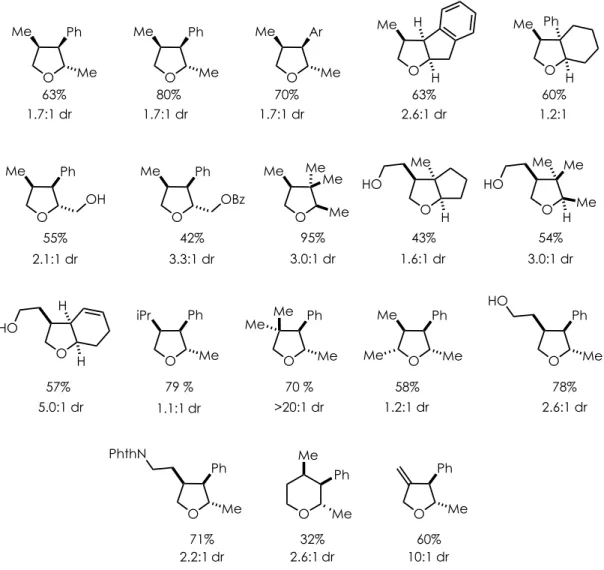
Ultimately, this photoredox system was applied to the synthesis of 18 highly substituted, tetrahydrofuran products beginning from a variety of alkenol and oxidizable alkene coupling partners (Figure 2-2).
Me N Me Me Me N Me Me Me Me * Me N Me Me Me Me NMA NMA* NMA● Ph Me -H+ HAT +e --e -+e --e -+H+ hv Ph Me OH
Ph OH Ph O
Me O Me Ph Me NC CHNH Ph NC CN H Ph
2.1 2.2 2.4 2.5 2.6
Figure 2-2. Tetrahydrofuran Synthesis Substrate Scope
In the following year, Zeller, Riener, and Nicewicz applied a similar photoredox-mediated PRCC to the synthesis of γ-butyrolactones (Scheme 2-11).20 These valuable products
could be accessed from a variety of oxidizable olefins and α,β-unsaturated acids. In this
example, thiophenol (PhSH) ultimately acted as the redox-active H-atom donor, which was also capable of turning over the acridinium photoredox catalyst.
O Me Ph Me O Me Ar Me O O Me O Me Me Ph OH 63% Ph H H H 70% 63% 2.6:1 dr 60% 1.2:1 55% 2.1:1 dr 80%
1.7:1 dr 1.7:1 dr 1.7:1 dr
O Me
42%
O Me
Me MeMe
95% 3.0:1 dr OBz Ph 3.3:1 dr O Me Ph Me O H H HO 57% 5.0:1 dr O Me Me H Me HO O H Me HO 43% 1.6:1 dr 54% 3.0:1 dr O Me Ph O Me O O Me Ph Me Ph O Me Ph Me O Me Ph
iPr Ph HO
Scheme 2-11.γ-Butyrolactones Accessed Through a Photoredox Mediated PRCC
Through the development of multiple photoredox-mediated transformations, our lab has been able to draw critical conclusions regarding the reactivity of the hydrogen atom donor co-catalyst as utilized in the PRCC systems. In order to achieve successful HAT, it is necessary that the redox-active donor meet key requirements including the following:
1) The hydrogen atom donor must possess a bond dissociation energy (BDE) that falls within the range of 70-80 kcal/mol for the X-H bond for the HAT event to occur 2) The resulting radical that forms, upon HAT to the substrate, must be capable of
undergoing single electron reduction to successfully turn over the photoredox catalyst and complete the catalytic cycle
3) The pKa of the hydrogen atom transfer agent must be sufficiently high enough so that it is reformed upon reduction, allowing the donor to be utilized catalytically
Multiple H-atom donors meeting these requirements have been utilized in our PRCC transformations (Figure 2-3). Thiophenol and its derivatives are often relied on as efficient H-atom donors given their sufficient BDE and pKa values. However, diphenyl disulfide21 is
commonly employed as an alternative thiophenol source due to its ease of use, lack of odor, and weak sulfur-sulfur bond (BDE ~50 kcal/mol22).23
DCM [0.15 M], rt, 24 h R1
R2
O R2
R1
O R4
H
HO O
R4 NMA (2.5 mol %) (PhS)2 (15 mol %)
450 nm LEDs
Figure 2-3. Hydrogen Atom Donors and Their Corresponding BDE/pKa Values
Using catalytic quantities of diphenyl disulfide as a hydrogen atom donor, Zeller et al. successfully synthesized over 20 γ-butyrolactones varying both the olefin and α,β-unsaturated
acid coupling partners (Scheme 2-12). In addition to trisubstituted alkenes (2.7), the oxidizable alkene scope included β-methylstyrene (2.8-2.10), as well as its derivatives substituted with both electron-withdrawing (2.11) and moderately electron-donating substituents (2.12-2.13). α -Methylstyrene also proved to be a competent substrate providing the lactone product, containing an all carbon quaternary center, in an 81% yield (2.14). Impressively, it was shown that substituted alkynoic acids could be utilized as coupling partners to provide the corresponding unsaturated lactones in good yield (2.15). This abbreviated exploration of the substrate scope merely touches on the impressive diversity of the transformation, though several reaction conditions were necessary to achieve this variety.
NC CN
H SH SH
O2N
S S
Phenylmalononitrile BDE = 77 kcal/mol
pKa = 4.2 BDE = 79 kcal/molpKa = 6.6 thiophenol
BDE ~ 50 kcal/mol BDE = 81 kcal/mol
pKa = 4.5 BDE = 77 kcal/molpKa = 11.2 SH
MeO
Scheme 2-12. Abbreviated γ-Butyrolactones Substrate Scope
In addition, the value of this system was further demonstrated with the synthesis of two bioactive, α-methylene paraconic acids (Scheme 2-13) known as methylenolactocin (2.16) and
protolichesterinic acid (2.17).
O Me
Ph
O CO2tBu DCM [0.15 M], rt, 24 h
H O Me Ph H Ph O O Me Ph O CO2Et H
2.8
66%, 2.2: 1 dr 74%, 2.3: 1 dr2.9 81%, 4.7: 1 dr2.10 R1 R2 O R2 R1 O R4 H HO O R4
NMA (2.5 mol %)
450 nm LEDs
O Me
O MeO
2.15
73%, 1.2: 1 (Z:E) O
Me
O CO2t-Bu
MeO
O Me
O CO2tBu
Cl H H O Me O CO2tBu H
O
O
O O
H
CO2tBu
Ph Me
2.11
77%, 2.3: 1 dr
2.12
76%, 2.8: 1 dr 65%, 4.3: 1 dr2.13 81%, 1.3: 1 dr2.14 O
Ph
O CO2t-Bu
H
2.7
64%, 5: 1 dr
SiMe3
R3
H R3
1.1 equiv
Scheme 2-13. Synthesis of Methylenolactocin and Protolichesterinic Acid via PRCC
Gesmundo, Grandjean, and Nicewicz accomplished a logical and valuable expansion of this PRCC method to the formation of γ-lactams and pyrrolidines.24 Using a system similar to
those discussed previously, oxidizable olefins were found to couple successfully with unsaturated amides and protected amines to catalytically generate a variety of highly substituted, nitrogen heterocycles in a regioselective manner (Scheme 2-14). In a similar fashion to the previous PRCCs, this system was optimized using β-methylstyrene as the substrate of choice. Beginning with a protected cinnamamide coupling partner (2.18), the authors sought to overcome the major challenge of identifying reaction conditions that favored nucleophilic attack, at the cation radical intermediate, by the nitrogen, rather than the oxygen functionality, to favor lactam (2.19) over imidate (2.20) formation. Upon a closer analysis of amide protecting group identity, it was determined that a lack of protecting group or a labile group, such as a Boc group, led to substrate decomposition and a lack of product formation. However, sulfonyl-protected substrates were found to work efficiently, with more electron deficient groups leading to higher yields and a higher N:O addition ratio, favoring N-addition.
Me
OMe Cl
O
OH
n
NMA (2.5 mol %)
PhS2 (10 mol %)
O O Cl
MeO
n Me
n = 3, 65% n = 11, 69%
2) K2CO3, ET3N, iPrOH
1) RuO4/NaIO4 O
O
n Me
OH O
2.16, n = 3 (±) methylenolactocin
25% yield 2.17, n = 11 (±) protolichesterinic acid
54% yield DCM [0.15], rt, 24 h
450 nm LEDs
Scheme 2-14. Regioselective Synthesis of γ-Lactams Through a PRCC
The alkene scope explored in this system is reflective of those studied in previous PRCC work (Scheme 2-15). A variety of styrenyl (2.21-2.32) and non-styrenyl (2.33-2.35) oxidizable alkenes were demonstrated to work well in the formation of lactam products, displaying good to great regioselectivity and functional group tolerance.
CHCl3 [0.2 M], rt, 24 h
NPhA (5 mol %)
4-MeO-PhSH(20 mol %) 450 nm LEDs 2,6-lutidine (20 mol %)
HN O Ph
PG
N O Me
Ph
O N
Me Ph
PG
N Ph
Me Me
Me
NPhA Ph
Ph
H H
Ph
Me
2.18
2.19 2.20
Scheme 2-15. γ-Lactam Scope N O Tf Me Cl N O Tf Me Ph MeO N O Tf Me Ph Me N O Tf Me Ph Me N O Tf Me Ph Me N O Tf Me Ph MeO N O Tf Ph N O Tf Ph Me N O Tf Me Ph TBSO N O Tf Ph MeO H H
HO N O
Tf Ph MeO
AcO N O
Tf Ph MeO PhthN N O Tf Ph Me Me Me N O Tf Ph Me Me Ph N O Tf Ph Me (1.5 equiv) 2.21
60%, 3.3:1 dr N/O addition: 4:1
2.22
54%, 3.8:1 dr N/O addition: 4.8:1
2.24
66%, 4:1 dr N/O addition: 5.8:1
2.25
65%, 3.5:1 dr N/O addition: 5:1
2.26
62%, 2:1 dr N/O addition: 5.2:1
2.23
65%, 3.6:1 dr N/O addition: 17:1
2.29
62%, 3.4:1 dr N/O addition: 16:1
2.27
60%, 10:1 dr N/O addition: 10:1
2.28
40%, 7:1 dr N/O addition: 9:1
2.30
35%, 6.3:1dr N/O addition: >20:1
2.31
52%, 5:1 dr N/O addition: 3:1
2.32
42% 5.7:1 dr N/O addition: 2.9:1
2.33
35%, 1.7:1 dr N/O addition: 10:1
Ph Me Me Ph HN O Ph Tf N O Me Ph Me 2.34
37%, 2.4:1 dr N/O addition: 7:1
2.35
35%, 6.8:1 dr N/O addition: 11.2:1 CHCl3 [0.2 M], rt, 24 h
NPhA (5 mol %)
4-MeO-PhSH(20 mol %) 450 nm LEDs 2,6-lutidine (20 mol %)
While protected cinnamamide derivatives worked well as an amide substrate (Scheme 2-16, 2.35-2.40), it was determined that β-aryl functionality was not required for the cyclization to occur successfully (2.41-2.44).
Scheme 2-16. Amide Scope for the Synthesis of Highly Substituted Lactams
N O Tf Me Ph Ph HN O R2 Tf N O Tf (1.5 equiv) Me R1
R3 Ph
Me R1 R3 R2 H N O Tf Me Ph N O Tf Ph Me Me 2.36 64%, 3.6:1 dr N/O addition: 5.2:1
2.39 59%, 1.7:1 dr N/O addition: 12:1
2.37 65%, 1.4:1 dr N/O addition: 5.2:1
N O Tf Me
Ph
2.38 55%, 3.1:1 dr N/O addition: 4.5:1
N O Tf Me
Ph
2.41 70%, 4.9:1 dr N/O addition: 9.2:1 F MeO N O Tf Me Ph 2.42 74%, 5.8:1 dr N/O addition: >20:1
Me Me N O Tf Me Ph 2.40 70%, 6.4:1 E/Z N/O addition: 8.1:1
N O Tf Me
Ph
2.44 73%, 8.1:1 E/Z N/O addition: 8.3:1
TIPS N O Tf Me Ph 2.43 52%, 1:1 dr N/O addition: >20:1
Me
Me CHCl3 [0.2 M], rt, 24 h
NPhA (5 mol %)
The disclosed scope for pyrrolidine product formation was limited compared to that of the γ-lactams (Scheme 2-17). Valuable however, was the discovery that the cyclization could be achieved using Boc-protected, unsaturated amines, which could then be easily deprotected upon treatment with TFA to afford the final, highly substituted, heterocycles.
Scheme 2-17. Pyrrolidine Product Scope
Our lab has demonstrated great success in applying PRCC systems to the preparation of highly functionalized tetrahydrofurans, γ-butyrolactones, γ-lactams, and pyrrolidine. Given this
substantial amount of precedent, we believed that it would be possible to develop a similar, mild, and efficient catalytic method, toward the synthesis of valuable and potentially bioactive, α
-R1
HN Ph
Boc R2 NH
(3 equiv)
H NPhDMA (5 mol %)
(PhS)2 (20 mol %) 455 nm LEDs CHCl3 [0.25 M], rt, 24 h 1)
2) TFA (8 equiv)
N H Me Ph Bn N H Me 4-Cl-C6H4 Bn
N H Me 4-Me-C6H4 Bn
N H Bn
2.45
51%, 3:1 dr 38%, 3:1 dr2.46 65%, 3:1 dr2.47 53%, 2.5:1 dr2.48 R2
R1
CH2Cl2 [0.25 M]