ESSAYS ON SELLERS’ INCENTIVE FOR INFORMATION DISCLOSURE
David Seung Huh
A dissertation submitted to the faculty of the University of North Carolina at Chapel Hill in partial fulfillment of the requirements for the degree of Doctor of Philosophy in the
Kenan-Flagler Business School.
Chapel Hill 2016
ABSTRACT
David Seung Huh: Essays on Sellers’ Incentive for Information Disclosure (Under the direction of William P. Putsis)
This dissertation attempts to provide a framework for understanding information
asymmetry in markets by verifying the economic incentives for sellers with low-quality products to fully disclose their types, through analytic models, experimental analysis, and market data analysis. This study achieves this goal by focusing on how risk intermediaries such as third-party certifications can reduce the perceived risk of customers and encourage sellers to voluntarily reveal weaknesses of their products or services.
Essay 1 explains whether, when, and how a seller with a low-quality product can disclose quality information to enhance his profitability and also increase the market demand through an analytic model and lab experiments. Essay 2 confirms the predictions of Essay 1 by verifying the economic incentives to disclose low-quality information from the sales data of various collectible items, and also shows that revealing weaknesses helps sellers more when they are selling
Overall, this dissertation aims to contribute to both academia and industry through presenting an important theoretical basis and empirical evidences regarding various market dilemmas under information asymmetry, as it is one of the first attempts to analyze the economic incentives for sellers with low-quality products to reveal their types and understand how to design an optimal certification system to solve adverse selection issues.
TABLE OF CONTENTS
LIST OF TABLES ... viii
LIST OF FIGURES ... xi
CHAPTER 1. INTRODUCTION ... 1
1.1 Motivation ... 1
1.2 Literature Review... 3
1.2.1 Full Disclosure ... 4
1.2.2 Incomplete Disclosure ... 12
1.2.3 Empirical Findings on Information Disclosure ... 20
1.2.4 Literature on Certification... 25
1.3 Contribution of the Dissertation... 30
1.3.1 Economic Incentive for Disclosing Low Quality ... 30
1.3.2 Impact of Certification on Information Disclosure ... 33
1.4 Dissertation Structure and Preview ... 34
2. ESSAY 1: THE ECONOMIC INCENTIVE FOR LOW-TYPE SELLERS’ INFORMATION DISCLOSURE ... 37
2.1 Introduction ... 37
2.2.1 Risk-Return Framework... 38
2.2.2 The Model ... 41
2.2.3 Application ... 41
2.2.4 Summary ... 51
2.3 Experimental Analysis ... 52
2.3.1 Procedure ... 52
2.3.2 Results ... 55
2.3.3 Alternative Experiment Design ... 65
2.3.4 Conclusion ... 66
2.4 Discussion ... 68
3. ESSAY 2: “TO HIDE, OR NOT TO HIDE—THAT IS THE QUESTION”: SELLERS’ ECONOMIC INCENTIVES FOR FULL VS. FRAUDULENT DISCLOSURE ... 70
3.1 Introduction ... 70
3.1.1 Motivation ... 70
3.1.2 Related Literature... 71
3.2 Data ... 75
3.3 Model ... 77
3.3.1 Variables ... 77
3.3.2 Model Specification ... 83
3.4 Results ... 93
3.4.1 Basic Specification... 93
3.4.2 Alternative Specification ... 111
3.5 Discussion ... 130
4. ESSAY 3: THE EFFECT OF NOISY CERTIFICATION ON INFORMATION DISCLOSURE ... 133
4.1 Introduction ... 133
4.2 Model ... 137
4.2.1 Payoff Structure ... 138
4.2.2 Market Equilibrium ... 140
4.2.3 Predictions... 149
4.3 Experimental Analysis ... 152
4.3.1 Outline... 152
4.3.2 Procedure ... 152
4.3.3 Payoff Calculation ... 155
4.4 Experimental Results ... 155
4.4.1 Seller’s Profit ... 156
4.4.2 Buyer’s Profit ... 166
4.4.3 Level of Information Disclosure ... 169
4.4.4 Other Empirical Findings ... 171
4.4.5 Robustness Check of Previous Models ... 175
4.5 Discussion ... 176
5. CONCLUSION ... 180
LIST OF TABLES
Table 1.1: Literature on Voluntary Disclosure ... 11
Table 1.2: Literature Supporting Mandatory Disclosure ... 17
Table 1.3: Empirical Literature on Information Disclosure... 23
Table 1.4: Literature on Certification ... 28
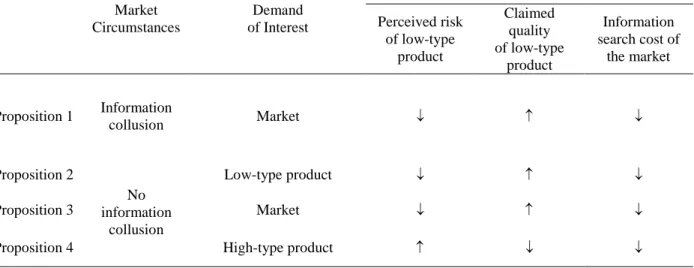
Table 2.1: Predictions on the Sizes of Demand ... 51
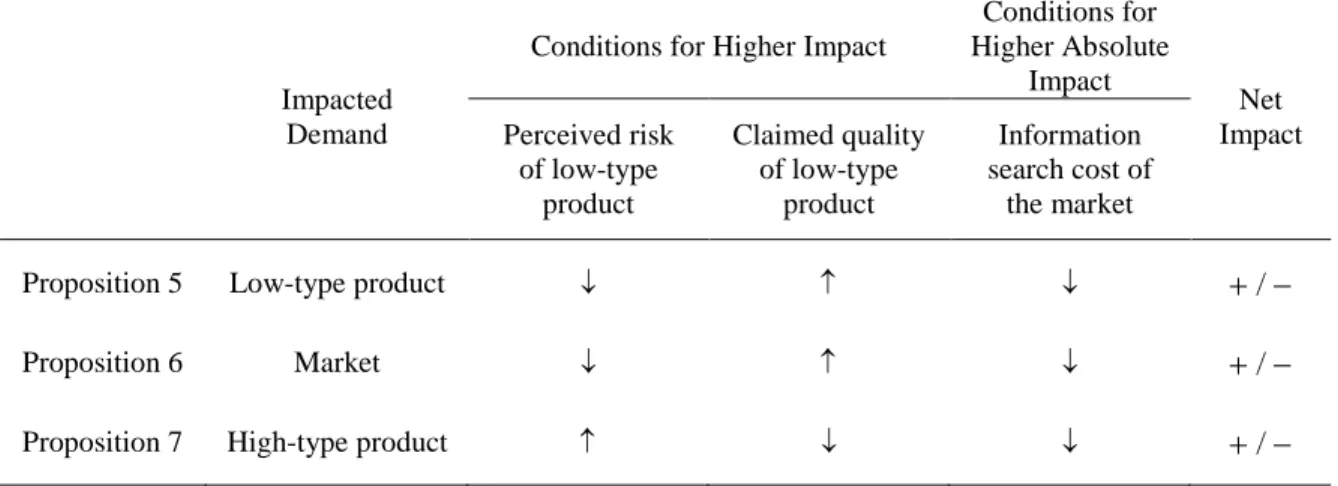
Table 2.2: Predictions on the Impact of a Low-Type Seller’s Information Disclosure ... 52
Table 2.3: 2×2 Experimental Design ... 54
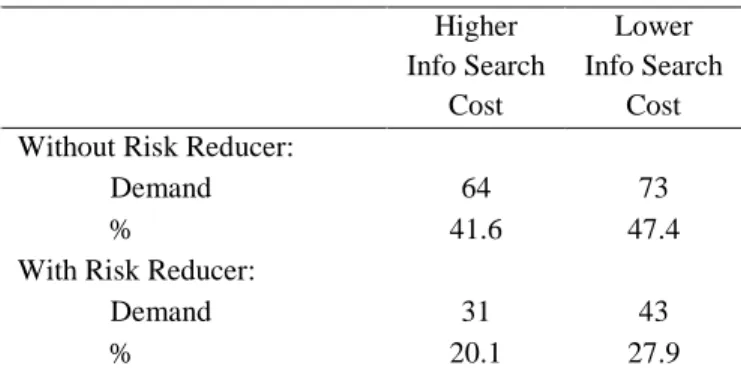
Table 2.4: Observed Market Demand (Information Collusion) ... 56
Table 2.5: Observed Demand of the Low-Type Seller (No Information Collusion) ... 57
Table 2.6: Observed Market Demand (No Information Collusion) ... 58
Table 2.7: Observed Demand of the Seller Claiming High Quality (No Information Collusion) ... 59
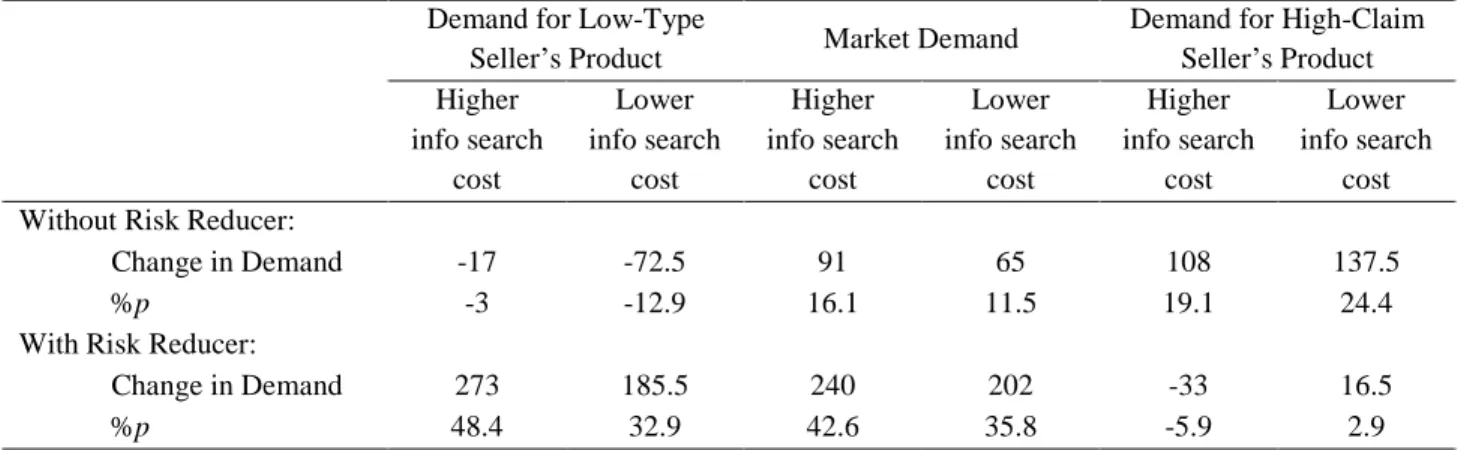
Table 2.8: Observed Change in Demand for the Low-Type Seller with Information Disclosure ... 61
Table 2.9: Observed Change in Market Demand with the Low-Type Seller’s Information Disclosure ... 62
Table 2.10: Observed Change in Demand for the High-Quality Claim Seller with the Low-Type Seller’s Information Disclosure ... 64
Table 2.11: Observed Impact of the Low-Type Seller’s Information Disclosure (Within-Subjects Experiments) ... 65
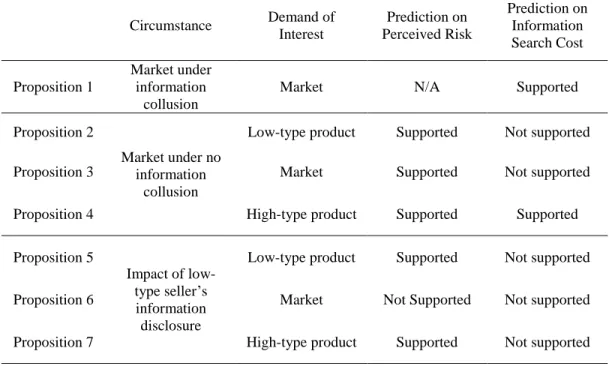
Table 2.12: Summary of the Results of Experimental Analysis ... 67
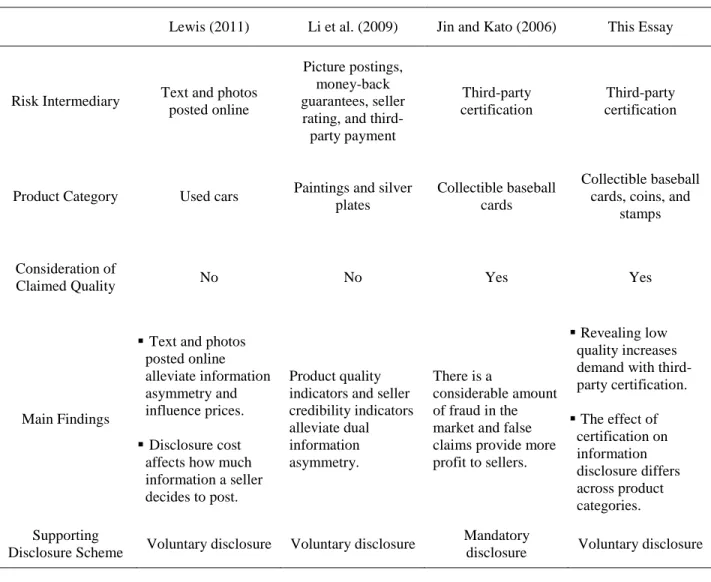
Table 3.1: Comparison of Information Disclosure Literature on Online Auction ... 75
Table 3.2: Summary Statistics: Collectible Baseball Cards... 80
Table 3.4: Summary Statistics: Collectible Stamps ... 82
Table 3.5: Vuong Tests of Zero-Inflated Models vs. Standard Count Models ... 86
Table 3.6: Variance Inflation Factors (Baseball Cards)... 87
Table 3.7: Variance Inflation Factors (Coins) ... 88
Table 3.8: Variance Inflation Factors (Stamps) ... 89
Table 3.9: Model Fit Comparisons ... 91
Table 3.10: Definitions of Variables ... 92
Table 3.11: Estimation Results for Baseball Cards (Basic Specification) ... 94
Table 3.12: Estimation Results for Coins (Basic Specification) ... 97
Table 3.13: Estimation Results for Stamps (Basic Specification) ... 99
Table 3.14: Estimated Demand of Baseball Cards (Basic Specification) ... 105
Table 3.15: Estimated Demand of Coins (Basic Specification) ... 108
Table 3.16: Estimated Demand of Stamps (Basic Specification) ... 110
Table 3.17: Observed Distribution of Risk Propensities of Customers ... 112
Table 3.18: Estimation Results for Baseball Cards (Alternative Specification) ... 115
Table 3.19: Estimation Results for Coins (Alternative Specification) ... 117
Table 3.20: Estimation Results for Stamps (Alternative Specification) ... 119
Table 3.21: Estimated Demand of Baseball Cards (Alternative Specification) ... 123
Table 3.22: Estimated Demand of Coins (Alternative Specification) ... 127
Table 3.23: Effect of Moderator Variables ... 130
Table 4.1: Payoffs for Sellers and Buyers ... 149
Table 4.2: Regression of Seller’s Profit on Certification Types ... 157
Table 4.4: Regression of Purchase Probability on Certification Types ... 159
Table 4.5: Regression of Purchase Probability on Various Factors ... 162
Table 4.6: Regression of Purchase Probability When Certification Is Not Used ... 163
Table 4.7: Regression of Consumer Surplus on Certification Types... 164
Table 4.8: Regression of the Probability of Using Certification on Certification Types ... 165
Table 4.9: Regression of Buyer’s Profit on Certification Types ... 168
Table 4.10: Regression of Buyer’s Profit on Certification Types When Purchased ... 169
Table 4.11: Regression of Dishonesty on Certification Types ... 171
Table 4.12: Regression of Social Welfare on Certification Types ... 173
LIST OF FIGURES
Figure 2.1: Equilibrium of Monopoly Market ... 42
Figure 2.2: Equilibrium of Duopoly Market with Information Collusion ... 44
Figure 2.3: Equilibrium of Duopoly Market Without Information Collusion ... 46
Figure 3.1: Ken Griffey, Jr.’s 1989 Upper Deck Card and 1921 Morgan Silver Dollar ... 77
Figure 3.2: Plotted Demand of Baseball Cards (Basic Specification) ... 104
Figure 3.3: Plotted Demand of Coins (Basic Specification) ... 107
Figure 3.4: Plotted Demand of Stamps (Basic Specification) ... 109
Figure 3.5: Interaction Between Perceived Risk and Claimed Quality ... 113
Figure 3.6: Plotted Demand of Baseball Cards (Alternative Specification) ... 121
Figure 3.7: Plotted Demand of Coins (Alternative Specification) ... 125
Figure 4.1: Game Tree of Market Outcomes when the Certification Is 100 Percent Accurate .. 143
Figure 4.2: Game Tree of Market Outcomes when the Certification Is 50 Percent Accurate .... 147
Figure 4.3: Game Tree of Market Outcomes Without Certification ... 148
Figure 4.4: Average Profit of Sellers Across Three Conditions ... 156
Figure 4.5: Average Profit of Buyers Across Three Conditions ... 167
1. INTRODUCTION
1.1 Motivation
What should sellers do with negative aspects of their products or services that customers cannot easily find out? Conventional wisdom holds that sellers should conceal negative
information as much as possible in order to maximize profit, particularly in markets where the level of information asymmetry is high. In other words, people generally believe that revealing low quality hurts, and thus most sellers try to claim higher than actual quality when possible. For example, when more than 500 new cars in the U.K. market were tested for their fuel figures in 2012, 95.5 percent showed lower miles per gallon (MPG) than officially claimed figures even under manufacturers’ suggested driving conditions.1 In this case, most car manufacturers were found to be concealing the fact that actual MPG figures were smaller than their claims, believing that customers would not be able to fully test MPG figures under proper conditions. Fraud in the olive oil market was also found to be a big issue, as a recent study found that 69 percent of imported olive oils labeled “extra virgin” did not actually meet the standard (Frankel et al. 2010). In this case, sellers were hiding the fact that the actual grades of their olive oils were lower than “extra virgin,” since most customers could not accurately evaluate the grade. Similar examples of incomplete information disclosure under informational asymmetry can be readily observed in many other markets.
What we find interesting is that it is also not uncommon to witness sellers voluntarily disclosing unfavorable information about their products and services. Many online retailers,
including Amazon.com, disclose information about weaknesses of the products they offer through various routes such as customer reviews on their own websites. Woot.com is especially famous for its preemptive revelation of the disadvantages of listed products. On their website they clearly state that they would prefer that customers not buy from them than to have customers regret their purchases.2 Traditional firms also show willingness to communicate weaknesses about their products to customers. In 2012, Four Seasons Hotels renovated their websites and included customer reviews for each of their 80+ properties directly from Twitter, Facebook, and TripAdvisor, without censoring any of the unfavorable comments. Chipotle Mexican Grill's website not only explains positive aspects of their ingredients, but also clearly indicates drawbacks of the ingredients through a “Room for Improvement'” section. Perhaps one of the most successful examples of communicating information about low quality with customers is the case of Hans Brinker Hotel in Amsterdam, the Netherlands. Hans Brinker is famous for its strategy of honestly revealing its low quality to customers, and actively explaining negative aspects of their services such as rooms without a view and no hot water, through pictures and detailed descriptions. Nevertheless, a lot of travelers visiting Amsterdam still choose to stay at this hotel and leave positive reviews.3
As these examples show, some sellers do voluntarily share information about weaknesses of their products or services, thereby raising a question: When and how can sellers benefit from such disclosures? The question is both interesting and important, as some of the decisions to hide unfavorable information in markets often cause various issues to customers, sellers, and the society. However, the incentive for the sellers with low-quality products (“low-type” sellers) to
2 http://www.woot.com/faq?ref=ft\_wiw\_faq (accessed on November 14, 2015). Archived version:
https://archive.is/b9cxI
3 http://abcnews.go.com/Travel/proud-worlds-worst-hotels/story?id=17696356 (accessed on November 14, 2015).
fully disclose quality information has not been investigated much in the literature. This dissertation thus attempts to question this conventional wisdom regarding sellers’ hiding weaknesses and provide more precise understanding about the incentive for low-type sellers to voluntarily reveal their types.
1.2 Literature Review
other words, information asymmetry makes the sellers provide the products with lower than a certain quality level at a given price, causing both the price and the average quality to decline until no trade takes place in the market. He has also applied this adverse selection issue to the insurance market and explained that the average medical conditions of insurance applicants deteriorate as the price increases. In other words, just as the average quality of used cars falls as the price decreases, only those people who are increasingly certain that they need the insurance will insure themselves as the price level rises, and the price eventually reaches the level at which no one would purchase insurances. Through these findings, Akerlof (1970) has shown that information asymmetry in markets will cause adverse selection issues which may eventually harm the entire market structure. He has listed guarantee, brand names, chains, and licensing as possible institutions which will solve adverse selection issues.
Since this seminal work, there have been numerous studies in economics and marketing that have attempted to provide possible solutions to the lemon problems from various
perspectives. These studies have investigated what types of mechanisms are keeping the market system alive, and more specifically, under what circumstances sellers may resolve the problems occurring from information asymmetry in markets.4
1.2.1 Full Disclosure
The series of studies on information disclosure has first shown how verifiable disclosure can solve the adverse selection problems of Akerlof (1970), arguing that full disclosure naturally happens in markets under information asymmetry. The most important findings have come from the seminal studies of the Grossman-Milgrom framework (Grossman and Hart 1980; Grossman 1981; Milgrom 1981), which is also very closely related with this dissertation. The main result of
4 Dranove and Jin (2010) have provided a more detailed literature review on information disclosure and quality
these three studies is that the seller will voluntarily reveal the quality information as long as fraudulent disclosure is prohibited and information disclosure is costless.
First, Grossman and Hart (1980) have provided a theoretical finding that mandatory disclosure is not necessary to solve adverse selection issues as long as making false statements is prohibited. They have analyzed the standard information asymmetry case where sellers know the quality of the product while prospective buyers have no information about the quality, and buyers only know that the sellers have the information about the quality. In particular, there are many buyers and many sellers providing different products, and the price is assumed to follow the quality level where the product with the lowest quality has the lowest price and the product with the highest quality has the highest price. More importantly, the cost of information
disclosure is assumed to be negligible in this case. They have shown that, under these
have relaxed the assumption of negligible disclosure cost and found out that only those sellers with higher than certain quality will fully disclose quality information and none of the bad sellers will pay the cost of information disclosure, as the sellers have to consider the fact that the price they can charge differs according to the true quality of the product. With these findings,
Grossman and Hart (1980) have provided a primary theoretical understanding of full disclosure by showing that the market will always end up with voluntary full disclosure of the quality. More specifically, they have argued that no mandatory disclosure is necessary as hiding information will always be interpreted as having low quality, as long as there is a law against lying. However, their assumption of no lying or negligible disclosure cost is somewhat strong, and the literature on mandatory disclosure, which is examined in a following section, thus argues that a full disclosure is not forthcoming in real markets.
post. However, even in this case, he argues that there should be certain attributes that are observable and related with true quality, and it is thus still possible for sellers to make ex post verifiable statements about the quality. According to his example, a patient may not fully
understand the medical care he receives from a doctor, but he can at least observe the recurrence of an illness after the treatment. Therefore, although it is very costly to communicate the
information about the actual medical treatment to the patient without proper medical knowledge (compared to the situation where a diamond seller shares information about a diamond’s weight), the doctor can still communicate the quality of his service through ex post verifiable patient’s status. He has shown that, even with the non-negligible cost of communicating and verifying true quality, the seller can still make ex post verifiable statement about the quality, and the consumers with rational expectations will thus conclude that the monopolistic seller tries to mislead the customers when he does make less than a full disclosure. Therefore, he has shown that even a monopolistic seller will voluntarily engage in full disclosure either because ex post verification of true quality is not costly for consumers or because there is at least some characteristic of the product which is observable, even when ex post verification of true quality is costly. In other words, he has basically considered the case where the product has certain attributes of which consumers can verify the true quality either directly or indirectly.5 Another important assumption behind his analysis is that he has restricted his attention to truthful disclosure and does not
consider fraudulent disclosure, which is still a strong assumption. These results and assumptions are also consistent with Grossman and Hart (1980).
Third, Milgrom (1981) has explained that full disclosure is forthcoming by observing the incentive for the sellers with high quality product to communicate favorable information. More
5 This can be regarded as the case of search or experience attributes which is explained more in detail later in this
specifically, he has provided a way to model how a signal follows true quality by incorporating a single unknown variable representing “quality” or “intrinsic value” and showing how this
variable influences signaling. The model has explained that even when a party cannot observe the true quality, one can still observe the signals that are influenced by the actual quality levels, thus a full disclosure is naturally forthcoming. He has then applied this model to various different settings and shown how signaling good quality leads to favorable results for the interested party. First, he has analyzed how public announcement of good news about the future returns on a security affects the stock price. In his comparison of the effect from a favorable signal and an unfavorable signal, a favorable signal affects the expected value of random return more
application to different settings, Milgrom (1981) has shown that signaling effectively shows true quality or intrinsic value and thus encourages the interested party to communicate favorable information as much as possible, leading to a full disclosure in markets. Throughout the analysis, he has assumed that lying is impossible either because of the verification or regulations, just like the other studies on full disclosure reviewed above.
In summary, these three seminal studies have provided an important finding that mandatory disclosure is not necessary to solve adverse selection issues, as rationality of consumers or the effectiveness of signaling mechanism encourages the sellers to fully disclose quality information. However, these papers have based their findings on one strong assumption that lying is not possible either because it is prohibited by laws or ex post verification is readily available. Therefore, we believe that one of the potential contributions of this dissertation is relaxing the no-lying assumption and considering the situation where sellers can fraudulently disclose false information. Moreover, while these studies on full disclosure have focused on the incentive for the sellers with high quality products (“high-type” sellers) to engage in a full
disclosure (i.e., the incentive to communicate favorable information), this dissertation attempts to find whether voluntary disclosure can still solve adverse selection issues without the no-lying assumption by analyzing the incentive for the sellers with low-quality products to disclose quality information (i.e., the incentive to communicate unfavorable information). The potential contributions of this dissertation are discussed more in detail in a following section.
that it is impossible for the seller to lie about the quality of his product, not because there is a law against lying but because the sellers worry about future business or litigation. Viscusi (1978) has called it an “unraveling process” when the disclosure of information happens top down, in such a way that full disclosure starts from the player with the highest quality and goes down to players with lower quality until the cost of information disclosure exceeds the benefit. This study has shown that unraveling happens not only in the product market with lemons but also in the labor market with potentially hazardous jobs, as the firms with better job outcomes will first invest in revealing true characteristics. Overall, the studies predicting full disclosure suggest that
11
Table 1.1:Literature on Voluntary Disclosure
Literature Key Findings Assumptions
Grossman and Hart
(1980)
The market will always end up with voluntary full disclosure of the quality
as hiding information will be interpreted as having low quality. If there is
cost for disclosure, then only the sellers with product quality higher than a
certain level will disclose.
Lying is prohibited by law. There is no mandatory disclosure.
The cost of disclosure is either positive or zero.
Grossman (1981)
A monopolistic seller always makes a full disclosure about the quality of
his product, as rational consumers will assume that the seller’s product has
the worst possible quality if he makes less than a full disclosure.
Lying is prohibited.
Customers can verify seller’s statement ex
post.
Disclosure cost is negligible.
Milgrom (1981)
Favorable information works as an effective signaling method which
communicates true quality information. This favorable effect is shown in
four different situations: a share price, an agent’s bonus, a buyer’s
expectation about products, and a bidder’s expectation in a sealed-bid
auction. Sellers are thus willing to commit to a full disclosure.
Lying is prohibited by law. There is no cost of disclosure.
Jovanovic (1982)
More than the optimal amount of disclosure will happen in the market
when there is disclosure cost, and thus the government should encourage
sales without disclosure.
It is impossible for the seller to lie about the
quality of his product, not because there is a
law against lying but because the sellers worry
about future business or litigation.
Viscusi (1978)
The disclosure of information happens top down in an “unraveling
process”, in such a way that full disclosure starts from the player with the
highest quality and goes down to players with lower quality until the cost
of information disclosure exceed the benefit. The unraveling also happens
in the labor market with potentially hazardous jobs.
There is no lying.
1.2.2 Incomplete Disclosure
Although the studies reviewed above have claimed that sellers will voluntarily commit to full disclosure, there is also a substantial literature that finds evidence that disclosure cannot be complete if it is not mandatory. These studies have listed various market factors such as
disclosure costs, cost of acquiring quality information, customer’s misunderstanding of seller’s disclosure, customer’s ignorance, and market structure as possible reasons why voluntary disclosure is not sufficient to solve adverse selection problems.
Disclosure cost.Basically, the Grossman-Milgrom framework (Grossman and Hart 1980;
Grossman 1981; Milgrom 1981) reviewed above has claimed that the firms will follow full disclosure if the disclosure cost is negligible, implying that full disclosure is not possible with a certain level of disclosure cost as only the sellers with product quality higher than a certain level will disclose. Verrecchia (1983) has argued that the disclosure cost provides noise in interpreting firm’s disclosure effort. More specifically, when there is disclosure cost and certain information is withheld, the observers are unsure whether the information is bad or just not as good for the seller to incur disclosure costs. Therefore, there exists an equilibrium threshold level of disclosure. Although Viscusi (1978) has explained how unraveling happens and most firms disclose, the paper also explained that if disclosure is costly, then only sellers with quality higher than a threshold level will disclose relevant information.
Market structure.Board (2009) has considered the competition in the market to explain
the failure of full disclosure. This paper has shown that a firm may not disclose information in a competitive environment, as disclosing information may lead to stronger competition. Therefore, when one high-quality firm discloses, other firms should compare the cost of increased
disclose. This paper thus has argued that it is possible that only high-quality firms choose to disclose, suggesting the need for mandatory disclosure. Cheong and Kim (2004) have argued that no firm will disclose information as the number of competing firms becomes infinity and the market is almost perfectly competitive, since the difference in the quality across different products becomes less evident. In other words, as there are more firms in the market, the benefit from information disclosure gets smaller due to price competition. Guo and Zhao (2009) have added another perspective to the consideration of the competition in understanding information disclosure by examining the sequential disclosing behavior in a duopoly setting. They have found that the leader reveals less information under sequential disclosure case than under simultaneous disclosure situation, while the follower may reveal more or less information
depending on the disclosure cost. Hotz and Xiao (2013) have focused on the heterogeneity in the market in terms of product attributes and customer preferences. They have shown that neither high-types nor low-types would disclose information, as more information results in more elastic demand, which in turn leads to increased price competition among the firms. Therefore, they suggest that government intervention or mandatory disclosure may benefit customers in the market.
because sellers are willing to reveal information and make competitors look worse in this condition.
Ignorance.Fishman and Hagerty (2003) have questioned the assumption that all
customers understand the seller’s disclosure and analyzed the case where only some customers understand it. They have found that voluntary disclosure is not forthcoming when the ratio of customers who understand the disclosure is low, and mandatory disclosure is thus necessary for the markets where the product information is difficult for customers to fully understand.
Cognitive errors.On the other hand, Hirshleifer, Lim, and Teoh (2004) have focused on
the observer’s limited attention and cognitive processing power. Therefore, instead of the assumption that people cannot understand the disclosed information, they have assumed that people neglect either the signal or the implications of non-disclosure, which has resulted in less than full information disclosure and excessive amount of optimism about the quality. Schwartz (2008) has come up with similar findings focusing on the cognitive errors of customers, in that some customers are more naïve and prone to err than others. Therefore, the naïveté of customers discourages the firms from disclosing relevant information, and the likelihood of socially
desirable disclosure increases with the number of sophisticated customers in the market.
Customer’s confusion. Focusing on the case of eco-labels, Harbaugh, Maxwell, and
Cost of quality assessment.Both Matthews and Postlewaite (1985) and Shavell (1994) have provided an interesting finding by considering the case of sellers having to incur costs to test their own products and acquire quality information. These studies have found that even certain imperfect mandatory disclosure laws can actually reduce the amount of information disclosed by the firm, as the firms do not invest in obtaining quality information because they worry that negative information might be revealed. For example, a car manufacturer may not invest in the research to find potential defects if they have to disclose all of their findings.
Seller’s risk averseness.Milgrom and Roberts (1986) have indicated the seller’s concern
of affecting customer’s knowledge of quality distribution as the reason for why voluntary disclosure is not happening. According to their explanation, sellers do not always know what information is favorable, and they worry that any information revealed will downgrade all possible alternatives in the market as customers become more skeptical. For this reason, firms may be reluctant to disclose any kinds of information.
Reputation of reticence.Grubb (2011) has focused on the dynamic context and provided
an interesting explanation about why some sellers try to conceal even favorable information. Sellers may try to get the reputation of reticence, withholding some good information either to improve the credibility of prior nondisclosures or to make the customers less skeptical of future nondisclosures.
Seller capacity.Gavazza and Lizzeri (2007) have focused on the public sector settings
of the incentives facing the bureaucrats and claimed that this may also be applied to some private sectors where prices do not fully adjust.
Strategic decision on multi-dimensional product.Bar-Isaac, Caruana, and Cuñat (2012)
have examined the monopolistic market where a seller sells a good with two characteristics and found the following: When there is an exogenous change in the cost of information gathering and the relevant information becomes easier to obtain, that change may affect customer welfare negatively. If an intermediary appears to reduce risk on one characteristic, it affects the firm’s investment in such a way that it only improves the dimension that it has to disclose the
information about, and reduces investment on the other dimension, thereby hurting some
customers’ welfare. Therefore, even a standard mandatory disclosure may not solve this problem unless the relevant policy considers this multi-dimensional aspect of the product and firm’s strategic considerations.
17
Table 1.2:Literature Supporting Mandatory Disclosure
Literature Key Findings Reason for Failed Disclosure
Verrecchia (1983) The disclosure cost provides noise in interpreting a firm’s disclosure effort and creates an equilibrium threshold level of disclosure.
Disclosure cost
Viscusi (1978) If disclosure is costly, then only sellers with quality higher than a threshold level will disclose relevant information.
Board (2009)
A firm may not disclose information in a competitive environment, as disclosing
information may lead to stronger competition. Therefore, it is possible that only
high-quality firms choose to disclose.
Market structure
(Competitive environment) Cheong and Kim
(2004)
No firm will disclose information as the number of competing firms becomes infinity and
the market is almost perfectly competitive, since the difference in the quality across
different products becomes less evident.
Guo and Zhao (2009)
In a duopoly setting, the leader reveals less information under sequential disclosure case
than under simultaneous disclosure situation, while the follower may reveal more or less
information depending on the disclosure cost.
Hotz and Xiao (2013)
Neither high-type nor low-type would disclose information, as more information results in
more elastic demand, which leads to increased price competition among the firms.
Therefore, a government intervention or mandatory disclosure may benefit customers in the
market.
Stivers (2004)
When customers do not know that the quality information is commonly available among
sellers, increased number of sellers and stronger competition will lead to more information
disclosure because sellers are willing to reveal information and make competitors look
18
Table 1.2:Literature Supporting Mandatory Disclosure (Continued)
Literature Key Findings Reason for Failed Disclosure
Fishman and Hagerty
(2003)
Voluntary disclosure is not forthcoming when the ratio of customers who understand the
disclosure is low, and mandatory disclosure is thus necessary for markets where the
product information is difficult for customers to fully understand.
Ignorance
Hirshleifer et al. (2004)
When customers have limited attention and cognitive processing power and thus either
ignore the signal or the implications of non-disclosure, there is less than full information
disclosure and an excessive amount of optimism about the quality.
Cognitive errors
Schwartz (2008)
The naïveté of customers discourages the firms from disclosing relevant information, and
the likelihood of socially desirable disclosure increases with the number of sophisticated
customers in the market.
Harbaugh, Maxwell,
and Roussillon (2011)
Consumer confusion is aggravated when the ecolabel is used by a product with bad
reputation, when there is proliferation of the label, and when the firms strategically uses
it based on the customer doubt. According to this finding, mandatory labeling may be
one way to reduce the confusion and solve disclosure issues.
19
Table 1.2:Literature Supporting Mandatory Disclosure (Continued)
Literature Key Findings Reason for Failed Disclosure
Matthews and
Postlewaite (1985);
Shavell (1994)
Imperfect mandatory disclosure law can reduce the amount of information disclosed by firms, as
the firms do not invest on obtaining quality information out of concern that negative information
might be revealed.
Cost of quality
assessment
Milgrom and Roberts
(1986)
Sellers do not always know what information is favorable, and they worry that any information
revealed will downgrade all possible alternatives in the market as customers become more
skeptical.
Seller’s risk averseness
Grubb (2011)
Sellers may try to get the reputation of reticence, withholding some good information either to
improve the credibility of prior nondisclosures or to make the customers less skeptical of future
nondisclosures.
Reputation of reticence
Gavazza and Lizzeri
(2007)
High-quality public sector service provider may be reluctant to disclose quality information as it
can lead to increased demand for their services and cause capacity issues. Seller capacity
Bar-Isaac, Caruana,
and Cuñat (2012)
If an intermediary appears to reduce risk on one characteristic, it affects the firm’s investment in
such a way that it only improves the dimension that it has to disclose the information about, and
reduces investment on the other dimension, thereby hurting some customers’ welfare.
Strategic decision on
multi-dimensional
1.2.3 Empirical Findings on Information Disclosure
The literature on information disclosure is more focused on theoretical analysis, as is shown in the reviews above, and the number of empirical studies is relatively small. Most of these empirical studies on information disclosure have claimed that mandatory disclosure is necessary to solve adverse selection issues of Akerlof (1970), while some studies have shown how voluntary disclosure can be an effective solution for information asymmetry in market.
Need for mandatory disclosure.Mathios (2000) has examined the information disclosure
done an interesting natural experiment by comparing health inspection scores, consumer demands, and the number of foodborne illness hospitalizations before and after Los Angeles County forced restaurants to display hygiene quality grade cards. They have found a lot of evidence of positive impact of mandatory disclosure, such as increased health inspection scores and decreased hospitalizations due to foodborne illness. Bennear and Olmstead (2008) have also found similar positive effects of mandatory disclosure. They have studied how 517 drinking water suppliers in Massachusetts provide customers with the information about the quality of drinking water they purchase and found that the suppliers who serve more than 10,000 customers and thus are mandated to directly mail the reports had significantly lower violations of drinking water standards, and also reduced health violations by 40 to 57 percent. Xiao (2010) has
investigated the effect of quality accreditation in the childcare market through a structural model of demand allowing consumers to gather quality information from both accreditation status and firm reputation. The result has shown that consumers do not get meaningful information out of accreditation status considering the effect of reputation, and its contribution to consumer welfare is merely 2 percent, suggesting overall ineffectiveness of the accreditation mechanism.
Jin and Kato (2006) have shown evidences that voluntary disclosure may not work in an online setting, and is very closely related with the Essay 2 of this dissertation. By analyzing sales data of collectible baseball cards from eBay and also purchasing and observing the actual
products, they have found that while higher-quality claim cards yield price premium, the average quality from high-claim cards is indistinguishable from cards with more modest claims, and reputable sellers do not provide better-quality products either. These results have shown that there is actually a considerable amount of fraud in this online market under information
selection issues in this marketplace. In particular, this study has some similarities with Essay 2 of this dissertation, as both use the data from same product category and investigate the relationship between claimed quality and information disclosure. However, the focus and findings are
different, as Jin and Kato (2006) basically show how low-type sellers fraudulently claim higher quality (i.e., conceal their types) and achieve higher profit, while Essay 2 explains how low-type sellers fully disclose quality information and increase profit. More detailed discussion on the comparisons between these papers is followed in a later section.
Support for voluntary disclosure.Lewis (2011) has examined the effect of online
information disclosure through observing nearly 50,000 car transactions on eBay Motors. The study found that text and photos posted online work as enforceable contract and thus alleviate information asymmetry, strongly influencing prices. It has also found that disclosure cost affects how much information a seller decides to post. Li, Srinivasan, and Sun (2009) have investigated how product quality indicators such as picture postings and money-back guarantees and seller credibility indicators such as seller rating and third-party payment alleviate dual information asymmetry (uncertainty about product quality and seller credibility) in an auction setting by observing eBay’s paintings and silver plates market. They have found that those indicators encourage bidder participation, and the effect is even stronger when both types of indicators are used simultaneously.
Overall, while most of the empirical findings have argued that mandatory disclosure is necessary, some other studies have shown that voluntary disclosure may help alleviate
23
Table 1.3:Empirical Literature on Information Disclosure
Literature Key Findings Context Support for Mandatory
Disclosure
Mathios (2000)
While all of the sellers of low-fat dressings voluntarily disclosed fat content information, only 9%
of the sellers of high-fat dressings did so without mandatory disclosure. Therefore, mandatory
disclosure of relevant product information will have positive impact on consumer behavior and
health.
Salad dressings Yes
Edelman (2009)
TRUSTe-certified websites are actually more than twice as likely to be untrustworthy as
uncertified sites. This happens because a trust authority currently benefits from that error and thus
ignores it.
Internet websites Yes
Jin (2005) Health maintenance organizations (HMOs) use information disclosure as a means to differentiate
themselves and disclosure propensity declines with the degree of competition. Healthcare service Yes
Jin and Leslie
(2003)
After Los Angeles County forced restaurants to display hygiene quality grade cards, a lot of
evidence of positive impact of mandatory disclosure have been observed, such as increased health
inspection scores and decreased hospitalizations due to foodborne illness.
Restaurants Yes
Bennear and
Olmstead (2008)
The drinking water suppliers who serve more than 10,000 customers and thus are mandated to
directly mail the reports had significantly lower violations of drinking water standards, and also
reduced health violations by 40–57%.
24
Table 1.3:Empirical Literature on Information Disclosure (Continued)
Literature Key Findings Context Support for Mandatory
Disclosure
Jin and Kato (2006)
There is a considerable amount of fraud in the online collectible goods market under information
asymmetry, and the information disclosure mechanisms do not work properly to prevent adverse
selection issues in this market.
Collectible goods
(Online) Yes
Xiao (2010)
Consumers do not get meaningful information out of accreditation status considering the effect of
reputation, and its contribution on consumer welfare is merely 2%, suggesting overall
ineffectiveness of the accreditation mechanism.
Childcare service Yes
Lewis (2011)
In an online car market, text and photos posted online work as enforceable contract and thus
alleviate information asymmetry, strongly influencing prices. Disclosure cost affects how much
information a seller decides to post.
Used cars (Online) No
Li, Srinivasan, and
Sun (2009)
In eBay’s paintings and silver plates market, product quality indicators such as picture postings
and money-back guarantees and seller credibility indicators such as seller rating and third-party
payment alleviate dual information asymmetry (uncertainty about product quality and seller
credibility).
1.2.4 Literature on Certification
The literature has indicated that the consequence of information disclosure depends mostly on the effectiveness of signaling methods employed by sellers. Among various signaling methods, information disclosure literature has focused on the effect of third-party certifications, as reputation is not easy to establish in the short run, a seller’s own signaling is generally not trustworthy, and warranty is usually not appropriate for credence attributes that customers cannot evaluate. Some studies on certification have empirically checked the effectiveness of
certification and focused on whether it solves adverse selection issues in a market or not, and some other studies have explained what makes the mechanism work poorly.
The effect of certification.Anderson, Daly, and Johnson (1999) have investigated 514
publicly held firms that obtained ISO 9000 certificates and found that the firms used the
certificates in order to send a credible public signal about their quality management practices and not simply sought to meet some regulatory standards, which is contrary to the views of critics of ISO 9000. Therefore, this study has shown that certification works as an effective risk
intermediary. On the other hand, Xiao (2010), as reviewed above, has shown that the effect of accreditation in the childcare market is not significant, by observing that consumers do not get meaningful information out of accreditation and its contribution on consumer welfare is merely 2 percent.
The bias of certifiers.Feinstein (1989) has investigated the result of more than 1,000
Nuclear Regulatory Commission (NRC) inspections of nuclear power plants over three years and found that NRC inspectors’ rates of detecting violations differ significantly. Interestingly,
at the power plants, indicating that the biased certification system caused by incompetent certifiers may harm the entire system. As is explained above, Edelman (2009) has observed the trust certifications of Internet websites and shown that TRUSTe-certified websites are actually more untrustworthy than uncertified sites because a trust authority benefits from that error and ignores it. Prendergast (2007) has explained that some government certifiers show bureaucratic bias depending on whether they advocate for the clients or the principal.
The analysis of third-party certifiers in the finance industry has also shown interesting findings. By analyzing the career concerns of security analysts, Hong and Kubik (2003) have found that optimism helped the analysts covering stocks underwritten by their houses more than accuracy did. The analysts who issue more optimistic forecasts on the stocks are 38 percent less likely to move down the hierarchy and 90 percent more likely to move up. This suggests that analysts who care about their careers may have some positive bias on their forecasts. On the other hand, Lim (2001) has argued that the reason financial analysts make optimistic and inaccurate forecasts is that they try to obtain management access and improve their overall forecast precision. He has also provided empirical evidence supporting this argument by
examining forecasts of quarterly earnings reported by analysts at more than 300 brokerage firms. This has suggested that the positive bias actually comes from the analysts’ rational and strategic consideration to improve their overall performances. Michaely and Womack (1999) have shown that “buy” recommendations by affiliated underwriters are biased and thus inferior to the
recommendations by unaffiliated, non-underwriters because of the investment bank’s
A similar conflict of interest can be found in Waguespack and Sorenson (2011) in a different industry. They have found that the Motion Picture Association of America (MPAA)’s parental guidance classification of movies is biased in that movies distributed by its own
members or created by more influential producers or directors are classified more leniently than others. This again suggests that conflict of interest may bias the third-party certification
mechanism, leading to negative impact on the public, and in particular in this case, on independent movie distributors or producers.
Other reasons of certification ineffectiveness.Other than the certifier’s own concern, the
literature has listed customer-side issues and market structure as reasons why certification is not effective. As reviewed above, Harbaugh et al. (2011) have shown that consumer confusion is exacerbated when the certification is used by a product with a bad reputation, when there is proliferation of the label, and when the firm strategically uses it based on the customer doubt, leading to a less trustworthy certification mechanism. Lizzeri (1999) has explained that the competitive environment for risk intermediary impacts the quality of certification. Its analytic model has shown that a monopoly certifier would only disclose whether the quality is above certain standard, while competition encourages full disclosure.
Overall, the literature on certification has explained that many factors related with certifier, customer, and market structure can impact the effectiveness of a certification
28
Table 1.4:Literature on Certification
Literature Key Findings Context Subject
Anderson et al.
(1999)
The firms have used the certificates in order to send a credible public signal about their quality
management practices and not simply sought to meet some regulatory standards, which is
contrary to the views of critics of ISO 9000.
ISO 9000 certificates Certification effectiveness
Xiao (2010) Consumers do not get meaningful information out of accreditation and its contribution to
consumer welfare is merely 2%. Childcare service
Certification
ineffectiveness
Feinstein (1989)
The Nuclear Regulatory Commission (NRC) inspectors’ rates of detecting violations differ
significantly. Interestingly, detection rates increased abruptly after Three Mile Island incident in
1979. These undetected violations had a significant impact on the number of abnormal
occurrences at the power plants, indicating that the biased certification system caused by
incompetent certifiers may harm the entire system.
Nuclear power plants
Bias of certifier Edelman (2009) TRUSTe-certified websites are actually more untrustworthy than uncertified sites because a
trust authority benefits from that error and ignores it. Internet websites
Prendergast (2007) Some government certifiers show bureaucratic bias depending on whether they advocate the
29
Table 1.4:Literature on Certification (Continued)
Literature Key Findings Context Topic
Hong and Kubik
(2003)
The analysts who issue more optimistic forecasts on the stocks are 38% less likely to move
down the hierarchy and 90% more likely to move up. This suggests that analysts who care
about their careers may have some positive bias on their forecasts.
Financial advisory
service
Bias of certifier Lim (2001)
The reason financial analysts make optimistic and inaccurate forecasts is that they try to
obtain management access and improve their overall forecast precision. This suggests that the
positive bias actually comes from the analysts’ rational and strategic consideration to improve
their overall performance.
Financial advisory
service
Michaely and
Womack (1999)
“Buy” recommendations by affiliated underwriters are biased and thus inferior to the
recommendations by unaffiliated, non-underwriters because of the investment bank’s
relationship with the IPO firm, thus making suboptimal effects to the public.
Financial advisory
service
Waguespack and
Sorenson (2011)
The Motion Picture Association of America (MPAA)’s parental guidance classification of
movies is biased in that the movies distributed by its own members or created by more
influential producers or directors are classified more leniently than others.
Movie rating
Harbaugh et al.
(2011)
The consumer confusion is exacerbated when the certification is used by a product with bad
reputation, when there is proliferation of the label, and when the firm strategically uses it
based on the customer doubt, leading to less trustworthy certification mechanism.
Theoretical Consumer confusion
Lizzeri (1999)
The competitive environment for risk intermediary impacts the quality of certification. Its
analytic model has shown that a monopoly certifier would only disclose whether the quality is
above certain standard, while competition encourages full disclosure.
1.3 Contribution of the Dissertation
1.3.1 Economic Incentive for Disclosing Low Quality
As is explained above, the literature has provided diverse understanding regarding how information disclosure may or may not solve the adverse selection issues in markets. This essay attempts to provide another perspective to the literature that has not been considered but is very important in understanding information asymmetry in markets. More specifically, this
dissertation investigates the economic incentive for sellers with low-quality products to voluntarily disclose quality information.
The inclination of low-type sellers to conceal quality information has been regarded as one of the fundamental reasons why full disclosure is not forthcoming in reality. As is explained above, the literature supporting mandatory disclosure has argued that full disclosure does not happen because low-types try to withhold quality information under various circumstances, such as high disclosure cost (Verrecchia 1983; Viscusi 1978), highly competitive environment (Board 2009; Cheong and Kim 2004; Guo and Zhao 2009; Hotz and Xiao 2013; Stivers 2004), irrational customers (Fishman and Hagerty 2003; Harbaugh, Maxwell, and Roussillon 2011; Hirshleifer, Lim, and Teoh 2004; Schwartz 2008), and others (Bar-Isaac, Caruana, and Cuñat 2012; Gavazza and Lizzeri 2007; Grubb 2011; Matthews and Postlewaite 1985; Milgrom and Roberts 1986).
lower valuation than no disclosure. Akerlof (1976) has shown how more talented workers try to work faster than the socially optimal pace to differentiate themselves from less talented workers. Milgrom and Weber (1982) have developed a model of competitive bidding in an auction setting and shown that although more information improves revenues on average and thus disclosure generally helps, unfavorable news will decrease revenues below a non-disclosure situation.
Moreover, the findings from the literature on voluntary disclosure are somewhat limited in explaining what happens in real markets, as they have basically assumed that lying is
and even under repeated-purchase situations where reputation matters, it seems that many sellers are actually myopic and do overstate their product qualities possibly because they only care about short-term profit. Moreover, the regulatory mechanism to prevent deceit of sellers may not work well either, as we can still observe numerous cases of seller-side frauds, including the examples shown at the beginning of this dissertation. Sellers’ fraud has also been verified by the empirical investigation of Jin and Kato (2006), who have observed a considerable amount of fraud in the market for collectible baseball cards. Accordingly, if low-type sellers fraudulently mislead customers, then the no-lying assumption is hard-pressed to withstand the challenges from reality and the argument of full disclosure thus becomes invalid.
cases, such as when the product has low awareness or there is a separate market for the customers who prefer low-quality products, a more universal explanation on the incentive for low-type sellers to voluntarily disclose unfavorable information in markets is still lacking.
Facing these gaps in the literature, this study attempts to provide a different framework for understanding information asymmetry in markets through verifying the economic incentives for low-type sellers to fully disclose their types. We especially believe that an important missing piece in the stream of related research is the understanding of the effect of customer’s perceived risk of purchase since newly revealed information, either positive or negative, is expected to influence the perceived risk of a customer and affect customer’s purchasing decisions. As we focus on the effect of perceived risk on purchase, we also consider the role of risk intermediaries, such as third-party certification, that can affect the perceived risk of purchase. Moreover, we investigate the effect of the risk propensities of customers, as some customers are more sensitive to risk from purchase than others. We believe the findings from this study can be generally applied to most market situations where sellers have to deal with the information about their weaknesses, and thus provide better advice on the need for mandatory vs. voluntary disclosure and how to solve adverse selection issues in the market for lemons (Akerlof 1970).
1.3.2 Impact of Certification on Information Disclosure
2011), consumer confusion (Harbaugh, Maxwell, and Roussillon 2011), and the competitive environment (Lizzeri 1999) as reasons why certification does not function effectively. However, there has not been sufficient understanding regarding how specific types of certification impact market outcomes, and the optimal design of the certification that accomplishes full disclosure. Therefore, after investigating how low-type sellers can benefit from information disclosure through information intermediary such as certification, this study investigates how the noise of certification affects seller and customer decisions under information asymmetry, with the
intention of providing guidance on the design of effective certification mechanism. Once we can figure out both the incentive for low-type sellers to disclose their types and the optimal design of certification for full disclosure, then we may find whether mandatory disclosure or government intervention is necessary to solve adverse selection problems.
1.4 Dissertation Structure and Preview
This dissertation pursues this research object theoretically, experimentally, and empirically. In Essay 1, we attempt to provide a new theoretical understanding about the
and comparing the sizes of economic incentives to disclose vs. conceal low-quality information. This essay also relaxes the original assumption of uniform distribution of customers’ risk sensitivity and shows that voluntarily revealing weakness is more effective when selling higher-than-average-quality products than when selling lower-higher-than-average-quality products. One more interesting finding from this essay is that the incentive for full disclosure and the effect of certification differ across different markets, which provides a motivation for the next essay. Based on this observation, Essay 3 attempts to assess the effect of certifications of varying qualities on various market outcomes such as seller profit, buyer profit, and the level of
information disclosure. Through the analytic model and economic experiments, this essay finds that an inaccurate certification is even worse than having no certification for sellers, as it provides the lowest profit, but it helps buyers through increasing their profits as sellers disclose more information than when there is no certification, even though the certification is inaccurate. By analyzing various drivers of seller and buyer profit under information asymmetry, this essay also suggests that using certification and disclosing information is generally the best method to increase profit for sellers under information asymmetry. Therefore, the result of Essay 3 is consistent with the findings from previous essays that the certification provides economic incentives for sellers to fully disclose and increases social welfare, and that the economic incentive for information disclosure differs across different product categories.
Overall, this study has important implications, ranging from the analysis of “lemons” markets to regulatory policies about market frauds, as this is one of the first attempts to
2. ESSAY 1: THE ECONOMIC INCENTIVE FOR LOW-TYPE SELLERS’ INFORMATION DISCLOSURE
2.1 Introduction
As explained in the previous chapter, this essay attempts to provide a theoretical
framework for understanding sellers’ disclosure of quality information to customers. In particular, we are interested in whether, when, and how sellers of low-quality products disclose quality information. In order to do that, this essay focuses on the effect of the customer’s perceived risk of purchase, as newly shared information influences the perceived risk of a customer and affects her purchasing decisions. Therefore, the concepts of perceived risk of purchase and search, experience, and credence attributes, which are discussed more in detail in a following section, play key roles in developing the theories and analytic models of this essay.
Ever since Bauer (1960) first identified the concept of risk as a major influence on
acquisition affects a customer’s purchase decision process have been explained in various studies (Murray 1991; Putsis, Jr. and Srinivasan 1994; Srinivasan and Ratchford 1991; Zeithaml 1981).
In this essay, we examine the impact of the low-quality seller’s information disclosure through an analytic model that investigates the tradeoff between expected benefit and perceived risk from purchase. The model observes a duopoly situation where there is one seller who always claims high quality and another seller with low-quality products who claims either high quality (incomplete disclosure) or low quality (full disclosure). This allows us to analyze the impact when a low-type seller shares his quality information and reveals his type. Moreover, we assume the sellers are myopic and base all of the analyses on a non-repeating, one-time purchase
situation in order to eliminate the effect of reputation motive. We also assume that price is fixed because we observe only one stage and want to focus on the factors of interest of this essay such as perceived risk and claimed quality level. We relax the assumption of fixed price in Essay 3.
2.2 Analytic Model
2.2.1 Risk-Return Framework
For the analytic model, we adopt the concept of perceived risk from marketing literature and use the risk-return framework (Sarin and Weber 1993; Weber, Blais, and Betz 2002), where the impacts of both the expected benefit and perceived risk on customer’s utility are considered, and in particular, where perceived risk is treated as a separate variable. The utility function when a buyer i purchases a product j has the following elements.
2.2.1.1 Claimed Quality and Price
2.2.1.2 Perceived Risk
The perceived risk of purchase also affects the utility level of this buyer, as he or she will prefer the product with less perceived risk. Applying the definition of perceived risk explained above, perceived risk is represented here as the function of the probability of loss and the size of loss from purchase, i.e., the expected loss from the purchase. We assume that the buyer worries about possible purchase failure of product j, which will cost (cost of purchase failure). Therefore, represents the perceived risk in this case.
We have also defined as the probability of purchase failure of product j ( , and the total perceived risk from the purchase can be represented as .
Moreover, when the probability of purchase failure is , then the probability that the actual quality of product j equals the claimed quality is . Therefore, the expected value of the claimed quality can be denoted as .
2.2.1.3 Risk Sensitivity
2.2.1.4 Information Search Cost
Our model has also included an element that represents information search cost. More specifically, is defined as the information search cost for the product j. As is explained above, to reduce the perceived risk before purchase, customers usually try to decrease the probability of loss rather than the size of loss (Cox 1967; Markin, Jr. 1974; Peter and Ryan 1976; Ross 1975), and information search is an often-used risk-reduction method as the probability of loss
diminishes with more information. Therefore, we also examine the effect of information search cost on the information disclosure of sellers.
More specifically, we employ the framework of search, experience, and credence attributes, which has been introduced by Nelson (1970) and Darby and Karni (1973), who have used information search cost to distinguish product attributes. According to Nelson (1974), a customer can determine search attributes prior to purchase but cannot determine experience attributes prior to purchase. Darby and Karni (1973) have also contributed to this approach and referred to those attributes that cannot be evaluated even after purchase as “credence attributes.” Therefore, we regard the search cost related to credence attributes to be almost infinite
( , because, by definition, customers can never find out the information about
2.2.2 The Model
Based on this framework, we present the utility function when a buyer i purchases a product j as follows:
As explained, the probability of purchase failure of the product ( ), the claimed quality of the product ( ), the price of the product ( ), the risk sensitivity of the customer ( ), the information search cost related with the product ( ), and the cost of purchase failure ( ) determine the utility from purchase. In particular, the same level of perceived risk ( ) has higher negative impact with higher risk sensitivity of the customer (higher ) or higher
information search cost in the market (higher ).
We first apply this utility function to a simple monopoly case and then analyze a duopoly situation to understand the incentive for low-type sellers to disclose their types.
2.2.3 Application
2.2.3.1 Monopoly Case
2.2.3.1.1 Overview
There is only one seller in this market and the customers either choose to purchase this product or not, according to their utility levels; that is, a customer will purchase the product if the utility from purchase is positive. In the utility function presented above, there is only one
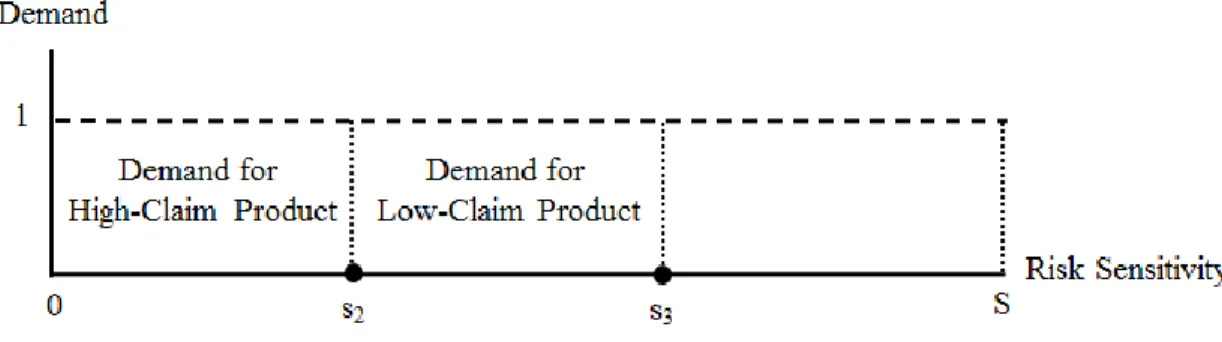
differentiate the purchase decisions for the same product. In Figure 2.1, the equilibrium point in this market is represented by the risk sensitivity of the indifferent customer, .
2.2.3.1.2 Market Equilibrium
The indifferent customer with risk sensitivity has the same utility from either purchasing the product or not purchasing the product. This is the situation where a customer decides whether to make a purchase or not according to the level of perceived risk of the product, since a customer’s information stock can affect her purchase/no purchase decision (Putsis, Jr. and Srinivasan 1994). For example, some people hesitate to visit car mechanics since they do not know much about their cars and want to avoid the possibility of getting “ripped off.” Therefore, the customers who have lower risk sensitivity than will all purchase the product, while none of the customers who have higher risk sensitivity than will make a purchase in this market. This represents the equilibrium point of this market.
Figure 2.1: Equilibrium of Monopoly Market
denotes the claimed value and denotes the probability of purchase failure for this monopoly product M. As explained, the price and information search cost of the product are fixed at and throughout our analysis. We will also fix the cost of purchase failure at , as we assume the same product category for our analysis. Then the utility of the indifferent customer with the risk sensitivity of from purchasing product M is calculated as follows:
As explained, the utility of this customer equals zero as this customer is indifferent between purchasing and not purchasing in this market. From this equation, we can calculate the market demand as follows:
∴ Market demand6
We can find some primary observations about the demand for the product from this result. The demand for the monopolistic seller’s product will be larger as the probability of purchase failure ( ) is smaller and the claimed quality of the seller’s product ( ) is higher. Moreover, the demand will be larger as the information search cost ( ) gets smaller. Therefore, it is better for the monopoly firm to increase the claimed quality and decrease the perceived risk of
purchase, and the demand will be smaller for the products with credence attributes than those with search or experience attributes.
2.2.3.2 Duopoly Case
Now let’s investigate the duopoly case where one seller always claims high quality while the other seller either claims high or low quality. We first examine how various factors in our model, such as the perceived risk and the claimed quality, affect the demand for each seller and the entire market demand.
6 We assume that the price is low enough to make the market demand positive. In other words, we assume the
condition that to hold for our analysis. We discuss more about this assumption in a following