PARTISAN ACCOUNTABILITY AND THE PERVERSION OF LOCAL DEMOCRACY: EVIDENCE FROM BOSNIA AND HERZEGOVINA
Kiran Rose Auerbach
A dissertation submitted to the faculty at the University of North Carolina at Chapel Hill in partial fulfillment of the requirements for the degree of Doctor of Philosophy in the Department
of Political Science.
Chapel Hill 2018
Approved by:
Graeme Robertson
Florian Bieber
Evelyne Huber
Mathew McCubbins
ii
iii ABSTRACT
Kiran Rose Auerbach; Partisan Accountability and the Perversion of Local Democracy: Evidence from Bosnia and Herzegovina
(Under the direction of Graeme Robertson)
How do politicians in emerging democracies undermine democratic performance despite
adopting reforms that enhance responsiveness to citizens on paper? Looking at patron-client
relations within political parties, this dissertation presents a mechanism, partisan accountability,
by which resource-rich parties subvert accountability to citizens. Parties use organizational and
electoral resources to build patronage networks in which resources are distributed to co-opt
politicians into being accountable to central party elites rather than to constituents. Using original
subnational data from Bosnia and Herzegovina that includes party organization, party finance,
electoral representation, party discipline, and recalls initiated against mayors, I demonstrate how
parties with extensive resources concentrate power by using patronage to undermine local
democratic institutions.
In emerging, unconsolidated democracies, parties are often weakly or non-programmatic,
which incentivizes central party leaders to maximize their control over political and economic
resources and to provide minimum benefits to citizens. As a result, variations in government
performance may reflect political favors or retribution that are consequences of intra-party
patronage rather than policy effort. Unpacking how the resources of political parties affect elite
strategies to concentrate power over subnational units therefore contributes to our understanding
of why many young democracies display uneven and substandard performance within their
iv
ACKNOWLEDGEMENTS
I am grateful to my dissertation committee for their unwavering support and guidance:
Graeme Robertson (chair), Florian Bieber, Evelyne Huber, Mathew McCubbins, and Milada
Vachudova. I thank the following sources of funding which supported my research:
Fulbright-Hays Doctoral Dissertation Abroad Fellowship, Title VIII Research and Language Fellowship
from American Councils, and the European Research Council Fellowship on the Causes and
Consequences of Multi-level Governance from Liesbet Hooghe and Gary Marks. At UNC
Chapel Hill: Dissertation Completion Fellowship, the Druscilla French Graduate Student
Excellence Fund, and the Richard J. Richardson Summer Fellowship.
I am thankful to the four mayors whose stories are featured in my dissertation: Bego
Birparić, Zdravko Krsmanović, Muhamed Ramović, and Milovan Topolović. I also thank the
other mayors, political party representatives, politicians, and political experts in BiH who shared
their experiences and insights about Bosnian politics with me. I am grateful for the mentorship
from Professors Suad Arnautović and Zdravko Grebo at the University of Sarajevo, and I thank
Mariana Hadžijusufović at the Center for Postgraduate Studies for helping me to become a legal
resident in BiH despite my ineptitude with fingerprinting.
I thank Bojan Bilić, my research assistant and confidant who traversed many far-flung
corners of Bosnia and Herzegovina with me and never grew tired of discussing my hare-brained
ideas. To my parents, Nirmala and Leslie, and my brother, Sol: Thank you for being my greatest
v
TABLE OF CONTENTS
LIST OF TABLES ... vii
LIST OF FIGURES ... viii
LIST OF ABBREVIATIONS ... ix
INTRODUCTION ... 1
REFERENCES ... 12
1. ACCOUNTABLE TO WHOM? HOW STRONG PARTIES UNDERMINE LOCAL DEMOCRATIC PERFORMANCE... 14
1.1. Introduction ... 15
1.2. Political Parties in Developing Democracies ... 18
1.3. Partisan Accountability: Theoretical Framework ... 21
1.4. Case Selection and Background ... 24
1.5. Operationalizing Local Democratic Performance and Party Strength ... 28
1.6. Results ... 37
1.7. Discussion ... 48
1.8. REFERENCES ... 50
2.HOW STRONG PARTIES UNDERMINE POLITICAL PARTICIPATION ... 54
2.1. Introduction ... 55
2.2. Participation and Manipulation in Democratic Elections ... 58
2.3. How Partisan Accountability affects Elections ... 61
2.4. Local Elections and Recall Referenda in Bosnia and Herzegovina ... 63
vi
2.6. Results ... 73
2.7. Discussion ... 78
2.8. REFERENCES ... 80
3. VARIETIES OF PUNISHMENTS: PARTISAN ACCOUNTABILITY IN PRACTICE ... 83
3.1. Introduction ... 83
3.2. Case Selection and Operationalization of Concepts ... 85
3.3. Banovići ... 88
3.4. Goražde ... 93
3.5. Foča ... 96
3.6. Laktaši ... 101
3.7. Discussion ... 105
3.8. REFERENCES ... 109
APPENDIX 1: MUNICIPALITIES IN BOSNIA AND HERZEGOVINA ... 110
APPENDIX 2: ADDITIONAL REFERENCES AND DATA SOURCES ... 111
Banovići ... 111
Goražde ... 111
Foča….. ... 112
Laktaši ... 113
Qualitative Sources Consulted ... 114
Quantitative Data Sources ... 115
Interviews ... 116
APPENDIX 3: RECALL DATA ... 117
vii
LIST OF TABLES
Table 1: Mayors Punished by their Parties (RS) 2004-2016 ... 8
Table 2: Mayors Punished by their Parties (FBiH) 2004-2016 ... 8
Table 3: Party Competition in the Republika Srpska... 26
Table 4: Party Competition in Federation of BiH ... 26
Table 5: Recall Initiation and Local Democratic Performance ... 30
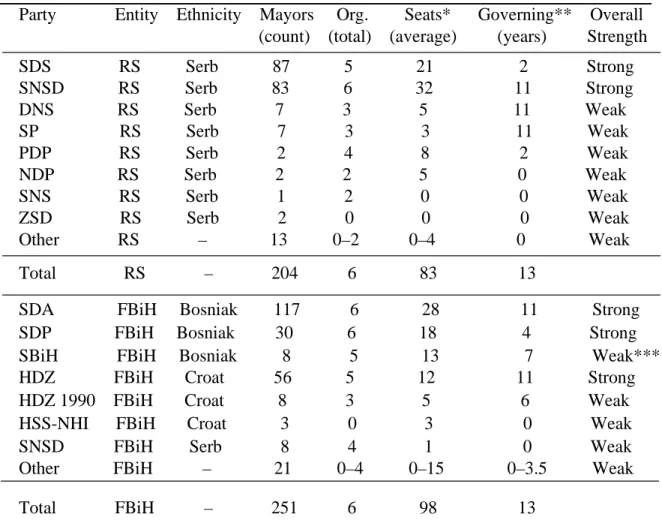
Table 6: Party Strength in BiH... 35
Table 7: Political Conflicts between Mayors and Initiators... 37
Table 8: Overview of Cases and Causal Variables ... 87
viii
LIST OF FIGURES
Figure 1: Decentralization in Bosnia and Herzegovina ... 25
Figure 2: Party Strength in Recalls Initiated by Mayor’s Party ... 39
Figure 3: Party Strength in Recalls caused by Inter-Party Conflict ... 42
Figure 4: Party Strength in Recalls related to Local Conflicts ... 45
Figure 5: Party Strength in Recalls related to Poor Governance ... 46
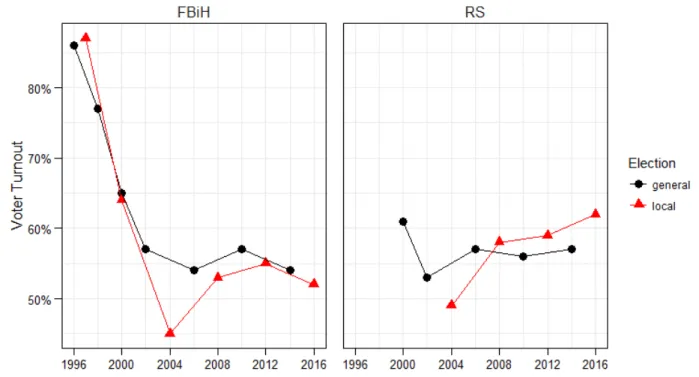
Figure 6: Voter Turnout in BiH ... 64
Figure 7: Citizen Trust in Government Institutions and Organizations in BiH ... 66
ix
LIST OF ABBREVIATIONS
BiH Bosnia and Herzegovina
CEC Central Election Commission of Bosnia and Herzegovina
DPA Dayton Peace Accords
FBiH Federation of Bosnia and Herzegovina
RS Republika Srpska
Political Parties
Bosniak
SBB Savez za bolju budućnost Bosne i Herzegovine- Fahrudin Radončić
SBiH Stranka za Bosnu i Herzegovinu
SDA Stranka Demokratske Akcije
SDP Socijaldemokratska partija Bosne i Hercegovine
Croat
HDZ Hrvatska Demokratska Zajednica BiH
HDZ 1990 Hrvatska Demokratska Zajednica BiH 1990
HSP Hrvatska Stranka Prava
HSS-NHI Hrvatska Seljačka Stranka-Nova Hrvatska Inicijativa (coalition)
Serb
DNS Demokratski Narodni Savez
NDP Narodni Demokratski Pokret
x
PDP Partija Demokratskog Progresa
SDS Srpska Demokratska Stranka
SNS Srpska Napredna Stranka
SNSD Savez Nezavisnih Socijalnademokratska Milorad Dodik
SP Socijalistička Partija Republike Srpske
1
INTRODUCTION
Laktaši, Republika Srpska
Milovan Topolović, a popular mayor from a booming agricultural town close to the
Croatian border, was elected to a third term in 2012. He won by a margin of 31 percentage
points, amounting to a greater vote share than his party’s list of municipal counselors. The mayor
was widely known for his progressive public policies by the community and international
donors, who had co-financed several large municipal projects.1 Yet pressure was mounting on
him from his party’s president, Milorad Dodik, and a local tycoon who was godfather to Dodik’s
children. The mayor’s refusal to spend money from the municipality’s budget on the tycoon’s
local soccer club was causing a major rift between the mayor and his party’s president. The
mayor was a longtime friend of Dodik and had assisted him back in 1996 in founding the
Alliance of Independent Social Democrats (SNSD), at the time a pro-democratic opposition
party to the nationalistic Serbian Democratic Party (SDS) which had been founded by convicted
war criminal Radovan Karadzić. In September 2014, two months after the mayor was recognized
by a pan-European NGO as the best mayor of the decade in Bosnia and Herzegovina (BiH) and
the 2014 best mayor-manager in his regional entity, the Republika Srpska (RS), he was forced to
submit his resignation and was removed from SNSD. His political career had just abruptly
ended. Why would SNSD, by now the most powerful political party in the RS, intimidate a
1References for the two cases presented in the introduction are listed in Appendix 2. They include interviews with
2
popular, high-performing mayor who brought in more votes than any other candidate in the
SNSD party president’s hometown?
What happened to this mayor was not an isolated incident. Two years later in the run-up
to the 2016 local elections, SNSD’s municipal board voted to nominate the SNSD mayor who
had replaced the former mayor in 2014 by a vote of 47 to 42. But Dodik had warned board
members to nominate a different candidate because like the former mayor, the current mayor
refused to comply with the tycoon’s demands. Livid that the board members disobeyed his
orders, Dodik annulled their decision and dissolved the entire board. A new board was
established and nominated an entirely different candidate, who went on to win the mayorship.
Goražde, Federation of Bosnia and Herzegovina
Muhamed Ramović, known by his nickname “Rambo,” is another popular mayor from
the eastern corner of Bosnia’s Muslim-Croat Federation. He was removed from his party, SBB,
in 2014 for proposing to form a coalition at the cantonal level with the governing party, the Party
for Democratic Action (SDA). Although the mayor’s intention was to ingratiate himself to
cantonal actors who held the purse-strings for his municipality, his party president punished him
for overstepping his authority. The punishment, however, only bolstered the mayor’s reputation.
He finished out his second term and ran as an independent candidate in 2016, winning by 31
percentage points over the second place candidate. The runner-up was an inexperienced
25-year-old who had been fielded jointly by SBB and SDA. This was his largest margin of victory yet.
Rambo’s victory, however, came as no surprise to anyone. The mayor’s popularity was
based on a solid foundation of good governance. During his two terms, the municipality’s
3
and people from neighboring towns were commuting to Goražde to work in its thriving factories.
How had the mayor accomplished this feat despite being a member of three different political
parties in fifteen years? Back in 2000, the local SDA establishment had fired him from his
position as high school principal for trying to modernize Goražde’s local high school. He had
been told to do an average job and not try to stand out. This punishment made the mayor aware
that his style of governance was fundamentally incompatible with party politics in BiH.
As mayor, his strategy became more pragmatic: First, to gain the community’s trust, he
established public channels of communication with his constituents in which they could voice
their concerns to him directly, and he worked closely with Goražde’s municipal counselors and
selected a team of young, educated advisors to help him push out numerous pro-development
policies. Second, seeing that financial contributions from higher levels of government were
inadequate and irregular, he funded most of Goražde’s public projects through international
grants, effectively bypassing Bosnia’s labyrinth of public institutions staffed by civil servants
and politicians who owe their jobs to the political parties currently in government. When the
mayor finally transgressed his position within the party, he was punished by SBB but his
political career did not suffer.
Why do political parties in emerging democracies punish high-performing mayors with
impressive policy records who are well-liked by their constituents? Why are some parties more
effective in disciplining mayors than others? And what effects do these punishments have on
local democracy? Democratic theory would expect parties to respect, even reward, popular and
responsive mayors who improve the public image of the party and increase the party’s vote
share. Furthermore, retaining popular mayors would seem to be critical for the survival of parties
4
these punishments against two high-performing mayors from different parties in distant towns
and in different ethno-federal regions say otherwise.
Current answers
Conventional wisdom holds that vibrant political party competition, specifically the
threat of losing elections, disciplines parties to respond to citizens interests (Geddes 1994,
Grzymala-Busse 2007, Vachudova 2005, Berliner and Erlich 2015). In addition, scholars have
linked the stability of a country’s party system to greater democratic quality (Mainwaring 1999,
Mainwaring and Torcal 2006, Mainwaring and Zoco 2007, Schleiter and Voznaya 2016).
According to these perspectives, strong parties are vital for democracy because they contribute to
the stability of electoral competition, the predictability of governing coalitions, and the
credibility of the opposition, and they foster programmatic linkage with voters. These views
build on Schumpeter’s (1942) classic definition of democracy as a procedure of regularized
elections enabling citizens to choose their leaders and evict them. While a voluminous literature
has expanded on the substantive conditions that enable elections to be free and fair, democracy’s
defining attribute centers on competitive elections as the mechanism by which citizens hold
politicians accountable for governance.
However the party competition literature has been criticized for overlooking the
possibility that strong party organizations also have capacities to subvert democratic mechanisms
of accountability, even when elections are competitive. These criticisms tend to come from
literature that has explored non-programmatic modes of linkage between politicians and citizens,
such as clientelism, in which parties target private goods to voters in exchange for political
support rather than committing to broad socio-economic platforms that benefit most citizens.
5
third-wave democracies, may not only coexist with vibrant party competition and electoral
stability (Keefer and Vlaicu 2008, Kitschelt and Wilkinson 2007, Luna and Altman 2011,
Remmer 2007), but that competition may also fuel it. (Kitschelt and Wilkinson 2007, Sanadanan
2012). Others point out that strong party organizations are imperative for clientelistic networks to
function effectively (Kitschelt and Kselman 2012, Stokes 2005). Furthermore, Randall and
Svasand (2002) warn that large variations in the institutionalization and organizational
development of individual parties may hinder the competitiveness of the political system and
limit the representation of certain group interests. However, most scholarship takes national party
systems as the units of analysis rather than scaling down to look at variations in the
organizational strength of individual parties. Even fewer works analyze the influence of
intra-party politics on electoral competition and democracy more broadly, but they do not look
directly at democratic performance (i.e. Bohlken 2016, Kemahlioglu 2012, Tavits 2013).
Main Argument
My work challenges conventional assumptions that competitive elections and the
existence of democratic institutions are indicative of well-performing democracies. I show that
the mechanisms on which such arguments rely may be subverted in practice by strong political
parties. My approach differs from previous work in two main respects. First, whereas most
works treat parties as unitary actors, I consider their internal relations and view parties as
networks of actors who have diverse interests and interact at multiple levels of governance.
Second, my work directly assesses the effectiveness of democratic institutions by their de facto
performance, rather than by their de jure formal rules which politicians often subvert in practice.
How do the internal dynamics of political parties affect the performance of subnational
6
I analyze how party organizational and electoral resources structure patron-client politics
inside parties to identify an alternative mechanism that leads subnational democratic institutions
to function poorly. I argue that parties with strong organizations and electoral representation at
the national level may undermine the performance of local democratic institutions. These parties
build elaborate patronage networks in which resources are distributed as a means to co-opt
politicians into being accountable to party leaders rather than to their constituents, a phenomenon
I refer to as partisan accountability. On the other hand, parties that are organizationally
undeveloped and lack national representation may foster greater accountability to citizens at
subnational levels. Since weak parties lack patronage resources to co-opt party members or
funnel them to voters, local politicians from these parties must build their reputations by being
responsive to the interests of ordinary citizens. In other words, the scarcity of patronage
resources makes responsiveness to citizens instrumental for the re-election chances of politicians
from weak parties.
To connect partisan accountability back to the puzzle from the first section, let us
consider the political environment in many emerging democracies in which electoral competition
is volatile, and it is costly for parties to credibly commit to electoral promises (Keefer 2007).
Instead, parties often adopt non-programmatic linkages with voters, such as ethnic appeals and
clientelistic benefits. This makes leaders of resource-rich parties more preoccupied with
maintaining control over the party’s patronage network than providing public goods and
improving socio-economic development. Since these party leaders see patronage as the primary
vehicle to increase the party’s political and economic power, they care about maintaining a loyal
cadre of members and party affiliates. Their power is therefore threatened by independent–
7
strong parties to entrench their political power over subnational units by punishing
high-performing mayors and replacing them with party loyalists, rather by promoting governance that
is responsive to citizen interests.
Overview of Dissertation
The specific context that I investigate is Bosnia and Herzegovina (BiH), a country rarely
included in the comparative democratization literature due to the complexity of its political
institutions, which relate to its consociational, power-sharing arrangements. BiH however meets
the scope conditions of my argument, and its political institutions offer a unique research design
in which to test my theory. First and foremost, BiH is a competitive electoral democracy in
which corruption is widespread and parties are weakly or non-programmatic. Furthermore,
Bosnia’s central state has few administrative competencies that mainly relate to foreign policy,
monetary policy, and border control (DPA 1995). The main arena of party competition and
political conflict instead occurs in Bosnia’s two highly autonomous, ethno-federal regions,
formally referred to as entities.
I test my theory separately in each entity. This design has the advantage of automatically
controlling for common cultural and contextual factors, while accounting for alternative
explanations based on political competition, ethnic diversity, and decentralization, which are the
areas in which the two entities differ. In particular, the Republika Srpska (RS) is ethnically
homogenous and mainly populated by Serbs, while the Federation of BiH is multi-ethnic and
home to most of Bosnia’s Bosniaks (Bosnian Muslims) and Croats. In Chapter 1, I show how
differences in ethnic composition lead the RS and FBiH to have distinct party subsystems. In
addition, the RS has a similar, but more centralized administrative structure than the FBiH,
8
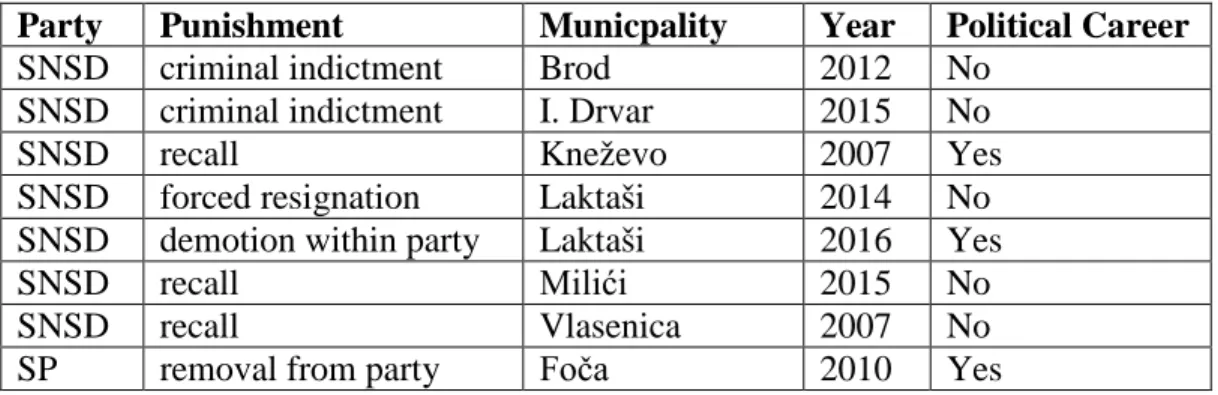
Moving back to the puzzle that motivates my research, Tables 1 and 2 identify mayors
who were punished by their parties over four election cycles. I define a punishment as a
deliberate action taken by a political party to hurt a mayor’s political career. Tables 1 and 2
identify fifteen mayors who received punishments, the strength of the party, the type of
punishment, and whether the mayor stayed active in politics afterwards. Looking at the varieties
of punishments, recalls stand out as particularly anomalous. Recalls are an institution of local
direct democracy which were intended to make mayors more accountable to their constituents.
Adopted simultaneously by both entities as part of a new electoral law, recalls consist of three
stages, each of which were meant to enable citizens to directly sanction mayors for poor
performance. Yet the table shows that four out of fifteen intra-party punishments also took the
form of recalls, running contrary to the formal purpose of this democratic institution.
Table 1: Mayors Punished by their Parties (RS) 2004-2016
Party Punishment Municpality Year Political Career
SNSD criminal indictment Brod 2012 No
SNSD criminal indictment I. Drvar 2015 No
SNSD recall Kneževo 2007 Yes
SNSD forced resignation Laktaši 2014 No
SNSD demotion within party Laktaši 2016 Yes
SNSD recall Milići 2015 No
SNSD recall Vlasenica 2007 No
SP removal from party Foča 2010 Yes
Table 2: Mayors Punished by their Parties (FBiH) 2004-2016
Party Punishment Municpality Year Political Career
SBB removal from party Goražde 2014 Yes
SDA recall Banovići 2014 No
SDA suspended from party Bihać 2016 Yes
SDA removal from party Visoko 2011 Yes
SDA removal from party Visoko 2016 Yes
SNSD removal from party B. Petrovac 2008 Yes
9
I use data from all recalls initiated during this period to test my theory of partisan
accountability. Chapter 1 presents the core theoretical framework connecting the strength of
party resources to the subversion of local democratic performance. I provide quantitative and
qualitative evidence to show that recalls are rarely initiated because of substandard governance.
Instead, strong parties initiate recalls to extend control over subnational units. These parties
attempt to remove disloyal mayors from their own ranks or vulnerable mayors from opposing
parties so they can replace incumbent mayors with docile partisans who are accountable to
central party officials rather than to constituents. In initiating recalls for political advantage,
strong parties break programmatic linkages between mayors and their local communities.
Chapter 2 extends the analysis by investigating the political factors that determine the
conditions under which mayors are successfully removed in recall referenda. I show that party
resources provide pernicious capacities to undermine recall referenda while permissive
institutional rules provide them with incentives to frequently initiate recalls. Furthermore, I find
that low voter turnout is the biggest predictor of referendum success, suggesting that the
competitive strategies of strong parties directly and indirectly reduce political participation.
Chapter 3 brings the discussion back to intra-party punishments more broadly. I present
four case studies in a controlled, comparative design in which I pair cases from the same entities
that vary on the treatment (strength of mayor’s party). Within-case information traces different
parts of the causal mechanism, such as the source of the conflict and the punishment strategy,
illustrating how partisan accountability functions in practice. Cross-case comparisons show that
the severity of punishments and the success in removing mayors differ for strong and weak
10
mayors who are more accountable to their constituents than their parties, which has negative
implications for local self-governance and democracy.
Broader Implications
By considering patronage practices inside of political parties, my research presents an
alternative mechanism that challenges the conventional notion that sustained political
competition between strong and stable party organizations improves democracy. In emerging,
unconsolidated democracies—which are often characterized by weakly or non-programmatic
political parties—electoral competition may encourage politicians to be accountable to their
parties rather than to their constituents who voted them in office. As a result, variations in
government performance may reflect partisan conflicts that are consequences of collusion and
intra-party competition rather than government responsiveness to citizens. Unpacking how the
resources of political parties affect local democratic performance therefore contributes to our
understanding of why many young democracies display uneven and substandard governance and
socio-economic development within their territories, lagging far behind their extensive
institutional reforms.
In the future, it would be informative to look at how party strength affects local
democracy in different party systems with varying degrees of democratic consolidation. For
example, by extending the analysis to other countries in the Western Balkans, other developing
democracies, and then comparing these findings to the dynamics in established democracies, we
would be better able to establish the boundaries of the scope conditions for partisan
accountability. This would enable us to better understand in which types of party systems are
strong parties a virtue, supporting institutions and public policies that entrench the quality of
11
electoral competition, and partisan accountability function in different systems may help us to
understand which aspects of competition lead parties to establish programmatic over
non-programmatic linkages with citizens.
From a policy perspective, the dynamics in BiH are readily generalizable to other
democracies that receive international aid for democracy promotion in the area of elections and
political parties. The strategy of Western donors has thus far been to identify strong individuals
from the opposition and then support them financially, as a means to foster electoral competition
and encourage citizens to replace corrupt incumbents with pro-democratic opposition parties.
However, from Saakashvili in Georgia to Orban in Hungary to Dodik in the Republika Srpska,
my research shows that there is a danger of funneling resources into parties and over-building
their capacities. My theory of partisan accountability explains why international aid spent in this
way is likely to have negative consequences: Once the opposition takes over, they often use party
resources to consolidate political and economic control through patronage instead of responding
to the interests of ordinary citizens. The next chapter lays out my theoretical framework
connecting the strength of party resources to the subversion of local democratic performance,
and I illustrate the phenomenon empirically by analyzing the political factors that motivate
12
REFERENCES
Berliner, Daniel, & Aaron Erlich. 2015. “Competing for Transparency: Political Competition and Institutional Reform in Mexican States.” American Political Science Review, 109(1): 110-128.
Bohlken, Anjali. 2016. Democratization from Above: The Logic of Local Democracy in the Developing World. New York: Cambridge University Press.
Geddes, Barbara. 1994. Politician's dilemma: building state capacity in Latin America. Berkeley: Univ of California Press.
Grzymala-Busse, Anna. 2007. Rebuilding Leviathan: Party Competition and State Exploitation in Post-Communist Democracies. Cambridge: CUP.
Grzymala-Busse, Anna. 2010. “The Best Laid Plans: The Impact of Informal Rules on Formal Institutions in Transitional Regimes.” Studies in Comparative International Development
45:311–333.
Kemahlioglu, Ozge. 2012. Agents or Bosses: Patronage and Intra-party Politics in Argentina and Turkey. Colchester: ECPR.
Keefer, Philip. 2007. "Clientelism, Credibility, and the Policy Choices of Young Democracies."
American Journal of Political Science 51(4): 804-821.
Keefer, Philip and Razvan Vlaicu. 2008. “Democracy, Credibility and Clientelism.” The Journal of Law, Economics, & Organization Vol. 24, No. 2.
Kitschelt, Herbert and Daniel Kselman. 2012. “Economic Development, Democratic Experience, and Political Parties’ Linkage Strategies.” Comparative Political Studies 46(11): 1453-1484.
Kitschelt, Herbert and Stephen I. Wilkinson, eds. 2007. Patrons, Clients, and Policies: Patterns of Democratic Accountability and Political Competition. Cambridge: CUP.
Mainwaring, Scott and Mariano Torcal. 2006. “Party system institutionalization and party system theory after the third wave of democratization.” In R. S. Katz & W. Crotty Handbook of party politics (pp. 204-227). London: SAGE Publications.
Mainwaring, Scott and Edurne Zoco. 2007. “Political Sequences and the Stability of Interparty Competition.” Party Politics 13(2):155-178.
Randall, Vicky and Lars Svasand. 2002. “Party Institutionalization in New Democracies.” Party Politics 8(1): 5-29.
13
Sadanandan, Anoop. 2012. “Patronage and Decentralization: The Politics of Poverty in India.” Comparative Politics, Vol. 44, No. 2: 211-228.
Samuels, David and Cesar Zucco. 2014. “The power of partisanship in Brazil: Evidence from survey experiments.” American Journal of Political Science 58.1: 212-225.
Schleiter, Petra and Alisa Voznaya. 2016. “Party System Institutionalization, Accountability and Governmental Corruption.” BJPS: 1-28.
Schumpeter, Joseph. 1987. Capitalism, Socialism, and Democracy. Boston: Unwin Paperbacks.
Stokes, Susan. 2005. “Perverse Accountability: A Formal Model of Machine Politics with Evidence from Argentina.” American Political Science Review 99(3): 315-325.
Tavits, Margit. 2013. Post-Communist Democracies and Party Organization. Cambridge: CUP.
14
1. ACCOUNTABLE TO WHOM? HOW STRONG PARTIES UNDERMINE LOCAL DEMOCRATIC PERFORMANCE
Abstract
How do politicians in young democracies undermine democratic performance despite adopting
reforms that enhance responsiveness to citizens on paper? Looking at patron-client relations within
political parties, this chapter presents a mechanism, partisan accountability, by which strong
parties subvert accountability to citizens. Strong parties use their organizational and electoral
resources to build patronage networks in which resources are distributed to co-opt politicians into
being accountable to central party elites rather than to constituents. Using original subnational data
from Bosnia and Herzegovina which include party resources and recalls initiated against mayors,
I demonstrate that recalls are rarely linked to the quality of local governance. Instead, strong parties
subvert this institution of local direct democracy as a means to extend partisan control over
subnational units. By measuring de facto institutional performance, my research demonstrates an
alternative path by which parties in developing democracies consolidate power to the detriment of
15
1.1. Introduction
The international community and scholars of comparative democratization alike celebrate
when governments adopt political reforms that espouse liberal democratic values. For third-wave
countries, such reforms are seen as incremental progress that augurs well for the transition to
democracy. However, the implementation of these reforms often fail to meet expectations, even
in contexts where governments have crafted them to strengthen democratic accountability. How
do politicians in young, electoral democracies subvert institutional reforms that are designed to
improve accountability to citizens? In analyzing this question, scholars have looked at the
features of parties and party systems, and a burgeoning literature investigates these dynamics at
subnational levels. Yet there are two major shortcomings. First, most works treat parties as
unitary actors, which obscures intra-party dynamics amongst networks of actors who have
divergent interests and operate at multiple levels of government. Second, scholarship tends to
measure institutional reforms de jure instead of de facto, which paints a misleading picture of
institutional effectiveness. As a result, we know little about how intra-party politics affect the
performance of subnational democratic institutions.
Conventional wisdom holds that the threat of losing elections acts as an insurance
mechanism, encouraging ruling parties to initiate democracy-enhancing reforms that constrain
rent-seeking and patronage (Geddes 1994, Grzymala-Busse 2007, Vachudova 2005, Berliner and
Erlich 2015). By tying their hands in the present, ruling parties prevent their competitors from
usurping government spoils in the future. Furthermore, the degree of party system
institutionalization (PSI)—consisting of electoral stability, party roots in society, popular
legitimacy of parties, and party organizational strength—has been linked to greater democratic
16
literature calls these claims into question by demonstrating that non-programmatic linkages
between parties and citizens, such as clientelism, may coexist with vibrant party competition and
electoral stability to undermine the quality of democracy in the long run (Keefer and Vlaicu
2008, Kitschelt and Wilkinson 2007, Luna and Altman 2011). Yet these works largely view
clientelism as an electoral strategy in which parties target private goods to citizens in exchange
for political support. They do not explore the nature of patron-client relations inside of parties or
their effects on democratic governance. In addition, the relationship between party organizational
strength and the other dimensions of PSI has been understudied.
My work challenges conventional assumptions that competitive, stable party systems and
the adoption of democratic reforms improve democratic performance. I show that the
mechanisms underpinning such arguments may be subverted by strong, resource-rich political
parties. Furthermore, I analyze how organizational and electoral resources structure patron-client
politics within parties to identify an alternative mechanism that leads subnational democratic
institutions to function poorly. I argue that parties with extensive organizations and electoral
representation at the national level are more likely to undermine the performance of local
democratic institutions. These parties build elaborate patronage networks in which resources are
distributed as a means to co-opt politicians into being accountable to central party leaders rather
than to their constituents, a phenomenon I refer to as partisan accountability. This leads strong
parties to subvert citizen interests to entrench their political power over subnational units.
My theory applies to competitive electoral democracies, which are characterized as
having a relatively level playing field between incumbent and opposition parties (Levitsky and
Way 2010). The specific context I investigate is Bosnia and Herzegovina, whose subnational
17
2004, Bosnia’s two highly autonomous federal regions adopted local electoral reforms, which
included a recall procedure for citizens to sanction poor-performing mayors. Although hailed by
the international community as an institution of direct democracy for citizens to hold mayors
accountable, in practice recalls are rarely linked to the quality of local governance. Instead the
evidence demonstrates that central party officials from electorally and organizationally strong
parties subvert recalls into an informal means to extend their political and economic control over
sub-national units. These party elites co-opt municipal counselors into sanctioning mayors from
opposing parties whom they deem politically vulnerable, or they use recalls as a means to punish
disloyal mayors from their own parties. My work leverages variations in the resource
endowments of political parties and directly measures the effectiveness of recalls in supporting
local democracy. In addition, I account for alternative explanations based on the nature of
political competition and ethnicity by treating Bosnia’s regional entities, which differ on these
variables, separately.
By uncovering patronage practices within political parties, this chapter presents an
alternative, top-down mechanism by which strong party organizations may stifle subnational
democratization. In emerging democracies, parties are often weakly or non-programmatic, which
incentivizes central party leaders to maximize their control over political and economic resources
and to provide minimum benefits to citizens. In such contexts, political competition may
encourage politicians to be accountable to their party leaders rather than to their constituents. As
a result, variations in government performance may reflect political favors, retribution, and
conflict that are consequences of intra-party patronage and strategies of competition. Patterns of
rewards and sanctioning of local politicians may therefore be more reflective of political interests
18
to concentrate political power over subnational units contributes to our understanding of why
many young democracies display uneven and substandard performance, lagging far behind their
extensive institutional reforms.
1.2. Political Parties in Developing Democracies
Influential scholarship has linked the quality of governance and the adoption of
democratic reforms to inter-party competition (Berliner and Erlich 2015, Geddes 1994,
Grzymala-Busse 2007, O’Dwyer 2006, Vachudova 2005) and the institutionalization of party
systems (Mainwaring 1999, Mainwaring and Torcal 2006, Mainwaring and Zoco 2007, Schleiter
and Voznaya 2016). These bodies of literature argue that strong governing and opposition parties
are vital for democracy because they contribute to the stability of electoral competition, the
predictability of governing coalitions, the credibility of the opposition, and programmatic linkage
with voters. However, this scholarship overlooks that strong party organizations also have
capacities to subvert these mechanisms, even in competitive systems.
Indeed, other scholarship has questioned some of the assumptions of this literature. One
group has questioned the construct validity of party system institutionalization (PSI), spanning
multiple iterations of the concept. In 1998, Levitsky pointed out that two dimensions of Samuel
Huntington’s original conceptualization did not move in the same direction within a single party.
Meanwhile, Mainwaring and Scully (1995) and Mainwaring (1999) adapted the concept to
developing democracies and it quickly became the gold standard. Their conceptualization lumps
together four dimensions of party systems: electoral stability, rootedness in society, popular
legitimacy of parties, and organizational strength. Yet more than a decade later, Luna and
19
necessarily move in the same direction. Furthermore, Randall and Svasand (2002) warn that the
institutionalization of individual parties does not automatically lead to the institutionalization of
the party system, and that large variations in the level of institutionalization and organizational
development of parties may hinder the overall competitiveness of the political system and limit
the representation of certain group interests. However, most scholarship has overlooked how
variations in the organizational strength of individual parties affect party system
institutionalization and democratic representation.2
Research on the micro-foundations of clientelism—including the causes, mechanisms,
and consequences—has also debunked some of the claims of the political competition and PSI
literature. Consensus exists that a major impediment to democratic representation and
socio-economic development is that parties in young democracies often invest in clientelistic party
machines as an electoral strategy. Rather than making broad programmatic appeals to voters,
clientelistic parties target private goods to voters in exchange for political support. Several
scholars have not only found that clientelism and patronage may coexist with competition
(Kopecky 2011, Remmer 2007, Weitz-Shapiro 2012), but also that competition may fuel it in
high-poverty contexts (Kitschelt and Wilkinson 2007, Sanadanan 2012). Others point out that
strong party organizations—the fourth dimension of Mainwaring and Scully’s (1995) PSI
concept—are imperative for clientelistic networks to function effectively (Kitschelt and Kselman
2012, Stokes 2005).
I build on this literature by considering patron-client relations inside political parties.
Indeed, classical party theories warned long ago that the evolution of individual party
20
organizations inevitably leads to the concentration of power into the hands of elites and
bureaucratic interests (Weber 1978, Michels 1915). Panebianco’s (1988) party life-cycle
approach similarly expects hierarchical power relations between the party’s central leadership
and its activist base (the former prioritizing office-seeking goals while the latter prioritizes
ideology) to have profound implications for party-building strategies and linkage with the
electorate. Among the sparse empirical literature looking at power constellations within parties
in developing democracies, three major works investigate disparate features of party organization
and subnational politics. Building on the party institutionalization literature, Tavits (2013) finds
that stronger organizational resources enhance a party’s electoral success in post-communist
countries, but her work does not explicitly look at the implications for governance or democracy.
Building on the clientelism literature, Kemahlioglu (2012) finds that the dependence of
politicians on party support and open competition for party leadership reduces subnational
patronage in Argentina and Turkey. Since her outcome of interest is patronage jobs provided by
politicians to citizens in exchange for political support, her findings do not focus on how
patronage affects institutional performance. Bohlken (2016) finds that intra-party competition
and lack of elite control over a party’s organizational network leads to the adoption of
institutional reforms that enhance local democracy in India. However, she does not consider the
effectiveness of these institutions on the ground, so her work does not consider alternative paths
by which politicians may subvert these reforms in practice.
My work adds to this debate by investigating how variations in the organizational and
electoral resources of parties within a system affect patterns of intra-party patronage and local
democratic performance. Specifically, I present a mechanism that links greater party resource
21
This leads strong, centralized parties to undermine formal mechanisms of local democratic
accountability. As such, my approach is in line with Kopecky, Mair and Spirova (2011), who
view patronage as an organizational resource that parties use to control state institutions, rather
than as a means of garnering mass electoral support from voters. More broadly, my research
provides insights into the emerging literature on the sources of institutional weakness and the
proliferation of informal rules in emerging democracies (Grzymala-Busse 2010, Holland 2016,
Levitsky and Murillo 2009, Lupu and Riedl 2012). Furthermore, it speaks to literature on
subnational authoritarianism (Gibson 2005, Gervasoni 2010) by showing how party-building
strategies and intra-party relationships between the center and periphery undermine local
democratization.
1.3. Partisan Accountability: Theoretical Framework
My theory applies to competitive electoral democracies with weakly or
non-programmatic parties. These types of democracies fall short of liberal democratic standards and
generally exhibit high degrees of corruption. However, electoral democracies can be
distinguished from competitive-authoritarian regimes by the existence of a relatively level
playing field between incumbent and opposition parties, so that opposition parties can
meaningfully compete and organize between elections (Levitsky and Way 2010). Patronage is a
form of political corruption common in electoral democracies that affects the quality of
democracy. By standard definitions, patronage involves the exchange of jobs, favors, and other
financial incentives as rewards for political support. For my study, I am interested in intra-party
patronage, which refers to patron-client relations between central party officials (patrons) and
party members, supporters, or economic or political affiliates not formally within the party
22
patronage relations between politicians and citizens. Instead it links intra-party patronage to the
capacity of strong parties to subvert the effectiveness of local democratic institutions.
The main assumption is that political parties seek to maximize political and economic
power. In the context of subnational politics, this means controlling local and regional
governments and profiting from their resources (Gibson 2005). This goal is at odds with the
interests of ordinary citizens, who desire greater investments in public goods and the adoption of
policies that enhance socio-economic welfare in their communities. This premise is consistent
with Keefer (2007) and Keefer and Vlaicu (2008), who argue that it is more costly for politicians
in young democracies to credibly commit to policies that serve the broad public interest than to
establish credibility by targeting goods to narrow groups of voters. These authors find that young
democracies also tend to perform worse than older ones: they provide fewer public goods, more
targeted spending, and engage in greater rent-seeking. Therefore, because parties in young
democracies cannot credibly commit to broad programmatic policies, they prefer to provide the
minimum benefits to citizens that will get them elected.
Next, abundant resources enable parties to build intra-party patronage networks that
induce the loyalty of members to the interests of central party elites. Recent scholarship has
stressed that a dense network of local branches attracts supporters and helps parties to win
elections (Tavits 2013, Samuels and Zoco 2014, Van Dyck 2014). Other scholars note that in
clientelistic systems, strong party organizations are necessary to effectively target private goods
to citizens and to monitor their political support, for example through local intermediaries such
as brokers (Stokes 2005, Kitschelt and Wilkinson 2007, Kitschelt and Kselman 2012). For
similar reasons, I hold that party finance and grassroots infrastructure may fuel intra-party
23
compliance of local party stakeholders. In this way, strong organizational resources enable
central party elites to influence politics in diverse local environments. Party resources also raise
entry and exit costs for members: moving up the ranks in parties with dense membership takes
more time than in organizationally undeveloped parties (Chhiber, Jensensius, and Suryanarayan
2014 make a similar point), while exiting incurs reputational costs and loss of patronage rewards.
This vulnerability induces greater party discipline, making voice and exit difficult (see
Hirschmann 1970).
The lack of intra-party democracy—or the ability of party members to hold leaders
accountable—affects the relationship between local politicians and their constituents: If
politicians do not act independently of party leaders, then they are de facto less responsive to
their constituents who voted them in office. I refer to this phenomenon as partisan
accountability. Placing this concept in a principal-agent framework, partisan accountability
means that principals are central party officials (rather than citizens) with lower-level
co-partisans acting as central party agents. Furthermore, strong parties may shirk responsiveness to
citizens because their accumulated stocks of resources help them to win elections. This explains
why mayors and municipal counselors from strong parties can afford to target benefits to key
party supporters rather than investing in local public goods and services. By contrast, weak
parties—those that are organizationally undeveloped and not well-positioned in national
government—may exhibit greater responsiveness to citizens. These parties have fewer resources
to attract voters (e.g., reputation, finance, access to public jobs, etc.) and to develop intra-party
patronage relations. The scarcity of party resources may create conditions that are more
24
reputations and re-election chances by responding to the needs of their local constituencies rather
than relying on support from their parties.
To summarize, my theory of partisan accountability explains why strong parties may
undermine local democratic performance in young electoral democracies. Organizational and
electoral resources provide central party officials with credible patronage incentives at their
disposal to punish members for disloyal behavior and reward party loyalty. This leads to a
situation in which the accountability of local politicians to central party officials trumps their
accountability to the electorate. The extensiveness of a party’s internal patronage machinery
therefore serves as the mechanism through which strong parties undermine local democratic
performance to increase their party’s political and economic power. This theoretical framework
leads to the following hypothesis:
H1: Strong parties undermine local democratic performance more than weak parties in electoral
democracies.
1.4. Case Selection and Background
I test my theory in Bosnia and Herzegovina (hereinafter: BiH or Bosnia). BiH meets the
scope conditions as an unconsolidated, electoral democracy in which corruption is widespread
and parties are weakly or non-programmatic. In 2004, BiH’s regional entities adopted local
democratic reforms which included a recall procedure for citizens to hold mayors accountable
for their performance in government. This reform allows me to directly assess the performance
of a formal institution of local direct democracy that ruling parties created to constrain and
subject themselves to greater scrutiny by citizens. Furthermore, the division of the country into
two highly autonomous regional entities whose party systems and ethnic composition differ,
25
Bosnia began its transition to democracy in 1995 as a result of the Dayton Peace
Agreement, which concentrated constitutional powers in Bosnia’s two ethno-federal entities
rather than at the state level.3 These entities, the Federation of BiH (Federation or FBiH) and
Republika Srpska (RS) establish laws that regulate municipal governments in their respective
entities.4 In 2004, the RS and FBiH parliaments reformed their election laws to allow citizens to
directly elect mayors,5 while municipal counselors continue to be elected on a proportional basis
through open lists.6 The new electoral law also introduced a recall mechanism giving citizens the
chance to remove poor-performing mayors through a three-step process: initiation by a citizen
petition or municipal counselors, local referendum, and early mayoral elections. Data on recall
initiations is used to operationalize the dependent variable, so the procedures are discussed in
detail in the following section.
Figure 1: Decentralization in Bosnia and Herzegovina
3The DPA also established a small, multi-ethnic territory of equal administrative status called Brčko District.
4The legal framework is largely the same in both entities. The main difference is that in FBiH, some municipal
competencies are shared with cantonal governments (e.g., social services, education, and healthcare).
5Previously, municipal counselors selected mayors, which meant that the mayor usually came from the party that
obtained the most seats. In 2004, RS mayors were selected by first-past-the-post while FBiH used a preferential voting system that was changed to first-past-the-post in 2008.
6Citizens may vote for individual candidates from the same party list and/or a party list. Seats are allocated by the
Sainte-Lägue method in which parties must obtain at least 3% of total votes. Seats are allocated to candidates according to the number of personal votes they receive if above 5% of the total party vote (amended to 10% in 2016). Remaining seats are allocated by the ranking of candidates on the party’s list. See Kapidžić (2016) for a discussion.
Bi
H
FBiH Cantons Municipalities
RS Municipalities
26
Because of BiH’s complicated power-sharing institutions, its party system is segmented
into three subsystems defined by ethnic group and entity. Bosniak-Muslim and Croat parties
mainly compete for power in the Federation, in which the vast majority of Bosniaks and Croats
reside. To accommodate these ethnic groups, FBiH is divided into ten cantons and below the
cantonal level, 79 municipalities. Serb parties mainly compete in the RS, in which ethnic Serbs
comprise 80% of the population.7 The RS is administratively centralized as its 62 municipalities
are the only units below the entity level government. Table 3 displays the main parties in the RS
with seat shares in the RS National Assembly and governing status of parties. Close seat shares
between the main governing and opposition parties, stable coalitions, and all relevant parties
having an ethnic Serb affiliation indicate that the party system of the RS can be characterized as
competitive, electorally-stable, and ethnically homogenous.
Table 3: Party Competition in the Republika Srpska Party Ethnic Pillar Seats in Parliament
2003–2005 2006–2010 2011–2014 2015– DNS Serb 3 4 (Gov.) 6 (Gov.) 8 (Gov.) PDP Serb 9 (Gov.) 8 7 7 SDS Serb 26 (Gov.) 17 18 24 SNSD Serb 19 41 (Gov.) 37 (Gov.) 29 (Gov.) SP Serb 3 3 (Gov.) 4 (Gov.) 5 (Gov.)
Elections were held in Oct. 2002, 2006, 2010, and 2014
Data is from the Central Election Commission and RS Agency for Statistics.
27
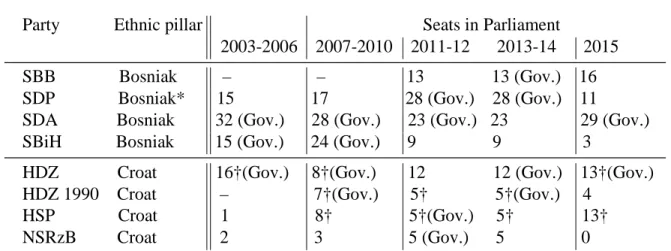
Table 4: Party Competition in Federation of BiH
Party Ethnic pillar Seats in Parliament
2003-2006 2007-2010 2011-12 2013-14 2015 SBB Bosniak – – 13 13 (Gov.) 16 SDP Bosniak* 15 17 28 (Gov.) 28 (Gov.) 11
SDA Bosniak 32 (Gov.) 28 (Gov.) 23 (Gov.) 23 29 (Gov.) SBiH Bosniak 15 (Gov.) 24 (Gov.) 9 9 3
HDZ Croat 16†(Gov.) 8†(Gov.) 12 12 (Gov.) 13†(Gov.) HDZ 1990 Croat – 7†(Gov.) 5† 5†(Gov.) 4
HSP Croat 1 8† 5†(Gov.) 5† 13† NSRzB Croat 2 3 5 (Gov.) 5 0
* Formally multi-ethnic but appeals to moderate Bosniak voters. †Part of a pre-electoral coalition.
Data is from the Central Election Commission and FBiH Agency for Statistics.
By contrast, the Federation has a more complex system in which parties compete for the
electoral support of one ethnic group but must form cross-ethnic coalitions once in office. Party
competition amongst Bosniak parties is vibrant with alternation of governing parties and close
seat shares compared to the Croat subsystem, in which HDZ is the dominant party but has
needed the support of smaller Croat parties to maintain its dominance. Overall, inter-party
competition in the Federation is more volatile and fragmented than in the RS, which has caused
difficulties in coalition-building and led to unpredictable and unstable coalitions that have shifted
within terms.
Accordingly, existing literature would predict that greater party system stability and the
lack of ethnic diversity in the RS would support democratic performance.8 In addition, the RS
8For example, Miguel (2004) and Miguel and Gugerty (2005) find that a shared national identity and lack of ethnic
28
has a more centralized administrative structure in which municipalities are directly under the
entity government, as opposed to the Federation in which contains ten cantons below the entity
level. Finding similar patterns of accountability in both entities would therefore suggest that my
theory is not dependent on the idiosyncrasies of a particular party system, ethnic composition, or
the degree of decentralization.
1.5. Operationalizing Local Democratic Performance and Party Strength
Dependent Variable: Local democratic performance
Local democratic performance refers to the representation of ordinary citizen interests in
the implementation of policies, procedures, and decisions of municipal governments. This
follows the same tradition as Putnam’s (1993) concept of institutional performance, which
focused on how responsive and effective Italian regional governments were to citizens through
policy processes, pronouncements and implementation. I measure the dependent variable as
supporting or undermining local democratic performance. These evaluations are based on two
dimensions that reflect procedural and substantive representation: 1. Political processes follow
democratic principles enshrined in formal rules; 2. Programmatic linkage exists between
politicians and voters, meaning that voters reward and sanction politicians based on public policy
outputs.
The data used to measure this variable relates to a specific institution of local direct
democracy: recalls against mayors. Formally, recalls are an accountability mechanism for
citizens to sanction mayors for their performance in government. They consist of three
successive stages:
1. Initiation by a citizen petition signed by 10% of residents or by one-third of municipal counselors.
29
3. Early election in which citizens vote for a new mayor, elected according to first-past-the-post.
I collected and hand-coded quantitative and qualitative data for each stage, which I obtained
from the archives of the Central Election Commission of BiH, an online media archive, NGO
and IGO reports, and more than sixty interviews with local politicians, political experts, and
other local stakeholders.9
The initiation stage contains qualitative data on democratic procedures and programmatic
linkages. Based on these dimensions, I develop a conceptual typology to operationalize local
democratic performance. According to formal rules, only citizens or municipal counselors may
initiate recalls. This engenders the principal-agent relationship of democratic representation:
Citizens, acting directly or through their local representatives (municipal counselors), act as
principals to sanction their political agents (mayors). However, my theory of partisan
accountability predicts that central-level party officials may also influence local government
performance by coopting local intermediaries, such as municipal counselors. The influence of
political actors at higher levels of government on recall initiation perverts the principal-agent
relationship, turning central party officials into principals who co-opt municipal counselors into
their sanctioning agents. To operationalize this dimension, the rows of the typology include three
possible initiators: citizens, municipal counselors, and central party officials. Next, the columns
indicate the initiator’s motivation for recalling the mayor. I account for two possibilities:
dissatisfaction with the mayor’s policy output, which corresponds to programmatic linkage
9Qualitative sources are listed in Appendix 2 and include: Mediacentar Sarajevo, infobiro.ba; Center for Civil
30
Ini
tia
tor
between mayors and citizens and is therefore supportive of local democratic performance. The
other possibility is that initiators sanction mayors for political reasons and to gain control over
municipal governments.
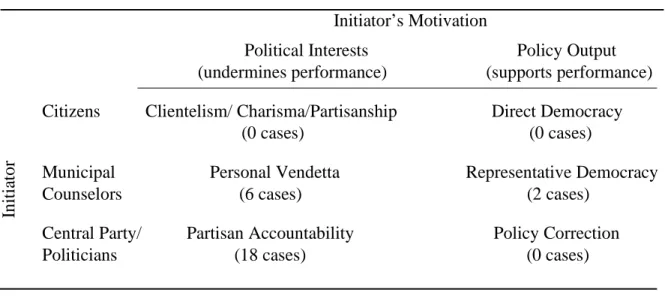
Table 5: Recall Initiation and Local Democratic Performance Initiator’s Motivation
Political Interests Policy Output (undermines performance) (supports performance)
Citizens Clientelism/ Charisma/Partisanship Direct Democracy (0 cases) (0 cases)
Municipal Personal Vendetta Representative Democracy Counselors (6 cases) (2 cases)
Central Party/ Partisan Accountability Policy Correction Politicians (18 cases) (0 cases)
Table 5 presents the conceptual typology for the dependent variable. The cells correspond
to six possible mechanisms by which politicians support or undermine local democratic
performance. The cells in the right-hand column support local democratic performance, as
sanctioning is based on policy outputs. The top-right cell follows a model of direct democracy in
which citizens initiate a recall to remove a mayor because of his public policies. The
middle-right cell indicates a representative democratic model in which municipal counselors initiate a
recall against a mayor whose policies they did not approve. In the bottom right cell, central party
officials sanction mayors. Although this does not follow formal rules, one could imagine a
hypothetical situation in which a mayor’s policies are not representative of citizen interests, but
citizens and counselors are unable to sanction the mayor due to collective action problems or
repressive local governments. In this scenario, involvement from higher levels of government
31
The left columns indicate sanctioning was done for political interests, which undermines
democratic performance. In the top-left cell, citizens sanction mayors because of political
interests rather than policy outputs. This implies some type of non-programmatic linkage such as
clientelism, charismatic appeal, or partisan attachment. In the middle-left column, municipal
counselors initiate due to a political vendetta against the mayor. Finally, if central party officials
influence recall initiation for political reasons, this implies partisan accountability in which
central party officials co-opt municipal counselors into formally initiating the recall for partisan,
rather than citizen, interests.
In total, 26 recalls were initiated between 2005 and 2015.10 I include the number of cases
in parentheses in the typology to illustrate that the observed cases are distributed unevenly across
three of the six cells. Strikingly, only two cases support democratic performance, whereas 24
undermine performance. Furthermore, no recall was initiated by a citizen petition, which
provides strong evidence that citizens are not the main driving force behind recalls. Six cases
were initiated by municipal counselors acting on their own volition. However, the bulk of the
cases, 18, involve central party officials or politicians who led recall initiatives through the
partisan accountability mechanism. In the empirical analysis section, I unpack and compare the
three mechanisms in the typology for which there are observed cases. I examine how
partisanship influences these mechanisms and the specific types of conflicts between mayors and
initiators.
An objection might be raised that recalls, even if prompted by central party officials, are
not necessarily inimical to local democratic performance. However, it is clear both theoretically
10Recalls were legally adopted in 2004 and may not take place during local election years. Local elections took place
32
and empirically that almost all cases do undermine democracy. Theoretically, it is difficult to
imagine that the involvement of central level actors in recall initiations would support the
decision-making autonomy of municipal counselors and have no influence over citizens in recall
referenda. This theoretical notion is supported empirically. I demonstrate this using 26 cases that
were coded based on multiple qualitative data sources and were cross-checked for each
individual case. Indeed it is remarkable that evidence from more than 60 semi-structured
interviews,11 more than 100 print and televised media reports, NGO reports and U.S. diplomatic
cables concur that in the vast majority of cases, politicians initiate recalls for political gain rather
than to remove mayors whose policies harm their local communities.
Independent Variable: Party Strength
Party strength is not a widely used concept in the literature, but scholars routinely refer to
a party’s organizational and electoral strength. I conceptualize the overall strength of a party
according to its wealth of organizational and electoral resources, and I measure them using
standard indicators corresponding to party finance, local branches, seat shares, and governing
status.12 My sample consists of fifteen parties that were included if they were involved in recall
initiations, plus parties that won at least five mayoral mandates.
Organizational Resources
The indicators for organizational resources include party finance and extensiveness of
local party branches. I measure party finance by averaging the party’s annual income from 2012
11Interviewees included mayors, municipal counselors, municipal employees, journalists, academics, representatives
from NGOs and IGOs stationed in Bosnia and are listed in Appendix 2.