MEMORY IN 3-YEAR-OLD CHILDREN WITH AUTISM
Debra M. Childress
A dissertation submitted to the faculty of the University of North Carolina at Chapel Hill in partial fulfillment of the requirements for the degree of Doctor of Philosophy in the Department of Psychology (Developmental Psychology).
Chapel Hill 2008
Approved by:
ABSTRACT
DEBRA M. CHILDRESS: Memory in 3-year-old children with autism (Under the direction of J. Steven Reznick, Ph.D.)
Autism is a severe neurodevelopmental disorder characterized by deficits in
communication and language skills; social behavior; and a restricted range of activities and interests (DSM-IV; American Psychological Association-APA, 1994). Furthermore, it is well documented that individuals with autism display a pattern of deficits and strengths in cognitive ability. Although considerable effort has been applied to investigating memory in autism, agreement has not been reached with respect to the status of almost any aspect of memory functioning in individuals with autism. Furthermore, we know little about the early development of any component of the memory system in autism due in large measure to methodological limitations. These factors leave the status of the characterization of memory abilities in autism as inadequate. The current study examines working memory, long-term memory and language ability in two groups of children: children with autism and typically-developing children matched to children with autism on receptive verbal mental age and gender. Working memory for this study was assessed using two spatial delayed response and two verbal working memory tasks. Long-term memory was examined using deferred
that working memory as measured on spatial and verbal tasks is significantly lower in children with autism. Additionally, children with autism showed significantly lower performance on action and action pairs generated as part of the deferred imitation task. However, both groups of children demonstrated memory gains as demonstrated by a
ACKNOWLEDGEMENTS
There are countless people who have played a role in this project, however there are a few that merit special recognition. I would like to thank my advisor, Steve Reznick, for his support and guidance during my graduate training. Steve’s patient and enthusiastic
mentorship are inspiring. This project reflects his passion for methodology; a passion that I now share. I would also like to thank Joe Piven. Joe’s unwavering faith in my ability contributed to my decision to pursue graduate level training. Furthermore, I would like to acknowledge the other members of my dissertation committee: Peter Ornstein, Patricia Bauer and Neil Mulligan. I could not imagine assembling a more accomplished and wise group to help guide me as I developed and completed this work.
I am very grateful to the families that participated in this project. The willingness of extremely busy parents to volunteer for research always leaves me awestruck.
Finally, my family and friends have provided immeasurable support during this process. I would like to express my sincere appreciation to my parents, who always
TABLE OF CONTENTS
LIST OF TABLES ... vii
Chapter I. INTRODUCTION…..……….………..1
1.1 Memory in autism……….………..………2
1.2 Short-term and working memory in autism………..….…….……..………….4
1.2.1 Short-term memory ………..….………...…………...4
1.2.2 Working memory …… ……….………..…………...…………...6
1.3 Long-term memory in autism ...….…………...…...………...………..……….12
1.3.1 Long-term recognition and recall memory..……….……..…..……...12
1.3.2 Semantic memory and 'savant' memory………...….………..13
1.3.3 Episodic and autobiographical memory…………..………….…….………..14
1.4 Assessment of memory in non-verbal children with autism..………..…….…….….17
1.5 The current study...19
1.6 Goal and hypotheses…….………..………..21
II. METHODS……….23
2.1 Participants... 23
2.1.1 Children with autism………23
2.1.2 Children with typical development………..24
2.3 Measures ….. ... 27
2.3.1 Autism diagnostic measures . ... 27
2.3.2 Standardized measure of development and language ... 29
2.3.3 Working memory measures ... 29
2.3.4 Long-term memory ... 35
III. RESULTS……… ...37
3.1 Data verification and reduction... 37
3.1.1 Working memory measures………..………..……...37
3.1.2 Deferred imitation...…………..…………...……….37
3.2 Data analysis.………...38
3.2.1 Sample characteristics and matching…….………38
3.2.2 Is working memory impaired in young children with autism?...…40
3.2.3 Is long-term memory as measured using deferred imitation tasks impaired in young children with autism?...………...…….…………43
IV. DISCUSSION...45
4.1 Working memory ... 47
4.2 Long-term memory and deferred imitation…...………...………...………51
4.3 Brain development and memory ... 55
4.4 Relevance ... 57
4.5 Toward a developmental model of autism... 57
APPENDIX A: Samples of scoring forms from all working memory measures………67
APPENDIX B: Description of deferred imitation sequences ...71
APPENDIX C: List of actions and action pairs for each deferred imitation task…...……….73
LIST OF TABLES
Table
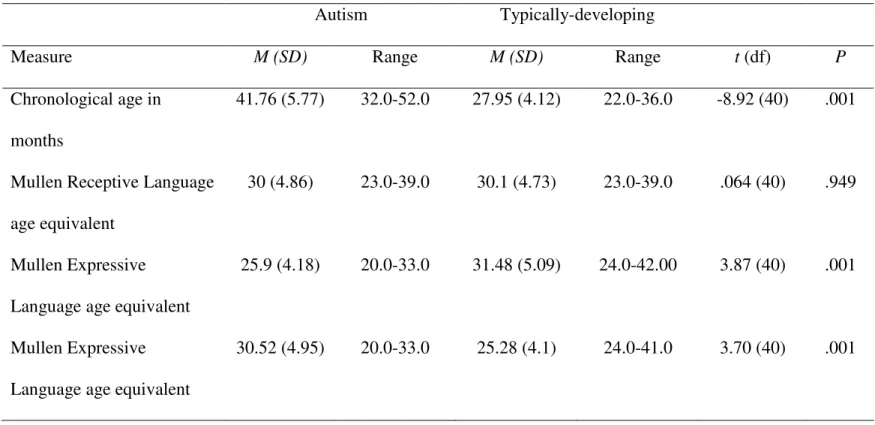
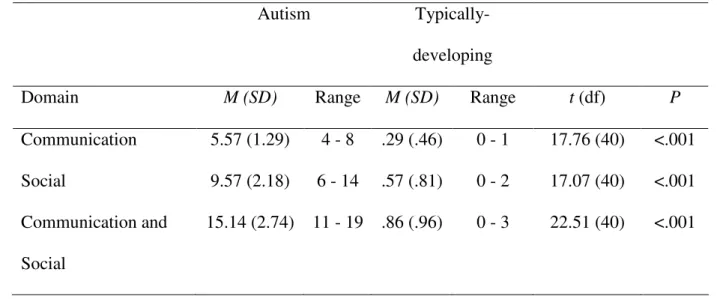
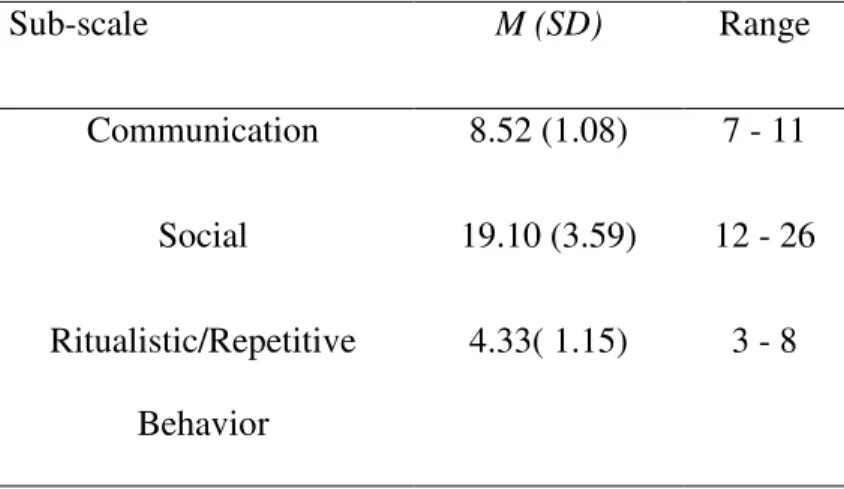
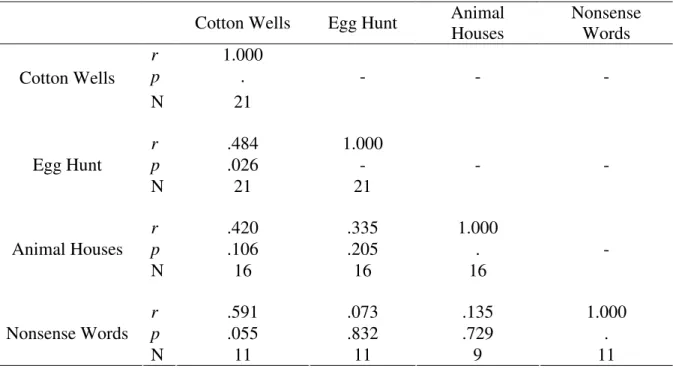
1. Comparison by group on chronological age and Mullen sub-scales……….…….…60 2. Comparison by group on ADOS domains……….…...……61 3. Descriptive statistics for the ADI-R domains………...……..…...…62 4. Comparison by group on working memory tasks……….………...…63 5a. Correlation matrix of working memory tasks for the autism group……..………...64 5b. Correlation matrix of working memory tasks for the
I. INTRODUCTION
Autism is a severe neurodevelopmental disorder characterized by deficits in three main domains: (1) communication and language skills; (2) social behavior; and (3) a restricted range of activities and interests (DSM-IV; American Psychological
Association-APA, 1994). Behavioral heterogeneity in each of the core domains can be found across individuals with autism. For example, 50% of children with autism remain mute throughout their life, while other individuals with autism are affected by more subtle pragmatic language deficits. In the social domain, some children exhibit extreme aloofness or avoidance of others while other children express interest in social interaction but have difficulty learning and applying social rules. Finally, repetitive behaviors may be expressed as part of motor stereotypies, a pronounced preference for sameness or elaborate routines that cause significant distress when interrupted. Furthermore, although cognition per se is not included among the three core diagnostic descriptors of the
disorder, it is well documented that individuals with autism display a pattern of deficits and strengths in cognitive ability. For example, 70% of individuals with autism have some degree of mental retardation (Fombonne, 2003). Paradoxically, 10% of individuals with autism are reported to have a “savant” or special skill, defined as an ability that far exceeds expectations based on the person’s IQ such as calendrical calculation or
Descriptions of human cognition are inherently complex, encompassing a vast array of processes such as memory, attention, perception, problem solving and mental imagery, to identify just a few, and researchers and clinicians have investigated each ofthese domains to discover the role that it might play in autism symptomatology (Pascualvaca, Fantie, Papageorgiou, & Mirsky, 1998; Garretson, Fein, & Waterhouse, 1990; Leslie & Thaiss, 1992). The status of memory function in autism is unique in that it has been characterized as both a primary source of autism symptomatology, such as in the amnesia theory (DeLong, 1992) and a secondary source, in that it reflects a more generalized cognitive deficit that transcends memory, such as in executive function deficits (Williams, Goldstein, Carpenter, & Minshew, 2005). Although considerable effort has been applied to investigating memory in autism, agreement has not been reached with respect to the status of almost any aspect of memory functioning in individuals with autism. Furthermore, while efforts aimed at early identification of children with autism have been increasingly successful, we know little about the early development of any component of the memory system in autism due in large measure to methodological limitations. These factors leave the characterization of the status of memory abilities in autism as inadequate.
1.1 Memory in Autism
Kanner did not provide expansive descriptions of the cognitive profiles of the eleven children in his original description of autism, but he did emphasize the memory abilities of the children (Kanner, 1943):
Their excellent rote memory, coupled with the inability to use language in any other way, often led the parents to stuff them with more and more verses,
of communication- was deflected in a considerable measure to a self sufficient, semantically, and conversationally valueless or grossly distorted memory exercise. To a child of 2 or 3 years old, all these words, numbers, and poems (questions and answers to the Presbyterian Catechism; Mendelssohn’s violin concerto; a French lullaby; an encyclopedia index page) could hardly have more meaning than sets of nonsense syllables to adults, (p. 230)
Clearly, the role of memory has been in question from the beginning of efforts to understand autistic symptomatology. Although there are numerous accounts of
exceptional memory abilities in children with autism (Mottron et al., 1998), the pattern of spared and deficient functions seems to be present across the autism spectrum.
A detailed discussion of memory must start with a definition for the broad construct. Memory is the aspect of cognition that refers to the representation, storage, control, maintenance, retrieval, and use of various kinds of information including, but not limited to, aspects of experience (Pelphrey & Reznick, 2003). Although theories in autism have rarely focused primarily on memory, with the notable exception of the amnesia theory, understanding the development of memory in autism is of critical
relevance to understanding the underlying etiology of the disorder, as well as, providing a point for intervention. In fact, from an intervention perspective, the unique pattern of intact and impaired abilities may provide both tools for intervention, through intact abilities, and opportunities for intervention, through impaired abilities.
audience. However, it should be noted that any account of memory development would ultimately have to integrate all of the memory systems regardless of the classification system used.
1.2 Short-term and working memory in autism
Short-term memory refers to the process through which information is temporarily stored before being acted upon, transferred to long-term memory, or
discarded from memory. Short-term memory can be contrasted with working memory, in which temporarily stored information is manipulated, thus contributing to the
performance of cognitive tasks such as language comprehension, reasoning, decision-making, problem solving, and mental arithmetic (Baddeley, 1986, 1992; Baddeley & Hitch, 1974). The examination of short-term and working memory in autism has largely been embedded in the investigation of executive dysfunction , although support for the absence and presence of short term and working memory deficits have been generated by almost all of the major theoretical perspectives (Minshew & Goldstein, 2002; Bennetto, Pennington, & Rogers, 1996; Ozonoff & McEvoy, 1994; Hill and Russell, 2002). 1.2.1 Short-term memory
verbal recall (i.e., repeating high-frequency nouns immediately after presentation) and nonverbal recall (i.e., pointing to pictures of verbally presented words), the performance of children with autism was superior to that of children with moderate learning
difficulties. Carpentieri and Morgan (1994) did not find impaired performance on a verbal short-term memory task when the performance from a group of low-functioning children with autism was compared to a group of children with mental retardation. Minshew and Goldstein (2002) did not find significant differences between adults with high-functioning autism and typically developing controls on short-term auditory memory tasks or immediate recall of words presented as part of a paired associate task. Notably, span tests of words and instructions produced significant differences in the autism and comparison groups while span test of letters did not (Minshew and Goldstein, 2002). These results suggest that the complexity of the material influences task
performance in individuals with autism more severely than in typically developing individuals. However when considering results that rely on the complexity of material, complexity must always be considered in relation to an individual’s knowledge base. That is, what is complex for one individual may not represent the same level of
typically developing children (Buitelaar, van der Wees, Swaab-Barneveld, & van der Gaag, 1999), and no difference in performance was found among the groups.
Short-term visual recognition memory also appears to be intact in autism. Barth, Fein, and Waterhouse (1995) found that four- to five-year old high- and low-functioning children with autism, subjects with developmental language disorders, and those with mental retardation, all performed similarly on visual recognition memory tasks, when co-varied on nonverbal intelligence. Visual memory recall was tested in three groups of children: children with autism, children with PDD-NOS and a group of typically developing children from the previously mentioned study by Buitelaar and colleagues (Buitelaar et al., 1999). No difference in performance was found among the groups. Carpentieri and Morgan (1994) also found unimpaired performance on a visual spatial short-term memory task when comparing performance from a group of low-functioning children with autism to a group of children with mental retardation.
In summary, individuals from childhood to adulthood, and across the autism spectrum, seem to display consistently intact short-term phonological and visual recognition memory abilities, and this pattern of results is consistent regardless of comparison group, (see Burack, 2004, for a review of the implications of comparison group selection).
1.2.2 Working memory
processing of representations, often in the face of distraction and interference, and the use of those representations to plan and constrain goal-directed behavior (Baddeley, 1986). Although the role of working memory has been examined as part of executive
dysfunction and information processing models of autism, the results of working memory studies in autism have been inconsistent.
Evidence supporting working memory impairment in autism was initially
provided through studies of performance on Tower of Hanoi and London tasks (Ozonoff & McEvoy, 1994; Ozonoff & Strayer, 2001). Because these tasks require the participants to generate and hold potential moves in memory while considering other moves, they havebeen considered tasks of working memory (Ozonoff, Pennington, & Rogers, 1991). Tower of Hanoi (or London) performance has been found to be significantly impaired in several studies (Ozonoff et al., 1991; Bennetto et al., 1996; Ozonoff & McEvoy, 1994; Hughes, Russell, & Robbins, 1994) and remains one of the most robust and consistent findings in support of executive dysfunction in autism (Ozonoff & Strayer, 2001). Additional evidence for impaired working memory also emerged in a group of high-functioning adults with autism who completed two verbal working memory tasks: a counting and a sentence span task (Bennetto et al., 1996). These results remained even after verbal short-term memory was co-varied. In contrast, Russell et al. (1996) did not find working memory deficits, as measured by dice counting and sentence completion tasks, in a comparison of children with autism and matched children with mental retardation.
administered delayed non-match to sample and delayed response tasks to children with autism then compared their performance to children with Down syndrome and typical development. Delayed non-match to sample and delayed response tasks have been used extensively to study nonverbal working memory in typically developing children (for a review see Reznick, 2007). Young children with autism, aged 3 to 4.5 years old, performed significantly worse on both tasks compared to both comparison groups (Dawson et al., 1998). This finding is supported by evidence from non-human primate studies in which delayed non-match to sample tasks were found to be deficient in primates who had received a medial-temporal lesion (Bachelavier, 1994). A different study completed with adolescents and young adults with autism found deficits in spatial working memory as measured by an occulomotor delayed response task (Minshew, Luna, & Sweeney, 1999). This task assesses the capacity for making a saccadic eye movement to the location of the target previously presented in the periphery and has been widely used in primate and human research to define the circuitry of the prefrontal cortex (Minshew et al., 1999).Landa and Goldberg (2005) found that adolescents with high functioning autism were impaired on a spatial working memory task when the working memory load was high (6- and 8- locations that could be searched) but they were not impaired when the load was low (3- and 4- search locations).
evidence emerged in a study of working memory by Ozonoff and Strayer (2001). In this study, three computerized tasks of spatial working memory were presented to groups of children with autism, Tourette syndrome and typical development. Although there were significant effects of memory load and delay, no working memory parameter interacted significantly with the group variable (Ozonoff & Strayer, 2001). The authors suggest that the pattern of inconsistent results from working memory tasks may be accounted for by the computerized format of the tasks. Specifically, tasks administered by humans, which required some degree of social interaction to indicate correct response, amplify a
cognitive impairment that may otherwise be borderline (Ozonoff & Strayer, 2001). However, the spatial task used by Landa and Goldberg (2005) was also computerized and this study found evidence for working memory deficits when memory load was greater. Ozonoff and Strayer (2001) also suggest that mixed results in the literature on working memory may be due to sample specific characteristics. That is, older and
high-functioning individuals with autism do not display, or perhaps no longer display, working memory impairment. Although not mentioned by the authors, it is possible that working memory load may have to be increased to cause the task scores of the individuals with autism to diverge from those of mental age matched controls. This would be consistent with the complex information-processing model of Minshew and Goldstein (1998) and the results obtained as part of the Landa and Goldberg (2005) study.
Additional insights can be gained from two recent studies by Williams and
groups, thus producing results across different dimensions of working memory in the same individual. In the first study (Williams et al., 2005), high functioning adolescents and young adults with autism had a spatial working memory deficit when task demands were complex (Williams et al., 2005). Specifically, the adults with autism performed as well as typically developing individuals except when the subtests involved social stimuli (e.g., memory for faces and memory for social scenes) or spatial working
memory-stimuli that were also high in information-processing demands (Williams et al., 2005). In the most recent study, Williams et al. (2006) tested the same hypotheses in a group of children with high-functioning autism and a verbal mental-age matched comparison group. Consistent with data from the adults tested in the previous study, children were shown to have poor spatial working memory but intact verbal working memory
(Williams et al., 2006). Interestingly, in a discriminant function analysis, spatial working memory was one of the factors that discriminated most accurately between the autism and control groups (Williams et al., 2006).
The combination of intact short-term memory with impaired working memory previously described in individuals with autism (Bennetto et al., 1996) provides an elegant illustration of the importance of preserving the distinction between short-term memory and working memory, a distinction that is frequently overlooked in discussions of memory. Of importance for autism, information addressing the development of distinct but interrelated systems (e.g., short term versus working memory, verbal versus spatial working memory) may provide insights into underlying neural relationships.
evidence for verbal and non-verbal working memory deficits across age and level of functioning. This pattern of inconsistent findings on verbal and non-verbal working memory tasks is not altogether surprising given the variability in task demands used with individuals in different levels of functioning, age ranges, and comparison groups used in the studies. Variability in task demands is often related to how working memory is defined. That is, how ‘work’ is instantiated in a working memory task has critical implications for outcomes. Ensuring that the limits of the system are being taxed seems to be critical in at least some of the studies of autism (Minshew & Goldstein, 1998; Landa & Goldberg, 2005). Furthermore, task demands, as illustrated previously by Ozonoff and Strayer (2001), are often more complex than previously recognized, and they vary along dimensions that are not yet under explicit investigation (i.e., language, attention, or social engagement).
Of note, the investigation of working memory performance in autism may be unique among executive processes as something that can be empirically investigated from infancy through adulthood. The importance of working memory as an early emerging executive process has been established in studies of typical development. For example, Reznick and colleagues (Reznick, Morrow, Goldman, & Snyder, 2004) have identified the onset of working memory in typically-developing infants to occur at approximately five to six months. This is long before other executive processes that are impaired in autism come online. With increased emphasis on early identification through screening (Reznick, Baranek, Reavis, Watson, & Crais, 2007; Gillberg, Ehlers,
autism, we have the opportunity to capture the developmental origins of perhaps the earliest emerging executive function.
1.3 Long-term memory in autism
In contrast to short-term memory, long-term memory has a limitless capacity and in some sense contains everything that a person knows. However for information to be stored in long-term memory, it must be encoded, and for it to be used, it must be
retrieved. Over time, memories may decay or become unaccessible. In fact, performance on tasks that tap long-term memory can be adversely affected by problems with
encoding, storage and retrieval.
The phenomenal long-term memory ability of certain individuals with autism has fascinated people since Kanner first described the disorder. Although savant memory skills are somewhat rare in autism, the majority of individuals with autism display a unique pattern of impaired and intact long-term memory functions that appears to be unrelated to overall intellectual ability. Specifically, episodic memory, including
autobiographical memory, tends to be impaired in autism while procedural and semantic memory remains intact.
1.3.1 Long-term recognition and recall memory
increasingly complex recognition stimuli including word lists, word pairs, and stories. Results from both of these studies are consistent with numerous other reports of intact memory function on simple recognition memory tasks (Hala, Rassmussen, & Henderson, 2005; Bennetto et al., 1996; Griffith, Pennington, Wehner, & Rogers, 1999; Ozonoff & Strayer, 2001; Russell et al., 1996) and may represent one of the most stable findings in the literature on memory in autism.
Salmond et al. (2005) also investigated long-term recall memory and found that children with autism had relatively intact recall memory for material previously presented in the testing session when compared to mental age matched typically-developing
children on tests of word list and word pair recall. This result is consistent with numerous other reports of intact memory function on simple recall memory tasks (Minshew,
Goldstein, Muenz, & Payton, 1992; Minshew &Goldstein, 1993; Bennetto et al., 1996). 1.3.2 Semantic memory and ‘savant’ memory
Semantic memory, defined as the memory for facts or world knowledge, (Tulving, 1972) appears to be unimpaired in individuals with autism based on the majority of studies to date. Barth et al. (1995) found both visual and verbal memory impaired in high- and low-functioning children with autism. However, the most severe impairments were noted on verbal tasks that required semantic organization of
typically-developing peers. In contrast, several other recent studies have reported intact recognition and recall for semantic material in individuals with autism. In a study by Minshew and Goldstein (1993), individuals with autism had intact recall and recognition memory. As part of their previously cited study, Salmond et al., (2005) found that children with autism had intact semantic memory, as measured on the Pyramids and Palm-trees Test and Wechsler test Information, Vocabulary and Similarities subtests (WISC-III; Wechsler, 1991 ) when compared to mental age matched typically-developing children. Ben-Shalom (2003) noted that memory for facts is generally a strength in
individuals with high-functioning autism.
Further evidence of intact semantic memory comes from reports of individuals who have extremely strong memory skills for specific types of information. It is a relatively common clinical occurrence to encounter a child or adult who knows countless facts on a highly specific topic (e.g., all of the statistics for the New York Yankees since 1945, or mailing addresses for all of his classmates). However, little is known about the development of these types of memory skills (Heaton & Wallace, 2005). Although prodigious memory abilities are often present from extremely early in development, it is unclear what facilitates these abilities given relative weaknesses in many modes of acquiring and organizing information. It may be notable that these special memory abilities are often related to topics that are either highly organized at the outset or lend themselves to this type of organization, which is consistent with Baron-Cohen’s empathizing-systemizing theory (Baron-Cohen & Belmonte, 2005).
Episodic memory refers to the memory for events and episodes (Tulving, 1972). Autobiographical memory is a type of episodic memory in which the memory is
personally relevant (i.e., the rememberer is part of the event). An early study of episodic memory in autism (Boucher, 1981) reported that high-ability children with autism remembered significantly less about recently experienced events than normal age-matched and mentally retarded age- and ability-age-matched comparison groups. She proposed that, as a result, children with autism might encode less information from a complex stimulus such as social interaction or conversation. Millward, et al. (2000) extended this finding and discovered that children with high-functioning autism have a specific deficit in recall of personally experienced events. In fact, children with autism remembered more about an event that happened to another person than they did when the event happened to them without another person present. Therefore, the problem is not with recall per se, but rather, with how memories are formed when the child with autism is the agent of action (Millward, Powell, Messer, & Jordan, 2000). Similar results were found in a study with low-functioning adults with autism (Klein, Chan, & Loftus, 1999). Specifically, there was impaired access to personal experiences but there was intact knowledge of personal traits.
Bowler, Gardiner, and Grice (2000) reported more ‘know’ (related to semantic memory) and fewer ‘remember’ (related to episodic memory) responses during
mental age matched typically-developing children. The Rivermead Behavioral Memory Test includes subtests such as remembering a name, an appointment, a belonging, a route around the room; remembering to deliver a message; and orienting to time and place. These results are consistent with earlier evidence of impaired memory for recent events reported by Boucher (1981).
To summarize: individuals with autism tend to have impaired performance on episodic memory tasks but relatively preserved abilities on simple memory tasks or tasks that rely on ‘rote’ or semantic memory. Impaired episodic memory appears to be related to the complexity of the information, available encoding and recall strategies, and
difficulties in temporal processing. As with studies of short-term memory, increased emphasis on early identification through screening (Reznick et al. 2007; Gillberg et al., 1990) and studies of ‘at-risk’ infant siblings of children with autism will provide the opportunity to explore the development of long-term memory. However, finding tasks appropriate for the range of long-term memory components in infants who cannot recount their experiences verbally presents a challenge. The earliest precursor might be found in studies of deferred imitation (Bauer, Werner, Dropik, & Wewerka, 2000; Carver & Bauer, 2001). Though not sufficient to cover all aspects of long-term memory, the
(Bauer, Wiebe, Carver, Waters, & Nelson., 2003). Tasks tapping this early emerging analogue to verbal reporting will be critical for constructing a developmental account of long-term memory and the underlying neural representation. This task is all the more critical given the emerging evidence suggesting that brain development in autism starts to go off-course before the second birthday (Hazlett, Poe, Gerig, Smith, Provenzale, Ross, et al., 2005; Courchesne, 2002), and thus before any behavioral measure of long-term memory has been applied in autism.
1.4 Assessment of memory in non-verbal children with autism
Because half of the children with autism are mute and the other 50% have language difficulties (as expected given the defining criteria of the disorder), it is imperative to develop tasks that can tap memory abilities in children who do not have strong verbal skills. This same obstacle faces researchers interested in infant and toddler development. For example, there is an active debate surrounding the onset of
Some modifications will be necessary to make tasks used with
typically-developing infants and toddlers applicable for studies of non-verbal children with autism. Researchers must employ tasks and stimuli that engage a child who may not otherwise be interested in the social components of the task, components that would be highly
motivating for a child who is developing typically. For example, playing ‘peek-a-boo’ with a child as part of a windows and curtains procedure, where the examiner makes eye contact with the child as part of a delayed response task, has been shown to activate prefrontal areas used in working memory tasks with typically-developing infants. The examiner provides an extremely salient stimulus for typically-developing children. However, children with autism may find the interaction to be less compelling or even aversive. Therefore, use of these social stimuli as part of a delayed-response paradigm may underestimate the child’s ability, not because of memory deficits but because of a lack of interest in the stimuli.
Furthermore, the task characteristics will need to capitalize on the child’s motor abilities and attention. Although the young child with autism may be processing information in a capacity similar to a younger toddler or infant, he will likely have age appropriate gross motor skills that will affect the manner in which he may demonstrate the capacity. For example, an infant may sit and watch repeated presentations of a delayed-response task, but a child with autism is unlikely to remain seated for long periods of time, even though this type of task is cognitively appropriate. Of course, it is important to note if a child has difficulty attending to social stimuli, but without
that children develop, and they present even greater obstacles when the goal is to
understand development in children with atypical development. For evidence, consider not only proposed difficulties in the delayed response task described above but also the conflicting evidence from computer versus human administered tasks. It is likely that even the most carefully designed and seemingly straightforward task will require the integration of multiple behaviors for successful task performance, and sorting out the contributions of each factor will undoubtedly be an enormous challenge.
Because we are becoming able to identify children with autism at younger and younger ages, and thus long before children have verbal fluency, we must construct appropriate tasks for assessing cognitive abilities in order to attain a full account of development. From this perspective, the biggest obstacle in autism research may be finding methods that are appropriate across the relevant age and abilities, and that can be used to describe development longitudinally. Without non-verbal tasks of cognitive development, we cannot construct an ontogeny of memory processes and determine the timing of the onset of memory differences in autism.
1.5 The current study
Working memory for this study was assessed using spatial and verbal working memory tasks. This strategy was selected to address the contradictory pattern of findings from older children with autism suggesting that spatial working memory is impaired, but verbal working memory may be intact (Williams et al., 2005). Two spatial working memory measures that utilize a delayed-response design, one verbal working memory measure, and one measure that could be performed using spatial and/or linguistic cues were administered.
Long-term memory was examined using a deferred imitation paradigm. This well-established paradigm, in which children observe a unique sequence of actions and are later asked to repeat the sequence, has been used extensively with typically
developing children from infancy through early childhood (Bauer et al., 2000; Cheatham & Bauer, 2005). Additionally, it has been used with infants of diabetic mothers (DeBoer, Wewerka, Bauer, Georgieff, & Nelson, 2005), children who use American Sign
Language (West & Bauer, 1999), children with developmental amnesia (Adlam, Vargha-Khadem, Mishkin, & de Haan, 2005), and infants with low birth weight (de Haan, Bauer, Georgieff, & Nelson, 2000). For this study, children were presented with four four-sequence events: two arbitrary (no clear relationship between the actions in the four-sequence) and two enabling (actions that needed to be completed in order for the subsequent action to be completed) sequences. All sequences were designed to maximally engage
participants with autism. Imitation is a weakness in children with autism (Charman et al., 2003, McDuffie et al., 2005; Dawson, 1984; Charman, 1994), however most
Furthermore, imitation has not been adequately examined as a cognitive precursor to memory in studies of autism.
A standardized test of language and cognition (Mullen Scales of Early Learning) and clinical assessments of autism (Autism Diagnostic Observation Schedule and Autism Diagnostic Interview-Revised) were performed to provide descriptive information about the participants.
1.6 Goals and hypotheses
This project addresses two primary goals:
Goal 1: To evaluate spatial and verbal working memory performance in young children with autism as compared to a group of verbal mental aged matched typically-developing children.
Questions and Hypotheses:
1A. Are spatial and verbal working memory impaired in young children with autism when language level is partialed out?
i. Children with autism will show significantly lower performance on all working memory tasks when compared to verbal mental age matched children.
autism as compared to a group of verbal mental aged matched typically-developing children.
Questions and Hypotheses:
2A. Is long-term memory as measured on deferred imitation tasks impaired in young children with autism?
i. Children with autism will show significantly lower performance on deferred imitation tasks involving arbitrary sequences but not on enabling sequences when compared to verbal mental age matched typically
II. METHODS 2.1 Participants
2.1.1 Children with autism
Thirty-one children (24 males/ 7 females) with a known diagnosis of autism between the chronological ages of 23 and 52 months (2.0 to 4.5 years) were screened for possible inclusion in this study. Ten children (9 males/ 1 female) from this group were excluded from participation: 5 did not meet diagnostic cutoff for autism on the ADI-R or ADOS and 5 could not complete the testing battery due to noncompliance or falling below a verbal mental age of 18 months. Twenty-one children (15 males/ 6 females) with a known diagnosis of autism between the chronological ages of 32 and 52 months (2.5 to 4.5 years) were included in this study.
The diagnosis of autism was verified with the Autism Diagnostic Observation Schedule (ADOS; Lord et al., 2000), the Autism Diagnostic Interview-Revised (ADI-R; Lord, Rutter,& LeCouteur, 1994), and according to DSM-IV diagnostic criterion (APA, 1994). Specifically, children with autism had to meet the diagnostic algorithm cut-offs on the ADI-R and ADOS.
2.1.2 Children with typical development
Twenty-one children with no known diagnosis of autism, or family history of first-degree relatives with a diagnosis of autism, were matched to participants with autism based on verbal mental age and gender. Typically-developing children’s chronological age ranged from 23-36 months. In addition to the twenty-one children included in the study, fifteen children (12 males/ 3 females) were screened but excluded: 9 children had scores greater than 1.5 SD on the Mullen Expressive Language subscale and 6 children could not be matched to any of the participants with autism.
Typically-developing children were matched to children with autism based on the Mullen Scales of Early Learning Expressive Language subscale. Typically-developing children with scores ±1.5SD were not considered for matches.
The ADOS was administered to the typically-developing children following standard administration protocol. Children who had scores in any diagnostic algorithm domain falling in the autism spectrum or autism range would not be included in the study. No children were excluded due to elevated ADOS scores.
2.2 Design and procedure
Multiple tasks were used to examine working memory and long-term memory. Parents were invited to bring their child to our laboratory at UNC Family and Community Research Center in Chapel Hill, North Carolina or, if they preferred, testing could take place in their home. Eighty of participants with autism and 65% of children with typical development were seen in their homes. We encouraged parents to select the environment that they felt would be best for their child. The UNC research space is child friendly, however, some children with autism and typically-developing children, are
Observation Schedule (ADOS) were administered in the first visit. The second one-hour visit was scheduled to occur within 3 weeks of the first visit. During the second visit children were presented with two of the short/term working memory tasks (Egg Hunt and Animal Houses) and two of the deferred imitation sequences (Ramp and Train). The third one-hour visit was scheduled to occur 1-7 days after the second one-hour visit. During the second visit, children were presented with the remaining tasks: two short-term working memory tasks (Cotton Wells and Nonsense Words) and two of the deferred imitation sequences (Funnel and Boat). If the child could not complete the tasks
scheduled for any visit due to fussiness or fatigue, those tasks were completed in the next visit. A fourth visit was required for 15 children (10 with autism and 6 with typical-development). All visits were scheduled to accommodate the participant’s schedule, and the child’s parent was present for all testing, usually sitting in a chair in the room away from the activities but available to the child, if needed. At the beginning of the first testing session, the parent read and signed the informed consent document. The parent was encouraged to ask questions about the study. Parents were informed that they could discontinue their child’s participation at any time, without any penalty. No parent took advantage of this opportunity.
Each child’s actions and responses were recorded by video camera. Videotapes were used for scoring responses and verifying live codes. The experimenter coded the child’s responses on the short term/working memory activities as the trials progressed; the videotape of the session was referenced to resolve any discrepancies and for scoring the elicited imitation activities.
2.3 Measures
2.3.1 Autism diagnostic measures
Autism Diagnostic Observation Schedule (ADOS; Lord, Risi, Lambrecht, Cook, Leventhal, DiLavore, et al. (2000). The ADOS is a semi-structured direct assessment designed to evaluate individuals suspected of having autism. It is appropriate for use with individuals from a broad age spectrum (toddlers to adults) and with a range of language ability (no speech through verbal fluency). The ADOS consists of various activities and associated toy materials that allow the assessor to create situations to observe social and communication behaviors in an enjoyable and fun environment. These activities provide interesting, standard contexts in which interaction can occur. Administration of the ADOS requires that the assessor follow a hierarchy of behavioral presses aimed at allowing the child to make and follow social and communication overtures.
Administration of the ADOS occurred during the first visit. Due to the age and language levels of the children only two of the modules were used: Module 1 for children with no speech through simple phrases and Module 2 for children with simple phrases through verbal fluency. Following administration, behavioral codes were recorded and the diagnostic algorithm scores computed. All administration and scoring of the ADOS was completed by an individual who had completed reliability training with the
instrument developer (80% reliability on the complete protocol and algorithm from three administrations). Parents of children with autism who meet algorithm cutoffs for autism were administered the Autism Diagnostic Interview-Revised (ADI-R). Four children with a clinical diagnosis of autism did not meet ADOS algorithm cut-offs for autism, so they were excluded from the study. No typically-developing children were excluded due to meeting autism spectrum or autism cut-offs on the ADOS.
Autism Diagnostic Interview-Revised (ADI-R; Lord, Rutter, &, LeCouteur, 1994).
The ADI-R was performed with a parent of participants who met or exceeded the diagnostic algorithm cutoffs for autism on the ADOS. Because of the length of time required to complete the ADI-R, the parent was interviewed in a session separate from the child visits. Parents were given the option of completing the interview in our laboratory or in their home. Eighty percent selected to have the interview done in their home. Following administration, behavioral codes were recorded and the diagnostic algorithm scores (i.e., communication, social and ritualistic/repetitive behavior) were computed. All administration and scoring of the ADI-R was completed by an individual who had completed reliability training with the instrument developer and who
demonstrated 90% reliability on the complete protocol and algorithm from three administrations.
2.3.2 Standardized measure of development and language
Mullen Scales of Early Learning (Mullen Scales). The Mullen Scales consist of five scales aimed at providing a broad assessment of early cognitive and motor
development by tapping fundamental abilities such as attending to a picture, matching objects, the ability to attend to sounds and/or simple questions, and the ability to produce sounds and/or words. The five scales measure gross motor, fine motor, visual reception, expressive language and receptive language skills in children from infancy through 5 years and 8 months of age. Due to time constraints, children were not administered the gross or fine motor scales. For each subscale, a T-score, percentile rank, and age equivalence was generated. Each child was given the Mullen Scales in the first visit following standard testing procedures for the instrument.
Sample score sheets for all working memory games can be found in Appendix A.
Cotton Wells Game. This task is a modification of a task that Newcombe and colleagues used to examine children’s ability to represent the spatial location of a hidden object (Newcombe, Huttenlocher, Drummery, & Wiley, 1998; Huttenlocher, Newcombe, & Sandberg., 1994). We altered the task to increase the demand placed on working memory.
A rectangular plastic box (18” x 30” x 6”) filled with cotton balls was placed in front of the child. The box was covered with a black, felt board that has either three or five 5” diameter holes in it. The cover prevents the child from accessing multiple
locations simultaneously. The child was positioned equal distance from either end of the box. An item that interests the child was selected from a collection of toys. That item was buried in the cotton balls by the examiner through one of the holes as the child watched. The child was then encouraged to find the object by digging in the cotton with his/her hand after a brief delay. During the delay the child was distracted from the apparatus to keep him from focusing his attention on the location where the toy was hidden.
This task was developed through a prior study of 27 month-olds to have
the teaching trials, then the game was discontinued. Following the teaching trials, a starting level was selected. It was up to the experimenter’s judgment to select the most appropriate level based on the specific child; for typically developing children age-related starting levels were suggested. For example, a 3 year-old child with autism would not generally start the task at the same level of difficulty as a child with typical development. The structure for this task is similar to many tests of cognitive development and allows performance to be assessed with less child fatigue and performance frustration. Each level of the task has three trials. If the child gets at least two trials correct in a level then he advances to the next level. When the child reaches a level where he is no longer getting at least two trials correct, the game is ended. If he gets at least one trial correct in any level, he is given partial credit for that level (reflected as .5 on his score). If the level selected for a child is too difficult (i.e., the child gets fewer than 2 correct) then the experimenter goes back two levels or to the easiest level, which ever is appropriate. By going back two levels, the experimenter has a greater chance of selecting a level in which the child will be proficient and will reduce the likelihood of the child disengaging from the game because of frustration. This procedure can be repeated as needed (i.e., if the child fails the newly selected level).
The hiding location of the toy is predetermined for each trial. Each participant’s reach responses were coded for all administered trials and a maximum level of
performance was determined (ranging from 0.0 to 6.0).
introduced to the child, “This is where the _____ lives,” as the child watched the
examiner place each of the animal tokens in the appropriate houses; the matching tokens were reserved by the examiner. The houses were then closed (i.e., the roof was placed on top of the ‘house’ so that the child cannot see the animal inside). Following a brief delay, the child was presented with one of the tokens and asked to identify the house that the particular animal lived in: “Where does the _____ live?” The child could respond by pointing to the house or lifting the roof from one of the houses. After the child responded, the houses were rearranged and the procedure was repeated.
event that the child did not complete the teaching trials, then the game was discontinued. Following the teaching trials, a starting level was selected based on the experimenter’s judgment. The experimenter was conservative in selecting a starting level as children can easily lose interest if the game demands exceed their skill level too rapidly. Each level of difficulty had three trials, and to advance to the next level the child must get two trials correct. Children who were correct on at least one trial in any level were given partial credit for that level (reflected as a score of .5). Scores on the game ranged from 0.0 to 6.0.
Egg Hunt Game. The child was asked to sit on an appliqué that was placed on the floor and that pictured a flower, racecar or train. The examiner then placed a row of opaque plastic containers approximately 24 inches in front of the child such that the containers were out of easy arm’s reach but the entire array was visible. The containers were placed approximately 8 inches apart to discourage a child from selecting two containers simultaneously. A transparent egg containing a highly motivating treat or an interesting toy was placed under one of the containers as the child watched. The child was then encouraged to find the object by lifting the container following a brief delay. During the delay, the child was distracted from the array to preclude the possibility of attending to the location where the food/toy was hidden.
experimenter’s judgment for each child. Each level of the task had three trials. Children who got at least two trials correct in a level then advanced to the next level. When the child reached a level where errors predominated, the game ended. Children who had one correct trial in any level were given partial credit for that level, reflected in a scored of .5. If the level selected for a child was too hard (i.e., the child had fewer than 2 correct trials) then the experimenter went back two levels or to the easiest level, whichever was appropriate. By going back two levels, the experimenter had a greater chance of
selecting a level in which the child was proficient and reduced the likelihood of the child losing interest in the game because of frustration. This procedure could be repeated as needed (i.e., if the child failed the newly selected level).
The hiding location of the food/toy was predetermined for each trial. Each participant’s reach responses were coded for all administered trials and a maximum level of performance was determined ranging from 0.0 to 6.0.
Nonsense Word Repetition. Each child was asked to repeat a series of nonsense words (i.e., a word with no known meaning but that follows English linguistic rules). Strings of nonsense words contained 1 to 6 words (e.g., tur ug; sah poe voor; tonk voo pur ug). Each word or word string was presented two times, and if the child did not respond then the next item was presented. The words were presented with the aid of puppets or child-safe objects to enhance the child’s attention and interest in the game. The child was asked to repeat several common words before the nonsense words began to establish general understanding of the task.
level four contained four four-word trials; and level five contains four five-word trials. There was no delay between presentation of words and repetition. If the child missed two or more word strings in a level, the game was concluded. Each child started at the same level of the game and was presented trials until errors occurred in more than two trials in any level. Responses were recorded on a data sheet. Each child was given an overall score based on the complexity of the word strings repeated (i.e., one- to five-word strings), on a scale of 0.00 to 5.00 with scores increasing by 0.25 increments. 2.3.4 Long-term memory
Deferred Imitation. This task began with introductory phase in which the child was given the opportunity to observe and imitate a simple sequence such as putting a ball in a cup and pressing a leaver to make it pop up. When the child demonstrated
the child was quietly engaged with a toy or other object of interest. Following the delay, the tray was re-introduced to the child. The child was encouraged to use the items again: “Remember what we did?” The child was then given encouragement such as “good job” or “what else can you do” during the imitation period regardless of whether the child was performing the target actions. The examiner did not label specific activities or actions. The task was concluded when the child completed the sequence or was no longer
III. RESULTS 3.1 Data verification and reduction
3.1.1 Working memory measures
Verification. Measures of working memory were coding live during the assessment sessions. Following the visits, 20% of the testing sessions for each group were reviewed and rescored for reliability by an undergraduate research assistant who did not participate in the initial visit. The rescored results were consistent with the original scoring in all cases (ranging from 92-100% agreement).
3.1.2 Deferred imitation.
existing set of deferred imitation demonstrations and established reliability at greater than 90% on a set of six sequences that were similar to those used in this study. The primary reviewer scored 100% of the assessments and the secondary reviewer scored 20% of the assessments. There was acceptable agreement between the reviewers: actions (ranging from 80 to 98%, averaging 91%) and action pairs (ranging 83-95%, averaging 92.5%).
Reduction. Summary scores were calculated for actions and action pairs. First, the actions from each of the four sequences were summed independently for the baseline and recall phases. The sum for baseline and recall actions have possible ranges of 0-16. This sum was used in all analyses. Second, the action pairs from each of the four
sequences were summed independently for the baseline and recall phases. The sum for each phase had a possible range of 0-12.
3.2 Data analysis
3.2.1 Sample characteristics and matching
peers. Because matching was based on verbal age equivalents, the children with autism would be expected to be older. The independent samples t-test for the matching variable, Mullen Receptive Language age equivalent, was not significant, t (40) = .064, p = .94, indicating that the participants were well matched. Results from the Mullen Expressive Language and Visual Reception age equivalents showed significant group differences,
t(40) = 3.87 , p < .001and t(40) = 3.70, p < .001, respectively. Significant difference in the Expressive Language age equivalents was not unexpected; expressive language is often more significantly delayed in children with autism than is receptive language. Results are summarized in Table 1.
The ADOS scores for the groups are summarized in Table 2. Two modules were used for this study: Module 1 (for children without speech or only producing simple phrases) and Module 2 (for children with simple phrases or fluent speech). As anticipated, the significant differences in the Mullen Expressive Language age
equivalents were reflected in the number of children receiving the two language based modules: Module 1 was administered to 19 children with autism and 16 children with typical development. Module 2 was administered to 2 children with autism and 5 children with typical development. Independent sample t-tests were computed for each diagnostic sub-domain, but they should be interpreted with caution because the ADOS is not
(Communication: t (40) = 17.76, p < .001; Social: t (40) = 17.07, p < .001; and Communication/Social Sum: t (40) = 22.51, p < .001).
Descriptive statistics for ADI-R sub-domain scores for the autism group only are reported in Table 3. The scores for the communication domain ranged from 7 to 11 (M = 8.52, SD = 1.08); social domain ranged from 12 to 26 (M = 19.1, SD = 3.6); and
ritualistic/repetitive behavior domain ranged from 3 to 8 (M = 4.3, SD = 1.2). Parents of children with typical development were not administered the ADI-R.
3.2.2 Is working memory impaired in young children with autism?
Data on working memory measures was examined for normality, outliers and unequal variances. No significant outliers were observed on any measure, and the data were normally distributed in both groups on the Cotton Wells, Egg Hunt and Nonsense Words tasks as indicated by the Kolmogorov-Smirnov test. The Animal House task was not normally distributed in the autism group. Levene’s Test for Equality of Variances indicated that the group variances were significantly different. Because data from Animal Houses violated two assumptions for parametric tests, a non-parametric test was used to examine these data. Parametric tests were to examine the remaining data.
the Equality of Variances was significant for the Cotton Wells, F (1,41) = 8.76, p = .005; the t statistic result based on the unequal variances is significant, t (40) = 5.63, p < .001. The autism group had significantly lower performance on both the Cotton Wells and Egg Hunt.
Verbal working memory. Only 16 children with autism were able to complete the Animal Houses. Levene’s Test for the Equality of Variances was significant for the Animal Houses, F(1,41) = 7.77, p = .005; the t statistic result based on the unequal variances is significant, t (31.4) = 9.79, p < .001. Again, the group of children with autism had significantly lower performance than the group with typical development. The Mann-Whitney test was also computed for the Animal House task. The non-parametric test transforms the data into ranks and finds group differences in the
constructed ranking variable. The results, consistent with the t-test, indicate a significant group difference, U = 2.0, p < .001. The Nonsense Words task had the lowest rate of completion; 11 children with autism and 19 children with typical development. Despite the small sample size, the independent samples t-test on the Nonsense Words task was significant, t (28) = 7.93, p < .001, suggesting a notably robust effect. As with the previous tasks, the autism group performed at a level lower than the children with typical development.
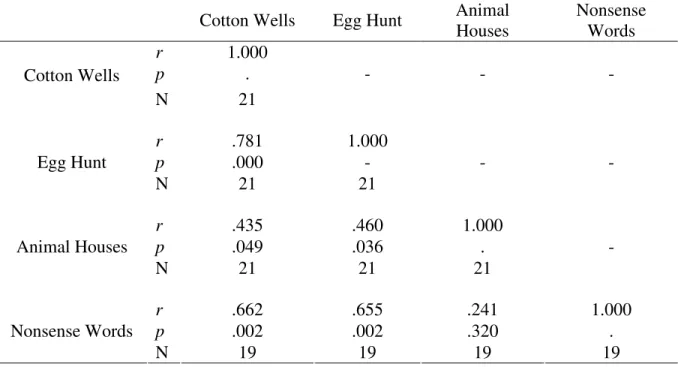
power, but supports a more straightforward interpretation. Table 5a contains the
correlation matrix for the autistic group and Table 5b has the comparable correlations for the typical group. It should be noted that the Pearson correlation makes the same
distributional assumptions as the parametric tests. Relationships between the Animal Houses and other measures should be interpreted with caution. However, the Pearson correlation is not recommended for use with data that contains fewer than five levels on a given variable. Therefore, the Spearman correlation was computed for the autism group. (Note: Spearman correlations on the data from the group with typical development reflected the same pattern of results as those reported here.) The relationships between the hypothesized spatial and verbal working memory tasks were of specific interest.
In the group with typical development, performance on the Cotton Wells was significantly related to each of the other measures: Egg Hunt, r = .78, p < .000; Animal Houses, r = .43, p < .05; and Nonsense Words, r = .66, p < .002. Performance on the Egg Hunt was significantly correlated with the Animal Houses, r = .46, p < .04 and Nonsense Words, r = .65, p < .002. Notably, Nonsense Word performance was not significantly correlated with Animal Houses, r = .24, p = .32, possibly indicating that verbal working memory is not being measured on Animal Houses. Additionally, the significant relationships between the Animal Houses and the two spatial working memory tasks suggest that children may not be using verbal working memory for
.026 and marginally related to Nonsense Words, r = .59, p = .055. All other relationships were not statistically significant.
3.2.3 Is long-term memory as measured using deferred imitation tasks impaired in young children with autism?
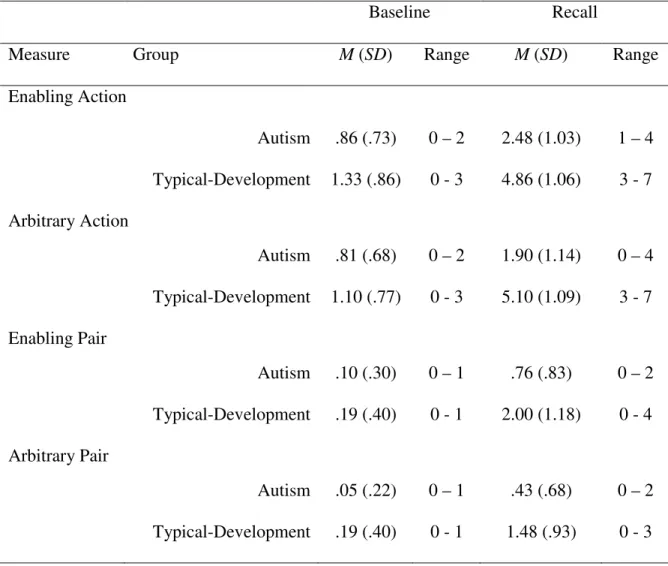
The deferred imitation data were examined for normality, outliers and unequal variances. Summary statistics are presented in Table 6. Significant outliers were not observed in any category: Baseline Actions, Baseline Action Pairs, Recall Actions or Recall Action Pairs; enabling or arbitrary. There was a notable floor effect in both groups during the baseline condition as well as for the autism group in the recall conditions. That is, the majority of children produced very few target actions. Based on this fact, it is not surprising that the data failed the Kolmogorov-Smirnov test of normality. Levene’s Test for Equality of Variances was only significant for the Baseline Arbitrary Pairs condition, F = 9.85, p < .003. That is, the variances for the groups were not generally significantly different. As discussed earlier, the general linear model is robust to non-normal distributions. Therefore, the planned 2 (group) X 2 (condition) X 2 (sequence) mixed-design analysis of variance controlling for Mullen Expressive Language age equivalent was conducted for the actions and action pairs. The between-subjects factor was group (autism or typically-developing). The two within-subjects factors were condition (baseline or recall) and sequence (enabling or arbitrary). The Huynh-Feldt correction was applied to the data due to sphericity using the procedure recommended in Girden (1992). The corrected degrees of freedom are reported.
than the children with typical-development. There was not a significant main effect of condition, F (1, 39) = .144, p = .706 or sequence, F (1, 39) = .008, p < .923. However, there was a significant 2-way interaction between group and condition, F (1,39) = 44.24,
p < .0001.
Follow-up analyses revealed that the groups did not differ significantly at baseline performance, but that the children with typical development performed significantly better than the children with autism at recall, t (39) = 10.42, p < .0001. Further follow-up analyses revealed that both groups produced significantly more actions at recall than at baseline: autism; t (20) = 6.65, p < .0001, and typically-developing; t (20) = 21.1, p < .0001, indicating memory for action pairs.
An analysis of action pairs revealed a significant main effect of group, F (1,39) = 12.27, p = .001. The children with autism had significantly lower performance than the children with typical development. There was not a significant main effect of condition,
F (1,39) = .016, p = .89 or sequence, F (1,39) = .139, p = .711. However, there was a significant 2-way interaction between group and condition, F (1,39) = 9.25, p = .004.
IV. DISCUSSION
The goal of this study was to examine working memory and long-term memory differences in a well-characterized group of children with autism, as early in development as possible. To accomplish this goal, a unique battery of working memory tasks and deferred imitation tasks were employed. Children with autism were matched to a group of typically-developing children based on verbal mental age and gender. The
characterization and matching procedure were important components of this study because the pattern of results from previous studies of memory in autism contain a broad range of participant ages, diagnostic categorizations, functioning levels and comparison samples, resulting in a conflicting account of memory in autism. In fact, when
unexpected results in previously reported studies were found, be they positive or
negative, the issue of appropriateness of the comparison groups was often raised. Indeed, finding an appropriate comparison group is challenging. For example, if a 15 year old child with autism who has a verbal mental age of 7 is matched with a typically
comparison groups (i.e., learning disability, typically-developing, Down Syndrome) or matching strategies (i.e., chronological age, verbal mental age, non-verbal mental age, IQ). The lack of widely accepted matching rules likely contributes to the pattern of inconsistent results and almost certainly impedes progress in the field (Dawson, 1996).
Overall, sample characterization and matching procedures were successful. The group with autism met all diagnostic standards for the study; the comparison sample was matched closely on verbal mental age and gender. Unfortunately, the strict
characterization of the group of children with autism (i.e., meeting autism criteria on the ADI-R, ADOS, and DSM-IV) resulted in the loss of a large number of potential
participants. This loss of participants could affect generalizability of the results on both the lower and upper levels of functioning in autism. The exclusion of children who are non-compliant with testing procedures is a limitation for any study employing measures where participants must actively participate. It is impossible to predict how these
children might have performed, but it is reasonable to think that their difficulties with the testing procedures, in-spite of the efforts of an experienced examiner, may reflect a greater degree of cognitive impairment. On the other end of the spectrum, the children who were excluded due to diagnostic test scores that did not meet required cut-offs may provide an interesting comparison group. Is there a specific memory profile that can be seen across the entire spectrum of children with autism? If there is not, the pattern of intact and impaired abilities could be used to develop meaningful sub-groups; which could aid in our understanding and treatment of this complex disorder.
was not large enough to sustain independent examination. No special effort was given to recruiting a large sample of females, so it is unclear whether this discrepancy reflects an artifact of recruitment or ashift in the rate of autism in females. Females with autism have historically had higher rates of mental retardation. However, the females in this group did not have any systematic features to distinguish them from the males. Because little is known about females with autism, future studies should focus recruitment efforts on this group.
4.1 Working memory
Working memory may be unique among executive processes because it is a cognitive process that can be empirically investigated from infancy through adulthood. The importance of working memory as an early emerging executive process has been established in studies of typical development. The onset of working memory in typically-developing infants occurs at approximately five to six months (Reznick et al., 2004), long before the emergence of other executive processes that have been found to be impaired in autism. Notably, working memory is necessary for completion of many executive
function tasks that have been used to identify executive function deficits in autism. For example, in flexibility tasks such as the Wisconsin Card Sorting Test (WCST) the
development may provide a useful basis for identifying children who may develop problems with other executive processes.
One may ask if the ‘work’ of working memory was fully evoked by the tasks used in this study. Task complexity is a critical component of studies that have shown
significant differences in working memory performance (Williams et al., 2005; Landa & Goldberg, 2005). However, there are many ways to increase complexity (e.g., amount, type of information, type of task, length of time). The manner in which these dimensions are varied may have important effects on outcomes and may contribute to the pattern of inconsistent findings that characterize research on working memory in autism. For this study, the inclusion of multiple locations, delay, and repeated trials was based on
previous studies in which these dimensions have been consistently shown to be effective (Reznick et al., 2004; Pelphrey et al., 2004). Perhaps the best indicator that the tasks used here were sufficiently complex is the robust group differences found across the four working memory tasks. Although Landa and Goldberg (2005) found that the memory load in a working memory task needs to be high (e.g., 6 to 8 locations) in order to evoke group differences in adolescents with high functioning autism, the present study suggests that tasks using 3 to 5 search locations is quite adequate to detect group differences in a younger and lower-functioning group of children.