T
HED
EVELOPMENT OFE
DUCATIONS
YSTEMSIN
A
DVANCEDC
APITALISTS
OCIETIESBenjamin Danforth
A dissertation submitted to the faculty of the University of North Carolina at Chapel Hill in partial fulfillment of the requirements for the degree of Doctor of Philosophy in the Department of Political Science.
Chapel Hill 2014
Approved by:
John D. Stephens
David Brady
Liesbet Hooghe
Evelyne Huber
c
ABSTRACT
BENJAMIN DANFORTH: The Development of Education Systems in Advanced Capitalist Societies.
(Under the direction of John D. Stephens)
Although mass education has become a common feature of all advanced capitalist so-cieties, it has not developed uniformly across these societies. Significant divergences have arisen in the types of education that these societies emphasize and in the levels of effort that they devote to promoting and improving education for all. To understand these divergences and their causes better, this dissertation comparatively analyzes two important phases in the development of mass education in more affluent societies: the pre-World War II ex-pansion in secondary education and the postwar growth in tertiary education. For both of these phases, the dissertation argues that notable institutional differences in these societies’ education systems arose from political struggles that were largely driven by distributional concerns.
ACKNOWLEDGMENTS
As with most major scholarly endeavors, the writing of this dissertation has been both chal-lenging and rewarding. Trying to untangle the histories of 17 different education systems and draw meaningful connections between them is an exercise that can be very intellectu-ally stimulating, but it can also be immensely frustrating. Thankfully, I have been able to share these experiences, both good and bad, with a number of kind and supportive people, including mentors, colleagues, and family. In addition, many of these experiences would not have been possible without the material aid I received from several organizations. I would like to acknowledge here these individuals and organizations and their contributions to the successful completion of this dissertation.
A number of other individuals in academia have also provided me with assistance at various points in the dissertation process. In the early stages of the project, I received useful feedback and added encouragement from the participants of three summer schools held in the Nordic region and organized by NordWel and NCoE REASSESS. I also had a positive and fruitful experiences at a doctoral workshops organized by RECWOWE. I would particularly like to thank Ben Ansell and Johannes Lindvall, the co-leaders of the 2012 Trans-Atlantic Summer Institute (TASI) in European Studies held at the University of Minnesota, for their comprehensive review of early welfare state politics and their advice on structuring this dissertation. During the research phase of this project, Joakim Palme and the Institute for Futures Studies (Institutet f¨or Framtidsstudier) kindly provided me with a workspace while I was conducting fieldwork in Sweden. While I was collecting prewar data on secondary education, Peter Lindert and David Mitch were generous in sharing their wisdom and research on this subject. Others who provided me support and deserve my heartfelt thanks include: Erica Edwards, Patrick Emmenegger, Shannon Eubanks, Torben Iversen, Pauli Kettunen, Pirjo Markkola, Layna Mosley, Chris Reynolds, Jason Roberts, Robin Shura, Jim Stimson, Duane Swank, Lena Trancik, Peter Uhlenberg, and Milada Vachudova.
In carrying out this project, I have been fortunate to receive funding from a variety of sources. I would first like to extend my thanks to the American-Scandinavian Foundation for their generous support of my 14-month stay in Sweden through a dissertation fellow-ship from the Thord-Gray Memorial Fund. I received additional support for this overseas research from an Academic-Year Foreign Language and Area Studies (FLAS) Fellowship (for Swedish) administered by the Center for European Studies at UNC and funded by the US Government.
TABLE OF CONTENTS
LIST OF TABLES. . . xii
LIST OF FIGURES . . . xiii
1 INTRODUCTION, THEORY, AND APPROACH . . . 1
1.1 Theoretical Inspirations . . . 4
1.1.1 Power Resources Theory . . . 5
1.1.2 Varieties of Capitalism . . . 7
1.1.3 Historical Institutionalism . . . 9
1.2 Theoretical Framework . . . 10
1.2.1 Prewar Period: 1880–1939 . . . 11
1.2.2 Postwar Period: 1950–1985 . . . 17
1.3 Analytical Approach. . . 26
1.4 Conclusion . . . 28
1.5 Tables and Figures . . . 34
2 THE POLITICAL ORIGINS OF EDUCATION-TRAINING REGIMES . . . 35
2.1 The Historical Emergence of Education-Training Regimes . . . 37
2.2 Hypotheses . . . 39
2.2.1 Economic Development . . . 39
2.2.2 Political Engagement . . . 42
2.2.3 Authority Structures and Coordination Legacies . . . 44
2.3 Methodology . . . 48
2.3.2 Estimation . . . 51
2.4 Results . . . 54
2.5 Discussion. . . 58
2.6 Tables and Figures . . . 62
3 THE COEVOLUTION OF EDUCATION AND TRAINING: HISTORICAL EVIDENCE . . . 71
3.1 Germany . . . 73
3.2 United States . . . 79
3.3 United Kingdom (England) . . . 87
3.4 Sweden . . . 94
3.5 Discussion. . . 101
4 THE DISTRIBUTIONAL POLITICS OF EDUCATION IN THE POSTWAR ERA . . . 105
4.1 Postwar Patterns of Change in Education Systems . . . 107
4.2 Hypotheses . . . 110
4.2.1 Political Agency . . . 110
4.2.2 Political Institutions . . . 114
4.2.3 Economic Development . . . 117
4.2.4 Education-Training Regimes . . . 119
4.3 Methodology . . . 119
4.3.1 Data . . . 120
4.3.2 Estimation . . . 124
4.4 Results . . . 126
4.5 Discussion. . . 132
4.6 Tables and Figures . . . 135
5 CONCLUSION . . . 150
5.2 Implications . . . 153
A APPENDIX A: MEASURES FOR OUTCOME VARIABLES, 1880–1939 . . . 156
A.1 Concept . . . 157
A.2 Dimensions . . . 159
A.3 Indicators. . . 161
A.4 Vocational Training Indexes. . . 161
A.4.1 Scoring. . . 162
B APPENDIX B: MEASURES FOR EXPLANATORY VARIABLES, 1880–1939 . . . 166
LIST OF TABLES
1.1 Historical Underpinnings of Education-Training Regimes, circa 1900 . . . 34
2.1 Institutional Development of Education and Training at the Secondary Level in Early Developing and Democratizing Societies, 1880–1935 . . . 63
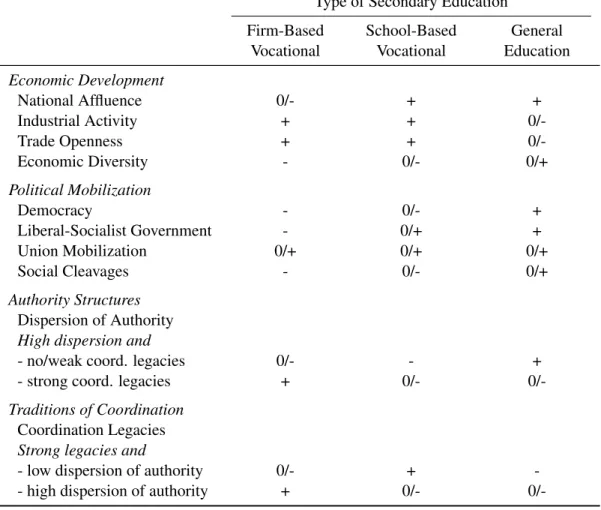
2.2 Hypothesized Effects of Explanatory Variables on Secondary Education . . . 64
2.3 Measure Selection and Summary Statistics for Explanatory Variables Used in Analyses of Secondary Education . . . 65
2.4 Determinants of Institutional Development of Education and Training, 1880–1939 . . . 66
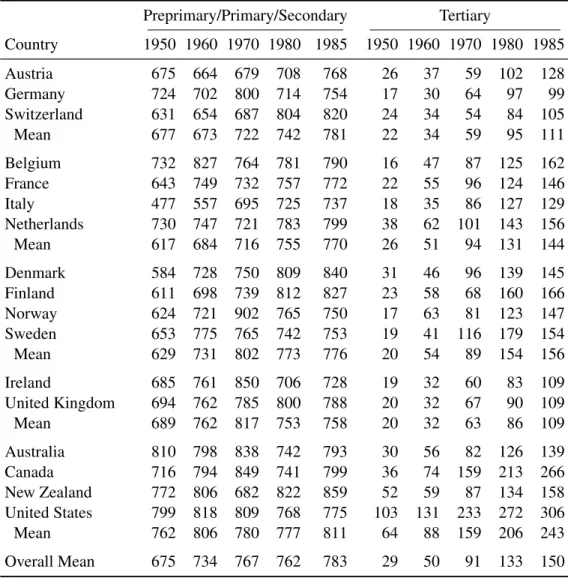
4.1 Enrollment Rates by Educational Level in Advanced Capitalist Societies, 1950–1985 . . . 135
4.2 Public Expenditures on Education in Advanced Capitalist Societies, 1950–1985 . . . 136
4.3 Public Expenditures per Student by Educational Level in Advanced Capitalist Societies, 1960–1985 . . . 137
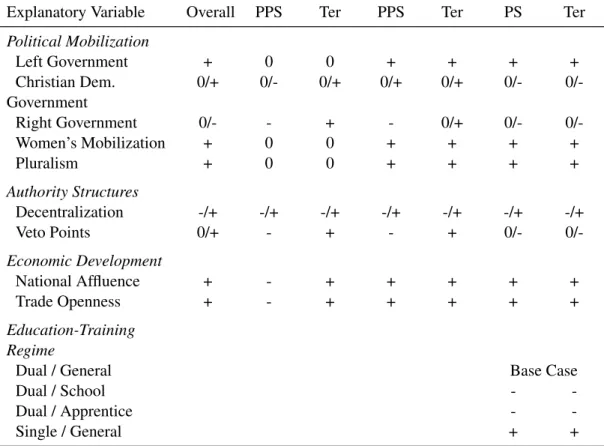
4.4 Hypothesized Effects of Explanatory Variables on Education Systems . . . 138
4.5 Measure Selection and Summary Statistics for Explanatory Variables . . . 139
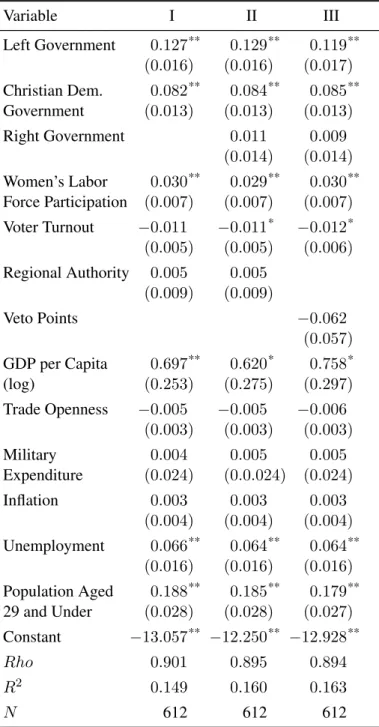
4.6 Determinants of Public Expenditures on Education, 1950–1985 . . . 140
4.7 Determinants of the Distribution of Public Expenditures on Education, 1950–1985 . . . 141
4.8 Determinants of Public Expenditures per Student by Educational Level, 1950–1985 . . . 142
4.9 Determinants of Enrollment Rates by Educational Level, 1950–1985 . . . 143
A.1 Scoring Scheme for Firm-Based Vocational Training. . . 164
A.2 Scoring Scheme for School-Based Vocational Training . . . 165
B.1 Measures for Explanatory Variables, 1880–1939 . . . 166
LIST OF FIGURES
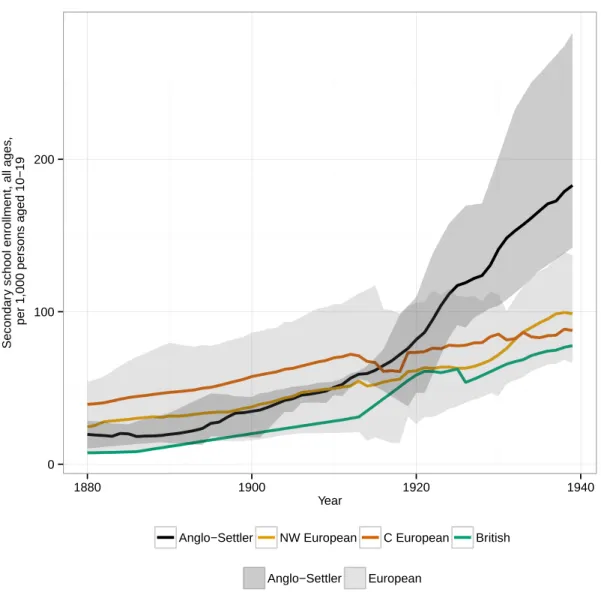
2.1 Comparative Development of General Education at the Secondary
Level, 1880–1939 . . . 62
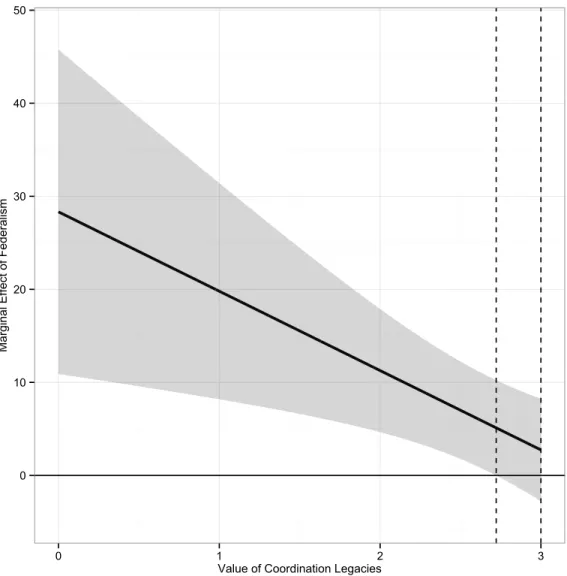
2.2 Marginal Effect of Federalism on Firm-Based Vocational Training . . . 67
2.3 Marginal Effect of Federalism on School-Based Vocational Training . . . 68
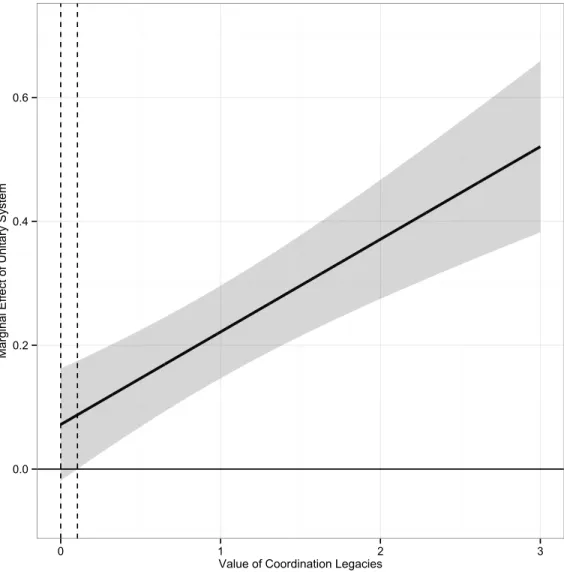
2.4 Marginal Effect of Unitary System on School-Based Vocational Training . . . 69
2.5 Marginal Effect of Federalism on General Education . . . 70
4.1 Relative Effects of Explanatory Variables on Public Expenditures on Education . . . 144
4.2 Relative Effects of Explanatory Variables on Tertiary Share of Public Expenditures on Education. . . 145
4.3 Relative Effects of Explanatory Variables on Public Expenditures Per Student at Preprimary, Primary, and Secondary Levels. . . 146
4.4 Relative Effects of Explanatory Variables on Public Expenditures Per Student at Tertiary Level . . . 147
4.5 Relative Effects of Explanatory Variables on Enrollment Rate at Preprimary, Primary, and Secondary Levels . . . 148
1 INTRODUCTION, THEORY, AND APPROACH
After it was first made compulsory in eighteenth-century Prussia by Frederick the Great, education has grown to become one of the most essential functions performed by modern states. Although it only applied to elementary schooling in one country and was loosely enforced at first, this seminal decision set in motion a process of expansion in public edu-cation that still has not reached its zenith. Across the more affluent regions of Europe and North America (and later Oceania), Prussia’s educational model inspired actors of many different ideological stripes to launch their own public education initiatives, and, conse-quently, systems of mass education gradually appeared in these societies as well. Once mass education at the primary level had taken hold in these parts of the world by the late nineteenth century – the United Kingdom was a surprisingly late adopter – it subsequently spread to other educational levels, particularly the secondary and tertiary levels.1 Now, at the beginning of the twenty-first century, many of these societies provide their citizens with educational opportunities across the entire life course, ranging from early childhood education to continuing adulthood education. And as knowledge becomes a more central part of modern economies, the pervasiveness of state-sponsored mass education is likely to continue to increase.
closer look at the composition of education in these societies reveals that some societies offer their members both general education and vocational training while other societies focus almost exclusively on the provision of general education. Likewise, a comparison of public investments in education by level (i.e. primary, secondary, tertiary, etc.) shows that some societies prioritize higher levels of education over lower levels while other societies adhere to a more balanced distribution of public resources. When these three patterns are considered together, it is evident that affluent societies have followed several different paths in developing their education systems, and yet little is known about key aspects of these long-run divergences. Why have the education systems in affluent societies evolved so differently? How have political factors influenced the trajectories of these systems?
elite strategies to manage pressures for educational expansion. Similarly, in broad conflicts over educational resources, constitutional structures have strengthened the political posi-tion of higher educaposi-tion compared to other forms of educaposi-tion. All in all, the arguments advanced by this dissertation underscore the importance of political factors in explaining long-term developments in education systems.
To evaluate these arguments, this dissertation uses a mixed-method approach to analyze a wide range of cross-national data covering 17 economically advanced societies and the years from the early 1800s to 1985. In its investigation of pre-World War II developments in secondary education, the dissertation combines broad statistical analysis with focused case-study analysis to examine the roles of constitutional structures and coordination legacies in generating different institutional mixes of general education and vocational training. In its study of post-World War II changes in education systems, the dissertation employs extensive quantitative analysis to explore the role of political partisanship and constitutional structures in shaping the distributional arrangements found in these education systems. Both of these studies make use of new data gathered and assembled for this dissertation. For the prewar study, the quantitative data come from a new political economy dataset covering the six decades leading up to World War II, and the qualitative data are drawn from an array of primary and secondary sources. For the postwar era, several new and extended data series measuring the size and structure of education systems are analyzed. Together, these two studies provide a sweeping view of the changing educational landscape in the more affluent parts of the world.
overview of the mixed-method approach used to examine empirical differences in educa-tion systems and describes the process used in selecting cases for these analyses. Finally, the chapter concludes with a summary of the dissertation’s main contributions and its re-maining chapters.
1.1 Theoretical Inspirations
Comparative research on the development of political economies has produced a num-ber of rich lines of social inquiry, but they have seldom been applied to education. Scholarly work on social policy in modern political economies has often avoided issues involving ed-ucation because eded-ucation policy does not neatly fit the standard mold of social policy. First of all, the initial establishment of public education occurred long before the creation of prototypic social policies, such as sickness insurance and old-age pensions, which only started to appear in the late nineteenth century. Moreover, education serves many different purposes, some of which fall outside the narrow conceptualization of “welfare” frequently used to distinguish social policy from other forms of public policy.2 Although these and other distinctions have led some to deem education policy as something distinct from so-cial policy (e.g. Wilensky 1975, 3–7), others have argued that there is less cause for this differentiation (e.g. Castles 1989, 431–432). As T. H. Marshall and others have pointed out, if one uses the concept of social rights to delineate the bounds of social policy, then education policy should be considered a form of social policy (Marhsall 1950; see also Stephens 2010).
The first is power resources theory, which recognizes that competing class-based interests have varied capacities to shape policy outcomes, particularly when matters related to social policy are involved. The second, varieties of capitalism, emphasizes the importance of complementarities between social policy and labor markets in sustaining broad political economic arrangements. The third, historical institutionalism highlights the many ways in which political institutions alter and absorb movements in social policy over varying time horizons.
1.1.1 Power Resources Theory
In explaining cross-national differences in political economies, particularly in their welfare components, power resources theory has become a widely used approach. This theoretical perspective holds that social policy largely reflects the distribution of power among competing forces in the civil and political spheres of society. With its emphasis on class-based politics, this approach frames competition over economic and social policy as a struggle between lower-class groups, particularly organized labor and left parties, and their upper-class counterparts, namely employer organizations and center and right parties (Esping-Andersen 1990; Huber and Stephens 2001; Korpi 1980, 1983; Stephens 1979). The relative power of these two sides are derived from different sources: the power of the left forces is based on their capacity to organize the working and lower-middle classes while the power of the center and right forces is tied to their ability to amass physical and financial resources from the upper-middle and upper classes. In the end, the side that ac-cumulates and maintains the larger share of power resources is expected to exert principal control over the direction of social policy in a given society.
significant advantages in the competition for political power and retained substantial con-trol over the formulation of public policy. Given their strong ties to the upper echelons of society, these forces had a vested interest in preserving institutions, like those in ed-ucation, that supported and reproduced existing systems of social stratification (Lindert 2004, 100–101; Ringer 1979, 12–22). With the progression of industrialization, however, new economic and social conditions undermined the conservative order endorsed by right forces, particularly as an increasingly large and radical working class made its entrance on to the political scene. Education reform was not initially a top priority for left movements that arose with the working class, but the movements’ strengthening presence elevated is-sues of democratic citizenship, human capital, and social control, all of which related to education. Eventually, by the mid-twentieth century, these left forces did assume a more prominent role in educational politics, and the balance of power between the left and right became an important factor in the development of education policy.
desegregate public education. Therefore, in defending a restrictive, class-based education system, conservative elites had to deal with challenges from both radical liberal forces and budding leftist forces.
1.1.2 Varieties of Capitalism
The varieties of capitalism (VoC) approach offers a more functionalist logic for explain-ing the development of cross-national differences in the organization of modern political economies. According to this theoretical perspective, social policy can serve as an im-portant tool for developing and maintaining long-term commitments between economic actors in the labor market, particularly industrial firms and skilled labor. A central premise of this approach is that businesses and labor face a number of coordination risks that fa-vor the development of institutions and policies, including social policies, that facilitate and support informational exchange and economic collaboration (Hall and Soskice 2001). The need for coordination is especially strong when industrial firms pursue production strategies requiring large pools of labor endowed with very specific skills. Evidence of this coordinative logic is most visible in the German economy and other coordinated mar-ket economies (CMEs), where firms and labor, backed by generous social policies, have established durable communication and training networks that facilitate intensive skill de-velopment among workers. By contrast, in liberal market economies (LMEs), such as the American economy, meager social policies have encouraged firms and labor to rely on market forces to regulate the labor market. In these environments, the persistence of co-ordination risks supports the extensive development of highly transferable general skills rather than firm-based specific skills. In outlining these distinctions between LMEs and CMEs, the VoC approach draws attention to how the interplay of political and economic arrangements, such as social policies and production strategies, can foster the development of complementary institutions and practices across different spheres of society.
skill production, its underlying logic has relevance for explaining the emergence and en-durance of different institutional configurations in education. In the preindustrial economies of Europe, state-sanctioned guilds played a central role in managing labor markets through the supply of skills. Even after governments, under the sway of market liberalism, abol-ished most of their privileges and monopolies during early phases of industrialization, guilds continued to have lasting effects on labor markets, particularly in the coordination of training (Iversen and Soskice 2009; Thelen 2004). When public and private actors later sought to establish modern institutions of vocational training, these lingering arrangements proved to be a critical asset in making durable systems. In the United Kingdom and the Anglo-settler countries, the weakness or absence of guild legacies posed a continual ob-stacle to governments seeking to impose training arrangements that required substantial cooperation from market actors. On the whole, the presence or absence of existing comple-mentarities in the labor market strongly bounded the potential paths of education systems, particularly in the development of training institutions.
forces have been instrumental in guiding the development of education systems. 1.1.3 Historical Institutionalism
As an approach to understanding the origins and evolution of political economies, historical institutionalism is concerned with both institutional structures and instituitonal change. In examining institutional structures, this theoretical perspective stresses that the design and makeup of states and markets can dramatically shape outcomes in social pol-icy (Immergut 1992; Skocpol 1992; Weir, Orloff, and Skocpol 1988; Iversen and Soskice 2006). In this vein, historical institutionalism has called attention to the role of constitu-tional structures in creating veto points that heavily skew the power of different political actors and interest groups and thus alter the potential for broad policy change (Hicks and Swank 1992; Huber, Ragin, and Stephens 1993; Huber and Stephens 2001; Immergut 1990, 1992). Recognizing that institutions themselves are products of social forces, historical in-stitutionalism has also looked closely at the catalysts and processes of institutional change. The notions of timing and sequencing figure prominently in this line of research, and signif-icant attention is paid to concepts like historical contingency and path dependence (Pierson 2000, 2004). One important insight from this historical institutionalist work is the idea of punctuated equilibrium, which emphasizes the importance of political agency at critical junctures in producing dramatic and enduring changes in institutions. This logic has often been used to explain long-term developments in political economy and social policy.
level, giving proponents of educational expansion many opportunities to move their cause forward.3 Under such decentralized systems of educational control, barriers to reform and growth in one area did not inhibit, but perhaps encouraged, expansionary efforts in other areas. Decentralized authority is often seen as barrier to the development and implemen-tation of top-down social policies, but it can have a protective effect in situations where social policy is cultivated from the bottom up.The notable divergence in the education and training profiles of education systems around the beginning of the twentieth century is also consistent with the concept of punctuated equilibrium. Prior to this point in history, public efforts in mass education were largely limited to primary education in common schools. As a consequence, despite some differences in their quality and coverage, early systems of mass education exhibited low variation in their institutional profiles. In the decades leading up to the onset of the twentieth century, however, the economic and social arrangements un-derpinning these early systems started to fracture, creating opportunities for profound and broad educational change. At this critical juncture, the choices made by political actors on education policy had long-lasting effects on the paths of education systems.
1.2 Theoretical Framework
Incorporating elements of these three theoretical perspectives, this section presents the two-part theoretical framework employed in this dissertation. Each part of this framework deals with a different historical phase in the evolution of education systems in advanced capitalist societies: the first part focuses on the rise of different models of secondary ed-ucations during the prewar period from 1880 to 1939 while the second part addresses the development of distinct distributional arrangements in education during the postwar period 3Although France is often viewed as the epitome of a centralized state, the French national government did
from 1950 to 1985. The explanations developed in each part are evaluated in later chapters of the dissertation.
1.2.1 Prewar Period: 1880–1939
Existing accounts for the emergence of modern education systems have largely dis-counted the high degree to which the histories of general education and vocational training are intertwined. In examining the evolution of education systems in advanced capitalist societies, it has become common practice in political analyses to focus on either general education or vocational training without paying much regard to the other. For the most part, comparative analyses of educational expansion have restricted their attention to as-pects of the former, general education. Older contributions to this research program, for instance, focus almost exclusively on early patterns of institutional growth in general ed-ucation (e.g., Archer 1984; Green 1990; Heidenheimer 1974, 1981; Ringer 1979). This tendency is also seen in a more recent batch of comparative studies looking at the develop-ment of postwar education systems (e.g., Ansell 2008a,b; Busemeyer 2007, 2009; Castles 1989, 1998), though some small efforts have been made to incorporate vocational educa-tion (e.g., Ansell 2010). Separate inquiries into the origins and evolueduca-tion of vocaeduca-tional training have only appeared fairly recently (e.g., Busemeyer and Trampusch 2012; Thelen 2004; Trampusch 2010), and they have limited their attention to small subset of affluent societies. While these studies have succeeded in raising the profile of vocational training in scholarly discussions of education systems, they have not challenged the strong division made between these two basic forms of education. In fact, in emphasizing the distinct skills produced by general education and vocational training, these studies have helped to rein-force the perception that general education and vocation training are fundamentally distinct and share few if any connections.
research on educational development, this dissertation contends that these systems have overlapping roots and that these roots lie in class-based politics. If the core institutions of general education and vocational training have shared origins, then tracing the rise of one set of institutions requires examining the genesis of the other set. In looking at both forms of education, this dissertation argue that cross-national differences in the institu-tional mixes of general education and vocainstitu-tional training originated in nineteenth-century political struggles heavily infused with class tensions and strongly shaped by constitutional structures and coordination legacies. As economic and social changes brought by high industrialization accentuated the need for richer forms of mass education beyond basic schooling, conservative elites across the economically advanced world faced a common dilemma: how could the overall standard of mass education be raised without undermining the privileged position of elite education? Although this dilemma was primarily centered on general education, vocational training emerged as a promising instrument for reconcil-ing the two competreconcil-ing demands captured by the dilemma. As will be elaborated below in a theoretical manner, promoting vocational training on a mass scale constitutes one ap-proach to addressing the need for more extensive education while preserving the integrity of existing social structures. This dissertation claims that the desirability and viability of this strategy as an elite response to the pressures for educational expansion hinged on two essential factors: the degree to which state authority over general education was decen-tralized and the extent to which traditions of coordinated vocational training existed. The interaction of these two factors ultimately determined the trajectories that affluent societies followed in developing their secondary education institutions.
Before discussing the logic of this argument in more detail, it is first necessary to specify a few key assumptions.
have this power because limited democracy and divided power (e.g., bicameralism) at the national level ensures that they are overrepresented in central government.
Second, it is assumed that divisions in authority over education and training are, for the most part, constitutionally defined. As elites and reformers compete for control over education policy, the authority structures established by constitutions heavily shapes the strategies each side pursues. In particular, these authority structures determine whether conservative elites, with their significant power at the political center, can easily intervene in decision-making at the political periphery.
Third, it is assumed that policy developments in secondary education unfolds in two stages. In the first stage, conservative elites choose a policy response to exogenous pres-sures for educational expansions at the secondary level. Then, in the second stage, institu-tional circumstances determine whether the selected policy response succeeds and whether it generates untended consequences. Constitutionally defined authority structures for gen-eral education play a central role in the first stage while legacies of non-market coordination in vocational training figure prominently in the second stage.
is strongly centralized, then political actors at lower levels have few opportunities to imple-ment reforms that undercut the educational objectives of conservative elites at the top level. In other words, there is less room in this centralized authority environment for regions and localities to expand and reform general education. On the whole, decentralized authority over education policy is more conducive to democratizing expansion and reform efforts than centralized authority is.
Besides affecting the potential for bottom-up innovation and expansion, the extent to which educational governance is dispersed also powerfully shapes the capacity of conser-vative elites to exert top-down control over institutions of general education. The thorough decentralization of authority hinders conservative representatives from using direct inter-ventions in education policy-making as a reliable means to advance and protect their edu-cational agenda. Where authority over education policy is highly decentralized, top-down operations are likely to be ineffective in both interrupting progressive reforms and propa-gating conservative reforms among subnational units. Conversely, the firm consolidation of authority over education policy gives conservative elites meaningful powers to guard and enhance social restrictions and segregation in general education. When conservative elites have direct control or serious sway over national policy-making, they can cripple, block, and delay policy reforms that challenged their educational vision when the central government has eminent authority over education policy. At the same time, under these conditions, conservative actors can draw on a wide range of state powers to implement their own reforms and compel others to respect them. All in all, education systems based on dispersed governance limit the capacity of conservative elites to set the course and pace of educational expansion and thus maintain their educational advantages.
systems. In contrast to general education, vocational training regularly falls under the ju-risdiction of central governments because of its prevailing ties to industry and commerce. This centralized authority provides conservative elites with meaningful opportunities to es-tablish and direct institutions of vocational training while keeping political resistance to these reforms to a minimum. As alluded to above, conservative actors are likely to ex-ploit these opportunities when decentralized authority makes the risks of inaction and the barriers to action in the area of general education high. From the elites’ perspective, the expansion of vocational training is preferable to the extension of general training because training imparts less status than education. A broad shift toward vocational training also satisfies the twin conservative objectives of improving the economic productivity of the lower classes while keeping down the costs of such improvements to the state. With its em-phasis on applied learning and practical skills, vocational training provides obvious benefits in terms of labor productivity. At the same time, the expenses associated with such training can often be shifted to participating non-state actors, particularly when the training takes the form of firm-based apprenticeships.
Yet, given their remedial objectives, these solutions also tended to incorporate many ele-ments of general education, causing some of the distinctions between training and educa-tion to blur. Moreover, the responses are likely to appear as school-based programs unless economic and legal conditions are particularly favorable for the expansion of apprentice-ships. As these independent initiatives develop a record of success, they are eventually appropriated by states and become important elements of public education. This process of increased state involvement is likely to coincide with the weakening of the conservative elites’ grip on centralized authority.
vocational training face fewer issues of acceptance when coordinative practices already ex-ist. These traditions of coordination can come from past systems of guild-based vocational training or prior experiences with state-sponsored vocational education.
Joining these lines of reasoning on the dispersion of authority over education and the prevalence of coordination in training leads to a rather simple way of parsing out discrete education-training regimes (see Table 1). A high dispersion of educational authority and a strong legacy of coordinated training tends to produce education systems with dualized programs of general education and apprenticeship-focused programs of vocational train-ing at the secondary level. The combination of high dispersion and weak legacies tends to engender education systems that feature extensive general programs and failed voca-tional programs in secondary education. A low dispersion of educavoca-tional authority and strong legacies of coordinated training typically leads to education systems with dualized programs of general education and school-based programs of vocational training at the secondary level. Low dispersion coupled with weak legacies tends to produce education systems with dualized programs of general education and failed programs of vocational training. In terms of expansion, decentralized systems usually exhibit more growth in their areas of educational emphasis than centralized systems do.
1.2.2 Postwar Period: 1950–1985
opposite conclusions
(e.g., Castles 1998; Busemeyer 2007; Iversen and Stephens 2008; Huber and Stephens 2014). Similarly, it remains an unsettled question as to how political institutions fit into this theoretical context and whether they account for some of the distinct distributional patterns observed among modern education systems. Although there is good reason to believe that institutional factors like territorial decentralization and veto points do matter, the few stud-ies to consider them have produced mixed findings (e.g., Cameron and Hofferbert 1974; Castles 1998; Busemeyer 2007). On the whole, it is clear that many gaps remain in the limited research that has been done on the distributional aspects of education politics.
With the aim of filling in these lacunas, this dissertation reexamines the roles of partisan politics and constitutional structures in shaping the development of education systems in the postwar era. To help untangle the complex relationships between these political factors and institutional outcomes, this dissertation considers three dimensions of education systems: generosity, distribution, and coverage. In looking at these dimensions, this dissertation does not simply focus on institutional changes in the aggregate, but also explores how education has evolved at different levels. Using this more comprehensive approach, this dissertation contends that certain elements of partisan politics and constitutional structures matter more depending on which dimension and which level are considered. In particular, it is argued that left government incumbency is the main political determinant of an education system’s generosity and coverage while right government incumbency and constitutional veto points are the key determinants of an education system’s distributional features. Before this argument is further elaborated, however, it is first necessary to define the objects and scope of the dissertation in greater detail.
– and at two different levels – an aggregate of the preprimary, primary, and secondary (PPS) levels and the tertiary level. Generosity and coverage are two dimensions that regularly ap-pear in cross-national comparisons of social policy and are straightforward to understand: the former represents the quality of a given social benefit or service and coverage captures the degree to which this benefit or service reaches a relevant population. Distribution is more ambiguous as a dimension for comparison, but in this dissertation it refers to the way in which resources are shared among different parts of an education system – in this case, the lower and higher levels of formal education. Given that access to these levels has var-ied significantly throughout history – with the higher levels being less accessible and more elite oriented than the lower levels – an examination of resource allocations across lower and higher education can shed light on the distributional aspects of education systems and highlight differences between them. The boundary between secondary and tertiary educa-tion is deemed important in this dissertaeduca-tion because the drive for mass educaeduca-tion started to shift its focus from the secondary level to the tertiary level in all rich countries during the postwar era.
these points make it clear that the early postwar period represents an important stage in the evolution of education systems and that it should be examined on its own.
To explain cross-national difference in educational generosity, distribution, and cov-erage for this early postwar period, this dissertation emphasizes the role of class-based partisan competition over education policy. Drawing heavily on power resources theory, this dissertation argues that the partisan coloring of national governments over the long run has a strong effect on the development of each of these three educational dimensions. The partisan forces that matter most in this context are those that have dominated postwar pol-itics in most affluent countries, namely left parties, Christian democratic parties, and right parties.4 Each of these broad party families draws its power from a different set of classes: left parties are rooted in working and lower-middles classes, right parties are based in the upper-middle and upper classes, and Christian democratic parties are tied to elements of all classes.5 Besides serving as the main sources of partisan power, these classes, with their distinct interests, influence the ideologies and positions of the three party families. Assum-ing that these class-party ties are firm, political competition over the nature and scope of public education should exhibit a powerful class dynamic.
Using this partisan framework, this dissertation contends that left parties are the strongest proponents of generous education systems while right parties are the weakest.
Left parties seek to improve the socioeconomic standing of their working- and middle-class constituents, and they view education as an important instrument in achieving this goal. To maximize the number and quality of educational opportunities available to the
4Left parties have regularly been identified as key drivers of social policy development (Brady, Beckfield, and Seeleib-Kaiser 2005; Hicks 1999; Huber and Stephens 2001; Korpi 2003). Christian democratic parties are also frequently considered in historical analyses of social policy because they have been shown to play a distinctive role in shaping social policy (Huber, Ragin, and Stephens 1993; Kalyvas 1996; Van Kersbergen 1995). Right parties have not been examined as much as the other two party families, but recent research suggests that right parties impact the development of social policy in distinctive ways (e.g., Allan and Scruggs 2004; Brady and Lee 2014; Brady, Beckfield, and Seeleib-Kaiser 2005; Castles 2004).
5For a more detailed discussion of the class bases of these party families, see Huber and Stephens 2001:
lower classes, left parties favor high levels of public investment on all levels of education – from preprimary education up to tertiary education and beyond. Right parties, however, are generally opposed to broad increases in public spending on education, particularly at the lower levels of education. Although right parties do not wish to see publicly financed education for the masses entirely eliminated, they do support the wide use of targeted fund-ing schemes and private fundfund-ing sources in education. Christian democratic parties, with their cross-class bases of support, have a position that lies in between these two extremes. While they do not support, as left parties do, the use of education to break down existing social orders, Christian democratic parties are sympathetic to the notion that a good basic education is essential for sustained self-sufficiency. Consequently, Christian democratic parties favor modest levels of public spending on education and oppose efforts to undercut mass education at the lower levels.
support an arrangement that gives relatively more resources to higher education than lower education, but to a lesser degree than their right counterparts. Although they accept social stratification in education as a natural feature of human society, Christian democratic par-ties are reluctant to back actions that substantially exacerbate social disparipar-ties or hurt the lower classes.
Turning to the final dimension, this dissertation contends that left parties strongly sup-port expansions in the coverage of education at all levels while right and Christian demo-cratic parties generally do not. As part of their efforts to improve educational outcomes for the working- and middle-class masses, left parties strive to increase the number of ed-ucational opportunities available to these masses. In their push to broaden the coverage of education systems, left parties do not limit their attention to any one level. Instead, they seek to transform all levels of education, including tertiary education, into mass institutions that are basically open to all. Right and Christian democratic parties, on the other hand, are much less enthusiastic about further increasing the coverage of education systems, par-ticularly at higher levels. Neither of these party families contests the idea that the masses have a right to public education, but they do not agree with the notion that this right extends to all levels of education. Instead, right and Christian democratic parties favor restricting mass education to the two forms that are typically compulsory now, namely primary and secondary education.
mass-oriented education. These differences in policy success rates, in turn, skew the distri-bution of public resources within education systems away from mass-oriented lower levels of education toward the elite-oriented tertiary level of education. Three different mecha-nisms associated with veto points contribute to these disparities in outcomes, and they are discussed below.
First, given the ways in which education systems are typically organized, veto points have more potential to hinder the advancement of existing forms of mass education. While tertiary education is usually administered on a national or regional basis, primary and sec-ondary education – the two prominent forms of mass education – are generally handled to some degree at the local level. Since the number of jurisdictions increases with each move down the territorial ladder, this organizational structure implies that there are more institutions involved in the policy-making process for lower levels of education than the policy-making process for tertiary education. When constitutional arrangements, such as federalism, formalize and strength this dispersion of authority across different levels, ju-risdictions, and institutions, they provide minority interests, including elite educational interests, with more opportunities to block education reforms, especially those that broadly improve educational opportunities for the masses.
education over lower education.
Third, when educational interests compete for public resources and policy changes, veto points strengthen the influence of elite-oriented interest groups and weaken the influence of mass-oriented interest groups. With the development of multiple levels within education systems, separate sets of interest groups – school associations, labor organizations, and parent/student organizations – have formed to represent and promote these different levels. As part of their advocacy efforts, all of these groups seek to increase the allocation of public resources made to the educational levels they represent. Although the distribution of funds is not inherently a zero-sum game, there are nonetheless instances when the desires of these groups clash. In these situations, elite-oriented interest groups should have the advantage because veto points give better funded and organized groups more direct access to the policy process and more bargaining power over policy decisions. In early phases of educational development, elite-oriented groups tend to have more established resource bases and be less territorially fragmented. To some extent, this mechanism is a derivative of the prior two.
and balanced, as a wider array of societal interests are typically consulted and financial resources usually carry less political sway. In the end, this type of process should lead to a more proportional distribution of public resources within education system.
1.3 Analytical Approach
To evaluate the validity of this two-part theoretical framework, this dissertation employs a nested analytical approach. This mixed-method approach combines broad statistical anal-ysis with intensive case-study analanal-ysis to maximize both the generalizability and validity of new theories (Fearon and Laitin 2008; Lieberman 2005; Seawright and Gerring 2008; Goertz 2008). The main role of the broad, or large-N, analysis in this approach is to es-tablish that there is indeed an empirical basis for a set of theoretical claims. With this type of analysis, it is possible to evaluate this set of claims against a host of alternative explanations in an efficient manner and to estimate the levels of confidence one can have in these claims in a systematic way. Once the theoretical claims have been vetted through this process, they are further scrutinized in the focused, or small-N, analysis. With its em-phasis on finer grain details and patterns, this form of analysis allows one to verify the existence of relationships between key variables and substantiate the causal mechanisms that link them. Seeing how they can complement each other in this integrated approach, both large-N statistical analysis and small-N case-study analysis are incorporated into this dissertation.6
measures of education systems. More specifically, the two datasets cover 17 advanced capitalist countries for the prewar period of 1880-1939 and the postwar period of 1950-1985. The geographical and historical breadth of these data enable this dissertation to carry out a sweeping analysis of the development of education system in affluent countries.
After these statistical analyses confirm that theorized relationships between key vari-ables do in fact exist, the dissertation turns to a number of case studies for additional in-sights into these relationships. These case studies, which cover four countries, have been produced using a variety of primary and secondary sources, most of which deal with the politics of educational expansion and reform. With their richer details on the motivations of actors and sequencing of events, these case studies are primarily used to trace the causal linkages between the main political determinants and educational outcomes highlighted before, though they also serve to rule out a number of competing explanations. For the purposes of this dissertation, a set of case studies is only provided for the prewar period, with their historical focus being the late nineteenth and early twentieth centuries.7
The cases for this nested design have been selected on the basis of several theoretical and methodological considerations. To maximize the generalizability of its theoretical con-tributions, this dissertation examines the universe of advanced capitalist societies that are relatively large and have long histories of democratic government in the twentieth century.8 These two conditions are needed to ensure that cases have possessed sufficient autonomy and dynamism to develop their education systems in meaningful ways. For the case-study analysis, four cases have been selected from this broader population of affluent democra-cies, and they are: Germany, Sweden, the United Kingdom, and the United States. These 7A set of cases studies for the postwar period (1950-1985) are being developed for a future version of this
manuscript.
cases have been chosen because they vary significantly on the key explanatory variables – constitutional structures, coordination legacies, and partisan politics – and they best fit the explanatory models constructed and tested in the broad statistical analyses. This approach of selecting cases that fall “on the line,” so to speak, is not without controversy, but it has been employed here in order to enhance the assessment of causal processes. As Lieberman (2005, 444) emphasizes, nested designs should, in most circumstances, include cases that help assess “the strengths of a particular model” and do not add “unexplained noise” to the model.
1.4 Conclusion
In contemporary debates about economic and social policy, education is regularly cited as the best solution to many of the most challenging problems facing affluent societies. As these societies grapple with the consequences of heightened global competition and extensive demographic change, it is often argued that they should look to their education systems to boost economic productivity and improve social outcomes (Esping-Andersen 2002). Consequently, with the rise of this “social investment” approach, there has been a renewed interest in the education systems of advanced capitalist societies and the strategies that can be employed to reform and expand them (Morel, Palier, and Palme 2011; see also Nelson and Stephens 2011). Yet, despite all this interest in developing education for the future, much is still not known about it developed in the past.
education is often described as the “great equalizer” in political discourse, this disserta-tion’s analysis of the distributional characteristics of different education systems and their historical determinants is also apposite. Overall, this dissertation addresses several impor-tant questions and, in doing so, makes a number of imporimpor-tant contributions to the body of research on education policy and social policy more generally. A few of these contributions are discussed below.
First, this dissertation draws attention to several important yet complex distributional aspects of education systems and their origins. Given its ubiquity in affluent societies and its place in the welfare state, public education is typically thought of as a state function that promotes egalitarianism. Consequently, the overall size of an education system is often assumed to be a good indicator of its equalizing effects on social outcomes. As this disser-tation stresses, however, education systems that appear to be similar on the aggregate can be built on very different distributional models. The multilevel nature of education systems makes it possible for states to allocate educational resources to some social groups and deny them to other groups. This distributional element of education systems has, in turn, profoundly influenced the political strategies used to expand and reform public education at all stages of development. In particular, this dissertation shows how efforts to increase the provision of vocational training and the relative generosity of tertiary education have been driven by conservative forces seeking to preserve elite advantages in education. There-fore, to understand fully the social consequences of long-run educational developments and the political motivations behind them, one needs to recognize that education systems have many distributional dimensions and that these systems are not inherently structured in an egalitarian way.
policy, few studies have thoroughly examined the effects of these state features on broad elements of education policy. With its extensive historical scope, this dissertation high-lights the ways in which two forms of constitutional structures – federalism and veto points – have deeply impacted the development of education systems in affluent societies over the long run. In determining how authority over education is dispersed, constitutional structures strongly shape the education policy process and the potential for far-reaching educational reforms. Whether constitutional structures ultimately aid or hinder the devel-opment of more extensive and generous education systems depends on the political and economic context. Dispersed authority can encourage bottom-up educational expansion when conservative elites dominate the top in a multilevel polity, but it can also hamper broad educational reform by fragmenting the underprivileged masses. This notion that the effect of constitutional structures on social policy is conditional has not been thoroughly explored in prior research.
suggests that the politics of education policy are not entirely analogous to those for other types of social policy.
Fourth, in its investigation of the long-term evolution of education systems, this disser-tation makes uses of many new and overlooked data sources. A surprising dearth of com-parable cross-national data has long hampered comparative research on education system (Danforth 2013), especially for periods of history predating the most recent four decades. For this dissertation, efforts have been made to overcome some of these obstacles by devis-ing new measures and assembldevis-ing new dataset. The quantitative analyses of prewar devel-opments in secondary education are based on a new dataset containing cross-national indi-cators of political economy and social policy for the period from 1870 to 1940. This dataset includes several original measures of education systems, three of which serve as outcome variables for the prewar analyses. Likewise, the quantitative analyses of postwar changes in the distributional aspects of education systems examines new data on educational gen-erosity, distribution, and coverage. As these prewar and postwar datasets continue to be expanded and improved, they should be useful in further research on early developments in education and social policy in general.
These contributions have culminated from research that is presented and discussed more thoroughly in the remaining four chapters of this dissertation. The first three of these four chapters contain the bulk of the analytical work done for the dissertation – the statistical analyses and cases studies. The final chapter makes connections between the findings of these investigations and elaborates on their significance for future research. Below is a brief summary of each chapter.
of mass education at the lower levels. The study shows that different institutional mixes in secondary education arose from political struggles that were strongly shaped by two factors: the dispersion of authority over general education and the legacies of non-market coordination in vocational training. The interaction of these two factors largely account for why the United States and other Anglo-settler countries surpassed Europe in the provision of general education in the decades leading up to World War II, and countries like Germany and Sweden developed extensive systems of vocational training.
Chapter 3 is comprised of four cases studies used to validate the key relationships es-tablished in the preceding chapter and identify the causal processes at work in these rela-tionships. Covering Germany, Sweden, the United Kingdom, and the United States, these case studies demonstrate how constitutional structures and coordination legacies shaped the strategies of reformer and elites in the development of mass secondary education. In ad-dition to tracing these causal connections, these case studies also illustrate the contentious nature of education politics in the prewar years.
Chapter 4 presents the remaining statistical study, with this one focusing on postwar developments in education systems. The distinguishing feature of this study is its multidi-mensional approach to examining educational change, particularly across different levels of education. The study finds that differences in class-based political competition and constitutional veto points account for the rise of distinct distributional arrangements in public education during the early postwar period. More specifically, these factors help ex-plain the emergence of highly generous, mass-oriented education systems in places like the Nordic countries and weakly generous, elite-oriented systems in places like Australia and the United Kingdom.
1.5 Tables and Figures
Table 1.1: Historical Underpinnings of Education-Training Regimes, circa 1900
Dispersion of Authority
Centralized Decentralized
Strong Coordinative Legacies
Sweden
general education: dualistic, modest expansion
vocational training: mostly school based, modest expansion
Germany
general education: dualistic, little expansion
vocational training: mostly apprenticeship based, robust expansion
Weak or No Coordinative Legacies
United Kingdom
general education: dualistic, modest expansion
vocational training: failed
independent efforts, little expansion
United States
general education: unified, robust expansion
2 THE POLITICAL ORIGINS OF EDUCATION-TRAINING REGIMES
The impressive gains made in educational effort and attainment over the past century have overshadowed the strong institutional continuities found in many education systems. In the more advanced countries of Europe, North America, and Oceania, public spending on education and average years of schooling have increased fourfold during this time, yet the institutional frameworks for education in these countries have mostly been slow to change. This institutional stability is plainly visible in how these countries’ education systems approach general education and vocational training, particularly at the secondary level. In some education systems, like those found in Germany and Sweden, both types of instruction are formally offered, but they are attached to programs with varying degrees of separation. As seen in the United Kingdom and United States, other education systems focus almost entirely on the provision of general education, so programmatic divisions between the two forms of instruction are largely nonexistent.
figured prominently in this conservative reaction. Even as new waves of democracy, capi-talism, and socialism intensified this reaction, conservative elites were not uniformly suc-cessful in protecting the old order in education. In the Anglo-settler countries, for instance, concerted attempts to develop coordinated systems of vocational training largely failed, even as similar efforts saw striking success in most parts of Western Europe.1
This chapter examines the origins of these divergent trajectories in education and train-ing at the secondary level to understand why some countries developed extensive systems of firm-based and school-based vocational training and others were largely left with vary-ing degrees of general education. The extensive quantitative and qualitative work contained in this chapter and the next point to a somewhat surprising finding: the rise of these dis-tinct arrangements, or regimes, in education and training was driven more by variation in authority structures in education and coordination traditions in training than differences in educational ideologies. This is not to say that competing ideas and interests were absent in the political struggles over the direction of education and training, but rather that these two institutional factors played a central role in mediating these struggles and shaping their outcomes.
To begin evaluating this argument, this chapter provides a high-level overview and anal-ysis of the trends that led to the formation of distinct education-training regimes. Drawing on a rich database of historical indicators related to political economy, a series of quanti-tative analyses involving 17 countries and covering the years from 1880 to 1939 are used to test the importance of authority structures and coordination legacies in explaining the rise of these regimes. In the next chapter, cases studies of Germany, Sweden, the United Kingdom, and United States are used to identify the causal linkages between these two explanatory variables and the institutional outcomes observed prior to World War II.
2.1 The Historical Emergence of Education-Training Regimes
When, at the end of the nineteenth century, the broad impulse for educational expansion in economically advanced societies moved on from the primary level to the secondary level, a number of critical decisions had to be made about the structuring of education systems. While some of these decisions referred to issues like the level of religious involvement and the division of financial responsibility, a central decision concerned the appropriate mix between general education and vocational training. At the primary level of education, all of these societies were converging on a basic design of mass education that stressed general education, but it was unclear at this moment in history whether this trend would extend into the upper levels of education. For one thing, the extension of mass education of the general sort to post-primary levels would upset a longstanding social order that was propagated through a segmented education system – with primary schools educating the poorer masses and secondary and tertiary institutions serving the wealthier elites. At the same time, the quickening pace of capitalist development, spurred on by intensive indus-trialization and economic liberalization, was generating new yet conflicting demands for educational change, particularly when it came to the choice between expanding general education or developing vocational training.
development at the secondary level. By the early twentieth century, the Anglo-settler coun-tries had supplanted their Germanic peers as the international leaders in the provision of general education. Although secondary education in the Anglo-settler countries had lagged behind secondary education in most of Europe during the nineteenth century, it experienced a tremendous expansionary boom in the first half of the twentieth century (see Figure 2.1). Meanwhile, in the countries of Northwestern Europe – excluding the British Isles – an-other form of education was taking hold. While general education at the secondary level did expand modestly in these countries, school-based vocational training grew to become a large component of their education systems. In contrast to all of these countries, the United Kingdom, and later Ireland, saw much less expansion in their institutions of secondary ed-ucation. General education did grow, to some extent, in these two countries, but neither form of vocational training – firmed-based or school-based – deeply took hold. As a result, the United Kingdom and Ireland remained notable laggards in the provision of secondary education into the twentieth century.
2.2 Hypotheses
How, then, does one account for the cross-national variation in the institutional mixes of general education and vocational training? One set of arguments posits that this variation simply reflects differences in capitalist development, while another set points to divergent patterns in political mobilization. The third set, which constitutes the main theoretical con-tribution of the study in this chapter, suggests that the broader institutional context mattered most in setting the long-run trajectories of secondary education and training around the be-ginning of the twentieth century. The logic of these arguments and the specific hypotheses derived from them are elaborated below (see Table 2.2 as well).
2.2.1 Economic Development
In theorizing the evolvement of distinct education-training regimes, factors related to industrial growth and capitalist development represent one set of potential determinants. Economic theory has long recognized that educational improvement and economic ad-vancement go hand and hand (see e.g., Becker 1964; Goldin and Katz 2009), and this association has frequently been used to explain historical and cross-national variations in the institutions providing education and training (e.g., Gellner 1964, 1983). In these ex-planations, the level of affluence is regularly identified as a core factor, but the levels of industrialization, openness, and diversity found in an economy also play significant roles. It is not unreasonable to think then that these four elements have been similarly important in shaping the provision of general education and vocational training in modern societies.
provision of welfare goods and services, like education (Wagner’s Law). Societies develop these preferences because economic development often engenders dramatic social change that undermines existing systems of social protection and support (Kerr et al. 1960; Wilen-sky 1975; WilenWilen-sky and Lebeaux 1958). By increasing the provision of education, states can both facilitate this economic transition and address its social consequences (Kerr et al. 1960). While firm-based training can meet some of these new demands, it should be a more attractive to poorer societies than wealthier ones. This is due to the fact that firm-based training generally requires little public investment, as most of the costs associated with this form of training can be passed on to trainees and their employers.
Industrial Activity. Despite the close historical association between increasing indus-trialization and rising affluence, a greater emphasis on industrial activity in a capitalist economy should favor the rise of vocational training over the expansion of general educa-tion. Building and maintaining a robust industrial sector requires a substantial number of workers trained in increasingly advanced and specialized forms of production. In an in-dustrializing economy, these labor demands can most directly be satisfied on a mass scale through the extension of vocational training – both firm-based and school-based – as this form of education encourages early integration into the labor force and focuses on the ac-quisition of more technical and specific skills (Finegold and Soskice 1988; Iversen and Stephens 2008; Streeck 1992). Assuming that its internal interests and actions are suffi-ciently aligned, a large industrial sector is likely to be a strong and influential proponent for this approach given its labor needs and economic clout (Hall and Soskice 2001). Of course, the emergence of a robust service sector could reverse some of these incentives and make general education more desirable for workers and firms (Goldin and Katz 2009).
sectors to more direct competition and technological change. To withstand these ampli-fied competitive pressures and exploit new growth opportunities, affected firms and their workers must continually improve their productivity through new investments in innova-tive processes and specific skills, thus making specialized education a central priority for these actors (Katzenstein 1986). When it comes to selecting the delivery method for this education, however, there are competing logics for firm- and school-based systems. On the one hand, the firm-based approach, with its emphasis on in-plant training and capital-labor oversight, can be quite efficient in transmitting relevant skills and giving those most im-pacted by increased trade a dominant say in its design and operation. On the other hand, the school-based approach, with its greater access to state financing, can serve as a mecha-nism for compensating certain segments of the economy for the heightened risks they face with greater trade liberalization (Cameron 1978; Garrett 1998; Katzenstein 1986; Rodrik 1997).
2.2.2 Political Engagement
Another set of explanations for the different institutional blends of general education and vocational training stresses the importance of political involvement. It has frequently been argued that the design and generosity of social policy largely reflects the distribu-tion of power among competing political forces (Huber and Stephens 2001; Korpi 1983; Stephens 1979), and there is good reason to believe that this theoretical account applies specifically to education and training too. Given their well-established roles in shaping the distribution of economic opportunities and life chances within societies, education and training systems are regularly the objects of political contestation. In the early instances of these battles, the level of democracy should be a key determinant of the evolving insti-tutional trajectories of education and training. At the same time, left-liberal government, union mobilization, and cleavage structures are likely to figure prominently in these politi-cal struggles and their policy outcomes.
vocational counterpart.
Left-Liberal Government. When one considers the political competition over education between specific groups, a stronger prevalence of left-liberal government should lead to a greater emphasis on the extension of general education instead of the development of vo-cational training. Liberal politicians and activists played a central role in the push for mass general education at the primary level during the nineteenth century, and they remained strong proponents of educational expansion at the upper levels into the twentieth century. With the emergence of socialist movements and parties in the later half of the nineteenth century, this push to open and expand education to the masses received a marked boost and developed a more conflictual tone. Although education reform was not initially a top priority for these socialist forces, the issue received more attention as these political ele-ments became increasingly committed to pragmatism and democracy in the early twentieth century. In their overlapping roles as education reformers, liberals and socialists saw the creation of a uniform and inclusive education system as an essential step in dismantling the old social order and consolidating major democratic breakthroughs (Ansell and Lind-vall 2013). The development of general education at the secondary level came to figure prominently in this libersocialist reform agenda, though these reformers were not al-ways opposed to school-based forms of vocational education.