What the Frack Are We Talking About? The Interrelated Roles of Science, Media, and Strategic Communication in the Public Debate of Fracking in North Carolina and New York
Kylah J. Hedding
A dissertation submitted to the faculty at the University of North Carolina at Chapel Hill in partial fulfillment of the requirements for the degree of Doctor of Philosophy in the School of
Media and Journalism.
Chapel Hill 2016
iii ABSTRACT
Kylah J. Hedding: What the Frack Are We Talking About? The Interrelated Roles of Science, Media, and Strategic Communication in the Public Debate of Fracking in North Carolina and
New York
(Under the direction of Daniel Kreiss)
A scientifically complex policy issue with implications for the environment, the
economy, and the community, fracking has become a hot-button political issue across the United States. Proponents of fracking point to the economic benefits and argue that it is a safe method for extracting natural gas, a cleaner alternative to coal, and an untapped resource in many areas of the United States. Opponents, on the other hand, argue that the process produces significant environmental and health effects, such as contamination of water supplies and air pollution. Yet state level legislation and regulation must be pursued even without scientific consensus. North Carolina has a small amount of shale gas available, yet fast-tracked legislation to allow fracking in the state, while New York, which sits on the natural gas-rich Marcellus Shale, put into place a ban on fracking.
Using the Advocacy Coalition Framework, I implemented a multi-method approach, incorporating content analysis of media coverage, fieldwork, and interviews with stakeholders in each state to examine the myriad roles of scientific and technical information, media, and
iv
over environmental policy issues, such the strategic communication actions of stakeholders, the role of the media, and the deliberate use of scientific and technical information in developing a policy image.
v
TABLE OF CONTENTS
LIST OF FIGURES ... ix
LIST OF TABLES ... x
Chapter 1 - Introduction ... 1
Fracking: A Scholarly Background ... 7
North Carolina ... 9
New York ... 12
The Advocacy Coalition Framework ... 15
Towards a Model for Understanding Science, Media, and Policy in Public Debate ... 19
Research Questions ... 23
Method ... 24
Fieldwork and interviews. ... 27
Content analysis. ... 29
Content analysis results... 34
Conclusion ... 37
Chapter 2 – The Elusive Role of Facts: Science, Policy, Politics and Public Debate ... 38
Literature Review... 40
Scientific and technical information within the Advocacy Policy Framework. ... 40
Science and environmental policy. ... 42
vi
Research Questions ... 48
Method ... 49
Findings... 50
Politicizing fracking. ... 51
Fracking symbols and stories. ... 58
Fracking as a symbol. ... 59
Discussion and Conclusion ... 61
Science, policy, and politics... 61
Is there a disconnect? ... 62
Chapter 3 – The Multifaceted Media: The Role of Media in the Fracking Policy Debates ... 64
Literature Review... 66
ACF and the role of media in environmental policy... 66
Agenda setting and framing. ... 69
Media and policy change. ... 70
Research Questions ... 70
Method ... 71
Findings... 72
Media as a source of information... 73
What do we mean by media? ... 77
Media as policy subsystem (un)actor. ... 80
(Dis)trust of the media. ... 85
Use of media by policy subsystem actors. ... 87
vii
Media and public opinion. ... 90
Trustworthy or not, the media are still a source of information. ... 90
Role of the media in the policy process. ... 91
Chapter 4 – Coalition Strength and the Control of Information: The Role of Strategic Communication in the Fracking Policy Debates ... 93
Literature Review... 95
The Advocacy Coalition Framework (ACF) and strategic communication. ... 95
Advocacy and activism within the public relations literature. ... 98
Issues management. ... 99
Media advocacy and framing. ... 100
Research Questions ... 101
Method ... 102
Findings... 106
The makeup of sources in the public debate. ... 107
Controlling information, controlling the message: Media and extramedia influences. ... 115
Discussion and Conclusion ... 123
Coalition strength. ... 123
Media relations and public outreach. ... 124
Playing the long game. ... 125
Chapter 5 – Toward a Better Understanding of Science, Media, and Strategic Communication in Public Debate about Environmental Policy Issues ... 126
Conclusion ... 132
viii
ix
LIST OF FIGURES
Figure 1.1 Fracking Operations and Bans in the United States ... 3
Figure 1.2 Media Coverage and Major Legislative and Regulatory Actions Related to Fracking in North Carolina ... 10
Figure 1.3 Media Coverage and Major Legislative and Regulatory Actions Related to Fracking in New York ... 13
Figure 1.4 Flow Diagram of the Advocacy Coalition Framework. ... 17
Figure 1.5 Model for Understanding Science, Media, and Strategic Communication in Public Debate ... 20
Figure 2.1 Frames of Fracking in North Carolina and New York (%) ... 54
Figure 2.2 Still of Flaming Faucet from Gasland. ... 58
Figure 3.1 Frames of Fracking in North Carolina and New York (%) ... 76
Figure 4.1 Types of Sources Quoted in Media in North Carolina and New York(%) ... 107
Figure 4.2 North Carolina Energy Coalition Website ... 110
Figure 4.3 Frack Free NC Website ... 112
Figure 4.4 New Yorkers Against Fracking Website. ... 113
Figure 4.5 Joint Landowners Coalition of New York Website ... 114
Figure 4.6 Pro- and Anti- Coalition Messages by Source in North Carolina and New York ... 117
x
LIST OF TABLES
Table 1.1 Major Stakeholders in North Carolina Public Debate on Fracking ... 11
Table 1.2 Major Stakeholders in New York Public Debate on Fracking ... 14
Table 1.3 Frequencies of Focus and Frame for each State (%) ... 35
Table 1.4 Frequencies of Assertions Made by Sources in Each State (%) ... 36
Table 2.1 Frequencies of Scientific Assertions Made by Sources in Each State (%) ... 55
1
Chapter 1 - Introduction
A scientifically complex policy issue with implications for the environment, the
economy, and the community, fracking has become a hot-button political issue across the United States. It has captured the interest of the media, the public, and policymakers, with actors on both sides vying to define the issue in terms of the policy implications and scientific information that advantages them most in public debate. Proponents of fracking point to the economic benefits and argue that it is a safe method for extracting natural gas, a cleaner alternative to coal, and an untapped resource in many areas of the United States. Opponents, on the other hand, argue that the process produces significant environmental and health effects, such as contamination of water supplies and air pollution. Often, there is a need to develop policy before scientific certainty has been reached, as is the case with fracking (Kester, Moyer, & Song, 2015; Pielke, Jr., 2004).
While natural gas drilling is not new in the United States, the combinations of techniques used in fracking are new (U.S. Energy Information Administration, 2011). To that end, fracking has only been recognized as a “game changer” for the U.S. energy market since around 2007 (U.S. Energy Information Administration, 2011). The jurisdiction of energy policymaking varies greatly within the United States, and it includes policymakers at the local, state and national levels (Arnold & Holahan, 2014; Davis & Hoffer, 2012). At the federal level, the U.S.
2
Protection Agency (EPA) released a comprehensive report on the effects of hydraulic fracturing on drinking water. The report raised concerns about isolated incidents of water pollution but found no systematic evidence of damage. However, the report “appears unlikely to cool the national debate over the drilling practice that has spurred huge increases in U.S. oil and gas production in the past five years [as] opponents and supporters of fracking instantly seized on portions of the report that supported their view (Warrick, 2015, June 4). As fracking has become more popular, the controversy around the topic has grown at both the state and federal levels, with increased attention from the public and the media, particularly beginning in 2010 (Mazur, 2014; Davis & Hoffer, 2012; Smith & Ferguson, 2013).
To date, the bulk of the development and management of fracking rules have occurred at the state level and are likely to remain there for the near future (Davis & Hoffer, 2012). Figure 1.1 shows where natural gas is available and which states have no economically feasible
reserves, including where fracking is active and banned. While 13 of the states where natural gas is available have seen cities and counties ban fracking, New York is the first to issue a
3
Figure 1.1 Fracking Operations and Bans in the United States
Figure 1.1. Fracking occurs in 22 states in the United States, while New York is the only state with robust natural gas resources to issue a statewide ban (Hirji & Song, 2015, January 20)
4
availability of shale gas in the state and shifting public opinion on the practice (Leslie & Binker, May 28, 2014). The fracking moratorium officially ended in March 2015, though legal issues have held up the approval of fracking permits in the state (Murawski, May 23, 2015).
Additionally, while local governments have passed fracking bans in North Carolina, the state government has passed a bill overriding them (Barbash, 2016, April 15).
Given the many facets of the debate, fracking provides an interesting case study for examining the role of media, advocacy, and scientific and technical information in public debate and the policy process. While many cases across the United States would prove interesting, the dichotomy of New York and North Carolina proves especially so. North Carolina has a small amount of shale gas available, yet fast-tracked legislation to allow fracking in the state, while New York, which sits on the natural gas-rich Marcellus Shale, put into place a ban on fracking. Why would a state like New York, which was poised to capitalize easily on the economic boom of fracking, take years to explore the process and ultimately issue the first permanent ban despite its vast reserves in the Marcellus Shale? Conversely, why would a state like North Carolina fast- track legislation in light of increasing public sentiment against it and decreasing optimism in the availability and economic viability of shale gas in the state? To answer these questions, it is important to explore how the policy images of fracking developed in each state. I rely here on Baumgartner and Jones’ (2010) definition of a policy image as “a mixture of empirical
information and emotive appeals” that is often manipulated by policy entrepreneurs to define a policy problem in such a way as to advantage their solution (p. 26, 85-86.). This dissertation also touches on the policy narratives of fracking as outlined in the Narrative Policy Framework.1 For
5
this definition I turn to Jones, McBeth, and Shanahan’s (2014) directive that a policy narrative must be “directed at a specific problem,” must include “distinct characters” (i.e. individuals, organizations, or even the environment), must “tell a story,” and must “offer a policy solution” (pp. 6-7). The development of policy images through policy narratives often takes place by actors within a policy subsystem, or community of experts and stakeholders that coalesce around a specific issue (Jenkins-Smith, Nohrstedt, Weible, & Sabatier, 2014). Most governing is done by a small group of actors within a policy subsystem outside of the public eye; however, when a policy image like fracking catches the public eye, the policy subsystem grows as more actors seek to change the policy image (Baumgartner & Jones, 2010).
For example, the fracking debate involves many actors, both individual and institutional. Journalists covering the issue shape the debate through their media coverage. Stakeholders with a vested interest in the policy outcomes, including environmental advocacy groups and industry organizations, employ strategies to influence policymakers through media relations, grassroots outreach, and direct lobbying efforts. Scientists and researchers studying fracking release reports that provide details that could be used to support or oppose these positions. Regulatory bodies, such as state, county, and municipal departments of environment and/or natural resources, are tasked with sorting through myriad public comments and developing regulations. Policymakers, including state lawmakers as well as county and city officials, develop and advocate for policy positions that support their constituents, ideologies and/or parties. So how did these actors shape the policy image within the fracking policy subsystem in New York and North Carolina?
The Advocacy Coalition Framework (ACF) is particularly useful for studying
6
provides a framework for understanding how actors within a policy subsystem align according to core beliefs, organizing into coalitions that use various resources and strategies to develop policy narratives that define the policy image according to those core beliefs (Jenkins-Smith et al., 2014). The ACF is especially useful for studying the fracking debates in North Carolina and New York, as the pro- and fracking coalitions in each state were relatively well organized, albeit in different ways. While the ACF is a robust framework, one main limitation is its lack of a full conceptualization of the media (Crow 2010; Shanahan et al., 2011). In addition to a better conceptualization of the media, policy researchers have called for an expanded understanding of science and policy analysis within applications of the ACF, as well as a better understanding of coalition formation, maintenance and resource allocation (Jenkins-Smith et al., 2014; Weible et al., 2011). My dissertation answers these calls as I analyze the different concepts we must account for when studying public debate over environmental policy issues. I outline in this dissertation how in addition to their lobbying efforts, these coalitions and their members leveraged scientific and technical information, media relations, and other strategic
communication strategies, to control the policy image for fracking though the policy process. The remainder of this dissertation proceeds as follows. In this chapter, I provide a general background on fracking research by media and policy scholars, followed by a detailed
description of the legislative and regulatory development of fracking in North Carolina and New York, including the evolution of public opinion about fracking and the media coverage of
7
My empirical chapters each focus on one main concept in the public debate around environmental policy issues. In Chapter 2, I examine how scientific and technical information was politicized in the debate, as well as the development of fracking as a symbol by bringing together research and theory from public policy, journalism, and the public understanding of science through the lens of the ACF. In Chapter 3, I explore the multifaceted role of the media in public debate by examining how media served as both an actor and a resource for other
stakeholders within the fracking policy subsystems of each state. To understand better the role of media in a developing a policy image, I bring together framing research from the political
science and media effects research traditions through the lens of the ACF. In Chapter 4, I elaborate the conceptualization of coalitions within the ACF to examine the strength of the pro- and anti-fracking coalitions in each state and the strategic communicative strategies each coalition utilized to educate and mobilize their publics around those core beliefs.
Finally, in Chapter 5, I conclude by arguing that media, strategic communication, and scientific and technical information play myriad roles in the public debate surrounding fracking. Drawing on my empirical evidence, I employ a model for a better understanding of the
interrelated roles of the strategic actions of advocacy coalitions, the media, and scientific and technical information as fracking policy was developed in New York and North Carolina. Fracking: A Scholarly Background
Fracking has become an increased focused of international academic research in the past few years, especially for media and communication scholars (Mazur, 2014; Jaspal & Nerlich, 2014; Cotton, Rattle, & Van Alstine, 2014; Mercado, Alvarez, & Herranz, 2014; Smith & Ferguson, 2013; Bolsen & Druckman, 2015; Shen, Ahern, & Baker, 2014; Williams,
8
been framed in the media as a controversial debate over its environmental effects and economic benefits (Mazur, 2010; Jaspal & Nerlich, 2014; Cotton et al., 2014; Mercado et al., 2014; Shen at al., Williams, et al. 2015). For example, Mazur (2014) explored the emergence of fracking as a media issue in the United States in an examination of fracking coverage in the New York Times from 2010-2012, noting that “once risk issues become controversial, highly publicized and polarized, they may be understood primarily as matters of politics, not of scientific appraisal.”
Smith and Ferguson (2014) approached the fracking debate from an issues management perspective, showing that pro- and anti-fracking coalitions in Pennsylvania identified,
legitimized, and delegitimized government officials based on their desire to influence the locus of decision making for hydraulic fracturing policy. Through an examination of coalition
websites, they found that environmental advocates were more likely to favor federal intervention, while industry advocates were more likely to support state-level decision makers (Smith & Ferguson, 2014). Bolsen and Druckman (2015) used an experimental design to examine the politicization of scientific information in the fracking debate, showing that warnings to dismiss future politicization and corrections to ignore past claims can counteract politicization’s effects (Bolsen & Druckman, 2015).
9
development of state-level policies (Heikkila et al., 2014; Davis, 2012; Fisk, 2013; Rabe & Borck, 2013). For example, Heikkila et al. (2014) in their study of hydraulic fracturing disclosure policy in Colorado, explored the beliefs and framing strategies of advocacy groups. They found that policy entrepreneurs, timing, negotiated agreements, and policy learning were important components to explain policy change. Other studies have found split public support for fracking (Davis & Fisk, 2014; Boudet et. al., 2014).
The fracking debate has garnered strong interest from both media and policy scholars, yet few studies have explored the implications of both lines of research together, even though
fracking policy is frequently mentioned in the media scholarship and media are frequently mentioned in the policy scholarship. This dissertation will add to the fracking literature by bringing together interdisciplinary communication theories within the Advocacy Coalition Framework. Specifically, I will extend the work begun by Heikkila et al. (2014) by exploring the actions of stakeholders in the public debate, particularly with regard to their strategic
communication actions. I will also extend the work begun by Bolsen and Druckman (2015) extending the discussion of the politicization of fracking science by exploring how stakeholders can both intentionally and unintentionally politicize the issue. My work will also explore the role of media within public debate about scientific policy issues.
North Carolina
In June 2012, the Republican-led North Carolina legislature passed Senate Bill 820, “The Clean Energy and Economic Security Act,” which removed prohibitions for hydraulic fracturing, horizontal drilling and wastewater injection though it placed a moratorium on permits until 2014 (Murawski, 2012, June 4). SB820 also established the North Carolina Mining & Energy
10
until the final regulations had been approved (Murawski, 2012, June 4). Governor Beverly Perdue, a Democrat, vetoed SB820 in July 2012, however, the legislature overrode the
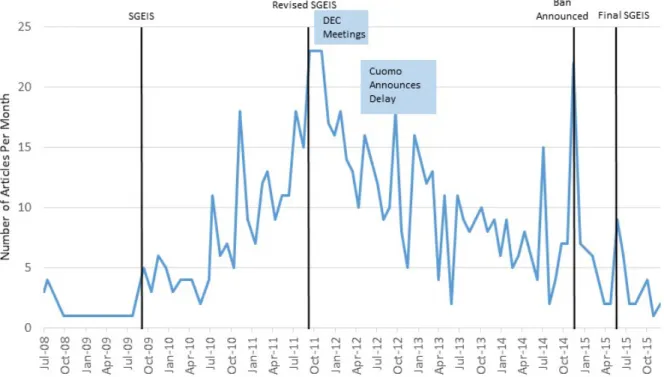
governor’s veto the next day, likely due to a mistakenly cast vote by Democratic Representative Becky Carney (Murawski, 2012, July 2). Media coverage peaked during this time in North Carolina (see Figure 1.2). At the time, however, fracking was a large unknown in the state: 57% of North Carolina voters did not know about fracking, While 21% supported it and 22% opposed it (Elon University Poll, March 2012). The Elon University Poll has tracked public opinion on fracking in the state since it first appeared on the media, public, and policy agendas.
Figure 1.2 Media Coverage and Major Legislative and Regulatory Actions Related to Fracking in North Carolina
Figure 1.2. The major actions within North Carolina related to fracking came from state legislative actions, and media coverage spiked during these times. Even when the government action was regulatory (such as the MEC meetings), from my observations they were not seen as separate but an extension of the legislative body.
11
Carolina voters had moved from approximately half not knowing about fracking to 50%
supporting it, while 34% were opposed and 16% didn’t know (Elon University Poll, September 2013). Meanwhile, actors began to join in the public debate, aligning on the pro- and anti- coalition side. Table 1.1 outlines the major individual and institutional actors in the fracking policy debate in North Carolina.
Table 1.1
Major Stakeholders in North Carolina Public Debate on Fracking
Pro-Fracking Self-Described Independent Anti-Fracking Advocacy Groups
American Petroleum Institute^
America's Natural Gas Alliance^
National Ocean Industries Association^
N.C. Chamber of Commerce^ Energy in Depth^
Elected Officials
State Senator Bob Rucho (R), sponsor SB720
State Representative Mike Hager (R)
Gov. Pat McCrory (R) Regulatory
Mining and Energy Commission Companies Halliburton
Media/Journalists
Raleigh News & Observer Jim Murawski Editorial Board Charlotte Observer
Editorial Board Southern Pines Pilot
Ted Natt, Jr. Science/Academics U.S. Geological Survey N.C. Geological Survey Dr. Terry Engelder, Penn State University
Dr. Avner Vengosh, Duke University
Dr. Robert Jackson, Duke University/Stanford University
Regulatory
Department of Environment and Natural Resources
Advocacy Groups Clean Water for North Carolina*
Environment North Carolina* Sierra Club North Carolina Chapter
Blue Ridge Environmental Defense League*
Food and Water Watch* Save Our Sandhills* 350.org*
Elected Officials
Gov. Beverly Perdue (D) State Representative Becky Carney (D)
Note. ^Denotes formal partnership with North Carolina Energy Coalition, according to their website; *Denotes formal partnership with Frack Free NC, according to their website. Because organizations were often served by several individuals, organizations are used except where an individual was the
stakeholder.
12
without approval for the final fracking regulation. Despite Democrats’ attempts to attach safe guards to the bill, it was passed with very little floor debate, as Republicans continually blocked attempts by Democrats to debate the bill, which one lobbyist and observer of the session called the “worst miscarriage of environmental justice” that she had ever seen (personal observation, May 27, 2014). It was easily signed into law in June 2014 by Gov. McCrory—as opposed to the battle with Democratic Gov. Perdue over The Clean Energy and Economic Security Act, there was no political fighting with the Republican governor. Media coverage of fracking rose again in May 2014 and continued at a relatively high pace. Shortly after, the MEC released its draft fracking regulations, it heard comments from 341 people at four public meetings from August 20-September 12, 2014 and accepted more than 200,000 comments electronically (North
Carolina Mining and Energy Commission, 2014). By this time, public sentiment had turned, with 51% of North Carolina voters opposed to and 34% supporting fracking (Elon University Poll, February 2015). Over and over at the public meetings, speakers used their three minutes to rail against a process which they felt would affect them greatly, and which they felt they had been left out of. The final fracking rules were released in December 2014, and fracking was allowed in March 2015. However, a judge halted the approval pending an NC Supreme Court decision that affected the legitimacy of the MEC, and therefore the rules it created (Murawski, personal communication, October 28, 2014). The complicated decision came down in January 2016; however, what it means for fracking permits is still unclear (Jones & Blount, 2016, January 29). New York
On December 17, 2014, New York became the first state in the United States with
13
Andrew Cuomo announced the ban, which was finalized in June 2015, after seven years of review (Nearing, December 18, 2015). During that time media coverage hit one of its highest peaks (see Figure 1.3) while public opinion showed overwhelming support for the ban, with the approval of 55% of New York voters, compared to 25% disapproval (Quinnipiac University Poll, December 22, 2014). According to the poll, no party, gender, age or regional group disapproved of the poll.
Figure 1.3 Media Coverage and Major Legislative and Regulatory Actions Related to Fracking in New York
Figure 1.3. As opposed to North Carolina, the policy decisions for fracking remained largely within the regulatory bodies. New York saw less drastic spikes coverage than North Carolina.
The process began around September 2009, when the DEC released its Draft
14
New York City's watershed while opening up large parts of the rest of the state to drilling and fracking (New York Department of Environmental Conservation, 2015). Media coverage at the time reached the first of two high peaks (See Figure 1.3). The Quinnipiac University Poll, which has polled about public support for fracking in New York relatively consistently, first asked about fracking in August 2011. At that time, 47% of New York voters supported fracking, while 42% opposed it, with voters focusing on the economic benefits over the environmental concerns across all regions of the state (Quinnipiac University Poll, August 11, 2011). Media coverage of fracking had risen steadily from 2009 to 2011 (See Figure 1.3), with many stakeholders joining the debate. Table 1.2 outlines the major stakeholders in the fracking debate in New York. Table 1.2
Major Stakeholders in New York Public Debate on Fracking
Pro-Fracking Self-Described Independent Anti-Fracking Advocacy Groups
American Petroleum Institute America's Natural Gas Alliance
Independent Oil & Gas Association of New York Joint Landowners Coalition of New York
Elected Officials
Gov. David Paterson (D) Gov. Andrew Cuomo (D) Companies
Halliburton U.S. Energy
Journalists
Albany Times Union Brian Nearing Buffalo News
Robert McCarthy
Science/Academics U.S. Geological Survey Dr. Terry Engelder, Penn State University
Dr. Avner Vengosh, Duke University
Dr. Robert Jackson, Duke University/Stanford University
Regulatory
Department of Environmental Conservation
Department of Health
Advocacy Groups
Environment New York* Capital District Against Fracking*
Frack Action New York* Sierra Club, Atlantic Chapter Toxic Targeting
Catskills Mountainkeeper* NRDC New York
Journalists
Fred Lebrun, columnist, Albany Times Union Elected Officials
Gov. Andrew Cuomo (D)
15
Meanwhile, the city of Buffalo New York, banned fracking in February 2011, a largely symbolic vote given that no fracking was planned for the area at that time. Other towns in the Southern Tier, where fracking was likely to take place, quickly followed that ban. In June 2012 the New York Times reported that, according to senior officials at the State Department of Environmental Conservation, Gov. Cuomo would likely limit drilling to the deepest areas of the Marcellus Shale rock formation — primarily Broome, Chemung, Chenango, Steuben and Tioga Counties. Instead, later that month, Gov. Cuomo announced a delay in the rulemaking process. In September 2012, DEC asked the NYSDOH to review the SGEIS, effectively restarting the rulemaking process. By March 2013, 46% of New York voters opposed fracking, while 39% opposed it (Quinnipiac University Poll, March 20, 2013). In August 2014, just before the ban was announced, 48% of New York voters opposed fracking, while 43% opposed it (Quinnipiac University Poll, August 2014). In May 2014, 38% of New York voters felt Gov. Cuomo was "dragging his feet, " while only 23% felt he was "carefully evaluating the issue" (Quinnipiac University Poll, May 22, 2014).
The development of the policy image for fracking is complicated. The number of stakeholders, shifting public opinion, and technical and scientific uncertainty led to the
politicization of the issue. Many stakeholders very clearly developed into pro- and anti-fracking coalitions, while others remained independent, or, like Gov. Cuomo, were accused of supporting “the enemy” by both sides.
The Advocacy Coalition Framework
16
well as the policy or policies’ outcomes” (Weible, 2014, p. 14). The ACF emerged out of a desire to move policy studies beyond policy sciences, a very simple descriptive stages approach to describe the various aspects of policymaking to push theories to test and evaluate causal relationships (Jenkins-Smith et al., 2014). Researchers implementing the ACF seek to
empirically explain the dynamic processes of policy learning and policy change by focusing on policy subsystems and their coalitions (Shanahan, Jones, & McBeth, 2011). According to the ACF, advocacy coalitions are “actors sharing policy core beliefs who coordinate their actions in a nontrivial manner to influence a policy subsystem” (Jenkins-Smith et al., 2014, p. 195). These coalitions can vary in their level of resources, formality, and size (Jenkins-Smith et al., 2014).
17
Figure 1.4 Flow Diagram of the Advocacy Coalition Framework.
Figure 1.4. My dissertation focuses on the coalitions and their beliefs, resources and strategies. From Jenkins-Smith et al., 2014.
My dissertation focuses on the area circled: the coalitions and their beliefs, resources, and strategies. It also touches on the reactions of the coalitions and other stakeholders to decisions and institutional rules developed, policy outputs and policy impacts.
The ACF was designed as “a subsystem-based theory of political behavior and policy change that purposely avoids a linear depiction of the policy process” to move away from the stages heuristic policy process theory in the 1970s and 1980s (Weible, Sabatier, & McQueen, 2009). However, due to the somewhat linear nature of the development of the fracking public debate as outline above, it is necessary to bring some stages heuristics, such as agenda setting and issues management, into the discussion. When doing so, I adhere to the guidelines outlined by Weible et al. (2009):
18
we recommend that researchers should adhere to the ACF’s assumptions, especially regarding beliefs as a causal driver…Second…researchers wanting to study just one policy should recognize that coalitions will likely be attending to multiple policies simultaneously. Third, coalitions operate across stages, and researchers should recognize that coalitions will, for example, simultaneously devote attention to fighting the
implementation of a given policy and seek to reformulate the same policy in a legislature. Fourth…researchers are encouraged to investigate the degree of coordination among coalition members who operate across different policy stages. (p. 136)
Taking these guidelines into account, my model assumes coalition beliefs are the causal drivers as strategic actors seek to influence policy image throughout the process. Additionally, I have incorporated other assumptions of the ACF into my study of the fracking policy subsystems in New York and North Carolina. I have already discussed the policy subsystem as my unit of analysis, as well as the coalitions that coalesced around the pro- and anti-fracking movements. Here I outline two more assumptions that are central to my dissertation.
19
(Jenkins-Smith et al., 2014, p. 192). Scientific and technical information can point to specific causal relations, problem attributes, and sometimes policy alternatives, especially for
environmental issues. However, because it can be tangled up within the belief systems of coalition members, science can often be politicized, especially when the science itself is uncertain and still being developed, as is the case with fracking. This can become especially confusing when the media get involved.
Toward a Model for Understanding Science, Media, and Policy in Public Debate
Scientific and technical information, media, and strategic communication play myriad roles in the public debate surrounding fracking, depending on where the debate is in the policy process. We do not full understand the role of each within the policy process, or how they relate to one another (Jenkins-Smith et al., 2014; Weible et al., 2011; Crow, 2010; Shanahan et al., 2011). This model provides a structure for examining the factors of the public debate that influences public policy for environmental (and other) issues that have strong scientific
20
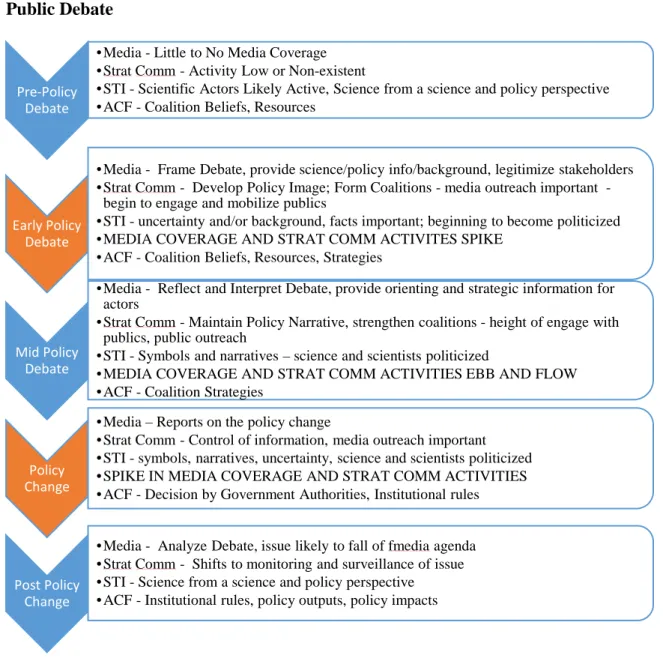
Figure 1.5 Model for Understanding Science, Media, and Strategic Communication in Public Debate
Figure 1.5. This model is designed to fit within the policy subsystem box of the Flow Diagram of the ACF (see Figure 1.4). Media refers to the role of the media, Strat Comm refers to the role of strategic communication, and STI refers to the role of scientific information.
Each empirical chapter in this dissertation focuses on the conceptual development of one main factor in the model. Chapter 2 focuses on the role of scientific and technical information, Chapter 3 focuses on the role of the media, and Chapter 4 focuses on the role of advocacy coalition strategic communication actions. While the phases of a policy debate are discussed in each chapter, they will focus mostly on the early- and mid-policy debate phases, as well as the
Pre-Policy Debate
• Media - Little to No Media Coverage • Strat Comm - Activity Low or Non-existent
• STI - Scientific Actors Likely Active, Science from a science and policy perspective • ACF - Coalition Beliefs, Resources
Early Policy Debate
• Media - Frame Debate, provide science/policy info/background, legitimize stakeholders • Strat Comm Develop Policy Image; Form Coalitions media outreach important
-begin to engage and mobilize publics
• STI - uncertainty and/or background, facts important; beginning to become politicized • MEDIA COVERAGE AND STRAT COMM ACTIVITES SPIKE
• ACF - Coalition Beliefs, Resources, Strategies
Mid Policy Debate
• Media - Reflect and Interpret Debate, provide orienting and strategic information for actors
• Strat Comm - Maintain Policy Narrative, strengthen coalitions - height of engage with publics, public outreach
• STI - Symbols and narratives – science and scientists politicized
• MEDIA COVERAGE AND STRAT COMM ACTIVITIES EBB AND FLOW • ACF - Coalition Strategies
Policy Change
• Media – Reports on the policy change
• Strat Comm - Control of information, media outreach important • STI - symbols, narratives, uncertainty, science and scientists politicized • SPIKE IN MEDIA COVERAGE AND STRAT COMM ACTIVITIES • ACF - Decision by Government Authorities, Institutional rules
Post Policy Change
21
actual policy change, when most activities occur. Additionally, while each chapter has a
conceptual focus, the interrelated roles of each factor are discussed. Below I outline what will be discussed in each chapter as they relate to the model.
Pre-Policy Debate
This phase aligns with Coalitions, Beliefs and Resources in Figure 1.4. In Chapter 2, I will outline how science often operates outside of public scrutiny at this time. In Chapter 3, I will outline how media coverage and activity is likely low during this time. In Chapter 4, I will outline how strategic communication activity will be low during this time.
Early Policy Debate
This phase aligns with Coalitions, Beliefs, Resources, and Strategies in Figure 1.4. In Chapter 2, I will outline how scientific information can begin to become politicized during this time, and a focus on scientific uncertainty will increase. In Chapter 3, I will outline how media coverage can spike at this time, helping frame the debate, providing scientific background, and legitimizing stakeholders. In Chapter 4, I will outline how strategic communications activities sharply increase, and media outreach and coalition building will be important factors for advocacy organizations.
Mid-Policy Debate
This phase aligns with Coalitions, Beliefs, Resources, and Strategies in Figure 1.4. This refers to the period between when a policy issue first becomes part of the public debate and a policy change occurs. This can take years (three in case of North Carolina, seven in the case of New York). In Chapter 2, I will outline how science and scientists are likely to become
22
actions of stakeholders. In Chapter 4, I will outline how strategic communications activities will be focused on either changing or maintaining the policy image, often by developing policy narratives.
Policy Change
This phase aligns with Decision by Government Authorities and Institutional Rules in Figure 1.4. This refers to the period when policy change is decided or implemented. In Chapter 2, I will outline how science and scientists are likely to be politicized in light of the policy change (particularly by the “losing” coalition). In Chapter 3, I will outline how this period will be marked by another spike in media coverage, as media serve as both actor and resource. In Chapter, 4, I will outline how strategic communications activities will be focused on controlling the policy image after the policy change.
Post-Policy Change
This phase aligns with Institutional Rules, Policy Outputs, and Policy Impacts in Figure 1.4. This refers to the period after the policy change occurs. In Chapter 2, I will outline how science shifts back to operating outside of the public eye. In Chapter 3, I will outline how media will spend some time analyzing the policy process before moving on to other issues. In Chapter 4, I will outline how strategic actors will do the same, shifting their actions to monitoring the policy subsystem until the next period of activity.
23 Research Questions
I set out to answer two questions related to the use of scientific and technical information. The first looks at how scientific evidence was deployed to develop policy image:
RQ1: How did the pro- and anti-fracking coalitions in New York and North
Carolina deploy scientific evidence to develop their policy image?
The second looks specifically at the politicization (or not) of fracking and environmental science:
RQ2: How was scientific evidence politicized during the fracking debates in New
York and North Carolina?
I also set out to answer two questions related to the role of the media in the policy process. The first looks at the media as actors within a policy debate:
RQ3: How did the media within the fracking policy subsystems in New York and
North Carolina serve as actors influencing the policy debate? The second looks at how other actors may use the media in a policy debate:
RQ4: How did the media within the fracking policy subsystems in New York and
North Carolina serve as a resource influencing the policy debate?
Finally, I set out to answer two questions related to the role of strategic communication in the policy process. The first looks at the coalitions themselves:
RQ5: Who participated in the pro- and anti-fracking coalitions in the public
debate around fracking in New York and North Carolina?
RQ5A: What were the core beliefs of the pro- and anti- coalitions?
24
RQ6: How did the anti- and pro-fracking coalitions within the fracking policy
subsystems in New York and North Carolina develop a policy image through strategic communication?
RQ6A: How were the pro- and anti- coalition messages reflected in public
debate of fracking in New York and North Carolina?
To best answer these questions, I implemented a multi-method approach, incorporating content analysis, fieldwork, and interviews with actors in the fracking policy subsystems in New York and North Carolina.
Method
The ACF has been interpreted as “an actual ‘framework’ that supports multiple
theoretical areas of emphasis” (Weible, Sabatier, Jenkins-Smith, Nohrstedt, Henry, & DeLeon, 2011, p. 351). To that end, I take an interdisciplinary, multi-method approach to explore how actors shape debate around an environmental policy issue in the public sphere. This dissertation seeks to answer the following questions regarding fracking policy and public debate in New York and North Carolina: How did media influence public debate and public opinion on
fracking? Which individual and organization actors were privileged in the public debate? What strategies, devices, and tactics did stakeholders use when communicating about fracking? How did those stakeholders who may be unfamiliar with a debate, particularly policymakers and journalists, educate themselves (or not educate themselves) about fracking? How was scientific evidence used to develop policy images of fracking?
25
interesting comparison. North Carolina has a small amount of shale gas available, yet fast-tracked legislation to allow fracking in the state, while New York, which sits on the natural gas-rich Marcellus Shale, put into place a ban on fracking. As indicated by the complexity of the ACF, the development of fracking policy in each state involves many moving parts, including economic drivers like the price of oil. The need to develop policy before consensus on the environmental effects of fracking had been reached within the scientific community, the number of stakeholders involved, and the controversial nature of the public debate only adds to the complexity. To that end, I employed a mixed-method case study approach, using both
quantitative and qualitative methods and multiple theoretical lenses, to “provide a robust view of a phenomenon of political communication” (Walsh, 2004, p. 204). Taken broadly, qualitative methods are useful for building theory, in-depth case study analysis, and exploring concepts and relationships we may know little about. Conversely, quantitative methods are useful for
empirically testing theory, studying large amounts of data, and looking at causation/making predictions about concepts with which we are familiar. While not common, previous researchers have shown that mixed-methods research can provide rich data and a comprehensive
understanding of the public debate and public policy processes. (Heikkila et al., 2014; Williams & Gajevic, 2015).
Media content is central to “understanding processes and effects of communication” (Riffe, Lacy, & Fico, 2014, p. 11). There is a long tradition of using content analysis of newspapers to assess the connection between the media and policy agendas in framing public policy issues (recent applications include Nisbet & Huge, 2006; Davis & Hoffer, 2012). This is especially true for environmental issues:
26
for public concern, while others – seemingly equally serious or important – quickly vanish from the media agenda and from public view. [The] ups and downs in
environmental issues coverage that content analyses of news media reveal rarely, if ever, reflect just a single influential factor, but likely result from the complex interaction of multiple factors…[which makes content analyses of media coverage] an essential, and potentially highly productive, starting point if we wish to begin, as I started out arguing, to reconnect the study of media content with empirical evidence on either its
production/construction or its implications for public understanding/engagement, political and related processes and power in society. (Hansen, 2011, p. 222)
Quantitative content analysis is the “systematic and replicable examination of symbols of
communication, which have been assigned numeric values according to valid measurement rules, and the analysis of relationships involving those values using statistical methods, to describe the communication, draw inferences about its mean, infer from the communication to its context, both of production and consumption” (Riffe et al., 2014, p. 19). Additionally, media can serve as a public sphere for debate, a representation of public opinion, and a means of information for actors and stakeholders (Herbst, 1998; Jacobs & Townsley, 2011).
27 Fieldwork and interviews.
I conducted 33 interviews and fieldwork from May 2014 through March 2016. Interviews included three journalists, four elected officials, fifteen county regulatory officials, and nine volunteers and staff members of advocacy groups. The initial actors contacted to be interviewed were selected from those who appeared in the sample of articles from the content analysis after IRB approval. The journalists who covered the issue and the sources they quoted were contacted via phone and email. I supplemented this initial list by leveraging relationship formed during my research as well as an implemented snowball sampling technique. As is common for this type of research, respondents were named, especially when their comments are public record, such as media statements or legislative testimony. However, I offered them the opportunity to use pseudonyms or speak on background for particularly sensitive information or as requested. The consent form, reviewed with all respondents, included the right to stop at any time, the right to retract content, and the right to revoke consent for a limited time after completing the interview.
28
News & Observer and Fred Lebrun and Chris Churchill of the Albany Times Union;
environmental advocates Hope Taylor of Clean Water for North Carolina; Harvey Richmond, Chelsea Barnes, and Nick Brown of the Sierra Club, North Carolina, Capital Group; Susan Zimet of Frack Action New York, Theresa Vick of Environment North Carolina; Robert M. Ciesielski and Roger Downs of the Sierra Club Atlantic Chapter; Dennis Harkawik, an environmental lawyer, Joseph Golombrek, Jr., a member of the Buffalo (NY) Common Council; and Darryl Moss, mayor of Creedmoor, NC. I also interviewed several researchers and county
environmental and health officials in both states who requested pseudonyms.
Many of the activities in New York had ended by the time I began my research, so I depended on recollections of respondents as well as public records, including media reports, triangulating accounts of all events. However, because of my location in North Carolina, as well as the timing of my research, I was able to attend and observe many public events, legislative sessions, and public meetings. Additionally, I spent six months volunteering with the Capital Group of the Sierra Club North Carolina Chapter. The major events that informed this
29
I depended on recollections of respondents as well as public records, including media reports, and I triangulated accounts of all events in both states. I employed thematic analysis to analyze the transcribed interviews and field notes from my participant observation. I employed general qualitative coding analysis by identifying topic areas to sort and synthesize the data into the major themes I discovered (Charmaz, 2014).
Content analysis.
This content analysis focused on newspaper coverage of fracking in North Carolina and New York from January 1, 2008, to December 31, 2015. This encapsulates the full extent of media coverage for the fracking policy process in each state, capturing when fracking first appeared on the media agendas in each state and ending after major legislative decisions in each state that, while not ending debate, at least moved debate about fracking to the next phase. Because this study includes a focus on state-level fracking policy, the analysis includes the Raleigh (NC) News & Observer and the Albany (NY) Times Union, which serve the state capitols. Additionally, because this study focused on media as they relate to public opinion and public understanding, the analysis includes the Charlotte (NC) Observer and the Buffalo (NY) News, which are the largest circulation newspapers focused on news coverage within each state. The Buffalo News was the largest circulating newspaper after the New York Times, which was omitted due to its larger national/international focus. Finally, the analysis included the Southern Pines (NC) Pilot and the Canandaigua (NY) Daily Messenger to incorporate newspapers serving small towns in areas where fracking would be most likely to affect the communities directly that may have different concerns than the larger cities.
30
that discussed fracking were captured. Articles were included if they mentioned “fracking” OR hydraulic fracturing” OR “hydrofracking” more than twice to ensure they included significant statements about fracking. I included editorials and op-eds (which made up approximately one-quarter of the final sample, but I omitted letters to the editor, in accordance with past research. This yielded a final sample of 411 articles for North Carolina and 837 articles for New York for a total of 1248 articles. I coded each article, and reliability was assessed with an independent coder on a 10% randomly selected sample of the articles. See Appendix III for the full coding protocol.
First, articles were coded for the focus of the article. This was determined by the presence of fracking in the headline or lead, or the assessment that the majority of the article was about fracking. While the majority of articles were focused on fracking or natural gas, other foci included energy, environmental policy, legislative session overviews, and year-in-review/look ahead articles. This step was necessary because articles focused on fracking did not always have the key terms in the headline and lead, particularly during the early phase of the debate.
Next, articles were coded for the way fracking was framed. This study employed a stable of frames adapted from Nisbet (2010) for studying scientific controversies. Each article was coded for one of the following main frames:
• Environmental effects - focused on environmental impacts and risks, such as air and water quality.
• Public health effects – focused on issues related to public health, such as gag orders without mentions of the environment.
31
• Conflict/strategy – focused on who is “winning” or “losing” the debate, or fracking as a tradeoff between environmental protection and economic development.
• Balance for the community – focused on the effects of fracking on the community, including a focus on a balance of environmental and economic considerations for the good of the community.
• Government administration – focused on how bills or regulations were being developed or administered without a focus on strategy of the actors.
• Technical/policy background – focused on the history of fracking in the state or the technical background of fracking without focusing on its uncertainties.
• Technical/policy uncertainty – focused on the unknowns of fracking, including the struggles among government leaders with how to regulate it and the availability of fracking in the state.
Next, because I was interested in the actors who participated in public debate around fracking within each policy subsystem, I identified the quoted sources in each article.
A source was defined as a specific, named person quoted in an article. Quotes could be direct or indirect, but had to be about fracking. Source categories used for this study were based on my own knowledge of the fracking issue. Each source was coded for the following source categories:
• Government – Elected Official – this includes the elected official, as well as statements or lawsuits on behalf of the individual from a spokesperson or lawyer.
32
• Government – Agency - this includes statements of a lawyer on behalf of the organization.
• Environmental Advocate – this was someone working for an environmental organization or issue. Someone attending a protest would be considered an advocate. This includes statements of a lawyer on behalf of an organization or individual who falls within this category.
• Industry Representative or Industry Advocate – this was an official representative of a fracking company or industry group. This includes statements of a lawyer on behalf of an organization or individual who falls within this category.
• Social/Community Advocate - this was someone working for an organization or issue about protecting the community regarding issues other than the environment. Someone attending a protest would be considered an advocate. This includes statements of a lawyer on behalf of an organization or individual who falls within this category. • Citizen – this was a local citizen asked to speak about the issue, but not attending a
protest specifically advocating for one side of the issue. They could be attending another kind of event though (i.e. a debate or a public meeting).
• Scientist/Academic – this includes any scientist or academic providing independent research or comment. This also includes scientists for the USGS and scientists working for institutes at universities that avow their independence.
• Media – usually columns written by journalists or editorials.
33
Next, the assertions made by each source were coded. Source Assertions were coded as at least one sentence related to fracking quoted from each source and were coded as present or absent for reach source. Source assertions were based on my knowledge of the fracking debate. Each source was coded for the presence or absence of the following source assertions:
• Need to protect the environment– such as water contamination or air pollution from fracking operations.
• Need to protect public health – if human/public health effects are mentioned. • Need to contribute to the economy – such as focusing on the economic benefits of
fracking for the community and/or the state.
• Need for energy independence – points to fracking as a means to energy independence, fracking as a “bridge” in U.S. energy policy, fracking as a better energy alternative • Quality of life issues – such as highlighting the stress of fracking operations on
communities, or effects or benefits of fracking that go beyond environmental effects or economic benefits.
• Questioning the science of fracking – such as questioning the amount of natural gas recovered by fracking, or whether the costs outweigh the benefits, or noting deficiencies in studies showing fracking is safe.
• Questioning the science of environmental effects – such as noting deficiencies in studies showing fracking degrades environment, benefits outweigh costs.
• Administration of fracking rules and regulations – looking at the rules of fracking, including the ability of the state to regulate fracking.
34
• Fracking is unsafe – general assertions about safety of fracking, without specific mentions of science or technology or specific effects of fracking.
• Fracking as a moral issue – such as calling fracking unethical or immoral, questioning the morality or ethics of energy companies, government, or environmentalists.
• Need for precaution – such as invoking the need to proceed carefully or do more study in light of uncertainties related to fracking and/or environmental research.
• A call for working together – calling on “both sides” (i.e. Democrats and Republicans, Government and Industry, Environmentalists and Industry and/or government) to work together for the good of the community and/or state.
• Distrust of the other side – questioning the actions or motivations of their opponents; also questioning if the other side knows what they are doing; also mentions of not knowing what’s in in fracking fluid .
Protocol and coding reliability between two trained coders for each variable was assessed independently using a randomly selected 10% of the articles using Krippendorf’s Alpha. Reliability for article focus was .933 and frame was .926. Reliability for source category was .893 and source tone was .981. Reliability for the source assertions ranged from .817 to 1: Need to protect the environment (.97); Need to protect public health (.975); Need to contribute to the economy (.982); Need for energy independence (.861); Quality of life issues (.981); Questioning the science of fracking (.856); Questioning the science of environmental effects (.817);
Administration of fracking rules and regulations (.992); Fracking is Safe (.874); Fracking is Unsafe (.813); Fracking as a moral issue (.919); Need for precaution (.907); A call for working together (1); Distrust of the other side (.935).
35
This content analysis yielded 1,248 articles, 411 for North Carolina and 837 for New York. I am presenting the aggregate results and frequencies here to provide context for the dissertation, and the data will be analyzed in more detail as they relate to the empirical chapters below. Table 1.3 provides the frequencies of the focus and frame of fracking for each state. Table 1.3
Frequencies of Focus and Frame for each State (%)
North Carolina (N=411) New York (N=837) Total (1248) Focus
Fracking/Natural Gas 81.0 79.7 80.1
Energy 3.6 12.1 9.3
Environmental Policy 3.2 2.9 3.0
Elections 3.6 2.6 3.0
Legislative Session 5.4 1.3 2.6
Year-in-Review 1.2 .8 1.0
Other 2.0 .6 1.0
Total 100 100 100
North Carolina (N=411) New York (N=837) Total (1248) Frame
Environment 16.2 18.9 18.9
Public Health .5 2.2 2.2
Economy 20.9 13.5 13.5
Conflict/Strategy 31.0 30.6 30.6
Balance 6.1 5.7 5.7
Administration 18.4 15.8 15.8
Background 1.5 1.1 1.1
Uncertainty 5.4 5.9 5.9
Other 0.0 6.3 6.3
Total 100 100 100
36 Table 1.4
Frequencies of Assertions Made by Sources in Each State (%) North Carolina (N=961) New York (N=2860) Total (3821) Source Categories
Government – Elected Official 19.7 16.2 17.7
Candidate 2.8 3.5 2.6
Government - Agency 21.6 16.9 18.1
Environmental Advocate 12.1 19.2 17.4
Industry Representative/Industry Advocate 11.4 16.9 15.5
Social/Community Advocate 4.6 1.5 2.3
Citizen 3.2 7.7 6.6
Scientist/Academic 10.1 4.2 5.7
Media 7.7 8.8 8.6
Landowner 5.6 2.3 3.1
Other 1.1 2.7 2.3
Total 100 100 100
Source Tone North Carolina
(N=961)
New York (N=2860)
Total (3821)
Pro-fracking 26.8 20.5 22.1
Anti-fracking 35.5 38.0 37.4
Neutral 37.7 41.5 40.5
Total 100 100 100
Source Assertions North Carolina
(N=961)
New York (N=2860)
Total (3821)
Need to protect the environment 23.5 45.8 40.2
Need to protect public health 5.6 13.5 11.3
Need to contribute to the economy 43.6 25.4 29.7
Need for energy independence 15.8 8.8 10.6
Quality of life issues 9.1 11.2 10.3
Questioning the science of fracking 15.3 11.5 12.5
Questioning the science of environmental effects 1.0 6.2 4.9 Administration of fracking rules and regulations 65.6 45.0 50.2
Fracking is safe 7.8 6.9 7.1
Fracking is unsafe 5.6 5.8 5.7
Fracking as a moral issue 7.8 3.5 4.6
Need for precaution 34.1 25.0 23.6
A call for working together 5.4 4.2 4.5
Distrust of the other side 27.5 22.3 23.6
37 Conclusion
The fracking debate is an extremely controversial debate that has seen the politicization of science in the face of scientific uncertainty and an increase in interested stakeholders. The media helped frame the issue as a choice between environmental effects and economic
38
Chapter 2 – The Elusive Role of Facts: Science, Policy, Politics and Public Debate In June 2015, the U.S. Environmental Protection Agency (EPA) released its most comprehensive report to date on the effects of hydraulic fracturing on drinking water. It raised concerns about isolated incidents of water pollution but found no systematic evidence of damage (Warrick, 2015, June 4). While the report garnered national media attention, it appeared
“unlikely to cool the national debate over the drilling practice that has spurred huge increases in U.S. oil and gas production in the past five years [as] opponents and supporters of fracking instantly seized on portions of the report that supported their view” (Warrick, 2015, June 4). This Washington Post article reveals this with three consecutive quotes from the EPA, the American Petroleum Institute (API), and the Sierra Club:
Burke [EPA’s science adviser] called the draft report “the most complete
compilation of scientific data to date,” encompassing 950 sources of information, such as scientific papers and technical reports, as well as original, peer-reviewed research conducted by the agency itself. “It greatly increases our understanding of potential impacts,” he said…
…The American Petroleum Institute called the study a validation of the energy industry’s contention that fracking poses little risk to drinking water.
“After more than five years and millions of dollars, the evidence gathered by EPA confirms what the agency has already acknowledged and what the oil and gas industry has known,” said Erik Milito, the institute’s Upstream Group director. “Hydraulic fracturing is being done safely under the strong environmental stewardship of state regulators and industry best practices.”
Michael Brune, the Sierra Club’s executive director, said the report “confirms what millions of Americans already know: that dirty oil and gas fracking
39
How could these actors within a policy debate draw such different conclusions about scientific evidence? What is the role of science in policy debates, and what should it be? What does this mean for both policymaking and for the public’s understanding of policy issues with strong scientific and technical aspects, such as fracking?
To understand better the role of science in a developing policy debate, this chapter brings together research from policy, journalism, and the public understanding of science through the lens of the Advocacy Coalition Framework (ACF). Using the ACF, I examine the fracking debate and policy development in North Carolina and New York.2 North Carolina has a small amount of shale gas available, yet fast-tracked legislation to develop fracking regulations in the state, despite increasingly conflicted public opinion on the subject. New York, which sits on the natural gas-rich Marcellus Shale, put into place a moratorium on fracking. I will explore the policy images that developed in these two states and the role of scientific and technical information in their development.
My model explores the use of scientific and technical information within the public policy framework, looking especially at how media and strategic actors can politicize science during the early- and mid-phases of a policy debate. Through the lens of the ACF, I will explore how both the pro- and anti-fracking coalitions used science to develop their policy images of fracking, especially as it rose to the top of the media, public, and policy agendas.
40 Literature Review
Scientific and technical information within the Advocacy Policy Framework. A broad definition of public policy includes formal decision, laws, and regulations, as well as the underlying mechanisms that govern the policy process. Policy researchers study “the interactions over time between public policy and its surrounding actors, events, and contexts, as well as the policy or policies’ outcomes” (Weible, 2014, p. 14). The ACF is particularly useful for studying environmental policy debates. In fact, from 1987 to 2013, environmental policy issues account for more than half of all empirical applications of the ACF (Jenkins-Smith et al., 2014).
Researchers implementing the ACF seek to explain empirically the dynamic process of policy change by focusing on policy subsystems and their coalitions (Shanahan et al., 2011). Policy subsystems are the community of actors that coalesce around a particular issue that often operate outside of the public eye, especially for policy issues with strong scientific and technical components (Baumgartner & Jones, 2010). According to the ACF, actors within these coalitions who share core beliefs about a particular issue and coordinate their actions around that issue can be grouped into coalitions (Jenkins-Smith et al., 2014). While coalitions in the ACF can vary in their level of resources, formality, and size, the coalitions in the fracking debate (anti-fracking or pro-fracking) in New York and North Carolina were relatively well-formed and official,
especially on the anti-fracking side. Coalitions have been one major theoretical focus of the ACF, with policy learning, which refers to the shifting of beliefs among coalition members, and policy change, which refers to alterations to a policy that deviate from a previous policy,
41
When the ACF was originally created, part of the intention was to better understand the role of science in the policy process (Jenkins-Smith et al., 2014). The ACF assumes that “to better understand policy processes is thus to understand how scientific and technical explanations are integrated into (or deflected from) belief systems, used in political debates and negotiations, and integrated with other forms of knowledge, especially local knowledge” (Jenkins-Smith et al., 2014, p. 192).Belief systems “are not just abstract representations of values and priorities, they also encapsulate the perceived causal patterns and relationships that shape the empirical world” (Jenkins-Smith et al., 2014, p. 192). Scientific and technical information can point to specific causal relations, problem attributes, and sometimes policy alternatives, especially for
environmental issues. However, because it can be tangled up within the belief systems of coalition members, science can often be politicized, especially when the science itself is uncertain and still being developed, as is the case with fracking.
42
indicate that something else, besides the scientific and technical information itself, determines how effective science is in public debate.
Understanding the role of science in environmental policy debates requires looking at science as a resource for policy makers and scientists as policy advisers (Pielke, 2006), as well as looking to scientists to help the public understanding of science as public communicators
(Friedman et al., 1986; Willems, 1995; Weingart, 2005; Peters, 2008). These dual roles are interdependent within a public policy debate, as “public communication of scientific expertise often has political impacts and – in response – politics, organisations and groups with political goals try to govern the production and use of scientific expertise” (Peters, 2008, p. 132). To understand better the role of science in public debate over environmental policy issues, we must understand the relationship between the scientific process, the policy process, and the journalistic process.
Science and environmental policy.
Past research has shown that when policy debates involve science, such as fracking and other environmental issues, then the science can be politicized, particularly where there is no scientific consensus and either side can make scientific claims (Nelkin, 2005; Oreskes, 2004; Sarewitz, 2004; Pielke, 2004; Jasanoff et al., 1998). We are talking here about three separate concepts: science, policy, and politics, though the three often can be conflated with each other (Pielke, 2006). Because of this, throughout this paper I will rely on Roger Pielke’s distinction of science from a policy or political perspective, and I will use each word accordingly:
Addressing the significance of science for decision making requires an ability to clearly distinguish policy from politics. For science, a policy perspective implies increasing or elucidating the range of alternatives available to decision makers by clearly associating the existing state of scientific knowledge with a range of choices. The goal is to enhance freedom of choice. By contrast, a political