INCIDENCE OF VENOUS THROMBOEMBOLISM FOLLOWING NEW USE OF NON-STEROIDAL ANTI-INFLAMMATORY DRUGS IN U.S. WOMEN
Tracy Kinsey
A dissertation submitted to the faculty at the University of North Carolina at Chapel Hill in partial fulfillment of the requirements for the degree of Doctor of Philosophy in the Department of
Epidemiology in the Gillings School of Global Public Health.
Chapel Hill 2019
Approved by: Til Stürmer Robert Glynn
Michele Jonsson Funk Charles Poole
ABSTRACT
Tracy Kinsey: Incidence of Venous Thromboembolism Following New Use of Non-steroidal Anti-inflammatory Drugs in U.S. Women
(Under the direction of Til Stürmer)
At least six pharmacoepidemiologic studies have suggested that non-steroidal anti-inflammatory drug (NSAID) use increases the risk of venous thromboembolism (VTE), however, biologic mechanisms for an association are unclear. Most previous studies employed prevalent user case control designs; none employed a new user active comparator design. Body mass index (BMI), often an important confounder in pharmacoepidemiologic studies, is unavailable in insurance claims data and its prediction is difficult. There is increasing interest in internal validation via linkage to electronic health records (EHR) systems to augment claims data. The aims of this dissertation were: 1) to evaluate incidence of VTE following new use of NSAIDs in a long-term cohort of U.S. women, and 2) to explore approaches to control for unmeasured confounding of the association of NSAID initiation and VTE by BMI with self-reported BMI values available for comparison.
We identified new use of non-aspirin NSAIDs and incident VTE among 39,876
participants of the Women's Health Study followed from 1993-2012 with annual questionnaires. We designed as-treated analyses comparing NSAIDs initiation with non-initiation and
iv
performance of multiple imputation (MI) of BMI under completely at random, at random, and not at random internal validation scenarios.
Initiation of NSAIDs was associated with increased VTE risk compared to non-initiation, but the association was null or diminished when compared with initiation of acetaminophen, an active comparator with similar indications but no known thrombotic effects. With internal
TABLE OF CONTENTS
LIST OF TABLES ... vii
LIST OF FIGURES ... ix
LIST OF ABBREVIATIONS ... x
CHAPTER 1. STATEMENT OF SPECIFIC AIMS ...1
1.1. Aim 1 ...1
1.2. Aim 2 ...2
CHAPTER 2. BACKGROUND AND REVIEW OF LITERATURE ...3
2.1. Public health significance of VTE ...3
2.2. Non-steroidal anti-inflammatory drugs ...3
2.3. Association of NSAID use with VTE risk ...4
2.4. Biologic plausibility of a causal association ...7
2.5. Unmeasured confounding by BMI ...7
CHAPTER 3. METHODS ...10
3.1. Data source ...10
3.2. Data structure ...11
3.3. Exposures ...12
3.4. Outcomes ...13
3.5. Covariates...14
3.6. Study design ...15
3.7. Analytic methods...16
3.8. Characteristics of the WHS cohort ...17
vi
CHAPTER 4. INCIDENCE OF VENOUS THROMBOEMBOLISM FOLLOWING INITIATION OF NON-STEROIDAL ANTI-INFLAMMATORY
DRUGS IN U.S. WOMEN ...29
4.1. Introduction ...29
4.2. Methods ...30
4.3. Results ...37
4.4. Discussion ...38
4.5. Tables and Figures ...41
CHAPTER 5. DESIGN AND ANALYTIC APPROACHES TO UNMEASURED CONFOUNDING OF THE ASSOCIATION OF NON-STEROIDAL ANTI-INFLAMMATORY DRUG INITIATION AND VENOUS THROMBOEMBOLISM BY BODY MASS INDEX ...62
5.1. Introduction ...62
5.2. Methods ...63
5.3. Results ...68
5.4. Discussion ...70
5.5. Tables and Figures ...74
CHAPTER 6. DISCUSSION ...91
6.1. NSAID use and VTE incidence ...91
6.2. Unmeasured confounding ...93
6.3. Public Health Implications ...94
6.4. Conclusions ...95
LIST OF TABLES
Table 3.1. Variables available in the WHS analytic dataset ...18 Table 3.2. Joint distributions of event type and provocation status of confirmed VTE
among 39,786 WHS participants that completed at least one follow-up
questionnaire ...20 Table 3.3. Bivariate distributions of baseline BMI by self-reported use of an NSAID 4+
days/mo and confirmed VTE event anytime during WHS observation ...21 Table 4.1. Ascertainment of self-reported use of NSAIDs from Women’s Health Study
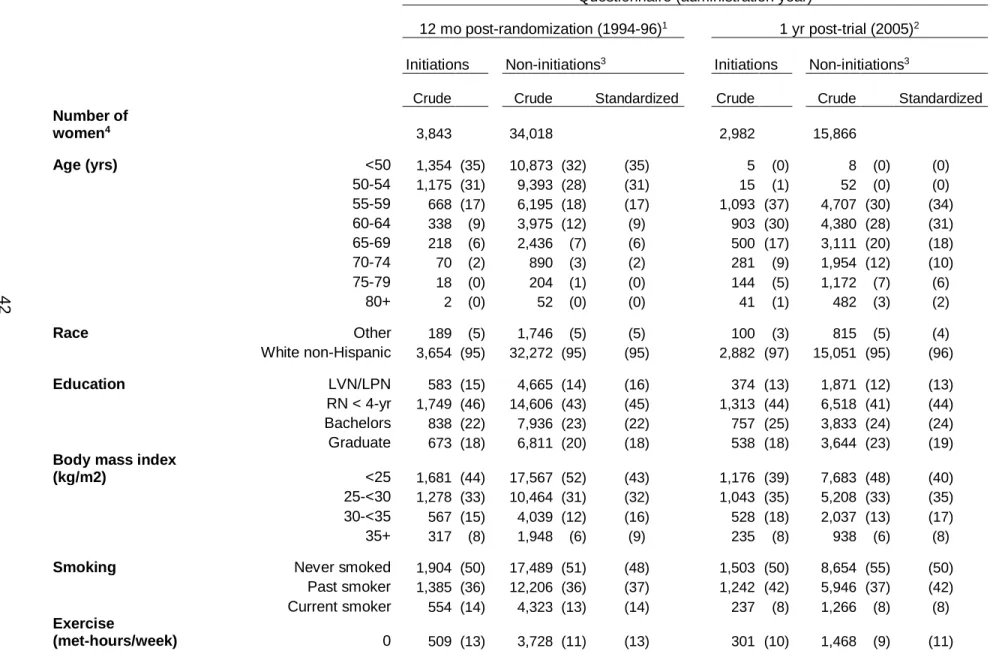
questionnaires ...41 Table 4.2. Covariate distributions of women with eligible questionnaires at selected
survey times (number (%) of women) ...42 Table 4.3. Risk (%) and risk difference for VTE within 2 yrs of NSAID initiation or
non-initiation using as treated and initial treatment designs ...45 Table 4.4. Incidence rates and hazard ratios for VTE comparing NSAID initiation with
non-initiation using as treated and initial treatment designs ...46 Table 4.5. Hazard ratios for VTE comparing NSAID initiation with non-initiation stratified
by frequency of use at time of initiation using as treated design ...47 Table 4.6. Risk (%), risk difference, and number needed to treat for VTE within 2 yrs of
NSAID initiation or non-initiation using as treated active comparator design ...48 Table 4.7. Incidence rates and hazard ratios for VTE comparing initiation of NSAID with
initiation of active comparator using as treated design ...49 Table 4.8. Sensitivity analysis: As treated hazard ratios for VTE comparing NSAID
initiation with non-initiation for selected subgroups ...50 Table 4.9. Sensitivity analysis: As treated and initial treatment incidence rates and
hazard ratios for VTE comparing NSAID initiation with non-initiation by length of
at-risk follow-up time restriction ...51 Table 4.10. Sensitivity analysis: As treated hazard ratios for VTE comparing initiation of
NSAID with initiation of active comparator by length of maximum follow-up time
restriction ...52 Table 4.11. Sensitivity analysis: As treated hazard ratios for VTE comparing initiation of
NSAID with non-initiation by frequency of use at initiation and length of maximum
viii
Table 5.1.Variables selected for the propensity score model for control of confounding in
the estimation of hazard ratio for VTE...74 Table 5.2. Variables selected for the imputation model for prediction of BMI ...75 Table 5.3. Fully adjusted, BMI-naïve, and crude hazard ratios for VTE comparing
initiation of traditional NSAIDs with non-initiation of any NSAID and initiation of
acetaminophen ...76 Table 5.4. Estimation of adjusted hazard ratios for VTE comparing initiation of traditional
NSAIDs with non-initiation of any NSAID with multiple imputation using MCAR
internal validation samples ...77 Table 5.5. Imputation model parameters for prediction of BMI using MCAR validation
samples ...78 Table 5.6. Estimation of adjusted hazard ratios of VTE for traditional NSAID initiation vs.
non-initiation using multiple imputation with MCAR validation samples of fixed
absolute sizes with incremental changes of total sample size ...79 Table 5.7. Performance of multiple imputation under MNAR scenarios of greater
missingness of BMI in the EHR correlated with normal values of BMI (normal:
18.5-25 vs. non-normal: <18.5 or >25 kg/m2) ...80 Table 5.8. Performance of multiple imputation under MAR scenarios of greater
missingness of BMI in the EHR correlated with absence of prevalent
comorbidities (0 vs. ≥1 of 14 possible) ...81 Table 5.9. Sensitivity Analysis: Estimation of adjusted hazard ratios using multiple
imputation with MCAR internal validation samples...82 Table 5.10. Sensitivity Analysis: Imputation model parameters for prediction of BMI using
MCAR validation samples...83 Table 5.11. Sensitivity Analysis: Estimation of adjusted hazard ratios using multiple
imputation with MCAR validation samples of fixed absolute sizes with
LIST OF FIGURES
Figure 3.1. Schematic diagram illustrating the classification of eligibility, initiation or non-initiation, and treatment change for a hypothetical questionnaire with as treated
design...22 Figure 3.2. Schematic diagram illustrating sequential observations for a hypothetical
woman with initial treatment (first treatment carried forward) design ...23 Figure 3.3. Schematic illustration of the same hypothetical woman with initial treatment
design with at risk follow-up for VTE restricted to 5 years following initiation or
non-initiation ...24 Figure 3.4. Schematic diagram illustrating sequential questionnaires for a hypothetical
woman with as treated design created by censoring ...25 Figure 3.5. Prevalent self-reported use of traditional NSAIDs and coxibs on sequential
questionnaires among all WHS participants...26 Figure 3.6. Annual incidence rates of initiation of traditional NSAIDs and coxibs during
1994-2010 ...27 Figure 3.7. Crude annual incidence rates of venous thromboembolism among all WHS
participants ...28 Figure 4.1. Flow diagram depicting the derivation of the study sample for the main
analysis (initiation v. non-initiation of any NSAID) ...56 Figure 4.2 Weighted Kaplan-Meier curves for time to first confirmed VTE event in
non-initiation comparator analyses ...57 Figure 4.3 Weighted Kaplan-Meier survival curves for time to first confirmed VTE event
in active comparator analyses ...60 Figure 5.1. Distribution of BMI in the NIC cohort by initiation ...85 Figure 5.2. Distribution of BMI among non-initiations the NIC cohort by VTE outcome ...85 Figure 5.3. Propensity score distributions before and after standardization, respectively,
for NSAID initiation vs. non-initiation (A, B) and NSAID initiation vs.
acetaminophen initiation (C, D)...86 Figure 5.4. Scatterplot showing known BMI values plotted against values predicted from
covariates in the 100% full sample for initiation vs. non-initiation of traditional
NSAIDs ...87 Figure 5.5. Known vs. predicted BMI values among imputed questionnaires using 20%
(A), 5% (B), and 1% (C) validation samples ...88 Figure 5.6. Scatterplot showing last vs. first self-reported BMI value of all women in the
x
LIST OF ABBREVIATIONS
AIC acetaminophen initiation comparator ARIC Atherosclerosis Risk in Communities
AT as treated
BMI body mass index
CASCADE Concerted Action on SeroConversion to AIDS and Death in Europe
CC complete cases
CHS Cardiovascular Health Study CI confidence interval
CLR confidence limit ratio COX cyclooxygenase
coxib cyclooxygenase-2 selective non-steroidal anti-inflammatory DVT deep vein thrombosis
EHR electronic health records FDA Food and Drug Administration GI gastrointestinal
HR hazard ratio
IR incidence rate IRR incidence rate ratio
IT initial treatment (intention to treat) LPN licensed practical nurse
LVN licensed vocational nurse MI multiple imputation MAR missing at random
MNAR missing not at random NIC non-initiation comparator NNT number needed to treat
NNTB number needed to treat for benefit NNTH number needed to treat for harm NSAID non-steroidal anti-inflammatory drug OA osteoarthritis
OR odds ratio
PE pulmonary embolism PS propensity score PUD peptic ulcer disease
PY person-years
RCT randomized controlled trial RD risk difference
RN registered nurse RR relative risk
SMR standardized morbidity ratio VS validation sample
VTE venous thromboembolism WHS Women’s Health Study
1
CHAPTER 1. STATEMENT OF SPECIFIC AIMS
Several pharmacoepidemiologic studies have suggested that non-steroidal
anti-inflammatory drug (NSAID) use increases the risk of venous thromboembolism (VTE), however, biologic mechanisms for a causal association are unclear. Body mass index (BMI), an important confounder in the association of NSAID use and VTE, is unavailable in insurance claims data and its accurate prediction is difficult. There is increasing interest in internal validation via linkage to electronic health records (EHR) systems to augment claims data. The aims of this dissertation were to evaluate incidence of VTE following new use of NSAIDs in a long-term cohort of U.S. women, and to describe confounding of the association of NSAID use and VTE by BMI and explore approaches to control for unmeasured confounding in the context of a claims data analyses with BMI data available from an internal EHR validation study. 1.1. Aim 1
Specific Aim: To estimate and compare incidence of VTE in women who participated in the Women’s Health Study (WHS) from 1993-2011 according to initiation of NSAID use
compared with non-initiation of NSAIDs and initiation of acetaminophen, an active comparator with similar indication but without a known or believed association with thrombosis.
Hypothesis: We hypothesized that NSAID initiation would not show a strong association with VTE risk in a well-designed non-experimental study using a true ‘new user’ design and robust methods to control for confounding by indication.
Rationale: NSAIDs are among the most commonly used drugs worldwide, however important unintended gastrointestinal and cardiovascular effects have been established.1
non-experimental studies.2-8 However, a biologic explanation for a causal affect is unclear. Previous pharmacoepidemiologic studies of NSAID use and VTE outcomes leveraged a variety of population-based data sources, and most utilized case-control designs with exposure
definitions based on prevalent use. Randomized trials of sufficient size to evaluate VTE risk have not been conducted, presumably owing to the low event rate.9 The strong associations of NSAID use with increased VTE risk seen in some non-experimental studies could plausibly be explained by confounding by indication or other residual confounding.
1.2. Aim 2
Specific aim: To describe and compare methods for adjustment of unmeasured confounding of the association of NSAID initiation and VTE incidence by BMI by mimicking a claims data analysis augmented by EHR linkage with self-reported values from the WHS available for comparison.
Hypothesis: We hypothesized that both multiple imputation (MI) with internal validation data and active comparator design approaches would demonstrate reduction of unmeasured confounding comparing with fully controlled and BMI-naïve analyses.
Rationale: BMI, often an important confounder in pharmacoepidemiologic studies, is unavailable in insurance claims data and its accurate prediction is difficult. There is increasing interest in internal validation via linkage to EHR systems to augment claims data in
3
CHAPTER 2. BACKGROUND AND REVIEW OF LITERATURE
2.1. Public health significance of VTE
Deep vein thrombosis (DVT) is a condition where blood clots form within veins, most commonly in the lower extremities. Pulmonary embolism (PE) is a less common but potentially fatal consequence where clots formed in the venous circulation travel to the pulmonary
circulation causing infarction of the lung. Collectively, these processes are referred to as VTE. Risk factors for VTE include older age, obesity, hormonal factors (pregnancy, postmenopausal hormone therapy, oral contraceptives), travel, previous personal or family history, genetic variants affecting coagulation, cancer, hospitalization, trauma, major surgery, major lower extremity and spinal orthopaedic procedures, spinal cord injuries, and other immobilizing conditions.17
VTE is a substantial public health problem affecting an estimated 350,000 to 600,000 Americans and possibly contributing to 100,000 deaths annually.18 Annual incidence has been reported as approximately 1 per 1,000 among adult populations aged 40-60 years, increasing sharply with age thereafter to approximately 8 in 1,000 or more among adults over 80.19,20 The true incidence and impact of VTE is widely believed to be underappreciated, due to under-diagnosis and difficulty of measuring the indirect contribution of VTE to mortality in seriously ill patients.18
2.2. Non-steroidal anti-inflammatory drugs
conditions).1,21 Aspirin has been available pharmacologically as a pain reliever, anti-inflammatory, and anti-pyretic for over a century.22 The discovery of indomethacin for the treatment of rheumatoid arthritis in 196323 was followed by the development of over 20 additional NSAIDs of multiple chemical classes, most notably acetic acid derivatives (e.g., indomethacin, sulindac, meclofenamate, tolmetin, ketorolac, diclofenac), proprionic acid derivatives (e.g., ibuprofen, naproxen, fenoprofen, ketoprofen, oxaprozin), enolic acid derivatives (e.g., meloxicam, piroxicam), and COX-2 selective inhibitors (e.g., celecoxib, rofecoxib, valdecoxib).22 Aspirin and most proprionic acid derivatives are currently available without prescription.
NSAIDs are a diverse group of drugs which inhibit prostaglandins through inhibition of cyclooxygenase (COX) enzyme binding sites, thereby mediating inflammation. COX enzyme is now known to exist in 2 forms; COX-2 expression is more highly concentrated at the site of inflammation, while COX-1 expression catalyzes prostaglandins that are involved in a broader array of physiologic functions. COX-2 selective NSAIDs (coxibs) were developed primarily to mitigate gastrointestinal intolerability attributed to the COX-1 inhibitory action of the ‘traditional’ (non-selective and partially selective) NSAIDs, which inhibit both COX-1 and COX-2, and aspirin, which is COX-1 specific.24,25 Celecoxib was the first coxib to receive U.S. Food and Drug Administration (FDA) approval in the U.S. (12/31/1998), followed by rofecoxib
(11/20/1999) and valdecoxib (11/16/2000); however, subsequently realized associations with increased cardiovascular morbidity and mortality lead to voluntary withdrawal of rofecoxib from the U.S. market on 9/30/2004 and withdrawal of valdecoxib by the FDA on 4/7/2005.
2.3. Association of NSAID use with VTE risk Nonexperimental studies
5
to 1999). Both cohorts underwent follow-up at least annually by telephone interview and/or examination. The authors reported an age-, race-, and sex-adjusted hazard ratio of VTE (DVT or PE) of 1.44 (1.03, 2.02) for NSAID use compared to no use, however NSAID use was not defined in the manuscript. It was stated the association “became null after further adjustment for BMI and diabetes,” however fully adjusted estimates were not provided.
Huerta, et. al. (2007)4 reported a positive association comparing current users to never users in a nested case-control study using the General Practice Research Database (adjusted odds ratio (OR) (95% CI), 1.86 (1.65, 2.10)). Shorter duration of use (i.e., closer to the time of initiation) was associated with higher relative risk (0-30 days use vs. never, adjusted OR 2.82 (2.32, 3.39)). Analyses were adjusted for age, sex, BMI, cancer, recent fractures, recent surgeries, and other factors.
Biere-Rafi, et. al. (2011)3 conducted a case-control study using claims data from the PHARMO record linkage system, a Dutch population-based registry. Cases were hospitalized patients with primary diagnosis of PE. Adjusted ORs (95% CI) for current use (prescription ending ≤90 days before index date) and past use (> 90 days) of NSAIDs (all types combined) were 2.39 (2.06, 2.77) and 1.23 (1.14, 1.34), respectively. Risk was higher with shorter duration of use (first prescription within 30 days of PE vs. non-use, 4.77 (3.92, 5.81)). Interestingly, the authors found similar associations with current use of acetaminophen and tramadol (adjusted OR 1.74 (1.42, 2.14) and 4.07 (2.86, 5.75), respectively), pain relievers without known
hemostatic effects.
Bergendal, et. al. (2013)2 reported mixed results in a comparatively smaller population-based case-control study of Swedish women (1,196 cases and 1,248 controls included in the fully adjusted models); however, confidence intervals for many estimates were wide and sample size justification was not provided. Cases were women hospitalized in Sweden for first-time DVT or PE; controls were age-matched women from the Swedish Population Registry. Data were obtained by telephone interview. The fully adjusted OR (95% CI) for current use (≤3 months before index date) of any vs. no NSAIDs (proprionic acid derivatives, acetic acid derivatives, and coxibs combined) was 0.96 (0.78, 1.18); for the separate types of NSAIDs included (any use vs. none) they were 0.87 (0.70, 1.08), 1.20 (0.83, 1.75), and 1.88 (0.77, 4.57), respectively. ORs for current use increased with increasing cumulative dose for acetic acid derivatives and coxibs (e.g., adjusted ORs for cumulative dose >25th and ≥75th percentile, 1.55 (0.80, 2.98) and 2.74 (0.53, 13.96), respectively).
Lee, et. al. (2016)5 conducted a case-control study using EHR data from primary care clinics throughout the UK (The Health Improvement Network). The authors restricted the study population to patients with an indication for NSAIDs by requiring a diagnosis of knee
osteoarthritis and receipt of at least one NSAID prescription. Person-time during using of more than one NSAID type within 60 days was also excluded from the sampling frame. The adjusted OR (95% CI) for current use (within <60 days) of any NSAID vs. remote use (>365 days ago) was 1.4 (1.3, 1.4). For recent use (60-365 days) vs. remote use was 1.4 (1.4, 1.5). Methods for confounding control included restriction, matching (age, sex, and calendar index date), and multivariable modeling (obesity, smoking, comorbidities, and health care utilization indicators).
Experimental studies
7
events during follow-up. From 15 studies identified for inclusion, combined VTE events among persons in rofecoxib vs. placebo arms were 8 of 9,217 (pooled incidence rate per 100,000 person-yrs, 86.7 (95% CI 37.5, 171.2)) and 9 of 9,092 (99.1 (45.3, 188.0)), respectively. The follow-up period was 6 months or less in 8 of the 15 studies. The authors concluded that pooling of all available published data yielded insufficient sample size to draw conclusions.
2.4. Biologic plausibility of a causal association
Notwithstanding recent epidemiologic observations, a biologic explanation for an
association between NSAID use and VTE outcomes is not immediately clear. The association of coxibs with serious cardiovascular outcomes is well-documented, and a mechanism has been posited whereby COX-2 inhibition reduces the synthesis of prostacyclin that normally functions as an inhibitor of platelet activation.26,27 Opinions differ regarding whether arterial and venous thrombotic diseases are etiologically connected or distinct.28-31 Shared strong risk factors include obesity and older age; other strong cardiovascular risk factors (i.e., hypertension, diabetes, and smoking) are modestly associated with VTE.31 The composition of arterial and venous thrombi and triggers for their formation are different.32 That said, it is possible that the known biologic actions of COX-2 inhibition might increase the propensity for thrombosis in both the venous and arterial sides of the circulatory system. Observations that increased VTE risk accompanies the use of non-selective NSAIDs as well as coxibs corroborate this hypothesis.33 Other plausible explanations for the associations observed in non-experimental studies include confounding by indication (i.e., an inflammatory process associated with the reason for using NSAIDs could be a driver of increased VTE risk34) and/or other sources of unmeasured or residual confounding. 2.5. Unmeasured confounding by BMI
the independent association of obesity to VTE have been posited including effects related to physical circulatory constraint, increased circulating leptin,38 increased coagulation cascade activity, and decreased fibrinolysis. Other conditions associated with obesity, such as diabetes, may also contribute to observed associations.39 The association of obesity with pain, the principal indication for the use of NSAIDs, is also well-established.40-42
Unmeasured confounding is a common challenge in non-experimental
pharmacoepidemiologic studies. Many commonly used data sources lack measurements of important covariates such as obesity, smoking, and activity level. There have been important recent advances in analytic methods designed to adjust for unmeasured confounding using validation data in such situations. Single and multiple imputation are longstanding methods whereby estimation of the unmeasured value does not or does, respectively, require data on the outcome in the validation sample.43,44 Propensity score (PS) calibration has been proposed for external adjustment of covariates unmeasured in claims data using a cross sectional validation study in situations where the outcome is not available.45,46 However, the key required
assumption of surrogacy is restrictive and cannot be evaluated in the absence of outcome data. Lunt, et. al. proposed a structural equation approach (‘path analysis’) to predict bias of PS calibration without the assumption of surrogacy.47
9
CHAPTER 3. METHODS
3.1. Data source
The WHS is a randomized controlled trial (RCT) designed to evaluate the possible benefits of low-dose aspirin and vitamin E for the primary prevention of cardiovascular disease and cancer in U.S. women.53-55 From 1993 to 1995, 39,876 female health professionals aged 45 years or older were randomized to a regimen of low dose aspirin and/or Vitamin E or placebo groups in a 2 x 2 factorial design. The trial also initially included a beta-carotene component, which was discontinued after 2 years median treatment duration.56
Eligibility criteria for enrollment included: female; aged 45 years or older; post-menopausal or had no intention of becoming pregnant; no prior history of coronary heart disease, cerebrovascular disease, or cancer (except non-melanoma skin cancer); no history of serious side effect to any study treatments (aspirin, Vitamin E, or beta-carotene); not taking aspirin, aspirin-containing medications, NSAIDs, Vitamins A or E, or beta-carotene more than once per week; willingness to forgo the use of non-study aspirin, aspirin-containing medications, and NSAIDs; not taking anticoagulants or corticosteroids; and successful completion of a 3-month run-in phase involving placebo medication, a food frequency questionnaire, and blood sample collection from those who were willing to give blood samples.57,58
11
VTE (factor V Leiden, the G20210A prothrombin mutation, the MTHFR 677C>T polymorphism, and ABO blood type) were also obtained for 26,779 (67%) of the women,59 however those data were not available for this study.
3.2. Data structure
For each woman, each cumulative year period of annual follow up (assuming no missing questionnaires) corresponds roughly to an annual questionnaire. During the RCT phase of the study, each questionnaire was designed to be administered at times referenced from
randomization through 120 months post-randomization (12, 24, 36, 48, 60, 72, 84, 96, 108, and 120 months following randomization). Enrollment of the cohort took place over 3 years (1993 to 1995); however, the cessation of the RCT phase of the study occurred on a single calendar date before all women had reached the 120-month questionnaire. At that time, the Health History form was administered to all women simultaneously as a final survey instrument for the RCT, and women were asked to voluntarily participate in a continuing post-trial observational follow-up phase. Approximately 6 months after administration of the Health History form, the Risk Factor form was administered to the subset of 90% who elected to continue, and annual surveys for the observational follow-up phase were administered in unison thereafter.
Questionnaires from pre-randomization through the 7th year post-RCT were available for our study. Post-trial observational follow-up questionnaires 1, 2, 3, 4, 5, 6, and 7 correspond, respectively, with calendar years 2005 through 2011.
secondary endpoints of the study underwent a process of confirmation by an Endpoint Committee; these include malignant cancers (colon, lung, breast, melanoma, non-melanoma skin, other), myocardial infarction, stroke, coronary artery bypass graft, percutaneous
transluminal coronary angiogram, DVT, and PE. All deaths were verified, and causes
determined by a Death/Endpoint Committee. Certain other reported outcomes were confirmed with the participant by follow-up questionnaire (e.g., diabetes, gastrointestinal bleeding, ulcers).
Incident diagnoses were also sometimes assigned by endpoint reviewers when other reported events are disconfirmed (e.g., self-reported myocardial infarction is frequently
disconfirmed to diagnosis of angina55). Unreported study endpoints could also be identified and confirmed in the process of Endpoint Committee reviews, or reviews of other correspondence. Thus, diagnoses or procedures could be entered into the study database in the absence of a self-report. Some illnesses, new diagnoses, and procedures that are etiologically related were collapsed into relevant composite outcomes for the purposes of this study.
3.3. Exposures
NSAID and acetaminophen usewas assessed upon enrollment and at each annual questionnaire for the duration of the study except the 6th post-trial observational follow-up questionnaire. The ascertainment of self-reported NSAID use from WHS questionnaires is described in detail in Chapter 4 (see Table 4.7). The exposure of interest was NSAID
medications exclusive of aspirin. Aspirin has distinct anti-platelet properties believed to reduce VTE risk in some settings, and is sometimes administered for secondary prevention of VTE in high-risk patients.60,61 Traditional NSAIDs and coxibs, on the other hand, may be associated with increased risk of VTE.4,6 Enrollment into the WHS required lack of regular use of NSAID’s, aspirin, and aspirin-containing medication as an inclusion criteria for entry into the study
13
Each annual follow-up questionnaire (except observational follow-up 6) asked the participant how many days she used NSAIDs and acetaminophen in the past month, with answers classified as none, 1-3 days, 4-10 days, 11-20 days, or 21+ days. We defined ‘regular use’ as ≥ 4 days/month (at least once per week on average) because this corresponded most closely to the WHS inclusion criteria for non-use of NSAIDS. Lack of regular use was defined as 0 or 1-3 days use per month. Beginning with the 84-month post-randomization questionnaire, the NSAID use query was separated into 2 questions, one for ‘COX-2 Inhibitors (e.g., Celebrex, Vioxx)’ and one for ‘other non-steroidal anti-inflammatory agents (e.g., Motrin, Advil, Aleve)’, which we refer to herein as traditional NSAIDs.
The primary treatment of interest was initiation of any NSAID, which we defined as the self-reported regular use of either traditional NSAIDs or coxibs. Traditional NSAIDs and coxibs were also analyzed separately because there are theoretical and epidemiologic bases to expect different associations with VTE. At study entry, all women were considered non-users of
NSAIDs according to the study inclusion criteria; therefore, all women were classified as eligible to initiate NSAIDs on their first questionnaire after randomization. Acetaminophen non-use was not required for study entry; therefore, we required a washout period to become eligible. Women who stopped using after initiating could become eligible to initiate again after a washout period. Further descriptions of exposure ascertainment and construction of the new user cohorts are provided in Chapter 4.
3.4. Outcomes
On each questionnaire women were asked if they had been newly diagnosed with DVT or PE since they last returned a questionnaire. Reported events underwent a process of verification by medical records with informed consent of participants. DVT was confirmed by a positive venous ultrasonogram or venography report. PE was confirmed by a positive
autopsy reports, symptoms, circumstances of death, and medical history, as judged by Endpoint Committee adjudicators. VTE outcomes were classified as DVT or PE (whichever occurred first), or as ‘both’ if confirmed DVT and PE occurred within 3 days of each other.12,22,29
The VTE were further classified by the endpoint reviewer as provoked and unprovoked according to the proximity of the event to high-risk conditions (malignancy, trauma, or major surgery) using previously established definitions.59,62 Unprovoked VTE was defined as those occurring in the absence of a known malignant condition (diagnosed either before or within 3 months after the VTE), or trauma or surgery, within 3 months before the VTE. Provoked VTE was defined as those occurring in the presence of cancer, during or within 3 months of trauma or surgery. The dataset included a confirmed date of diagnosis for VTE events. Our outcome of interest was first VTE during WHS participation. We did not analyze repeated VTE events for this study, however we included women (2.9%) with a history of VTE before randomization. 3.5. Covariates
Data for relevant covariates were provided for baseline and all follow-up questionnaires from which they were collected. The WHS collected a rich set of covariates with updated values collected periodically over time at intervals that varied according to the particular covariate. Covariates of interest for the current study included those desired for descriptive purposes as well as for estimation of PSs. Table 3.1 lists covariates available in the analysis dataset. For incident events, diagnoses, and procedures, participants were typically queried regarding whether they had received each as a new diagnosis or new procedure since their last
15
interest (e.g., statins, antihypertensives, antidiabetics, etc.) was also asked cross-sectionally on the questionnaires (i.e., ‘Are you currently taking statins regularly?’).
3.6. Study design
The proposed study is a comparative evaluation to estimate and compare incidence of venous thromboembolism in women who participated in the WHS according to initiation of NSAID use, and to explore approaches for adjustment of unmeasured confounding in the setting of a claims data analysis with internal EHR validation data. To achieve these aims, we used the longitudinal data the WHS participants to construct cohorts of women who initiated NSAIDs and comparator cohorts of women who did not initiate or who initiated acetaminophen.
Current use and new use (initiation) of NSAIDs were identified using data from baseline and sequential yearly follow-up questionnaires of the study participants as described in earlier sections of this chapter, and in additional detail in Chapter 4. Briefly, each time each woman was eligible to initiate or not initiate, the exposure status for that questionnaire was declared and covariate values for that observation were determined (Figure 3.1). In order to ensure that covariate values preceded exposure, lagged values that were current at the time of the most recent previous questionnaire were used to predict initiation or non-initiation. The unit of
analysis was the questionnaire, and women could contribute more than one questionnaire to the study. Each questionnaire also had its own uniquely defined at-risk follow-up period which began on the questionnaire date. This design was introduced by Hernan, et. al. (2009),64 and described subsequently in the context of time-to-event analysis by the CASCADE collaboration writing group (Jonsson-Funk, corresponding author).65
We designed as treated (AT) and initial treatment (IT) analyses with at-risk periods beginning on the questionnaire date (index date) (Figures 3.2, 3.3, 3.4). The at-risk follow-up period for VTE was constructed separately for each questionnaire, and the same
follow-up time was censored on the earliest of the first reported treatment change (stopping, or
switching to or adding a different non-aspirin NSAID), the first reported regular use of the active comparator, or death, withdrawal, or end of study follow-up. For IT design, treatment changes, starting, stopping, adding, and/or switching of therapy were ignored. The at-risk follow-up time of each questionnaire was furthermore limited to 5 yrs following initiation or non-initiation for both designs. We conducted sensitivity analyses to explore variations on our censoring
decisions. We did not consider beginning the at-risk period earlier than the questionnaire index date because it would introduce immortal time bias.66 Because we only evaluated first incident VTE during WHS participation, a woman who experienced a VTE endpoint was ineligible to contribute initiation or non-initiation questionnaires after the VTE date (i.e., she was no longer at risk for a first VTE).
3.7. Analytic methods
We used Cox proportional hazard models to estimate hazard ratios using time from initiation to first confirmed VTE event or censor as the dependent variable. We used a robust variance to account for repeated observations of the same participant.67 We estimated PSs using logistic regression and constructed weights from the PS to standardize the comparator group to the treatment group on all covariates to control confounding.68 Covariates for the PS were selected on the basis of substantive knowledge with the goal of capturing important confounders and known risk factors for VTE.69 NSAID utilization is known to have changed during the time period of the study in relation to the introduction and subsequent withdrawal of COX-2 specific NSAIDs.1 Therefore, we incorporated interaction by calendar time into the PS by using separate models for 2-year calendar time periods.70
17
periods with which to model calendar time trends in the imputation model. In those situations, the relationships of secular time expressed in the analysis model could not be preserved in the imputation model.
3.8. Characteristics of the WHS cohort
The WHS enrolled 39,876 women aged ≥45 yrs between 1993-1995. 39,786 participants who completed at least one follow-up questionnaire containing NSAIDs use data were
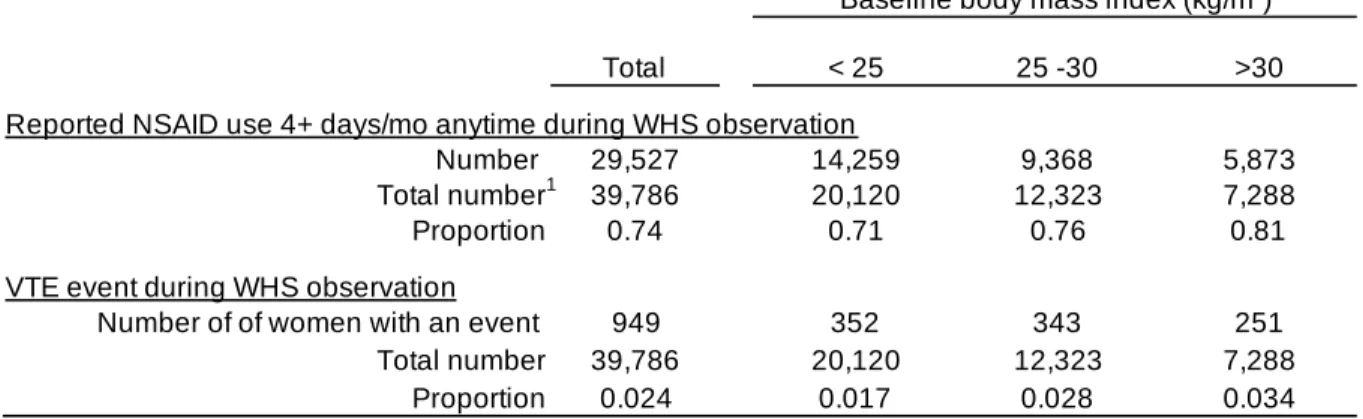
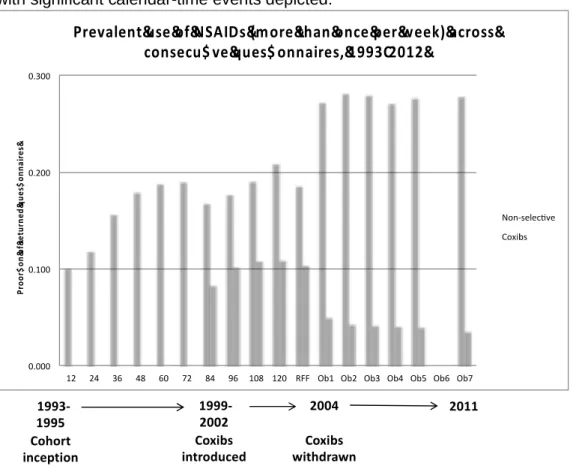
potentially eligible for inclusion in our analysis (90 women from the overall cohort did not meet this criteria). Of those, 29,527 (74%) reported using NSAIDs regularly at some time during the study. The prevalence of self-reported regular use of NSAIDs on each distinct questionnaire is shown on Figure 3.5. Despite women’s agreement to forgo use of NSAIDs during the WHS trial, 10% reported using NSAIDs regularly 12 months after randomization.
Dramatic secular trends of NSAID utilization were evident in association with the introduction of coxibs in late 1999 and subsequent withdrawal of some coxibs beginning 2004 (Figure 3.5, 3.6). Decreased prevalent and new use of traditional NSAIDs coincided with the introduction of coxibs, after which sharp decreases of prevalent and new use of coxibs coupled with sharply increased traditional NSAID use characterized the time of coxib withdrawal. These trends underscore the importance of incorporating interaction with calendar time in our PS models.
Confirmed incident VTE was observed in 949 women (Table 3.2), corresponding with an overall 17-year unconditional VTE risk of 0.024. Glynn, et. al. (2007) reported the ten-year conditional risk of VTE for the duration of the WHS RCT as 0.012 (482 confirmed events at conclusion of the RCT with 10 years follow-up).59 Crude annual incidence of VTE in the WHS increased over time from 0.8 to 2.0 per 1,000 person-yrs from 1994-2009 (Figure 3.7). The prevalence of obesity (defined as BMI >= 30 kg/m) at study baseline was 18%. Qualitatively, the unconditional risks of VTE and regular NSAID use sometime during WHS follow-up was
3.9. Tables and Figures
Table 3.1. Variables available in the WHS analytic dataset Participant characteristics
Age
Sex (all female) Race Anthropometric factors Height Weight BMI7,29,30,35 Socioeconomic factors Educational attainment Behavioral factors
Smoking (current, former, never)30 Alcohol consumption
Physical exercise – time in physical/recreational activities (met-hours per week)71 Hormonal factors
Menopausal status (pre, post, uncertain) Use of hormone replacement therapy Use of oral contraceptives
Active or placebo treatment group allocation Aspirin
Vitamin E62 Medication use
Non-study Aspirin
Aspirin containing medications Acetaminophen
Statins Insulin
Oral anti-diabetics Antihypertensives
Raloxifene (US approved in the mid-2000’s) Vitamin supplement use
Multivitamins
Vitamin B supplements72,73 Non-study Vitamin E Medical conditions / events1
Composite outcomes:
Coronary heart disease (confirmed myocardial infarction, angina, coronary artery bypass graft, coronary angioplasty)
Cardiopulmonary (congestive heart failure, chronic lung disease)
Cerebrovascular disease or events (congestive heart failure, chronic lung disease)
19
Gastrointestinal (gastrointestinal bleeding, peptic ulcer disease) Major orthopaedic event (fractures, total joint replacement) Diagnoses
Elevated cholesterol (diagnosed by physician) Diabetes (diagnosed by physician)7,28
Hypertension (diagnosed by physician)28 Atrial Fibrillation
Coagulation disorder Migraine headaches Rheumatoid arthritis77
Osteoarthritis; joint pain or swelling Osteoporosis
VTE history
Personal history of DVT or PE before enrollment78 (assessed on run-in questionnaire) Family history of DVT (collected on 4th post-trial observational follow-up questionnaire) 1Baseline history indicator, plus date of first incident event during follow-up for those without history prior to enrollment
Table 3.2. Joint distributions of event type and provocation status of confirmed VTE among 39,786 WHS participants that completed at least one follow-up questionnaire
Type of event Total No Yes
Could not determine
Any type (PE, DVT, or both)2 949 381 546 20
PE with or without DVT 406 167 234 5
DVT only 543 214 312 15
Table 4. Joint distributions of event type and provocation status of confirmed VTE among 39,786 WHS participants that completed at least one follow-up questionnaire
VTE coincided with a provocating factor1
1
Provocating factors were cancer diagnosed previously or within 3 months after the VTE event, or trauma or surgery within 3 months prior to the VTE event
2
21
Table 3.3. Bivariate distributions of baseline BMI by self-reported use of an NSAID 4+ days/mo and confirmed VTE event anytime during WHS observation
Total < 25 25 -30 >30
Reported NSAID use 4+ days/mo anytime during WHS observation
Number 29,527 14,259 9,368 5,873
Total number1 39,786 20,120 12,323 7,288
Proportion 0.74 0.71 0.76 0.81
VTE event during WHS observation
Number of of women with an event 949 352 343 251 Total number 39,786 20,120 12,323 7,288
Proportion 0.024 0.017 0.028 0.034
Baseline body mass index (kg/m2)
1Excludes 90 WHS enrollees with no follow-up questionnaires
Abbreviations: BMI= body mass index, NSAID= non-steroidal anti-inflammatory drugs, VTE= venous thromboembolism, WHS= Women's Health Study
Figure 3.1. Schematic diagram illustrating the classification of eligibility, initiation or non-initiation, and treatment change for a hypothetical questionnaire with as treated design Covariate values that were up-to-date at the beginning of the initiation eligibility period were assigned to the index questionnaire to predict initiation or non-initiation.
N
Y N
Y N
N Y Eligible to
initiate
Initiation or non-initiation
reported
Persistence reported
Treatment change reported Non-use
washout
N N
Initiation eligibility period Current use Y/N:
23
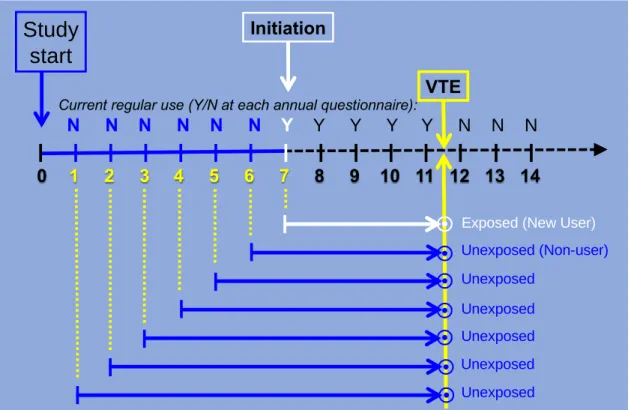
Figure 3.2. Schematic diagram illustrating sequential observations for a hypothetical woman with initial treatment (first treatment carried forward) design
with follow-up extended indefinitely until the earliest of a VTE event, administrative censor, death, or withdrawal from the study. Numbers 1-14 represent sequential yearly questionnaires. This woman would contribute 7 observations to an unrestricted IT analysis, according to her pattern of self-reported prevalent use of NSAIDS at each time point. Under an unrestricted IT design, she would be classified as exposed on the 7th questionnaire and unexposed on the 1st through 6th questionnaires and would experience the outcome for all 7 with the appropriate time-to-event calculated for each.
0
1 2 3 4 5 6 7
8 9 10 11 12 13 14
Initiation
Study
start
Current regular use (Y/N at each annual questionnaire):
VTE
Exposed (New User)
Unexposed
Unexposed (Non-user)
Unexposed
Unexposed
Unexposed
Unexposed
N N N N N N
Y
Y Y Y Y N N
N
¤
¤
¤
¤
¤
¤
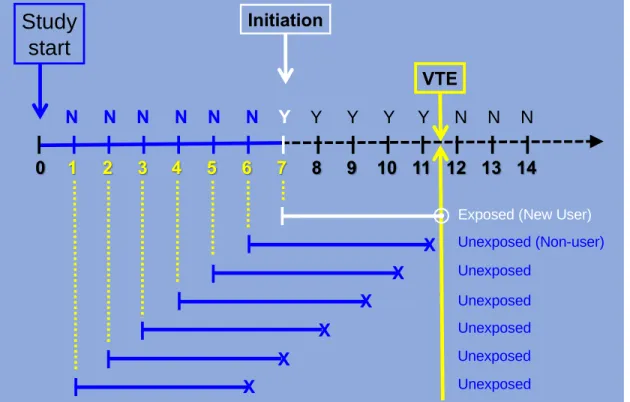
Figure 3.3. Schematic illustration of the same hypothetical woman with initial treatment design with at risk follow-up for VTE restricted to 5 years following initiation or non-initiation
0
1 2 3 4 5 6 7
8 9 10 11 12 13 14
Initiation
Study
start
VTE
Exposed (New User)
Unexposed
Unexposed (Non-user)
Unexposed
Unexposed
Unexposed
Unexposed
X
X
X
X
X
X
N N N
N N N
Y
Y Y Y Y N N
N
25
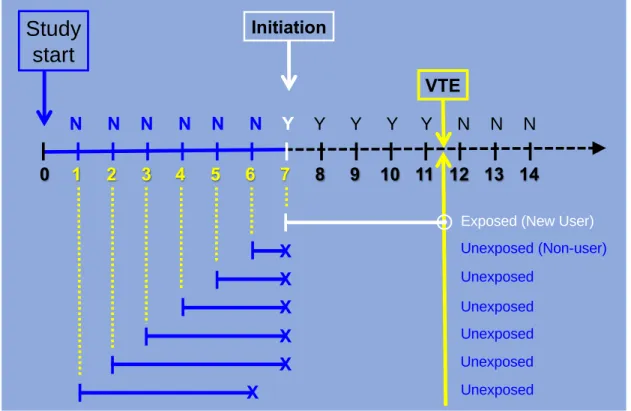
Figure 3.4. Schematic diagram illustrating sequential questionnaires for a hypothetical woman with as treated design created by censoring
The at risk follow-up time of each questionnaire was censored at the earliest of treatment change, a VTE event, administrative censor, death, withdrawal from the study, or 5 years following initiation or non-initiation. This woman would contribute one exposed questionnaire culminating in VTE, and 6 unexposed questionnaires censored without VTE.
0
1 2 3 4 5 6 7
8 9 10 11 12 13 14
Initiation
Study
start
VTE
Exposed (New User)
Unexposed
Unexposed (Non-user)
Unexposed
Unexposed
Unexposed
Unexposed
X
X
X
X
X
N N N
N N N
Y
Y Y Y Y N N
N
¤
Figure 3.5. Prevalent self-reported use of traditional NSAIDs and coxibs on sequential questionnaires among all WHS participants
with significant calendar-time events depicted.
P ro o r$ o n &o f& re tu rn ed &q u e s$ o n n a ir e s& Prevalent&use&of&NSAIDs&(more&than&once&per&week)&across& consecu$ ve&ques$ onnaires,&1993C2012&
27
Figure 3.6. Annual incidence rates of initiation of traditional NSAIDs and coxibs during 1994-2010
Initiation was assumed at the midpoint of the initiation eligibility period for calculation of person-time. 0 20 40 60 80 100 120
1994 1996 1998 2000 2002 2004 2006 2008 2010
In ci d en ce r at e p er 1 ,0 0 0 p e rs o n /y rs
Figure 3.7. Crude annual incidence rates of venous thromboembolism among all WHS participants
0.0 0.5 1.0 1.5 2.0 2.5 3.0 3.5 4.0 4.5
1994 1996 1998 2000 2002 2004 2006 2008 2010
In
ci
d
en
ce
r
at
e
p
e
r
1
,0
0
0
p
e
rs
o
n
/y
rs
29
CHAPTER 4. INCIDENCE OF VENOUS THROMBOEMBOLISM FOLLOWING INITIATION OF NON-STEROIDAL ANTI-INFLAMMATORY DRUGS IN U.S. WOMEN
4.1. Introduction
Non-steroidal anti-inflammatory drugs (NSAIDs) are among the most commonly used drugs worldwide. Approximately10-40% of adults in developed countries are prescribed or use over-the-counter NSAIDs on a regular basis, principally for musculoskeletal pain.1,79 Venous thromboembolism (VTE) is a substantial public health problem affecting an estimated 350,000 to 600,000 Americans and possibly contributing to 100,000 deaths annually.18 Approximately 1 of 1,000 adults aged 40-60 years and 8 of 1,000 adults over 80 years are affected.19,20
NSAID use compared with non-use is associated with 1.5- to 3-fold VTE risks in multiple non-experimental studies.2-8 However, a biologic explanation for a causal effect is unclear. NSAIDs inhibit prostaglandins through inhibition of cyclooxygenase (COX) enzyme binding sites, thereby reducing inflammation. The association of COX-2 selective inhibitors (‘coxibs’) to serious arterial cardiovascular outcomes is well established, and a mechanism has been posited whereby COX-2 inhibition reduces the synthesis of prostacyclin that normally functions as an inhibitor of platelet activation.26,27
Opinions differ regarding whether arterial and venous thrombotic diseases are
Randomized trials of sufficient size to evaluate VTE risk have not been conducted, presumably owing to the low event rate.9 At the same time, the limited scope of treatment options for individuals with chronic pain81 coupled with national calls for improved prevention of VTE18 underscore the importance of defining the risk of VTE associated with NSAIDs. We therefore undertook this study to evaluate the risk of VTE following new use of NSAIDs in a long-term cohort of U.S. women.
4.2. Methods Data source
The Women’s Health Study (WHS) is a double-blind randomized controlled trial of low-dose aspirin, vitamin E, and beta-carotene for the primary prevention of cardiovascular disease and cancer in U.S. women.53-55 From 1993 to 1995, 39,876 female health professionals aged ≥ 45 yrs were allocated to a regimen of aspirin (100mg every other day) or placebo and Vitamin E (600 IU every other day) or placebo in a 2 x 2 factorial design. The trial also initially included a beta-carotene component, which was discontinued after 2 years median treatment duration.56
Eligibility criteria for enrollment included: female; aged 45 years or older; post-menopausal or had no intention of becoming pregnant; no prior history of coronary heart disease, cerebrovascular disease, or cancer (except non-melanoma skin cancer); not taking aspirin, aspirin-containing medications, NSAIDs, Vitamins A or E, or beta-carotene more than once per week; willingness to forgo the use of non-study aspirin, aspirin-containing medications, and NSAIDs; not taking anticoagulants or corticosteroids; and successful completion of a 3-month placebo run-in.58
31
NSAID use
Questions regarding current use of non-aspirin NSAIDs were included in 19 of 20 questionnaires administered during the study period: before randomization (baseline); every 12 months through 120 months following randomization; at trial conclusion in 2004; and 1, 2, 3, 4, 5, and 7 years after trial conclusion for participants (~90%) of the observational follow-up phase. We classified self-reported use of ‘traditional’ NSAIDs (i.e., non-aspirin non-COX selective NSAIDs), coxibs (COX-2 inhibitors), and any NSAID (not including aspirin) from WHS questionnaire responses. Details are provided on Table 4.1. We defined regular use as 4 or more days self-reported use in the past month, which corresponded most closely with the WHS entry criteria.
VTE outcomes
Each year women were asked whether they had been newly diagnosed with deep vein thrombosis (DVT) or pulmonary embolism (PE) since their last questionnaire. As VTE was a secondary trial endpoint, reported events underwent medical records verification by an Endpoint Committee of physician reviewers with consent of the participant. Events discovered during medical record reviews for other study endpoints were also captured. DVT was confirmed based on a positive venous ultrasonogram or venography report. PE was confirmed based on a
positive angiogram or computed tomography scan of the chest, or a ventilation–perfusion scan with 2 or more mismatched defects. Deaths due to pulmonary embolism were confirmed according to autopsy reports, symptoms, circumstances of death, and medical history, as judged by Endpoint Committee adjudicators.
VTE events were also classified by the endpoint reviewer as DVT, PE, or both if confirmed DVT and PE occurred within 3 days of each other, and as provoked (cancer
not evaluated for this study, however women with self-reported history of VTE at study entry (2.9% of WHS participants) were included in the analysis.
Covariates
Covariates were ascertained before randomization and were updated whenever possible. Race, education, and history of VTE before study enrollment were collected once at baseline. Age was calculated at every questionnaire. Body mass index (BMI), smoking (current, previous but not current, or never), physical exercise, alcohol use, multivitamin use,
menopausal status (pre-menopausal, post-menopausal, or uncertain), and hormone
replacement therapy use (current, previous but not current, never) were reassessed only on some questionnaires. The last recorded values were carried forward to later questionnaires where they were not asked for or missing unless described otherwise. Missing values were not imputed with later values with the exception of baseline height, which was imputed with values from later questionnaires if available.
BMI was calculated from self-reported height and weight and carried forward by linear interpolation. Self-reported weight was highly correlated with measured weight (r=0.97) among similar women in the Nurses’ Health Study.82 Menopausal status was imputed to
post-menopausal for all women at ages ≥ 60 years in the absence of self-report data indicating otherwise.83 Physical exercise was classified as 0, 0<-<3.75, 3.75-< 7.5, 7.5-<15, 15-<22.5, and 22.5+ met-hours per week;71,84 7.5 met-hours represents the minimum physical activity for adults recommended by Federal guidelines.85
Women were questioned yearly regarding new diagnoses of cancer, cardiovascular disease events, and other conditions, and use of selected medications. As cancer and incident cardiovascular disease were primary trial endpoints, occurrences including heart failure during follow-up underwent medical record verification by an endpoint committee of physician
33
inquired about symptoms, diagnostic testing, and use of diabetic medications.87 Self-reported peptic ulcer disease (PUD) and gastrointestinal (GI) bleeding were verified with a follow-up questionnaire. We used confirmed incident diagnoses for these covariates, except that self -reported PUD and GI bleeding diagnoses were accepted after 2005 because follow-up verification for those endpoints was discontinued after trial completion.
Hypertension was defined as a self-reported diagnosis, self-reported use of
antihypertensive medication, or self-reported systolic blood pressure ≥140 mmHg or diastolic ≥90 mmHg. Atrial fibrillation, osteoarthritis, rheumatoid arthritis,77,88 osteoporosis, major orthopaedic event (fracture or joint replacement), migraine headaches, chronic lung disease, and coagulation disorder diagnoses were self-reported. Dates of first lifetime incidence, whether before enrollment or during follow-up, were identified for all diagnoses and events of interest. Self-reported concurrent regular use ( 4 days in the past month) of acetaminophen, non-study aspirin, and aspirin containing medications was asked each year, and statins on 13
questionnaires.
Study design
not initiate, and so on. Following initiation, the woman’s next and subsequent questionnaires became ineligible until the washout criteria was again met.
Each woman’s follow-up time was thereby conceptualized as a sequence of discrete observations, with individual women potentially contributing both non-initiations and initiations to the analysis over the duration of her study participation. The up-to-date covariate values on first day of the inter-questionnaire period preceding the questionnaire date (the “eligibility period”) were used as the predictors of initiation or non-initiation for each questionnaire.
We designed as treated (AT) and initial treatment (IT) analyses with at-risk periods beginning on the questionnaire date (index date). The at-risk follow-up period for VTE was constructed separately for each questionnaire, and the same inter-questionnaire period(s) of an individual woman’s calendar time could be contained in the at-risk follow-up period of more than one eligible questionnaire.64,65 For AT design, the at-risk follow-up time was censored on the earliest of: 1. the first reported treatment change (stopping, or switching to or adding a different non-aspirin NSAID); 2. the first reported regular use of the active comparator; or 3. death, withdrawal, or end of study follow-up. For IT design, treatment changes, starting, stopping, adding, and/or switching of therapy was ignored. The at-risk follow-up time of each
questionnaire was furthermore limited to 5 yrs following initiation or non-initiation for both designs.
Missing NSAID use values occurring during a washout or at-risk follow-up period were carried forward from the last non-missing observation for the purpose of establishing the duration of continued use or non-use; however, we required non-missing responses for all variables used to define the beginning and end of washout, eligibility, and at-risk periods, including variables needed to define non-use of an active comparator or other concurrent medications required for eligibility.
We excluded as ineligible all questionnaires with confirmed VTE before the
35
the exclusion of 421 otherwise eligible questionnaires (53 initiations, 368 non-initiations) for which VTE occurred during the initiation eligibility period. We did not consider beginning the at-risk period earlier than the questionnaire index date because it would introduce immortal time bias.66
Coxibs were commercially available in the U.S. for approximately 1.3 yrs before WHS questionnaires began capturing coxib use with a separate question (Table 4.1). For all questionnaires without the coxib question (72 mo post-randomization and earlier), we considered the value of coxib use as non-use if returned on or before 12/31/1998 (date celecoxib released in the U.S.), and missing if returned after 12/31/1998; those classified as missing were excluded as ineligible to initiate or not initiate as their exposure data were incomplete. 324,124 eligible questionnaires of 38,493 women were included (Figure 4.1).
We compared initiation of any NSAID, traditional NSAIDs (exclusive of coxibs), and coxibs (exclusive of traditional NSAIDs) with non-initiation of any NSAID. We also compared initiation of traditional NSAIDs and coxibs with non-initiation by frequency of use at the time of initiation (4-20 days and 21+ days in the past month). We compared initiation of coxibs with initiation of traditional NSAIDs, and initiation of each NSAID type to initiation of acetaminophen, an active comparator with similar indications and without known hemostatic effects.
Acetaminophen use was asked in the same manner as NSAIDs on each questionnaire, and we used the same criteria to classify current regular use (4 days in the past month). For the acetaminophen comparator analyses, we required nonuse of any non-aspirin NSAID and acetaminophen during the washout period. We did not restrict according to concurrent aspirin use for any analyses.
Analytic methods
including important confounders and preserving causal pathways.90 Randomized low dose aspirin was not associated with VTE risk in the WHS population,59 but moderate dose aspirin is employed as a VTE preventive in some post-surgical and other high-risk settings;61,91 therefore, we included non-study aspirin in the PS. We omitted concurrent acetaminophen use from the PS for the acetaminophen active comparator analyses.
The PS was estimated using separate logistic regression models for 2-calendar year periods.70 We used the PS to construct weights to standardize the comparator group to the treatment group, known as standardized morbidity ratio (SMR) weighting.68 We multiplied SMR weights by the marginal odds of treatment received, which redistributed their values around a mean of 1.92 This stabilization provided scale by which to interpret the magnitude of the weights.
We used SMR weighted Cox proportional hazard models to estimate the relative and absolute effects of NSAID initiation on time to and cumulative incidence of VTE.93 A robust variance was used to account for multiple questionnaires from the same woman in either or both treatment groups.94,95 Risks for 2 years of treatment, risk differences (RD), and number needed to treat for harm (NNTH) or benefit (NNTB) to one additional woman were calculated from the adjusted survival curves.96 Risks were multiplied by 100 to express as percentages. Confidence intervals for the RD and NNTH/NNTB were obtained by bootstrap with 1,000 resamples with replacement. The weighted copy method was employed for the PS models to facilitate the bootstrap.97 We plotted weighted Kaplan-Meier curves to illustrate the standardized cumulative incidence of VTE.98 The proportional hazard assumption for each model was assessed using graphical methods and Schoenfeld residual tests. SAS 9.4 software (SAS Institute, Cary, NC) was used for all analyses.
Sensitivity analyses
37
mo eligibility period limit would restrict to no more than one missing yearly questionnaire during the period, allowing a 3 mo grace period for late returns.
4.3. Results
While all 39,876 WHS participants were non-regular users of NSAIDs at study entry by design, 10% reported using NSAIDs regularly 12 months after study enrollment, and 31% in 2011. 29,527 women (74%) reported regular use of an NSAID at some time during their study follow-up; 71% used traditional NSAIDs and 24% used coxibs at some time. Nine hundred fifty-one WHS participants had confirmed VTE during follow-up of which 382 (40%) were classified as unprovoked. The first confirmed event was PE for 408 (with accompanying DVT in 61%), and DVT without PE for 543.
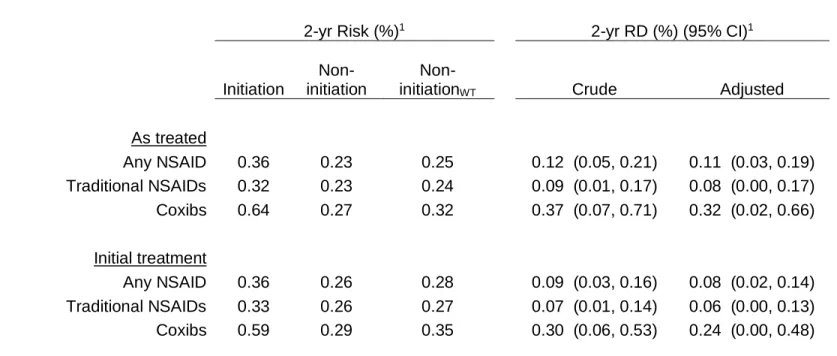
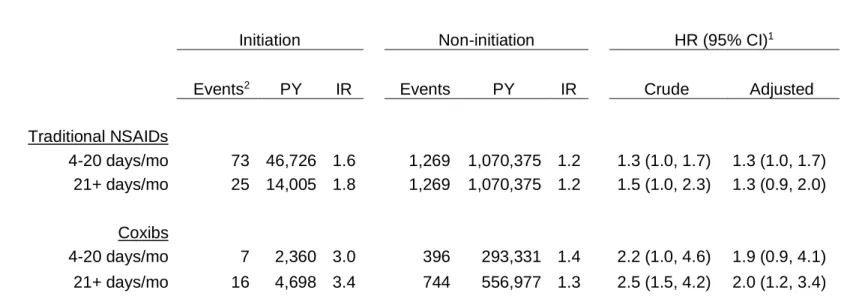
Compared with non-initiation, we saw modestly elevated risk of VTE after NSAID initiation and greater risk with coxibs than traditional NSAIDs. The 2-yr risks (%) of VTE among women who initiated any NSAID, traditional NSAIDs, and coxibs, respectively, were 0.36, 0.32, and 0.64 in the AT analysis; among non-initiators, these risks standardized to the initiators on all covariates were 0.25, 0.24, and 0.32, respectively (Table 4.3, Figure 4.2). The hazard ratio (HR) (95% CI) for VTE in the AT analysis was 1.5 (1.2, 1.8) for any NSAID, 1.3 (1.1, 1.7) for
traditional NSAIDs, and 2.0 (1.3, 3.1) for coxibs (Table 4.4). HRs were closer to the null value for the IT analysis (Table 4.4). The 2-yr RDs (95% CI) for the AT analysis were 0.11 (0.03, 0.19), 0.08 (0.00, 0.17), and 0.32 (0.02, 0.66), respectively (Table 4.3).
In AT analyses stratified into low (1-20 days/mo) and high (21+days/mo) frequency of use at initiation, HRs were similar to each other and to the overall HR for both traditional NSAID and coxib initiation (Table 4.5) suggesting that increased risk for coxibs was not simply a function of their typically daily or almost daily use patterns compared with the typically less frequent use of traditional NSAIDs.
the null value. The 2-yr risks (%) of VTE among women not using acetaminophen who initiated any NSAID, traditional NSAIDs, and coxibs, respectively, were 0.39, 0.36, and 0.61; among acetaminophen initiators, these risks standardized to the NSAID initiators on all covariates were 0.37, 0.37, and 0.50, respectively (Table 4.6, Figure 4.3). The HR (95% CI) for VTE was 0.9 (0.6, 1.5) for any NSAID, 0.9 (0.5, 1.5) for traditional NSAIDs, and 1.3 (0.5, 3.2) for coxibs (Table 4.7); 2-yr RDs (95% CI) were 0.03 (-0.46, 0.14), -0.01 (-0.55, 0.12), and 0.11 (-0.43, 0.73) corresponding to NNTH 3,826, NNTB 10,766, and NNTH 937, respectively (Table 4.6).
Sample sizes were small, particularly for coxibs (8 VTE events during AT follow-up, all within the first 2 years). We restricted the at-risk follow-up time for coxib vs. acetaminophen initiation to 2 yrs for estimation of the HR because the proportional hazard assumption was not met after 2 yrs (Figure 4.3 D).
Sensitivity analyses suggested that our findings were robust to our decisions to include women with prior history of VTE and ignore longer eligibility period lengths for a small (<1%) proportion of questionnaires (Table 4.8), and to variations of maximum follow-up time restriction for AT analyses with the exception of coxibs vs. acetaminophen analysis (Tables 4.9, 4.10, 4.11). For IT analyses, HRs decreased toward the null with increasing duration of maximum follow-up time (Table 4.9).
4.4. Discussion
Our non-initiator comparator analyses showed associations similar in magnitude to some previous studies2,5 with stronger associations for coxibs that did not appear to be explained by differences in frequency of use. Coxib initiation was associated with 80% greater VTE risk than traditional NSAIDs in head-to-head comparison. Compared with acetaminophen initiation, traditional NSAIDs did not show increased risk and coxibs showed relative and absolute risk increases that were attenuated compared with the non-initiator analysis.
39
4.12).2-8 Goy, et. al.9 conducted a pooled analysis of data from 14 trials of randomized rofecoxib v. placebo that reported VTE as secondary outcomes. A difference of VTE incidence was not detected, but small numbers of events provided very low power (8 events / 9,217 person-yrs compared to 9 events / 9,092 person-yrs, respectively). Biere-Rafi, et.al. reported elevated risk of VTE for current use of acetaminophen and tramadol compared to non-use [adjusted OR 1.7 (95% CI 1.4, 2.1) and 4.0 (95% CI 2.8, 5.8), respectively] in a case-control study of NSAIDs and VTE in a Dutch population-based registry, but did not report direct comparison of NSAIDs to acetaminophen or tramadol use. Since these drugs have no known hemostatic effects, the authors suggested these findings could indicate residual confounding by underlying conditions that may also influence analyses of NSAID use. In our study, the HR comparing initiation of acetaminophen to non-initiation (both groups exclusive of NSAID use) was 1.3 (95% CI 0.9, 1.9) (data not shown).
Our study design offers several advantages in terms of confounding and other biases. Previous studies of NSAIDs and VTE risk have leveraged a variety of population-based data sources, and most utilized case-control designs with exposure definitions based on prevalent use (Table 4.12). We implemented a ‘new user design’ 99 in a long-term follow-up cohort of women initially not using NSAIDs where users were identified at the start of treatment, outcomes were ascertained during follow-up, and pretreatment covariates were utilized for appropriate confounding control as would be done in a randomized trial. An active comparator design moreover increases the similarity of the groups on both measured and unmeasured characteristics by restricting to individuals with indication for treatment.16,52 The rich WHS covariate set also includes lifestyle variables not captured by claims data, and VTE ascertainment that captures all clinically significant events including those without a hospitalization (e.g., sudden death).
Our study has limitations. While dates of confirmed VTE were known, drug use
initiation began, or whether a non-initiator may have started and stopped between
questionnaires. Likewise, when treatment change was detected during as-treated follow-up, the precise date of change was unknown. When initiation or treatment change and VTE occurred during the same interval, the true exposure status at the time of the VTE was unclear. However, in this scenario it seems more plausible that regular NSAID use would stop as a consequence of experiencing a VTE than that initiation would occur. Our analyses assume that the use or non-use reported on a questionnaire continued until day of the next questionnaire. Our sample sizes were small for some analyses involving coxib initiation.
While high prevalence of NSAID use and clinical and public health significance of VTE underscore the importance of understanding their association, current knowledge is limited and inconclusive. Pragmatically, the large sample size requirement for a randomized trial of VTE outcomes will necessitate that further work rely heavily on observational designs.9 For the many sufferers with chronic pain, options are limited and effective pharmacologic treatment is not a luxury that can simply be done without in the interest of risk avoidance.1 An accurate
understanding of small but potentially serious risks associated with NSAID use is needed to correctly weigh the risks and benefits of treatment for affected individuals.
Conclusion