Investigating Disparities in Opioid Receipt among Older
Patients with Stage IV Colorectal Cancer
By
Steven K. Otto, PharmD Candidate
Mentor: Stacie B. Dusetzina, PhD
Additional Contributors:
Yi-Ting Chou, MSPH; Cleo Samuel, PhD; Drew Roberts, PharmD, PhD; C. Tyler Ellis, MD, MS
Honors Thesis
UNC Eshelman School of Pharmacy University of North Carolina at Chapel Hill
2
ABSTRACT
Purpose: Pain is common among patients with late-stage cancer, and pain management is an important component of high quality cancer care. Previous research has documented racial disparities in pain management for some types of cancers; however, little is known about the extent of disparities in pain management among individuals diagnosed with colorectal cancers. In this study, we investigated racial differences in opioid use patterns among Medicare beneficiaries with newly diagnosed stage IV colorectal cancer who did not receive surgery after diagnosis.
Participants: We included individuals from the Surveillance, Epidemiology, and End Results (SEER)-Medicare database who were greater than 66 years old, either black or white race, and newly diagnosed with stage IV colorectal cancer between July 2007 and December 2011. Patients were required to have at least 6 months of continuous enrollment in Medicare Parts A, B, and D prior to diagnosis, continued through death or end of follow-up and were opioid-naïve for at least 3 months prior to their cancer diagnosis.
Procedures: We classified patients based on their recorded race in the SEER cancer registry as black or white. Outcome measured included whether the patient filled any opioid in the post-diagnosis period, the dose of first filled opioid, and any receipt of a long-acting opioid prescription.
Statistical Analysis: We used Kaplan-Meier analysis to compare time to opioid use by race. We used Cox proportional hazard models to control for other need-related characteristics.
Results: There were 796 white and 167 black patients included. Approximately 56% of patients received opioids in the post-diagnosis period, with no difference by race (p=0.80). White patients were more likely to be started at a higher average dose (53.8 MME vs. 45.2 MME, p<0.05) and were somewhat more likely to receive long-acting opioids (13.2% vs. 18.3%, p=0.11).
Conclusions: While black and white patients with late stage colorectal cancer in this cohort had similar use of opioid prescriptions post-diagnosis, there may be important gaps in the adequacy of pain
3
BACKGROUND
Cancer pain has been documented in 70-90% of patients with advanced stage cancer and has profound negative consequences on patients’ quality of life.1
Patients with cancer reporting pain may be less comfortable performing activities of daily living and may experience communication challenges with their family and caregivers.2 Furthermore, some studies indicate that inadequate pain control may be linked to poor outcomes in patients with cancer.3 The National Comprehensive Cancer Network (NCCN) recommends screening for pain at each contact with providers, and that treatment of pain should be titrated in a stepwise fashion based on previous strategies and level of pain.2 All patients should receive psychosocial support and nonpharmacologic therapy. In addition, it is recommended that non-opioid analgesics, such as acetaminophen and nonsteroidal anti-inflammatory drugs (NSAIDs), should be considered for patients with all levels of pain. If and when opioids are required, NCCN recommends starting with a short-acting low dose oral opioid such as morphine sulfate 5-15 mg before progressing to a long-acting opioid. Titration of opioids and addition of a long-acting opioid should be used based on control of pain.2 In the context of advanced cancer, early integration of supportive care, including pain management, is considered an integral part of high quality palliative care.4
Significant disparities have been documented between black and white patients in a variety of aspects of colorectal cancer including screening, diagnosis, treatments, and survival.5,6 White patients tend to be diagnosed with colorectal cancer at an earlier stage, which has been frequently linked to better treatment outcomes compared to black patients.8,9 These differences persist even when controlling for poverty, baseline health, tumor stage at diagnosis, gender, and treatment receipts.8,9,10
4
Health Organization (WHO). Additionally, centers that served primarily black or Hispanic patients were three times more likely to inadequately treat pain.12
Although disparities in pain management have been described previously, no studies have examined population-level disparities in opioid prescribing among patients diagnosed with advanced stage (stage IV) colorectal cancer. Identifying differences in opioid analgesic prescriptions between black and white colorectal patients with cancer may elucidate an important disparity in colorectal cancer
symptom management and palliative care. The present study aims to identify potential racial disparities in opioid utilization and dose between elderly black and white Medicare enrollees with advanced stage colorectal cancer. We hypothesize that black patients will be less likely to receive opioid prescriptions, and among those receiving any opioid, black patients will receive them later in the course of disease, receive a lower first dose, and be less likely to use long-acting opioids than white patients.
MATERIALS AND METHODS Data Source
The National Cancer Institute’s Surveillance, Epidemiology, and End Results (SEER)-Medicare database was used for the current study. This data source links data from cancer registries participating in the SEER program with fee-for-service Medicare claims and provides detailed population-level
information on patient cancer-related characteristics and health services use by Medicare beneficiaries aged 65 and older. Specifically, the SEER registry contains information on patient demographics, tumor characteristics, and vital status, and the Medicare claims contain information on inpatient, outpatient, and pharmacy services received by enrollees.
Inclusion and Exclusion Criteria
5
end of follow-up). We restricted to patients aged 66 years and older at diagnosis, excluding younger patients who qualified for Medicare through disability. Because we are interested in understanding uptake of opioid for suspected cancer-related pain, we required patients to be opioid-naïve for at least three months prior to diagnosis (i.e. excluding those with ongoing pain management) and we excluded patients who received cancer-directed surgery following diagnosis.
Variables
Demographic characteristics included race (black or white), sex, age at diagnosis, marital status (married or unmarried), urban or rural residence and SEER region, tumor site, and year of diagnosis. We also included census tract level measures of median income, poverty (percent below poverty level), and education (percent without a high school degree). Cancer treatment characteristics included receipt of chemotherapy or radiation therapy. Medical comorbidity was defined using the Charlson Comorbidity Index with the Klabunde modification.13,14
Outcomes
The primary outcome was receipt of any opioid after diagnosis. Secondary outcomes included the dose of the first opioid filled in the post-diagnosis period and whether the patient filled a long-acting opioid prescription. To compare opioid dose, we standardize filled prescriptions in terms of milligram morphine equivalents (MME). This measure is used to express opioid dose in terms of an equipotent dose of oral morphine, allowing doses to be easily compared across products.
Statistical Analysis
6
covariates. All statistical tests were performed at a significance level of α = 0.05. The data analysis for this study was generated using SAS, version 9.3 (SAS Institute Inc., Cary, NC, USA).
RESULTS
A total of 963 patients were included (796 white patients and 167 black patients). Among our cohort, white patients were more likely to be married (41.5% vs 20.4%), and to live in census tract areas with higher median income and graduation rates and lower poverty. Black patients were more likely to live in a big metropolitan area and live in the South than white patients. Black patients also tended to have higher levels of cancer medical comorbidity (39.5% of black patients reporting at least one non-cancer comorbidity versus 31.3% of white patients) and were less likely to receive chemotherapy during the post-diagnosis period (34.1% vs. 44.3%) (Table 1).
Opioid Utilization
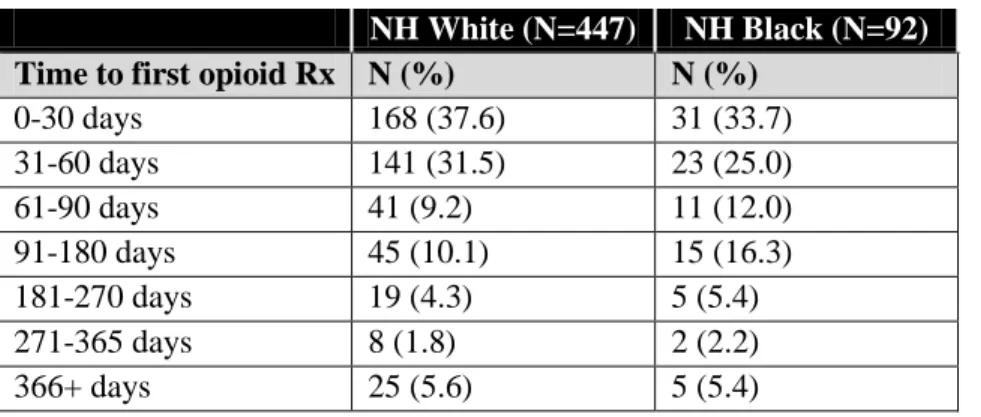
In the cohort, 55.1% of black patients and 56.2% of white patients received an opioid at any time post-diagnosis (p=0.80). However, black patients were somewhat less likely to receive long-acting opioids as compared with white patients (13.2% vs. 18.3%, p=0.11) (Table 2). Among those receiving any opioid, black patients appeared to be somewhat less likely to receive opioids within the first 60 days after diagnosis, although this was not statistically significant (Table 3).
When considering opioid dose, white patients were more likely to receive a higher first dose of opioid than black patients. Specifically, white patients received a mean starting dose of opioid of 53.8 MME (SD 52.1), while black patients received a mean starting dose of 45.2 MME (SD 33.8) (p<0.05). Expressing first opioid dose as a categorical variable of ≤ 50 MME or > 50 MME, there was no
significant difference between groups (p=0.11) (Table 4). DISCUSSION
7
Taken together, this may indicate that white patients are more likely than black patients with late stage colorectal cancer to receive adequate pain management, which supports previous literature on pain control between racial groups with cancer.11,12
Chronic cancer-related pain occurs in 70-90% of advanced stage patients with cancer and is a frequently undertreated symptom of advanced disease. Potential causes of inadequate management of cancer-related pain may include a lack of clinician understanding of risks of addiction or side effects, clinicians focusing on disease management instead of symptom management, or patients underreporting pain or not adhering to pain treatment regimens.1 The NCCN notes that patients experiencing pain may have difficulties performing activities of daily living and communicating with their caregivers, which may have detrimental effects on quality of life.2 There is evidence to support that early palliative care that includes pain management for patients with metastatic cancer improves patient quality of life, as compared with standard oncologic care alone. Additionally, early palliative care in metastatic disease may improve survival as compared with standard oncologic care alone.3 Efforts should be made to ensure that all patients have access to appropriate pain management, particularly in the context of late stage disease and palliative care.
A number of limitations to this study were present. First, while it is possible that observed differences in opioid dose are a result of racial disparities in prescribing practices, we are not able to determine the cause of these differences. Second, we assume that opioids received following
diagnosis were primarily for treating cancer-related pain, but the indication for use cannot be
determined directly from the data source. To attempt to address this limitation, we excluded
patients who received an opioid in the three months before diagnosis and those who received
surgery post-diagnosis. However, it is possible that some opioids were prescribed for other
conditions. Third, some patients may be contraindicated to receiving opioids, which may falsely
lower their respective group’s likelihood of receiving an opioid. However, it may be unlikely
8
analgesics and medications received in hospitals are not captured in this data. If a patient is
adequately controlled with non-prescription analgesics, it would not support a conclusion of
racial disparities in pain control in cancer. Additionally, patients who receive opioids during
inpatient hospital stays may be receiving adequate opioid treatment but would not be identified
as such in the current study. Finally, although there were nearly 1,000 patients included in the
current study, there were a small number of black patients (n=167) which may result in
imprecision of some estimates.
Future research on racial differences in pain management among late stage cancer
patients is warranted. Next steps for the current project include estimating outcomes while
controlling for sociodemographic differences, which may lessen differences seen. Furthermore,
patients who received surgery following diagnosis were excluded to increase homogeneity
between patients. However, differences in opioid use following surgery may yield similar results
and should be explored. Additionally, the present study only examined first use of opioids, but
opioid dose changes over time were not assessed. Differences in dose as opioids are titrated
should be explored. Because nearly all of the patients in our sample died during the study period
we plan to evaluate differences in opioid dose during the month before death, an important
quality consideration for palliative care for patients with end-stage disease. Finally, we
anticipate adding two additional years of data to the cohort within the next month, which will
9
REFERENCES
1. Portenoy RK and Lesage P. Management of cancer pain. Lancet. 1999;353(9165):1695-700. 2. Swarm RA, Abernethy AP, Anghelescu DL, et al. Adult cancer pain: Clinical practice guidelines
in oncology. J Natl Compr Canc Ne. 2013;11(3):992-1022.
3. Temel JS, Greer JA, Muzikansky A, et al. Early palliative care for patients with metastatic non-small-cell lung cancer. N Engl J Med. 2010;363:733-42.
4. TJ Smith, S Temin, ER Alesi , et al. American Society of Clinical Oncology provisional clinical opinion: The integration of palliative care into standard oncology care. J Clin Oncol.
2012;30:880-7.
5. Clegg LX, Li FP, Hankey BF, Chu K, and Edwards BK. Cancer survival among US whites and minorities: a SEER (Surveillance, Epidemiology, and End Results) Program population-based study. Arch Intern Med. 2002;162(17):1985-93.
6. Alexander DD, Waterbor J, Hughes T, Funkhouser E, Grizzle W, and Manne U. African-American and Caucasian disparities in colorectal cancer mortality and survival by data source: An epidemiological review. Cancer Biomark. 2009;3(6):301-13.
7. Chien C, Morimoto LM, Torri J, and Li CI. Differences in colorectal carcinoma stage and survival by race and ethnicity. Cancer. 2005;104:629-39.
8. Marcella S and Miller JE. Racial differences in colorectal cancer mortality. The importance of stage and socioeconomic status. J Clin Epidemiol. 2001;54:359-66.
9. Mayberry RM, Coates RJ, Hill HA, et al. Determinants of black/white differences in colon cancer survival. J Natl Cancer Inst. 1995;87:1686-93.
10. Govindarajan R, Shah RV, Erkman LG, and Hutchins LF. Racial differences in the outcome of patients with colorectal carcinoma. Cancer. 2003;97(2):493-8.
11. Fisch, MJ, Lee, JW, Weiss M, et al. Prospective, observational study of pain and analgesic prescribing in medical oncology outpatients with breast, colorectal, lung, or prostate cancer. J Clin Oncol. 2012;30(16):1980-8.
12. Cleeland CS, Gonin R, Hatfield AK, et al. Pain and its treatment in outpatients with metastatic cancer. N Engl J Med. 1994;330(9):592-6.
13. Charlson ME, Pompei P, Ales KL, and MacKenzie CR. A new method of classifying prognostic comorbidity in longitudinal studies: development and validation. J Chronic Dis. 1987;40:373-83. 14. Klabunde CN, Potosky AL, Legler JM, and Warren JL. Development of a comorbidity index
10
11
TABLES AND FIGURES
Table 1. Characteristics of patients with stage IV colorectal cancer at diagnosis
Characteristic NH White (N=796) NH Black (N=167) p-value
Age N (%) N (%) 0.75
65-70 107 (13.4) 22 (13.2)
70-75 151 (19.0) 31 (18.6)
75-80 160 (20.1) 27 (16.2)
80-85 161 (20.2) 35 (21.0)
85+ 217 (27.3) 52 (31.1)
Sex N (%) N (%) 0.3
Female 456 (57.3) 103 (61.7)
Male 340 (42.7) 64 (38.3)
Marital Status N (%) N (%) < 0.001
Married 330 (41.5) 34 (20.4)
Single 466 (58.5) 133 (79.6)
Year of Diagnosis N (%) N (%) 0.72
2007 75 (9.4) 15 (9.0)
2008 193 (24.2) 42 (25.1)
2009 181 (22.7) 32 (19.2)
2010 176 (22.1) 35 (21.0)
2011 171 (21.5) 43 (25.7)
Tumor site, N (%) 0.31
Rectal 226 (28.4) 41 (24.6)
Colon 570 (71.6) 126 (75.4)
Klabunde Comorbidity Index, N (%)
< 0.001
0 547 (68.7) 101 (60.5)
1 160 (20.1) 28 (16.8)
2+ 89 (11.2) 38 (22.8)
Received radiation, N (%) 118 (14.8) 23 (13.8) 0.73
Received chemo, N (%) 353 (44.3) 57 (34.1) 0.02
12
Table 2. Receipt of any opioid prescription by race
NH White (N=796) NH Black (N=167)
N (%) N (%)
Received opioid 447 (56.2) 92 (55.1) Received long-acting opioid 146 (18.3) 22 (13.2)
Table 3. Time to first opioid prescription post-diagnosis
NH White (N=447) NH Black (N=92)
Time to first opioid Rx N (%) N (%)
0-30 days 168 (37.6) 31 (33.7)
31-60 days 141 (31.5) 23 (25.0)
61-90 days 41 (9.2) 11 (12.0)
91-180 days 45 (10.1) 15 (16.3)
181-270 days 19 (4.3) 5 (5.4)
271-365 days 8 (1.8) 2 (2.2)
366+ days 25 (5.6) 5 (5.4)
Table 4. First opioid dose
NH White (N=447) NH Black
(N=92)
p-value
Average dose of first opioid (MME)
Mean (SD) Mean (SD)
53.8 (52.1) 45.2 (33.8) < 0.05
Dose of first opioid Rx N (%) N (%) 0.11
≤ 50 MME 308 (68.9) 71(77.2)
13
Figure 1. Time to first opioid prescription post-diagnosis
Kaplan Meier curve for time to opioid. Cox proportional hazard regression covariates: Non-significant HR for race, age (categorical), sex, marital status, diagnosis year, tumor site, Klabunde score, reception of radiation. HR for receipt of chemotherapy 1.36, p<0.01