Is Mobile Work Really Location-Independent?
The Role of Space in the Work of Digital Nomads
By:
Caleece Nash
University of North Carolina at Chapel Hill
Senior Honors Thesis
School of Information and Library Science University of North Carolina at Chapel Hill
The enthusiasm around remote and independent working has rapidly gained momentum in the last few years. The digital nomad phenomenon has frequently been portrayed as an
exemplar of this pattern, and referred to by the media as a completely location-independent form of mobile work. However, findings from this study highlight the centrality of various spaces in digital nomadic work, and suggest finding and configuring these spaces allow digital nomads to accomplish productive work. Building on interviews with 23 digital nomads and analyzing pictures of workspaces from Twitter, this study examines the unique relationship between the digital nomad’s spaces, work practices, and technologies which both enable and restrict digital nomadic work. We call into question the common argument that that digital nomads or mobile workers can work from “anywhere, anytime,” as it does not take into account the large role that space plays in shaping work. As such, this exploratory research contributes a better
Table of Contents
Is Mobile Work Really Location-Independent? The Role of Space in the Work of Digital Nomads 1
Abstract 2
Table of Contents 3
Acknowledgements 5
Introduction 6
Literature Review 8
Rise of Nomadic Workers 8
Space and Nomadic Work 9
Technology and Nomadic Work 11
Methods 12
Interviews 12
Twitter Analysis 13
Findings 14
Collaboration work 18
Socialization Work 20
Focus Work 22
Discussion 24
Limitations/Conclusion 27
Bibliography 28
Appendix 33
List of Preliminary Research Questions: 33
Email Sent to Participants 34
Script for Interview Participants 35
Professional Background and Work Context 35
Technology and information use 35
Space-related Questions 36
Social Aspect of Work 37
Personal Knowledge Management 37
Wrap-Up 38
Acknowledgements
I would like to begin by thanking Dr. Mohammad Hossein Jarrahi. Without his guidance, advice, and support I would not be where I am today. Not only has he served as my research mentor, but also as my academic advisor. He has looked for scholarships, programs, and other opportunities that have allowed me to grow as both a student and a researcher. His meaningful impact on my academic career has helped me to not only succeed at The University of North Carolina at Chapel Hill, but has also fully prepared me for the next chapter of my life.
I would also like to acknowledge Will Sutherland who has also served as a peer author and a research mentor to me. His expertise in the field is invaluable and I wish him the best of luck at University of Washington in his PhD program. I would also like to thank Dr. Bergquist, who not only has been my professor twice since I started at SILS, but is also now serving as a reader on my honors thesis committee. Also, I would like to acknowledge the final member of my defense committee, Dr. Shaw, thank you for your time to read my work and your dedication to the BSIS program. I would also like to thank Cara Wagner for her preliminary research into the spatial patterns of digital nomads. Her foundation helped build a strong and successful framework for this paper.
Introduction
In recent years, media outlets have promulgated a form of location-independent, mobile work that implies many independent workers now have the ability to “work from anywhere” (Clark 2017; Chayka 2018; Adams 2017). This professional lifestyle the media has painted, often exaggerates the reality for many mobile workers, particularly in regards to the spatial dynamics of their work. For mobile workers, finding places to work can be a difficult exercise due to the significant influence that characteristics such as people, technology, and meanings can have on a particular environment; these factors can be highly restraining to mobile workers when
attempting to utilize a space for professional purposes (Jarrahi and Thomson 2017; Perry 2007).
While advancements in technology are increasingly allowing mobile workers to travel more “off the grid”, their dependence on certain work spaces that facilitate their technologies and work practices has seemingly increased. For mobile workers, managing their work spaces is an essential part of working productively (Nelson et. al 2017; Brown and O’Hara 2003). Thus, while mobile workers are not bound to a traditional office space, there appears to be a pattern of distinguishable spatial needs that they must seek out in order to facilitate practices that are imperative to their lifestyle (Bardram and Bossen 2005; Kakihara and Sorenson 2002; Richards 2015) .Due to their dependence upon on digital technologies and specialized environment ecologies needed for their work, mobile or what some researchers call nomadic workers are in fact dependent on locations for conducting various types of work (Spinuzzi 2012; Rossitto and Eklundh 2007). Thus, while this professional lifestyle has been popularized for the ability to work unrestricted to any location, this is an inaccurate miscategorization of mobile work, even in one of the most extremes manifestation of it (i.e., digital nomadism) (Vanderkam 2014).
Nath 2008). However, digital nomads still need to create a mobile office that can be transported to various locations to conduct work (O’Brien 2011; Messenger and Gschwind 2016). This ability to have flexible, mobile work arrangements requires them to know when and how to use their technologies to create an appropriate work environments (Kietzmann 2008; Dal Fiore et al. 2014). While mobile workers can be “spatially, contextually, or technologically” mobile, digital nomads generally are mobile in all three categories (Erickson et al. 2014). However, in order to be mobile in all of these categories, digital nomads must acquire the “right configuration of people, resources, knowledge and place” (Bardram and Bossen 2005). Thus, digital nomads rely heavily upon accessing spaces that can accommodate these designated characteristics.
It is evident that there are important dependencies mobile workers heavily rely upon between their technologies, spaces, and nomadic practices which causes irreconcilable
limitations when working outside of a traditional office. We seek to understand 1) how and why spaces matter to mobile workers 2) how spaces restrict and enable mobile workers 3) what the difference is between mobility and location independence in the context of digital nomadism.
Literature Review
Rise of Nomadic Workers
Previous literature acknowledges that mobility, nomadic work practices, and digital technologies are highly dependent upon each other (Nelson et. al 2017). Nomadic workers are a form of extreme mobile workers since they are continuously traveling while working (Aguilera 2008; Chayka 2018). Nomadic workers have previously been defined in organizational
workers who are straying from the traditional definition by traveling for adventure or other purposes as well as traveling for various lengths of time (Richards 2015;Aguilera 2008). While definitions in mobile work are varying, it is clear that mobile workers must not only be able to maintain mobile lifestyles but also mobile social interactions (BenMoussa 2003). Mobile technologies enable people work in various environments while maintaining these social interactions (Karanasios and Allen 2014). While media outlets have debated the most ideal workspace, spaces have become highly important concern for professionals and mobile workers (Waber et. al 2014).
Nomadic workers spend a lot of time finding and researching spaces that can
accommodate their necessary work practices and are willing to pay to access them (Rossitto and Eklundh 2007). Regardless of differences between nomadic workers, all of them have several issues in common, including the most prominent being the “burden of mobility” or the struggle to continuously find suitable environments for both working and living (Jarrahi and Thomson 2017; Cass et. al 2005). However, through their ability to creatively solve problems and consult others through knowledge sharing forums online, nomadic workers can learn how to prepare for any potential issues and ask questions through information and communication technologies (ICTs) before traveling to a certain area (Büscher 2014; Jarrahi et al. 2018; Messenger and Gschwind 2016).
Space and Nomadic Work
practice a place is not just an abstract space, but must have a set of required characteristics in order to be appropriate for a line of action”.
Nomadic workers are excellent at using many of the corporeal implications that a particular space can have to offer for their work (Kusenbach 2017). In order to use spaces that accommodate their tools and have the necessary corporeal implications, nomadic workers often turn to coworking spaces to provide these elements. These coworking spaces serve “as a place where often ‘hip’ freelance creative workers gather and share knowledge” (DeGuzman and Tang 2011; Schuermann 2014; Ross et. al 2015). Coworking spaces can provide characteristics such as “collaboration, openness, community, accessibility, and sustainability” (Capdevila 2015, pg. 2). Nomadic workers value having control over these types of characteristics when finding places to work (Ivaldi et. al 2018). The characteristics coworking spaces often encompass are not found in many locations outside of an office building. These environments often have to be created and monitored with the nomadic workers’ needs in mind (Ivaldi et. al 2018). Hence, nomadic workers will pay money to occupy these spaces in order to facilitate both social and work interactions as well as enable their mobile technologies to work properly. This successively enables the nomadic worker to accomplish their tasks productively. Coworking spaces also provide workers the opportunity to “bump” into other professionals to network and brainstorm ideas (Urry 2013; Lee et. al 2019).
In addition, nomadic workers tend to seek out environments that provide necessary resources, such as workspaces that allow them to feel like a member of a community or
Technology and Nomadic Work
Nomadic workers rely heavily on their technology in order to facilitate their regular business practices and work. Since knowledge workers are able to conduct work outside of one particular business location, nomadic workers are generally considered knowledge workers as well (Davis 2002; Fabbri and Charue-Duboc 2013; Pittinsky and Shih 2004). While nomadic workers may not be tied to a particular spot, they are restricted to working in areas in which their technologies can operate properly. Their ability to learn and share their knowledge relies heavily on their access to ICTs. The technologies and tools which serve as mediums for networking and finding gigs, sharing their work, as well as receiving payment are crucial to their work practices (Jarrahi et al. 2018). Tools such as strong Wi-Fi connections and outlets for chargers are not found in every space and often nomads must seek out locations in which these tools are accessible. These tools include both physical devices and software applications.
For nomadic workers, the space they choose to work in must not only facilitate
Methods
The “location-independent” digital nomad lifestyle seemingly implies the ability to travel anywhere in the world (Mohn 2017). Inspired and motivated by the freedom that coincides with this lifestyle, digital nomads seek to escape a life of traditional work arrangements. However by avoiding these traditional arrangements, digital nomads are forced to create inventive practices that accommodates their mobility. These innovative practices highlight in particular their unique relationships with various spaces and their technologies. Thus in order to understand these spatial patterns and technology needs, interviews with digital nomads and a systematic review of
pictures from Twitter were conducted to provide data for empirical analysis.
Interviews
Approximately hour-long interviews were conducted with 23 self-identifying, active digital nomads. Interview participants were intentionally selected for a variety of professional backgrounds and differing nomadic experiences. Some had been travelling for a little over a year, while others had more than five years experience. Participants were selected from three online forums where large communities of digital nomads have developed: /r/digitalnomad, a subforum of the forum site Reddit.com; digital nomads Around the World, a group for digital nomads on facebook.com; and nomadlist.com, a website built by a digital nomad expressly for the purpose of supporting digital nomadic work; and the social networking site twitter.com. Additionally, some participants were contacted because they had written articles about being a digital nomad, or were prominent members of an online community. Participants were asked a variety of questions about their mobility and daily use of technology in a semi-structured format. The interviews took place over video conferencing applications and were transcribed verbatim afterwards.
Some of the participants also offered to partake in app-base data collection prior to interview which further detailed information about their mobile lifestyle. These participants were asked to download a mobile application called Tracemobile1 to track their various locations and
monitor their spatial patterns. Data collected from Tracemobile included GPS data, Internet connection (WiFi vs. Cellular networks), IP addresses (internet service providers), battery usage, accelerometer (to identify the speed and type of mobility: walking vs. driving), and a survey of the other apps’ names (only for Android users). For these participants, the interview also included specific questions tailored to to better understand their Tracemobile data.
Interview transcriptions were uploaded into data management and analytics software. Specific statements were coded by types of nomadic work and generalized spaces that digital nomads have regularly utilized. Two categories were also created for “general work” and “general rental living place” for comments that were relevant to the study but the participant did not clarify the specific type of work or space.
Twitter Analysis
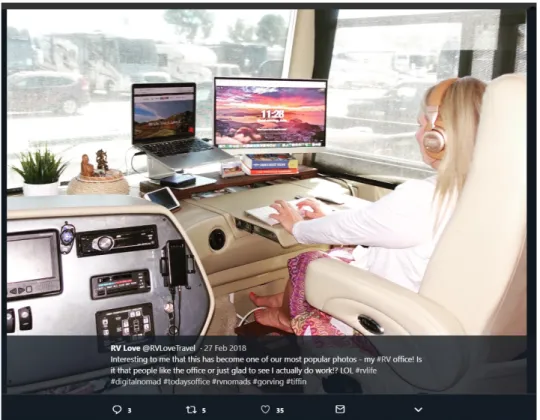
To visualize digital nomads’ differing work spaces and understand how they use their technologies to “make spaces”, pictures from Twitter were downloaded into a data management and analytics software chronologically. Pictures downloaded were dated from June 2017 to January 2019 and were listed publicly with the hashtags #digital nomad or #digitalnomads in the caption. Pictures which included advertisements or did not have any mobile devices, desks, or indications of a designated workspace were not analyzed due to a lack of relevance for
Findings
Interview participants did reflect the media’s claim that the digital nomad lifestyle allows for the ability to work across different places. Many participants discussed how there were few restrictions when selecting the physical locations to conduct work, including Participant 15 who claimed to “have the flexibility to work from anywhere in the world”. Interview participants used the term “location-independent” frequently to describe their lifestyle and many believe their technologies enables them to be what they consider location-independent and unrestrained from any physical location while working. However, their statements about being
“location-independent” should be put in context as they also provided details about spatial patterns, constraints, and needs for productively accomplishing work.
Consistently when digital nomads defined their office, they listed technologies they used on a regular basis to conduct work. Participant 8 commented that in terms of her office, “it’s definitely not physical, it’s when I think about my office it’s definitely not a physical space. I guess my office is my laptop, it’s my laptop and my mobile phone, that’s my office”. Through these portable technologies, digital nomads are able to create a mobile office (Nash et al. 2018). However, Participant 7 noted that not only did she need her technologies to create their mobile office space, but also needed to go “anywhere I can get a good phone connection.” Thus, digital nomads must seek environments that can facilitate their portable technologies functions in order to accomplish work.
glamorous but inaccurate portrayal on social media is likely part of the reason digital nomads are being mislabeled as “location-independent” workers by the media.
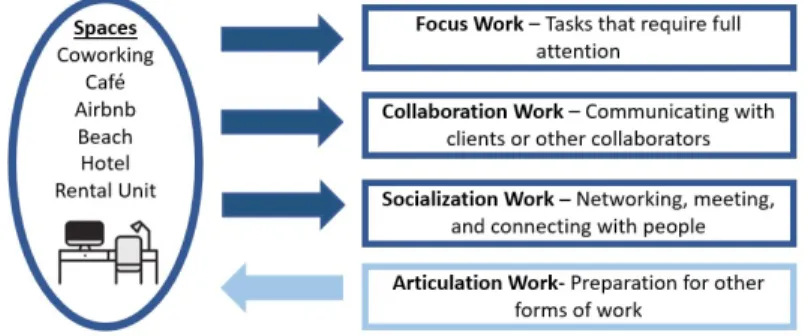
Digital nomads often have the intent to accomplish a particular item or a few tasks in a certain space which are decided upon prior to arrival. There are evident associations between the type of spaces they select and form of work they accomplish in those spaces. Due to the unique spatial arrangements nomadic workers commonly encounter with, there are generally four types of work they regularly engage in: articulation work, focus work, socialization work, and
collaboration work. Figure 2.1 demonstrates the general relationships that these various work nomadic practices have with space.
For digital nomads, their relationship with space is unique while conducting articulation work since that particular form of work provides digital nomads the opportunity to find and configure spaces that are suitable for conducting the other three forms of work. While accomplishing the other three forms of work, the spatial affordances of the surrounding
environment and technologies helps supplement the digital nomads’ work practices. The concept of spatial affordances posits each space has its own agency with several unique facets, and therefore enabling and constraining certain work practices (Kusenbach 2017; Raulet-Croset 2013).
Figure 2.1 The relationships between space and nomadic forms of work
Articulation Work
planning the logistics for how work to can be accomplished (Corbin and Strauss 1993). Simply put, articulation work is the necessary preparation in order to perform the actual work that is being paid for by the client or corporation. For nomadic workers, it is crucial to dedicate a significant amount of articulation work to finding places and configuring resources to do their work.
During articulation work, digital nomads must decide and plan what type spaces to seek out and how to alter the spatial affordances of that place with their technologies. Many digital nomads felt articulation work was an appropriate use of time as necessary or at locations that were not ideal for any of the other forms of work. Participant 3 stressed the importance for digital nomads of having “no free time or no dead time” and as long as she could access her technologies, she felt responsible “using that time to be efficient and productive”. However, in an environment that can be loud and often distracting, such as an airport lobby or in transit, Participant 10 achieved tasks that were meaningful “for my business and less about client work”. Places related to transportation continuously surfaced in interviews with digital nomads for achieving articulation work. However, despite being labeled as work for “dead-time”, Participant 8 demonstrated her range of tasks involved with articulation work including “marketing, set up social media posts, plan my events, check email, so just kind of like the quick tasks or like writing projects”.
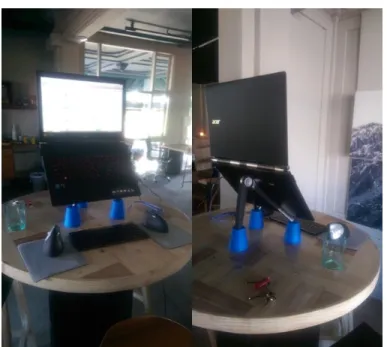
setting up their mobile office. For digital nomads, this is particularly evident throughout the process of configuration work, a form of articulation work in which the surrounding environment and tools are configured to fit the appropriate context of the environment, form of work, and types of technologies used (Jarrahi and Nelson 2018). Figure 2.2 shows a digital nomad’s office which has features to supplement their technologies, such as the adjustable height laptop stand, but also innovative technologies, like the vertical ergonomic mouses for both the left and right hand. All these portable tools and technologies can be configured to help make the mobile office more spatially adequate for the digital nomad to complete work.
Collaboration work
In order to communicate with the necessary professional associates, digital nomads need an environment in which they can collaborate and communicate with like-minded workers, while also being able to speak at an appropriate level. When digital nomads meet with other
collaborators or clients they also must have an internet or cellular connection that is stable enough to maintain the connection throughout the duration of the collaboration work session. These requirements are not only fundamental to carrying out their collaboration work, but also imperative for creating a professional appearance. Participant 20 commented how in the wrong environment, collaborators will mention that it is “distracting when we’re talking with them, they’ll be like where are you right now, why are there so many trucks going by.”
Since digital nomads do not want their lifestyle to appear as unprofessional to the
collaborator, they do not want to give off any notion that the collaboration work is inconvenient. Participant 7 touched on the idea of ensuring the client does not have any reason to doubt that the digital nomad is not in a professional workspace and admits that “I don’t always tell them where I am because sometimes they get upset to think I’m far away” in order to avoid when “clients get really bent out of shape.” Thus physical spaces that allow for the digital nomad to control the noise level and maintain a reliable online connection are the most ideal when performing collaboration work.
work generally mirror a traditional office space as closely as possible. However, due to the variations in coworking spaces, some encourage socialization which can be not ideal for conducting collaboration work.
Socialization Work
Casual, workplace conversation, otherwise known as the “water-cooler” effect, often requires intentional effort when seeking this convention outside of a traditional office space (Ross et. al 2015). However, these opportunities are often missing in the remote lifestyle of nomadic workers. One of the most notable spaces mobile workers have popularized as a solution to contrive these conversations are coworking spaces. Coworking spaces are built with the intention of providing a space that offers the same conveniences and social affordances of a traditional, stationary office (Spinuzzi 2012). Often, coworking spaces have designated rooms or areas to help facilitate socialization work, which is often the most difficult for digital nomads to partake in due to the moving nature of their office. Notably, coworking spaces have helped to fill this void creating environments encourage and facilitate networking and creative problem solving with surrounding professionals.
Coworking spaces also help mobile workers to separate their workplace and home while avoiding complete isolation and an enervating sense of loneliness (Lee et. al 2019). Participant 5 commented how working outside of private areas is “so important I think for my mental health and my emotional health as well as just for my state of mind, just a general state of mind, and like being around people.” Figure 2.4, taken from Twitter, demonstrates the value coworking spaces provides for casual conversations and discussions to learn and share new ideas. While coworking spaces vary in environments and aura, Participant 2 noted that some coworking spaces can be very difficult to accomplish other forms of work since “there’s lots of distraction in co-working spaces unless you have a dedicated desk there.” Thus often coworking space managers play a large role in shaping the environment to fit the needs of the occupants (Ivaldi et. al).
Beyond coworking spaces, digital nomads often seek out conferences and events with fellow mobile, remote workers. There are many programs such as Nomad Cruise, which provides group mobile accommodations and resources geared specifically towards digital nomads.
reaffirming to know that other people were in a similar place as me.” This participant frequently hosted conferences which gave him the opportunity to share his experiences and expertise in creative writing and yoga. He held conferences in a range of places during his travels from Germany to his home base in Rhode Island, United States. However, for digital nomads who are not able to budget money on coworking spaces or conferences will spend time in social public venues to network and meet with others. Participant 2 stated that “when I’m at coffee shops obviously it’s a good place to meet people just because it’s more social.”
Focus Work
For digital nomads, focus work can be the most tedious and crucial to maintain a balance between highly mobile lifestyle and productive work. In order to perform this work productively and exemplary manner, finding an environment that is quiet and enables the digital nomad to focus is vital. Participant 10 stated how “being in a café is often not very conducive to doing that kind of focused work, I need quiet, you know, no distractions.” Generally, many digital nomads concurred that public environments are not adequate when attempting to complete focus work. However, some digital nomads considered public environments that had minimal to no noise levels were also acceptable for completing focus work. Participant 4 discussed that when
“working on something that I really need to lose myself in and I need to be completely absorbed by it, being in the library is one of the best places.” Participants frequently referenced this important ability to be engulfed by their focus work when necessary. Generally, many participants needed a silent area in order to shift into that mindset that would be free from distractions. Photos that displayed focus work were generally taken in private areas in which the digital nomad was the only person that had access or was inhabiting that particular space.
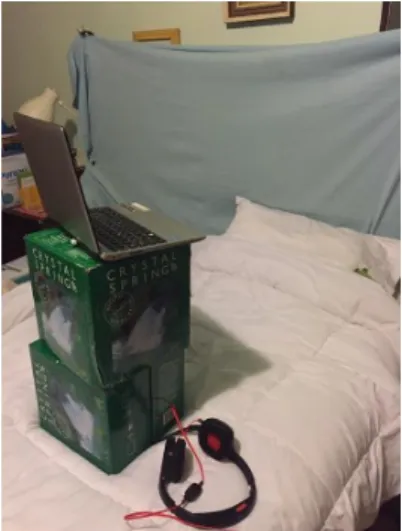
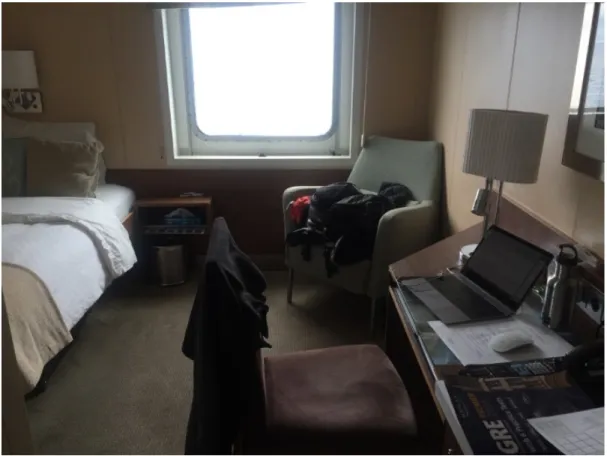
Digital nomads frequently referenced their housing area as a good environment to
for creating a simple, yet sufficient environment to conduct focus work.
Discussion
While recognizing the advancement in technologies that allow digital nomads to work outside a traditional office space, the media fails to recognize the nuanced interplay of space, work, technology in enabling and constraining this lifestyle. These dynamics became apparent to our research participants when discussing their workspaces. The imperative reliance on their technologies and tools prevents them from going completely location-independent. While their technologies may be portable, it can often not be operable in particular spaces. The spatial affordances of certain locations are simply impossible to alter in order to use technologies and perform certain types of work, thus restricting digital nomads when choosing spaces.
Connectivity and maintaining operable battery levels on devices were issues that digital nomads had to consider throughout their travels. Digital nomads must find spaces that accommodate these necessary attributes to complete their work before they can begin to select space that appeal to their spatial preferences. These qualifying technology factors are not found in every space. Digital nomads may not always constantly need access to all of these technological components, they will likely need regular, predictable access.
change as well.
While digital nomads have the ability to be mobile and the opportunity to work in a range of spaces outside of a traditional office, they are still not location-independent. The
characteristics of spaces can still restrict and enable what forms of work can be conducted in certain location. While some characteristics can be altered through technology, others cannot, which in turn makes some spaces not conducive for work. Thus, it is not possible to be location-independent since space matters to digital nomads and is a carefully selected to enable their nomadic practices. Digital nomads have differing spatial requirements for various forms of work which inhibit them from being able to work in any location. For example, a digital nomad’s collaboration work is similar to socialization work since information and knowledge is being shared, but yet they often need vastly different environments for collaboration work. Thus, while digital nomads are an interesting form of mobile workers, even their extreme mobility does not translate to being location-independent.
When nomadic workers are unable to find a space that fits all their needs for a space, they are often able to use technology to alter the materiality of space in order to fit their requirements or become better-suited for their productivity levels (Brown and O’Hara 2003). In order to be as productive as possible, mobile workers often utilize their technologies and applications to create an appropriate space to focus on their tasks. This phenomenon of “making space” requires advanced preparation as well as thorough planning in order to achieve productive work (Perry et al. 2001; Büscher 2014).
Frequently, digital nomads spoke to their preferences when searching and creating spaces to work. Occasionally, a participant would stray from the general preferences of a space for a particular kind of work. Their unique personalized preferences limit the ability to solely
Conclusion
Digital nomads have been pioneers in terms of creatively problem solving many
challenges mobile workers face on a regular basis. While spaces have previously been studied in the context of mobile work, understanding the term location independence through this context has not received an adequate level of attention. If a mobile worker were to be
location-independent, by definition they would be able to transform any space into an adequate place to work. As mobile work continues to evolve into more extreme trends, understanding the role of digital technologies and the changing relationship with space is critical for scholars. Forms of work that are independent from a particular space are now gaining traction and have become very appealing to many young professionals. However, through recognizing that being location independence cannot be achieved by any form of mobile worker, we can begin to perceive a greater conceptualization of the dynamic relationship between space, work, and technology.
Labeling digital nomads as location-independent mobile workers is a fundamental miscatagorization that has been created and perpetuated by the media. In order to complete their work, digital nomads deeply rely not only on their technologies but also the ability to find and use environments in which they can conduct productive work and use their technologies. While digital nomadism is indeed considered one of the most highly mobile trends in work, it does not lift the burden of finding sufficient spaces to work. Discovering spaces that fit the requirements necessary to accomplish work while also prioritizing spaces that accommodate individual preferences could not be accomplished without technology. The important role that space has for mobile workers should not be overlooked, especially as these workers become more prevalent.
Bibliography
https://www.forbes.com/sites/robertadams/2017/01/20/how-to-become-a-digital-nomad-and-travel-the-world/.
Aguilera, Anne. 2008. “Business Travel and Mobile Workers.” Transportation Research Part A: Policy and Practice 42 (8): 1109–16.
Bardram, Jakob E., and Claus Bossen. 2005. “Mobility Work: The Spatial Dimension of Collaboration at a Hospital.” Computer Supported Cooperative Work: CSCW: An International Journal 14 (2): 131–60.
BenMoussa, Chihab. 2003. “Workers on the Move: New Opportunities through Mobile Commerce.” Stockholm Mobility Roundtable, 22–23.
Brown, Barry, and Kenton O’Hara. 2003. “Place as a Practical Concern of Mobile Workers.” Environment & Planning A 35 (9): 1565–87.
Büscher, Monika. 2014. “Nomadic Work: Romance and Reality. A Response to Barbara Czarniawska’s ‘nomadic Work as Life-Story Plot.’” Computer Supported Cooperative Work: CSCW: An International Journal 23 (2): 223–38.
Capdevila, Ignasi. 2015. “CO-WORKING SPACES AND THE LOCALISED DYNAMICS OF INNOVATION IN BARCELONA.” International Journal of Innovation Management
19 (03): 1540004.
Cass, Noel, Elizabeth Shove, and John Urry. 2005. “Social Exclusion, Mobility and Access 1.” The Sociological Review 53 (3): 539–55.
Chayka, Kyle. 2018. “When You’re a ‘Digital Nomad,’ the World Is Your Office.” The New York Times, February 8, 2018. https://www.nytimes.com/2018/02/08/magazine/when-youre-a-digital-nomad-the-world-is-your-office.html.
Chen, Leida, and Ravi Nath. 2008. “A Socio-Technical Perspective of Mobile Work.”
Information Knowledge Systems Management 7 (1, 2): 41–60.
Ciolfi, Luigina, and Aparecido Fabiano Pinatti de Carvalho. 2014. “Work Practices, Nomadicity and the Mediational Role of Technology.” Computer Supported Cooperative Work: CSCW: An International Journal 23 (2): 119–36.
Clark, Dorie. 2017. “Thinking About a ‘Work from Anywhere’ Arrangement? Ask These Questions First.” Harvard Business Review, September 26, 2017.
https://hbr.org/2017/09/thinking-about-a-work-from-anywhere-arrangement-ask-these-questions-first.
Corbin, Juliet M., and Anselm L. Strauss. 1993. “The Articulation of Work Through Interaction.” The Sociological Quarterly 34 (1): 71–83.
DeGuzman, Genevieve V., and Andrew I. Tang. 2011. Working in the Unoffice: A Guide to Coworking for Indie Workers, Small Businesses, and Nonprofits. Night Owls Press LLC. Diannah Lowry. “Hanging on the Mobile Phone: Experiencing Work and Spatial
Flexibility.” August 2005.
https://www.researchgate.net/profile/Megan_Moskos/publication/246356788_Hanging_on_ the_Mobile_Phone_Experiencing_Work_and_Spatial_Flexibility/links/
0046353c730df8696f000000/Hanging-on-the-Mobile-Phone-Experiencing-Work-and-Spatial-Flexibility.pdf.
Erickson, Ingrid, Mohammad H. Jarrahi, Leslie Thomson, and Steve Sawyer. 2014. “More than Nomads: Mobility, Knowledge Work, and Infrastructure.” In Proceedings of the the European Group for Organizational Studies Colloquium.
http://www.jarrahi.com/publications/EGOS_Erickson_Subtheme52.pdf.
Fabbri, Julie, and Florence Charue-Duboc. 2013. “The Role of Physical Space in
collaboration workplaces Hosting Entrepreneurs: The Case of the ‘Beehive’in Paris.” In
Materiality and Space, 117–34. Springer.
Gerdenitsch, Cornelia, Tabea E. Scheel, Julia Andorfer, and Christian Korunka. 2016. “Coworking Spaces: A Source of Social Support for Independent Professionals.” Frontiers in Psychology 7 (April): 581.
Ivaldi, Silvia, Ivana Pais, and Giuseppe Scaratti. 2018. “Coworking(s) in the Plural: Coworking Spaces and New Ways of Managing.” In The New Normal of Working Lives: Critical Studies in Contemporary Work and Employment, edited by Stephanie Taylor and Susan Luckman, 219–41. Cham: Springer International Publishing.
Jarrahi, Mohammad Hossein, and Sarah Beth Nelson. 2018. “Agency, Sociomateriality and Configuration Work.” The Information Society 34 (4).
https://doi.org/10.1080/01972243.2018.1463335.
Jarrahi, Mohammad Hossein, Gabriela Phillips, Will Sutherland, Steve Sawyer, and Ingrid Erickson. 2018. “Personalization of Knowledge, Personal Knowledge Ecology, and Digital Nomadism” (August).
https://www.researchgate.net/publication/327172717_Personalization_of_Knowledge_Pers onal_Knowledge_Ecology_and_Digital_Nomadism.
Jarrahi, Mohammad Hossein, and Leslie Thomson. 2017. “The Interplay between
Information Practices and Information Context: The Case of Mobile Knowledge Workers.”
IS: 25th Information Systems Research Seminar in Scandinavia~(IRIS25).
https://www.academia.edu/2841590/Post-ModernProfessionals_Work_and_Mobile_Technology.
Karanasios, Stan, and David Allen. 2014. “Mobile Technology in Mobile Work:
Contradictions and Congruencies in Activity Systems.” European Journal of Information Systems 23 (5): 529–42.
Kietzmann, Jan. 2008. “Interactive Innovation of Technology for Mobile Work.” European Journal of Information Systems 17 (3): 305–20.
Kusenbach, Margarethe. 2017. “Martina Löw 2016: The Sociology of Space: Materiality, Social Structures, and Action . New York: Palgrave Macmillan.” International Journal of Urban and Regional Research 41 (6): 1032–34.
Lee, Ahreum, Austin L. Toombs, and Ingrid Erickson. 2019. “Infrastructure vs.
Community: Co-Spaces Confront Digital Nomads’ Paradoxical Needs.” In CHI 2019 Late-Breaking Work. https://doi.org/10.1145/3290607.3313064.
Mark, Gloria, and Norman Makoto Su. 2010. “Making Infrastructure Visible for Nomadic Work.” Pervasive and Mobile Computing 6 (3): 312–23.
McCarthy, John, and Peter Wright. 2005. “Technology in Place: Dialogics of Technology, Place and Self.” In Human-Computer Interaction - INTERACT 2005, 914–26. Springer Berlin Heidelberg.
Mohn, Tanya. 2017. “The Digital Nomad Life: Combining Work and Travel.” The New York Times, April 3, 2017. https://www.nytimes.com/2017/04/03/business/digital-nomads-work-tourism.html.
Nash, Caleece, Mohammad Hossein Jarrahi, Will Sutherland, and Gabriela Phillips. 2018. “Digital Nomads Beyond the Buzzword: Defining Digital Nomadic Work and Use of Digital Technologies.” In Transforming Digital Worlds, 207–17. Springer International Publishing.
Nelson, Sarah Beth, Mohammad Hossein Jarrahi, and Leslie Thomson. 2017. “Mobility of Knowledge Work and Affordances of Digital Technologies.” International Journal of Information Management 37 (2): 54–62.
O’Brien, Michelle. 2011. “Finding a Home for the ‘digital Nomad.’” Disponible En Ligne. http://www.michelleobrien.net/wp-content/uploads/2011/10/OBRIEN_Home_digital_noma d.pdf.
dic_work_Developing_the_concept_of_Mobilisation_Work/links/ 00b7d532197585a308000000.pdf.
Perry, Mark, Kenton O’hara, Abigail Sellen, Barry Brown, and Richard Harper. 2001. “Dealing with Mobility: Understanding Access Anytime, Anywhere.” ACM Trans. Comput. -Hum. Interact. 8 (4): 323–47.
Pittinsky, Todd L., and Margaret J. Shih. 2004. “Knowledge Nomads: Organizational Commitment and Worker Mobility in Positive Perspective.” The American Behavioral Scientist 47 (6): 791–807.
Raulet-Croset, Nathalie. 2013. “When Urban Space Becomes Organizational Space: A Space-Based Coordination to Deal with Volatile and Recurring Problems of Urban Incivility.” In Materiality and Space: Organizations, Artefacts and Practices, edited by Francois-Xavier de Vaujany and Nathalie Mitev, 157–78. London: Palgrave Macmillan UK.
Rossitto, Chiara, and Kerstin Severinson Eklundh. 2007. “Managing Work at Several Places: A Case of Project Work in a Nomadic Group of Students.” In Proceedings of the 14th European Conference on Cognitive Ergonomics: Invent! Explore!, 45–51. ACM. Ross, Peter, Susan Ressia, and Others. 2015. “Neither Office nor Home: Coworking as an Emerging Workplace Choice.” Employment Relations Record 15 (1): 42.
Schuermann, Mathias. 2014. Coworking Space: A Potent Business Model for Plug ‘n Play and Indie Workers. Epubli.
Spinuzzi, Clay. 2012. “Working Alone Together: Coworking as Emergent Collaborative Activity.” Journal of Business and Technical Communication 26 (4): 399–441.
Spreitzer, Gretchen M., Lindsey Cameron, and Lyndon Garrett. 2017. “Alternative Work Arrangements: Two Images of the New World of Work.” Annual Review of Organizational Psychology and Organizational Behavior 4 (1): 473–99.
Saar, Maarja and Palang, Hannes “The Concept of Space and Place.” 2014. November 25, 2014. http://www.lrlr.landscapeonline.de/Articles/lrlr-2009-3/articlese2.html.
Urry, John. 2013. “Mobile Lives and Materialities.” In Materiality and Space:
Organizations, Artefacts and Practices, edited by Francois-Xavier de Vaujany and Nathalie Mitev, 263–73. London: Palgrave Macmillan UK.
Vanderkam, Laura. 2014. “Will Half Of People Be Working Remotely By 2020.” Fast Company (Aug 2014). Https://www. Fastcompany. com/3034286/will-Half-of-People-Be-Working-Remotely-by-2020.
Appendix
List of Preliminary Research Questions:
•Are digital nomads truly location-independent?
•What are the emerging dynamics among 1) space, 2) nomadic work practices, 3) technology in the context of digital nomadism?
•What is the difference between mobility and location independence in the context of digital nomadism?
•How do spaces/technology enable/restrict workers?
Email Sent to Participants
Hi
My name is ______ and I am a _____ at the University of North Carolina’s School of Information. I am contacting you about participating in a research project entitled “digital nomads as information constructs: A growing sub-culture changing the landscape of the traditional work environment”. I am serving as a research assistant on this project under Dr. Mohammad Jarrahi, a faculty member here at UNC.
As researchers, we are interested in gaining a fuller insight into the growing ‘digital nomad’ community: the tools, applications, and online resources you use for work, the places you may visit for work, and how you manage knowledge.
We would like to interview you (45-65 mins) online. For every 15 participants in the study we will conduct a raffle for a $60 Amazon gift card.
There is a second, optional part of the study that would be very helpful to us. If you agree to participate in this portion of the study we will ask you to download the tracemobile app
(http://www.tracemobileapp.com/) onto your phone and allow it to collect data from your phone for 10 days. We developed the app for our research and it will only collect a specific set of data points. This includes GPS data, Internet connection (WiFi vs. Cellular networks), IP addresses (internet service providers), battery usage, accelerometer (to identify the speed and type of mobility: walking vs. driving), and a survey of the other apps’ name you have installed (only for Android users). The app is secure, does not know your identity, and will not have access to any of your contact information or other apps
information. This data is invaluable in helping us better understand and visualize digital nomads’ geographic/spatial mobility. As a gesture of our appreciation, you will be compensated for running the app for 10 days with a $30 Amazon gift card.
And, of course, you can stop participating at any time or in any part of the study; your participation is totally voluntary.
Please let me know if you are interested in participating in this research or if you have any questions. If you have any questions about your rights as a potential research participant that you wish to address to someone other than me, please contact UNC’s Institutional Review Board at 919-966-3113 or
Looking forward to hearing from you.
Thank you! ____________
digital nomads INTERVIEW PROTOCOL
Version: April 2017 IRB Walkthrough
Professional Background and Work Context
1. What kinds of work do you do?
● [Is it done in groups or mostly alone?]
● [Who do you work with? e.g., clients, collaborators, teammates?]
● [Do you work for a larger organization or are you an independent entrepreneur?] <If the person works for an organization>
■ Is the entire organization remote?
■ Where do you fall within the organization hierarchy and how do you handle communication to your superior/lower level colleagues?
■ Does your organization offer any training or professional development within your field of work?
■ Have you considered working freelance or starting your own business?
1. How do you define a “digital nomad”?
○ [What are the main characteristics or traits of a digital nomad?]
○ [What are some terms that you associate with the word “digital nomad”?]
○ [Besides extreme forms of travel, what differentiates you from other types of workers?]
1. Would you call yourself a digital nomad? Why?
2. Approximately how frequently do you tend to travel to a different city or country? (monthly, every 3 months, etc.)
○ [What modes of transportation do you use for this travel? (Plane, bus, both, other)]
Technology and information use
In the next few questions, we focus on your use of online communities and website for different work-related purposes.
1. What are the most important online resources, websites and communities for you as an independent worker and a digital nomad?
● [Do you provide advice or share knowledge on these websites?]
● [Do you use any of these websites, or forums when looking for work?]
1. Do you ever leave and use ratings on these websites?
2. What online tools do you use to make professional connections?
3. How do you use social media for your work?
4. Do you maintain a personal pages or website on the web?
● [How do you use it?]
1. In addition to online websites, what are the other primary technologies that you use?
● [e.g., computers, devices, peripherals; software, applications; service providers and purchased services]
● [What the key devices and applications do you use regularly?]
1. What technologies do you use to manage your time? How about to organize your daily activities?
Space-related Questions
<If the interview has participated in the app-based data collection>
1. What spaces have you used for work recently? (in the last week or so) - the app will help us here
1. Where do you primarily stay when you travel?
2. Where do you get your work done?
● [Are there certain places do you prefer for individual work?]
● [Are there places do you prefer for creative work?]
● [Are there places do you prefer for collaborative or group work?]
● [Are there spaces do you prefer for networking and sharing knowledge with professional ties]
● [What networking activities do you participate in when traveling and meeting new people? Both social and professional networking?]
1. <if did not come up above> Do you work in, or actively avoid any of the following places?
● Coworking spaces?
● Cafes (i.e. Starbucks, wifi cafes)?
● Libraries?
● Your place of residence (i.e. rental, hostel, AirBnb, hotel)
● Transit? (i.e. on an airplane or bus, or in an airport lounge, etc.)
3. Do you feel that “getting out of the office” helps you to be more creative and come up with innovative ways of thinking or performing your job?
4. Is your preferred technology setup mobile, or more difficult to move? (i.e. multiple screens that aren’t easy to move might make someone more likely to work from their place of residence)
● [Does the mobility of your technology setup restrict where you can and cannot work?]
Social Aspect of Work
1. Can you describe who makes up your work-related network, inclusive of clients, colleagues, partners, and subordinates?
● [Describe how you communicate, meet, and work with your professional network, inclusive of the collaborators and clients identified earlier?]
1. For many ‘digital nomads’ keeping social cohesion is challenging. How do you keep yourself socially engaged with other people and make yourself visible while working independently or remotely?
2. Do you take part in any professional development events or relevant conferences?
● [Have you ever attended a nomad conference or program? (Hacker’s Paradise, Remote Year, etc.)]?
Personal Knowledge Management
1. How do you manage your work-related information
2. Do you ever feel overloaded or burdened by the amount of information you encounter?
● [How do you deal with unnecessary information overload]
1. Do you need to work offline and away from distraction to think deeper?
● [When and how does deep thinking happen?]
● [How do you disconnect from distractions? Do you use any technologies?]
1. Do you reflect on your work activities? How often? Do you use this reflection to change the way you work?
1. When you learn a new job activity, technology, or “tip/trick” related to your work and/or being a digital nomad, how do you incorporate this new learning into your established routine or job activities?
2. What special literacies/knowledge do you think you've developed as a ‘digital nomad’?
Wrap-Up
1. What are some of the most important challenges associated with being a ‘digital nomad’?
● [What are specific technological challenges?]
1. Can you send us a picture of your primary or preferred workspace setup?
● [Where does that workspace fall in our typology of places- is it a coworking space, cafe, nomad conference, residence, transit?]
1. What things do you think are important that I haven’t asked you about?
● [What other ideas/thoughts/issues have these questions raised for you? (what do you associate with infrastructure? ‘digital nomadism’?)]
List of Participants
Participant Gender Position Profession
P1 M Freelancer Web Designer/Developer
P2 F Freelancer UX Designer
P3 F Freelancer Marketing and Social Media Consultant
P4 M Freelancer Online Marketing and Development
P5 M Freelancer Business Writer
P6 F Freelancer Media Producer
P7 F Freelancer Personal Coach
P8 F Freelancer Organization and Process Consultant
P9 F Freelancer Web Developer
P10 F Freelancer Web Editor
P11 F Freelancer Technical Writer
P12 F Freelancer Blogger
P13 M Entrepreneur Developer
P14 M Freelancer Journalist
P15 F Entrepreneur Ecommerce Consultant
P16 M Entrepreneur Lawyer
P17 M Freelancer Journalist
P18 M Freelancer Web Developer
P19 F Freelancer Online Marketing
P20 F Organization Product Manager
P21 M Organization Entrepreneurship Consultant
P22 M Freelancer SEO Marketer
Complete list of tags in Dedoose
Spaces Form of Work
AirBnB Articulation Work
Beach/Outdoors Collaboration work
Cafe Socialization Work
Coworking Space Focus Work
Hotel General Work
Rental House/Apt
Transportation