Rachel E. Duffus. Outcomes-Based Evaluations in School Libraries: Developing an OBE Tool for Elementary School Libraries. A Master’s Paper for the M.S. in L.S degree. March, 2020. 70 pages. Advisor: Dr. Casey Rawson
In today’s library culture, outcomes-based evaluations (OBE) are becoming the gold standard for program design and evaluation. Organizations like American Library Association (ALA) are promoting the benefits and increased use of OBE’s in libraries, but the usage rate has been slow to grow. As well, research is limited in this area, based mainly in academic libraries and occasionally in public library settings, but not in school libraries. For this project, I developed an OBE tool for Frank Porter Graham Bilingüe, an elementary school library in Chapel Hill, NC. This tool will be used initially at their quarterly Media Night programs but will also have the ability to be modified for use with other programs. The tool was piloted at their December Media Night, the data was analyzed and presented to the librarian and technology administrator, and the tool was modified based on stakeholder feedback and my own feedback. This project has the purpose of developing a usable tool that does not require a great deal of time to use, decreasing the barriers to using OBE in this school library setting. The results of this project and the model tool will also contribute to the limited research in the school library field.
Headings:
Elementary school libraries – Activity programs in elementary school libraries
Evidence-based library science
School libraries – evaluation
OUTCOMES-BASED EVALUATIONS IN SCHOOL LIBRARIES: DEVELOPING AN OBE TOOL FOR ELEMENTARY SCHOOL LIBRARIES
by
Rachel E. Duffus
A Master’s paper submitted to the faculty of the School of Information and Library Science of the University of North Carolina at Chapel Hill
in partial fulfillment of the requirements for the degree of Master of Science in
Library Science.
Chapel Hill, North Carolina
March 2020
Approved by
______________________________________
Table of Contents
Table of Contents ... 1
Introduction ... 5
Problem / Area of Need ... 7
Related Work ... 10
Historical Trends in Evaluation in Libraries ... 10
Outcomes-Based Evaluation (OBE) ... 11
Assessment in Education and School Classrooms ... 12
Case Studies ... 12
Gap in Literature ... 13
Goals and Deliverables ... 14
Key Concepts and Terms ... 15
Variables ... 16
Deliverable ... 16
Context ... 18
2
Positionality and Conflicts of Interest ... 19
Stakeholders ... 19
Procedures / Scope of Work ... 22
Project Evaluation ... 24
Data Collection from Human Subjects ... 24
Risk and Ethical Considerations ... 27
Risks ... 27
Ethics ... 27
Impact and Limitations ... 29
Impact ... 29
Limitations and Delimitations ... 30
Assumptions and Constraints ... 31
Process ... 32
Pre-Project ... 32
Planning ... 32
Implementation ... 34
Reflection ... 35
Reflection ... 36
Methods of assessment: ... 36
Paper Survey ... 37
Flipgrid ... 39
Talkback Board ... 41
Observations ... 45
Main Takeaways ... 46
Recipient Feedback ... 47
Feedback ... 47
Questions ... 48
Future Work ... 49
Additional Suggestions ... 49
Recipient Usage ... 50
Personal Usage ... 51
Further Research ... 52
Conclusion ... 53
References ... 54
Appendix A: Recruitment Letters/Emails ... 59
Appendix B: Participant Instructions ... 61
4
Appendix D: Observation Template ... 66
Appendix E: List of Applications/Programs Used for Feedback ... 67
Introduction
In today’s library culture, outcomes-based evaluations (OBE), which looks at
impacts on patrons as a result of the program during and after they participate, are
becoming the gold standard for program design and evaluation (McNamara, n.d.).
Organizations like American Library Association (ALA) are promoting the benefits and
increased use of OBE’s in libraries, but the usage rate has been slow to grow. As well,
research is limited in this area, based mainly in academic libraries and occasionally in
public library settings, but not in school libraries. The lack of research, and subsequently
training of librarians, has led to this slow increase in use, yet the benefits of utilizing
OBE to design and evaluate programs makes it an important tool for librarians. The
culture within libraries requires changing, and the exposure of librarians, specifically in
school libraries, to the OBE model and tools is necessary.
For this project, I developed an OBE tool for Frank Porter Graham Bilingüe, an
elementary school library in Chapel Hill, NC. This tool will be used initially at their
quarterly Media Night programs and was piloted at their December Media Night. Then,
the data was analyzed and presented to the librarian, Janet Peterson, and the technology
administrator, Alex Linares, and the tool was modified based on their and my own
feedback. The tool was created specifically for the school’s Media Nights, but in order to
further encourage use of the OBE model in this school library, I have made the tool
6
designing and evaluating other programs makes using OBE’s less of a time
commitment for users, decreasing the barrier to use.
The results of this project and the model tool contribute to the limited research in
the school library field. The final product is a usable tool that has been tested and
modified based on the initial test, which can be used by other researchers to improve
research around the OBE model in school libraries. Also, this tool can be used by other
librarians outside of Frank Porter Graham Bilingüe—other school libraries, and even
public libraries, will be able to benefit from the model I developed. Since it can be
modified, other librarians can alter it to fit their needs. Through this project, I hope to
Problem / Area of Need
As mentioned, the outcomes-based evaluation model is currently being favored by
organizations like ALA, AASL (American Association of School Librarians), etc., as the
ideal assessment model for libraries. Some types of libraries have long been using the
OBE model, such as academic libraries, but school libraries are among the few types that
have been slow to make the adoption. Studies conducted within academic libraries and
non-library organizations, like governmental agencies, have shown a wide variety of
benefits. At the school library level, students would experience these same benefits, along
with benefitting from actual use of evaluation, which is not frequently used due to time
constraints.
Before the utilization of OBE, assessment focused on inputs, which are “materials
and resources that the program uses in its activities, or processes, to serve clients,” and
outputs, which are “the units of service regarding your program…the number of clients
served, books published, etc. very often indicates nothing at all about the actual
impacts/benefits/changes in your clients who went through the program” (McNamara,
n.d., para. 10). Outcomes, the current preference in assessment, are “actual
impacts/benefits/changes for participants during or after your program…usually
expressed in terms of: knowledge and skills…behaviors…[and] values, conditions, and
8
Currently, OBE is not uncommon in the academic library setting. In the
1990’s, academic libraries were beginning to see the need for program evaluation through
the use of outcomes (Wallace, 2001). But, in these early days, the outcomes were used to
prove success, not better the programs for the patrons who produced the outcomes
(Wallace, 2001). School libraries, in the early 2000’s, also started some assessment with
a focus on outcomes, but there still has not been widespread adoption (Callison, 2007).
Unlike in academic libraries, though, the focus of the outcomes assessment in school
libraries is on student learning, not proving the worth of the program (Callison, 2007).
Here, the organizational differences are evident.
But, despite the proven benefits, such as increased literacy scores (Bailey & Paul,
2012), changed parent behaviors (Colburn, n.d.), and increased librarian and teacher
interactions (Doiron, 1998), school libraries do not use OBE widely. OBE requires more
up-front work (Colburn, n.d.), which acts as a barrier to librarians, decreasing the use of
OBE. Also, due to a lack of widespread use, there are fewer formal studies and templates
for librarians to use in schools to assess their lessons and programs, also making outcome
development harder for librarians. The overarching issue for school librarians is a lack of
time, so the fewer resources that are available and easily accessible, the less likely the
librarians are to switch to the OBE model.
Ultimately, students are the group that can benefit the most from OBE in school
libraries, and they can suffer the most by the lack of OBE. Because OBE uses the
outcomes to design and redesign the original program to fit the desires of students, the
needs of the students, who are the users, are prioritized, which aligns with the
student learning outcomes, along with assisting with developing soft skills, like
10
Related Work
Historical Trends in Evaluation in Libraries
Historically, literature regarding evaluation in libraries focused on proving the
worth of libraries, as mentioned with the early use of OBE in academic libraries
(Hannigan, 1976). Even as recently as 2005, as a new school librarian worked to form
assessment practices in her library, her focus was on proving the library’s worth to
stakeholders, like administrators (Marie, 2005).
A rare few, though, saw evaluation through the same lens as OBE. As Hannigan
states, “it [evaluation] may lead us into the pitfall of accountability to the institution
rather than to the child,” and noted that observing children laughing and talking can be a
valuable form of evaluation (1976). From my review of the literature, Hannigan’s 1976
article was the first mention of outcomes-based evaluation, though it had not acquired its
official name, yet. School libraries, though slow to adopt the formal OBE model, have
always focused on student learning as the bottom line, and therefore have had a greater
historical focus on outcomes than other library types (Latrobe & Masters, 1999). In these
other types of libraries, as mentioned, the focus, previously, was on the inputs and
outputs in evaluations, instead of outcomes (Wallace, 2001). This different focus reflects
the varying priorities of libraries, organization-centric versus patron-centric. But, even in
school libraries, sometimes the focus is not on students. For example, Tilley (2011)
reasoning for measuring impact is for job retention, not student needs. Clearly,
the simple implementation of OBE is not enough if the goals are not prioritizing the
users.
Outcomes-Based Evaluation (OBE)
OBE is currently a top priority for ALA and AASL, as their most recent issuance
of standards includes “a section dedicated to assessment and evaluation…examples on
how to create your own tools that align school and district models with AASL Standards”
(American Library, 2018, para. 3). A multitude of documents provide loose guidelines for
the process of developing OBE for school libraries, but specifics for the process and
actual templates are not included in literature or online sources yet (Arnold & Colburn,
2001; Choinski & Emanuel, 2006; Dando, n.d.; Doiron & Davies, 1998; “Evaluating”,
n.d.; Everhart, 1998; Keller, 2018; Oberg, 2001; Poll, 2003; Rawson, 2018; Todd, 2003).
The benefits of OBE, such as “increased positive comments,” increased number
of student research projects (Callison, 2007), and changed behaviors (Colburn, n.d.), are
also commonly written about, but, again, no templates or formal studies are performed
(Choinski & Emanuel, 2006; Dresang, Gross, & Holt, 2003; Dresang, Gross, & Holt,
2006; Hughes, 2014). Without actual templates, though the benefits and school-specific
examples may be extremely appealing to school librarians, the barrier to use has not been
decreased. Here, again, the literature reveals a massive gap in the resources available for
school librarians, and other librarians working with youth, which might contribute to the
lack of effective implementation of OBE in school libraries.
A positive and rare example of OBE implementation in a school library is found
12
encouraged to be “self-managers,” directing their own learning process
(Gordon, 2000). And, the students are asked to perform self-assessment (Gordon, 2000).
While Gordon does not provide specific templates, important questions for librarians to
raise are described, along with promoting student-created standards, which differs greatly
from the vast majority of other literature in this area (2000).
Assessment in Education and School Classrooms
Because school libraries exist within the greater framework of their schools, I
chose to investigate the literature around assessment in school classrooms. “Formative”
assessment, which is similar to OBE, is common in education literature, and
demonstrates the benefits of using assessment to develop the next steps in students’
learning (Hargreaves, 2005). Collaboration with classroom teachers could improve
assessment measures for librarians, providing an example of beneficial assessment
methods—increased collaboration between teachers and school librarians have proven to
improve literacy and other measurable outcomes (Bailey & Paul, 2012; Hughes, 2014).
Case Studies
To support the worth of OBE, several case studies exist. These case studies still
lack where the other literature does, but they demonstrate tangible results for librarians to
use as motivation in implementing OBE. Cox (2010) describes the creation of a
sports-related project for a group of fourth graders who love sports, and the project is evaluated
with dynamic assessment. This project and the subsequent assessment are detailed from
the project idea to the evaluation of the assessment results.
More specifically related to OBE, Mills, Campana, and Goldsmith (2017) analyze
(Outcomes-Based Planning and Evaluation), and Radical Change Theory. The
goal of this study was to present a new model for “LIS educational approaches,” which
encourages a shift in the field and a tangible example of OBE application, from initial
planning to final takeaways (Mills, Campana, & Goldsmith, 2017, p. ?).
Gap in Literature
As mentioned, there is a gap in the literature and resources available for school
librarians regarding OBE. And, even when OBE, or similar assessment methods, are
being implemented, the purpose of the assessment is often described as benefitting the
organization or the librarians, not the users. In order for OBE to be implemented as it was
intended by ALA, the culture around assessment within school organizations needs to
change. Lakos and Phipps (2004) discuss this need for change in all libraries, pushing for
the alteration of organizational culture, which eventually trickles down to change of the
14
Goals and Deliverables
For this project, I conducted my work at Frank Porter Graham Bilingüe (FPG), a
bilingual (Spanish and English) elementary school in Chapel Hill, North Carolina. This
school’s library lacked an Outcomes-Based evaluation (OBE) system for their daily
lessons and both in and out of school events. The library desired an evaluation tool that
follows the OBE system, to use for all of their different interactions with the students. A
tool that can be modified for different library-student interactions is ideal, so for this
project I created an evaluation tool that is for a specific event but, at its core, can be
adjusted for other needs within the library. Currently, the library and technology
department host four Media Nights per year, where families visit the library in the
evening for themed activities and stories. I designed my tool to evaluate the purpose and
effectiveness of the Media Nights.
My goal for this project was to develop an event evaluation tool for use in a
school library setting that is outcomes-based, usable across library events within the
school, and considerate of time constraints faced by school librarians. Per the
aforementioned research, the OBE model is used, but not widely and not to its full
potential. By creating a tool that is usable across library events within in the school and
consumes as little staff time as possible, this project works to decrease the barriers to
evaluation tool for the FPG Media Nights, which can be altered, as needed, for
other library-related events at the school.
Key Concepts and Terms
Important key concepts for this project include inputs, activities, outcomes-based
evaluation, outcomes, outputs, outcome targets, and outcome indicators. Inputs “are
materials and resources that the program uses in its activities, or processes, to serve
clients,” and are usually the items needed to make the program function, like equipment
(McNamara, n.d., para. 10). Activities, which use the inputs, are the “processes that the
program undertakes with/to the client in order to meet the clients’ needs…the focus is
still pretty much on the organization or program itself” (McNamara, n.d., para. 11). The
outcomes-based evaluation, though, makes the shift from the organization to the
population being served, as it “looks at impacts/benefits/changes to your clients (as a
result of your program(s) efforts) during and/or after their participation in your programs”
(McNamara, n.d., para. 8). Outcomes “are actual impacts/benefits/changes for
participants during or after your program…usually expressed in terms of: knowledge and
skills…behaviors…[and] values, conditions, and status” (McNamara, n.d., para. 13).
Outcomes are often confused with outputs, which “are the units of service
regarding your program,” for example the number of people who attend a library program
(McNamara, n.d., para. 12). Unlike outcomes, an output measure such as “the number of
clients served, books published, etc. very often indicates nothing at all about the actual
impacts/benefits/changes in your clients who went through the program” (McNamara,
n.d., para. 13). Also important in creating an outcomes-based evaluation is defining the
16
achieve the outcome” (McNamara, n.d., para. 14). Finally, outcome indicators
“are observable and measurable ‘milestones’ toward an outcome target…what you’d see,
hear, read, etc., that would indicate to you whether you’re making any progress toward
your outcome target or not” (McNamara, n.d., para. 15).
Variables
The variables for this project were fairly similar to the list of defined terms
mentioned above. Variables for this project included inputs, activities, outcomes-based
evaluation, outcomes, outputs, outcome targets, outcome indicators, and data collection.
For this project, data collection was defined as “a process of collecting information from
all the relevant sources to find answers to the research problem, test the hypothesis and
evaluate the outcomes” (“Data Collection”, n.d., para. 1). Definitions for the additional
variables can be found in the previous section.
Deliverable
The final deliverable for this project, as mentioned, was an Outcomes-Based
evaluation tool, made specifically for the FPG Media Nights but with the option to edit
portions for use with other events. This tool takes the form of a written template, which
was both printed and emailed to the stakeholders (librarian and technology
administrator). I have also published the tool online in the Carolina Digital Repository,
which is open access format, for other library professionals to use. Sections that can be
changed for fitting with other types of events are highlighted, and instructions accompany
the different sections.
A second, more minor deliverable is a report of the data gleaned from the pilot
it is a pilot test of the tool, the data was valuable to the library, so it was
compiled and presented to them. Their review of this report also aided in improving the
18
Context
This project took place at Frank Porter Graham Bilingüe (FPG), a bilingual
(English/Spanish) elementary school in Chapel Hill, North Carolina. I developed the
evaluation tool for use during the library’s quarterly Media Nights, which is an
already-occurring event that is sponsored by the librarian and the technology administrator.
This project is directly related to the library’s goal of gathering data more
frequently during their programs and events with the students. The librarian wanted to
use this data to improve her services to the students, in addition to sharing the data with
stakeholders at the school to provide reasons for requests for funding and support. Also,
this project directly relates to the district’s 2018-2021 CHCCS Strategic Plan, which has
the goal to “build a data-driven culture to inform instruction at the teacher, Professional
Learning Community (PLC) school and District levels to positively impact students
(2018). The OBE tool helps to gather data, which will be used to improve student
services, aligning with the district’s Strategic Plan. FPG also listed the utilization of data
as a priority in the 2018-2020 School Improvement Plan (FINAL FPG, 2018).
My Role
I worked alone on developing the evaluation tool itself. Using research and
observations of previous Media Nights, I developed the tool and conducted the actual
implementation. My work on the data that is collected and the presentation of this data
But, I was also part of a team for coordinating the implementation of the
tool because the Media Nights are created and hosted by the school’s librarian and
technology administrator. I needed the library’s permission to set up my data collection
tools and to plan how my tools will interact with and exist around the activities they had
planned for the Media Night. Also, I worked together with the librarian and the
technology administrator to review the data and improve the OBE tool, but this was the
extent of my work within a team.
Positionality and Conflicts of Interest
My relationship with the library, students, and their families is professional. I
decided to take on this project because I also hope to work in an elementary school
library after graduation and wanted to develop skills in evaluation development to use in
my future career. And, after discussing with the school’s librarian, I noted a lack of
tangible evaluations and the librarian stated a desire to have such tools.
I am qualified to take on this project because of previous experience working in
the setting as a field experience intern and my familiarity with the library’s needs, current
evaluation standards, and population served. Also, during my time at UNC SILS, I have
taken a library instruction course, which has covered evaluation and designing programs
based on desired outcomes, which is what I developed in my tool for this project.
Stakeholders
Stakeholders included Frank Porter Graham Bilingüe, Janet Peterson (librarian),
Alex Linares (technology administrator), and the students who attend the library’s Media
Nights. In the long term, if this tool is modified for use with other programs, other
20
Frank Porter Graham Bilingüe provided the facilities for the family
night program. Therefore, FPG also authorized all activity that took place in the school.
FPG also benefits from the data generated from my evaluation tool, as the school
administrators assess data for funding purposes and to evaluate the success of the library,
so they have stake in this work.
Peterson, as the librarian, was the primary recipient of the OBE tool, and she is
the individual who expressed a need for an evaluation/data collection system. She also
runs the Media Nights, for which I have built the tool. The success of this tool and its
flexibility for modification for other events is important to Peterson, so she was invested
in the outcome of this project.
Linares, as the technology administrator, hosts the Media Nights with Peterson, so
he, like Peterson, was invested in the success of the tool so he can use it in the future to
assess his work and promote his programs. Also, as with Peterson, his input in the
development and assessment of the tool was vital.
Finally, the students, and, we hope eventually, their families, were stakeholders in
this project. The students are ultimately going to benefit the most from this project, as the
OBE model works to reflect the users’ experiences. In this case, the users are the
students, and their input during the evaluation and future implementations will be used to
continually improve the program. So, the success of this tool will impact the programs
that service the students and whether or not those programs reflect the needs of the
students. Eventually, when the tool is modified for use with other programs, families of
the students could possibly be stakeholders, as some of the library programs focus on
families will be the users, and the success of the tool will impact the library’s
22
Procedures / Scope of Work
For this project, I followed an outlined procedure, which ensured that I did not
miss any steps and had an estimation of how much time should be scheduled for each
portion of the project.
First, I developed a project plan with my master’s paper advisor, Dr. Casey
Rawson. Next, I outlined the project steps in preparation for proposing the project to the
identified stakeholders. I planned on expanding the steps as I moved through the project’s
process. But, initially, it took a short amount of time to develop the steps needed to
present to the stakeholders.
Next, I presented the project idea and steps to the stakeholders, Janet Peterson and
Alex Linares, asking for permission and initial feedback. I conducted this step in person,
and it was a brief meeting. I had additional discussions in the days after, once Peterson
and Linares had the opportunity to think over my proposal and speak with each other
about it. Then, I proceeded to gather information about the Media Nights, through
interviewing stakeholders and attending the October Media Night on October 11, 2019.
Peterson and Linares were also involved at this stage of the process, as I interviewed
them for information and coordinated with them for my visit at the Media Night.
My next step was to develop the OBE tool, using literature from my literature
review. The next Media Night was in December, so I wanted to have the tool developed
was to meet with my advisor, Dr. Rawson, to have her review the tool before it
was implemented.
Next, I conducted a pilot test of the OBE tool at the December Media Night, held
on December 13, 2019. The test of the OBE tool involved Peterson and Linares, as I had
to coordinate with them before and during setup to figure out how my tool would interact
with the different parts of their Media Night and how to best arrange my contributions in
relation to theirs. I conducted data collection through observations throughout the Media
Night.
After piloting the OBE tool, I assembled the gathered data to analyze it. Once
analyzed, it was manipulated into a form that was understandable for my stakeholders; I
wanted to present the data in graphs and infographics in order to make it easy to digest
quickly, as efficiency is important in their work days. Also, I developed
recommendations for program improvement, which were included in the report for
Peterson and Linares.
Next, I presented the data and recommendations report to Peterson and Linares. I
also verbally explained the report and discussed the findings with them. I sent the report
to them via email ahead of time, so they could review it before we met.
The final step of this project was to interview the stakeholders, Peterson and
Linares, about their experience with the tool and its results. During this meeting, I also
made recommendations for improvements to the tool itself and other ways that it could be
24
Project Evaluation
For this project, success was developing a tool that both produced results that are
usable by the Frank Porter Graham Bilingüe librarian to understand the success of her
programs and was time efficient for the librarian to use.
To evaluate the impact of my project, I interviewed the librarian and technology
administrator after the tool was developed for their opinions on the tool. This technique
was appropriate for my project because the tool was built for the librarian and technology
administrator to use for their programs, so if it was not acceptable to them, it would be of
no use for the library. Also, these stakeholders were the individuals who have stated a
need for such a tool.
I presented my data collection results to the stakeholders, along with templates for
using the tool itself. They were also recipients of my evaluation of the tool, including
recommendations for improvements. I shared documents and emailed them results, in
addition to having in-person discussions with them.
Data Collection from Human Subjects
I made the choice to use human subjects in this project because OBE is based on
human feedback and bettering programs for people, so it was required to collect data
from them. With their feedback, library programs can be improved to more effectively
I sampled from the Media Night attendees, which were families and
students from Frank Porter Graham Bilingüe. When sampling, I collected data from as
many participants as possible, and chose to do this because their experience at the Media
Night was valuable for assessing the successfulness critically. My data collection
methods were qualitative interviews, qualitative questionnaires, qualitative observations,
and quantitative observations.
I elected to conduct qualitative interviews because by speaking to the participants,
I could glean data like facial expressions and tone of voice, from their answers, which
provided more information than a written answer that just showed words. This method
was important because participants could feel like they are having a more personalized
experience, since they were able to put a face to the recipient of their information.
Qualitative questionnaires were included as a data collection method because I
could reach every person by myself to conduct interviews, so written questionnaires,
talk-back boards, and flip-grids were important for collecting data from a larger data set. It
was a more efficient method of data collection than face-to-face interviews. Also, it gave
participants more privacy and anonymity when answering questions, which might have
been desired if a participant had negative/constructive feedback to give. A weakness of
written questionnaires was they could have been more difficult to complete for those who
have low literacy levels, like some adults and younger children. I presented the
questionnaires in both English and Spanish, but there still could have been be some gaps
in understanding for which I could not account.
I also utilized both qualitative and quantitative observation as data collection
26
attendee numbers, and participant distribution in the library space because I
could collect this data while the event was happening, as opposed to only collecting data
after the participants finished experiencing the Media Night and were all trying to leave
at one time. Also, this data was important because it represented information about my
participants that they might have not necessarily shared or think to have shared during an
interview. A major weakness of these methods of data collection was that the
observations were noted through my eyes and ears, so there was inevitably some bias,
and while unintended, it still existed since I was interpreting the observations and they
Risk and Ethical Considerations
Risks
For this project, there were no risks for the participants or stakeholders. I
generated data from interviews and observations. The feedback from the interviews and
behavioral observations was information that was private for the individuals participating
in the Media Nights and therefore was only be shared with FPG, specifically Janet
Peterson and Alex Linares, in order to improve their services. Also, I did not write up the
results of the evaluation tool for this paper, nor was any of the participant data included
in the paper, as the focus remained on the development and evaluation of the OBE tool.
Ethics
It was important to assess whether or not this project posed threats for participants
and stakeholders. The main threat that I foresaw was embarrassment, as if a participant
gave feedback that was unsavory and the participant thought it could be seen as poor
behavior on their part to give negative feedback, that perception might have affected their
willingness to give honest answers to evaluation questions. Also, it could have been seen
as socially unacceptable for certain participants, depending on their background, to give
certain types of feedback.
Knowing this was a possible threat, I worked to minimize this barrier for our
28
will be used. I also utilized signs to explain the purpose of the feedback and
posted the signs in both English and Spanish, to reach all participants.
I also assessed my positionality to ensure that there were no conflicts of interest in
my work at the Frank Porter Graham Bilingüe library. My position as an intern/student
teacher did not present conflicts of interest or ethical concerns. As a library intern, my
position allowed me to practice my skills within the library space without being
constrained by employment rules. Therefore, my research and the opinions gleaned from
my project did have any bearing on my own personal employment. I did not have
anything to gain from the results of this project, so my data collection methods were
Impact and Limitations
Impact
The impact of this study was in the sectors of research and in actual library
practice. Successes and methods for making an OBE tool that is quick to use could
contribute to the field in its research. As discussed in the literature review, there is a gap
in formal research about outcomes-based evaluations in school libraries, so this project
was necessary work.
These successes and methods could also be valuable for other librarians in
changing to OBE methods in their libraries, specifically, elementary school librarians.
Also, the suggestions for improving the piloted tool could be useful for school librarians
working towards developing their own tool. Also beneficial for librarians is the
replicability of the final tool, and ideally this model will be usable for not just school
librarians, but public librarians as well.
Because a major component of the OBE model is utilizing the collected data to
improve and redesign programs, this project could have an influence on the actual design
and planning of programs, events, and lessons in libraries, in addition to the methods of
evaluation when librarians judge the value of these programs. Patrons, being the focal
point of the OBE model, can also benefit, as OBE methods improve programs for the
30
methods for programs and lessons, specifically within the Frank Porter Graham
Bilingüe library, will be improved and/or changed as a result of this project.
Limitations and Delimitations
To better understand the scope of this project, I explored the limitations that might
be confronted during the process. One limitation is finances, as I was only be able to use
assessment tools that are already available at the school, such as the iPads, and free
software programs and applications that could be used on those tools. Paper surveys were
also within my budget, but I was not able to use anything much more complex than free
software or paper and pencil.
Another limitation was my lack of formal experience in this area—I had never
developed an OBE tool before, and while this project was meant to be a pilot study, it
was my first experience with it. There was inevitably a learning curve, and I went into
this project knowing that the tool I created would have to be developed iteratively in
order to achieve a final product that was acceptable.
In terms of delimitations, there was one area, program design, that I did not take
part in, as the readers of this project paper might have expected. Program design is
usually done in conjunction with designing the assessment of an OBE tool, as bearing in
mind and using the OBE results in order to create a program is the focus of the OBE
model. I was not involved in this portion of the event because of time constraints and due
to there already being an established program in existence at this school library, and my
Assumptions and Constraints
For this project to work, my assumption that families and students would be
willing to give feedback had to be true. Also, I assumed that participants who were
willing to give feedback would take the time out of their evenings to give this feedback. I
recognized that the feedback being requested upon the conclusion of their time at the
Media Night might have been ill-timed, as once families decided they were leaving, they
were likely ready to get home. Also, families might have struggled with giving feedback
if they had children who were having trouble waiting for their parents to fill out forms or
complete surveys. The behavior of their children could have had a strong impact on their
ability to give feedback.
Some constraints might have arisen in this project with the technology being used.
To an application on iPads to log feedback, I needed enough devices available for
families and students to use. To mitigate this constraint, I obtained permission for use
beforehand and gathered information about how many devices are available for use.
Then, I planned other assessment methods accordingly to make sure there were enough
32
Process
Pre-Project
Before beginning the actual project, I knew I wanted to work with the FPG
library, as I was conducting my field experience there. I spoke with Peterson and my
professors about projects that could benefit this library and the greater field. With
Peterson’s approval, I settled on developing an OBE tool. Next, I drafted and submitted
the paper proposal before starting work on creating the tool.
Planning
For the proposal, I conducted detailed research into OBE tools and various
assessment methods. I did not want to create a tool that would theoretically work but not
actually have practical applications in the setting for which it was created. Therefore, I
attended the year’s first Media Night in October to observe how the event operating and
begin brainstorming ideas that might work well. During the event, I noted the traffic flow
and where activities were placed, which helped me determine how many assessment tools
I could implement and where they might be the most noticeable. I also noticed the
schedule of activities and the volume of attendees.
After experiencing a Media Night, I began making a list of possible assessment
methods from my previous research. I felt like this list mainly targeted the adult
students at the elementary level. I shared these ideas with both my advisor and
Peterson, and they also gave me suggestions to add to my list.
Next, I drafted an email to be sent to each adult that signed their child up for the
Media Night. When they emailed Peterson to attend, I followed up with my email,
informing them about my project, where the data would be going (to Peterson), and my
desire for their participation. This email also had to be translated into Spanish, due to the
bilingual nature of the school.
I developed the surveys, in both English and Spanish, prior to the event. Because
these surveys would be filled out by adults, I wrote questions focused on their experience
and the experiences of their students. Most questions focused on time, location, theme,
and activities, as these matter to the adults and they can gauge their children’s reactions
to these elements, as well.
I also created a Flipgrid account and survey platform for the kids ahead of the
event. I had never used Flipgrid before, so I had to explore the program to understand
how it worked and how the children access the surveys. I noticed that one route kids
could take is by entering a student ID, which the Media Night participants would not
have, so I found a way for the kids to enter their first name and last initial to be able to
record a video response. I foresaw difficulties with this step, but I could not find another
option. Prior to the event I also typed up instructions for using the Flipgrid/iPads and
translated these instructions into Spanish.
For the observations, I brainstormed a list of behaviors to watch for and numbers
to count. While I did not plan to stick exactly to this list, I wanted to have some ideas in
34
questions for the Talkback Board and translated them into Spanish before the
Media Night.
Implementation
I arrived to the Media Night early to set up my OBE tool and assist with any
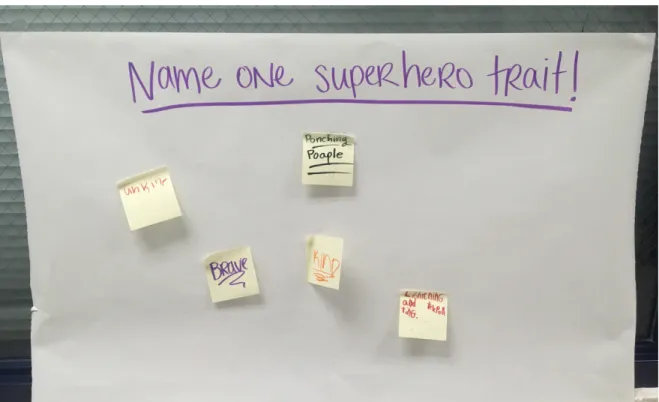
needs Peterson, Linares, and the volunteers had. I taped a large, blank poster for the
Talkback Board in the hallway directly outside the library doors to attract attention from
the attendees leaving the event. I wrote the question and an example answer with bold
letters and noticeable marker. I set up a chair beside the poster (I could not find an extra
table), where I placed the markers and sticky notes for the participants to use.
Next, I found a secluded spot in the library that Peterson did not need for her
activities. Here, I set up the Flipgrid station. I made a poster with paper and marker to
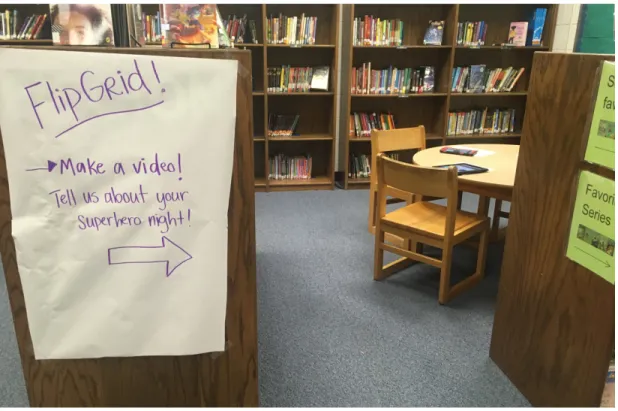
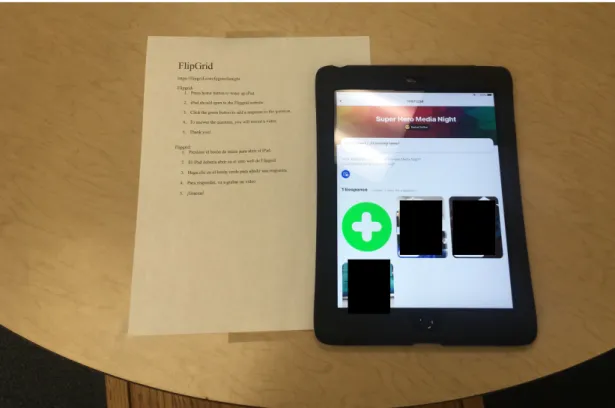
direct students to the Flipgrid corner, which was behind a set of bookcases. At the table in
this corner, I laid out four iPads and taped the printed instructions to the tabletop beside
each of the iPads.
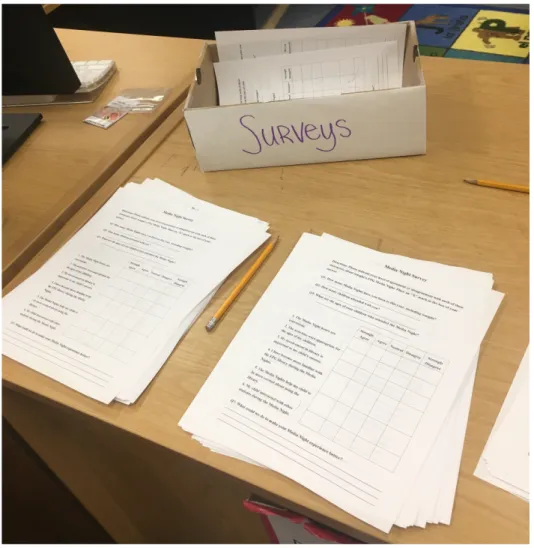
The surveys needed printing, so, with Peterson’s permission, I printed the surveys
in the library and used a shoebox to make a receptacle for the completed surveys. I found
a place to display the surveys and placed a stack of pencils with them. At this point,
participants began to arrive and I started my observations, which I did with pen and
paper. Also, throughout the evening I frequently stopped by the Flipgrid station for
maintenance (logging out of non-Flipgrid apps) and assisting the children trying to make
Reflection
After the evening ended, I reviewed the data and assessed the results. I compiled
these results into a report for Peterson. The majority of my time, though, was spent
reflecting on the successfulness of each assessment method. I judged each of them and
thought about ways to improve them. Why did the method not work? Could it be tweaked
to make it work better? Is the method just not suited for this environment age group?
How would the method change if used by someone else in a different setting? I also took
the time to brainstorm new methods to use in the future based on my experience with the
36
Reflection
Introduction
In terms of assessment methods that required a response from participants, the
talkback board was the most effective for obtaining responses. The email survey, with
only one response, returned the fewest responses. Here, I will be looking at each mode of
assessment and discussing the results and in what ways they were and were not effective.
Also, ideas for how to improve each of these assessment methods will be discussed.
Parents were notified by email about the data collection that would be occurring
at the Media Night. They were emailed as they signed up for the event. I introduced
myself and the purpose of the OBE tool. Responses were not requested, but some parents
did reply. Also, some families did not sign up for the Media Night and simply attended,
so they were not notified by email ahead of time. The emails were intended to inform
both for family privacy reasons (in case a parent was not comfortable with the data
collection, etc.) and in hopes of increasing parent and child participation.
Methods of assessment:
Paper surveys
Flipgrid
Talkback board
Post-event emailed survey
Paper Survey
The paper surveys were placed at the front of the library, on top of the checkout
desk. The checkout desk faces the entrance to the library, so the pile of papers and stack
of pencils were more visible there, especially since they were placed beside event
information fliers and a sign calling attention to the fliers. Also, an activity table was
located beside where the surveys were placed. The surveys were written in English and
Spanish, printed front and back.
38
At the start of the event, a parent or two immediately worked on the
survey. But, the area got crowded and other parents could not see that there was a survey
available. Also, even after the parents completing the survey moved, the area was further
blocked by kids and parents crowding around the activity table beside the surveys.
Therefore, only three surveys were completed and returned. Two surveys were completed
in English and one was completed in Spanish.
Clearly, the surveys were not successful. Had they been presented in a different
way, they might have returned more responses. One option would be to include more
signage with the stack of surveys to catch the attention of participants. Or, placing stacks
of surveys around the event in multiple locations, in addition to increasing signage, might
be even more effective. Ideally, surveys would be passed out to the parents, as this would
encourage participation by putting a face to the surveyor, but this is not as feasible for
those running the event, as they are constantly occupied by operating activities during the
Media Night.
The surveys for the OBE tool piloting were one page long. The questions could be
pared down to half a page, at least, to decrease the time commitment of parents filling out
the survey. Having a half page survey could encourage greater participation, while also
decreasing the amount of paper used, costing the school less money for printing.
My final recommendation for the use of paper surveys at subsequent Media Night
events would be to shorten the survey length, continue the use of English and Spanish,
scatter the placement of the survey stacks, and increase signage to make the surveys more
Flipgrid
Flipgrid, an app that students can use to answer questions by recording a video,
was used to gather data from the students attending the Media Night. The app was
downloaded and opened on four iPads, provided by the FPG technology administrator.
Instructions for how to use Flipgrid and how to find the survey in the event the app was
closed by a previous user were taped to the table beside each iPad. Since the students
were going to be recording videos, the Flipgrid station was placed in an area of the
library that is blocked off by bookshelves. To draw attention to the area, a large sign
explaining the activity was posted nearby.
By the end of the evening, four video responses were logged on the Flipgrid app.
Three of these videos had responses pertaining to the posted survey question; the last
video was a child and parent playing around with the filters and stickers that can be added
to each video. These features seemed to be distracting to kids, as I observed often that
40
they were just playing around on the app. Another distracting aspect was that
the kids could close out of the app and access the rest of the iPad, so multiple times I
found students on Youtube and other apps that were not related to Flipgrid. Adult
supervision for the use of Flipgrid is ideal, but this was not possible, as kids could access
the Flipgrid center on their own. When assisted, the kids seemed more likely to stay on
track and make it to the point of recording their videos.
Another barrier observed while the kids worked was the multi-step process they
had to go through in order to record the final video. From opening the iPad from sleep
mode to clicking “record” in Flipgrid, the kids gave up on the process at multiple points. I
did not observe a child record a video response without an adult present. Being prompted
to type in their name caught the kids more than any other step, and kids frequently
stopped the entire process at that point.
I implemented the Flipgrid station in order to give the students a way to
share their opinions in a way that was entertaining and appealing to them, which was very
necessary during an event with lots of exciting activities going on. And, having an
assessment tool that did not require time from the event hosts was important. Because of
the complexity of Flipgrid and the chaotic nature of the Media Nights, I would not
recommend using Flipgrid as an assessment tool. It would be better used in a classroom
where a teacher assistant could assist the students in navigating the app.
Talkback Board
Talkback boards are interactive means of assessment where a question is
presented on a poster, large paper, or big space where here is room for survey participants
to write brief or one-word answers on post-it notes and stick them to the blank area under
42
the question. This form of assessment does not require much time from
participants, as they are only being asked one question and their responses are not meant
to be lengthy.
Also, participants can read others’ responses, which can provide a reflective moment
where they learn about other perspectives within their community. The large format is
unusual, compared to traditional surveys, and is eye-catching, bringing in more
participants.
The Talkback board for the December Media Night consisted of a large sheet of
art roll paper taped to the hallway wall facing the entrance/exit to the library where the
Media Night was taking place. The Talkback board was placed facing the exit to attract
participants who were leaving the Media Night, as they had to pass the poster in order to
leave the event. Also, the Talkback board required a large portion of wall space, and this
area in the hallway was the only spot I could find, in both the hallway and inside the
library. A chair (all tables were taken up with activities for the event) was placed beside
the Talkback board, providing a place for a box of markers and sticky notes. Also,
instructions were posted on the wall beside the poster for participants not familiar with
Talkback boards. I added the first response for inspiration.
The Talkback board garnered the most responses out of all the assessment
methods. Its noticeable location and short time commitment made it more appealing to
parents and kids. Also, its interactive nature seemed exciting to kids. By the end of the
night, there were four responses (Post-it notes) on the Talkback board. One of those
responses was a joke answer, but it is still being counted as a response. While four is a
but only three were in response to the question), it is still quite low, considering
the number of participants.
Issues that might have led to the Talkback board gaining fewer responses than
expected could have been based in the location of the poster. While it was the best
available space at the time, a better spot could be chosen to capture more participants.
People tended to leave in groups, which might have led to them missing the Talkback
board on the way out of the library. Also, people might have been in a hurry as they were
leaving, not wanting to spend more time at the event. Needing to leave the event in a
timely manner might have been an issue specific to this particular Media Night, though,
as the Media Night schedule was cut short to accommodate another event occurring at the
same time. So, participants of the Media Night, many of whom needed to attend the other
event, might have left quickly. At the previous Media Night, I had observed families
dawdling at the entrance of the library and in the hallway, staying past the end time of the
Media Night. Due to this observation, I thought that placing the Talkback board in the
hallway would be a strategic way to capture responses.
Another issue was the use of a chair to hold the materials. I noticed at one point
during the Media Night that an adult was sitting in the chair, taking a phone call, thus
blocking the Talkback board and the materials needed to use it. In the future, I would
recommend securing a small table for the materials to avoid such a misuse. Also, for
future Media Nights, I would recommend placing the Talkback board in the same
location to see if, under normal scheduling circumstances, participants spend more time
44
significantly increased, then I would suggest moving the Talkback board to a
new location.
Unlike some of the other assessment methods, like Flipgrid, I would highly
recommend using Talkback boards to survey both adults and children, and it was the
most used surveying technique and the few kids that used it appeared to enjoy its
interactive nature, as they can see how they are contributing to the conversation about the
given topic. Also, it can completely operate without supervision from those who are
running the event, so it is an ideal method of data collection. Post-Event Emailed Survey
Using the same email list I was provided with to notify participants before the
event about the assessments occurring, I emailed a short, three question survey in Google
Forms to the adults who brought students to the Media Night. The entire survey
was written in both English and Spanish to meet the needs of the bilingual population. To
not further tax the same participants that I had already been surveying during the event, I
intentionally kept the emailed survey brief, and the questions were open-ended. The
Media Night occurred on a Friday night, so I emailed the survey on the following
Monday morning, assuming many parents check email less frequently during the
weekend, compared to work days. The survey included a brief introduction and thanked
the participants for their assistance.
Unfortunately, I only received one response to the survey. This participant
answered all of the questions completely. Since the event had ended, the adult guardians
might not have cared as much about responding to event-related emails. Also, the timing
of the emailed survey could have been poorly planned—perhaps emailing the parents
immediately following the event could increase the response rate. In the future, I would
recommend reusing this same survey and slightly tweaking the questions to fit the
specific Media Night or event. If response rates continue to be low, use of the emailed
survey could be discontinued.
Observations
For the assessments, I wanted to collect data directly from the participants to gain
their honest opinions and allow them to know they were actively contributing to
improvements happening in their library and at their events. But, observations are also
important to gain data that the participants are not aware of and learning general trends
occurring at the event. While the Media Night ran, I walked around observing the adults,
46
were the most popular and how the kids were spending their time. Also, I
observed how the adults were interacting with the event—were they assisting their
children with the activities, watching their children, or just interacting with other adults? I
learned the most about the event and everyone’s experience through the observations,
compared to the other assessment methods.
Main Takeaways
While these data collection methods did not capture a great amount of data
pertaining to the event participants, a great deal of data exists from observing how each
method worked. Low-tech methods seemed to work the best, as participants did not have
to learn how to operate a piece of technology, so there were fewer barriers to access.
With the low-tech methods, like the Talkback Board and Paper Survey, the results were
still low, but this was generally due to placement of the tool. I recommend using these
two tools, in addition to observations, in the future. Placement should be adjusted to
well-trafficked areas to ensure greater participation. For the high-tech methods, I recommend
attempting them again, if time allows, and possibly better educating participants for what
to expect and how to use the tech-based tools, like the FlipGrid and the emailed survey. If
continued use of these tech tools does not yield results despite adjustments, I would
discontinue use.
Also, through my observations, I noted high popularity with the coding activity,
for a variety of ages. There were far more kids interested than could be supported by the
set-up that evening. Perhaps this could be expanded or connected to data collection for
Recipient Feedback
Feedback
After the Media Night, I compiled the data collected and analyzed the
effectiveness of the tools. I presented these findings, which included the “Reflection”
portion of this paper, to Peterson for both her usage and feedback (actual data from the
participants is not included for privacy reasons). She found my report very helpful and
gave feedback both by email and through a meeting, once she had the opportunity to
review the report. I also provided her with drafts of the tools I used, such as the surveys,
so she could modify and reuse them for future events.
The most helpful aspect of my report was the data collected, specifically the
observations. Since Peterson is so busy and consumed with her responsibilities running
the Media Night, she often is not able to see beyond the area where she is working.
Having an extra set of eyes to note the activity flow and participant behaviors revealed
many surprises for Peterson—she did not realize certain areas received an enormous
amount of traffic, for example. Other observations confirmed facts she already knew
about the Media Nights and is working to address, and having hard data helps with
making desired changes. Peterson mentioned that she and Linares usually have a meeting
after the event to review the experience, but they still cannot fully see the whole picture
48
Peterson had recommendations for the individual tools, as well. The
email survey, overall, was not successful for me. Instead of a Google Form, she
suggested adding the questions into emails that are already being sent to caregivers after
the event. When a green screen is used, which is quite often, she will send the children’s
pictures to the caregivers. It would be in this kind of email, which is already expected by
the caregivers, that she would see as a good opportunity to ask follow-up questions. She
postulated that this would be more effective since the email is expected and she already
has a rapport with the families. She also likes the idea of incorporating the tools (or,
future tools) into activities to increase the student participation and having a suggestion
box at events to keep surveys anonymous, while still enticing kids to participate (she said
they love suggestion boxes).
Questions
To conclude our meeting, Peterson wanted to know if I would implement a
program like their Media Night, based on my work through this project. After seeing the
positive interactions between the kids and the library setting, in addition to the large
volume of families that were exposed to Peterson and the library, I would definitely
incorporate a media night or similar event. I observed engaged students and received
positive feedback from them and their caregivers, so I see the event as a positive addition
Future Work
Additional Suggestions
In addition to the tools tested at this Media Night, I have additional ideas for other
tools that could be used in the future.
To relate to the activities already happening at the Media Night and to reach
students who express themselves best through art, the FPG library could use drawing to
survey the students. Kids could be asked to draw a picture in response to a question, such
as, “How will you act like a superhero this week?” This survey will also act as an activity
for the kids, so they will not have to take a break from the fun of the Media Night. There
can be a box where they slip in their submissions, which is also fun for kids. Their
pictures can be posted in the library after the Media Night, too.
Also, a variation of the Talkback Board could be done to create a fresh version to
catch kids’ attention. A question could be posed on a “Twitter Board” that is modeled to
look like a Twitter feed. Students can write their responses on strips of paper as tweets.
This could be a fun and relevant take on the Talkback Board.
Finally, a sticker chart could be used for students to place stickers in different
regions of the poster to indicate their answer to a question or their opinion on a statement.
Interactive tools like this and the Talkback Board seem to excite the kids, and they are
able to see the progress from their peers and how it relates to their contribution, so
50
Recipient Usage
As mentioned, Peterson would like to use this OBE tool in the future. She saw
great value in the data collected and would like to build upon the assessment methods.
She plans on organizing one or more volunteers to help with assessment. She would
particularly like to have a volunteer designated to make observations during the Media
Nights or take her place for periods of time so she can work on observations. She would
also utilize these volunteers for types of assessment that need to be monitored, like video
recording in Flipgrid. She wants more feedback directly from students, but this would
often require guidance and supervision from an adult.
Working towards relating to and integrating with the school’s curricula is also one
of Peterson’s goals for future Media Nights. Currently, the Media Nights have themes,
but she would like move into creating learning outcomes from the work students are
already doing in their classes. With more concrete outcomes, she could better measure
the effectiveness of the Media Nights in changing knowledge levels for the attending
students. While the current structure of the Media Nights is highly successful in drawing
families into the library and strengthening relationships between Peterson and the school
community, Peterson wants to be even more intentional about her goals and the feedback
questions associated with those goals.
Finally, Peterson plans on using the various methods in this tool with other
programs in her library. She would especially like to gather data at her Family Checkout
nights, when students and their caregivers can come in, outside of school hours, to check
out books and have a library experience. Peterson has ideas for using the surveys and
possibly attend in the future. The tool can also apply to her daily library
activities—data is important to her for advocating for the library.
Personal Usage
Since I plan on working in a school library environment, specifically at the
elementary school level, I will be implementing the successful assessment methods I
tested at the Media Night. Not only will I use them during large events, like the Media
Night, but I will work to implement them in smaller contexts, such as lessons and daily
library interactions. Generally, when students visit a library, data taken is based on
headcounts and circulation statistics. These tools, such as the Talkback Board, could be
used to better understand each student’s experience on a normal day in the library, which
involves much more than just the books they choose to check out.
For events or large-scale programs like the Media Night, I will implement the
OBE tool similarly to in this project. I would continue to tweak the assessment methods
for improvement. Also, I would expand my focus on how the students are changed by the
experience. For this Media Night, I mainly gathered input from participants about their
opinions on the Media Night and how it could be improved. I gathered only a small
amount of data on the students’ learning experiences through the Talkback Board. In the
future, I would like to start teaching the topics for an event ahead of time, incorporating it
into interactions with classes in the library. The event would have specific learning
outcomes, like a lesson, and my assessment tools would look at whether the students
gained any new knowledge, behaviors, or outlooks through the program. Assessment