TEACHERS’ PERCEPTION OF
AGGRESSIVE BEHAVIOUR IN
CHILDREN: CASE OF BOSNIA
AND HERZEGOVINA
Senija Tahirović,
International Univeristy of Sarajevo, Bosnia and Herzegovina.
Abstract
Aggressive behaviour in children and youth is a widespread phenomenon. Antisocial behaviour that includes certain kind of aggressive behaviour can occur and disappear again during a child’s development. However, from a psychological perspective ag-gression can be one of the problematic types of behaviour in children with long-last-ing negative consequences. The aim of this research paper is to examine teachers’ perceptions of the types of aggressive behaviour as well as to find out the causes for the development of aggressiveness in school-age children in Bosnia and Herzegovi-na (BiH) from the teacher’s point of view. In order to define and classify the types of aggressive behavior in school age children in BiH, the descriptive method was used. In order to understand aggressive phenomena and to identify their cause(s), the ex-planatory method was used. In order to examine teachers’ perceptions of the types of aggressive behaviour as well as the causes for the development of aggressiveness, assessment scales for teachers’ perceptions were used. The research findings indicate that proactive, reactive, and relational types of aggression are most often seen in school-age children from teachers’ perceptions. The causes of aggressive behaviour range widely: Aggressive behaviour occurs as a combination of internal impulses and external stimuli or triggers that indicate possible aggression, so temperament as well as environmental factors can influence the development of aggressiveness; aggressive behaviour is acquired through learning by observing and imitating a model; the role of parents and their way of disciplining a child is another impor-tant cause; finally, mass media is seen as imporimpor-tant cause of aggressive behaviour.
Introduction
Aggressive behaviour in children and youth is a widespread phenomenon world-wide and in Bosnia and Herzegovina (BiH). We usually pay special attention to this issue when aggressive behaviour by children causes serious material dam-age or physical or emotional harm to a victim of aggression. Bosnia and Herze-govina is a specific context that is characterized by a variety of features includ-ing its post-war transformation in the spheres of economic development, the reconstruction of destroyed cities, state-building and the democratisation of society, fostering reconciliation and overcoming war trauma. Increasing news about the extremely aggressive behaviour of young people who commit mur-der, perform physical violence against children, emotionally abuse their peers or engage in serious crimes has raised serious concern for Bosnia-Herzegovina. For children and youth, the term ‘aggression’ is usually used for behavioural disor-ders or problems. In adults, these behaviours are specified as antisocial disordisor-ders or personality disorders. When we talk about children, the term aggression may be used when a child breaks social norms and rules, whereas the behaviour of autistic children, for example, are not classified with this term (Delfos, 2008). According to Krahe, Baron and Richardson (2001) the term aggression describes any form of behaviour directed toward the goal of harming or injuring another living being who is motivated to avoid such treatment. Aggression is ‘behaviour perpetrated or at-tempted with the intention of harming another individual physically or psycholog-ically’ (Bartol, 1995). Therefore, aggression has been defined as category of behav-iour that causes or threatens physical harm to others. So aggression is not used as a unitary term but encompasses a variety of behaviours including verbal aggression, physical assault, homicide, destruction of objects, violence against humans and an-imals and other behaviour with the intention to cause pain and harm to victims. From a psychological perspective, aggression is one of the problematic types of behaviour in children and youth in which two widely accepted behavioural syn-dromes can be recognised, as follows (Essau and Conradt 2004, Achenbach, 1993): a) Externalising behaviour which includes uncontrolled types of behaviour such as hyperactivity, aggressiveness, and delinquency.
b) Internalising behaviour characterised by over-controlled behaviour (anxie-ty, depression, social withdrawal)
Statistical Classification of Diseases and Related Health Problems (ICD 10, 1992), specifically Chapter V: Mental and behavioural disorders, and the American Psychi-atric Association’s Diagnostic and Statistical Manual of Mental Disorders (DSM). According to DSM-IV (1994) classification, aggression and antisocial behaviour are related to oppositional defiant disorders. DSM-V (2013) explains aggression as a part of disruptive, impulsive-control, and conduct disorders that include behav-iors that violate the rights of others and/or that bring the individual into significant conflict with societal norms or authority figures. The lack of self-control, both in terms of emotions and behaviors are underlined as the main causes of the problems. One of the concepts of aggressive behaviour introduces a new category of be-havioural disorders (Delfos, 2008) which distinguish between conduct disor-ders and conduct problems. Conduct disordisor-ders, according to this concept, are related to genetic predisposition and the process of growing up, while con-duct problems are caused by environmental factors. Making a distinction be-tween conduct disorders and conduct problems is an issue of the dominance of one or another influence. As in the above-mentioned dilemmas to identi-fy the intention of a child acting aggressively, determining a genetic predisposi-tion or environmental factors is equally difficult, in particular when considering the child’s normal process of growing up, development of the nervous system and the constant interaction of other environmental factors (Tahirović, 2011). Because of the diversity of the causes and consequences of aggressive be-haviour, there is a need to observe different types and expressions. Krahe (2001) presents one typology of aggressive behaviour in the following table.
Table 1. Types and expressions of aggressive behaviour
Response modality Response quality Immediacy Visibility Instigation Goal direction Type of damage
Duration of consequences Social units involved
Verbal vs physical Action vs a failure to act Direct vs indirect Overt vs covert
Unprovoked vs retaliatory Hostile vs instrumental Physical vs psychological Transient vs long-term
The table above shows that the author analysed a variety of dimensions, differ-ent forms of aggression as well as differdiffer-ent types of social consequences of ag-gressiveness. Krahe (2001) explained that the most of the definitions present-ed in table 1 are self-explanatory, but he underlines importance of clarifying differences between hostile and instrumental aggression. The difference refers to the psychological function of the aggressive behaviour for the actor. The prima-ry motive for the hostile aggression may be the desire to harm another person through an expression of negative feelings. Contrary to that, the main motive for instrumental aggression is to reach an intended goal by means of the aggressive act. The two types of motives for aggressive behaviour may frequently coexist and that is a main reason why children express the variety of aggression dimen-sions as well as suffer different types of social consequences of aggressiveness. Essau and Conradt (2004) developed a typology of aggressive be-haviour explaining different types of aggressive bebe-haviour such as:
Open aggression defined as open confrontation associated with physical
vi-olence, such as physical fighting, terrorizing others, the use of weapons, etc.
Hidden aggression can be defined as acts that take place in secret like
steal-ing, running away from school or home, setting something on fire. Shy children and children with less family emotional support are more prone to such acts.
Reactive aggression is behaviour that occurs in response to some external
stimulus, event, or behaviour. The external stimulus very often does not pose a real danger to a child but often child’s perception about situation or event is completely different. Children expressing reactive aggression are very of-ten children with underdeveloped skills for emotional and behaviour con-trol. Development of reactive aggression is connected with parenting styles, exposure to violence as well as social and economical factors in the family.
Proactive aggression is the use of aggressive behaviour as an instrument to
achieve a certain goal. Children with proactive aggression assume that aggressive-ness is supposed to bring about better status in their respective peer community.
Relational aggression is aggression aimed at destroying relations,
relation-ships, or friendship. One of the examples of relational aggression is peer exclu-sion. Children, victims of relational aggression, are not able to meet basic needs for friendship, they feel unhappy and desperate, and they often react impulsively.
com-monly occur together. These types of aggression include aggressive behaviour in which the reward for the aggressor is the victim’s pain and the harm that he or she inflicts upon the victim.
hostile and often wrongly assess their own behaviour; they are often not aware that their behaviour is unsuitable (Essau and Conradt 2004). Poor skill to assess and apply non-verbal cues in communication, something which may be related to social intelligence, is also a significant factor in the development of aggressive behaviour. The socio-economic status of the family in which the child grows up may not, by itself, be directly linked to the development of aggressive behaviour, but may reflect and support other risk factors. Interpersonal influences with-in the family or peer group or membership with-in a particular group is a significant variable primarily for the development of interpersonal relationships, which then may directly or indirectly determines the way how children treat others. Nowadays, we more and more often encounter media violence, in movies, on tel-evision, in music, and video games. It is likely that such mass media can influence the development of aggressive behaviour such that children and young people are de-sensitised to aggressive behaviour. Even more, children, as those who learn through models, identify themselves with aggressive heroes. Cultural factors can significantly determine to what degree aggressive behaviour is ‘allowed’ and to what degree certain behaviour violates social norms. Some cultures and traditions tolerate more aggressive behaviour, especially when it comes to gender, race or social milieu.
Study Methods
commitment to follow ethical research principles. Prior to submitting assessment scales to the participants, we organized pilot testing and discussion. Minor termi-nological corrections were made after pilot testing. The assessment scales were com-pleted anonymously and teachers took around 20 minutes to answer all the items. Two instruments were used: (1) an assessment scale of teachers’ perceptions of aggressive behavioural types and (2) an assessment scale of the causes of the development of aggressive behaviour in school age children from teach-er’s point of view. The scales were developed for the purposes of this study and they are connected to the theoretical framework of the research problem. The assessment scale for teachers’ perceptions of types of aggressive behav-iour includes a six-item survey and a three-point Likert-scale where 1 is not at all, 2 are often and 3, unsure. The items represent a typology of aggressive be-haviour noted by Essau and Conradt (2004). Each item has explanation of the type of aggressive behaviour with aim of avoiding possible terminologi-cal misunderstandings. We established the reliability coefficient of the sterminologi-cales in the amount of 0.75, using the Guttman-Nicewander measure of reliability. The assessment scale for teacher’s perceptions of the causes of aggression is a 12-item survey with again a three-point Likert-scale where 1 is disagree, 2 is unsure and 3, agree. The scale consists of a list of possible causes for the development of aggressive behav-ior that follow the causes of aggression presented in a variety of scientific theories. The teachers expressed their perceptions about possible causes of aggressiveness via their level of agreement with the statement. We established the reliability coefficient of the scales in the amount of 0.78, using the Guttman - Nicewander measure of reliability. The starting hypotheses of this study are: Reactive and relational aggression are the most frequent types of aggressive behaviour in school-age children from a teacher`s perception; Interpersonal influences within the family are the most common causes of aggressive behaviour in school-age children from a teacher`s point of view. The fieldwork occurred in Sarajevo, Mostar and Tuzla, three cit-ies in Bosnia and Herzegovina. Data used for this paper was gathered in 2014.
Study Findings
Table 2 Teacher’s perceptions of the most common types of aggressive behaviour in school-age children
Degree exhibited Type of aggressive
behaviour Not at all Often Unsure Total
Open aggression (open confrontation associated with phys-ical violence, such as physical fighting, ter-rorizing others, the use of weapons, etc.)
24
14.3% 13882.1% 63.6% 168100%
Hidden aggression (actions that take place in secret like stealing, running away from school or home, setting fire to something)
66
39.3% 9053.6% 127.11% 168100%
Reactive aggression (behaviour that occurs in response to some external stimulus, event, or behaviour).
0 144
85.7% 24 14.3 % 168 100%
Proactive aggres-sion (the use of ag-gressive behaviour as an instrument to achieve a certain goal)
0 168
100% 0 168 100%
Relational aggres-sion (aggresaggres-sion aimed at destroying relations, relation-ships, or friendship)
6
3.6% 14485.7% 1810.7% 168100%
Instrumental and hos-tile aggression (two subtypes of aggres-sion that commonly occur together. These types of aggression include aggressive behaviour in which the reward for the ag-gressor is the victim’s pain and the harm that he or she inflicts upon the victim.)
60
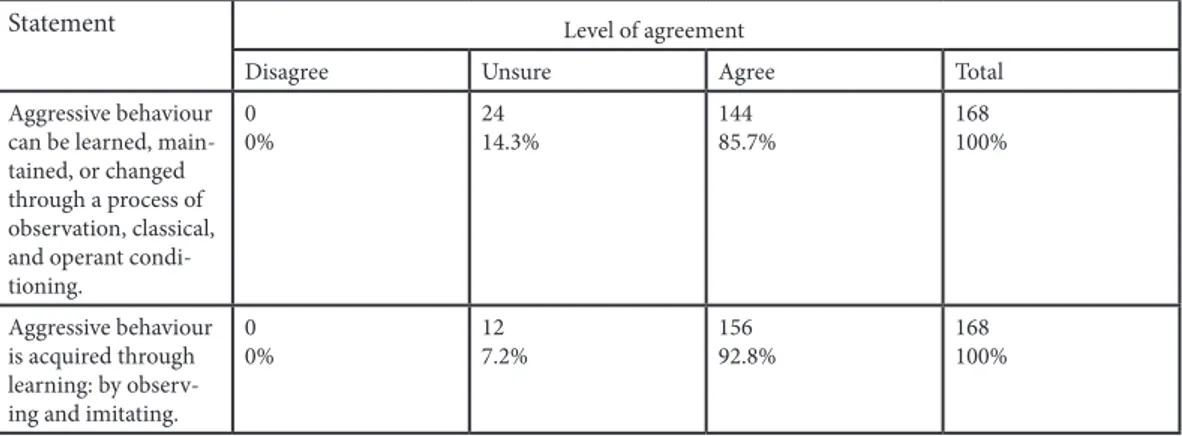
The fact that teachers observe relational aggression (85.7%) in school-aged chil-dren came as no surprise to us. Increase of relational aggression among school-aged children can be explained by children’s cognitive ability to comprehend im-portance of friendship. From middle childhood physical aggression decreases and becomes more deliberate and planned, while aggression aimed at destroying relationships or friendship ¬is more frequently used to induce emotional harm. Thus our hypothesis that teachers often perceive reactive and rela-tional aggression is partly confirmed since teachers recognized pro-active aggression as the most frequently displayed types of aggres-sive behaviour, and reactive and relational aggression as secondary. We cannot ignore the fact that more than half of teachers in our sample often ac-knowledged both open and hidden aggressive behaviour in children. Having in mind that hidden aggression takes place in secret and open aggression is associated with physical violence, and in line with previously explained findings, we can em-phasize the following; teacher’s perception of the most common types of aggressive behaviour in school-age children indicates presence of variety types of aggressive behaviour expressed in different level but still very often used among children. The findings that teachers often do not recognize instrumental and hostile aggression or are not certain (17%) of its presence, cannot lead to the conclusion that such kinds of aggressiveness do not exist, but rather that it is difficult to detect these types of aggression. The victims of such kind of violence are most often shy and withdrawn children, which usually do not report about violence that they are exposed to. In this study, we were interested in teachers’ perceptions of the caus-es of aggrcaus-essive behaviour in children. The rcaus-esults shown in Table 3 sug-gest that teachers perceive a wide range of causes of aggressive behaviour:
Table 3. Teachers’ perceptions of the causes of aggressive behaviour in children
Statement Level of agreement
Disagree Unsure Agree Total
Aggressive behaviour can be learned, main-tained, or changed through a process of observation, classical, and operant condi-tioning.
0
0% 24 14.3% 144 85.7% 168 100%
Aggressive behaviour is acquired through learning: by observ-ing and imitatobserv-ing.
0
Aggressive behav-iour is the result of frustration that arises in situations where a child or young person is prevented or hin-dered from obtaining a specific goal
12
7.1% 14 8.9% 142 84.5% 168 100%
Aggressive behaviour occurs as a combi-nation of internal impulses (anger, ani-mosity) and external stimuli or triggers that indicate possible aggression
6
3.6% 0 0 % 162 96.4% 168 100%
Instincts are the basis
of aggression. 12 7.3% 48 28.5% 108 64.2% 168 100% Antisocial tendencies
(temperament, en-vironmental factors, the role of parents and their way of disci-plining a child, and peer pressure) are the cause of aggressive behaviour.
0
0 % 12 7.1% 156 92.8% 168 100%
Genetic factors, primarily hereditary traits cause aggressive behaviour in children
12
7.1% 42 25.2% 114 67.8% 168 100%
Poverty is a cause of aggressive behaviour in children.
78
46,4% 18 10,7% 72 42.85% 168 100%
Interpersonal influences within the family are the cause of aggressive behaviour in children
0
0 % 24 14.2% 144 85,7% 168 100%
Membership in a particular peer group determines the devel-opment of aggressive behaviour in children.
6
3.6% 24 14.2% 138 82.2% 168 100%
Mass media (movies, television, music, video games) directly affect the develop-ment of aggressive be-haviour in children.
0
0% 6 3.6% 162 96.4% 168 100%
Culture and traditions affect the develop-ment of aggressive be-haviour in children.
90 53.5%
44 26.3%
34
connected culture and traditions with aggressive behaviour. As we explained before, cultural factors determine sensitivity to aggressive behaviour, while social norms define acceptable behaviour. Therefore, teachers did not see culture as a direct cause for aggressiveness or its development. Teachers do not believe that genetic factors or instincts influence aggressiveness. The 25% and 28.5% or teachers who participated in this research are not sure about this issue. This finding may be explained by the fact that teachers do not possess information about family history, so they have dif-ficulty connecting a child’s genetic predisposition with their aggressive behaviour. Our hypothesis that interpersonal influences within the family are the most common cause of aggressive behaviour in school-age children, from the teach-er’s point of view, has been partly confirmed. The theoretical background of our hypotheses was the notion that dysfunctional families with marital problems and stress and the use of physical punishment can make children feel insecure; if they assess this environment as being hostile and learn aggressive behaviour from their parents, children may model this outwardly. The teachers perceived interpersonal influences within the family as important but not the most impor-tant cause of the development of aggression in children. The fact that teachers of-ten also perceived other causes in the proposed list indicates that they grasp the multiplicity of causes contributing to the development of aggression in children.
Conclusion
in development. Our research findings indicate the likelihood that young people in Bosnia and Herzegovina might continue to use aggressiveness in their future life. We believe that the qualitative study findings presented in this article significantly increase the knowledge and understanding of the development, causes, and types of aggressive behaviour in children in BiH. However, aggressive behaviour is not just inappropriate behaviour, but a very important factor that can influence a child’s development. On the other hand, development of aggressive behaviour is related to the child’s psychological development, especially in the areas of emotional, so-cial and cognitive development. Thus, we believe that the qualitative research that we plan to conduct in the near future will help us to further understand and ex-plain the following research question: why do many children develop aggressive behaviour in BiH? The quantitative and qualitative data will serve as the baseline for the development of a plan of action with the aim of reducing risk factors for the development of aggressive behaviour among children in Bosnia and Herzegovina
References
Achenbach, T.M. 1991. Manual for the Child Behaviour Checklist / 4-18. Burlington: University of Vermont.
Anderson, C., Funk, J. B., Griffiths, M.D. 2004. Contemporary Issues in Adolescence Video Game Playing: Brief Overview and Introduction to the Special Issue. Journal of Adolescence, 27, 1-3. Bandura, A. 1977. Self Efficacy: Toward a Unifying Theory of Behavioral Change. Psychological Review, 84, 191–215.
Banjanin-Duričiċ, N. 1998. Udarac po duši - sociološka studija zlostavljanja dece u porodici. Bel-grade: Institut za kriminološka i sociološka istraživanja i Jugoslovenski centar za prava deteta. Bar-On, R. 2006. The Bar - On Model of Emotional-Social Intelligence (ESI). Psicothema, 18, 13–25.
Baron, R.A., Kalsher, M.J. 2008. Psychology: From Science to Practice. Boston: Pearson.
Bartol, C.R. 1995. Criminal Behavior: A Psychological Approach. Englewood Cliffs, NJ: Prentice Hall.
Bennett, P. 2008. Abnormal and Clinical Psychology: An Introductory Textbook. New York: McGraw Hill.
Bennett, P. 2006. Abnormal and Clinical Psychology. Buckingham: Open University Press. Berk, L.E. 2009. Child Development. Boston: Pearson.
Broidy, L.M., et. al. 2003. Developmental Trajectories of Childhood Disruptive Behaviours and Adolescent Delinquency. Developmental Psychology, 39, 222-245.
Burns, G.L., et. al. 1997. Internal Validity of Disruptive Behaviour Disorder Symptoms: Implica-tions from Parent Ratings for a Dimensional Approach to Symptom Validity. Journal of Abnormal Child Psychology 25, 307-319,
Connor, D.F. 2002. Aggression and Antisocial Behaviour in Children and Adolescents, New York: Guilford Press.
Herzegovina: Cross-Sectional Study. Croat Med J; 49:528-535
Davison, G.C., Neal, J.M. 1999. Psihologija Abnormalnog doživljavanja i ponašanja. Zagreb: Nakla-da Slap.
DeHart, G., Sroufe, L.A., Cooper, R.G. 2004. Child Development, Its Nature and Courses. New York: McGraw Hill.
Delfos, M.F. 2004. A Strange World, Autism, Asperger’s Syndrome and PDD-NOS. A Guide for Parents, Partners, Professional Carers and People with ASDs. London: Jessica Kingsley. Delfos, M.F. 2004. Children and Behavioural Problems. Anxiety, Aggression, Depression and ADHD: A Biopsychological Model with Guidelines for Diagnostics and Treatment. London: Jessica Kingsley .
DSM-V-TR Diagnostic and Statistical Manual of Mental Disorders 2014. Arlington: American Psychiatric Association.
Essau, C.A., Conradt, J. 2004. Agresivnost kod djece i mladih. Zagreb: Naklada Slap. Feldman, S.R. 2009. Development Across the Life Span. Boston: Pearson.
Holt, M.K., Finkelhor, D., Kantor, G.K. 2007. Multiple victimization experiences of urban elemen-tary school pupils: associations with psychosocial functioning and academic performance. Child Abuse Neglect. 31: 503–515.
Loaber, R., Hay, D. 1997. Key Issues in the Development of Aggression and Violence from Child-hood to Early AdultChild-hood, Annual Review of Psychology, 48, 371-410.
Mash, E.J., Wolfe, D.A. 2010. Abnormal Child Psychology, Wadsworth: Cengage Learning. Morton, C. 2008. Tehnike u dječijoj terapiji. Zagreb: Alineja.
Ross, V., Haith, M.M., Miller, S. A. 2005. Dječija psihologija. Zagreb: Naklada Slap.
Tahirović, S. 2007. Borba protiv nasilja nad djecom iz perspektive prava djece. International Con-ference on Violence against Children, Sarajevo.
Tahirović, S. 2009. Stavovi djece o vrijednosti roditeljstva. Didaktički putokazi, 51, 17-26. Tahirović, S. 2010. The Value of Parenting is measured by Love and Support, Bologna University journal Riccerche di Pedagogia e Didarrica. http://rpd.cib.unibo.it/.
Tahirović, S. 2013a. Psihološki razvoj djece i mladih, Sarajevo: International University of Sarajevo. Tahirović, S. 2013b. Preliminarno istraživanje o agresivnim ponašanjima kod djece predškolskog uzrasta, Naučna monografija o suvremenim tokovima u ranom odgoju. Zenica
Tahirović, S. 2011. Agresivnost djece, razvojna perspektiva, Tuzla: University of Tuzla.