Journal of Global Pharma Technology
Available Online at:
www.jgpt.co.in
RESEARCH ARTICLE
A Validated Stability Indicating RP-HPLC Method Development
for Platelet Aggregation Inhibitor Ticagrelor in Bulk and Tablet
Formulation
Kirtimaya Mishra
1*,Snigdharani Behera
1,Sruti Ranjan Mishra
1,Somesu M
2,Kiran Kumar B
31. Jeypore College of Pharmacy, Jeypore, Odisha -764002, India.
2. College of Pharmaceutical Sciences, Mahuda, Brahmapur, Odisha-760002, India.
3. Annamalai University, Chidambaram, Tamilnadu-608002, India.
*Corresponding Author Kirtimaya Mishra
Abstract
A stability-indicating Reverse Phase-HPLC technique for the quantification of Ticagrelor (TCG) in pharmaceuticals was developed and validated. Chromatography was done on Phenomenex Luna C18 5μm (250 mm×4.6 mm) analytical column with acetonitrile: methanol: water in 40:30:30% v/v/v ratio as mobile phase and 0.9 ml/min as a flow rate. TCG was detected at 280 nm UV-wavelength maximum. In this present research work developed technique was validated over 20-150μg/ml linear concentration range for TCG. This method was accepted with linearity coefficient value of 0.99 and the percentage recovery was found to be 99.3%. This method was shown with LOD and LOQ findings of 0.53μg/ml and 1.61μg/ml respectively. The drug was degraded in acid and alkaline medium and the percentage degradation values were 3.10 % and 4.54 % respectively. There was no degradation of drug when wide open to neutral, UV, thermal, sun-light and oxidative conditions. Drug was undergoing degradation when exposed to acid and alkaline conditions.
Keywords: Ticagrelor, Reproducible, Degradation, Oxidative conditions.
Introduction
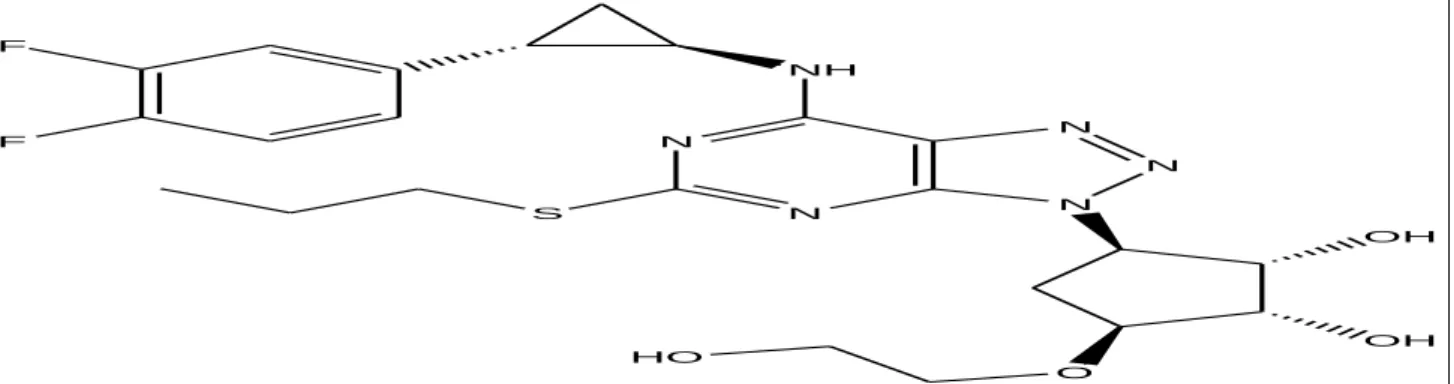
Ticagrelor (TCG) used for prevention of thrombotic events (for example stroke or heart attack) in people with acute coronary syndrome or myocardial infarction with ST elevation. It is also used as blood thinner. It was chemically designated as (1S, 2S, 3R, 5S)-3- [7-[(1R, 2S)-2-(3, 4- Difluorophenyl) cyclopropylamino]-5-(propylthio)-3H [1, 2, 3] triazolo[4, 5-d] pyrimidin- 3-yl]- 5-(2-hydroxyethoxy) cyclopentane-1,2-diol with
molecular formula and weight of
C23H28F2N6O4S and 522.575 g/mol.
Nonthienopyridine P2Y12 platelet ADP-receptor antagonist; unlike thienopyridines (e.g., clopidogrel, prasugrel), ticagrelor binds reversibly to P2Y12 receptor and does not require hepatic transformation to exerts its pharmacologic effect [1].Prevents signal transduction of the cyclic adenosine monophosphate (cAMP) pathway,
resulting in reduced exposure of fibrinogen binding sites to the platelet glycoprotein (GP IIb/IIIa) complex and subsequent inhibition of platelet activation and aggregation.
Inhibits reuptake of adenosine into
erythrocytes [2].
Materials and Methods
Liquid Chromatographic System
Liquid chromatographic system (Shimadzu, Japan) consisted of a binary LC -20A CE pump, solvent degasifying system
(DGU-20A), autosampler (SIL- HTC) and
temperature controller (CTO-10 AS) for maintaining column temperature was used for the chromatographic elution of drug. Separation was achieved by optimized chromatographic conditions on Phenomenex
Luna C18 5μm (250 mm × 4.6 mm). All the
chromatograms were processed and
integrated using Empower-2 software.
Chemicals and Reagents
TCG pure drug obtained from Hetero drugs, Hyderabad, India. ACN and methanol of HPLC grade were procured form SD-Fine Chemicals, Mumbai, India. Other chemicals of analytical grade were bought from
Qualigens chemicals, Mumbai, India. TCG
marketed formulations (Brilinta Tablet, AstraZeneca) were obtained from local market for the sample analysis.
F
F
NH
N
N N
N N
S
O
OH OH
HO
Fig. 1: Chemical structure of TCG
Mobile Phase Preparation
It was processed by mixing HPLC-grade
acetonitrile, methanol and water in
40:30:30% v/v proportion. The prepared mobile phase subjected for sonication for 10 to 15 min for degasification and filtered through 0.45 micron filter paper. In the present research work mobile phase were used as a diluent for sample and standard preparations.
Protocol for Standard Solution
Accurately weighed amount of 100 mg of TCG working standard was transferred to a 100 ml volumetric flask and drug was dissolved in few ml of mobile phase completely, then the final volume was make up to 100 ml using mobile phase (diluent). Further dilutions were made with diluent to get 60μg/ml.
Protocol for Sample Solution
10 tablets were weighed separately and the mean of 10 tablets were calculated and recorded. An accurately weighed amount of TCG equivalent to 100 mg was transferred and dissolved in 70 ml of diluent by sonicating the solution for 30 minutes in a 100 ml flask. Final volume was made up to the mark with diluent.
The resulting solution was filtered and serial dilutions were processed to get 60μg/ml. The resultant solution filtered with the help of a 0.45μ membrane filter.
Liquid Chromatography conditions
Phenomenex Luna C18 5μm (250 mm × 4.6
mm) fixed phase was used for the separation at 25ºC as column oven temperature. The mobile phase was infused through the fixed phase at 0.9 ml/min flow rate. In the LC system the infusion volume was 10μL. The photodiode array detection system was set to λmax of 280 nm for the detection and chromatographic run time was 10 minutes.
Validation
The developed and optimized technique was validated in compliance with ICH validation parameters.
Precision
Method precision was assessed by infusing the six solutions of standard into the HPLC system and % RSD (relative standard deviation) was calculated.
Specificity
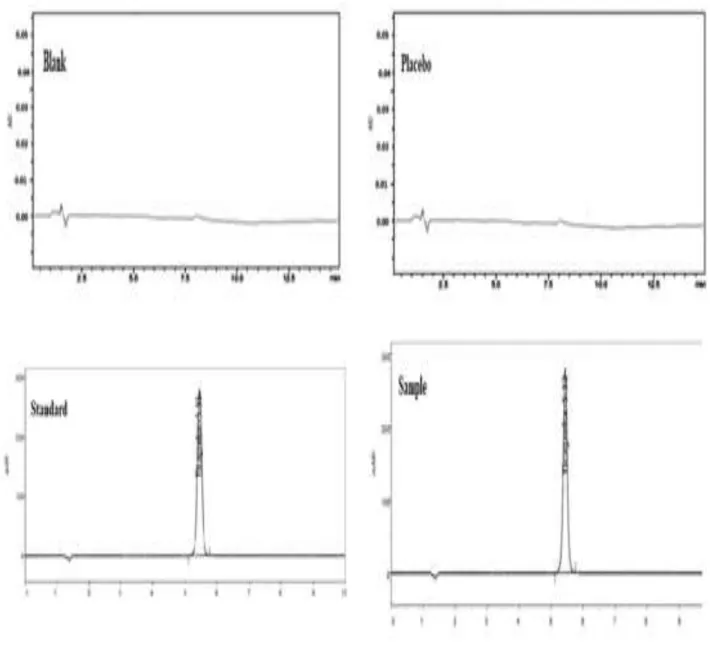
system and the resulting chromatograms observed for the interference of drug response with placebo peak response.
Linearity
Linearity of the analytical method was analyzed by processing series of replicates ranging from 20-150μg/ml and infusing them into HPLC system.
Accuracy
Method accuracy was evaluated in the form of % recovery. The drug solution along with sample was prepared in three variable concentrations of 50.0, 100.0 and 150.0 percentage. Then the percentage recovery was estimated.
Ruggedness
Ruggedness was assessed by infusing the 6 standard solutions into chromatographic system for different days. The %RSD was calculated.
Robustness
Robustness of the method was assessed by
fluctuating the optimized analytical
conditions like mobile phase composition by ± 5%, flow-rate by ± 0.1 ml/min and temperature of the oven by ± 5°C.
Solution Stability
Stability of solution was assessed by analyzing the standard drug solution after storage for 24 h at laboratory conditions.
Ruggedness
Ruggedness was evaluated by infusing the 6 solutions of standard into HPLC for different days. The %RSD was calculated.
Forced Degradation Studies
Forced degradation studies were processed with acid, oxidative, alkaline, photolytic, thermal, and ultra violet (UV) degradations on sample. The drug sample was processed by exposing to these stress environments and the peak purity was determined from the resulting chromatograms, which indicates that the technique was effectively separated the degrade components from the standard [8, 12].
Acid Degradation
It was processed by utilizing 0.1 M Hydrochloric acid solution. 10 mg of TCG
pure drug was transferred in to a 10 ml volumetric flask. Drug was made solubilize in 5 ml of 0.1 M Hydrochloric acid and solution was exposed to 80°C temperature in a hot water bath. Samples were processed at different timings such as 0.0 min, 30.0 min, 1.0 h, 2.0 h, and 4.0 h. At variable time intervals, samples were collected and 5.0 ml of methanol was added vortexed for 5 min. From the resulting solution serial dilutions were processed get 60μg/ml with diluent. Finally the resulting solution was filtered through 0.22 micrometer filter paper and infused in to LC-system.
Alkali Degradation
It was processed by utilizing 0.1 M sodium hydroxide solution. 10 mg of TCG pure drug was transferred in to a 10.0 ml volumetric flask. Drug was made solubilize in 5.0 ml of 0.01 M sodium hydroxide, and solution was exposed to 80°C temperature in a hot water bath. Samples were processed at different timings such as 0.0 min, 30.0 min, 1.0 h, 2.0 h, and 4.0 h. At variable time intervals, samples were collected and 5.0 ml of methanol was added vortexed for 5min. From the resulting solution serial dilutions were processed get 60μg/ml with diluent. Finally the resulting solution was filtered through 0.22 micrometer filter paper and infused in to LC-system.
Oxidative Degradation
For oxidation, hydrogen peroxide (3%) selected as reagent. 10mg of the standard drug was transferred in to a 10.0 ml volumetric flask. Drug was made solubilize in
5.0 ml of H2O2. Resulting solution was kept a
side for room temperature. Samples were processed at different timings as mentioned in acid degradation study and prepare 60μg/ml by serial dilution and infused into LC-system.
Neutral Degradation
Thermal Degradation
It was processed by placing the standard drug at 40°C in an incubator.
Samples were collected at definite time intervals. The weighed amount of sample was added to 5 ml of HPLC-grade methanol and vortexed for 5 min. Final volume was made to get 1000μg/ml. From that serial dilutions were made to get 60μg/ml with diluent. It was vortexed and filtered with a 0.22μm filter, and 20μL of sample was infused into LC-system.
UV-degradation
100 mg of pure drug was weighed and transferred to a clean petri-dish. Then the petri-dish was positioned under a UV chamber by maintaining 30 cm distance. The
petri-dish cover was removed for
degradation. After 3 h, the UV-lamp was
switched to off and 10 mg drug sample was taken and 1000μg/ml was processed with diluent, from which 60μg/ml concentration was processed by serial dilution. It was vortexed and filtered through a 0.22μm filter. Twenty microlitres of the sample was infused into LC-system.
Photolytic Degradation
For photolysis condition, 100 mg of the pure drug was weighed and transferred to a clean petri-dish and closed. Then the petri-dish was exposed to direct sunlight. At different timings, 10mg of drug sample was taken out. From it, a stock solution of 1000 μg/ml was processed with diluents, and 60μg/ml concentration was processed by serial dilution. It was vortexed and filtered through a 0.22μm filter. Twenty micro liters of the sample was infused into LC-system.
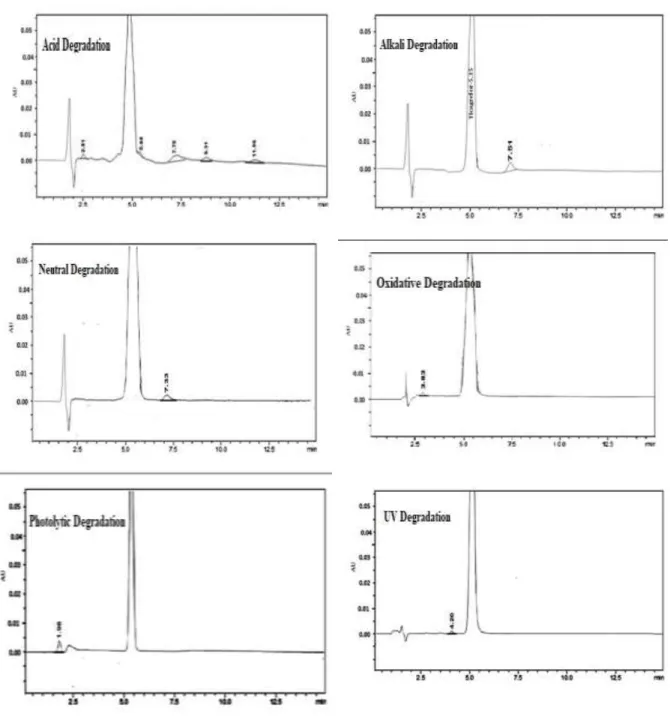
Fig. 3: Chromatograms of TCG forced degradation studies
Table 1: Validation results for TCG
Parameter Result (mean ± SD)
Precision (%RSD, n)
Specificity 0.96 (100.08 ± 0.96) No interference Accuracy (% Recovery, n mean±SD) 99.58% ± 0.28 - 99.89% ± 0.19
Linearity 20-150μg/ml
Correlation coefficient( r2) 0.9998
LOD concentration 0.18μg/ml
LOQ concentration 0.58μg/ml
Ruggedness(%RSD, n) Day 1 Day 2
0.92 0.82
Robustness (%RSD, n) Decrease in flow rate 0.8 Increased flow rate 0.18 (Organic phase) Decrease in mobile phase 0.4 Increased mobile phase (Organic) 0.65
Decreased column temperature 0.5 Increased column temperature 1.02
Solution stability Day 1 (0 h) Day 2 (After 24 h)
(%RSD, n) 0.85 1.25
(% Assay, n) 100.12 ± 0.97 99.85 ± 1.05
USP-tailing 1.36
USP theoretical plates 3789
Table 2: Forced degradation results for TCG
Stress condition % Assay % area of degradation peak % Degradation
0.1M HCl for 4 h at 80°C 96.90 2.65 3.10
0.1 M NaOH for 4 h at 80°C 95.46 - 4.54
3% H2O2 for 4 h 96.20 - 3.80
Water for 4 h at 80°C 99.50 - 0.50
UV light for 3 h 98.12 - 1.88
(Thermal) 40°C for 6 h 98.34 - 1.66
Results
Method Development
Method was optimized after trials with different types of columns, mobile phase composition and flow rate. The optimized method was processed with Phenomenex
Luna C18 5μm (250 mm × 4.6 mm) analytical
column with acetonitrile: methanol: water in the proportion of 40:30:30% v/v as mobile phase at 1 ml/min flow rate. Drug was
detected at 280 nm UV-wavelength
maximum. The chromatograms for the optimized method were shown in the Fig. 2.
Validation
The optimized technique was validated in compliance with ICH validation parameters and the results were shown in Table 1.
Forced Degradation Studies
Forced degradation studies were processed for the TCG drug by exposing the drug solution to different stress environments such as acidic (0.1 N hydrochloric acid for 4 h at 80°C), basic (0.1 N sodium hydroxide for 4 h at 80°C), peroxide (3% hydrogen peroxide for 4 h at 60°C), neutral (refluxing the drug in water for 4 h at 80°C), photolytic (UV-light for 3 h) and thermal (40°C for 6 h) conditions. All the findings of forced degradation findings were presented in Table 2 and respective chromatograms were shown in Fig. 3.
Discussion
In the present specific RPHPLC-technique, linearity was assessed over the concentration level of 20-150μg/ml, the research work was successfully validated, and the validation constraints were within the acceptable limits (Table 1 and Fig. 2). In this liquid chromatographic technique, the LOD and LOQ of drug were 0.18μg/ml and 0.58μg/ml, respectively. In present technique, TCG was exposed to its stress studies under different environments as per the ICH-guidelines. The neutral/hydrolytic degradation study of TCG
reveals that no degradants were observed for 4.0 h in neutral environment. The findings of acid hydrolysis showed that degradation component peak at 7.35 min along with drug peak.
From the chromatogram it was observed that 3.10% of drug was degraded in 0.1M hydrochloric acid at 80°C. TCG was degraded in 0.01 M sodium hydroxide at 80.0°C for 4.0 h, and the degradation peak was eluted at 1.72 min in the chromatogram. From the
chromatogram the drug percentage
degradation was 4.54%. TCG did not degrade after it was kept under direct sunlight for 21 days. Drug under UV-chamber for 48.0 h it was not underwent degradation, observed from the resulting chromatogram. The chromatogram of oxidative degradation of drug was showed that no degradants were formed after 4 h of exposure.
The chromatogram of thermal degradation showed that TCG was not degraded for 15 days at 40°C. In this research article Stability-indicating Reverse Phase-HPLC technique for TCG was developed and validated. All the validation parameters: selectivity, accuracy, precision, recovery, robustness, and ruggedness were within the acceptance limit.
The drug sample was resolved on
Phenomenex Luna C18 5μm (250 mm × 4.6
Acknowledgment
Our thanks to Department of Pharmaceutical Analysis, Jeypore College of Pharmacy,
Jeypore for the laboratory facilities provided to an outcome of this investigation.
References
1. Wilmington LP, Astra Zeneca (2010) Drug
detailing cardiovascular and renal drug advisory committee meeting, Set III, CC-1.
2. Gurbel PA (2009) Randomized
double-blind assessment of the ONSET and OFFSET of the antiplatelet effects of drug versus clopidogrel in patients with stable coronary artery disease. Circulation, 22(120): 2577-85.
3. Highlights of prescribing information,
AstraZeneca 2943105, Initial US approval, 2011.
4. Ambasana Mrunal (2014) Development
and validation of a UV spectrophotometric method for the determination of drug in bulk form. Scholars Res Library, 6: 237-40.
5. L Lakshmana Rao (2013) A validated
stability-indicating HPLC method for determination of drug in bulk and its formulation. Int. J. Pharm., 3: 634-42.
6. PR. Kulkarni, GK Gajare (2016)
Development and Validation of Rp-Hplc Method for Estimation of Ticagrelor in Bulk Form. International Journal of Research in Pharmacy and Chemistry, 6: 733-737.
7. MA Ambasana, NP Kapuriya, KM
Mangtani, KD Ladva (2016) An Improved
Assay Method for the Estimation of Ticagrelor Hydrochloride by Reverse
Phase Liquid Chromatography.
International Journal of Pharmaceutical Sciences and Research, 7: 2009-14.
8. K Tabassum, R Sarvesh (2017) Analytical
Method Development and Validation Studies of Ticagrelor Tablets by Rp-Hplc.
International Journal of Applied
Pharmaceutics, 9: 10-21.
9. ICH Guidelines for stability of new drug
substances and products. Q1A (R2) ICH, Geneva, 2005; 1-13.
10.ICH guidelines for validation of analytical
procedures: text and methodology. Q2 (R1) ICH, Geneva, 2005; 1-14.
11. Jayaprakash (2017) Stability indicating
method development and validation for
the simultaneous determination of
vidagliptin and metformin in
pharmaceutical dosage form. Int. J. Pharm Pharm Sci., 9: 150-7.
12.Nazneen (2017) Development of assay