91 _______________________________________________________
Mastari Ramadhani1, M. Oky Fardian Gafari2, Marice2
1Master Student in Indonesia Language, Postgraduate Program, State University of Medan (Unimed), Indonesia 2State University of Medan (Unimed), Indonesia
Abstract : The development of interactive media on learning to write experience-based short stories is designed according to the needs and characteristics of students who are expected to be able to overcome all the problems in learning activities to write short stories and make students more active, independent and able to think critically. This research was carried out at Amanah Islamic Modern School Middle School in Medan. The data in this study are the results of observations, interviews, results of questionnaires validation of material and design of learning media, the results of questionnaires teacher perceptions of learning media developed, and student learning outcomes totaling 32 people. Data from observations in the form of learning values writing short stories totaling 32 students so far and the results of interviews in the form of opinions of two Indonesian language teachers related to learning to write short stories obtained from students and teachers of Indonesian. Learning outcomes in short story text writing material based on the experience of students of class IX-1 Amanah Middle School Islamic Modren School Medan after using interactive learning media are in the category of "very good" with an average value of 80 and average values before using interactive multimedia learning media for 69.37 which is in the "good" category.
Keywords : development; interactive learning; material writing; short story; experience
I. Introduction
The use of learning media has a role that can support the success of learning activities. The use of appropriate learning media will have an impact on better learning outcomes. Effective, creative and innovative learning media can attract students' learning interest for the better. Students will be more interested in learning that uses new media than learning that only uses conventional media such as the use of teaching aids. In other words, directly the learning media is a support for the smooth learning process, increasing students' interest and attractiveness in participating in learning. One of the important things and always get serious attention in learning is the delivery of subject matter so that it is easily understood or understood by students. Students' understanding of the material delivered by the teacher, one of which is influenced by the choice of methods and learning media. The use of media that attracts students' attention is expected to help students improve their understanding and ways of writing short stories based on experience. During this time, the teacher only delivered material with conventional methods such as lectures which had an impact on monotonous and boring learning. Therefore, the use of interactive media using the Macromedia Flash Professional CS 6 application which is packaged in the form of a learning CD can help teachers to teach short stories based on experience easily to students so students can understand them well.
qualifications. The results of the evaluation of design experts by 78% were in good quality. Individual test results of 92.3% were in very good qualifications. Small group test results of 83.6% are in good qualifications. Field test results of 82.74% were in good qualification. The average value before using media (62.09) and (86.77) after using media so that it can improve learning outcomes.
A similar sentiment was also expressed by Susiana (2014: 9) in a research journal entitled Improving Short Story Writing Ability with Media Video Clips explaining that learning to write short stories using video clips received positive re-sponsors from both teachers and students. The results of his research showed that teacher activity increased by 13.4% while student activity increased 6.6%. Overall the students' responses increased with learning by using video clips. Student learning outcomes also increased by 19.8%.
Referring to several research results that support the importance of using media in the learning process above, it can be concluded that the development of science and technology increasingly encourages efforts to renew the use of technological results in the learning process. Teachers in schools are required to be able to develop media as a support in KBM.
Based on the facts in the Islamic Modern Islamic Middle School with the support of the opinions of education practitioners and research that have been carried out, it is necessary to conduct a study that produces a learning tool in the form of interactive learning media in writing experience-based short stories. The development of interactive media on learning to write experience-based short stories is designed according to the needs and characteristics of students who are expected to be able to overcome all the problems in learning activities to write short stories and make students more active, independent and able to think critically. Therefore, to find out the results of the development of the use of interactive multimedia and the impact in the learning process of writing short stories, in-depth research is needed.
II. Review of Literature 2.1 Writing a Short Story
The type of literary text that is the most popular and widely read by people with adequate understanding is short stories. Sumardjo (2007: 52) Short stories are stories in the form of relatively short prose. Short words in this case are interpreted as being able to be read once sitting in less than one hour. It is said to be short because it only has a single effect, characters, plots, and settings are limited, not diverse and not complex. Short stories tend to be less complex than other narrative prose. Short stories usually focus on an event, have one plot, a single setting, a limited number of characters, covering a short period of time.
Priyatni (2010: 198) states that short stories are short tropes (less than 10,000 words) that give a single impression and focus on one character in writing. Sumardjo (in Antilan 2001: 50) short stories are short fiction that are read in one sitting. Next Thahar (2009: 5) states that short stories usually contain a more solid storyline and the background and flashback are alluded to casually. In addition, Thahar (2008: 82) also states that short stories not only convey stories, but also must describe an experience (in the form of a story)
93 _______________________________________________________
DOI : https://doi.org/10.33258/birle.v2i1.189
prose. Short stories are told a piece of life of a character, who is full of conflict, a touching or pleasant event, and contains an impression that is not easily forgotten. The problem raised in a story is generally human life with all aspects. There are so many aspects of life that can occur in humans starting to be born into the grave. Aminuddin (2004: 66) explains that short stories are stories or stories that are carried out by certain actors by characterization, background and certain stages and series of stories that depart from the results of the author's imagination so as to forge a story. Furthermore Jingga (in Mastini, 2016) that short stories are stories that tell a small part of aspects in human life that are told centrally on characters and events that are the main story. According to Hendy (in Mastini, 2016) states that short stories are literary works in the form of prose which are short stories that contain a single impression. Short for short stories is not because of the shorter form of the novel, but because of the aspect of the problem.
Diponegoro (1994: 6) explains that writing short stories is the most selective and economical way of writing. According to Sumardjo (2007: 75) writing short stories is a creative inner process. Writing a lot of short stories is done spontaneously, but some are done by correcting the writing many times and doing rewriting. However, in writing everyone always experiences a similar creative process. The problem raised in a story is generally human life with all its aspects. There are so many aspects of life that can occur in a human being from birth to entering in the circumference of the grave. The many aspects of life that stories can be developed are also very diverse and short stories as one form of literature that tells the story of human life and has its own scope, which only tells a small part of the life of the most interesting figures.
2.2 Learning Based Experience
An experiential learning approach was introduced in 1984 by David Kolb in his book entitled "Experiential Learning, Experiential As The Source Of Learning And Development". Experience-based learning defines learning as the process of how knowledge is created through changing forms of experience. Knowledge is caused by a combination of understanding and transforming experiences. As defined by the Association for Experiential Education (AEE), "experiential education is a process through which knowledge constraints, and value from direct experiential learning." Experience-based education is a process in which students build knowledge, skills and values from direct experience.
According to Nasution (1995: 90) The term learning by experiential or learning through experience is also often identified with the term learning by doing or learning while passing through. Esperiential means living through actual situation. All products are learning through the learner throught its own activity. Experiencing means living the real situations. All learning outcomes are obtained through their own activities. That way, students will gain their experience to develop the potential that exists within themselves. However experience is all complex activities and results of active human interaction.The above quote gives meaning that experience-based learning is learning best understood as a process, not a result. All learning activities are learning again, learning is a process of creating knowledge.
participates in activities. After that, they looked critically at the activity. Then they get an understanding and pour it in oral or written form in accordance with the learning objectives. In this case, experience-based learning uses experience as a facilitator to help learners develop their capacities and abilities in the learning process.
Whereas Silberman (2014: 10) states that experience-based learning is the involvement of students in concrete activities that enable them to experience what they are learning. This learning is based on real work / life experience and structured experience that simulates or detects actual work / life experience. Sanjaya (2010: 160) learning experiences (learning experiences) are a number of student activities carried out to obtain new information and competencies in accordance with the objectives to be achieved. Furthermore Sani (2014: 153) learning based on experience is inductive learning, student-centered, and activity-oriented.
Usher and Salmom (in Moon, 2004: 104), experience in the context of "learning from experience" is interpreted as all forms of events that occur in everyday life, while experience in the context of "experiential learning" is a particular experience in which there is knowledge delivered with a particular approach such as observation and reflection. This opinion is strengthened by Evans (in Moon, 2004: 104), experience-based learning methods (experiential learning) can be interpreted as situations where the educational process is organized in the form of formal educational programs.
Experience-based learning is a teaching and learning process that focuses on or emphasizes student experience, both intellectual, emotional, and psychimotor experience. According to Sukmadinata (2012: 139) explains that human development is achieved through a series of experiences namely; practice sensing such as seeing, hearing, feeling, kissing, tasting, etc. Thinking experiences such as remembering, responding, imagining, fantasizing, assimilating, etc. Social experiences such as relating, communicating, interacting, etc. Emotional experiences such as loving, appreciating, admiring, loving, etc. These experiences are planned or not planned, realized, or not realized, traversed systematically or not systematically, natural walk or made.
2.3 Learning Media
Media comes from Latin, which is a medium that means "middle, intermediary, or introduction. According to Arsyad (2014: 3) In particular the notion of media in the teaching and learning process is more likely to be interpreted as a stationery, photographic, or electronic to capture, process, and reconstruct visual or verbal information. Gagne in Sadiman (2010: 6) states that "media are various types of components in the student environment that can stimulate them to learn."
95 _______________________________________________________
DOI : https://doi.org/10.33258/birle.v2i1.189
effectively and efficiently." Association for Education Commucation and Technology (AECT) in Arsyad (2014: 4) defines media as all forms used to channel information.
2.4 Assessment of Learning Media
Media assessment is carried out to ensure that the learning media used in schools are feasible and truly meet national standards. National Education Standards Agency (BNSP) (2006: 2-3) states that quality teaching materials (in this case learning media) must fulfill four elements of feasibility, namely: 1) content feasibility, 2) feasibility of presentation, 3) language feasibility, and 4 ) the feasibility of graphics. The four feasibility elements are elaborated in the form of indicators that have been adjusted to the assessment of the feasibility of the material and learning media.
1. Content Feasibility Assessment
The content feasibility assessment contains three indicators that need to be considered, namely:
a. Compliance with the order of material with SK and KD which includes:
1) Completeness of material: the material presented is complete or meets KD, which is related to writing short story texts.
2) Extent of material: the material presented meets the broad scope of material, not only one material, but also presents some material related to short stories. 3) Depth of material: the material presented has a level of accuracy / accuracy of
concepts and definitions that are right / true related to short stories. b. Material accuracy, including:
1) Accuracy of concepts and definitions: the material presented has the level of accuracy accuracy of the concept and the exact / true definition associated with the short story.
2) Accuracy of examples: the examples presented have good accuracy / accuracy.
3) Accuracy of images and illustrations: the images and illustrations presented have a good level of accuracy / accuracy or examples of images and illustrations that are presented according to the facts.
c. Learning support materials include:
1) Compatibility of material with the development of science: the material presented in accordance with the development of the latest science (actual material) is exposed to short stories.
2) Using examples in accordance with everyday life.
3) The images and illustrations presented are true / close in the daily lives of students related to short story writing material based on experience.
2. Assessment of presentation feasibility
Evaluation of presentation eligibility, contains three indicators that must be considered, namely:
a. Presentation techniques, including:
1) Systematic presentation has systematic consistency in the presentation of learning activities.
2) Demands for presentation: material presented sequentially, starting from the beginning to the end relating to the short story text.
b. Presentation of learning, including:
1) Involvement of students: learning media used also involve students in learning activities.
2) Centered on students: the learning media used make students as learning centers. 3) Stimulating students' ability to solve problems through illustrations: illustrations presented in learning media can stimulate / encourage students to complete the tasks given.
4) Preliminary section, content section, and closing section "completeness of media content, starting from the opening of the media, contents of media material and media cover.
5) Practice questions at the end of learning: there are practice questions and evaluations at the end of the learning media.
3. Assessment of Language Feasibility and Readability
Language assessment and readiness contains three indicators that must be considered, namely:
a. Conformity with the level of development of students, namely conformity with the level of intellectual understanding, the language used in the media is not difficult for students to digest / in accordance with the level of understanding of students. b. Communicative, covering
1) Readability of messages: messages or information presented in the media are easily understood by students.
2) Accuracy of language rules: the rules of the language used are in accordance with the rules of good Indonesian.
c. Straightforward and integrated mindset, including:
1) Effectiveness of sentences: sentences that are used properly and correctly. 2) Digestibility of material: the material presented is easy for students to
understand / understand.
3) Ease of language understanding: the language used is easy for students to understand.
4. Assessment of Feasibility Integrity
97 _______________________________________________________
DOI : https://doi.org/10.33258/birle.v2i1.189
a. Changable, display related to typography and illustration 1) Typography: the form of writing presented is good.
2) Illustration: illustrations such as examples of text or images are well presented.
III. Methodology
This research was carried out at Amanah Islamic Modern School Middle School in Medan at the level located at Jalan Kapten Sumarsono, Medan Helvetia Subdistrict, the year of 2017/2018 pursuits for students of class IX. This research was conducted in the even semester of learning 2018/2019. The data in this study are the results of observations, interviews, results of questionnaires validation of material and design of learning media, the results of questionnaires teacher perceptions of learning media developed, and student learning outcomes totaling 32 people. Data from observations in the form of learning values writing short stories totaling 32 students so far and the results of interviews in the form of opinions of two Indonesian language teachers related to learning to write short stories obtained from students and teachers of Indonesian. Data in the form of material validation and design of learning media were obtained from the validator / expert team, as well as data on learning outcomes from students before and after using the learning media developed. The type of research used is the type of research and development (R & D). According to Sugiyono, (2012: 407) The research and development (R & D) model is a research model used to produce certain products and test the effectiveness of the product. As for the development research model used in this study is the DDD-E model. (Decide, Design, Develop, Evaluate). According to Tegeh et al (2014: 16) there are 4 stages of the process of developing the DDD-E model, namely:
1. Decide 2. Design 3. Development 4. Evalute
IV. Discussion
The process of implementing interactive multimedia development is done in stages. In the early stages of this development research is to determine the subjects to be developed in accordance with the standards of competence and basic competencies. The next step is to carry out preliminary research using observation and interview methods. The observation and interview method aims to find out the process of learning Indonesian in the classroom and to obtain data on how the media concepts will be used.
outlining the definition of multimedia interactive learning on questionnaires so that respondents have an overview of the questions in the questionnaire presented. This activity was carried out at the beginning of August 2018.
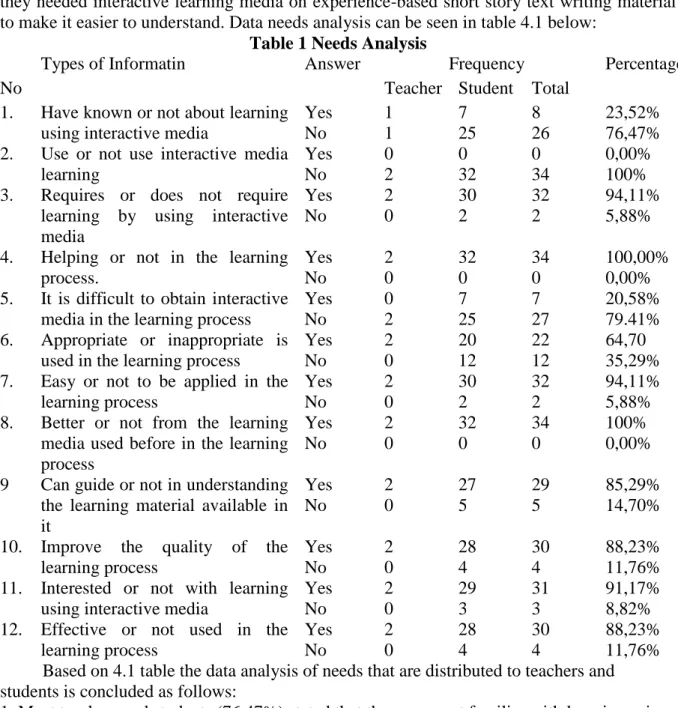
The results of the questionnaire found that 94.11% of teachers and students stated that they needed interactive learning media on experience-based short story text writing material to make it easier to understand. Data needs analysis can be seen in table 4.1 below:
Table 1 Needs Analysis
Types of Informatin Answer Frequency Percentage
No Teacher Student Total
1. Have known or not about learning using interactive media
Yes 1 7 8 23,52%
No 1 25 26 76,47%
2. Use or not use interactive media learning
Yes 0 0 0 0,00%
No 2 32 34 100%
3. Requires or does not require learning by using interactive media
Yes 2 30 32 94,11%
No 0 2 2 5,88%
4. Helping or not in the learning process.
Yes 2 32 34 100,00%
No 0 0 0 0,00%
5. It is difficult to obtain interactive media in the learning process
Yes 0 7 7 20,58%
No 2 25 27 79.41%
6. Appropriate or inappropriate is used in the learning process
Yes 2 20 22 64,70
No 0 12 12 35,29%
7. Easy or not to be applied in the learning process
Yes 2 30 32 94,11%
No 0 2 2 5,88%
8. Better or not from the learning media used before in the learning process
Yes 2 32 34 100%
No 0 0 0 0,00%
9 Can guide or not in understanding the learning material available in it
Yes 2 27 29 85,29%
No 0 5 5 14,70%
10. Improve the quality of the learning process
Yes 2 28 30 88,23%
No 0 4 4 11,76%
11. Interested or not with learning using interactive media
Yes 2 29 31 91,17%
No 0 3 3 8,82%
12. Effective or not used in the learning process
Yes 2 28 30 88,23%
No 0 4 4 11,76%
Based on 4.1 table the data analysis of needs that are distributed to teachers and students is concluded as follows:
1. Most teachers and students (76.47%) stated that they were not familiar with learning using interactive media and only a small proportion (23.52%) of teachers and students stated that they had recognized the media.
99 _______________________________________________________
DOI : https://doi.org/10.33258/birle.v2i1.189
3. Most teachers and students (94.11%) stated that they need learning by using interactive multimedia in the learning process.
4. Most teachers and students (100%) state that learning using interactive multimedia can help in learning activities
5. Most teachers and students (79.41%) stated that it was not difficult to obtain learning by using interactive learning media
6. Teachers and students (64.70%) state that learning using interactive multimedia is appropriate to use in the learning process.
7. Teachers and students 94.11% state that interactive multimedia is easily applied in the learning process.
8. 100% of teachers and students state that interactive multimedia is better than conventional learning media such as the use of teaching aids used in the learning process.
9. Teachers and students state that 85.29% of learning using interactive learning media can demand in understanding the learning material available in it.
10.Teachers and students state that 88.23% of interactive multimedia can improve the quality of the learning process.
11.Teachers and students state that 91.17 are interested in interactive learning media in the learning process.
12.Teachers and students state that 88.23% of interactive learning media is effectively used in the learning process.
This research is a development research that aims to produce a product of developing short story text based on experience with the help of interactive learning media. The products produced are intended to improve the quality of learning, especially in short story writing material. Learning media developed have been declared feasible to be implemented in the learning process of writing short story experiences based on experience.
elements, namely images, animation, audio, and video is carried out. Feedback obtained from the assessment rubric is used as a reference for revising from each stage.
Then a needs analysis was conducted by distributing questionnaires to 32 students and 2 teachers at the Islamic Modern School Medan Amanah Middle School which contained questions related to media development. The results of questionnaires were found to be 94.11 from teachers and students requiring interactive learning media in writing short story text material to make it easier to understand the learning process.
The results of the needs analysis show that 94.11 students need interesting and easily understood learning media in the learning process. The presence of a good interactive learning media will help students and learn the material of writing short story experiences based on experience. The existence of a learning process through computer media makes students interested in learning it. There are 100% of students feel helped by the existence of interactive learning media. Based on the explanation above, it can be concluded that the learning media used so far have not been in accordance with the needs of students. Therefore the development of this interactive learning media will help students to understand the material of short story-based experience writing.
The results of this product development received good reception from teachers and students. This can be seen from the needs analysis carried out in which teachers and students stated that they needed interactive learning media as a tool to understand experience-based short story writing material.
V. Conclusion
Learning outcomes in short story text writing material based on the experience of students of class IX-1 Amanah Middle School Islamic Modren School Medan after using interactive learning media are in the category of "very good" with an average value of 80 and average values before using interactive multimedia learning media for 69.37 which is in the "good" category. This proves that the learning outcomes of students in experience-based short story text writing material with a difference in value of 10.63 after using interactive learning media.
References
Abbas, Saleh. 2006. Pembelajaran Bahasa Indonesia yang Efektif di Sekolah Dasar. Jakarta: Dikti
Ahmad Rofi’uddin dan Darmayati. 1998/1999. Pendidikan Bahasa dan Sastra Indonesia di Kelas Tinggi . Jakarta: Depdikbud
Aminuddin. 2011. Pengantar Apresiasi Karya Sastra. Bandung; Sinar Baru Alesindo
Andayani. 2014. Pendekatan Saintifi & Metedologi Pembelajar Bahasa Indonesia.Surakarta : Yuma Pustaka
101 _______________________________________________________
DOI : https://doi.org/10.33258/birle.v2i1.189
Baharuddin dan Eka Nur Wahyuni. 2008. Teori Belajar dan pembelajaran. Yogyakarta: Ar Ruzz Media Group
Bambang, Warsita. 2002. Teknologi Pembelajaran Landasan & Aplikasinya. Jakarta: Rineka Cipta
Barus, Sanggup. 2010. Pembinaan Kompetensi Menulis. Medan : USU Perss
Cahyani,I. 2000. Peran Experientail Learning dalam Meningkatkan Motivasi Pembelajaran BIPA. Makalah. Bandung : UPI
Daryanto. 2012. Media Pembelajaran. Bandung: Sarana Nuraini Sejahtera
Deny. 2015. Pengembangan Multimedia Interaktif Bahasa Indonesia Untuk Meningkatkan Hasil Belajar Siswa Kelas VIII SMP Melaya. Skripsi : Universitas Pendidikan Ganesha Diponegoro, M. 2011. Nulis Cerpen Yuk !.Jakarta: Narasi
Endraswara. 2003. Membaca, Menulis, Mengajarkan Sastra. Yogyakarta: Bandung
Fauzziyah. 2013. Pengembangan Multimedia Interaktif Berbasis Kecerdasan Jamak Dalam Pembelajaran Inkuiri Untuk Meningkatkan Kemampuan Menulis Cerita Pendek di SMA Darul Quran Bandung. Tesis: Universitas pendidikan Bandung
Haryadi & Hamzami. 1996/1997. Peningkatan Keterampilan Berbahasa Indonesia. Depdikbud
Hasrul. 2010. Langkah-ngkah Pengembangan Pembelajaran Multimedia Interaktif. Jurnal MEDTEK. Universitas Negeri Makasar
Irvansyah. 2012. Pengertian dan Fungsi Photoshop.
http://muhamad-Irvansayh.blogspot.com/2012/11/
pengertian-dan-fungsi-photoshop.html,diakses:20.05/2017 20.30
Jingga. M. 2012. Yuk Menulis Yuuk Diary, Cerpen, Puisi dan Naskah Drama. Yogyakarta : Araska
Keraf, Gorys. 2004. Argumentasi dan Narasi. Jakarta: Gramedia Widya Sarana Klob , D.A. 1984 Experiential Learning: Experiential as the Source of Learning and Development. Englewood Cliffs, N.J; Prentice-Hall
Kosasih. 2011. Ketatabahasaan dan Kesusastraan Cermat Berbahasa Indonesia. Bandung: CV Yrama Widya
Laksana. 2006. Ketatabahasaan dan Kesusastraan Cermat Berbahasa Indonesia. Bandung: Yrama Widya
Mahsun. 2013. Teks dalam Pembelajaran Bahasa Indonesia Kurikulum 2013. Jakarta: PT Raja Grasindo Persada
Mastini. dkk. 2016. Peningkatan Keterampilan Mneulis Cerpen Melalui Metode Pembelajaran Berbasis Pengalaman dan Media Audiocisual Pada Sekolah Menengah Pertama. Jurnal. UNS
Mayasari, Deasy.dkk.2012. Pengembangan Bahan Ajar menulis Kreatif Cerpen untuk Siswa SMA. Jurnal. Universitas Negeri Malang
Mc Crimmon, James. M. 1984. Writing With A Purpose :Eight Edition, Bostan; Houghton Mifftin Company
Monteith, Moira.& Robet Miles, 1992. Teaching Creative Writing; Theoy and, Practice. Buckingham; University Perrs
Mudrajad, Kuncoro. 2010. Mahir Menulis. Jakarta: Erlangga
Prastito. 2011. Pengembangan Media Interaktif Pada Materi Menulis Poster oleh SMP. Tesis : UNS
Priyatni, Tri Endah. 2010.Membaca Sastra Dengan Ancangan Literasi Kritis. Jakarta ; Bumi Aksara
Purba. Antilan. 2006. Sastra Indonesia Kontemporer. Medan: USU Perss
Rosidi, Imron. 2009. Menulis..Siapa Takut? Panduan Bagi penulis Pemula. Yogyakarta : PT Kanisius
Rusman. 2014. Pengembangan Media Pembelajaran Berbasis Adobe Flash Cs5 Dengan Teknik Latihan Dalam Pembelajaran Menulis Cerpen Siswa SMP. Skripsi. UNY Satria, Romi Wahono.on 5 Juni, 2006 in Software Engineering. http://romisatriawahono.net/
/2006/06/05/teknik-pengukuran-kualitas-perangkat-lunak/
Sanjaya, Wina. 2007. Strategi Pembelajaran Berorientasi Standar Proses Pendidikan.Jakarta : Prenada Media Grop
Sayuti,S, A. dkk. 2009. Modul Menulis Fiksi. Yogyakarta: PBSI FBS: UNY Sayuti. S. 2014. Berkelana dengan Prossa Fiksi. Yogyakarta : Gama Media Semi, Atar. 1993. Menulis Efektif. Padang : Angkasa
Setyosari. 2015. Metode Penelitian Pendidikan & Pengembangan. Jakarta : Kencana
Silberman, Mel. 2014. Handbook Experiential Learning, terjemahan. M.Khozim. Bandung: Nusa Media
Sudatha. 2015. Desain Multimedia Pembelajaran Yogyakarta : media Akademi
Sudjana, Nana. 2007. Dasar-dasar Proses Belajar Mengajar. Bandung: Sinar Baru Algesindo
Sudjiman. 2014. Media Pendidikan, Pengertian, Pengembangan dan Pemanfatannya. Jakarta: PT Raja Grafindo Persada
Sugiyono. 2013. Metode Penelitian Pendidikan Pendekatan Kualitatif Kuantitatif, dan R&D.
Bandung : Alfabeta
Sukmadinata. N. 2012. Metode Penelitian Pendidikan . bandung : PT Remaja Rosdakarya Sumardjo, Jacob. 2007. Catatan Kecil Tentang Menulis Cerpen. Yogyakarta : Pustaka pelajar Supriyadi. 2006. Pembelajaran Sastra yang Apresiatif dan Integratif di Sekolah Dasar.
Jakarta: Depdikbu
Suryaman, Maman. 2012. Metodologi Pembelajaran Bahasa. Yogyakarta : UNY Press Suryanto. 2005. Multimedia Alat Untuk Meningkatkan Keunggulan Bersaing. Yogyakarta : Andi Offset
Suyatno. 2004. Teknik Pembelajaran Bahasa dan Sastra. Surabaya: SIC
Syathariah, Sitti. 2011. Menulis Berantai Sebagai Metode Inovatif dalam Pembelajaran Menulis Cerpen di SMA Cendana Pekanbaru. Jurnal. http://rsjd.pdii.lipi.go.id
Tarigan. G Hendry. 2008. Menulis Sebagai Suatu Keterampilan Berbahasa. Bandung: Angkasa
Thahar, haris Effendi. 2008. Kiat Menulis Cerita Pendek . Bandung : Angkasa Trianto. 2011. Model Pembelajaran Terpadu. Jakarta : Bumi Aksara