IoT Based Smart Trash /Garbage Collection System
B.Surya Sudha Rani, Praveen kumar.B
M.Tech, Embedded systems, Assistant professor Department of ECE Aditya college of engineering Surampalem,E.G.dist,A.P,India.
[email protected], [email protected].
Abstract--Waste Management is one of the major problem in our day to day life. The current observation is that trash-bin is not efficiently managed, it is not emptied from time to time thus leading to a critical situation which has many adverse effect on the environment and the surrounding inhabitants. Thus waste should be managed efficiently right from the time to time collection of the waste of particular areas and then treatment should be done. Hence, we are making this in real time scenario by connecting to the Internet of Things (IoT) concept.
To overcome the problems caused by the waste disposal we can use the concept of smart-trash bins. The system makes use of MSP 430 microcontroller, LCD screen, Wi-Fi module for sending bin status data. The LCD screen is worn to exhibit the status of the level of refuse together in the bins. Whereas a web page is built to show the status to the municipal right or user to monitor it. The web page offers a graphical vision of the garbage bins and things to see the garbage collectively. It also analyses the received data and represents each city bin status for a particular time period in graphical manner, such that they can analyze the cleanliness in the city.
1.INTRODUCTION
The Internet of Things (IoT) is a idea in which adjacent things are associated during wired and wireless networks without user involvement. In the pasture of IoT, the things communicate and replace information to provide superior intelligent services for users. due to the current advances in mobile plans capable of with various sensors and communication modules, mutually with communication network technologies such as Wi-Fi and LTE, the IoT has gained huge academic comforts. The word Internet of Things was started by Kevin Ashton, who was the executive of the Auto-ID Center of MIT in 1999 [1]. The underlying specialized acknowledgment of IoT was accomplished by using RFID innovation for the distinguishing proof and following of gadgets and putting away gadget information. Be that as it may, IoT using RFID innovation was restricted to protest following and removing information of particular items. The current IoT performs detecting, inciting, information assembling, putting away, and handling by interfacing physical or virtual gadgets to the
Internet. planned for IoT machines playing out these assignments, a differing qualities of explores on IOT benefits and additionally ecological observing [2, 3], question following [4], activity administration [5], medicinal services [6], and brilliant home innovation [7, 8] are being directed. because of the portrayals and characteristics of IoT administrations, squander administration has likewise turned into a critical issue in the scholarly world, industry, and government as major IoT application fields. An unpredictable and illicit release of waste, a nonattendance of waste transfer and administration frameworks, and wasteful waste administration arrangements have brought on genuine ecological issues and have acquired extensive expenses for waste transfer. To deal with these issues, different inquires about into waste administration in view of IoT innovation have been directed, from studies on RFID innovation to thinks about on waste administration stages and frameworks [9–12]. Figure.1.1:
2. RELATED WORK Smart waste/junk receptacles and frameworks have been in discourse for a significant long time. The advancements utilized at transfer to build up this brilliant framework have likewise developed, i.e. from WSNs to RFIDs to now the most prevalent Internet of Things (IoT). Every thought is by all accounts comparable yet is marginally extraordinary at its center and our proposed work is no exemption from the same. After the IoT field, discovering its hold in our lives, this is our unique arrangement for planning a brilliant waste/refuse gathering framework which has arrangement for resident support and investigation of information for better basic leadership. At equipment level, the savvy framework is a waste/trash canister with ultrasonic sensor, a small scale controller and Wi-Fi module for transmission of information. The overall usage of Internet of Things is conceivable with a Cloud driven vision [1]. This work abuses the future conceivable outcomes, key innovations and application that are probably going to drive IOT investigate. In any case, a solid establishment to our work is given, where the rudiments and utilizations of Arduino board is clarified [5]. It is very fascinating as it executes a GAYT (Get As You Throw) framework idea as an approach to empower reusing among nationals [6]. As we would talk about further, the resident cooperation part of our framework is very affected by their work.
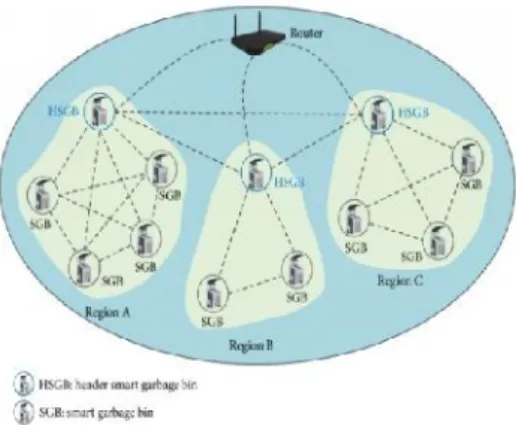
2.1: Network Topology of SGBs
Figure 4.1 represents the system topology of SGBs situated in the administration space. The SGBs trade information, for example, their ability, battery life, and occupant information through
3.INTERNET OF THINGS
There are a few implications and meanings of Internet of Things (IoT) which will quickly give the thought regarding the fundamental functionalities and attributes of it. IoT might be considered as a worldwide system framework where virtual and physical areas are associated utilizing circulated figuring like cloud innovation, and different information gathering and system advancements. Part permits diverse gadgets which are situated at various areas to speak with each other, to get to information on the web, to store, investigate and recover information, and to cooperate with clients, accordingly making inescapable, keen and constantly associated conditions. To secure such knowledge inside the figuring conditions, major mechanical advancements and improvements are required. The specialists expect that it will be conceivable to
recognize a recently framed shape for IoT, together with the blast of Ubiquitous gadgets sooner rather than later. The vision of the IoT is that individual things of regular day to day existence, for example, autos, roadways in transport frameworks, pacemakers, remotely associated pill-molded cameras in stomach related tracks for social insurance applications, coolers, or other family things including steers' can be outfitted with sensors, which can track helpful data about these items. IoT should comprise of particularly addressable articles and their virtual portrayals on a web like structure. Such protests may connection to data about them, or may transmit continuous sensor information about their state or other helpful properties related with the question. The particularly addressable items are associated with the Internet, and the data about them can move through a similar convention that interfaces PCs to the Internet. Since the articles can detect nature and convey, they can comprehend complex practices in the earth, and may frequently empower autonomic reactions to testing situations without human mediation. The vast number of things produces information from nature in a computerized way and empower unavoidable and pervasive registering IoT is conceived as a coordinated some portion of Future Internet. In this way, keeping in mind the end goal to empower quick headway in advances identified with loT, look into must target key issues like recognizable proof, interoperability and protection and security. The coordination of enormous information, cloud advances and future systems like 5G with loT should likewise be considered [13].
4.PROPOSED FRAMEWORK
The engineering of the SGB is appeared in Figure 1.1. The SGBs, which are built up by condo structures and individual houses, swap data with each other and send the information to the server through remote correspondence. Basically, the future framework is isolated into two fields: an organization area and an administration space. In the organization domain,data exchanged from a SGB is broke down and prepared. In the administration space, occupants discard their junk/refuse in a SGB, and inhabitant and SGB information is gathered and exchanged to the organization area. In this venture, we have actualized the authoritative area utilizing IoT and distributed computing innovation.
junk/rubbish support server, a client administration server, and an installment administration server. The client administration server oversees waste/rubbish release information and the individual information of the enlisted occupants who are enrolled in the client administration server through a chairman. Moreover, information on the release measure of waste/junk is put away and grouped in view of district, occupant, and receptacle in the client administration server. The charge administration server directs the installment procedure in light of the heaviness of the waste/junk with the occupant's card organization. At the point when an occupant uses a RFID card to release his junk/trash, his own card information enrolled on the RFID card is exchanged to the charge administration server, which then demands the card organization to handle the installment. The rich waste conservation server plays a duty in control all information related to the SGBs, for example, the measure of junk/rubbish each SGB has, the measure of junk/refuse an accumulation organization has assembled, and the status information of the SGBs. Consequently, if a disappointment is seen in a SGB behind examining the status information, the administrator is sent to check the issue, and the brilliant waste/trash upkeep server initiates inhabitants to utilize a close-by SGB. All information overseen in the organization area is likewise given through a Web-based administration, through which the heads can decide the condition of the framework and inhabitants can check the measure of junk/refuse they have discarded and for the amount they have paid. In this venture usage, we have outlined the SGB utilizing low power microcontroller, sensor and WiFi gadget. The managerial area was executed utilizing cloud administrations to screen the distinctive SGB status on web application. While the BIN distinguishing proof information was produced by microcontroller program, so here we haven't utilized the RFID.
(ii) Service Domain. This space is the place the inhabitants discard their junk/trash. At the point when an occupant's RFID card touches the RFID peruser of a SGB, the SGB confirms the inhabitant and opens the cover. The inhabitant then discards his junk/waste, and the SGB measures its weight. After the release procedure, the SGB sends the gathered information on the inhabitant and the heaviness of his junk/waste to the organization area. In view of the gathered information, a waste/junk jockey gathers the junk/trash from the SGB, a head reviews or repairs the receptacle, and a cleaner cleans the container as vital. In this venture, the administration space wasn't executed.
Figure 4.1: Network Topology of SGBs
n when the same residents use different trash/garbage bins. A header smart trash/garbage bin (HSGB), located within each region, analyzes and manages the other SGBs within its region after collecting their data. The HSGB also exchanges this data with other HSGBs through the WMN, allowing the service continuity to be secured. Moreover, designed for network consistency, if a communication trouble occurs in a HSGB, heading authority is assigned to the most suitable SGB within the similar area.
5.IMPLEMENTATION OF SYSTEM
Figure 5.1: block diagram of implemented hardware
In this section, prototyping of proposed low power SGB and administration domain using cloud services was implemented. The entire
implemented system block diagram was shown in the figure 5.1.
to drive LCD, MSP430, WiFi device and sensors even though battery voltage falls below 7V.
The following are the different devices current usages in SGB. MSP430 will take 160uA when it is in active state, LCD takes 300mA and WiFi device will take 250mA while transmission.
The ultrasonic sensor requires a driving signal with ON period (10ms) and Off period of (0.1ms), which will generated through MSP430 internal timer circuit. And the echo signal of the ultrasonic sensor was detected using timer capture interrupt in MSP430. By calculating the difference between the two captures, msp430 will find out the depth of the dust bin. The block diagram of implemented SGB hardware was shown in figure.
A. MSP430G2553
The hub of the smart trash bin by IOT is the Texas tools MSP430 family of ultra-low-power microcontrollers consists of a number of devices featuring dissimilar sets of peripherals under attack for a variety of appliances. The architecture, combined with five low-power modes, is optimized to achieve extended battery life in portable measurement applications.
The mechanism skin texture a dominant 16-bit RISC CPU, 16-16-bit registers, and constant generators that put in to maximum code efficiency. The digitally controlled oscillator (DCO) allocates awaken from low-power modes to dynamic mode in less than 1 µs. The MSP430G2x13 and MSP430G2x53 series are ultra-low-power miscellaneous signal microcontrollers with built-in 16-bit timers, up to 24 I/O touch-sense-enabled pins, a versatile analog comparator, and built-in communication capability using the universal serial communication interface. It can operate at 3.3v consumes 230uA in active mode, which is suitable for battery based applications. It has two I/O ports, 512B of RAM, 16KB of on-chip flash memory is available.
B. Wi-Fi Module ESP8266
The ESP8266 Wi-Fi Module is a self-contained SOC with integrated TCP/IP protocol stack that can give any microcontroller access to your Wi-Fi network. The ESP8266 is able of either hosting an appliance or offloading all Wi-Fi networking tasks from one more appliance workstation. Every ESP8266 module approaches preprogrammed with an AT command set firmware, sense, you can simply hook this up to your Adriano device and get about as much Wi-Fi ability as a Wi-Fi Shield offers. The ESP8266 module is an extremely cost effective board with a huge, and ever growing, community).
C. Ultra Sonic sensor
An Ultrasonic sensor is a mechanism that can calculate the distance to an thing by using sound waves. It processes distance by sending out a sound wave at a exact frequency and listening for that sound wave to bounce back. By recording the elapsed time between the sound wave being generated and the sound wave bouncing back, it is possible to calculate the distance between the sonar sensor and the object.
Distance= (Speed of Sound X Time Taken) / 2 because it is identified that sound travels throughout air at about 344 m/s (1129 ft/s), you can obtain the time for the sound wave to return and multiply it by 344 meters (or 1129 feet) to locate the total round-trip distance of the sound wave. Round-round-trip means that the sound wave travelled 2 times the distance to the object before it was detected by the sensor; it includes the 'trip' from the sonar sensor to the object AND the 'trip' from the object to the Ultrasonic sensor (after the sound wave bounced off the object). To find the distance to the object, simply divide the round-trip distance in half.
D. Hyper Text Mark up Language (HTML)
It is the target mark up language for generates web pages and web applications. With JavaScript and cascading Style Sheets (CSS), it structures a harmony of cornerstone technologies for the World Wide Web. Web browsers allow HTML documents as of a web server or from local storage and go them into multimedia web pages. HTML illustrates the constitution of web page semantically and initially built-in cues for the exterior of the document.
E. Javascript
computer Javascript is a dynamic programming language. It is trivial and most regularly used as a part of web pages, whose implementations allow client-side script to interact with the user and make dynamic pages. It is an deduced programming language with object-oriented abilities.
F. Pubnub
PubNub utilizes a Publish/Subscribe model for real-time data streaming and device signalling which lets you establish and maintain persistent socket connections to any device and push data to global audiences in less than ¼ of a second. We can publish mails to any known channel, and subscribing clients get only messages linked with that channel. The message supplies can be several JSON information as well as numbers, strings, arrays, and objects.
6.RESULTS
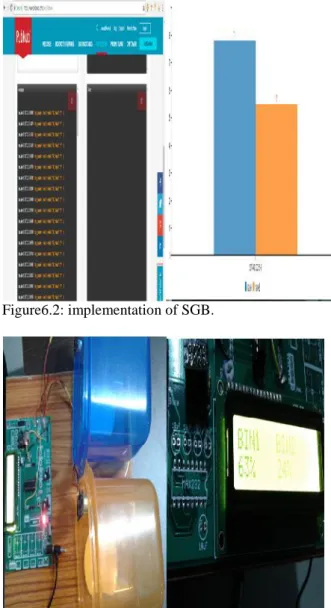
trash. The figure 6.1 shows the raw JSON data from SGB on pubnub cloud service and client application shows the bar status.
Figure6.2: implementation of SGB.
Figure 6.1: pubnub and client application
7.CONCLUSION
To overcome the problems caused by the waste disposal we used the concept of smart-trash bins i.e. by making use of sensor technology. These smart bins are interfaced with microcontroller based system having Ultra-Sonic wireless systems along with central system showing current status of garbage, on web browser with web page by Wi-Fi. Hence the status will be updated on to the web page. The system normally consists an ultrasonic sensor whose job is to detect level of the waste in the bin. The sensor is placed at the top of the smart-trash bin. This system monitors the trash bins and informs about the level of garbage collected in the trash bins via a web page.
8. REFERENCES
1. K. Ashton, “That “internet of things” thing,”RFiD Journal, vol. 22, pp. 97–114, 2009.
2. M. T. Lazarescu, “Design of a WSN platform for long-term environmental monitoring for IoT applications,”IEEE Journal on Emerging and Selected Topics in Circuits and Systems, vol. 3, no. 1, pp. 45–54, 2013S.
3. D. T. Kelly, N. K. Suryadevara, and S. C. Mukhopadhyay, “Towards the implementation of IoT for environmental condition monitoring in homes,”IEEE Sensors Journal, vol. 13, no. 10, pp. 3846–3853, 2013. View at Publisher ·
4. K. Gama, L. Touseau, and D. Donsez, “Combining heterogeneous service technologies for building an internet of things middleware,”Computer Communications, vol. 35, no. 4, pp. 405–417, 2012.
5. L. Foschini, T. Taleb, A. Corradi, and D. Bottazzi, “M2M-based metropolitan platform for IMS-enabled road traffic management in IoT,”IEEE Communications Magazine, vol. 49, no. 11, pp. 50– 57, 2011. A. J. Jara, M. A. Zamora, and A. F. G. Skarmeta, “An internet of things-based personal device for diabetes therapy management in ambient assisted living (AAL),”Personal and Ubiquitous Computing, vol. 15, no. 4, pp. 431–440, 2011. View at Publisher · View at Google Scholar · View at Scopus
6. S. Tozlu, M. Senel, W. Mao, and A. Keshavarzian, “Wi-Fi enabled sensors for internet of things: a practical approach,”IEEE Communications Magazine, vol. 50, no. 6, pp. 134–143, 2012. View at Publisher· View at Google Scholar · View at Scopus 7. X. Li, R. Lu, X. Liang, X. Shen, J. Chen, and X. Lin, “Smart community: an internet of things application,”IEEE Communications Magazine, vol. 49, no. 11, pp. 68–75, 2011.
8. I. Nielsen, M. Lim, and P. Nielsen, “Optimizing supply chain waste management through the use of RFID technology,” inProceedings of the IEEE International Conference on RFID-Technology and Applications, pp. 296–301, Guangzhou, China, June 2010. View at Publisher · View at Google Scholar · View at Scopus
9. Z. Lizong, A. Anthony, and H. Yu, “Knowledge management application of internet of things in construction waste logistics with RFID technology,”International Journal of Computing Science and Communication Technologies, vol. 5, no. 1, pp. 760–767, 2012.
and Applications Conference, pp. 175–180, December 2007.
11. M. A. Hannan, M. Arebey, R. A. Begum, and H. Basri, “Radio Frequency Identification (RFID) and communication technologies for solid waste bin and truck monitoring system,”Waste Management, vol. 31, no. 12, pp. 2406–2413, 2011.
12. P. Jianli, S. Paul, and R. Jain. "A survey of the research on future internet architectures." IEEE Communications Magazine, vol. 49, no. 7 (2011) PP: 26-36.