266
THE INFLUENCE OF DIFFRENT CONCENTRATION OF CYTOKININ OF
MENTHA PIPERITA
Ioan Sarac, Irina Petrescu, Emilian Onisan, Emilian Madosa, Paula Iancu, Elena Bonciu
Banat’s University of Agricultural Sciences and Veterinary Medicine “King Michael I of Romania” from Timișoara
Faculty of Agronomy of the University of Craiova
Key word: cytokine, in vitro , in vivo, Mentha piperita
ABSTRACT
Mentha piperita is an important specie of the family Lamiaceae. The experiments evaluate the effect of different growth hormone. This study was performed to develop a protocol by standardizing the different hormonal concentrations. Regeneration of Mentha piperita in vitro and in vivo was obtained by treating seed with different concentration of cytokinin for the formation of plants. Sterilization of the seed for in vitro was obtained by treating with etanol 70% for 5 minutes with 2-3 drops of Tween-20 (a detergent) for in vivo used Clorox TM solution (5.25 % NaOCl) and then rinsed thrice with double distilled water. Fully developed plantlets were successfully transferred to suitable growing media for acclimatization and there further growth and development. Experiment was performed to study the effect of different concentration of cytokinin BAP (1.0 mg/l), Kn (1.5mg/l) on the germination and growth of peppermint explants. The parameters of the study was number of days to the effect of cytokinin germination in vitro and in vivo and growth plant.
.
INTRODUCTION
Peppermint (Mentha piperita L.) belonging is an important aromatic plant. This plant is native to the Mediterranean regions but can be commercially cultured in temperate regions of the world especially in America, Canada and China. Its extracts and essential oil are used for making gum and confectionery industries to produce different flavors and drugs. Plant growth hormones is a term which includes hormonal substances of natural occurrence as well their synthetic analogues. All the aspects of plant growth and development are under hormone control. On the other hand, a unique process can be regulated by the action of many plant hormones. Although nowadays the use of mutants is a valuable tool to clarify hormone functions, traditionally the physiological effects of diverse plant hormones has been established by their exogenous application. Cytokine is a hormone that participates in events in the course of whole plant ontogeny, from fecundated ovule to senescence and death. 6-Benzylaminopurine, benzyl adenine or BAP is a first-generation synthetic cytokine that elicits plant growth and development responses, setting blossoms and stimulating fruit richness by stimulating cell division.
MATERIALS AND METHODS
267
comparison with V1-control. Two distinct experiments were carried out separately first, the effect of cytokine growth hormones at germination seed and the second various combinations were assessed on plant growth. In vivo germination used 100 healthy and uniformly sized seeds were selected and then sown at equal distance in petri dish lined with filter paper. Then, 1.0 mg/l BAP and 1.5 mg/l Kn was added. And for the control, only double distilled water was added to the petri dish. Petri dish was kept inside the culture chamber in a dark environment because light is one of the preventers of germination. Therefore, we supplied a dark condition for our seeds like the one under the soil; and after the germination process, we put them in light condition and soil to continue their normal growth. During the experiment, germinated seeds were counted daily and were irrigated with 1.0 mg/l BAP and 1.5 mg/l Kn suspensions. For in vivo germination we used peppermint seeds were immersed in a 2.5% sodium hypochlorite solution for 15 minutes for sterilization. After rinsing for two times with double distilled water. The seed were put on the experimental variant. In every experiment, control seeds were also taken for comparison with the treated ones Surface sterilization was obtained by immersion for 5 min in 70% ethanol, followed by soaking for 10 min in Clorox TM solution (5.25 % NaOCl) plus 0.01% Tween 20 as surfactant and rinsing four times in sterile distilled water. Nodes were cultured on MS medium (Murashige and Skoog, 1962) supplemented with 30 g/l sucrose, 1 mg/l thiamine and 8 g/l agar in glass bottles. The seeds were placed in a germination chamber at 25°C. Following 10 days of treatment, germination percentage was calculated. Additionally, root length and shoot length were measured using a ruler. The collected data were statistically computed and analyzed.
RESULTS AND DISCUSSION
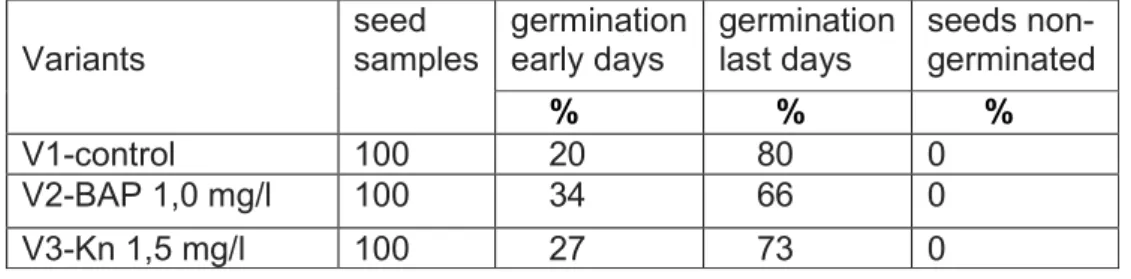
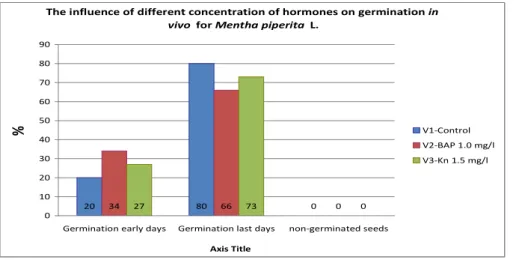
The effect of different concentrations of 1.0 mg/l BAP and 1.5 mg/l Kn on the germination compared to the control was not significant statistically and seed germination percentage decreased when exposed to concentrations of 1.0 mg/l BAP and 1.5 mg/l Kn compared to control caused to the inhibited germination, so we showed them just in table 1.1. for in vivo conditions. We observed in vivo stimulatory effect on germination of cytokine growth hormone BAP and Kn. In the early days the percent was 34 % and in the last day period of observation was 66 % for V2 for early days the percent was 27% and in the last day period of observation was 73 % for V3. We can see different percent of germinated seed and the influence of the hormones if we compare with V1 in the early days 20% and for the lest days 80%
Table 1.1 The influence of different concentration of hormones on germination in vivo for Mentha piperita L.
Variants
seed samples
germination early days
germination last days
seeds non-germinated
% % %
V1-control 100 20 80 0 V2-BAP 1,0 mg/l 100 34 66 0
268
The influence of different concentration of hormones on germination in vivo for Mentha piperita L.
20 34 27 80 66 73 0 0 0
0 10 20 30 40 50 60 70 80 90
Germination early days Germination last days non-germinated seeds
Axis Title
% V1-Control
V2-BAP 1.0 mg/l V3-Kn 1.5 mg/l
Other studies indicated that the germination index for 1.0 mg/l BAP and 1.5 mg/l Kn was consistently reduced with an increase in concentration. The negative effect on seed germination suggests that the seeds were likely stressed by the presence of 1.0 mg/l BAP and 1.5 mg/l Kn. In table 1.2 we observed in vitro stimulatory effect on germination of cytokine growth hormone BAP and Kn. The germination percent in the early days and the last few days was 35 % and 65 % on V2 BAP 1.0 mg/l, at V3 Kn 1.5 mg/l of 27%. For V1 in the first period the germination was reduced to 20 % and in the last days was 80%.
Table 1.2.The influence of different concentration of hormones on germination in vitro for
Mentha piperita L.
Variants seed samples
germination early days
germination last days
seeds non-germinated
% % %
V1-control 100 20 80 0 V2-BAP 1,0 mg/l 100 35 65 0 V3-Kn1,5 mg/l 100 27 73 0
20 35 27 80 65 73 0 0 0
0 10 20 30 40 50 60 70 80 90
Germination early days Germination last days non-germinated seeds
%
.The influence of different concentration of hormones on germination in vitro for Mentha piperita
269
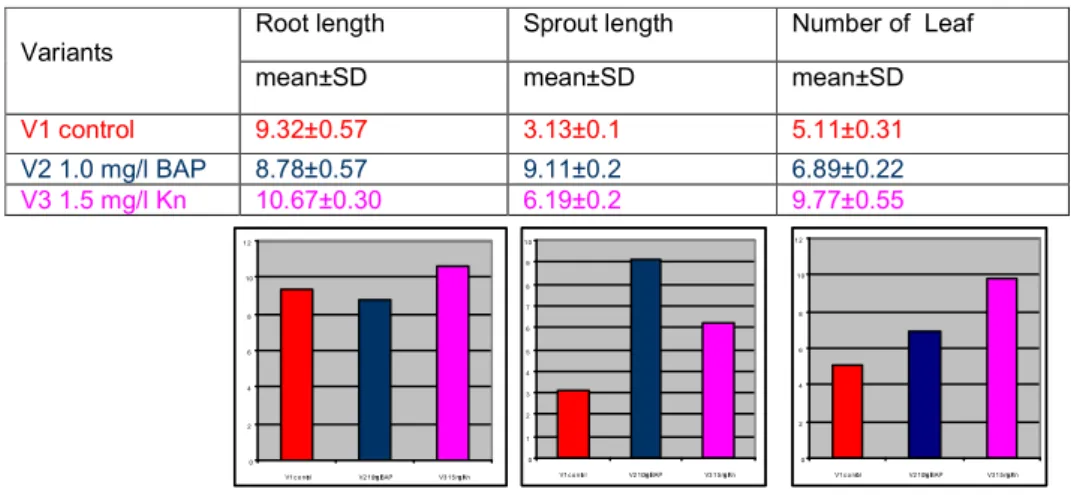
The study was carried out on the basis of the results of two experiments, in vitro and in vivo conditions, for the effect of cytokine growth hormone on peppermint. In the in vitro experiment, cytokines considerably increased the shoot length V2 1,0mg/l BAP and number of leaf V3 1,5 mg/l Kn in comparison with control variant. An increase in shoot length and number of leaf was noticed by all the treatments for in vitro conditions.
Table 1.3 The influence of different concentration of hormones on growth of the root, sprout and leaf in vitro for Mentha piperita L period I(30 days)
Variants
Root length Sprout length Number of Leaf
mean±SD mean±SD mean±SD
V1 control 9.32±0.57 3.13±0.1 5.11±0.31
V2 1.0 mg/l BAP 8.78±0.57 9.11±0.2 6.89±0.22
V3 1.5 mg/l Kn 10.67±0.30 6.19±0.2 9.77±0.55
Also the effect of cytokines on the root growth of peppermint can be seen in table 1.3. for 1,0 mg/l BAP and 1,5 mg/l Kn concentrations we saw different effect from control group on length. For variant V2 it had decreased the effect on root length, the reason could be due to the application of 1.0 mg/l BAP which has intensely decreased on the other hand the shoot biomass and shoot length is increasing due to the application of 1.5 mg/l Kn for the variant V3. For the vivo conditions the experiment were immersed with solutions of 1.0 mg/l BAP and 1.5 mg/l Kn. In the experiment, cytokines considerably increased the shoot length and number of leaf for V3 1.5 mg/l Kn in comparison with control variant. Also the effect of cytokines on the root growth of peppermint can be seen in table 1.4 for 1.0 mg/l BAP and 1.5 mg/l Kn concentrations we saw different effect from control group on length.
Table 1.4 - The influence of different concentration of hormones on growth of the root, sprout and leaf in vivo for Mentha piperita L period I(30 days)
Variants
Root length Sprout length Number leaf
mean±SD mean±SD mean±SD
V1 control 10.32±07 6.00±0.1 5.21±0.3
V2 1.0 mg/l BAP 9.78±0.7 5.52±0.2 6.39±0.1
V3 1.5 mg/l Kn 8.67±0.3 7.12±0.3 7.67±0.2
0 2 4 6 8 10 1 2
V1 c o n trol V2 1.0 mg /l BAP V3 1.5 mg /l Kn 0 1 2 3 4 5 6 7 8 9 1 0
V1 c o n tro l V2 1.0 mg /l BAP V3 1 .5 mg /l Kn 0 2 4 6 8 1 0 1 2
V1 c o n tro l V2 1.0 mg /l BAP V3 1 .5 mg /l Kn
0 1 2 3 4 5 6 7 8
V1 c o n tro l V2 1 .0 mg /l BAP V3 1 .5 mg /l Kn 0 1 2 3 4 5 6 7 8 9
1 2 3
7 .5 8 8 .5 9 9 .5 1 0 1 0.5
270
All of the concentrations of 1.0 mg/l BAP and 1.5 mg/l Kn decreased the root length. The effect of concentration of 1.0 mg/l BAP and 1.5 mg/l Kn on root length was significantly lower than the control.
CONCLUSIONS
For in vitro and in vivo conditions compared to the control statistically seed germination percentage decreased when exposed to concentrations of 1.0 mg/l BAP and 1.5 mg/l Kn compared to control caused to the inhibited germination. In the in vitro experiment.
Cytokines considerably increased the shoot length V2-1.0mg/l BAP and number of leaf V3-1.5 mg/l Kn in comparison with control variant. The effect of cytokines on the root growth of Mentha piperita for variant V2 it had decreased the effect on root length. An increase in shoot length and number of leaf was noticed by all the treatments for in vitro conditions. For in vivo experiment cytokines considerably increased the shoot length and number of leaf for V3-1.5 mg/l Kn in comparison with control variant. All of the concentrations of 1.0 mg/l BAP and 1.5 mg/l Kn decreased the root length. The effect of concentration of 1.0 mg/l BAP and 1.5 mg/l Kn on root length was significantly lower than the control.
REFERENCE
1) Bosela Kh. A and Smik GK (1977) Biomorphological changes in Mentha piperita and Mentha crispa caused by growth regulators . Ukrains Kiu Botanichnii Zhurnal 34 : 95-99 . From Hort Abstr (1978) 48 : 2696
2) Chathurani G.D.G.. Subasinghe S.. Jayatilleke M.P. 2006. In-vitro establishment. germination and growth performance of Red Sandalwood (Pterocarpus santalinus L.). Trop. Agric. Res. Extension 9: 117–130
3) Daffalla M.H.. Abdellatef E.. Elhadi E.A.. Khalafalla M.M. 2011. Effect of growth regulators on in vitro morphogenic response of Boscia senegalensis (Pers.) Lam. Poir. using mature zygotic embryos explants. Biotechnol. Res. Int. 2011:
4) El-Keltawi NE and Croteau R 1987 Influence of foliar applied cytokinins on growth and essential oil content of several members of lamiaceae . Phytochemistry 26 : 891-895 5) Nathiya S.. Pradeepa D.. Devasena T.. Senthil K. 2013. Studies on the effect of
sucrose. light and hormones on micropropagation and in vitro flowering of Withania somnifera var. Jawahar-20. J. Anim. Plant Sci. 23: 1391–139
6) Murashige T & Skoog F, 1962Physiol Plant, 15: 472-497.
7) Samuel. K.. Debashish. D.. Madhumita. B.. Padmaja G.. Prasad S.R.. Bhaskara V.. Murthy R.. Rao P.S. 2009. In vitro germination and micropropagation of Givotia rottleriformis Griff. In Vitro Cell. Dev. Biol. Plant 45: 466–473.