412
ECO-PHYSIOLOGICAL ASPECTS REGARDING THE VEGETATION
FROM BALUTEI GORGE- MEHEDINTI PLATEAU, ROMANIA
BUSE DRAGOMIR LUMINITA, NICOLAE ION, NICULESCU MARIANA
Key words: drought, water content, transpiration, photosynthesis
ABSTRACT
Located in the south-western part of Romania, in the Mehedinti Plateau, Balutei Gorge are distinguished by their geological structure and a climate with submediterranean influences.
The vegetation, mainly represented by thermophilous species, is dominated by Fraxinus ornus, Syringa vulgaris and Cotinus coggygria shrubs. The large number of orchid species that are present in this area give it a great conservative importance.
Under the climatic conditions of the 2017 year, characterized by very small amounts of rainfall, the plants were heavily affected
Thus, there were very low water content in tissues, low values of photosynthesis intensity, very small amounts of accumulated biomass.
Therefore, the perennial species from this area may be in danger, because the amount of assimilated substances that have to be translocated in the reserve organs before entering the resting state is insufficient.
INTRODUCTION
Placed in Mehedinti Plateau, Balutei Gorge are the only keys of great size and importance from the territory of Ponoarele.
They have a length of about 1 km and are located near the village of Baluta, being bordered by Cornetul Balutei and Raienilor, with limestone walls with heights measuring between 300-400 m.
The mild climate, with submediterranean influences alongside with the geological structure and relief, were favorable conditions for the formation and preservation of a vegetation that has a great scientific value, as well as for a great landscape ( fig. 1).
Under the climatic conditions of 2017, the very small amount of precipitation and very high temperatures have accentuated the soil drought, characteristic for the limestone slopes. For this reason, it was important to know the physiological reaction of plants to these extreme conditions.
Analele Universităţii din Craiova, seria Agricultură – Montanologie – Cadastru (Annals of the University of Craiova - Agriculture, Montanology, Cadastre Series)Vol. XLVII 2017
413
(Ingram and Bartels, 1996 cited by Chaves M.M., Oliveira M.M, 2004). It is well known that a major effect of decreased water availability is diminished leaf carbon fixation (A) due to stomatal closure, which may start at moderate plant water deficits. At the whole plant level, total carbon uptake is further reduced due to the concomitant or even earlier inhibition of growth. It has been shown that cell division and expansion are directly inhibited by water stress (Zhu, 2001 cited by Chaves M.M., Oliveira M.M, 2004).
Fig.1. Balutei Gorge ( original photo)
MATERIAL AND METHOD
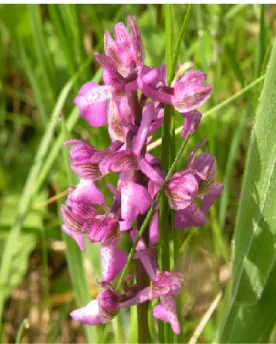
Research has been carried out on two ligneous species : Fraxinus ornus, Syringa vulgaris, and two orchid species that were abundant in the area: Orchis tridentata ( fig. 2) and Orchis morio ( fig. 3).
The determination period was 1 May – 30 June 2017.
Physiological researches consisted in the analysis of physiological processes (photosynthetic intensity, transpiration intensity) as well as physiological indexes (active photosynthetic radiation, leaf temperature, stomatal conductance) using the Lci portable analyser.
The chlorophyll content was determined using the portable Minolta SPAD 502 chlorophyllmeter.
414
Fig. 2. Orchis tridentata ( original photo)
Fig. 3. Orchis morio (original photo)
RESULTS AND DISCUTIONS
The intensity of photosynthesis
In May, in soil and climatic conditions of the researched area, the highest value of the photosynthesis intensity (9.23 μmol / m2 / s) was recorded in Syringa vulgaris at an active photosynthetic radiation value of 1027 μmol / m2 / s, a leaf temperature of 25.6 ° C and a stomatal conductance value of 0.05 mol / m2 / s ( gr.1).
Analele Universităţii din Craiova, seria Agricultură – Montanologie – Cadastru (Annals of the University of Craiova - Agriculture, Montanology, Cadastre Series)Vol. XLVII 2017
415
At the two orchid species, at the end of May, during the blooming period, photosynthesis had a maximum value of 6.41 μmol / m2 / s for Orchis morio and 5.94 for Orchis tridentata at an active photosynthetic radiation of 1093 μmol / m2 / s, leaf temperature of 28.2 ° C and a stomatal conductance of 0.07 mol / m2 / s.
In June, at an active photosynthetic radiation of 1292 μmol / m2 / s), a leaf temperature of 33.2 ° C and a stomatal conductance of 0.02 mol / m2 / s, Syringa vulgaris had the intensity of photosynthesis of 3, 68 μmol / m2 / s, and Fraxinus ornus, of 3.23 μmol / m2 / s ( gr.1).
Orchis tridentata had a photosynthesis intensity of 2.56 μmol / m2 / s, and the lowest photosynthetic intensity was recorded at Orchis morio (2.33 μmol / m2 / s).
The much lower photosynthesis values recorded in June are due to higher temperatures and low soil and air humidity, with negative implications for stomatal opening and stomatal conductance.
Gr. 1. The intensity of photosynthesis (µmol/ m2/s)
The intensity of transpiration
In the researched area, the highest transpiration intensity (3.21 mmol / m2 / s) was registered in May at Orchis tridentata, at an active photosynthetic radiation value of 1093 μmol / m2 / s, a leaf temperature of 28, 2 ° C and a stomatal conductance value of 0.07 mol / m2 / s ( gr.2).
Similar values of the transpiration intensity were recorded in Orchis morio (3.16 mmol / m2 / s).
The lowest intensity of transpiration was recorded in Syringa vulgaris (1.18 mmol / m2 / s) at an active photosynthetic radiation of 1114 μmol / m2 / s, a leaf temperature of 27.5 ° C and a stomatal conductance of 0.06 mol / m 2 / s.
In June, the transpiration intensity recorded the lowest value in Syringa vulgaris (1.21 mmol / m2 / s), the other three studied species showing close values: 1,45 mmol / m2 / s in Orchis morio, 1,43 mmol/ m2/s in O. tridentata, 1.39 mmol / m2 / s in Fraxinus ornus)( gr.2).
0 2 4 6 8 10 12
Syringa vulgaris Fraxinus ornus Orchis morio Orchis tridentata
May
Gr. 2. The intensity of transpiration (mmol/ m
The chlorophyll content of the leaves
In the case of Syringa vulgaris
units, correlating with the higher value of the photosynthesis intensity. In June, the amount of chlorophyll recorded was 29.1 SPAD units.
At Fraxinus ornus, the average value recorded in May was of 32.6 SPAD units, while in June it decreased to 26.1 SPAD
Of the two orchid species,
(53.7 SPAD) compared to Orchis tridentata had the same mean values (27 SPAD units), amount of pigments( gr.3).
The total water conten
In Syringa vulgaris, in May, the total leaf water content averaged 63.4%. In June, this dropped to 54.1%, indicating a negative water balance in the plant.
A significant reduction in wat in May to 57.2% in June).
In orchid leaves, the average water content was of 79% at at Orchis tridentata, and in June 58% at
Recorded data show the fact that all plants that have been taken into study have been severely affected during the long period of drought. Due to this, the vegetation period decreased significantly. 0 0.5 1 1.5 2 2.5 3 3.5 Syringa vulgaris 416
Gr. 2. The intensity of transpiration (mmol/ m2/s )
The chlorophyll content of the leaves
Syringa vulgaris, in May, the content of chlorophyll was 41.7 SPAD correlating with the higher value of the photosynthesis intensity. In June, the amount of chlorophyll recorded was 29.1 SPAD units.
, the average value recorded in May was of 32.6 SPAD units, while in June it decreased to 26.1 SPAD units.
Of the two orchid species, Orchis morio showed a higher chlorophyll content in May Orchis tridentata (48.6 SPAD units), but in June, both species had the same mean values (27 SPAD units),indicating a significant reduction in the
content of the leaves
, in May, the total leaf water content averaged 63.4%. In June, this dropped to 54.1%, indicating a negative water balance in the plant.
A significant reduction in water content was recorded in Fraxinus ornus
In orchid leaves, the average water content was of 79% at Orchis morio , and in June 58% at O. morio and 56% at O. tridentata
data show the fact that all plants that have been taken into study have been severely affected during the long period of drought. Due to this, the vegetation period
Fraxinus ornus Orchis morio Orchis tridentata
, in May, the content of chlorophyll was 41.7 SPAD correlating with the higher value of the photosynthesis intensity. In June, the amount
, the average value recorded in May was of 32.6 SPAD units,
showed a higher chlorophyll content in May (48.6 SPAD units), but in June, both species indicating a significant reduction in the
, in May, the total leaf water content averaged 63.4%. In June, this dropped to 54.1%, indicating a negative water balance in the plant.
Fraxinus ornus (from 71.3%
Orchis morio and 77% O. tridentata ( gr.4).
data show the fact that all plants that have been taken into study have been severely affected during the long period of drought. Due to this, the vegetation period
may
Analele Universităţii din Craiova, seria Agricultură Montanology, Cadastre Series)Vol. XLVII 201
Gr.3. The chlorophyll content of the leaves ( SPAD units)
Gr.4. The total water content of the leaves (%)
It is known that the duration of the vegetation period is decisive for the CO and for the annual yield of production.
Even with a rather modest CO
enough, an appreciable gain of biomass is achieved.
If CO2 assimilation is possible only for a relatively short time, even if the plants have a high photosynthetic capacity, the yield of production
In this case, the duration of the vegetation period, as well as the photosynthetic yield have decreased. This has led to a reduction in the amount of reserve substances required for winter survival.
The data presented reveals that under the climatic conditions of the summer of 2017, the plants in the investigated area were severely affected.
0 10 20 30 40 50 60 Syringa vulgaris 0 10 20 30 40 50 60 70 80 Syringa vulgaris
Analele Universităţii din Craiova, seria Agricultură – Montanologie – Cadastru (Annals of the University of Craiova I 2017
417
Gr.3. The chlorophyll content of the leaves ( SPAD units)
Gr.4. The total water content of the leaves (%)
It is known that the duration of the vegetation period is decisive for the CO and for the annual yield of production.
Even with a rather modest CO2 assimilation intensity, if the vegetation period is long enough, an appreciable gain of biomass is achieved.
assimilation is possible only for a relatively short time, even if the plants have a high photosynthetic capacity, the yield of production remains very low.
In this case, the duration of the vegetation period, as well as the photosynthetic yield have decreased. This has led to a reduction in the amount of reserve substances
CONCLUSIONS
reveals that under the climatic conditions of the summer of 2017, the plants in the investigated area were severely affected.
Syringa vulgaris
Fraxinus ornus
Orchis morio Orchis tridentata
Syringa vulgaris
Fraxinus ornus Orchis morio Orchis tridentata
Annals of the University of Craiova - Agriculture,
Gr.3. The chlorophyll content of the leaves ( SPAD units)
It is known that the duration of the vegetation period is decisive for the CO2 balance
assimilation intensity, if the vegetation period is long
assimilation is possible only for a relatively short time, even if the plants have remains very low.
In this case, the duration of the vegetation period, as well as the photosynthetic yield have decreased. This has led to a reduction in the amount of reserve substances
reveals that under the climatic conditions of the summer of
May
June
May
418
Although they are drought-tolerant species, they have recorded very low levels of photosynthesis since June, a significant reduction in water content in tissues and a decrease in chlorophyll content. .
The reduction in the period of vegetation, as well as the photosynthetic yield, have negative effects on plants, as they cause a decrease in the amount of reserve substances that are necessary for survival during the winter.
BIBLIOGRAPHY
1. Atanasiu L. 1984, Ecofiziologia plantelor, Ed. Ştiinţifică şi Enciclopedică, Bucureşti, 2. Blum A.,2005, Drought resistance, water use efficient and zeld potential- are thez compatible, dissonant or mildlz exclusive, CSIROPublisching, Australia Journal of Agriculture
3. Chaves M.M., Oliveira M.M, 2004, Mechanisms underlying plant resilience to water deficits: prospects for water-saving agriculture , Journal of Experimental Botany, Volume 55, Issue 407 2365–2384
4. Ciocirlan V., 2000, Flora ilustrata a Romaniei, Ed. Ceres, Bucuresti
5. Farooq M. et all. 2008, Plant drought stress: effects, mechanisms, management, INRA, EDP Sciences
6. Roman N., 1974, Flora si vegetatia din sudul Podisului Mehedinti, Ed. Acad.RSR 7. ***Catalogul Info Natura 2000