106
Ahmad Fauzi Sulton
Queen Al-Falah Islamic Boarding School Kediri, Indonesia [email protected]
Abstract: This study aims to find what maxims and how the maxims are observed or infringed in text your sayof The Jakarta Post based on the cooperative principle and maxims. The research design of this study is descriptive qualitative. The resercher himself is the main instrument. He uses typological analysis (based on categories). In addition, investigator triangulation is usedtovalidate the analysis. The research results show that all maxims are observed and infringed. In this case, the most comments (42 comments from 53) gathered in „text your say’ of The Jakarta Post do not match the cooperative principle and they also infringe and observe one or some of the maxims.
Key Words: comments, cooperative principle, maxims
INTRODUCTION
Mass media are means of public communication (Walter, 2008). These mass media consist of the printed mass media and the electronic mass media. Those become inseparable parts of society‟s life. One of the most preferred mass media for communication is newspaper. This is because it reaches more audience and it contains all kinds of information related to various topics like socialism, politics, current affairs, etc. Therefore, the newspaper is an effective medium in general for communicating, disseminating information and sharing views, ideas and opinions among the society.
107
firsthand communication and to build opinions, which every stratum of society is easier to consume. In addition, it becomes an effective medium to take part in social control and to bestow current information about governments, politics, society, etc. Moreover, there is one of the mass media engaging the society to impart comments about hot and current issues. In this case, The Jakarta Post could provide a question in whichreaders could be involved in imparting comments about hot and recent issues in the column of „text your say’. Then, the readers could answers throughshort message servises (SMS), facebook, email or twitter.
Comment is what someone says or writes related to their opinion. Here, the comments in „text your say’ of The Jakarta Postshows public views in relation to governmental policies and current issues occured amongsociety. The above explained reasonsencourage the writer as the reader of The Jakarta Post is interested in analyzing the comments in text your say of The Jakarta Post usingcooperative principle as one of the theories of discourse analysis.
Discourse analysis is a way of analyzing a sentence or a paragraph that contains a message in order to discover more about itused either in spoken or written. Gee (2011) stated that discourse analysis is the study of language in use. In addition, Schiffrin and Tannen (2001) define discourse as anything beyond the sentence. Furthermore, Boey (1975) stated that discourse is the study of relationship between language and context in which it is used. In this case, language is not only a system of communication (Corder, 1993), consisting of sounds and words but also it consists of more than just a sentence. This means that language contains of messages needed to be well transferred. Hornby (2010) defines communication as a method of sending information. In addition, Cook (1989) states that communication is how people create meaning and make sense of what is said in a specific conversation.
108
react to each other either to ask a question or to inform ideas in a dialogue.
Dialogue (Yesufu, 2008) is a conversation between two or more people. In dialogue, people engage in a conversation or in a communication. They share ideas, opinions, and assumptions for the purpose of acquiring a higher level of understanding. The aim is to surface and fully explore all relevant information, which is clarified and fully understood by others.
In this research, the writer analyzes a dialogue, one of the communication interaction types as explained above. In „text your say‟ of The Jakarta Post, there is a dialogue consisting of two participants, The Jakarta Post and the comment-imparting persons, talking about hot and recent issues. And the dialogue will be analyzed using the cooperative principle and its maxims.
Cooperative principle is a set of rules created to help communicate well in the talk exchange as Grice (1991) stated that each participant recognizes cooperative efforts, a common purpose or set of purposes, or at least a mutually accepted direction. The cooperative principle explains how the effective communication is acquired in common social situation. Grice has a belief upon conversing, the speaker and the listenershare cooperative efforts so conversing in a dialogue can run well either in spoken or in written media.Grice(in Renkema, 1993) stated that the cooperative principle makes your conversational contribution such as is required, at the stage at which it occurs, by the accepted purpose or direction of the speech exchange in which you are engaged.Then, Grice divides the cooperative principle into four categories or maxims (quality, quantity, manner and relevance).
109
imparts an example“If, at a particular stage I need four screws, I expect you to hand me four, rather than two or six” (Grice, 1991). Here is the Grice‟s maxim of quantity that can be infringed through providing utterances of patent tautologies like Women are women and war is war (Grice, 1991). It is included as infringing because such remarks are totally non-informative.
The second category is maxim of quality. The Grice‟s maxim of quality expects your contribution to be genuine and not spurious. He formulated the maxim of quality as follows: 1) Do not say what you believe to be false, 2) Do not say that for which you lack adequate evidence.The Grice‟s maxim of quality (Grice, 1991) says that I expect your contributionto be genuine and not spurious. Then Grice imparts an example “If I need sugar as an ingredient in the cake you are assisting me to make, I do not expect you to hand me salt; if I need a spoon, I do not expect a trick spoon made of rubber” (Grice, 1991).
Here is the Grice‟s maxim of quality that can be infringed through imparting information using some figures of speech (Grice, 1991). Irony is a means of expression which suggests different, usually humorous or angry meaning for the words used (Mayor, 2009). For instance, he is so kind but actually he is not kind.Metaphor is an expression which describes a person or object in a literary way by referring to something that is considered to have similar characteristics to the person or object you are trying to describe (Hornby, 2010). For example, she is the sugar in my tea. Hyperbole is the use of exaggerated terms not in order to deceive but to emphasize the importance or extent of something (Drabble, 1985). For example, every handsome boy loves a shopkeeper.
110
speech are considered as infringing the maxim of quality because it is contrary to the fact as stated by Grice to utter the truth.
The third category is the maxim of relevance. The Grice‟s maxim of relevance expects a partner‟s contribution to be appropriate to the immediate needs at stage of the transaction. The Grice‟s maxim of relevance saysthat I expect a partner‟s contribution to be appropriate to the immediate needs at stage of the transaction. Then Grice imparts an example “if I am mixing ingredients for a cake, I do not expect to be handed a good book or even an oven cloth (though this might be an appropriate contribution at a later stage)” (Grice, 1991).
The fourth category is maxim of manner. The Grice‟s maxim of manner expects partner to make it clear what contribution he is making and to execute his performance with reasonable dispatch. Grice (in Renkema, 1993) formulated this maxim as follows: 1) Avoid obscurity of expression, 2) Avoid ambiguity, 3) Be brief (avoid unnecessary prolixity), 4) Be orderly.The Grice‟s maxim of mannersays that I expect partner to make it clear what contribution he is making and to execute his performance with reasonable dispatch.
In this research, the researcher uses the cooperative principle and its maxims to analyse comments in „text your say’ of The Jakarta Post that requests readers‟ comments relating to hot and recent issues that happen among the society. From the above phenomenon, the researcher intended to investigate written comments in „text your say’ of the Jakarta Post in relation to what maxims and how the maxims are observed and infringedbased on the cooperative principle and its maxims.
RESEARCH METHOD
111
(asking and bestowing comments) based onthe cooperative principle and its maxims (quality, quantity, manner, and relevance).
The researcher becomes a planner, a datum collector, an analyzer, an interpreter and finally the researcher becomes a reporter of his research findings. The main instrument of the study is the researcher himself to collect, analyse, interprete and report the data.
The data of this study are written-comments, a sentence and a paragraph. The focus of this study is concerning about the analysis of what maxims and how the maxims in the Text Your Say of the Jakarta Post are observed and infringed.
The researcher usesa typological analysis. The typological analysis is “dividing everything observed into groups or categories on the basis of some canon for disaggregating the whole phenomenon under the study” (Le Comte& Preisle , 1993). In analysising the data, the researcher divided the overall comment data set into categories (maxims) or groups based on the predetermined typologies. To check the validity of analysis, the researcher uses investigator triangulation as technique used to enhance the level of confidence in the findings that the researcher gets. The researcherasked the suggestion from the two advisors, the first and the second advisors, of this research because this research needs more than one persons to check the result of the conducted research.
FINDINGS AND DISCUSSIONS
112
Data 1: Three Police Officers Killed in Papua (Monday, December 3, 2012)
Context:
Your comment on the death of three officers in the latest attacks on security personnel in the impoverished, natural resource rich province of Papua:
Comment:
How come a resource rich province impoverished? The answer to the question is the solution to the problem! TACO DE VRIES
The analysis of the data above is as follows. a. Maxim of quantity
The Grice‟s maxim of quantity expects your contribution to be neither more nor less than is requested. This comment is included as infringing the Grice‟s maxim of quantity because it bestows inappropriate information and furthermore that is out of the requested comment.
b. Maxim of quality
The Grice‟s maxim of quality expects your contribution to be genuine and not spurious. From the comment, this data is included as infringing the Grice‟s maxim of quality because this comment contains a rhetorical question. The rhetorical question is intended to produce an effect rather genuinely to get an answer
c. Maxim of relevance
The Grice‟s maxim of relevance expects a partner‟s contribution to be appropriate to the immediate needs at stage of the transaction from the comment. This datais included as infringing the Grice‟s maxim of relevance because this imparted comment which is not related to what is being discussed. In addition, the comment is out of the requested response about “three police officials killed in Papua”. d. Maxim of manner
113
words like “answer” similar to “solution” and “question” similar to “problem” called verbosity.
Data 2: Andi’s Deaparture (Wednesday December 12, 2012) Context:
Your comments on youth and sports minister Andi Mallarangeng who announced his resignation at a press conference on Friday after the Corruption Eradication (KPK) named him a graft suspect.
Comment:
This is how it should be. Every public official who is named a graft suspect should step down until the court finds hem or her not guilty. The youth and sports minister is an honorable person. KETUT, DENPASAR, BALI
The analysis of the data above is as follows. a. Maxim of quantity
The Grice‟s maxim of quantity expects your contribution to be neither more nor less than is requested. Here, this datais considered as observing the Grice‟s maxim of quantity because this comment contains appropriate response based on the question and furthermore this is informative as is required.
b. Maxim of quality
The Grice‟s maxim of quality expects your contribution to be genuine and not spurious. From the comment, this data is considered as observing the Grice‟s maxim of quality because this contains adequate evidence.
c. Maxim of relevance
The Grice‟s maxim of relevance expects a partner‟s contribution to be appropriate to the immediate needs at stage of the transaction. Here, this data is considered as observing the Grice‟s maxim of relevance because this comment contains appropriate response.
d. Maxim of manner
114
Grice‟s maxim of manner because this comment contains no infringement of all items of the maxim of manner.
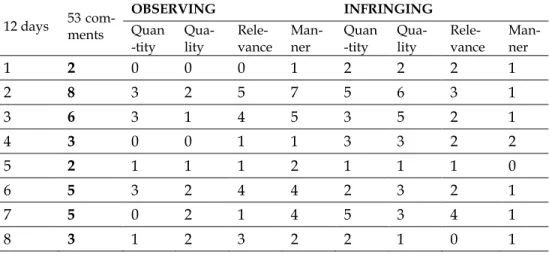
From the the overal analysis of 53 comments during 12 days in text your say, the researcher found that all examples of observances and infrigements of the Grice‟s maxims (of quantity, quality, relevance and manner). Here is the table that shows the amount of comments observing and infringing the Grice‟s maxims in cooperative principle conducted in „text your say’ of The Jakarta Post. The number of comments gathered is 53 comments presented in table 1.
The results of the research show that there are all maxims which are observed and infringed in text your say. The reasons for the number of observances and infrigements of maxims from the above comment-data table are classified into seven:
1. The number of comments observing the Grice‟s maxim of quantity is strightly lower than the number of comments infringing the Grice‟s maxim of quantity. It is because the comment-imparting people give inappropriate information (to show what they really want to say rather than to fulfill the requested comments) or give more information than is requested. From the 53 comments, there are 21 observing comments and 32 infringing comments.
Table 1 the amount of comments observing and infringing the Grice’s maxims in cooperative principle conducted in ‘text your say’ of The
Jakarta Post
12 days 53 com-ments
OBSERVING INFRINGING
Quan -tity
Qua-lity
Rele-vance
Man-ner
Quan -tity
Qua-lity
Rele-vance
Man-ner
1 2 0 0 0 1 2 2 2 1
2 8 3 2 5 7 5 6 3 1
3 6 3 1 4 5 3 5 2 1
4 3 0 0 1 1 3 3 2 2
5 2 1 1 1 2 1 1 1 0
6 5 3 2 4 4 2 3 2 1
7 5 0 2 1 4 5 3 4 1
115
9 4 3 3 4 4 1 1 0 0
10 4 1 1 2 4 3 3 2 0
11 7 5 3 5 5 2 4 2 2
12 4 1 1 2 3 3 3 2 1
Total 21 18 32 42 32 35 21 11
2. The number of comments observing the Grice‟s maxim of quality is strightly lower than the number of comments infringing the Grice‟s maxim of quality. It is because the comment-imparting people form accusing opinions that lacks of enough evidence or use some figures of speech. From the 53 comments, there are 18 observing comments and 35 infringing comments.
3. The number of comments observing the Grice‟s maxim of relevance is strightly higher than the number of comments infringing the Grice‟s maxim of relevance. It is because the comment-imparting people‟s contribution is appropriate to the immidiate needs at each stage of the transaction. From the 53 comments, there are 32 observing comments and 21 infringing comments.
4. The number of comments observing the Grice‟s maxim of manner is significantly higher than the number of comments infringing the Grice‟s maxim of manner. It is because most of the comment-imparting people are educated people therefore the educated people are easy to transfer ideas into written comments. From the 53 comments, there are 42 observing comments and 11 infringing comments.
116
6. The above table shows that the number of observing the Grice‟s maxim of manner is the highest of the other maxims. It is because most of the comment-imparting people are educated.
7. The above table shows that the number of infriging the Grice‟s maxim of quality is the highest. It is because the comment-imparting persons have no reasons to form valuable opinions in ‘text your say’ of The Jakarta Post rather than to form accusing opinions that lacks of enough evidence and use some figures of speeches like hyperbole, metaphore, rethorical speech, irony and understatement.
CONCLUSIONS
The result of analysis shows that most comments (42 comments from 53 comments gathered during 12 days from December 3, 2012 to December 15, 2012) in „text your say’ of The Jakarta Post do not match the cooperative principle and also infringes and observe one or some of the maxims (the highest number of observance is the Grice‟s maxim of manner while the highest number of infrigement is the Grice‟s maxim of quaity). On the other hands, there are only eleven comments (5.3.2, 6.4.3, 8.5.1, 9.5.1, 9.5.2, 9.5.4, 10.5.1, 11.6.1, 11.6.3, 11.5.4, and 12.7.4) which observe the maxims from 53 comments available within 12 days. Therefore, the data show that most comments in ‘text your say’are inappropriate to the cooperative principle and its maxims because the comment-imparting persons observe one or some maxims of cooperative principle and infringe one or some maxims of cooperative principle.
REFERENCES
Best, J. W. (1991).Research in Education. New Jercey: Practice-Hall.
Boey, L. K. (1975).AnIntroduction to Linguistics for the Language Teacher. Singapore: University Press.
117
Corder, S. P. (1993). Introducing Aplied Linguistics. Australia: Penguin Education.
Le Comte, D. M., & J., Preisle (1993).Ethnography and Qualitative Design in Educational Research. San Diedo: Academic Press.
Dabble, M. (1985). TheOxford Companion to English Literature. New York: Oxford University Press.
Gee, J. P. (2011). An Introduction to Discourse Analysis. New York: Rutledge.
Grundy, P. (2000). Doing Pragmatics. New York: Oxford University Press.
Hornby,A.S. (2010). Oxford Advanced Learner’s Dictionary. New York: Oxford University Press.
Mayor, M. (2009). Dictionary of Contemporary English. London: Longman Publishing Group.
Renkema, J. (1993). Discourse Studies. New York: John Benjamins Publishing Company.
Ringgenbanch, H. (1999). Discourse in the Language Classroom. USA: The University of Michigan.
Schiffrin, D. & Tannen, D. (2001). The Hand Book of Discourse Analysis. New York: Blackwell Publishers.
Yesufu, A. R. (2008). Elements of Drama. Nigeria: National Open University of Nigeria.