7
OBSERVATIONS ON THE EPIGEOUS COLEOPTERS FAUNA IN SOME
FRUIT APPLE ORCHARDS
ANDRON GEORGEL, TĂLMACIU MIHAI, HEREA MONICA, MANOLE LILIANA, TĂLMACIU NELA
Keywords: Barber soil traps, entomophagous, apple orchard
ABSTRACT
Observations were made at the SC Loturi Service SRL Delesti, Vaslui in a fruit tree apple orchards where a vegetal carpet is made especially of garlands between the rows of trees.
In the plantation it was chosen to maintain the interval between rows as a black the field and as an overworked interval that could influence the local ecosystem conditions, with multiple effects on the quantity and quality of the fruit and finally on the profitability of the apple culture.
To collect the biological material, were used six Barber soil traps which were arranged on a single row of trees at a distance of 10 m between them.
The traps worked for 5 days in each of the three months: April, May, June. In April between 25 and 30, in May between 5 and 10 and in June between 10 and 15
At each collection, the trap material was cleansed by plant debris, and the entomofauna collected was brought to the lab and then the useful and harmful species were identified.
INTRODUCTION
Natural combat, that is population reduction of pests under the influence of factors in agriculture, which are directly adjusted by humans, is achieved due to unfavorable environmental factors and by biotic factors. Entomophagous in the adult or larval stadium attack a significant number of individuals from a species of pests or from several species, which leads to a reduction in pest populations (T. Baicu și A. Săvescu 1978).
In the present paper, observations have been made in the apple tree fruit orchards on entomophagous moving to the surface of the soil.
The second category includes a number of internal factors of the population itself and entomophagous (predators, parasites) and entomopathogens.
MATERIAL AND METHOD
The observations were made in a apple fruit tree orchards belonging to SC Loturi Service SRL Deleşti, Vaslui County, in the year 2017.
For harvesting the material, we have been used the soil traps type Barber.
The traps were placed in the plantation from April to July, with 6 traps at a time using two variants.
V1- black field;
V2- The interval between rows it was grass area.
The traps worked for 5 days in each of the three months: April, May, June.
8
RESULTS AND DISCUSSIONS
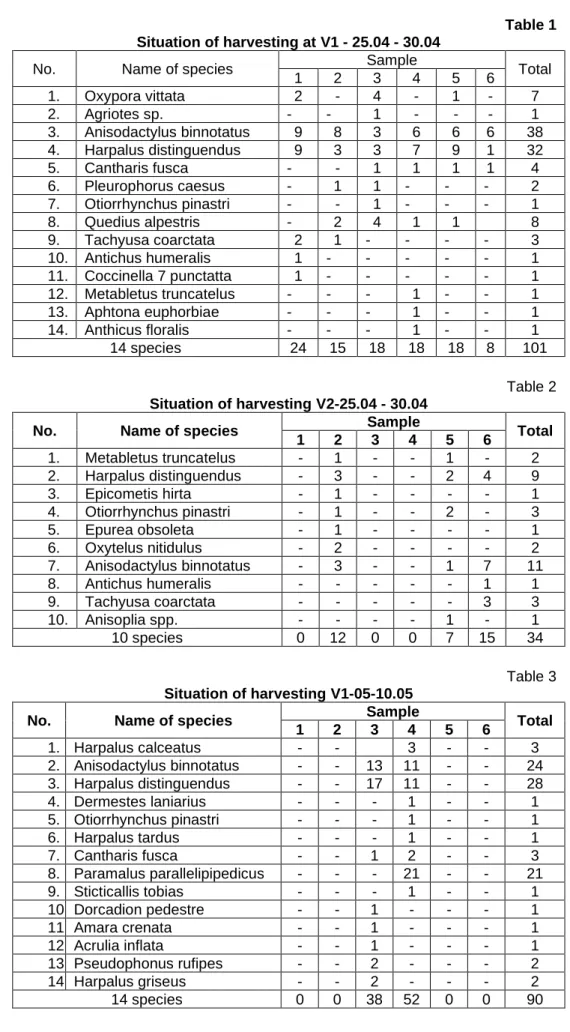
At Variant 1 (table 1), the black field, in April were collected the species of beetles in the total number of 101 specimens in the 6 traps belonging to a number of 14 species.
The species with the highest number of specimens collected were:
Anisodactylus binnotatus F. with 38
specimens and Harpalus distinguendus
Duft. with 32 specimens.
In Variant 2 (table 2), the grass area between interval rows were collected a number of 34 specimens of beetles belonging to a number of 10 species. The species with the highest number of specimens collected were
Anisodactylus binotatus F., with 11
specimens and Harpalus distinguendus
Duft. with 9 specimens.
In May , at 1st Variant (table 3),
black field it was collected 90 specimens of beetles belonging to a number of 14 species. The species with the highest number of specimens were Harpalus
distinguendus Duft. With 28 specimens,
Anisodactylus binotatus with 24
specimens and Paramalus
parallelpipedicus with 21 specimens.
In 2nd Variant (table 4), the grass
area between interval rows were collected specimens as follows: 86 specimens belonging to 16 species. The species with the highest number of
Anisodactylus binotatus with 48
specimens and Harpalus distinguiendus
with 8 samples.
In June at Variant 1 black field (table 5), a number of 59 specimens were collection, belonging to 21 species.
The species with the highest number of collected specimens were
Anisodactylus binotatus and Dermestes
laniarius with 12 specimens.
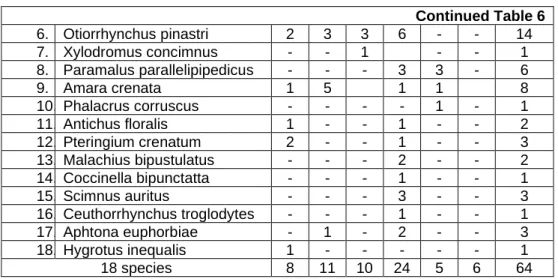
In Variant 2 (table 6), the grass area between interval rows were collected a number of 64 specimens of 18 species.
In the period of observations to the two variants, the situation shall be
presented as follows: at 1st Variant the
black field the largest number of beetles were collected in April, 101 specimens, and at Variant 2 the highest number was collected in May, with 86 specimens. The largest number of species was collected in June in Variant 1, in total number 22, and at Variant 2 the highest number of species were collected also in June, in the total number of 20 (table 7, fig.1).
CONCLUSIONS
The highest number of specimens and species were collected in Variant 1, the
Black the field during the period of observations 250 specimens belonining
to 22 species, respectively 184 specimens and 20 species in Variant 2. 1. The species with the highest number of specimens collected were:
Anisodactylus binotatus with 74
specimens to V1 and 29 specimens to Variant 2 and Harpalus distinguiendus
with 65 specimens to V1 and 29 specimens to V2.
BIBLIOGRAPHY
1. Baicu T. Săvescu A., 1978 - Combaterea integrată în protecţia plantelor, Edit. Ceres Bucureşti
2. Panin S., 1951 - Identification
manualof harmful and useful beetles in
R. P. R .. Publisher of State for scientific
and didactic literature, Bucuresti.
3. Reitter E., 1908-1916- Fauna
Germanica. Die Kafer des Deutschland
Reichs Lutz., Edit. Stuttgardt, Stuttgardt, 5., p. 246, p 392.; p 436.; p 236.; p 342. 4. Tălmaciu M., Mocanu Ionela, Herea Monica, Talmaciu Nela, Manole Liliana,
2016 - Observations on Invertebrates
Fauna Encountered in Some Agricultural
Crops, Full Paper Proceeding NDMRP,
Istanbul, 2, p. 119-129.
5. Tălmaciu Nela, Tălmaciu M., Herea
Monica,2010 - Comparative research on the structure and abundance of beetles in
some orchards, Bulletin of University of
9
Table 1 Situation of harvesting at V1 - 25.04 - 30.04
No. Name of species Sample Total
1 2 3 4 5 6
1. Oxypora vittata 2 - 4 - 1 - 7
2. Agriotes sp. - - 1 - - - 1
3. Anisodactylus binnotatus 9 8 3 6 6 6 38
4. Harpalus distinguendus 9 3 3 7 9 1 32
5. Cantharis fusca - - 1 1 1 1 4
6. Pleurophorus caesus - 1 1 - - - 2
7. Otiorrhynchus pinastri - - 1 - - - 1
8. Quedius alpestris - 2 4 1 1 8
9. Tachyusa coarctata 2 1 - - - - 3
10. Antichus humeralis 1 - - - 1
11. Coccinella 7 punctatta 1 - - - 1
12. Metabletus truncatelus - - - 1 - - 1
13. Aphtona euphorbiae - - - 1 - - 1
14. Anthicus floralis - - - 1 - - 1
14 species 24 15 18 18 18 8 101
Table 2
Situation of harvesting V2-25.04 - 30.04
No. Name of species Sample Total
1 2 3 4 5 6
1. Metabletus truncatelus - 1 - - 1 - 2
2. Harpalus distinguendus - 3 - - 2 4 9
3. Epicometis hirta - 1 - - - - 1
4. Otiorrhynchus pinastri - 1 - - 2 - 3
5. Epurea obsoleta - 1 - - - - 1
6. Oxytelus nitidulus - 2 - - - - 2
7. Anisodactylus binnotatus - 3 - - 1 7 11
8. Antichus humeralis - - - 1 1
9. Tachyusa coarctata - - - 3 3
10. Anisoplia spp. - - - - 1 - 1
10 species 0 12 0 0 7 15 34
Table 3
Situation of harvesting V1-05-10.05
No. Name of species Sample Total
1 2 3 4 5 6
1. Harpalus calceatus - - 3 - - 3
2. Anisodactylus binnotatus - - 13 11 - - 24
3. Harpalus distinguendus - - 17 11 - - 28
4. Dermestes laniarius - - - 1 - - 1
5. Otiorrhynchus pinastri - - - 1 - - 1
6. Harpalus tardus - - - 1 - - 1
7. Cantharis fusca - - 1 2 - - 3
8. Paramalus parallelipipedicus - - - 21 - - 21
9. Sticticallis tobias - - - 1 - - 1
10. Dorcadion pedestre - - 1 - - - 1
11. Amara crenata - - 1 - - - 1
12. Acrulia inflata - - 1 - - - 1
13. Pseudophonus rufipes - - 2 - - - 2
14. Harpalus griseus - - 2 - - - 2
10
Table 4
Situation of harvesting V2-05-10.05
No. Name of species Samples Total
1 2 3 4 5 6
1. Anisodactylus binnotatus - 9 4 16 10 9 48
2. Harpalus distinguendus - 2 5 2 9 - 18
3. Aphodius granarius - - - 1 - - 1
4. Metabletus truncatelus - - - 1 1 2 4
5. Siparia circelaris - - - 3 1 - 4
6. Ceuthorrhynchus troglodytes - - - 1 - - 1
7. Epicometis hirta - - - - 1 - 1
8. Harpalus aeneus - - - - 1 - 1
9. Valgus hemipterus - 1 - - - - 1
10. Harpalus tardus - 1 - - - - 1
11. Pseudocleanus cinereus - - 1 - - - 1
12. Dorcadion pedestre - - 1 - - - 1
13. Colodera aetiops - - 1 - - - 1
14. Monotoma picipes - - 1 - - - 1
15. Tachyusa coarctata - - - 1 1 16. Atomaria nigripenis - - - 1 1 16 species 0 13 13 24 23 13 86 Table 5 Situation of harvesting V1-10-15.06 No. Name of species Samples Total 1 2 3 4 5 6 1. Anisodactylus binnotatus 1 4 - 3 2 2 12 2. Harpalus distinguendus - 1 1 3 - - 5
3. Dermestes laniarius 4 1 4 1 1 2 13 4. Amara crenata - 1 - - - 1 2 5. Phyllotreta atra - 1 2 - - 1 4 6. Antichus humeralis - 1 - - - - 1
7. Crypticus quisquilius - 1 - - - - 1
8. Anthicus floralis - - - - 1 - 1 9. Coccinella 7 punctatta - - - - 1 - 1 10. Ophonus sabulicola - - - - 2 - 2 11. Brachynus explodens - - - - 1 - 1 12. Paramalus parallelipipedicus - - - 1 - 2 3 13. Phalacrus corruscus - - - - - 1 1 14. Harpalus pubescens - - 1 1 - - 2
15. Pterostichus cupreus - - - 1 - - 1
16. Aphtona euphorbiae - - 1 - - - 1
17. Pterostichus niger - - 2 - - - 2
18. Otiorrhynchus pinastri 3 - - - 3
19. Argopus bicolor 1 - - - 1
20. Ceutorhynchus pyrrhorhynchus 1 - - - 1
21. Tachyporus abdominalis 1 - - - 1
21 species 11 10 11 10 8 9 59
Table 6
Situation of harvesting V2-10-15.06
No. Name of species Samples Total
1 2 3 4 5 6
1. Metabletus truncatelus - - 2 1 - 1 4
2. Anisodactylus binnotatus - 2 3 1 - 2 8
3. Harpalus distinguendus - - 1 1 - 1 3
4. Dermestes laniarius - - - 1 1
11
Continued Table 6
6. Otiorrhynchus pinastri 2 3 3 6 - - 14
7. Xylodromus concimnus - - 1 - - 1
8. Paramalus parallelipipedicus - - - 3 3 - 6
9. Amara crenata 1 5 1 1 8
10. Phalacrus corruscus - - - - 1 - 1
11. Antichus floralis 1 - - 1 - - 2
12. Pteringium crenatum 2 - - 1 - - 3
13. Malachius bipustulatus - - - 2 - - 2
14. Coccinella bipunctatta - - - 1 - - 1
15. Scimnus auritus - - - 3 - - 3
16. Ceuthorrhynchus troglodytes - - - 1 - - 1
17. Aphtona euphorbiae - 1 - 2 - - 3
18. Hygrotus inequalis 1 - - - - - 1
18 species 8 11 10 24 5 6 64
Table 7
Species with the highest number of specimens collected
Variant No. Name of species Month Total
April May June
V1 1 Anisodactylus binnotatus 38 24 12 74
2 Harpalus distinguendus 32 28 5 65
V2 1 Anisodactylus binnotatus 11 48 8 67
2 Harpalus distinguendus 9 18 2 29
Fig. 1. Evolution of the number of specimens and species per month and by variants
14 10
101
34
14 13
90 86
22 20
59 64
250
184
0 50 100 150 200 250 300
V1 V2
No. sp April No. specimens April No. sp May No. specimens May