281
STUDY REGARDING THE DEVELOPMENT OF ORGANIC FARMING
SYSTEMS IN ROMANIA AS THE BASIS FOR OBTAINING OF INNOCUITY
AGRICULTURAL RAW MATERIALS – USED IN FUNCTIONAL FOOD
SAVESCU P1*, POENARU MARIA MAGDALENA2, IACOBESCU F.2
1*University of Craiova, the Faculty of Agronomy 2 University of Craiova, the Faculty of Horticulture
*- [email protected] Keywords: organic agricultural system, functional foods, legislation
ABSTRACT
The work paper shows the variation of structures of Organic Agriculture systems in Romania in the last 5 years and the influence of this variation on developing a niche in the bio-economy system Romanian.
Process of non-toxically agricultural raw material is a main condition for the development of functional foods so necessary for healthy consumers.
The work paper presents the influence of national and international legislation in the development and certification of organic agriculture sector.
The change of a new order of the minister of agriculture in 2016 generate the way for new requirements imposed to the Control Body for Organic Agriculture in Romania and the main requirements are presented in summary in this paper.
INTRODUCTION
Simply and clever, organic farming is an agricultural system that seeks to provide to consumer, with fresh, tasty and authentic food while respecting natural life-cycle systems.
In 2007 the European Council of Agricultural Ministers agreed on a new Council Regulation (Council Regulation (EC) No. 834/2007) setting out the principles, aims and overarching rules of organic production and defining how organic products were to be labeled. [1]
The regulation set a new course for developing organic farming further, with the following aims:
-sustainable cultivation systems
-a variety of high-quality local products
-greater emphasis on environmental protection (financed by agricultural-environmental measures)
-more attention to biodiversity (for protect this)
-higher standards of animal protection (for assuring the welfare) -consumer confidence
-protecting consumer interests.
Organic production respects natural systems and cycles. Biological and mechanical production processes and land-related production should be used to achieve sustainability, without having recourse to genetically modified organisms (GMOs).
To achieve this, organic farming relies on a number of objectives and principles, as well as common practices designed to minimize the human impact on the environment, while ensuring the agricultural system operates as naturally as possible.
Typical organic farming practices include:
- Wide crop rotation as a prerequisite for an efficient use of on-site resources - Very strict limits on chemical synthetic pesticide and synthetic fertilizer use,
282
- Taking advantage of on-site resources, such as livestock manure for fertilizer or feed produced on the farm
- Choosing plant and animal species that are resistant to disease and adapted to local conditions
- Raising livestock in free-range, open-air systems and providing them with organic feed
- Using animal husbandry practices appropriate to different livestock species In organic farming, closed cycles using internal resources and inputs are preferred to open cycles based on external resources. If the latter are used, they should be: organic materials from other organic farms, natural substances, materials obtained naturally, or mineral fertilizers with low solubility.
Exceptionally, however, synthetic resources and inputs may be permissible if there are no suitable alternatives. Such products, which must be monitoring by the Commission and EU countries before authorization, are listed in the annexes to the implementing regulation (Commission Regulation (EC) No. 889/2008).
In Romania, in accordance with the article 27 of Regulation (EC) 834/2007, for the organic agriculture sector, have been designated as the competent authority the Ministry of Agriculture and Rural Development (MADR). The Authority work like as the General Directorate of Agricultural Policies and Strategies (the Department of Organic Agriculture and Processed Products) and the Direction of Agriculture of the County and the municipality of Bucharest. In each of these locations is a compartment for the implementation of policies in the field of organic agriculture.
In this year (2016) the Order of Minister (Minister of Agriculture and Rural Development from Romania) no 181/2012 was changed and the new Order of Minister no. 895/2016 (that is in order after 2016, august, 31)[5]. After this new Order and in accordance with the provisions of article no. 27 of Regulation (EC) No. 834/2007, the check powers have been delegated to Control of Inspection and Certification Bodies (CB). According those the official controls performed to ensure the verification of compliance with the legislation on feed and food and animal health standards and animal welfare.
All this is getting to exceptional results and getting to some safe food and agricultural raw materials that can be used successfully in obtaining functional foods.
MATERIAL AND METHOD
Follow analysis of the evolution of organic agriculture sector in Romania and E.U. countries result a number of important issues.
In order to develop the work paper (in the synthesis), have been studying National Legislation, European and International Regulations in this field and we analyzed the practical results achieved. For to develop the practical study and interpretation of the obtained results the essential contribution give the first author as approved responsible for certification in the field of organic farming in the National Inspection and Certification Body for the organic food products[3].
For a good documentary, were studied all EC Regulations: Reg. (EC) No 834/2007, Reg. (EC) No. 889/2008, Reg. (EC) No 1151/2012 and the national legislation Emergency Ordinance 34/2000 (with additions and attachments in 2006), Ministry Order no. 895/2016-in terms of the field of Organic Farm895/2016-ing and Quality Schemes (with the national legislation and Regulations related to) who treat topics related these organic products [1], [5].
RESULTS AND DISCUSSIONS
The aim of certification of products, processes and services is to provide confidence to all parties concerned that a product, process or service fulfils specified requirements.
283
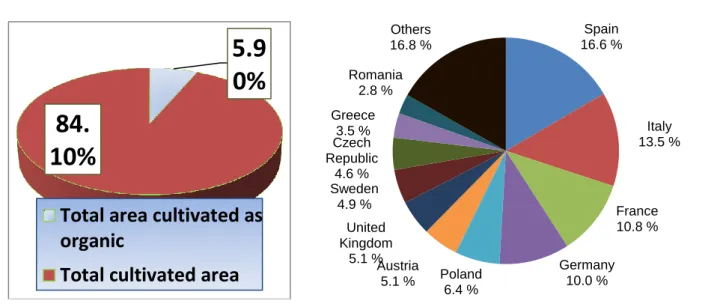
Fig 1 and 2 - Total organic area (fully converter and under conversion), EU-28, after 2014 (the last oficial report), % of total EU-28 area (Source: Eurostat - online data code: org_cropap)
Fig.3. Number of registered operators in organic farming (2006-2016) (Source: www. madr.ro) [5]
According to the latest report of the EU in October 2015, the E.U. organic sector has developed rapidly in recent years. According to Euro stat Data System, in 2014, the EU-28 had a total area of 10.315 million hectares organically cultivated – in 2014, compared to 5.7 million in 2002 [3,9,10]. Although this is a large increase in the area of organic agriculture as a whole is only 5.9 % of the total utilized agricultural area in Europe [figure 1, a]. The organic farming is practiced in more than 190 000 farms in Europe (more than 12 200 organic farms in Romania) [figure 3]. Most organic land (78%) and organic farms (83%) are located in EU Member States that joined the EU before 2000 and the national and European legislation, among other things, helped to stimulate the development of this sector.
The advantages of production in organic farming system in reducing the risks and dangers to food production are grouped into five broad categories [9].
The applied of specific rules for organic farming system can lead to the elimination of hazards, microbiological, physical and chemical properties by:
5.9
0%
84.
10%
Total area cultivated as
organic
Total cultivated area
Spain 16.6 %
Italy 13.5 %
France 10.8 % Germany
10.0 % Poland
6.4 % Austria
5.1 % United Kingdom
5.1 % Sweden
4.9 % Czech Republic
4.6 % Greece
3.5 % Romania
2.8 % Others 16.8 %
0 2000 4000 6000 8000 10000 12000 14000 16000
2006 2007 2008 2009 2010 2011 2012 2013 2014 2015 3409 3834 4191 3228 3155
9703
15544 15280 14553
284
- The management of food additives (removal of some additives that may create a risk to the health of consumers and to those who can produce various toxic compounds as a result of the processing, the use of natural food additives),
- The use of health raw materials, deprived of toxicity (which originated in the area of organic agriculture, the area certified agricultural products, agricultural products which are obtained in areas free from contamination or pollution)
- The management of Operations, equipment and machinery, management of the phenomena of heat transfer, mass, impulse
- the removal of some processing steps that are Critical Control Points, using natural additives (e.g. Some thermal treatments removed using natural preservatives and/or effects that can facilitate and maintain food preservation)
- The introduction of specific processes of Bioengineering and biotechnology and valuable results of the research-development-innovation from these fields
- The application of special systems for further evaluation of the risk according to the zoning of agricultural and processing of food products
- The establishment of a continuous system of measurements of parameters of the process by introducing combined physical and chemical analyses (such as thermo-stability, free) and automation.
Figure 4 - the relationships that must to exist between Organic Agriculture System, Safe Raw Agriculture Products, Safe Food Products
For producing the safe agricultural raw materials must be some measures of risk management - complementary with requirements of organic agriculture system [figure 4]. So, the management of nearly environmental, management of hazards (physical, chemical, microbiological) and critical control points, ensuring of traceability in the very short chain of safe products, ensuring of animal welfare and the management of waste are main categories of requirements for ensuring the safe agricultural raw materials producing.
285
Statistics show that many consumers in the EU are looking for products bearing these organic logos and labels when shopping for groceries or buying a meal in a restaurant or canteen [2].
Studies estimate that the market for organic products in develop state is growing by 10-15% a year [4, 7, 8].
In general, the safety of food is greater with organic than with conventional products. It is important to take a precautionary approach to new technologies, in order to reduce their negative effects on humans, the environment and nature. If labeling, control and certification function properly, the attachment of labels to the food products improves food safety; and in this context the organic label has significant advantages [6].
CONCLUSIONS
- The Agricultural and Food Specialists have a very important role in public information, awareness raising, training and preparation of all stakeholders of organic agriculture; - -The Organic Agriculture is very important for Romania; it is an economic segment which is in a lot of spelling development and produce added value;
- In the European Union is given a special importance of organic agriculture sector growth-through the provisions of the Common Agricultural Policy, that the Ministry of Agriculture and Rural Development together with other Romanian authorities have a very important role in the development of economy in the Horizon of 2014-2020;
- 90 % of Europeans believe that ‘organic’ by definition means ‘GMO-free’. Find out what restrictions exist on pesticides, fertilizers, and antibiotics and how organic farmers create good quality produce through crop rotations and cultivating in season;
-The EU organic logo and labeling is a quick and simple way for consumers to recognize organic produce, and an important step in guaranteeing that organic produce is always of the same high standards.
BIBLIOGRAPHY
1. COM (2004) 415 final din 10.06.2004, Communication from the Commission to the Council and the European Parliament European Action Plan for Organic Food and Farming;
2. http://ec.europa.eu/agriculture/organic/consumer-confidence_en - accessed in September, 01, 2016;
3. http://ec.europa.eu/agriculture/organic/eu-policy/eu-legislation/brief-overview_en- accessed in August, 22, 2016;
4. http://kennuncorked.com/organic_eu.html - accessed in August, 22, 2016;
5. http://www.madr.ro/ro/agricultura-ecologica.html - accessed in September,01, 2016; 6. http://orgprints.org/206/1/Hansen_organic_food_safety.pdf - accessed in August,01,
2016;
7. Paull, J., 2011- "The Uptake of Organic Agriculture: A Decade of Worldwide Development", Journal of Social and Development Sciences, 2 (3), pp. 111-120; 8. Paull, J., 2011 - Organics Olympiad 2011: Global Indices of Leadership in Organic
Agriculture and "Organics Olympiad 2011: Global Indices of Leadership in Organic Agriculture". Journal of Social and Development Sciences 1 (4): 144–150;