Barriers and Facilitators of Adherence to
Pediatric Antiretroviral Therapy Regimens
in Resource Limited Settings:
A Systematic Review and Qualitative Research Plan
By
Bradley C Fetzer
A Master's Paper submitted to the faculty of
the University of North Carolina at Chapel Hill
in partial fulfillment of the requirements for
the degree of Master of Public Health in
the Public Health Leadership Program.
Summary:
Introduction: Good adherence to ART is known to be extremely important for successful suppression of HIV viral load and to improve clinical outcomes in children. However, high rates of adherence, greater than 95%, are needed to achieve these goals. Therefore it is important that clinical and support staff who work with caregivers and their HIV children understand the importance of good adherence and convey this message to their patients. To do this, we need a foundation of knowledge with which to base an adherence theory on and an understanding of the barriers and facilitators to ART adherence. Though much work on understanding ART adherence has been done in developed settings, the majority on adults, there continues to be a paucity of research and lack of guiding theory regarding ART adherence in children in resource limited settings. This is a significant problem, as the number of children living with HIV in
resource limited settings continues to grow, especially in places like sub-Saharan Africa which accounts for 90% of all children living with HIV. Recent scale-up efforts of ART to children in resource limited settings means that adherence has become a highly salient issue. Studies to date on pediatric ART adherence in resource limited settings incorporate a wide array of study populations, study designs, adherence measurement strategies, and definitions of adherence. Drawing conclusions from these studies and development of a culturally appropriate adherence theory has been difficult. Prior studies recommend that more qualitative, formative research will be helpful in the development of such an adherence theory and to help inform the design of more uniform future studies.
Systematic Review:
Objectives: This paper includes a systematic review (Section II) of qualitative research
assessing pediatric ART adherence in resource limited settings. The objective was to obtain a better understanding of what types of qualitative literature exist regarding ART adherence in children in resource limits settings, along with their contributions to the literature.
Methods: I searched online bibliographic databases, including MEDLINE, EMBASE, NLM, Cochrane Database, and various conference abstract databases using systematic criteria. Studies were selected for review that used qualitative methods to assess ART adherence in children less than 18 years of age in resource limited settings. The qualitative findings were extracted and summarized.
Research Plan:
Objectives/Rationale: A research plan was developed to add to our general understanding of why ART regimens are difficult for children in resource limited settings (Section Ill). The objective of this plan was to inform more accurate measurement of adherence and the
development of culturally appropriate best practice ART adherence guidelines. Since little data exists on adherence to pediatric ART regimens in resource limited settings, the Kalembe Lembe (KLL) Pediatric Hospital in Kinshasa, Democratic Republic of the Congo represents a prime target for farther study. Little information exists regarding adherence in Kinshasa. To date, direct assessment of pediatric adherence at KLL has yielded rates well above expected norms of children in similar settings and lack expected variability of adherence rates between subjects. Qualitative methods represent a sensible place to begin study in a new setting. They can be used to inform the development of more valid, culturally appropriate adherence measures and a contextual adherence theory, as well as provide more in-depth information than quantitative studies alone.
Methods: This plan called for a set of 40 qualitative interviews to be administered to HIV positive children taking ART regimens and their caregivers at the KLL Pediatric Hospital. An interview script for adults, HIV status disclosed children, and HIV status non-disclosed children were developed to assess barriers and facilitators to ART adherence in this setting. Demographic information were also collected. Interviewers were trained and interviews were recorded for transcription and translation into English. IRB approval was obtained and the project was begun in June of 2009. Analysis of results will take place following completion of the study.
Feasibility of Research Plan and Lessons Learned:
Table of Contents
I. Introduction ... 5
Background ... 5
General Overview ... 5
ART Adherence in Children ... 6
Aims of the Paper ... 8
Literature Review ... 9
General Overview ... 9
Qualitative Literature Overview ... 13
II. Systematic Review ... , ... 16
Introduction ... 16
Methods ... 17
Results ... 20
Discussion ... 28
Ill. Research Plan ... 35
Overview and Rational. ... 35
Background ... 35
ART Adherence in Kinshasa ... 37
Study Rationale ... 38
Research Plan Procedures and Methods ... 38
Setting ... 38
Subjects, Recruitment, and Consent.. ... 39
Qualitative Interviews ... .41
Benefits and Risks to Participants and Safety Measures ... .44
Compensation to Participants ... .46
Analysis of Data ... 46
IRS Application ... 46
IV. Implementation of Research Plan and Lessons Learned ... .48
Feasibility of Research Plan ... .48
Lessons Learned Conducting International Research ... 50
Acknowledgements ... 52
Bibliography ... 53
Addendum
1:
Research Plan Interview Script. ... 60
I.
Introduction
1. Background
General Overview:
There are over 2.1 million children world-wide living with HIV/AIDS.1 With 370,000 new infections in 2007, this number is continuing to grow, especially in places like sub-Saharan Africa, which accounts for 90% of all children living with HIV.1 Fortunately, over the past decade many low and middle income countries have made commitments to scale up antiretroviral therapy distribution to children. This is partly due to the World Health Organization's (WHO) '3x5' initiative and the Joint United Nations Program on HIV/AIDS (UNAIDS) initiatives for children, which has a goal to provide ART or cotrimoxazole prophylaxis therapy to at least 80% of children in need by 2010.
Progress has been made to increase availability of ART in these settings, thanks to increased advocacy along with the decreasing price of drugs and a focus on infrastructure for pediatric care. In 2007, nearly 200,000 children received ART in resource limited settings, compared with only 75,000 in 2005.2 Within the past 5 years, the US President's Emergency Plan for AIDS Relief (PEPFAR), the Global Fund to Fight AIDS, Tuberculosis and Malaria, the Clinton Foundation, and the international drug purchase facility, have all made significant financial and technical contributions to scaling up pediatric HIV treatment.' This has allowed ART to reach children in even the most remote parts of the world.
Despite the improved availability of ART drugs, adherence remains a problem. ART regimens are complicated for children. While once a day combination dosing is available to adults and older adolescents in some resource limited settings, younger children are typically still on standard therapy with three different drugs. Syrups and solutions are necessary for treating infants and young children who cannot swallow pills. However, these have
shortcomings, which may include limited availability, high cost, storage difficulties, reduced shelf-life, and alcohol excipient or solutions leading to poor palatability. Many other drugs do not have pharmokinetic data on, or formulations suitable for, pediatric dosing.8 Often regimens may require up to 4 doses per day, making routine administration difficult. Fortunately, pediatric fixed dosed regimens and combination ART are becoming more widespread in resource limited settings.
ART Adherence in Children:
Accurately measuring ART adherence in children is extremely important, as it is critical to know the frequency of, and reasons behind, first line ART regimen failures. How often do these regimens fail? Further, is it because first line treatments develop resistance and have become ineffective in reducing viral load levels, or are failure rates due in large part to non-adherence of these mediations? In the latter case, unnecessary switches to expensive alternate or second line regimens may occur, resulting in a failure to address the underlying problem. Without an understanding of true adherence rates and barriers to good adherence, addressing failure of treatment regimens in children becomes a difficult process.
It is known that high levels of ART adherence are required for successful treatment of HIV. Studies show that at least 90% to 95% adherence to ART regimens is needed for optimal virologic suppression and to minimize failure rates.9•11 This level of adherence is recommended
continuing decline of adherence rates. Without adequate adherence to ART, viral resistance, opportunistic infections and ultimately failure of therapy can result.13.15
Adequate adherence to pediatric ART regimens is possible in low and middle income countries.16 In some instances, adherence is equal to or better than rates in higher income countries, where children typically receive increased support and less complex regimes.16 However, in many instances adherence rates are still sub-optimal. Reported rates vary from as low as 49% adherence up to 1 00% adherence rates. In one well conducted systematic review of 17 articles assessing pediatric adherence in low and middle income countries, 13 articles
reported > 75% adherence rates in their study cohort, although only 5 reported >=95% adherence.16 Given that 3 of those 5 studies reporting >95% adherence were patient or caregiver self reports of 100% adherence and did not employ any validation strategies on measurement, it is likely these are overestimates. This review and its findings are addressed in greater detail in the Literature Review: Overview section (Part
1:
Introduction, Section 2).Accurate assessment of adherence in these settings is much more difficult without ready access to objective testing measures, such as viral load or CD4 counts. Though a number of low tech measurement techniques for ART adherence in resource limited settings exist, it is not known which are most reliable or accurate. Evidence suggests that more invasive techniques of measuring adherence tend to yield lower rates of adherence.17"19 For instance, studies
implementing pill counts to determine adherence rates report lower rates than those where clinicians rely on self reported adherence rates during interviews or follow-up visits.
Unannounced home pill counts and Medication Event Monitoring System (electronic
Measurement of ART adherence is thought to be much more complex in children compared with adults, as good adherence often depends on many additional factors.16•2
°
For instance, adherence factors in children can be extremely variable depending on age. Younger children will depend more heavily on the caregiver, whereas older children gain autonomy and become increasingly responsible for taking their own medication as they age.Unfortunately, both younger children and older adolescents may not be aware of their HIV infection, and may not be well informed of the rationale behind taking such a complex regimen of medication. Estimates of HIV status disclosure to children in sub-Saharan Africa range from 75% to as low as 20%.21 Often caregivers who present to the clinics are not the primary care giver at home, making assessment and understanding of poor ART adherence during routine clinic visits challenging. Due to these complex issues there is little consensus on what underlying factors contribute most to pediatric ART adherence in resource limited
settings.16
While numerous studies in adults have been undertaken to better understand adherence in these settings, studies in children have been sparse. To date, quantitative studies in children looking at factors predicative of non-adherence are variable in both their methods and results. Definitions for what is meant by 'adherent', factors measured, and analyses vary widely among published studies. At this time there appears to be a lack of guiding theory in pediatric ART adherence research and no reliable predictors of non-adherence have been established.16• 22.24 Aims of the Paper:
Adherence to pediatric ART regimens has not been well characterized in resource limited settings. A better understanding of barriers and facilitators of adherence is needed to allow development of more accurate measures of adherence.
assessing pediatric ART adherence in resource limited settings justifies the need for a qualitative study.
This paper will also outline a research plan (Section Ill: Research Plan) for a qualitative research study incorporating in-depth, semi-structured interviews to assess pediatric ART adherence at the Kalembe Lembe Pediatric Hospital in Kinshasa, Democratic Republic of the Congo. During the course of the paper I will travel to Kinshasa and work to implement this research plan. Also, I will describe the feasibility of implementing qualitative research in
resource limited settings and lessons learned during the experience (Section IV: Implementation of Research Plan and Lessons Learned).
It is the hope that information gathered frorn this systematic review and research plan will ultimately inform the design of future studies so we can continue to better understand, measure, and ultimately help provide best practice guidelines for improving pediatric ART adherence in Kinshasa and in other resource limited settings.
2. Literature Review:
Overview:
The majority of literature available on pediatric ART adherence in resource limited settings appears to exist in the form of quantitative studies that incorporate statistical methods to determine correlates to non-adherence. The most recent published systematic review on children over viewing this type of literature was completed by Vreeman and colleagues in 2007.16 Their study revealed 17 published studies on this topic. Their aim was to 'compile and critically analyze pediatric ART adherence measurement in resource limited settings to inform adherence monitoring strategies' and to provide 'measurement techniques, adherence
estimates, and clinical correlates to inform ART adherence monitoring.
assessed were children 18 years of age or less, though some studies also incorporated adults as study subjects. Countries included were those of low and middle income as defined by the World Bank.25 All articles were in English and displayed a 'descriptive interventional study describing non-pregnant, HIV positive children that measured ART adherence'.16 No
assessment of quality was undertaken for these studies, other than the initial inclusion criteria. They noted some studies were 'reasonably well done' while others 'did not have ideal
methodological strength'.
Their results reveal studies on pediatric ART adherence in resource limited settings incorporate a wide array of study populations, study designs, adherence measurement
strategies, and definitions of adherence. Strategies for measuring adherence within the studies included self or caregiver reports, pill counts, pharmacy records, clinic attendance, or serum drug levels. No studies used direct clinical indicators, such as CD4 count or viral load, to assess adherence, nor did they correlate adherence with direct clinical outcomes.
Definitions of 'adherent' varied among studies and prevented the authors from pooling results or conducting a meta-analysis of correlates to adherence. The definition used for 'adherent' is an especially important distinction in statistical analyses, where subjects must be defined as either adherent or non-adherent. Further, adherence rates were assessed over different time spans, ranging from 1 to 30 days.
Only 6 of the 17 studies within the Vreeman eta/. review were specifically designed to identify predictors of non-adherence. General themes arose among the studies; however there were few consistencies among all 6 studies. To overview their findings, the studies reveal familial and social factors to be most predictive of non-adherence. These are living in rural settings, disorganized biologic families, low parental education, living in poverty, experiencing of stigma, and lack of caregiver availability. Reported instances of non-adherence included
non-disclosure of the child's HIV status. Several of the studies also point out that complicated regimens, medication side effects, and high costs are also likely correlated with non-adherence.
Overall, Vreeman and colleagues conclude that due to the heterogeneity of the studies included in their review, it is difficult to draw any broad conclusions on best measurement techniques, best definition of 'adherent', best time frames in which to assess adherence, or predictive correlates to adherence. They also note that none of the studies reported any efforts to develop adherence measures using qualitative techniques to test these items and ensure cultural relevance and validity, nor do they confirm cross cultural validation of item translation.
The review supports the notion that implementing systems to monitor pediatric ART adherence remains highly important. However, a comprehensive theory of pediatric ART adherence research is needed to guide future investigations of predictors of adherence. Vreeman recommends qualitative formative research will be useful in these settings to inform the development of more valid, culturally appropriate measures and a contextual adherence theory.
Since the Vreeman eta/. review, few additional studies on pediatric adherence in
resource limited settings have been published. One prospective cohort study from South Africa in 2008 used medication return (MR) to measure adherence, coupled with viral and immune responses to treatment.20 This was assessed over a period of one year. 'Adherent' was defined as >=90% of medication taken (ie <1 0% returned). The study found access to water and
electricity as well as caregivers having secondary education or higher was associated with being adherent. Also, the MR method appeared to correlated well with viral load and CD4 count testing. In another study conducted in Togo from 2008, 'adherent' was defined as no caregiver reported missed doses in the past 4 days.26 They found that female gender, living in an
There are several other studies similar studies published on children in resource limited settings. Though these studies do yield valuable information for their settings, they still face the same problems noted in the Vreeman eta/. review. That is, heterogeneity of methods and variables measured, varying definitions of what is meant by 'adherent', and the clear
heterogeneity of findings using logistic regression of dichotomous variables. This continues to support the assertion that an improved theory on pediatric adherence is needed to guide future, and more uniform, research.
There has been some work done on development of adherence theory in adults in the USA. Adamian et a/.27 worked to combine the more than 200 variables that have been used to assess and measure adherence in past studies and boil this down into simplified categories of factors relating to the person, practitioner, the regimen itself, and socio-environmental factors. They used 'social cognitive theory with empirical studies of ART adherence' to ultimately suggest that patients' adherence is affected by both their motivation and self-efficacy, or confidence in their ability, to take the medication. They developed a figure which takes into account these major categories, as seen in Figure 1.
Figure 1. Conceptual model of factors affecting adherence to antiretroviral therap/7
PERSON
Di:;...., .. .evomy, l<t...:y.
~clliml;11JDcs.s,
--
MOTIVATIONRa.!iiz.wo In cbnge Of' ~<:<!eS<bmge
SELF-EFFICACY
CoiW""-il:toG(:'a
abilitylocb>ll;~:o
SOCIO-ENVJRONMENTAL FACTORS
Ware et a/."8 were able to take adherence theory and provide guidelines for application to resource limited settings. They introduce a heuristic schema for examining the validity of conceptual models of adherence, such as that of Adamian eta/., in these settings. They note that for an adherence model to be socially and culturally valid it must 'accurately and
comprehensively represent the dynamics of adherence for a socially and/or culturally defined group.'28 To do this, we should ask if current models are relevant to resource limited settings, if the basic concepts are important and meaningful to the resource limited setting, and is the complexity of adherence captured in the new setting. If the answer is no to any of these, formative research is likely needed to develop an appropriate model or theory for a particular setting.
Both Adamian eta/. and Ware eta/. provide extremely helpful insights into understanding adherence and the theory that should go behind any future assessment. Unfortunately no current adherence theory takes into account the complexities of dealing with children, nor do they take into account the social and cultural complexities of resource limited settings. Farther complicating things, not all resource limited settings are equal and may in fact present very different realities for the people who live in one setting versus another. This again supports the need for more qualitative formative research in these settings.
Qualitative Literature Overview:
Several recent reviews of ART adherence literature that focus on studies with qualitative methodology currently exist. Mills eta/. conducted a review of both quantitative and qualitative studies on adherence to highly active ART (HAART) in both developed and developing
countries.29 Their review revealed 37 studies with qualitative methodology. However, only two were performed in developing countries and neither of these looked at children.
understanding of treatment benefits, complicated regimens, and being away from their
medications were consistent barriers to adherence across developed and developing nations. The most common barriers to adherence from the two studies undertaken in resource limited settings (Botswana, Brazil) were issues of access, including financial constraints and a disruption in access to medications. Other barriers which arose in developing countries were co-existing substance addiction, a basic matter of forgetting, financial constraints, complaints of bad taste, side effects, not feeling like the medications were working, trouble incorporating work and family responsibilities with HAART, and difficulties with complex HAART regimens. While themes overlap with those in the high income countries, it is clear that external and structural factors tend to play a larger role in developing countries.
Simoni
et at.
conducted a review of literature on ART adherence, specifically focusing on children.30 They found 50 studies that address this topic in children; however the majority gives only an estimate of adherence rates or quantitative analyses of correlates to adherence. Only two of these studies reported using qualitative methods and neither study took place in a resource limited setting. Regardless, they found that many factors in children are similar to those of adults found in the Millset at.
review, namely fear of social stigma related to HIV disclosure, complexity of the regimen, adverse effects, forgetfulness, absence ofsymptomatology, or the thought of not needing to be on ART because they feel healthy.
However, there are issues specific to children. For instance, some factors are unique to the developmental stage of the child or adolescent. Often youths will focus on gaining rewards and 'living in the moment', hence there is much less concern on planning for the future.
Therefore a conscious decision not to take medications is often made.31 For the younger children who may not make the decision themselves, caregiver adherence depends on
be a strong correlate to adherence, which underscores the impotence of psychosocial well being in children with HIV.31• 32
No reviews found focused solely on caregivers of HIV positive children. However a number of qualitative studies have been published regarding ART adherence of caregivers, though these studies have been concentrated in developed settings, such as the USA and Europe.31• 33• 34 It's clear caregivers play a huge role in maintenance of good adherence for their children. The main factors which appear to influence adherence include the caregiver-child dynamic, the caregiver's attitudes and feelings towards HIV and ART, and knowledge and understanding of the disease and the importance of treatment. It is also clear that the younger the child, the more responsibility the caregiver has in maintaining good adherence.
Overall, there was very little qualitative literature to be found by conducting general literature searches on pediatric ART adherence in resource limited settings. A more systematic approach may be needed to understand what type of literature exists on this topic and if
II. Systematic Review
Introduction:
To gather a broader understanding of barriers and facilitators of adherence to ART in resource limited settings, I undertook a systematic literature review to assess barriers and facilitators of adherence in the pediatric population. Because prior reviews had been largely unable to draw broad conclusions from quantitative analyses of correlates to non-adherence, the aim of this review was to obtain a better understanding of what types of qualitative literature exist regarding ART adherence in children in resource limits settings, along with their
contributions to the literature.
Studies which incorporate qualitative methods have the ability to access information that is often missed in quantitative studies alone. They are able to describe challenges, barriers, and facilitators in ways that cannot be characterized by simple surveys or from statistical analyses on a myriad of dichotomous variables. These types of studies are useful to better understand how patients take ART, what their beliefs and perceptions are about these drugs and their disease, as well as to characterize the lived experiences of those patients on ART.22 Qualitative methods can also be used to confirm the validity of quantitative analyses of barriers to adherence or interventions which address adherence.
At present, there is a 'tremendous paucity of qualitative research in developing settings' that characterizes barriers or facilitators to ART.29 Though prior reviews on qualitative literature have been helpful in shaping our understanding of barriers and facilitators of ART, we are unable to generalize these findings to children in resource limited settings. Since no published reviews to date have specifically focused on this, this review will aim to do so.
synthesize them into a broader set of conclusions which may give some additional theoretical background with which to base future qualitative and quantitative research.
Methods:
To understand how qualitative methods have been used in pediatric ART adherence research in resource limited settings and conclusions these studies have drawn, several bibliographic databases were searched. These included PubMed (MEDLIN E), EM BASE, the Cochrane Library, and other relevant websites such as those for the WHO, UNAIDS, and the International AIDS Society. Both English and French language articles were included in the search, since many resource limited settings across the world speak French or English as their primary languages. Search dates ranged from January 1 ", 1990 through the present (March 15'h, 2009), since ART was essentially unheard of in resource limited settings before the mid-nineties. Conference abstracts from international conference the web sites of the International AIDS Society (inception to 2008) and Conferences on Retroviruses and Opportunitistic
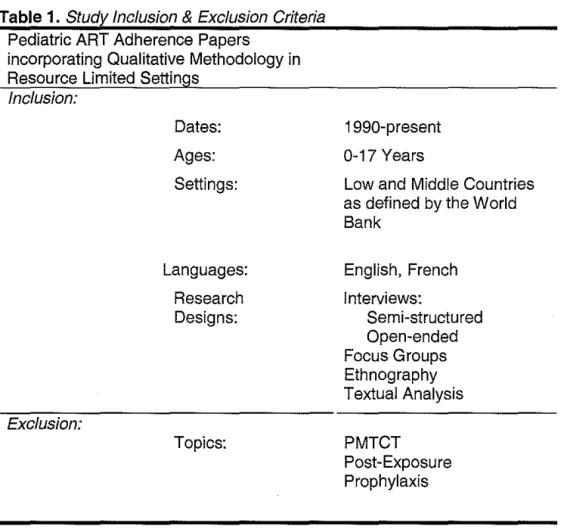
Infections (inception to 2008) were also searched, as well as the National Library of Medicine (NLM) Abstract Database. Other inclusion criteria can be summarized in Table 1.
The following search strategy was used: (pediatric OR paediatric OR infant OR child OR adolescent OR teen OR teenager) AND ((antiretroviral OR anti-retroviral AND agent) OR
antiretroviral agent* OR ART OR HAART) AND (compliance OR adherence OR patient compliance OR patient dropout OR barrier OR facilitator) AND (qualitative OR anthropology, cultural OR interviews OR interviews as topic OR chart review OR ethnography OR
For inclusion, articles must have used some form of qualitative methodology for
assessment of adherence to ART regimens in non-pregnant, HIV positive children less than 18 years of age or of their caregivers. Types of qualitative research included interviews, focus groups, ethnography, or textual analysis (medical record review, other document review,
visual/art representations, or vignettes/conversations). The study settings must also have been a low or middle income country as classified by the World Bank [World Bank website].25
included studies if they described any individuals less than 18 years of age, even if they included adults as well. Studies that focused on Prevention of Mother to Child Transmission (PMTCT) or post-exposure prophylaxis were excluded. There was no exclusion criteria based on the time frame of the study or number of subjects included.
I analyzed each article to determine study characteristics, study setting, and types of qualitative methodology to determine if they met the inclusion criteria. If the studies met inclusion criteria, they were further analyzed for themes which arose in the qualitative
methodology and overall conclusions of studies. Though this process was performed by only one person, ideally this process would include two individuals for reviewing and assessing the articles.
Table 1. Study Inclusion & Exclusion Criteria Pediatric ART Adherence Papers
incorporating Qualitative Methodology in Resource Limited Settings
Inclusion:
Exclusion:
Dates: Ages: Settings:
Languages: Research Designs:
Topics:
1990-present 0-17 Years
Low and Middle Countries as defined by the World Bank
English, French Interviews:
Semi-structured Open-ended Focus Groups Ethnography Textual Analysis
PMTCT
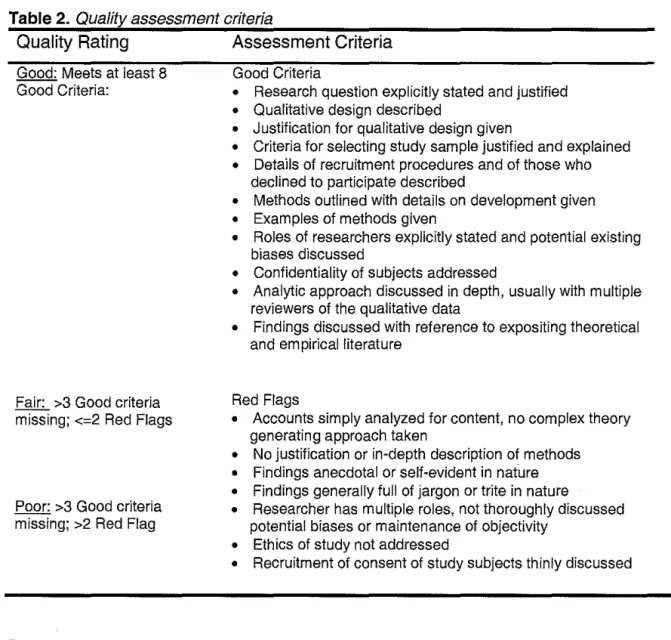
Table
2.
Quality assessment criteriaQuality Rating
Assessment Criteria
Good: Meets at least 8 Good Criteria:
Fair: >3 Good criteria missing; <=2 Red Flags
Poor: >3 Good criteria missing; >2 Red Flag
Results:
Good Criteria
• Research question explicitly stated and justified • Qualitative design described
• Justification for qualitative design given
• Criteria for selecting study sample justified and explained • Details of recruitment procedures and of those who
declined to participate described
• Methods outlined with details on development given • Examples of methods given
• Roles of researchers explicitly stated and potential existing biases discussed
• Confidentiality of subjects addressed
• Analytic approach discussed in depth, usually with multiple reviewers of the qualitative data
• Findings discussed with reference to expositing theoretical and empirical literature
Red Flags
• Accounts simply analyzed for content, no complex theory generating approach taken
• No justification or in-depth description of methods • Findings anecdotal or self-evident in nature • Findings generally full of jargon or trite in nature
• Researcher has multiple roles, not thoroughly discussed potential biases or maintenance of objectivity
• Ethics of study not addressed
• Recruitment of consent of study subjects thinly discussed
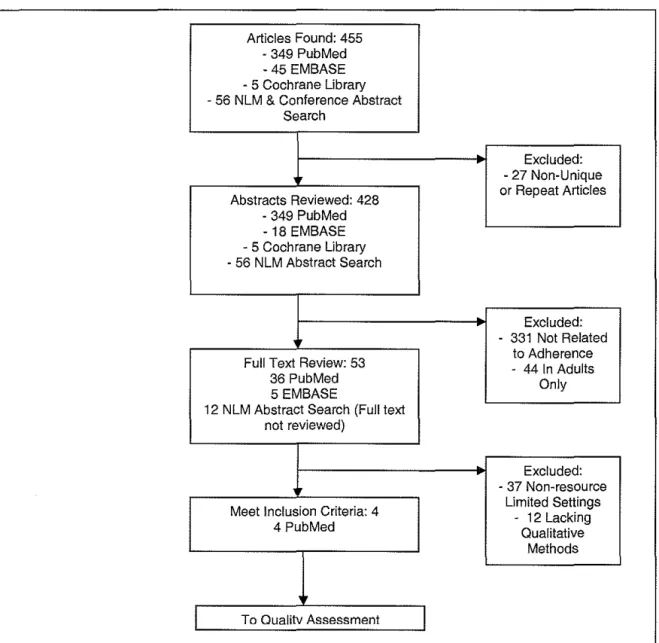
The systematic literature search identified 445 articles and abstracts. The online search of PubMed yielded 349 articles and the search of EMBASE yielded 45 articles, 18 of which were not found by the PubMed search. The Cochrane Library Database yielded 6 articles, though none of which dealt with resource limited settings. National Library of Medicine and conference abstract databases yielded 56 additional potential sources for review. This strategy resulted in a total of 428 unique articles and abstracts.
underwent a full text review to confirm the methods used and the location of the studies. If studies did not employ a type of qualitative methods or take place in a resource limited setting, they were excluded. 49 additional studies did not meet criteria, which left 4 studies employing qualitative methods addressing ART adherence in children in a resource limited setting. Each was published between 2005 and 2008, which tends to mark the dramatic increase made in the provision of ART to children in resource limited settings during the last 5 years. The review process is outlined in Figure 2.
Figure
2.
Article Selection Flow ChartArticles Found: 455 • 349 PubMed -45 EMBASE - 5 Cochrane Library - 56 NLM & Conference Abstract
Search
Excluded: - 27 Non-Unique
Abstracts Reviewed: 428 or Repeat Articles • 349 PubMed
-18 EMBASE - 5 Cochrane Library ·56 NLM Abstract Search
Excluded: • 331 Not Related
Full Text Review: 53 • 44 In Adults to Adherence
36 PubMed Only
5 EMBASE
12 N LM Abstract Search (Full text not reviewed)
Excluded:
- 37 Non-resource
Meet Inclusion Criteria: 4 Limited Settings • 12 Lacking
4 PubMed Qualitative
Methods
For each of these 4 studies, I conducted a quality assessment based on the criteria as outlined in Table 2. Two studies were rated of good quality (Bikaako-Kajura eta/. and Abadia-Barrero eta!.) while the two others were of fair or poor quality (Ellis eta/. and Makoae eta/.)
The studies tended not to provide much, if any, justification for their use of qualitative methods. Also there was generally scant information on recruitment procedures of the subjects or the role of the researchers along with any potential sources of bias from interviewers or data collectors. However, the finding of 'red flags' was all together minimal, with the Bakaako-Kajura eta/. and Makoae eta/. studies having two red flags and Ellis eta/. having three. Because these criteria were a combination of qualitative methods quality assessments collected from other sources, their validity has not been reviewed by experts. Tables 3 and 4 outline the quality criteria each specific study met.
a e
.
ua nvT bl
3
Q ft A ssessmen:tG dC't. Mt
00 nena eRecruitment Methods Roles of Findings
Study
Question explicitly Qualitative cation for a Justifi· Criteria for selecting procedures and outlined with Example of researchers explicitly Confidenti· alityof Analytic discussed withstated and design qualitative study declinations develop· methods stated and subjects approach reference
justified described desiQn sample described ment Qiven biases addressed discussed literature
Bikaako·
Kajura,
X
X
X
X
X
X
X
X
2006
Abadia-Barrera,
X
X
X
X
X
X
X
X
X
2005
Ellis,
2006
X
X
X
X
X
Makoae,
T bl
a e
4.
Q ua1ty f A ssessmen: ua1a 1ve IU1y e tQ r t f SdRdFI agsResearcher
has multiple Recruitment of
Study
ana!yzation, no Simple No justification Findings Findings thoroughly roles, not Ethics of study study subjects consent otcomplex theory or description anecdotal or generally full of discussed not well thinly
generation of methods self-evident jargon or trite biases addressed discussed
Bikaako-Kajura, X X
2006
Abadia-Barrera, X
2005
Ellis,
2006 X X X
Makoae,
2008 X X
Of the 4 studies found, only Bikaako-Kajura eta/. directly assessed ART adherence in children as their primary objective. Adherence was a secondary assessment in the other studies, or rather discussed within the context of a greater topic, such as with stigma or in the overall care of HIV positive children. Still, their findings yield some valuable information about ART adherence in children and allow us to better characterize potential barriers or facilitators. Also, two studies dealt with barriers to adherence from a caregiver's perspective only (Ellis eta/. and Makoae et a~.
Bikaako-Kajura et a/.9 conducted in-depth interviews of 42 HIV-infected children taking ART and/or cotrimoxazole prophylaxis therapy (CPT) ages 5-17, and 42 primary caregivers, at a comprehensive HIV/AIDS clinic in Kampala, Uganda. Overall this study was of good quality, its major fault being absolutely no justification for using qualitative methods, or a discussion of what this type of method would add to our understanding, above and beyond quantitative studies, despite being a purely qualitative study.
They found that strong parental-child relationships and disclosure of the HIV status to the child has a strong correlation to good ART and CPT adherence, and that not-disclosing or only partially disclosing made adherence more difficult. The younger the child, the stronger the parental relationship tended to be, which led to less resistance to taking the medications. As the children grew older, those who had not been disclosed to often became suspicious. The study defined this as 'partial-disclosure', where the child is suspicious and asks questions about his or her status, but has not been formally disclosed to. This tended to weaken the child-caregiver relationship and there was much more resistance on the part of the child to take their medicine. Reasons for non-adherence such as side-effects, difficult regimen, or bad taste tended to become much more prevalent in this group. In other words, when the true purpose and benefits of the medications were not known, there appeared to be less motivation on the part of the child to adhere, which then made the job of the caregiver much more difficult. Forgetting was also more common among the non- and partial-disclosures, since the child had less motivation to help the caregiver to remember. ART adherence relies on a strong inter-working relationship between the child and their caregiver.
Irrespective of disclosure status, structural factors such as poverty and stigma were commonly cited as barriers to taking medicine. All other barriers assessed appeared to be secondary to the disclosure status. Children who knew their status were more likely to develop their own strategies to overcome these barriers, such as ways to remember taking their
medicine and routines which avoided other people finding out about their status.
affected their experiences with stigma. Overall this study was of a good quality rating and met the highest number of criteria, as seen in Tables 3 and 4.
Though the primary focus was not addressing adherence to ART, barriers to taking ART arose within the interviews. The main barrier to adherence appeared in the adolescents, who were almost solely responsible for taking their medications. Because they lived in a group home for orphans, they received much less adult care and supervision at this age than non-orphans. This being the case, often it was a lack of understanding about the regimen that contributed to poor adherence. For instance, children had a poor understanding of the regimen and believed they could take their doses whenever they wanted throughout the day, which meant they were not adhering to the three times daily dosing typical among their regimens. Many of the children, who felt well, would purposefully not take their medications, as they did not understand why they should be taking medicine if they feel well. Often the children would simply forget to take their medicine without any kind of structure, or would prioritize personal enjoyment over taking a dose, such as continuing to play through a game of soccer.
More open communication amongst all the children, and with the few adult caregivers, resulted in less adherence problems. It appears having some sort of support system in place, whether it be peers or adult caregivers, was important to maintaining good adherence levels. By grouping HIV positive children together in homes for orphans, issues with stigma and taking ART appeared to be less of an issue, which may be an important factor in ART adherence of orphaned children.
Ellis et a/. 39 conducted a study to identify factors that predict adherence to drug
their qualitative method, which were developed to farther probe answers from the quantitative surveys.
Though this study had a 'poor' quality rating based on the qualitative study assessment scale, likely this is due to the fact the paper focused more on the quantitative methods and did not devote much of their text to describing their qualitative methods. None the less, we know little about study sample selected to undergo the focus groups, how and why participants were selected, how bias may have been addressed in a setting where information is shared with a group, or anything about the specific questions asked of these focus groups. Also, only some of the children were on HIV drug regimens. The study focused on drug regimens in general, so not all the findings may have been specific to ART. They do not distinguish which findings are specific to which type of drug regimen.
The focus groups revealed that among the mothers who provided medication to their children, they found that lack of food, financial constraints, and timing of difficult regimens compromise the ability of mothers to adhere to their child's medication regimen. The mothers also report often simply forgetting to give the medication all together or having extreme difficulty in getting their child to take medication. The latter often occurs because of the large size and bitter taste of the pills. Further, when the child is resistant to take their medicine, the mother tends to report being unable to get the child to adhere as well over the long term.
Lastly, Makoae et a/.40 analyzed the challenges which caregivers encounter while providing care to HIV positive family members at home in Lesotho. Adherence to medication was addressed as part of their general care. The study enrolled 21 family caregivers to undergo in-depth qualitative interviews. Not all caregivers were in the care of children, some were also caring tor adults. The study does not provide characteristics of the study sample or to whom each caregiver provided their care. Therefore we do not know how many caregivers were caring tor children or the children's characteristics, but we are told in the findings that there is at least one mother, one father, and one grandmother who were caring tor children during the study.
Findings are mostly reported as example quotations which highlight certain barriers to HIV care. Since the number of adults caring tor children is quite small in this study and no rigorous exploration of themes or qualitative analysis within this sub-group, the findings are mostly anecdotal with relation to medication adherence. Also, recruitment procedures are thinly discussed. Therefore this study received a 'fair' quality rating.
The findings as they relate to ART adherence and children are minimal, though they produce a few findings. Barriers discussed mainly deal with cost and availability of medicine as an issue. These are not unique findings to this study. However, a more original topic discussed is that of the caregiver's health status and how disruptions in their health tend to negatively affect the care of their children. For instance, it a caregiver is ill such as with an acute illness, their ability to ensure adequate care, including receiving all medications, is compromised. In these cases, the child must be relied upon to some extent to take their own medication. Relying on other family members who may not know the proper medication regimens or even know the HIV status of the child can lead to poor adherence.
Table 5. Study Settinfi!. & Desifi!.n, Overall Qualiti:, Ratinfb and Summa;:r of Results
Study
Overall
Barriers to
Facilitators to
Study
Setting
&
Quality
ART Adherence
ART Adherence
Design
Rating
Kampala, 0 Non-Disclosure of HIV status to 0 Strong parental-child
Uganda the child relationship
0 Financial constraints/poverty 0 Good communication
Bikaako·Kajura, Qualitative
Good 0 Stigma with HIV and taking between child and parent
20069
interviews with medications 0 Disclosure of HIV status to
42 children 0 Other barriers secondary to Child
and caregivers disclosure status
Sao Paulo, 0 Lack of adults to supervise and 0 Living in an environment
Brazil assist with the medicine with other HIV positive
Abadia-Barrero, 0 Poor understanding of regimen children
200538 Ethnographic Good 0 Feeling healthy 0 Support from other children
study of 50 0 Poor communication with adult or adults
orphaned supervisors
children
Nairobi, Kenya 0 Financial constraints/poverty
0 Lack of food
Ellis, Focus groups 0 Resistance from children due to
200639 of mothers Poor difficulty of regimens or poor No facilitators reported
who care for taste
H IV positive 0 Difficulty with transportation
children
Lesotho 0 Financial constraints/poverty
0 Difficulty with transportation;
Makoae, Qualitative availability of medicine
200840 interviews of Fair 0 Poor health status of caregiver No facilitators reported
caregivers with HIV positive children
Discussion:
This systematic review presents the first comprehensive review of the qualitative
methodology used to better understand pediatric ART adherence in resource limited settings. It
is immediately evident that there is a paucity of this type of research, which supports this
assertion noted in a number of other articles. 16• 29 Because these studies use heterogeneous
methods and study populations, it is difficult to draw broad conclusions or to generalize findings
based on all four studies. However when looking at the results as a whole, common themes
transportation) as well as situations where the caregiver is impaired, or not present, for motivating or assisting the child to properly take their medications. Also, conflict between the caregiver and child appears to serve as a barrier to good adherence.
The quality and breadth of information obtained from the Bikaako-Kajura eta/. study9 was much more in depth than the other three studies and was most valuable to the understanding of this topic in resource limited settings. Their primary objective was assessing pediatric ART adherence, where as the other three studies only address ART adherence with in the context of larger objectives such as dealing with stigma, medication adherence relating to all medications, or with overall care of HIV positive individuals. Therefore the results from the other three studies do not have as much significance to this review and typically their findings were more anecdotal since there were fewer subjects speaking on ART adherence with which to draw conclusions.
Significant, and well explored, in the Bikaako-Kajura eta/. study was the issue of non-disclosure and its effects on adherence. The underlying theme was conflict created between the child and parent due to this issue. Many of the children in this study were suspicious of their HIV status and were considered 'partially disclosed', meaning they may have had some idea about their status, but no one had confirmed it specifically. This created an atmosphere of tension and lack of trust between the child, caregiver, and clinical staff, especially for older children or those nearing adolescence. Without a strong rational behind taking such medications, there is little motivation on behalf of the child to do so. The findings in the Abadia-Barrero eta/. study seem to support Bikaako-Kajura eta/., where they note poor communication with the child and lack of a strong caregiver-child relationship seemed to create conflict, lack of motivation, and adversely impact ART adherence.
caregiver support strategy, availability, and willingness to give medicine as prescribed, which is much more difficult as a long term strategy. The common facilitator noted between Bikaako-Kajura eta/. and Abadia-Barrero eta/. studies was that of providing a support system to the child. This could be having other HIV positive children to rely on for support, or having an adult caregiver with whom there is a relationship of trust.
Three of the four studies noted structural barriers as significant barriers to good adherence. This is not surprising, as previous reviews looking at children in some developed settings and adult populations in resource limited settings have also found that structural
barriers such as financial constraints, access to medications, and transportation are significantly associated with maintaining good adherence.16• 29 The difficult question is how to address and overcome these structural barriers in resource limited settings, which can be extreme for both children and adults.
This systematic review suggests that the need for strategies to overcome child-caregiver relationship and structural barriers is paramount. Training social workers or support staff at clinics which provide ART may be effective in helping children and caregivers to develop coping strategies for structural barriers. This could employ techniques such as Motivational
Interviewing, which have been used to promote adherence in developed settings.27 Formation of child peer support groups for behavioral reinforcements may also be useful. This strategy may only be available to children who know their HIV status, however peer support groups for adult caregivers of children who do not know their status may be a useful alternative.
For children who do not know their status, Bikaako-Kajura eta!. 9 recommend
this sub-set of children and specific mechanisms of support should be available at the
ART
clinics for both the caregiver and child.
Ultimately, caregivers should be encouraged to disclose the HIV status to the child. This is also not easy for those living in settings where the stigma associated with the disease is great and other family members may also be unaware of the child's status. However, despite these problems, previous studies show that children generally want to know their status and it appears this could facilitate better
ART
adherence.21This review has a number of important strengths. The methods employed to tabulate these findings come from a multi-step process which is clearly outlined in Figure 2. A number of different search strategies were employed with the aid of librarians who were very familiar with the databases and trained to determine which strategy would carry the best balance of
sensitivity, yet still keeping a narrow enough focus of the topic.
Pooling the results seemed infeasible due to the heterogeneity of methods. Because there were few studies, this seemed largely unnecessary as well, with only four studies meeting inclusion criteria. While a number of themes arose among the studies, they can be easily surmised in Table 5. Though the quality criterion has not been validated, it is taken from a number of sources which assess the quality of qualitative research. Since I found a range of good, fair, and poor quality studies, it is reasonable to believe this criterion is capable in discerning between well done studies and those whose methods are lacking.
studies conducted in developed settings. Indeed, the fact that even four studies were found in resource limited settings that dealt with this topic is somewhat surprising.
Other limitations to this review should be acknowledged. Because this review has only one author, there was no way to validate the review process or selection of studies to assess for agreement. Only studies in English and French were considered, though no studies in French were found. It is still possible some relevant studies in other languages may have been
overlooked. Publication bias could potentially be a concern. However since qualitative studies typically represent formative research, I believe it is unlikely that some qualitative findings would selectively remain unpublished. Further, two of the four studies did not have ideal
methodological strength and their findings may not have great significance for this reason. It may also be incorrect to assume findings from one resource limited country to another will be applicable. There is great breadth between populations in these countries. The children of Brazil may face a very different reality from those of Uganda or Lesotho when taking their HIV medicines.
More high quality studies are needed from different resource limited settings to better understand the barriers and facilitators of ART adherence in children. Development of an improved theory and best practice guidelines for pediatric ART adherence are severely needed. Also, more quantitative studies that employ culturally appropriate models to accurately measure adherence and a better established definition of what ' good adherence' means with regards to children in resource limited settings are warranted.
good adherence in non-disclosed children? How are strategies different, and perhaps more successful, with caregivers of disclosed children?
Though we know that structural, cultural, and social barriers can make ART adherence difficult in children, understanding the 'why' behind these barriers will be helpful to developing strategies to overcome them. Along these lines, we also need more information on facilitators to good ART adherence and a better understanding on why certain practices or strategies tend to aid in adherence. The studies in this review did not focus on identifying and exploring facilitators, though facilitators were briefly mentioned in two of the studies.
As found in prior reviews, qualitative studies are superior at identifying and
understanding patient-important barriers and facilitators and should set the basis for future quantitative works. 29 More studies will be useful to support and add to the findings of these four studies, and to determine whether barriers and facilitators in one resource limited setting are similar to others. Though three of the four studies found in this review were performed in Sub-Saharan Africa, more are needed in this region, where 90% of pediatric HIV cases exist and scale-up of ART access to children continues.
None of the studies provided information about the length of time children had been prescribed ART, so it is difficult to make comparisons between the children with-in, or between, studies. It is also likely adherence practices change over time, especially when illness improves or side-effects increase. Future studies may make better measure of the time frame of the ART regimens they are assessing and correlate this as a barrier or facilitator to good adherence.
Ill. Research Plan
1. Overview and Rationale
Background:
The Democratic Republic of the Congo (DRC) is a war torn nation of around 63 million inhabitants.41 Since 1998, on-going conflict in the eastern part of the country has been characterized by extreme violence, mass population displacements, widespread rape, and a collapse of public health services.42 This has been dubbed 'Africa's first World War' due to the number of nations involved and population affected. To date, nearly 4 million people have been killed as a result of the unrest, the highest number in any conflict since World War 11.42 In recent years, the violence has ebbed somewhat due to the signing of peace accords by various
factions and the presence of UN peacekeeping troops. However outbreaks of violence in the eastern part of the country are still common.
The DRC (formerly Zaire) was one of the first countries to develop and HIV/AIDS prevention program in the 1980's. Due to the political, social and economic impacts of conflict during the 1990's, this region unfortunately now lags behind many other African nations in the development of a stable public health infrastructure. This means that continued progress in HIV prevention and treatment, among many diseases, has been slow. The capital city of Kinshasa in the western part of the country has fortunately received relative stability in recent years and some progress has been made in terms of addressing the HIV epidemic.
Despite the fact that one of the earliest known strains of HIV was detected in the Kinshasa region dating from 1959,43 the DRC has remained on the low end of HIV prevalence rates, relative to sub-Saharan Africa. Data from 2007 estimates the HIV prevalence range on the order of 400,000 to 500,000 cases.41 37,000 to 52,000 of these cases are estimated to be in children less than 15 years of age. These numbers put the countrywide prevalence at a rate of around 1.2-1.5%. However, sentinel site surveillance in pregnant women suggests that the prevalence is higher in urban settings. A 2004 survey revealed HIV prevalence to be around 4% in Kinshasa and as high as 7-9% in other urban settings.41• 44 The accuracy of this HIV prevalence data is difficult to ascertain. In a war torn region such as the DRC, it is possible these numbers are under reported since accurate data measurement is difficult in many areas of the country. Other estimates of HIV prevalence put the total number of people living with HIV upwards of 3 million.44
It is clear that provision of ART has also lagged behind in the DRC and is limited in many provinces. Though the prevalence may be low relative to other sub-Saharan African countries, those with HIV typically do not receive adequate care. The country is large, has a sizeable mobile population, and health care services are inadequately decentralized. There is a severe shortage of human resources trained to deliver antiretroviral therapy.44 Of those HIV positive individuals in need, only 20% to 29% were estimated to be receiving ART, most of whom live in Kinshasa.41 Only 1,632 HIV positive children are recorded as receiving ART, which is a mere 3.1% to 4.4% of all HIV positive children in the country.'
Overall, more study is needed on nearly all aspects of HIV prevention and treatment in the DRC. Years of civil unrest have damaged the health care delivery system and the ability to successfully perform research in many areas of the country is compromised.44 Much of the research done in other areas of sub-Saharan Africa may be generalizable to the DRC, but not all. This is especially true with subjects that may address culturally specific behavioral or social issues, such as adherence to ART.
ART Adherence in Kinshasa:
Access to ART has lagged behind for children all across sub-Saharan Africa. As
mentioned, the DRC appears to be no exception. Data on adherence to ART in the DRC is not surprisingly sparse, considering the relatively small number of children currently taking ART regimens.
Some preliminary data on adherence does exist from children receiving care at the
Kalembe Lembe Pediatric Hospital (KLL) in Kinshasa, collected through the SARA program. The data comes from provider administered questionnaires to both caregivers accompanying children at clinic visits and from children themselves, who are over 12 years of age.
This data reveals >99% of caregivers and children > 12 years of age are reporting 100% adherence within the last 2 days along with zero days of missed treatment within the last month.45 This is well above expected norms of children in similar settings, where favorable adherence rates range from 50% to 80%.16 These data also lack the expected variability in adherence rates
between subjects and the figures are likely inaccurate. Failure rates of ART have not been well recorded in children at the KLL Pediatric Hospital. However, failure rates of first line ART
regimens in children are increasing in number and have been shown to be twice as high as adults in similar settings.46
not optimal for measuring adherence and the SARA adherence rate data is likely over inflated, however it is difficult to estimate the degree of this.
Study Rationale
Pediatric adherence to ART has not been widely assessed in sub-Saharan Africa, where over 90% of children living with HIV are located.9 Because the number of children accessing ART is rising substantially each year, best practice guidelines to ensure high rates of adherence is needed. Without an in-depth understanding of what makes these regimens more difficult, or perhaps easier, in sub-Saharan Africa and other resource limited settings, these best practice guidelines will be difficult to synthesize.
Since little data exists on adherence to pediatric ART regimens in Kinshasa and in resource limited settings in general, the Kalembe Lembe Pediatric Hospital represents a prime target for farther study. I am proposing a study which assesses barriers and facilitators of adherence to ART regimens in children through qualitative, formative research.
Qualitative methods represent a practical place to begin study in this setting. This type of methodology can be used to inform the development of more valid, culturally appropriate
adherence measures and a contextual adherence theory and can serve as validation to any future quantitative studies addressing adherence in Kinshasa.16 As described in Section II, very few qualitative studies assessing pediatric ART adherence in resource limited settings exist, and even fewer are generalizable to the context of Kinshasa.
2. Research Plan Procedures & Methods
Setting:
Subjects who meet specific criteria are also started on ARV treatment. For children, this includes being HIV positive, aged 0 through 17 years, who had been receiving HIV/AIDS care before the start of the program or who were identified HIV positive through the expanded HIV testing strategy (op-out system) at the KLL Infectious Disease Unit. Children under 18 months with confirmed HIV infection with a positive viral test result are also eligible to participate in the SARA program. All participants in this study will be recruited from the subset of children receiving ART within the SARA Program at the KLL Pediatric Hospital in Kinshasa. Subjects, Recruitment. & Consent:
During a six week period over May and June 2009, we will recruit approximately 40 study participants for qualitative in-depth interviews. These participants will be children 8 years of age or older who are actively receiving regimens of ART, enrolled in the SARA program, and receiving care from KLL physicians and staff. We will also recruit the adult who accompanies the children to their regularly scheduled clinic visits. If more than one adult accompanies the child, we will recruit the one who has the most active role in caring for the child. We will also recruit caregivers with young children below the age of 8 to participate. Specific inclusion and exclusion criteria are outlined in Table 6.
If they agree, we will take the caregiver to the private, closed off room in the clinic where the consent forms will be provided and the study objectives described in greater detail, as per the script in the attached Interview script and questions. If they refuse to participate, reasoning will be
documented if given. During the interview, the child (and other accompanying children) will remain in the care of the clinic staff or other research personnel. The caregiver will be informed that they may opt out at any point during the process without penalty and compensation will still be provided for their time given.
If consent is given for children over the age of 8 to participate in the study, the qualitative interviewers will interview them in the same private room alone, after completion of the caregiver interview. Their caregiver will be asked to remain in the clinic waiting area.
For recruitment purposes, a history of non-adherence will be elicited in two ways. First, selection will come from previous medical records, which the clinic staff will review prior to the clinic visit for documentation or suspicion of non-adherence to ART. Since we will be working in close collaboration with the clinic staff, we will also elicit non-adherence from clinical suspicion during or immediately following the scheduled appointment. The physicians, nurses and psychosocial support workers will be instructed to alert study personnel if this is the case.
If selected from medical records, the definition of non-adherence will be documented based on the written record. If selected based on clinical suspicion, the physicians and/or psycho-social support workers will be asked to explain their reasoning (i.e. admitted non-adherence, unusual failure of first line therapy, falling viral load or CD4 count, continued poor clinical presentation)
children during this time, we may also invite adult caregivers and their child to return on Saturdays for
the interviews.
Typically, qualitative interviewing is an iterative process. It continues until a set of
themes on particular topics begin to arise and reach saturation. Previous studies on ART
adherence have reached saturation of themes with anywhere from 20 to 50 participants.9• 32• 40• 47
Therefore we will conduct as many interviews as feasible within this time frame, which we
anticipate will be anywhere from 30 to 50 adult caregivers and children.
Table
6:
Inclusion & Exclusion CriteriaParticipant Children Adults Children & Adults Criteria Inclusion:
(1) Aged 8 to 17 years and enrolled in the SARA program (2) Actively receiving care at KLL for at least 6 months
(3) Have been prescribed and actively taking an ART regimen for at least 6 months
(4) Have a documented history of poor adherence noted within their medical record or a clinical suspicion of non-adherence supported by the physicians, nurses, or psychosocial support staff at KLL at the time of the clinic visit. (5) Must speak French or Lingala
(6) Willingness to be interviewed alone
Inclusion:
(1) At least 18 years of age or older
(2) Accompanying a child aged 6 months to 17 years to their scheduled clinic visit
(3) Must have known the child for a minimum of 6 months (if not a primary relative)
(4) Must speak French or Lingala (5) Willingness to be interviewed alone
(6) The child they accompany must have a documented history of poor adherence noted within their medical record, or a clinical suspicion of non-adherence supported by the physicians, nurses, or psychosocial support staff at KLL at the time of the clinic visit.
(7) The adult care giver is aware of the child' HIV status old
Exclusion:
(1) Adult and child (if 8 years of age or older) are unwilling to be separated for interviews
(2) Both adult and child do not speak either French or Lingala
Qualitative Interviews:
The interviews will assess the opinions and experiences of the study participants in dealing with ART regimens. General themes explored with adult caregivers will include overall attitudes towards ART regimens, perceived benefits or liabilities of ART, health beliefs on ART and on HIV, what good adherence means to them, perceived barriers in carrying out regimens as prescribed, facilitators which aid ART adherence, and an assessment of the child's specific adherence rate. With the children, we will explore similar themes. These include beliefs regarding ART and HIV as well as what they perceive to be barriers and facilitators to good adherence. Throughout the process, we will explore specific instances of missed doses.
Trained qualitative interviewers who are fluent in French and Lingala, the local language, will carry out all recruitment procedures and conduct interviews, under the supervision of the study coordinator and clinic staff. These interviewers will follow scripts that have a list of themes and corresponding questions with probes to be addressed with the study participants. The interview script can be seen in Addendum I. Questions were based on prior literature searches which explored potential barriers to ART adherence. The semi-structured nature of the
interviews and multiple question probes will allow the interviewers to explore topics in detail which are relevant to each participant. This flexibility will allow us to explore and clarify emerging issues pertinent to ART adherence as they arise.