Screening for Intimate Partner Violence: An Evaluation of the USPSTF Systematic Evidence Review and Recommendation
Mary Lang-Furr
A Master's thesis submitted to the faculty of the University of North Carolina at Chapel Hill
In partial fulfillment of the requirements for the degree of Master of Public Health in
the Public Health Leadership Program.
Abstract
Background: The United States Preventive Services Task Force (USPSTF) issued
an "I" recommendation in 2004 for screening for intimate partner violence (IPV);
it found insufficient evidence to recommend in favor of or against screening. This
recommendation has been criticized. It is inconsistent with the recommendations of the American Medical Association and the American College of Obstetrics and
Gynecology, both of which recommend that clinicians routinely inquire directly
about a history of abuse. The purpose of this paper is to evaluate whether the "I"
recommendation is consistent with the evidence that exists for IPV screening and
whether the criteria used by the USPSTF to evaluate IPV screening were
comparable to the criteria used for other health topics.
Methods: I used one set of criteria to evaluate the USPSTF's systematic evidence
review (SER) on screening for IPV and to compare it to the SER's on screening
for depression and alcohol misuse. Another set of criteria was used to evaluate
the USPSTF recommendation for IPV screening and to compare it to other
USPSTF recommendations.
Results: There were important differences in the SER's that may have resulted in
adverse effects being given more weight in determining the benefit-harm ratio in
the IPV SER than they were given in the other two SER's. However, there was
Conclusion: Evidence for screening for IPV may not have been assessed in a
comparable way to that for depression and alcohol misuse, but due to a shortage
of evidence on IPV screening, the "I" recommendation would likely stand if
disparities in the synthesis of the evidence were remedied.
Background
USPSTF Recommendations for Screening for Intimate Partner Violence
The United States Preventive Services Task Force (USPSTF) systematic evidence
review (SER) for screening for intimate partner violence (IPV) "identified no
studies that directly addressed the effectiveness of screening in a health care
setting in reducing harm from family and intimate partner violence or the adverse
effects of screening and interventions."1 Screening instruments were validated,
but none were evaluated on violence or health outcomes. Authors of the SER
stated a need for studies of the effectiveness of treatment programs for survivors
of violence and perpetrators to demonstrate that identification and intervention
does or does not lead to improved health outcomes, including reduced violence,
improved quality of life, mental health, social support, self-esteem, and
productivity.
The USPSTF gave screening for IPV an "I" recommendation, which means they
found insufficient evidence to recommend for or against the routine screening of
evidence, the USPSTF could not determine the balance between the benefits and
harms of screening for intimate partner violence.
One Critique of the USPSTF's Recommendation for Screening for IPV
Dr. Linda Chamberlain is an epidemiologist specializing in the health effects of
domestic violence who works as a consultant for the Family Violence Prevention
Fund (FVPF). She wrote an article for FVPF that detailed several criticisms of
the USPSTF guidelines for IPV. 3 She felt IPV should be evaluated as its own
topic, rather than being evaluated in the same review with child and elder abuse.
She also said there should be a separate recommendation on screening pregnant
women, like USPSTF did for screening for alcohol and tobacco use. Instead, the
authors dismissed the limited evidence that exists for screening and intervention
for IPV during pregnancy, rather than lending weight to findings in this high-risk
group.
Chamberlain asserted that evaluating IPV as a screening practice forces the topic
into a medical model that requires a greater burden of evidence than if it had been
evaluated as a behavioral assessment and counseling practice, which would be a
more appropriate framework for the evaluation of ways to address IPV. The
authors excluded trauma studies in order to emphasize screening asymptomatic
patients, but the USPSTF's previous recommendations emphasized injury-related
Another problem Chamberlain identified was that authors speculated on potential
adverse effects of screening based on studies that were not germane to screening
for IPV. In fact these studies did not meet the inclusion criteria for the SER. She
asserted that emphasizing theoretical adverse effects of screening without
considering potential benefits resulted in misleading analysis. The USPSTF did
not acknowledge the adverse effects of doing nothing to address IPV in the
primary care setting. The adverse effects of not asking women about IPV should
be given as much consideration as the adverse effects of screening. Finally,
Chamberlain stated that other screening services that have been given a favorable
recommendation by the USPSTF have gaps in the evidence similar to those that
exist for IPV screening.
USPSTF Recommendations for Screening for Depression and Alcohol Misuse
The USPSTF systematic evidence review for screening for depression found that
the "rate of detection and diagnosis of depression, based mainly on chart reviews
or the completion of a study-specific form" increased from 37% to 47% in six
studies that examined the effect of providing feedback of depression screening
results to primary care providers.4 Among studies with interpretable clinical
outcomes, screening was associated with 9% absolute reduction in proportion of
patients with persistent depression. The USPSTF gave screening for depression a
"B" recommendation, which means that they recommend that clinicians routinely
screen for depression because there is at least fair evidence that the benefits of
recommends screening adults for depression in clinical practices that have
systems in place to assure accurate diagnosis, effective treatment, and follow up.
The evidence review for screening for alcohol misuse found that for good-quality
brief, multi-contact behavioral counseling interventions, absolute risk reduction of
risky and harmful alcohol use by primary care patients was 10.5% (NNT=l0).6
Mean drinks per week were reduced 2.9-8.7 compared to controls. There was not
sufficient evidence to assess the effects of interventions on morbidity and
mortality. The USPSTF gave screening for alcohol misuse a "B"
recommendation.7 The Task Force recommended in favor of screening and
behavioral counseling interventions to reduce alcohol misuse by adults, including
pregnant women, in primary care settings.
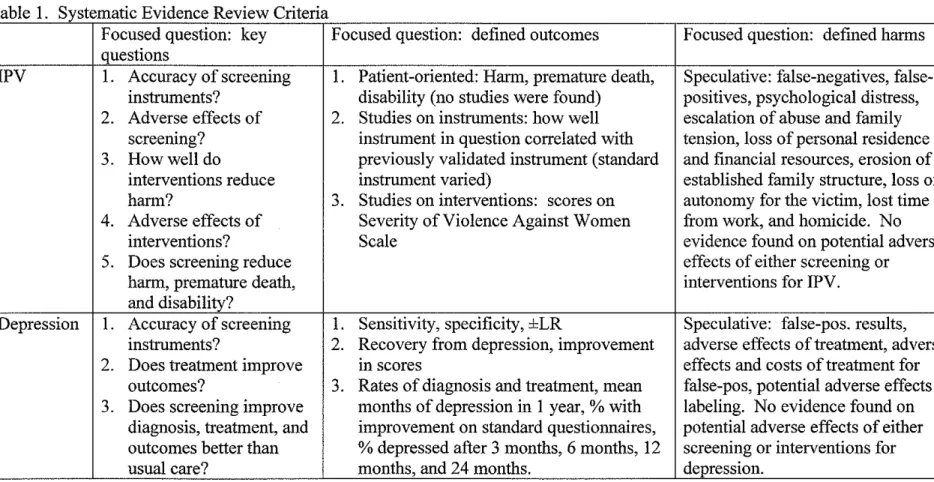
Key Questions
• Was evidence for screening for IPV assessed by the USPSTF -designated
Evidence-based Practice Center (EPC) in a fair way compared to other
problems assessed by the USPSTF and its EPC's?
• Is the recommendation for IPV screening consistent with other USPSTF
recommendations?
To answer my key questions I used two sets of criteria, one for evaluating SER's
and one for evaluating the USPSTF recommendations. The criteria for evaluating
evidence reviews are as follows:
I. Is there a focused question, including specific key questions, defined
outcomes, and defined harms?
2. Was there an adequate search of the literature for evidence including
appropriate sources of data, appropriate inclusion and exclusion criteria
decided upon prior to the literature search, reasonable methods for
determining article eligibility, and uniform methods of article review?
3. Was the evaluation of quality of individual studies standardized according to
USPSTF criteria?
4. Was the assessment of overall quality of the evidence standardized according
to USPSTF criteria?
5. Was the assessment of magnitude of net benefit of screening reasonable based
on the quality of available evidence?
To evaluate the USPSTF recommendations on screening for IPV, depression, and
alcohol misuse, I used the following criteria:
I. Was the recommendation consistent with the overall quality of evidence for
the benefits of screening?
2. Was the recommendation consistent with the overall quality ofthe evidence
for harms of screening?
4. Was the recommendation consistent with the net magnitude of harm found?
I compared and contrasted the three different sets of recommendations issued by
the USPSTF based on these questions.
Results
Key Questions on Screening for IPV
All three SER' s included specific key questions, but there were some important
differences in what they asked. The EPC that conducted the SER on screening for
IPV asked the following key questions:
1. How well does screening identify current harm or risk for harm from IPV?
2. What are the adverse effects of screening?
3. How well do interventions reduce harm from IPV?
4. What are the adverse effects of interventions?
5. Does screening for IPV reduce harm, premature death, and disability?
Key Questions on Screening for Depression
The EPC that conducted the SER on screening for depression asked three key
questions that were similar to questions 1, 3, and 5 asked by the IPV group:
I. What is the accuracy of screening instruments for depression in primary care
populations?
2. Is treatment of depression in primary care patients effective in improving
3. Is screening more effective than usual care in identifYing patients with
depression, facilitating treatment of patients with depression, and improving
outcomes?
Key Questions on Screening for Alcohol Misuse
The key questions asked in the SER for screening and behavioral interventions for
alcohol misuse were as follows:
I. Is there direct evidence that behavioral counseling interventions to reduce risky
or harmful alcohol use reduce morbidity and/or mortality?
2. What methods were used to identifY target populations for behavioral
counseling interventions in primary care?
3. What are adverse effects associated with alcohol use screening and
screening-related assessment?
4. Does behavioral counseling intervention in primary care reduce risky or
harmful alcohol use in the targeted subgroup? What are the essential elements of
efficacious interventions?
5. Are there other positive outcomes from behavioral counseling interventions to
reduce risky/harmful alcohol use?
6. What are adverse effects associated with behavioral counseling interventions
for risky/harmful alcohol use?
7. What health care system influences are present in effective screening and
screening-related assessments and interventions to reduce risky/harmful alcohol
Comparison of Key Questions
The difference in the sets of key questions for screening for IPV and screening for
depression may have resulted in a differential assessment of harms between the
IPV and depression SER's and, consequently, the recommendations that followed
each. The IPV group gave more weight to adverse effects of screening and
interventions by making each of them a key question. The depression group cited
a lack of evidence about adverse effects as a problem in the Results section of the
SER, but the examination of adverse effects was not given the status of "key
question."
As with the IPV paper, the EPC evaluating evidence on screening and behavioral
interventions for alcohol misuse designated two key questions for asking about
adverse effects, those associated with screening and those associated with
behavioral counseling interventions.
The papers were inconsistent in the way they dealt with the evaluation of
screening instruments. The IPV and depression papers both had key questions
that specifically asked about the accuracy of screening instruments; whereas the
alcohol misuse paper instead asked, "What methods were used to identify target
populations for behavioral counseling interventions in primary care?'' without
may have created a lesser burden of evidence for the alcohol misuse review than
for the other two reviews.
The papers also had different approaches to answering the question of how
interventions impacted outcomes. First, both the IPV and depression review
articles asked one key question about how interventions affected outcomes in
general. The alcohol misuse paper asked three different key questions about
outcomes, which included morbidity, mortality, risky or harmful alcohol use, and
"other positive outcomes."
Finally, both the IPV and depression groups searched for evidence about the
effects of screening on outcomes, but the IPV group sought data about harm,
premature death, and disability, none of which were found. The depression group
was seeking data on the effect of screening on rate of diagnosis, rate of treatment,
and non-specific "outcomes" compared to usual care, which it was able to find.
My own search of the literature for studies on the effect of screening for IPV on
rate of detection of violence, rate of treatment, questionnaire scores, and other
outcomes revealed one article that would have been included if the authors had
allowed these as outcomes. It was a systematic review article that concluded that
there is insufficient evidence of benefit to recommend in favor of implementing
screening programs. 8 The alcohol misuse SER did not include a question about
the effects of screening on outcomes, another discrepancy between its key
Defined Outcomes
IPV screening outcomes included:
1. Patient -oriented outcomes like indicators of physical abuse, neglect, emotional
abuse, sexual abuse, and related health outcomes if reported such as depression.
2. How well a screening instrument compared to a standard.
3. Outcomes for evaluating studies on interventions: scores on Severity of
Violence Against Women Scale, which includes questions about frequency of
threats and actual physical and sexual violence.
Depression screening outcomes included:
I. Patient oriented outcomes like recovery from or improvement in depression
after certain period of time and mean months of depression in I year
2. Sensitivity, specificity, ±LR of screening instruments.
3. Intermediate outcomes like improvement in SCL-20 score,% reduction in
depressive severity score, rate of diagnosis, rate of treatment, % with > 12 point
decrease on SDS at 1 month,% with HAM-D<IO at 6 months, Mean GHQ at 6
months, Zung scale score,% depressed at 3 months DSM-IIIR criteria,% with <1
DSM-IIIR criteria symptoms,% depressed at 6 months,% depressed at 12
months, % depressed at 24 months, mean months of depression in 1 year, % with
Alcohol misuse screening and behavioral counseling interventions outcomes
included:
1. Patient -oriented outcomes like reduced morbidity and mortality and "other
positive outcomes."
2. 3 primary alcohol use outcome categories:
1. average consumption (mean drinks per week)
2. binge use (proportion bingeing)
3. safe/moderate/recommended use (based on attaining each study's
recommended limits on average consumption and/or binge us)
The disparity in defined outcomes reflected the disparity in key questions, with
the alcohol misuse group neglecting to evaluate any outcome reflecting the
accuracy of screening instruments. All three defined some outcomes
quantitatively and left room for more open-ended outcomes to emerge.
Harms of Screening
The same amount of evidence was found on the adverse effects of screening for
all three problems. However, the assessment of potential adverse effects, which
in no case was based on any evidence, was different in the three SER' s. The only
potential adverse effect considered in the alcohol misuse SER was the potential
for offending patients. The depression group discussed a longer list of potential
adverse effects: false-positive results, adverse effects of treatment, adverse
labeling. The IPV group listed some potential adverse effects that were similar to
those listed for the depression group like false-negatives discouraging inhibiting
identification of those at risk, and false-positives leading to "inappropriate
labeling and punitive attitudes." The IPV group also enumerated potential
adverse effects that were more severe than those mentioned for depression and
alcohol misuse screening without any additional evidence to warrant them. These
potential consequences included psychological distress, escalation of abuse and
family tension, loss of personal residence and financial resources, erosion of
established family structure, loss of autonomy for the victim, lost time from work,
and homicide.
Data Sources
Sources of data were comparable for the IPV, depression, and alcohol misuse
SER's. The IPV group searched MEDLINE, Cochrane Register, PsychiNFO,
CINAHL, Health & Psychosocial Instruments, reference lists of systematic
reviews, and experts. The depression EPC used MEDLINE, Cochrane database
on depression, neurosis, and anxiety disorders, and bibliographies of SR's,
original articles, Guide to Clinical Preventive Services, and the AHCPR 1993
Clinical Practice Guideline on Depression. The authors of the SER on screening
and behavioral interventions for alcohol misuse used the Cochrane Database of
Systematic Reviews and Database of Research Effectiveness, bibliographies of
Guide to Clinical Preventive Services, MEDLINE, Cochrane Controlled Clinical
Trials, Psychlnfo, HealthSTAR, and CINAHL from 1994-April2002.
Inclusion and Exclusion Criteria
The inclusion and exclusion criteria for each SER are described in Table 1. The
criteria were similar for all three. One difference for the SER for IPV was that it
included studies that were conducted in primary care, ob-gyn, and emergency
room settings, excluding studies of patients presenting with trauma The other
two SER' s included studies done in primary care and community settings but
excluded those that were conducted in emergency departments. The IPV SER
seemed to be more inclusive than the other two SER's.
The SER for screening for depression stated that inclusion and exclusion criteria
were agreed upon prior to performing a search of the literature. Neither the
authors ofthe IPV SER nor the authors ofthe SER on screening for alcohol
misuse stated whether such criteria were established prior to searching for
evidence.
The method for determining eligibility for inclusion in the SER was not specified
by the IPV authors. The depression group stated that two reviewers
independently reviewed titles and abstracts of articles identified by literature
searches and excluded ones which they agreed did not meet eligibility criteria.
about inclusion. For the SER of screening and behavioral interventions for
alcohol misuse, one investigator reviewed 4,331 titles and abstracts, and a second
investigator reviewed a random 3 5% of titles and abstracts for agreement.
Approximately 95% agreement was found, and no articles that met review
inclusion criteria were coded differently by the two reviewers. Seventeen studies
met setting and quality criteria, but one did not have study results in time for the
SER. Twelve of the sixteen reviewed studies addressed non-pregnant adults and
were included in the SER.
Methods of Article Review
All three SER's had similar methods for review articles, though the alcohol
misuse group described their methods in more detail. The IPV group abstracted
study design, number of participants, setting, length and type of interventions,
length of follow-up, outcomes, methods of outcome measurement, and study
duration of each study. The depression group abstracted study design and
outcomes data from articles on screening accuracy, screening outcomes, and
treatment. These data were used to construct evidence tables. For alcohol
misuse, one primary reviewer abstracted relevant information for many more
categories than were included in the other two SER's. All data in evidence tables
were checked by a second reviewer and articles excluded for quality or relevance
were listed in Table I 0 of the Appendix. Abstracted data included author, year
published, type of trial, setting, definition of a standard drink used in the study,
participants, baseline alcohol consumption, proportion that was alcohol
dependent, and proportion that was motivated, help-seeking, or thought they had a
problem with alcohol. The alcohol misuse SER was the most explicit about
outcomes that were abstracted, including mean drinks per week or reduction in
mean drinks per week, percentage of participants without binge drinking (usually
defined as more than four drinks per occasion), and percentage of participants
achieving recommended drinking levels or patterns as defined by the individual
studies.
Methods of Evaluating Quality of Individual Studies
The methods for evaluating the quality of individual studies were similar for all
three SER's. In the IPV SER, two reviewers independently rated each study's
quality using criteria specific to different study designs developed by the
USPSTF. Each study was categorized as good, fair, or poor. When reviewers
disagreed, a final score was reached "through consensus." In the depression SER,
internal and external validity for each article were rated separately using criteria
developed by the USPSTF. The criteria for determining internal validity were
described and were exactly the same as those used by the IPV authors. In the
SER on screening and interventions for alcohol misuse, the quality of the articles
was graded using the same USPSTF criteria, supplemented by guidelines on
evaluating study randomization, attrition, and intention-to treat analyses from the
Cochrane Drug and Alcohol Group. The final quality rating for each study was
Evaluation of Quality of Individual Studies
To answer the question of how accurate screening instruments are, the IPV SER
found four good-quality studies, seven fair-quality studies, and three poor-quality
studies, as defined by the USPSTF. The depression SER found many more
studies addressing the accuracy of instruments designed to screen for depression:
twenty-three good-quality studies and eighteen fair-quality studies. The alcohol
misuse SER did not seek evidence on the accuracy of screening instruments, and
none was included in the final evidence review.
The IPV SER found two fair-quality studies on the effectiveness of interventions
for IPV while the authors of the depression review found eight good-quality
studies and eleven fair-quality studies on the effectiveness of either
pharmacotherapy or psychotherapy at treating depression. The alcohol misuse
SER included seven good-quality studies and five fair-quality; this group
excluded poor-quality studies from eligibility for the SER. There was a large
disparity in the amount of evidence available for the three different SER's and a
notable lack of any good-quality studies on the effectiveness of interventions
designed to improve outcomes for IPV.
No studies of any quality were found that addressed the question of adverse
There was no difference in the evidence for adverse effects among the SER's
since none was found for any of the three topics covered in this review.
The authors of the IPV SER sought studies on the effects of screening on harm,
premature death, and disability, but none was available that met the eligibility
criteria for the review. In evaluating the clinical outcomes of screening, the
authors of the depression SER asked the question about outcomes in terms of the
rate of diagnosis of depression, the rate of treatment, and any other outcomes of
screening. They found eight good-quality studies and five fair-quality studies that
evaluated the effect of screening on diagnosis, care, and outcomes. If the authors
of the IPV SER had expanded the outcomes beyond premature death, disability
and "harm," more similar to the outcomes evaluated by the authors of the
depression study, they may have found more than the two outcomes studies that
were ultimately included. A quick search ofMEDLINE for "outcomes of
screening" and "intimate partner violence" revealed at least one more systematic
review that appears to meet the SER's inclusion and exclusion criteria.8
However, that systematic review concluded that there was insufficient evidence to
recommend for universal screening. The authors of the review of screening and
behavioral interventions for alcohol misuse did not seek or find evidence of the
effects of screening on outcomes.
The methods for evaluating the overall quality of the evidence were not discussed
by the authors of the IPV SER. However, a summary-of-evidence table included
an assessment of internal and external validity, but not coherence (number of
studies, homogeneity of those studies, precision of findings, and direction of
results). The authors of the depression SER described their methods for
evaluating the overall quality ofthe evidence as follows: they rated the aggregate
internal validity, external validity, and coherence for each of the key questions.
These three ratings were combined to rate the overall quality of evidence. The
SER for screening and behavioral interventions for alcohol misuse described a
process identical to the one used in the SER for screening for depression.
Evaluation of the Overall Quality of Evidence for Screening for IPV
The IPV screening review rated the overall quality of evidence separately for the
accuracy of screening instruments and for the efficacy of interventions. The
overall quality of evidence for the accuracy of screening instruments was assessed
as "poor-good" for non-randomized controlled trials. Screening instruments were
found to have fair-good correlation with longer instruments, but the authors were
concerned that there were no studies of instruments that followed women
longitudinally. The external validity was not given a rating, but the authors noted
that several instruments were tested using a variety of settings and populations.
The overall quality of evidence for the efficacy of interventions was assessed as
"fair" for one randomized controlled trial and one controlled trial without
populations were small and included only pregnant women. No evidence was
found on the effects of screening on clinical outcomes, nor on adverse effects of
screening or interventions.
Evaluation of the Overall Quality of Evidence for Screening for Depression
The SER for screening for depression evaluated the overall quality ofthe
evidence on accuracy of screening instrument and efficacy of treatments as well
the effects of screening on diagnosis, care, and outcomes. The investigators
found good overall internal and external validity and good coherence for the
studies on the accuracy of instruments designed to screen for depression in adults.
They found good overall internal and external validity and good coherence for the
studies on the effectiveness of pharmacotherapy in adults. They found fair overall
internal validity and good overall external validity and coherence for the
effectiveness of psychotherapy in adults. The investigators assessed the studies
on the effects of screening on diagnosis, care, and outcomes as having good
internal and external validity, but only fair-poor coherence. No evidence was
found on the topic of adverse effects of depression screening and interventions.
Evaluation of the Overall Quality of Evidence for Screening and Behavioral
Interventions for Alcohol Misuse
The authors of the SER on screening and behavioral interventions for alcohol
misuse evaluated the overall quality of evidence available for each of the seven
counseling interventions to reduce harmful alcohol use actually reduce morbidity
and/or mortality. They found fair overall evidence about which methods were
useful for identifying target populations for behavioral counseling interventions in
primary care. They found poor overall evidence on adverse effects associated
with alcohol use screening and screening-related assessment. They rated
evidence on whether behavioral counseling interventions in primary care reduces
risky or harmful alcohol use as poor-fair quality overall. They found poor-fair
overall evidence for other positive outcomes from behavioral counseling
interventions. There was poor overall evidence on the adverse effects associated
with behavioral counseling interventions. Finally, they evaluated evidence on
"health care system influences" that are present in effective screening and
screening-related assessments and interventions as being of fair overall quality.
Direction and Magnitude of the Evidence for IPV Screening and Interventions
Screening instruments for IPV were found to have fair-good correlation with
longer instruments. Two studies of interventions "suggest benefit using
self-reported outcomes," but the magnitude of increased detection was not self-reported by
the SER. Both used the Severity of Violence Against Women Scale (SVA WS) to
evaluate the screening instruments. One of these studies found that one
intervention consisting of "unlimited access to counseling services of a
... professional counselor with expertise in domestic violence," and the services of
a "mentor mother" who "offered support, education, referral, and assistance in
had significantly lower (p<0.05) physical violence scores on the SV A WS two
months following initiation of the intervention than those who received only
professional counseling (adjusted means of 34.7 and 39.5, respectively).9
However, the physical violence score for those who received professional
counseling and a "mentor mother" were not significantly lower than for those who
received only a brief intervention consisting of "a wallet -sized resource card that
included phone numbers of local agencies to assist with domestic violence" and
"information about plarming for personal safety" (adjusted mean of38.2). No
evidence was found for the effects of screening on clinical out comes nor for the
adverse effects of screening or interventions.
The second study included in the IPV SER on the effects of interventions on
outcomes found differences between the intervention group whose participants
received a "one-to-one interview conducted by ... nurses who had received a
minimum of 4 hours training with the investigator" along with "information on
applying for legal protection orders and filing criminal charges, and community
resource phone numbers such as the shelter, hot lines, and law enforcement" and
the comparison group whose participants received only a "wallet-sized card with
information on community resources for abuse, including the crisis hot line, the
shelter, and law enforcement."10 The authors found higher mean SVA WS scores
for threats and physical violence in the comparison group than in the intervention
group (33.4 vs. 27.3 for threats; 35.9 vs. 33.1 for actual violence) six months
out with higher mean scores than the intervention group at the time of entry into
the study (46.4 vs. 39.1 for threats; 52.0 vs. 47.9 for actual violence), and it is
unclear from the study which of these differences is statistically significant.
Direction and Magnitude of the Evidence for Depression Screening and
Interventions
Screening instruments for depression were found to improve the rate of detection
of depression by 10-47%. The use of pharmacologic interventions resulted in a
10-30% absolute risk reduction for main outcomes, including HAM-D score
reduction and recovery from depression. Investigators reported that
psychotherapeutic interventions appeared as effective as antidepressant
interventions. No evidence was found on the adverse effects of screening or
interventions. The effects of screening on clinical outcomes were mixed in
different studies. Two small older trials found large improvements in depression.
Two larger good quality trials found moderate improvements (9%) in recovery
from depression. Four other studies found small or no improvements in clinical
outcomes for those who had been screened.
Direction and Magnitude of the Evidence for Alcohol Misuse Screening and
Interventions
Studies found by the investigators that addressed the question of whether
interventions for alcohol misuse reduce morbidity or mortality produced mixed
improved with no differences between intervention and control groups at
follow-up. Two other studies showed no changes from baseline to follow-up within or
between groups. With other outcomes, studies generally found no improvement
or similar improvements in interventions and controls over the duration of the
trials. Of the five trials that examined health care utilization, only one found
reduced self-reported hospital days at twelve months. In one good-quality trial
there was a trend toward reduced all-cause mortality in interventions compared to
controls (three vs. seven deaths; p>O.l ). In a second study a brief single-contact
intervention had no long-term effects on morbidity, mortality, or alcohol
consumption at ten-year follow-up. A third study found that men who received an
intervention had a significantly lower total mortality rate (24/1 00,000
person-years) than non-invited controls (30/100,000 person-person-years) (p<0.02) and had
significantly reduced alcohol-related mortality after 3 to 21 years.
Various methods were used to identify target populations for behavioral
counseling interventions in primary care, including screening (identifying patients
with probable risky/harmful alcohol use) and screening-related assessment
(confirming screening results and distinguishing patients suitable for brief
interventions from those needing specialty care referral). Screening usually
involved self-administered questionnaires or brief interviews to assess average
The investigators found that screening and interventions integrated into primary
care reduce alcohol consumption and improve use patterns: four good-quality
trials reported that weekly drinking was reduced 13-34% compared to controls,
resulting in 2.9-8.7 fewer mean drinks per week at follow-up in intervention
group compared to control group. One good-quality trial did not find significant
change in average use. All five good-quality trials found significant effects on
recommended or sage alcohol use, resulting in 1 0-19% more intervention
participants than controls reporting recommended or safe drinking patterns. Two
of four good-quality trials reported significantly reduced binge drinking.
The investigators found that there are often health care system influences present
in effective screening and screening-related assessments and interventions to
reduce risky/harmful alcohol use or its outcomes. In all 12 trials, additional staff
or systems support were required to provide screening and assessment services
and sometimes intervention support. In nearly every study, research staff
conducted the screening and assessment outside the routine care encounter. Most
of these processes took more than 30 minutes. Provider training sessions ranged
from fifteen minutes to 2. 5 hours. Only three studies used incentives for
participating providers or patients. Besides usual care physicians, studies also
used research staff or non-physician health care staff to deliver some or all of the
intervention. Research staff often performed important support functions like
No studies were found that addressed what adverse effects were associated with
alcohol use screening or assessment. No studies were found that addressed the
question of what adverse effects were associated with behavioral counseling
interventions for risky or harmful alcohol use. No other positive outcomes from
behavioral counseling interventions emerged. "Null findings may reflect lack of
an effect, lack of appropriate measures, and/or reduced power for secondary
analyses."
IPV Recommendations
Next I examined the consistency of each recommendation statement with the
overall quality of the evidence and the net benefit found for each key question in
its corresponding SER. For the question of accuracy of IPV screening
instruments the SER found four good quality studies and two fair studies that all
showed good correlation (R=0.69-0.85) between screening instruments and longer
questionnaires. It also found three studies rated "poor" because they used an
interview as the reference standard, but the interview was not defined. In each of
these studies the screening instruments yielded a higher rate of detection of IPV
(14% vs. 0.4%, 85% vs. 59%, and 41% vs. 14%). In the Discussion section of
the Recommendation Statement, the USPSTF wrote, "Newer brief instruments
designed to identify women who are victims of IPV in primary care settings
compare well with lengthier, previously validated instruments," but in the
studies that determine the accuracy of screening tools for identifying ... IPV
among ... women in the general population."
To answer the question of how effective interventions are for IPV, the SER found
two fair quality studies that indicated interventions improved self-reported
outcomes. One study compared three interventions (card with resources vs.
unlimited access to counselor in clinic vs. counseling plus "mentor mother" in
community).9 According to the USPSTF's SER, "abuse decreased significantly in
all groups with no significant differences between the groups." However, a
careful reading of the original paper revealed that the counseling plus "mentor
mother" group had significantly lower physical violence scores on the SV A WS
two months following initiation of intervention than those who received only
counseling.
The other study on IPV outcomes compared two interventions (three counseling
sessions vs. card with resources). The IPV SER stated that less violence occurred
in the intervention group at six and twelve months using the SV A WS (p=0.052)
and using the Index of Spouse Abuse (ISA) (p=0.007).10 The Discussion section
of Recommendation Statement said, "both studies ... showed a trend (not
statistically significant) in women reporting decreased violence after brief
counseling or outreach interventions." In fact, both studies produced results that
showed a statistically significant difference between different types of
associated with significantly lower physical violence scores on the SV A WS; the
second showed significantly less violence using the ISA instrument and an
arguably significant difference using the SV A WS. However, given the fair
quality of the studies and the fact that in the second study participants were not
assigned to intervention groups randomly, the Summary of Recommendation
accurately stated, "The USPSTF found limited evidence as to whether
interventions reduce harm to women."
On the question of effect of screening on harm, premature death, and disability for
IPV, the SER found no evidence on the effect of screening on harm, premature
death, and disability for IPV. In the Discussion section of the Recommendation
Statement the USPSTF wrote, "No studies were found that directly addressed the
impact of screening on reducing harmful outcomes." The Summary of
Recommendation states, "The USPSTF found no direct evidence that screening
for family and intimate partner violence leads to decreased disability or premature
death."
The USPSTF Recommendation Statement for IPV reflected the findings in the
SER on the adverse effects ofiPV screening, but it treats the same amount of
evidence differently in the IPV Recommendation Statement than in either the
depression or the alcohol misuse Recommendation Statement. The SER found no
evidence on the adverse effects of IPV screening. The USPSTF stated in the
addressed the harms of screening and intervention for. . .IPV. False-positive test
results, most common in low-risk populations, may compromise the
clinician-patient relationship. Additional possible harms of screening may include loss of
contact with established support systems, psychological distress, and an escalation
of abuse. However, none of these potential harms has been studied." In the
Summary it was reiterated that "no studies have directly addressed the harms of
screening and interventions for ... IPV. As a result, the USPSTF could not
determine the balance between the benefits and harms of screening for. . .IPV."
Depression Recommendations
Regarding the question of accuracy of depression screening instruments, the SER
found "good" overall quality of evidence that screening improved rate of
detection by 10-47%. In the Recommendation Statement, the USPSTF stated that
"most instruments have relatively good sensitivity but only fair specificity."
"Assuming ... a prevalence of major depression of 5-l 0% in primary care settings,
about 24-40% of patients who screen positive will have major depression." This
is consistent with the Summary of Recommendations, which stated "The USPSTF
found good evidence that screening improves the accurate identification of
depressed patients in primary care settings."
The SER for depression found good internal and external validity and coherence
for studies that showed moderate benefits for pharmacotherapy. It found fair
moderate benefits for psychotherapy. Treatment resulted in about 10-30% ARR
for main outcomes for both pharmacotherapy and psychotherapy. In the
Recommendation Statement the USPSTF wrote, "Antidepressant medications for
major depression ... are clearly more effective than placebo," and "Psychosocial
and psychotherapeutic interventions are probably as effective as antidepressant
medications for major depression." The Summary of Recommendations stated,
"The USPSTF found good evidence ... that treatment of depressed adults identified
in primary care settings decreases clinical morbidity."
The question on the effects of screening for depression asked about diagnosis,
care, and outcomes for depression, rather than harm, premature death, and
disability like in the IPV paper. The SER characterized the studies evaluating the
effect of screening on patient-oriented outcomes as having good internal and
external validity and fair-poor coherence. The effects of screening on outcomes
were mixed. In the Recommendation Statement the USPSTF described the trials
that demonstrated positive effects of screening and those that showed no effect.
The Summary of Recommendations states, "Trials that have directly evaluated the
effect of screening on clinical outcomes have shown mixed results." The
Recommendation statement was consistent with the quality, direction, and
magnitude of the evidence reported in the SER.
Like the IPV SER, the depression SER found no evidence on the adverse effects
Recommendation statement, "The potential harms of screening include
false-positive screening results, the inconvenience of further diagnostic work-up, the
adverse effects and costs of treatment for patients who are incorrectly identified as
being depressed, and potential adverse effects oflabeling. None of the research
reviewed provided useful empirical data regarding these potential adverse
effects." In the Summary the authors wrote, "The USPSTF concluded the
benefits of screening are likely to outweigh any potential harms" without any
mention of the lack of evidence on harms.
Alcohol Misuse Recommendations
The authors of the SER on screening and behavioral interventions for alcohol
misuse discovered various methods for identifYing target populations for
behavioral counseling interventions in primary care: screening (identifYing
patients with probable risky/harmful alcohol use) and screening-related
assessment (confirming screening results and distinguishing patients suitable for
brief interventions from those needing specialty care referral). Screening usually
involved self-administered questionnaires or brief interviews to assess average
quantity or frequency and binge use. Unlike IPV and depression, the authors did
not determine the extent to which screening improved the rate of detection of
risky or harmful alcohol use. In fact, accuracy of screening instruments was not a
question posed by the authors of the review, who instead asked, "What methods
were used to identifY risky/harmful drinkers for behavioral counseling
misleading for the USPSTF to write in the Recommendation Statement, "The
USPSTF found good evidence that screening in primary care settings can
accurately identify patients whose levels or patterns of alcohol
consurnption ... place them at risk for increased morbidity and mortality ... "
The USPSTF recommendation for screening and behavioral interventions for
alcohol misuse was consistent with the SER findings. The SER concluded that
screening and interventions integrated into primary care reduce alcohol
consumption and improve use patterns: four good-quality trials reported that
weekly drinking was reduced 13-34% compared to controls, resulting in 2.9-8. 7
fewer mean drinks per week at follow-up in intervention group compared to
control group. One good-quality trial did not find a significant change in average
use. All five good-quality trials found significant effects on recommended or
sage alcohol use, resulting in 1 0-19% more intervention participants than controls
reporting recommended or safe drinking patterns. Two of four good-quality trials
reported significantly reduced binge drinking. Correspondingly, the USPSTF
reported in the Recommendation Statement, "good evidence that brief behavioral
counseling interventions with follow-up produce small to moderate reductions in
alcohol consumption that are sustained over 6-to 12-month periods or longer."
Unlike the authors of the SER's on IPV and depression, the authors of the SER
for alcohol misuse did not include in their list of key questions one about the
evidence that behavioral counseling interventions to reduce risky or harmful
alcohol use reduce morbidity and/or mortality?" Eligible studies produced mixed
results, which are described above. In their Recommendation Statement the Task
Force wrote, "The USPSTF found some evidence that interventions lead to
positive health outcomes 4 or more years post-intervention, but found limited
evidence that screening and behavioral counseling reduce alcohol-related
morbidity." The Recommendation Statement is consistent with the quality of the
evidence and the magnitude of benefit found.
The SER on screening and behavioral interventions for alcohol misuse reported
that no studies were found that addressed adverse effects associated with alcohol
use screening or assessment or with behavioral counseling interventions for
alcohol use. The USPSTF mentioned in the Discussion section of the
Recommendation Statement that little evidence was found to address the question
of the magnitude of harms of screening and behavioral counseling interventions.
In contrast to IPV Recommendation Statement, the lack of harms was not stated
in the Summary of Recommendations, which, parallel to the depression
recommendation, stated, "The USPSTF concluded that the benefits of behavioral
counseling interventions to reduce alcohol misuse by adults outweigh any
potential harms."
It is likely that evidence for screening for IPV was not assessed in a fair way compared to other problems addressed by the USPSTF. The USPSTF
Recommendation for screening for IPV was not consistent with recommendations
for comparable health problems. However, it is unlikely that the recommendation
for screening for IPV would be different if disparities in assessment and synthesis
were addressed.
The largest discrepancy among the three sets of guidelines was the different
speculation and emphasis placed on adverse effects of screening and
interventions. It is unclear why a lack of evidence on adverse effects caused the USPSTF to declare in its Recommendation Statement on screening for IPV that it
was unable to determine the balance between benefits and the harms, but the same
lack of evidence for screening for depression and screening and behavioral
interventions for alcohol misuse did not prevent the USPSTF from issuing a B
recommendation and stating that there is at least fair evidence that the benefits of
screening outweigh harms for those two health problems.
Nonetheless, it is clear that there is much less evidence available on the effects of
screening and interventions for IPV than for depression and for alcohol misuse.
The USPSTF assessment that there is insufficient evidence to recommend in favor
or against universal screening for IPV is probably correct. Since there appear to
instruments at identifying women at-risk for IPV, what is needed is evidence on
whether screening leads to interventions that improve outcomes for such women.
Future Research
To answer the question of whether the benefits of universal screening for IPV
outweigh the risks, a randomized controlled trial should be conducted in several
primary care settings like family practice offices in rural and urban settings as
well as a hospital-based emergency room. Women in each setting should be
randomized to screening for IPV or to usual care. It should be determined ahead
of time the sample size that would be required to detect a significant difference
between the two comparison groups. Participants should be randomized to either
the screening group or to the usual care group by a reliable method like using a
random number table or computer-generated random numbers. Following
randomization, investigators should ensure that the groups have comparable
demographic characteristics and do not differ in a way that would contribute to or
mask differences between the measured outcomes for each of the two groups.
Patients who are randomized to the screening group should be screened using a
validated screening instrument like the HITS scale, which asks patients how often
their partner physically hurt, insulted, threatened, and screamed at them.11 Within
72 hours of randomization, patients should be assessed using a "gold standard"
for measuring intimate partner violence. The most widely used standard is the
Family and Intimate Partner Violence note that, "the Conflict Tactics Scales may
not have undergone sufficient testing of its validity to qualify as a gold standard"
(cite SER). The person conducting the assessment using the CTS or other
standard should be blinded to the screening results.
Following screening, those participants who are identified as having an increased
risk of experiencing abuse should receive and intervention consisting of, at a
minimum, education about intimate partner violence and referral to a program or
agency that provides support for victims of IPV. Interventions taken by clinicians
following the screening vs. usual care stage should be assessed by reviewing the
medical records of participants. Patients should be classified as having been
treated for IPV if the medical record documented counseling for or education
about IPV and a referral to a mental health provider or community agency that
provides support for victims ofiPV. Patient and physician satisfaction should be
assessed using an instrument such as Likert scales.12
Patients in the usual care and screening groups should be assessed at three
months, six months, one year, two years, five years, and ten years following the
begiuning ofthe study. One instrument that has been used to measure outcomes
of interventions for IPV in the past is the Severity of Violence Against Women
Scale (SV A WS). It measures threats of physical violence, actual physical
violence, and sexual abuse.9•10 Other outcomes that ought to be measured include
life, and psychiatric disorders like depression and anxiety. These outcomes
should be measured in a way that they would be assessed equivalently whether
they were positively or negatively influenced by screening.
Only a randomized controlled trial would provide evidence that would answer the
question of whether the risks of screening outweigh the benefits. The more
women that can be followed for longer periods of time, the more information will
be gained. Consultation with a member of the University of North
Carolina-Chapel Hill's Institutional Review Board revealed that this design would likely be
approved. She anticipated that the biggest challenge being the ability to ensure
confidentiality for the participants. Especially concerning would be how to
contact them for follow-up so that their partners would not be alerted to their
status as a study participant. Solutions to this problem include using only contact
information to which the participants consent, not leaving messages for the
participants, not sending letters or e-mail messages, clarifying times when it is
safe to call, blocking features like caller ID, and always allowing the participant
to control when and how she is contacted.
Limitations
One limitation of this review is my personal experience as an advocate for
survivors of domestic and sexual violence since 1998. I have made every effort to
maintain an unbiased attitude in this examination of USPSTF guidelines but must
the many women, men, and children who are abused by their own family
members. To address my own bias I have depended on my advisor and other
readers to bring to my attention statements and conclusions that are or appear to
References
1. Nelson H, Nygren P, Mcinerney Y. Screening for family and intimate
partner violence. Systematic Evidence Review No. 28 (Prepared by the Oregon Health & Science Evidence-based Practice Center under Contract No. 290-97-0018). Rockville, MD: Agency for Healthcare Research and Quality. February 2004. (Available at www.ahrg.gov/clinic/serfiles.htm).
2. U.S. Preventive Services Task Force. Screening for family and intimate
partner violence: Recommendation statement. Ann Intern Med.
2004;140(5):382.
3. Chamberlain, L. The USPSTF recommendation on intimate partner
violence: what we can learn from it and what we can do about it. Family Violence Prevention and Health Practice. Vol. 01, January 2005
4. Pignone M, Gaynes BN, Rushton JL, Mulrow CD, et al. Screening for
depression. Systematic Evidence Review No.6 (Prepared by the Research Triangle Institute-University of North Carolina Evidence-based Practice Center under Contract No. 290-97-0011). Rockville, MD: Agency for Healthcare Research and Quality. May 2002. (Available at
www.ahrg.gov/clinic/serfiles.htm).
5. U.S. Preventive Services Task Force. Screening for depression: Recommendations and rationale. Ann Intern Me d. 2002; 136(1 0):760.
6. Whitlock EP, Green CA, Polen MR. Behavioral counseling interventions
in primary care to reduce risky/harmful alcohol use. Systematic Evidence Review No. 30 (Prepared by the Oregon Health & Science Evidence-based Practice Center under Contract No. 209-97-0018). Rockville, MD: Agency for Healthcare Research and Quality. March 2004. (Available at www.ahrg.gov/clinic/serfiles.htm).
7. U.S. Preventive Services Task Force. Screening and behavioral counseling interventions in primary care to reduce alcohol misuse:
Recommendation statement. Ann Intern Med. 2004;140:555.
8. Ramsay J, Richardson J, Carter YH, Davidson LL, et al. Should health professionals screen women for domestic violence? A systematic review. BMJ. 2002 August 10;325(7359):314.
9. McFarlane J, Soeken K, Wiist W. An evaluation of interventions to
decrease intimate partner violence to pregnant women. Public Health
10. Parker B, McFarlane J, Soeken K, Silva C, et al. Testing an intervention to prevent further abuse to pregnant women. Res Nurs Health.
1999;22:59.
11. Sherin KM, Sinacore JM, Xiao-Qiang L, Zitter RE, eta!. HITS: A short domestic violence screening tool for use in a family practice setting. Fam Med. 1998;30(7):508.
Table I. Systematic Evidence Review Criteria
Focused question: key Focused question: defined outcomes Focused question: defined harms
questions
IPV I. Accuracy of screening I. Patient-oriented: Harm, premature death, Speculative: negatives,
false-instruments? disability (no studies were found) positives, psychological distress,
2. Adverse effects of 2. Studies on instruments: how well escalation of abuse and family
screening? instrument in question correlated with tension, loss of personal residence
3. How well do previously validated instrument (standard and financial resources, erosion of
interventions reduce instrument varied) established family structure, loss of
harm? 3. Studies on interventions: scores on autonomy for the victim, lost time
4. Adverse effects of Severity of Violence Against Women from work, and homicide. No
interventions? Scale evidence found on potential adverse
5. Does screening reduce effects of either screening or
harm, premature death, interventions for IPV.
and disability?
Depression I. Accuracy of screening I. Sensitivity, specificity, ±LR Speculative: false-pos. results,
instruments? 2. Recovery from depression, improvement adverse effects of treatment, adverse
2. Does treatment improve m scores effects and costs of treatment for
outcomes? 3. Rates of diagnosis and treatment, mean false-pos, potential adverse effects of
3. Does screening improve months of depression in I year, % with labeling. No evidence found on
diagnosis, treatment, and improvement on standard questiounaires, potential adverse effects of either
outcomes better than % depressed after 3 months, 6 months, 12 screening or interventions for
Focused question: key questions Focused question: defined Focused question: defined
outcomes harms
Alcohol 1. Is there direct evidence that behavioral counseling 1. Reduced morbidity and Speculative: potential for
miSUSe interventions to reduce risky or harmful alcohol use mortality offending patients. No
reduce morbidity and/or mortality? 2. 3 primary alcohol use evidence found on
2. What methods were used to identify target outcome categories: potential adverse effects
populations for behavioral counseling interventions in A. average consumption for either screening or
primary care? (mean drinks per week) interventions for alcohol
3. What are adverse effects associated with alcohol use B. binge use (proportion problems.
screening and screening-related assessment? bingeing)
4. Does behavioral counseling intervention in primary C. safe/moderate use (based
care reduce risky or harmful alcohol use in the targeted on attaining each study's
subgroup? recommended limits on
4a. What are the essential elements of efficacious average consumption and/or
interventions? binge us)
5. Are there other positive outcomes from behavioral 3. Other positive outcomes
counseling interventions to reduce risky/harmful alcohol use?
Evidence search: sources of data Evidence search: inclusion criteria Evidence search: exclusion criteria IPV MEDLINE, Cochrane Register, English, applicable to U.S. clinical practice, describes Studies on patients
PsychiNFO, CINAHL, Health & abuse of women, conducted in primary care, ob-gyn, presenting with trauma, Psychosocial Instruments, or ER settings, includes a clinician in process of interventions designed to reference lists of SR's, and assessment or intervention. For assessment: educate health care experts evaluates assessment procedure, clearly describes professionals or increase
sample, instrument outcomes, and data collection. screening rates,
For intervention: measures effectiveness of mandatory reporting laws, intervention compared to comparison groups accuracy of physician
diagnosis and reporting, physician factors related to reporting, and
descriptions of programs Depression MEDLINE, Cochrane database English, humans, original data only. For assessment: Conducted in hospitals or
on depression, neurosis, and 1994-1999, includes "criterion standard", measures psychiatry clinics, non-anxiety disorders, and sensitivity and specificity, conducted in primary care published studies, non-bibliographies ofSR's, original or community setting. For effectiveness of English, animal studies, articles, Guide to Clinical pharmacotherapy: 1994-1999, RCT's, conducted in letters, editorials, non~ Preventive Services, and the primary care or community settings. For systematic reviews AHCPR 1993 Clinical Practice effectiveness of psychotherapy: 1966-1999, same as
Evidence search: sources of Evidence search: inclusion criteria Evidence search: exclusion criteria data
Alcohol Key questions 1,4,5,7: English-language reports of randomized or Emergency department or hospital miSUSe Cochrane Database of nomandomized controlled clinical trials of setting, non-human, non-English
Systematic Reviews and nondependent drinkers 12 years of age or abstract, study design (case reports or Database of Research older who received a primary care series, letters to editor or editorials, Effectiveness, bibliographies behavioral counseling intervention primarily observational studies), population (age ofSR's, unpublished studies to reduce alcohols intake. Conducted in < 12 years, dependent drinkers;
located through expert primary care setting co morbid treatment populations), contacts and referrals, 1996 setting (specialty treatment, behavioral Guide to Clinical preventive health, community or school without
Services, MEDLINE, clinic/health care personnel,
non-Cochrane Controlled Clinical comparable cultural setting),
Trials, Psychlnfo, intervention (no behavioral counseling
HealthST AR, and CINAHL intervention, intervention delivered in
from 1994-April 2002 non-replicable ways), poor quality
Key questions 3 and 6: according to USPSTF criteria; studies
MEDLINE and Psychlnfo on pregnant women and adolescents.
Evidence Evidence search: Method for determining eligibility Evidence search: Methods of article
search: review
I/E Criteria decided on prior to lit. search?
IPV No Not specified Abstracted study design, number of
participants, setting, length and type of interventions, length of follow-up, outcomes, methods of outcome
measurement, and study duration of each study.
Depress Yes 2 reviewers independently reviewed titles and abstracts of articles Abstracted study design and outcomes data
identified by literature searches and excluded ones which they from articles on screening accuracy,
agreed did not meet eligibility criteria. When they disagreed, all screening outcomes, and treatment. These
authors reviewed full articles and reached consensus about data were used to construct evidence
Evidence Evidence search: Method for Evidence search: Methods of article review search: I/E determining eligibility
Criteria decided on prior to lit. search?
Alcohol No One investigator reviewed 4331 non- One primary reviewer abstracted relevant information using misuse duplicative titles and abstracts, and a data-abstraction forms. All data in evidence tables were checked
second investigator reviewed a by a second reviewer and articles excluded for quality or random 35% of titles/abstracts for relevance appear in Table 10 of the Appendix. Abstracted concordance. Approximately 95% author, year published, type of trial, setting, and definition of a agreement was found, and non standard drink used in the study. Abstracted total number articles that met review inclusion randomized to the study, proportion of female and non-white criteria were discrepantly coded by participants, baseline alcohol consumption, proportion that was he 2 reviewers. 17 studies met alcohol dependent, and proportion that was motivated, help-setting and quality criteria, but 1 did seeking, or thought they had a problem with alcohol. Alcohol not have study results in time for the use outcomes measured: I. mean drinks per week or reduction SER. 12 ofthe 16 reviewed studies in mean drinks per week. 2. percentage of participants without addressed non-pregnant adults and binge drinking (usually defined as >4 drinks per occasion). 3. were included in the SER percentage of participants achieving recommended drinking
Methods for evaluating quality of Evaluation of quality of individual Methods for evaluating overall quality
individual studies studies of the evidence
IPV 2 reviewers independently rated Accuracy of screening instruments: 4 Not discussed. Summary of evidence each study's quality using criteria "good" quality, 7 "fair," 3 "poor." All table included internal and external specific to different study designs are non-randomized controlled trials. validity, but not coherence.
developed by the USPSTF. Each Adverse effects of screening: no study was categorized as good, evidence available
fair, or poor. When reviewers Effectiveness of interventions: 2 studies disagreed, a final score was rated "fair." 1 RCT and 1
non-reached "through consensus." randomized contro lied trial
Adverse effects of interventions: no evidence available
Effect of screening on harm, premature death, and disability: no evidence available
Depression Internal and external validity for Accuracy of screening instruments: 23 Rated the aggregate internal validity, each article were rated separately "good," 18 "fair" external validity, and coherence using criteria developed by the Effectiveness of interventions: (number of studies, homogeneity of USPSTF. The criteria for Pharmacotherapy: 8 "good," 11 "fair" those studies, precision of findings, and determining internal validity were Effect of screening on diagnosis, care, direction of results) for each of the key described and were exactly the and outcomes: 8 "good," 5 "fair" questions. These 3 ratings were same as those used by the IPV combined to rate the overall quality of