PERSPECTIVES
disorders and schizophrenia — has become one of the most profitable sectors of the phar-maceutical market. CNS drugs account for 11 of the top 25 drugs on the US market, with annual US sales in excess of US $17 billion (2002 sales figures). Additionally, it is now widely accepted that moderately effective treatments exist for most of the common CNS diseases, including schizophrenia, depression, anxiety disorders, insomnia, migraine headaches, chronic pain and seizure disorders. This article will focus on the two largest sectors of the CNS drug market: atypical antipsychotic drugs for schizophrenia and related disorders, and antidepressants for depression and anxiety disorders.
Despite the acknowledged potential of CNS therapeutic agents, few drugs with truly novel mechanisms of action have been intro-duced in the past several decades. Indeed, the most widely prescribed drugs — the serotonin-selective reuptake inhibitors (SSRIs) and atypical antipsychotic drugs — represent only marginal advances over the prototypes zimelidine (discovered in 1971 (REF. 2)) and clozapine (discovered in 1958 (REF. 3)).
Because the aetiology of depression and schizophrenia is unknown, choosing the appropriate molecular target for drug dis-covery is especially risky. In terms of aetiology, it is now widely accepted that the major mental illnesses are polygenic4,5, with substan-tial environmental and, perhaps, epigenetic components. The polygenic and non-genetic components of major CNS diseases makes
the use of genetically engineered mice to provide validated models for drug discovery efforts precarious6.
Another fundamental difficulty with developing novel CNS therapeutics is the appreciation that the most widely prescribed CNS medications, especially those for mood disorders (for example, lithium, anticonvul-sants and antidepresanticonvul-sants7) and schizophrenia8 have complex and ill-defined mechanisms of action. As will be summarized below, the dis-covery that the most clinically effective CNS drugs are pharmacologically complex, with pleiotypic actions (that is, they act as ‘magic shotguns’), has made the development of ‘magic bullets’ (that is, drugs selective for a single molecular target) less likely.
Why ‘dirty’ drugs might be better Even though clozapine was discovered nearly 50 years ago3, it remains the ‘gold standard’ atypical antipsychotic drug because of the absence of debilitating extra-pyramidal side-effects and demonstrated clinical superiority in treating schizophrenia9and in reducing suicidality10. However, clozapine is also associated with severe and potentially life-threatening side effects, including an increased risk of agranulocytosis, seizures, weight gain and diabetes, and is therefore typically pre-scribed only for individuals with ‘treatment-resistant’ schizophrenia. Clozapine has a highly complex pharmacological profile, with high affinity for a number of serotonin (5-HT2A, 5-HT2C, 5-HT6, 5-HT7), dopamine (D4), mus-carinic (M1, M2, M3, M4, M5), adrenergic (α1 -and α2-subtypes) and other biogenic amine receptors (REF. 8and references cited therein).
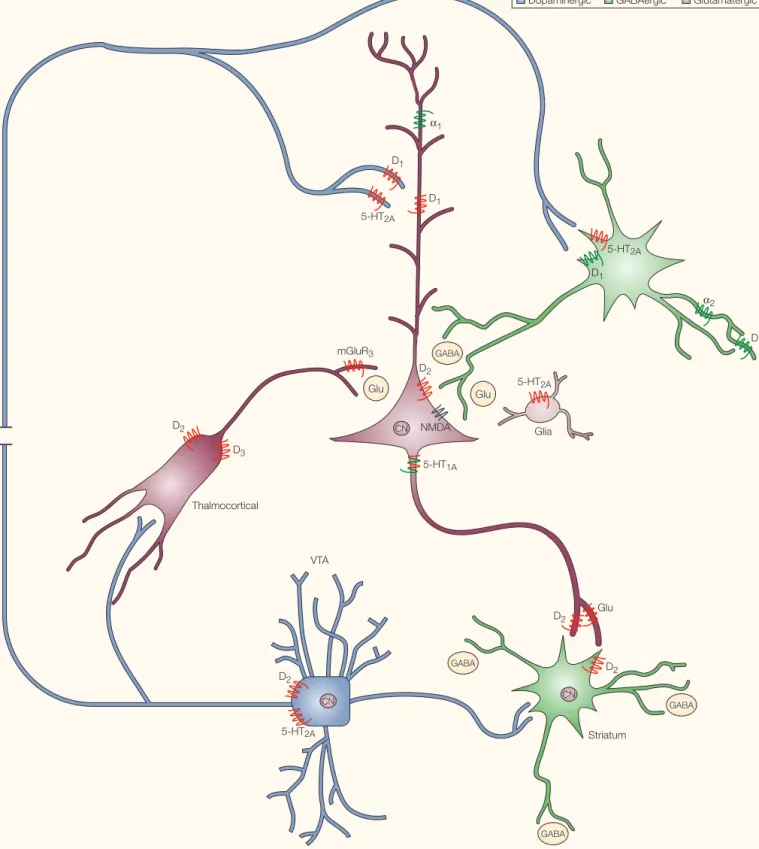
FIGURE 1shows the distribution of some of the receptors targeted by clozapine in relation to various molecular targets implicated by genetic studies of schizophrenia (see REFS 4,5 for details). As can be seen in FIG. 1, many of the genes implicated in the aetiology of schizo-phrenia are found in anatomical loci where they could, directly or indirectly, modulate glutamatergic and dopaminergic neurotrans-mission in the frontal cortex. Clozapine is Most common central nervous system
disorders — such as depression, bipolar disorder and schizophrenia — seem to be polygenic in origin, and the most effective medications have exceedingly complex pharmacologies. Attempts to develop more effective treatments for diseases such as schizophrenia and depression by discovering drugs selective for single molecular targets (that is, ‘magic bullets’) have, not surprisingly, been largely unsuccessful. Here we propose that designing selectively non-selective drugs (that is, ‘magic shotguns’) that interact with several molecular targets will lead to new and more effective medications for a variety of central nervous system disorders.
Despite their enormous potential to alleviate human suffering, before the introduction of fluoxetine (Prozac; Eli Lilly) in the late 1980s central nervous system (CNS) therapeutics were not widely embraced as either highly reliable or profitable. This is despite the fact that from the 1960s to the 1970s selected areas of CNS drug discovery yielded profitable drugs (for example, Valium, Milltown and Haldol). This was due, in part, to the lack of suitable animal models, disagreements regarding the biological basis of many dis-orders, uncertainty regarding the ultimate mechanism(s) of action and the clinical ineffectiveness of many CNS medications1. During the past two decades, CNS drug dis-covery — particularly in the areas of mood
Magic shotguns versus magic bullets:
selectively non-selective drugs for
mood disorders and schizophrenia
GABA
VTA Thalmocortical
Dopaminergic GABAergic Glutamatergic
D3
D2
5-HT2A
D2 CN
Glu D2
GABA
GABA CN
D2
5-HT2A
D1
D1
α2
mGluR3
Glu Glu 5-HT2A
5-HT1A
Glia D2
CN
GABA
5-HT2A α1
D1 D1
NMDA
Striatum
In addition to improving the core symp-toms of schizophrenia, such as hallucinations and delusions, atypical antipsychotic drugs as a class modestly improve cognition18, though it is unknown how these cognition-enhancing actions are mediated. Current hypotheses suggest that the cognition-enhancing actions of atypicals may be due to interactions with 5-HT2A19and 5-HT
6
20receptors, and to their abilities to enhance prefrontal cortical dopamine release21(FIG. 1).
Many attempts, largely unsuccessful, have been made to develop drugs that target the ‘magic receptor’ responsible for clozapine’s salutary effects in schizophrenia and related disorders and, thereby, yield novel atypical antipsychotic drugs. For instance, D4-selective compounds22, as well as compounds with 5-HT2A/D4antagonism23, are ineffective in thought to normalize glutamatergic and
dopaminergic neurotransmission in schizo-phrenia, thereby ameliorating symptoms, via complex interactions with a large number of molecular targets (FIGS 1,2). These pleiotypic actions of clozapine are probably responsible for its exceptionally beneficial actions in schizophrenia and related disorders9,10.
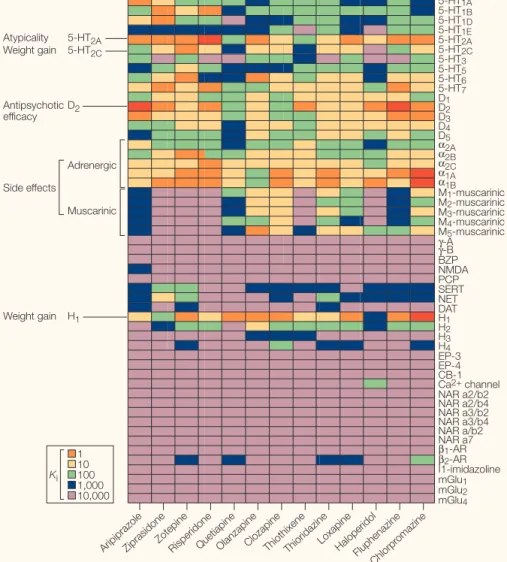
A graphical representation of the relative affinity values of clozapine and a number of other atypical antipsychotic drugs (aripipra-zole, ziprasidone, zotepine, quetiapine, olanza-pine, risperidone) and typical antipsychotic drugs (haloperidol, chlorpromazine) at a por-tion of the receptorome (that is, that porpor-tion of the proteome comprising receptors) is shown in FIG. 2. As can be seen, most of the presently approved atypical antipsychotic drugs have a complex pharmacology, with appreciable affinities for a variety of biogenic amine receptors. Given the huge potential market for atypical antipsychotic drugs (~US $10 billion annually), great effort has been devoted to uncovering the receptors responsible for effec-tiveness, for atypicality and for side effects. The idea has been that if one could design drugs that targeted the appropriate receptors, one could develop atypical antipsychotic drugs that are more effective than clozapine and have fewer side effects. These efforts will be furthered in the future by the precise delin-eation of the areas of the brain in which the drug exerts its beneficial effects, as well as char-acterization of the intracellular biochemical pathways contributing to both effectiveness and the development of side effects.
‘S2/D2’ drugs: not quite clozapine
The first ‘non-clozapine’ atypical to be mar-keted was risperidone, which potently blocks the effects of lysergic acid diethylamide (LSD) in laboratory animals by virtue of its high affinity for 5-HT2A receptors11. A systematic analysis of receptor pharmacology of a number of typical and atypical antipsychotic drugs led Meltzer12and others13to propose that the single distinguishing feature of an atypical antipsychotic drug was a relatively high affinity for 5-HT2Arelative to D2receptors (the ‘S2/D2hypothesis of atypicality’). Sub-sequently, several atypical antipsychotic drugs were introduced that fulfilled the ‘S2/D2’ cri-terion, including olanzapine, ziprasidone, zotepine and quetiapine. Although these drugs represent an advance in the treatment of schizophrenia, none of the presently approved atypical antipsychotic drugs is better than clozapine for schizophrenia14,15. As a class, the ‘S2/D2atypicals’ are not without serious side effects, including weight gain and the asso-ciated metabolic sequelae of diabetes and
hypercholesterolaemia16. In this regard, recent studies have implicated the histamine receptor H1, the 5-HT2C receptor and α1-adrenoceptors — sites for which many atypical antipsychotic drugs have high affinity — for causing weight gain and associated metabolic side effects17. S2/D2atypicals that have relatively low affinity for H1receptor and α1-adrenoceptors (for example, ziprasidone) are less likely to induce weight gain. Because other CNS medications that induce weight gain, such as amitryptiline, mirtazepine and imipramine (see PDSP Ki
Database, Further Information), also have high H1, 5-HT2C- and α1-adrenoceptor affinities, these data strongly imply that antipsychotic drugs that lack affinities at H1, 5-HT2Cand α1receptors will be less likely to induce the metabolic side effects of many of the presently marketed drugs.
5-HT1A
5-HT1B
5-HT1D
5-HT1E
5-HT2A
5-HT2C
5-HT3
5-HT5
5-HT6
5-HT7
α2A α2B α2C α1A α1B
D1
D2
D3
D4
D5
M1-muscarinic
M2-muscarinic M3-muscarinic M4-muscarinic
M5-muscarinic
H1
H2
H3
H4
EP-3 EP-4 CB-1 Ca2+ channel
NAR a2/b2
β1-AR β2-AR
NAR a2/b4 NAR a3/b4 NAR a3/b2 NAR a/b2 I1-imidazoline mGlu1
mGlu2
mGlu4
NAR a7 BZP NMDA PCP SERT NET DAT
γ-A
γ-B Adrenergic
Side effects 5-HT2A Atypicality
Muscarinic 5-HT2C
Weight gain
H1
Weight gain D2
Antipsychotic efficacy
Arip ipra
zole
Zipra sidon
e
Zote pine
Rispe ridon
e
Que tiapin
e
Olanz apin
e
Cloza pine
Thio thixe
ne
Thio ridaz
ine
Halo perid
ol
Loxa pine
Fluph enaz
ine
Chlo rpro
maz ine
1 10 100 1,000 10,000
Ki
Figure 2 |Screening the receptorome reveals multiple molecular targets implicated in antipsychotic drug actions.The affinity (Ki) values for clozapine and a large number of other biologically active compounds at various receptors can be found at the PDSP KiDatabase (see Further Information);
postsynaptic antagonist and would therefore ‘stabilize’ dopaminergic neurotransmission. This notion of ‘anatomical selectivity’ is diffi-cult to reconcile with later findings that aripiprazole is a D2partial agonist at post-synaptic pituitary D2receptors in vitroand
in vivo33. Likewise, the D
2partial agonism has been inconsistently replicated, with some groups reporting that aripiprazole is a high-affinity partial agonist in vitro34, and others reporting that aripiprazole is a D2antagonist
in vivoand in vitro35. By contrast, Lawler et al.36 proposed that aripiprazole was ‘functionally selective’ and that the agonist properties of aripiprazole were entirely dependent on the cellular milieu in which it was studied. As a result, it was proposed36that aripiprazole might function as a D2antagonist, agonist or partial agonist depending on the precise complement of D2receptors and G-proteins in a particular cell. This notion is similar to the idea of agonist-directed trafficking of receptors (see REF. 37for a recent review), an idea originally proposed many years ago38. This idea proposes that receptors can couple to several signal transducing molecules and suggests that “selective agonists and antago-nists might be developed which have spe-cific effects on a particular receptor-linked effector system.”38
When the various competing hypotheses of aripiprazole’s actions were tested, we found39, in support of the hypothesis of Lawler et al.36, that the actions of aripiprazole were entirely dependent on the cellular milieu. Interestingly, we also discovered39 that aripiprazole had a robust pharmacologi-cal profile with partial agonism at several 5-HT (5-HT1A, 5-HT2A, 5-HT2C, 5-HT7) and dop-amine (D2, D3, D4) receptors. So although aripiprazole is clearly a functionally selective partial agonist, its complex pharmacology precludes us from concluding that its bene-ficial actions in schizophrenia are due solely to partial agonism of D2receptors. It is more likely that the balance of partial agonism and antagonism at a multiplicity of receptors is responsible for its efficacy in schizophrenia and related disorders. Taken together, these findings have profound implications for CNS drug discovery, because they imply that simply developing selective low-efficacy D2 partial agonists will not yield effective antipsychotic drugs, but that D2partial ago-nists that functionally interact with various 5-HT and dopamine receptors might be effective. Therefore functionally non-selective dopamine agonists might represent a new generation of atypical antipsychotic drugs, with aripiprazole being the first member of this class.
schizophrenia, it was found to be effective for a short period (~one week), after which clinical efficacy was lost — presumably due to receptor desensitization28. Because (–)PPP has sub-stantial affinities for non-D2receptors (for example,σ-,α2B- or α2C-adrenoceptors; see PDSP Database, Further Information), it is conceivable that the ineffectiveness of (–) PPP was due to unforeseen interaction with non-D2receptors. Intriguingly, (+)-UH232 actually worsened psychotic symptoms, per-haps via a combination of D3and 5-HT2A agonism29, because 5-HT
2A agonism is known to exacerbate psychosis62.
On the basis of these early trials, it was unclear whether (–)PPP’s lack of efficacy beyond one week was due to either inadvertent interaction with psychotomimetic receptors (for example,σ1-adrenoceptor) or the rela-tively high intrinsic activity of (–)PPP leading to desensitization. Several other D2partial agonists, including terguride, OPC-4392, pramipexole and SDZ HDC 912, have now been tested in schizophrenia, mainly unsuc-cessfully30. To date, only aripiprazole (OPC 14597), a weak D2partial agonist31, has shown efficacy for schizophrenia32, although con-siderable controversy exists regarding its mechanism of action (BOX 1).
Kikuchi et al.31originally proposed that aripiprazole was a presynaptic agonist and a treating schizophrenia. Likewise, the 5-HT2A
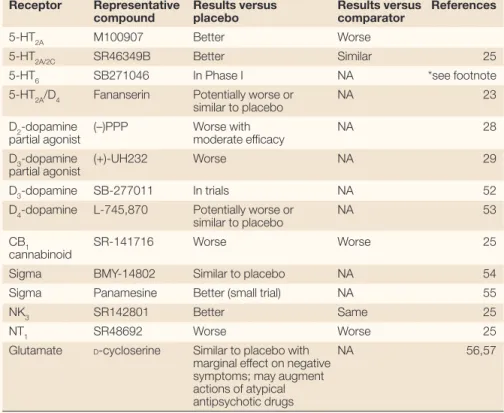
selective compound M100907 (REF. 24)failed to reduce symptoms to the same extent as haloperidol (a typical antipsychotic drug comparator) in a multi-centre clinical trial, whereas the 5-HT2A/2C antagonist SR46349B fared better in comparison with haloperidol25 (TABLE 1). There have also been suggestions that compounds with muscarinic26or adreno-ceptors (both α2- and α1-adrenoceptors) actions might be effective antipsychotic drugs but, so far, none have shown efficacy in clinical trials (see REF. 8and references cited therein). TABLE 1lists a number of other ‘magic bullets’ which, with few exceptions, were shown to lack efficacy in schizophrenia.
Partial agonists for schizophrenia Some years ago, Carlsson proposed that (–)-3-(3-hydroxyphenyl)-N-n-propylpiperidine ((–)PPP), by virtue of its autoreceptor agonist properties, might represent a prototype for a new family of atypical antipsychotic drugs27. Carlsson’s notion was that a partial agonist would normalize or ‘stabilize’ dopaminergic neurotransmission in a way that would be salutary for both the positive and negative symptoms of schizophrenia. Two potential compounds were subsequently tested: (–)PPP and (+)-UH232 (a D3-preferring agonist with 5-HT2Aagonism). When (–)PPP was tested in
Table 1 | Non-D2dopamine antagonists in schizophrenia are inferior
Receptor Representative Results versus Results versus References
compound placebo comparator
5-HT2A M100907 Better Worse
5-HT2A/2C SR46349B Better Similar 25
5-HT6 SB271046 In Phase I NA *see footnote
5-HT2A/D4 Fananserin Potentially worse or NA 23
similar to placebo
D2-dopamine (–)PPP Worse with NA 28
partial agonist moderate efficacy
D3-dopamine (+)-UH232 Worse NA 29
partial agonist
D3-dopamine SB-277011 In trials NA 52
D4-dopamine L-745,870 Potentially worse or NA 53
similar to placebo
CB1 SR-141716 Worse Worse 25
cannabinoid
Sigma BMY-14802 Similar to placebo NA 54
Sigma Panamesine Better (small trial) NA 55
NK3 SR142801 Better Same 25
NT1 SR48692 Worse Worse 25
Glutamate D-cycloserine Similar to placebo with NA 56,57
marginal effect on negative symptoms; may augment actions of atypical antipsychotic drugs
that the large-scale, automated and random screening of libraries of compounds enriched for activity at CNS targets, using mainly behavioural assays, will yield compounds with novel and, possibly improved, efficacies for a variety of CNS diseases. These approaches carry with them the advantage of examining responses to drugs at the level of entire organ-isms, and therefore in the context of their biological functioning, rather than in overly simplified experimental systems, for example, as in isolated in vitrobinding studies.
Another approach is a genomic one in which compounds are screened solely on the basis of their abilities to modify the Non-selective antidepressants?
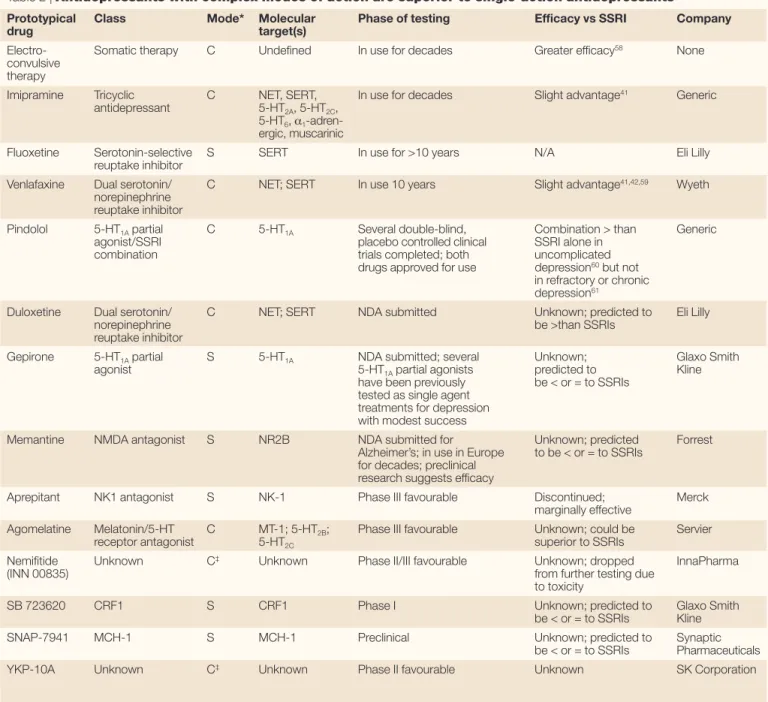
If ‘dirty’ drugs are better for treating schizo-phrenia than selective (‘clean’) ones, what about other CNS disorders? TABLE 2lists the current classes of antidepressants, ranking them by their relative effectiveness in treating depression. The most effective treatment for depression — electroconvulsive therapy (ECT) — alters the dynamics of a vast number of neurotransmitters and neuromodulators, and has profound effects on intracellular signalling pathways related to signal transduction and mitogenesis7. Indeed, very recent studies imply that the pleiotypic actions of antidepressants on signal transduction and neuronal mitogen-esis are required for the beneficial actions of antidepressants on mood40. Likewise, so-called ‘dual-action’ antidepressants, which inhibit the reuptake of both 5-HT and other biogenic amines (for example, dopamine and nor-adrenaline), have been shown to be more effec-tive than ‘single-action’ antidepressants such as the SSRIs41,42. As an added benefit, the ‘dual-action’ antidepressants also seem to effectively treat chronic pain43. Finally, recent genetic studies have implied that depression, like schizophrenia, is a complex disorder with linkage to several genes44, including many that converge on the transcription factor cAMP-responsive element binding protein-1
(CREB1). These results imply that improved
treatments for mood disorders are likely to arise from drugs with several mechanisms of action, and that studies that connect new knowledge of genetic linkage of these diseases in humans with those of changes in gene regulation in dis-ease, as well as after treatment, are likely to be helpful in the development of new therapies.
Implications for CNS drug discovery Given that selectively non-selective drugs are likely to be more beneficial than single-action agents in many CNS disorders, how best to develop them? Clearly, conventional approaches relying on high-throughput screening (HTS) of cloned human molecular targets and the subsequent optimization of these ‘single-target agents’ is not likely to yield selectively non-selective agents, except, perhaps, by chance. Structure-based drug design approaches in which ligands are designed to interact with the correct subset of molecular targets are also not likely to be successful. This is because many of the mol-ecular targets selected have a high degree of structural similarity and designing drugs to target a subset of them is not likely to be successful (see REF. 63for discussion).
The implication of these findings is that the screening of small molecules by non-conventional approaches should be considered.
Conceptually, at least two non-conventional approaches for discovering ‘magic shotguns’ can be envisioned: behaviour-based screening and genomic approaches. The first, which has been dubbed ‘HTS’-based behavioural screening’45,46, relies on the semi-automated screening of candidate drugs in broad-based behavioural assays. At least two novel anti-depressants — YKP10A and INN 00835 — were discovered using this approach. Neither drug seems to have appreciable affinity for any known antidepressant drug target, including various biogenic amine receptors and trans-porters47, and both have demonstrated effec-tiveness in early-phase trials48,47. It is probable
Box 1 |Partial functionally selective agonists for schizophrenia?
The figure shows three different proposed models of aripiprazole action. In these various models, receptors coloured green are activated by aripiprazole and those coloured red are antagonized; receptors colourd yellow can be partially activated by aripiprazole, depending on the assay conditions. In panel a, the anatomical specificity model is highlighted. This model originally proposed that partial agonists which are effective in treating schizophrenia have differential actions at pre- and postsynaptic D2dopamine receptors31. This model proposed that aripiprazole, for instance, is a presynaptic agonist and a postsynaptic antagonist; these dual actions thereby ‘normalize’ dopaminergic signalling. In panel b, the density-dependent partial agonist model34is shown schematically. This model, which relies on classical receptor theory, proposes that aripiprazole is a partial agonist whose actions depend solely on the relative density of D2-dopamine receptors. As such, in brain regions in which relatively high concentrations of D2-dopamine receptors exist, drugs like aripiprazole would be partial agonists, whereas in brain regions with relatively low concentrations of D2receptors exist aripiprazole would function as an antagonist. In panel c, we show our conceptualization of the functional selectivity model. This model proposes that aripiprazole’s partial agonist actions at a variety of G-protein-coupled receptors (GPCRs) are dependent on the precise cellular complement of receptors and G-proteins36 and relies on our current understanding of GPCR actions. This model predicts that partial agonists, such as aripiprazole, will have a multiplicity of actions, functioning as agonists, partial agonists or antagonists. Indeed, recent studies indicate that the functional selectivity model best explains aripiprazole’s actions39.
D2
D2
D2
D2
D2
D2
D2
D2
D2
D2
D2
D2
5-HT2A
D2
α β γ
αβγ αβγ
α β γ
5-HT2A
5-HT1A
αβγ αβγ
a Anatomical specificity
b Density-dependent partial agonism
drugs — ‘magic shotguns’ — could be dis-covered by combining behavioural and genomics-based screening. Once leads are discovered, potential toxicities could be rela-tively easily ‘designed out’ by counter-screening approaches combined with straight-forward medicinal chemistry approaches. Such magic shotguns, or selectively non-selective drugs, are likely to represent highly effective and novel treatments for major CNS disorders. The rational discovery, optimization and eventual marketing of selectively non-selective drugs will end our reliance on serendipity as the driving force for effective drug discovery for CNS disorders. On the other hand, in a gene K+channel for arrhythmias50and the
5-HT2Breceptor for fenfluramine-like valvular heart disease51). In addition, it might prove possible to use combinations of compounds to ‘fine-tune’ these gene regulatory signatures.
The end of serendipity?
Historically, serendipity has been the driving force in the discovery of novel and highly effective drugs for CNS disorders. Not sur-prisingly, the most clinically effective treat-ments for depression and schizophrenia, and perhaps other disorders, continue to be the ones with the most nonspecific actions. It is likely that selectively non-selective coordinated expression of gene families. In this
approach, compounds with known beneficial actions and pleiotypic actions (for example, lithium, clozapine) are screened in vivoand
in vitrofor their effects on coordinated gene expression. Once gene ‘signatures’ are dis-covered, compound libraries are subsequently screened to discover small molecules which, when administered in vitroand in vivo, yield similar signatures; such an approach is now being undertaken by Psychiatric Genomics, Inc.49. Lead compounds can then be optimized to eliminate interactions with potentially toxic molecular targets (for example, H1receptor for weight gain17, human ether-a-go-go-related
Table 2 | Antidepressants with complex modes of action are superior to single-action antidepressants
Prototypical Class Mode* Molecular Phase of testing Efficacy vs SSRI Company
drug target(s)
Electro- Somatic therapy C Undefined In use for decades Greater efficacy58 None
convulsive therapy
Imipramine Tricyclic C NET, SERT, In use for decades Slight advantage41 Generic
antidepressant 5-HT2A, 5-HT2C,
5-HT6, α1
-adren-ergic, muscarinic
Fluoxetine Serotonin-selective S SERT In use for >10 years N/A Eli Lilly
reuptake inhibitor
Venlafaxine Dual serotonin/ C NET; SERT In use 10 years Slight advantage41,42,59 Wyeth
norepinephrine reuptake inhibitor
Pindolol 5-HT1Apartial C 5-HT1A Several double-blind, Combination > than Generic
agonist/SSRI placebo controlled clinical SSRI alone in
combination trials completed; both uncomplicated
drugs approved for use depression60but not
in refractory or chronic depression61
Duloxetine Dual serotonin/ C NET; SERT NDA submitted Unknown; predicted to Eli Lilly
norepinephrine be >than SSRIs
reuptake inhibitor
Gepirone 5-HT1Apartial S 5-HT1A NDA submitted; several Unknown; Glaxo Smith
agonist 5-HT1Apartial agonists predicted to Kline
have been previously be < or = to SSRIs tested as single agent
treatments for depression with modest success
Memantine NMDA antagonist S NR2B NDA submitted for Unknown; predicted Forrest
Alzheimer’s; in use in Europe to be < or = to SSRIs for decades; preclinical
research suggests efficacy
Aprepitant NK1 antagonist S NK-1 Phase III favourable Discontinued; Merck
marginally effective
Agomelatine Melatonin/5-HT C MT-1; 5-HT2B; Phase III favourable Unknown; could be Servier
receptor antagonist 5-HT2C superior to SSRIs
Nemifitide Unknown C‡ Unknown Phase II/III favourable Unknown; dropped InnaPharma
(INN 00835) from further testing due
to toxicity
SB 723620 CRF1 S CRF1 Phase I Unknown; predicted to Glaxo Smith
be < or = to SSRIs Kline
SNAP-7941 MCH-1 S MCH-1 Preclinical Unknown; predicted to Synaptic
be < or = to SSRIs Pharmaceuticals
YKP-10A Unknown C‡ Unknown Phase II favourable Unknown SK Corporation
44. Zubenko, G. et al. Genome-wide linkage survey for genetic loci that influence the development of depressive disorders in families with recurrent, early-onset, major depression. Am. J. Med Genet.123B, 1–18 (2003). 45. Brunner, D., Nestler, E. & Leahy, E. In need of
high-throughput behavioral systems. Drug Discov. Today7, S107–S112 (2002).
46. Bohannon, J. Animal models. Can a mouse be standardized? Science298, 2320–2321 (2002). 47. Amsterdam, J. D., Brunswick, D. J. & Hundert, M.
A single-site, double-blind, placebo-controlled, dose-ranging study of YKP10A — a putative, new antidepressant. Prog. Neuropsychopharmacol. Biol. Psychiatry26, 1333–1338 (2002).
48. Feighner, J. P. et al. Double-blind, placebo-controlled study of INN 00835 (netamiftide) in the treatment of outpatients with major depression. Int. Clin. Psychopharmacol.16, 345–352 (2001).
49. Palfreyman, M. G. et al. Novel directions in antipsychotic target identification using gene arrays. Curr. Drug Target CNS Neurol. Disord.1, 227–238 (2002).
50. Suessbrich, H., Waldegger, S., Lang, F. & Busch, A. E. Blockade of HERG channels expressed in Xenopus
oocytes by the histamine receptor antagonists terfenadine and astemizole. FEBS Lett.385, 77–80 (1996). 51. Rothman, R. B. et al. Evidence for possible involvement
of 5-HT(2B) receptors in the cardiac valvulopathy associated with fenfluramine and other serotonergic medications. Circulation102, 2836–2841 (2000). 52. Remington, G. & Kapur, S. SB-277011 GlaxoSmithKline.
Curr. Opin. Investig. Drugs2, 946–949 (2001). 53. Kramer, M. S., Last, B., Getson, A. & Reines, S. A.
The effects of a selective D4dopamine receptor antagonist (L-745,870) in acutely psychotic inpatients with schizophrenia. D4Dopamine Antagonist Group.
Arch. Gen. Psychiatry54, 567 (1997).
54. Gewirtz, G. R. et al. BMY14802, a σreceptor ligand for the treatment of schizophrenia.
Neuropsychopharmacology10, 37–40 (1994). 55. Muller, M. J. et al. Antipsychotic effects and tolerability of
the sigma ligand EMD 57445 (panamesine) and its metabolites in acute schizophrenia: an open clinical trial.
Psychiatry Res. 89, 275–280 (1999). 56. van Berckel, B. et al. Efficacy and tolerance of
D-cycloserine in drug-free schizophrenic patients. Biol. Psychiatry40, 1298 (1996).
57. Evins, A. E., Amico, E., Posever, T. A., Toker, R. & Goff, D. C. D-Cycloserine added to risperidone in patients with primary negative symptoms of schizophrenia. Schizophr. Res.56, 19–23 (2002). 58. Efficacy and safety of electroconvulsive therapy in depressive disorders: a systematic review and meta-analysis. Lancet361, 799–808 (2003).
59. Stahl, S. M., Entsuah, R. & Rudolph, R. L. Comparative efficacy between venlafaxine and SSRIs: a pooled analysis of patients with depression. Biol. Psychiatry52, 1166–1174 (2002).
60. Perez, V., Gilaberte, I., Faries, D., Alvarez, E. & Artigas, F. Randomised, double-blind, placebo-controlled trial of pindolol in combination with fluoxetine antidepressant treatment. Lancet349, 1594–1597 (1997).
61. Berman, R. M. et al. The use of pindolol with fluoxetine in the treatment of major depression: final results from a double-blind, placebo-controlled trial. Biol. Psychiatry 45, 1170–1177 (1999).
62. Nichols, D. E. Hallucinogens. Parmacol. Ther.101, 131–181 (2004).
63. Kroeze, W. K., Sheffler, D. J. & Roth, B. L. G-protein-coupled receptors at a glance. J. Cell Sci.116, 4867–4869 (2003).
Acknowledgements
Work in the authors’ laboratories is supported by the National Institutes of Health.
Competing interest statement
The authors declare competing financial interests; see Web version for details.
Online links
DATABASES
The following terms in this article are linked online to:
LocusLink:http://www.ncbi.nlm.nih.gov/LocusLink/ CREB1
FURTHER INFORMATION
National Institutes of Mental Health Psychoactive Drug Screening Program: http://pdsp.cwru.edu/
PDSP KiDatabase:http://kidb.cwru.edu/
Access to this interactive links box is free online. recent colloquium sponsored by the Collegium
Internationale Neuro-Psychopharmaco-logicum, Arvid Carlsson has argued that the field of CNS drug discovery is likely to con-tinue to depend very much on serendipity. The approaches he suggested to facilitate these serendipitous discoveries are very similar to those outlined above, although we would argue that the results of such searches will not be serendipitous at all, but rather the result of looking for the right thing (magic shotguns) in the right place and at the right time.
Bryan L. Roth, Douglas J. Sheffler and Wesley K. Kroeze are in the Department of Biochemistry, School of Medicine, Case Western Reserve University, 2109 Adelbert Road, Cleveland, Ohio 44106, USA. Correspondence to B.L.R. e-mail: [email protected]
doi:10.1038/nrd1346
1. Shorter, E. Looking backwards: a possible new path for drug discovery in psychopharmacology. Nature Rev. Drug Discov.1, 1003–1006 (2002).
2. Carlsson, A. & Wong, D. T. Correction: a note on the discovery of selective serotonin reuptake inhibitors.
Life Sci.61, 1203 (1997).
3. Hippius, H. A historical perspective of clozapine. J. Clin. Psychiatry60(Suppl. 12), 22–23 (1999).
4. Harrison, P. J. & Owen, M. J. Genes for schizophrenia? Recent findings and their pathophysiological implications.
Lancet361, 417–419 (2003).
5. Lewis, C. M. et al. Genome scan meta-analysis of schizophrenia and bipolar disorder, part II: Schizophrenia.
Am. J. Hum. Genet.73, 34–48 (2003).
6. Setola, V. & Roth, B. L. Why mice are neither miniature humans nor small rats: a cautionary tale involving 5-hydroxytryptamine-6 serotonin receptor species variants. Mol. Pharmacol.64, 1277–1278 (2003). 7. Coyle, J. T. & Duman, R. S. Finding the intracellular
signaling pathways affected by mood disorder treatments. Neuron38, 157–160 (2003). 8. Roth, B., Sheffler, D. J. & Potkin, S. Atypical
antipsychotic drugs: unitary or multiple mechanisms for ‘atypicality’. Clin. Neurosci. Res.(in the press). 9. Kane, J., Honigfield, G., Singer, J., Meltzer, H. Y.
Clozapine for the treatment-resistant schizophrenic: a double-blind comparison with chlorpromazine.
Arch. Gen. Psychiatry45, 789–796 (1988). 10. Meltzer, H. Y. et al. Clozapine treatment for suicidality in
schizophrenia: International Suicide Prevention Trial (InterSePT). Arch. Gen. Psychiatry60, 82–91 (2003). 11. Colpaert, F. C. Discovering risperidone: the LSD model
of psychopathology. Nature Rev. Drug Discov.2, 315–320 (2003).
12. Meltzer, H. Y., Matsubara, S. & Lee, J.-C. Classification of typical and atypical antipsychotic drugs on the basis of dopamine D-1, D-2 and serotonin2 pKivalues. J. Pharmacol. Exp. Ther.251, 238–246 (1989). 13. Altar, C. A., Wasley, A. M., Neale, R. F. & Stone, G. A.
Typical and atypical antipsychotic occupancy of D2and
S2receptors: an autoradiographic analysis in rat brain. Brain Res. Bull.16, 517–525 (1986).
14. Leucht, S., Wahlbeck, K., Hamann, J. & Kissling, W. New generation antipsychotics versus low-potency conventional antipsychotics: a systematic review and meta-analysis. Lancet361, 1581–1589 (2003). 15. Tuunainen, A., Wahlbeck, K. & Gilbody, S. Newer atypical
antipsychotic medication in comparison to clozapine: a systematic review of randomized trials. Schizophr. Res. 56, 1–10 (2002).
16. Fontaine, K. R. et al. Estimating the consequences of anti-psychotic induced weight gain on health and mortality rate. Psychiatry Res.101, 277–288 (2001). 17. Kroeze, W. K. et al. H1-histamine receptor affinity
predicts short-term weight gain for typical and atypical antipsychotic drugs. Neuropsychopharmacology28, 519–526 (2003).
18. Meltzer, H. Y. & McGurk, S. R. The effects of clozapine, risperidone, and olanzapine on cognitive function in schizophrenia. Schizophr. Bull.25, 233–255 (1999).
19. Williams, G. V., Rao, S. G. & Goldman-Rakic, P. S. The physiological role of 5-HT2Areceptors in working
memory. J. Neurosci.22, 2843–2854 (2002). 20. Woolley, M. L., Bentley, J. C., Sleight, A. J., Marsden, C. A.
& Fone, K. C. A role for 5-HT6receptors in retention of
spatial learning in the Morris water maze.
Neuropharmacology41, 210–219 (2001). 21. Castner, S. A., Williams, G. V. & Goldman-Rakic, P. S.
Reversal of antipsychotic-induced working memory deficits by short-term dopamine D1receptor stimulation.
Science287, 2020–2022 (2000).
22. Bristow, L. J. et al. Schizophrenia and L-745,870, a novel dopamine D4receptor antagonist. Trends Pharmacol. Sci.18, 186 (1997).
23. Truffinet, P. et al. Placebo-controlled study of the D4/5-HT2Aantagonist fananserin in the treatment of schizophrenia. Am. J. Psychiatry156, 419–425 (1999). 24. de Paulis, T. M-100907 (Aventis). Curr. Opin. Investig.
Drugs2, 123–132 (2001).
25. Meltzer, H., Arvantis, L., Bauer, D., Rein, W. & Group, M. S. A placebo-controlled evaluation of four novel compounds for the treatment of schizophrenia and schizoaffective disorder. Arch. Gen. Psychiatry(in the press).
26. Rasmussen, T. et al. The muscarinic receptor agonist BuTAC, a novel potential antipsychotic, does not impair learning and memory in mouse passive avoidance.
Schizophr. Res.49, 193–201 (2001).
27. Clark, D. et al. Is 3-PPP a potential antip sychotic agent? Evidence from animal behavioral studies.
Eur. J. Pharmacol.83, 131–134 (1982).
28. Lahti, A. C. et al. Antipsychotic properties of the partial dopamine agonist (–)-3-(3-hydroxyphenyl)-N -n-propylpiperidine(preclamol) in schizophrenia. Biol. Psychiatry43, 2–11 (1998).
29. Lahti, A. C., Weiler, M., Carlsson, A. & Tamminga, C. A. Effects of the D3and autoreceptor-preferring dopamine antagonist (+)-UH232 in schizophrenia. J. Neural Transm. 105, 719–734 (1998).
30. Benkert, O., Muller-Siecheneder, F. & Wetzel, H. Dopamine agonists in schizophrenia: a review. Eur. Neuropsychopharmacol.5, S43–S53 (1995). 31. Kikuchi, T. et al.
7-(4-[4-(2,3-Dichlorophenyl)-1-piperazinyl]butyloxy)-3,4-dihydro-2(1H)-qui nolinone (OPC-14597), a new putative antipsychotic drug with both presynaptic dopamine autoreceptor agonistic activity and postsynaptic D2receptor antagonistic
activity. J. Pharmacol. Exp. Ther.274, 329–336 (1995). 32. Kane, J. M. et al. Efficacy and safety of aripiprazole and
haloperidol versus placebo in patients with schizophrenia and schizoaffective disorder. J Clin. Psychiatry63, 763–771 (2002).
33. Inoue, T., Domae, M., Yamada, K. & Furukawa, T. Effects of the novel antipsychotic agent 7-(4-[4-(2,3- dichlorophenyl)-1-piperazinyl]butyloxy)-3,4-dihydro-2(1H)-quinolinone (OPC-14597) on prolactin release from the rat anterior pituitary gland. J. Pharmacol. Exp. Ther. 277, 137–143 (1996).
34. Burris, K. D. et al. Aripiprazole, a novel antipsychotic, is a high-affinity partial agonist at human dopamine D2 receptors. J. Pharmacol. Exp. Ther.302, 381–389 (2002).
35. Hemrick–Luecke, S. et al. Pharmacological activity of aripiprazole at presynaptic and postsynaptic dopamine receptors and in antipsychotic models. Proc. Soc. Neurosci.894.9 (2002).
36. Lawler, C. P. et al. Interactions of the novel antipsychotic aripiprazole (OPC-14597) with dopamine and serotonin receptor subtypes. Neuropsychopharmacology20, 612–627 (1999).
37. Kenakin, T. Efficacy at G-protein-coupled receptors.
Nature Rev. Drug Discov.1, 103–110 (2002). 38. Roth, B. L. & Chuang, D. M. Multiple mechanisms of
serotonergic signal transduction. Life Sci.41, 1051–1064 (1987).
39. Shapiro, D. A. et al. Aripiprazole, a novel atypical antipsychotic drug with a unique and robust pharmacology. Neuropsychopharmacology28, 1400–1411 (2003).
40. Santarelli, L. et al. Requirement of hippocampal neurogenesis for the behavioral effects of antidepressants. Science301, 805–809 (2003). 41. Anderson, I. M. Meta-analytical studies on new
antidepressants. Br. Med. Bull.57, 161–178 (2001). 42. Thase, M. E., Entsuah, A. R. & Rudolph, R. L. Remission
rates during treatment with venlafaxine or selective serotonin reuptake inhibitors. Br. J. Psychiatry178, 234–241 (2001).