Timothy A. Ross. Searching without SQL: Re-engineering a database-centric web application with open-source information retrieval software. A Master’s Paper for the M.S. in IS degree. November, 2008. 34 pages. Advisor: Gary Marchionini.
This paper seeks to describe the process by which a database-centric web application was redesigned and rewritten to take advantage of Apache’s Lucene - an open-source
information retrieval software library written in the Java programming language. After the implementation of a Lucene-based text index of “semi-structured data”, a college radio station's card catalog application was able to deliver higher-quality search results in significantly less time than it was able to do using just a relational database alone.
Additionally, the dramatic improvements in speed and performance even allowed the search results interface to be redesigned and enhanced with an improved pagination system and new features such as faceted search/filtering.
Headings:
Information Systems - Design
Database Management Systems – Evaluation
Information Retrieval – Evaluation
Computer Software - Development
SEARCHING WITHOUT SQL:
RE-ENGINEERING A DATABASE-CENTRIC WEB APPLICATION WITH OPEN-SOURCE INFORMATION RETRIEVAL SOFTWARE.
by
Timothy A. Ross
A Master’s paper submitted to the faculty of the School of Information and Library Science of the University of North Carolina at Chapel Hill
in partial fulfillment of the requirements for the degree of Master of Science in
Information Science.
Chapel Hill, North Carolina
November 2008
Approved by
_______________________________________
Table of Contents
Introduction ...2
Background and Description of the Existing System ...3
Technical Details and the Data Model ...7
Problems with the Existing System ...9
Implementing Lucene ...14
Results and Comparative Analysis ...22
Additional Enhancements and Challenges ...27
Introduction
A solid understanding of relational database principles and the ability to write
queries using the Structured Query Language (SQL) are two of the most fundamental
skills in the toolboxes of most server-side developers and web programmers. The clear
and human-comprehensible syntax of a SQL SELECT statement make it an elegant and
almost irresistible choice for a web developer who is asked to take unknown input from a
user and dynamically generate a web page full of specifically tailored results derived
from existing application data.
Despite the simplicity and ubiquity of SQL, however, it is not always the best
solution to a data-retrieval need – even for a system in which there is already a database
involved. Depending on the type of data that is contained in an application, the range of
possible user inputs, and the extent to which multi-word pieces of text are present within
the data, a full-text search solution with ranked search results may be a much better
option. The field of information retrieval may be the bedrock of Internet search engines
and other complex systems that manage large quantities of text-filled documents, but the
specific methods and techniques developed in the information retrieval world can also
offer great benefit to all types of applications large and small, even those in which the
data is more structured than it might typically be in a system containing journal articles or
blog postings. Many relational databases do not offer much, if any, support when it
relational data store with an additional text-based index, developers can use the best of
both worlds to optimize both the performance and the usability of their applications.
This paper seeks to describe the process by which a database-centric web
application was redesigned and rewritten to take advantage of Apache’s Lucene - an
open-source information retrieval software library written in the Java programming
language. After the implementation of a Lucene-based text index of “semi-structured
data”, a college radio station's card catalog application was able to deliver higher-quality
search results in significantly less time than it was able to do using just a relational
database alone. Additionally, the dramatic improvements in speed and performance even
allowed the search results interface to be redesigned and enhanced with an improved
pagination system and new features such as faceted search/filtering.
Background and Description of Existing System
WXYC 89.3 FM is the college radio station for the University of North Carolina
at Chapel Hill. The station has a huge music library consisting of well over 50,000
records and CDs. For decades, the station had used a paper-based card catalog index to
store information about its collection, but in 2002, a card catalog application that I
designed and developed became the digital replacement for the aging paper-based
system. In its initial 2002 version, this card catalog application was mainly a web
interface that allowed DJs to search and view limited amounts of data about all of the
various artists and releases in the station's music library. Special WXYC-specific “library
library, which was divided up by both format and genre across several different rooms
throughout the station.
An administrative interface to the system allowed music librarians and other
authorized WXYC personnel to add new artists and releases to the card catalog whenever
the station acquired new records and CDs. These music librarians/catalog administrators
could also use this interface to modify and/or delete artist and release data as necessary.
The central component of the online card catalog application, however, was its search
interface. Search, after all, was the core functionality that allowed DJs to see what
releases the station had for a given artist, whether or not the station had a specific album,
and exactly where to find these artists and releases within the station's physical record
library.
The card catalog application had two search interfaces. One was a basic “simple
search” interface (see Figure 1) not too unlike the no-frills textbox that one finds on the
Google homepage. This interface would simply attempt to search the station's catalog of
releases using all of the default search options.
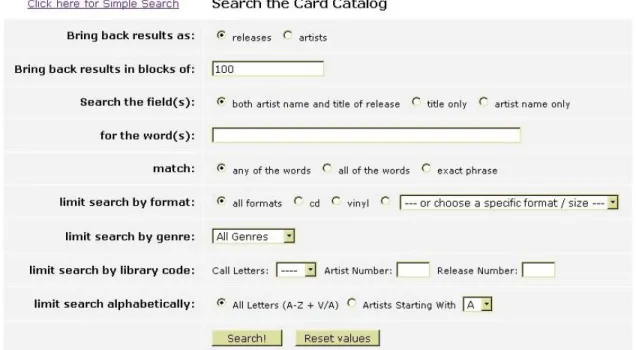
A second “advanced search” interface (see Figure 2) allowed DJs to tweak the
search options however they saw fit. DJs could search for either artists or releases, and
results could be limited by format, by genre, by specific portions of the library code, or
alphabetically. Additional search metadata allowed DJs to specify how they wanted their
search string to be handled by the system. These extra parameters specified what fields
the system should search against (artist, title, or both), as well as whether the system
should attempt to match any of the search words, all of the search words, or simply the
exact phrase in the order that it was typed.
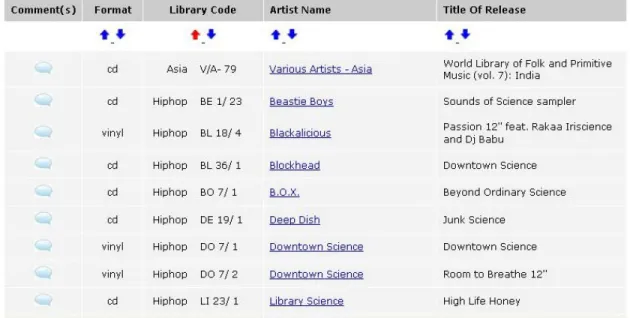
After a user submitted a search via either of the two search interfaces, search
results would be presented on either an “artist results” page or a “release results” page.
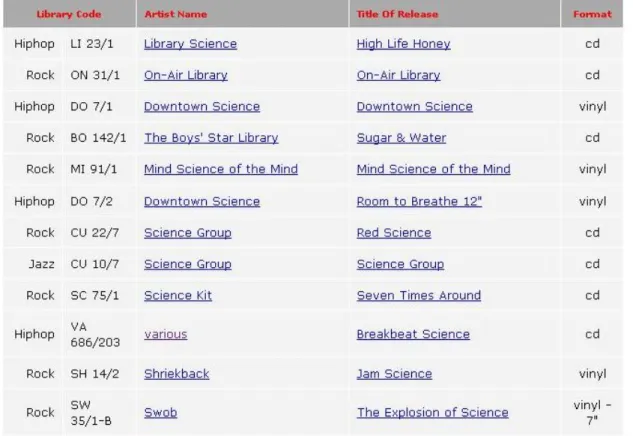
(Figure 3 shows a portion of a “release results” page for the query “library science”).
Over the years, release searches have been far more common in the system, and these
searches pose a more interesting problem from an information retrieval point of view. As
a result, I have focused primarily on release searches in this paper.
Technical Details and the Data Model
I designed and developed this card catalog application in Java, using the standard
server-side Java/J2EE technologies of the 2001-2002 era (servlets, JDBC, Java Server
Pages) and employing the fairly common “Model 2” version of the popular
“model-view-controller” pattern/architecture. The web application was deployed to a Tomcat
application server that supported all of the aforementioned Java technologies. All data
was persisted to a MySQL database. Of the approximately ten tables in the MySQL
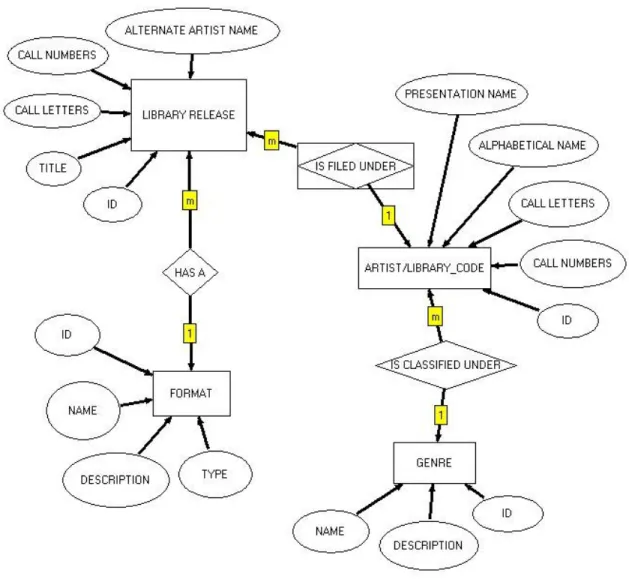
database, four are directly queried by the application's original searching routine:
FORMAT, GENRE, LIBRARY_CODE, and LIBRARY_RELEASE. (See Figure 4 for
an ER diagram of the entities and relationships represented in these four database tables.)
The FORMAT and GENRE tables basically acted as “lookup” tables that stored
all of the various release formats and genres found in the station's music library. The data
in these two tables did not change much at all, and each table only had a limited number
of categories that could be used to classify artists and releases. The FORMAT table
contained details about 22 specific formats, all of them different variations of the two
major format types – CD and vinyl. The GENRE table was even smaller. It had 14
entries that represented the 14 genre sections of the WXYC music library: Africa, Asia,
Blues, Classical, Comedy, Hiphop (a section that also includes Electronic/Techno), Jazz,
Latin, OCS (a station-specific moniker for traditional/folk music), Reggae, Rock,
Soundtracks, Spoken Word, and Xmas.
The LIBRARY_CODE table is somewhat confusingly named and is better
thought of as being an artist table that includes specific library code attributes for each
these are usually identical, but with an individual performer, these tend to be different
(e.g. “Springsteen, Bruce” and “Bruce Springsteen”). The LIBRARY_CODE table also
contains the library code letters/numbers used to identify the artist and all associated
releases within a certain section of the music library. A foreign key to the GENRE table
signifies the genre section in which this happens to be. As of November 2008, the
LIBRARY_CODE table contained well over 18,000 artist records.
The LIBRARY_RELEASE table contains information about a specific library
release. Basic library release fields include title, library call letters, and library call
numbers. A foreign key to the FORMAT table specifies the format of the release, and a
foreign key to the LIBRARY_CODE table identifies the artist/library code under which
the release is filed. An optional ALTERNATE_ARTIST_NAME field also allows for the
storage of the release’s actual artist listing (e.g., “Bruce Springsteen and the E-Street
Band”) in the event that this information differs from the artist name associated with the
release’s library code. As of November 2008, the LIBRARY_RELEASE table contained
well over 50,000 library release records.
Problems With The Existing System
I had a few years of Java development experience under my belt before beginning
work on this application in 2001, but this was my first attempt at building a MySQL
database from scratch and writing all of the queries that would be needed by the
application. Looking back, I can honestly say that in my eagerness to flex some of my
new MySQL/database skills, I implemented much of the application's search
functionality in a fairly crude way. Upon receiving a search request from the user, the
application would first read in the search string and all of the extra search parameters
specifying how to process the search string, what additional search requirements/limits to
use, and exactly how to sort/present search results. This information was then passed to a
Java object that would go through all of it and dynamically create a giant SQL statement
that reflected the specified search logic. If a search string happened to contain multiple
release” field-specification option had been selected, the SQL-creating code would
generate numerous text-comparison “LIKE” clauses (one for each combination of field
and search term) and “OR” these SQL fragments together into a convoluted WHERE
clause that would attempt to match any of the supplied search words with either of the
artist or title fields. See Figure 5 for an example of how the aforementioned query for
“library science” was translated into SQL.
SELECT LR.ID, LR.LIBRARY_CODE_ID, LR.CALL_NUMBERS, LR.CALL_LETTERS,
LR.TITLE, LR.ALTERNATE_ARTIST_NAME, LR.FORMAT_ID,
LR.TIME_LAST_MODIFIED, LR.TIME_CREATED, LC.GENRE_ID, LC.CALL_LETTERS,
LC.CALL_NUMBERS, LC.ARTIST_ID, LC.TIME_LAST_MODIFIED, LC.TIME_CREATED,
LC.PRESENTATION_NAME, LC.ALPHABETICAL_NAME, G.REFERENCE_NAME,
F.REFERENCE_NAME
FROM LIBRARY_RELEASE LR, LIBRARY_CODE LC, FORMAT F, GENRE G
WHERE LR.LIBRARY_CODE_ID = LC.ID
AND LR.FORMAT_ID = F.ID AND LC.GENRE_ID = G.ID AND
(LC.PRESENTATION_NAME like '%library%' OR LR.TITLE like '%library%' OR
LC.PRESENTATION_NAME like '%science%' OR LR.TITLE like '%science%')
ORDER BY LC.GENRE_ID ASC, LC.CALL_LETTERS ASC, LC.CALL_NUMBERS ASC;
Figure 5: SQL query generated by the existing system for the user query “library science”.
This brute-force approach to matching text fragments with SQL may have been
sufficient for the system's initially modest goal of getting library data out of the
paper-based system and into a digital form where it could be searched more easily, but from an
information retrieval standpoint, this search system had numerous flaws. First and
foremost, search results were not ranked or scored in any fashion. In this “pure Boolean”
an equal match, and everything else that did not come back from the database was not a
match at all. If the number of search results was high, a user might have to wade through
pages and pages of results in order to find the desired release. If the user instead tried to
narrow the number of search results by selecting the “match all” or “exact phrase”
options, there was a risk that the unforgiving system would exclude the desired release
from search results because of inevitable differences between the user's search string and
the specific text fields of the release that it was trying to match. To put this issue in
information retrieval terms, users were often forced to oscillate between extremely low
precision and extremely low recall.
A second major drawback to the existing search system was that searching was
often relatively slow. Using Java code to precisely calculate and log query times over a
two week period in November 2008, I discovered that 1143 release queries were executed
in an average of 0.816 milliseconds each. This by itself seemed far from ideal, but even
worse, I discovered that many of the “default option” queries took three to five seconds
each and that a couple of queries required at least 10 seconds to execute. This poor
performance often correlated directly with the number and/or size of search terms used in
an all-encompassing “match any” query. In the “match any” scenario, the system would
create a SQL query in which two distinct VARCHAR fields in two separate tables would
be used in text-comparing LIKE clauses for each of the supplied search terms. Steps had
already been taken to optimize both the database tables where possible – for instance,
indexes were placed on all foreign keys used for table-joining as well as any other field
that might be directly queried against. But database indexes are typically most efficient
job at supporting lexicographical sorting, but it has inherent limitations that prevent it
from being very efficient in cases where all portions of a VARCHAR field (and not
merely the beginning few letters) must be examined for a possible match. An SQL query
that contains numerous text-comparing LIKE fragments (each effectively requiring a full
table scan) is bound to perform more slowly than a similar query with either fewer
text-comparisons and/or an additional WHERE clause fragment that utilizes a numeric index.
To make things worse, the problems with search query performance were often
compounded by users trying to work around the issue of not having prioritized/ranked
results. An examination of user queries indicates that users often addressed the low
precision issue by first trying to sort the results and then paging through them until they
found a specific release. Sorting had been implemented by simply resubmitting the
original query with a different “ORDER BY” clause – if a sort happened to be on one of
the text-based fields (artist, title), this would potentially add some time to the execution
of the original SQL query. Pagination was also implemented via re-submission of the
original SQL query along with a different set of “start display” and “end display”
numbers that would determine the specific page of results to display. Depending on how
many pages a user had to browse through, a sub-optimal query might be executed several
times in a row.
Finally, it was clear that the existing search system was not very extensible and
would have a difficult time growing to support future functionality and additional search
needs. The optional “ALTERNATE_ARTIST_NAME” field in the
LIBRARY_RELEASE table had not originally been included among the text fields
might have exacerbated some of the existing problems with query performance.
Additionally, song titles had never been part of the card catalog system at all, simply
because the station did not have this data in digital form. But if the station decided to take
the step of entering song/track data and/or capturing portions of track-listings from an
existing music database, this would be another major text field to search. Finally, some
radio station personnel were interested in giving DJs the ability to “tag” releases in
various ways and add their own comments to the library catalog. This data would only be
useful if it was searchable in some fashion.
Before discussing the alternative search solution that I researched and
implemented, it should be noted that MySQL does have limited support for full-text
indexing/searching. Database tables that use the MyISAM storage engine can use a
special full-text index that allows character-based content to be broken down into terms
and searched with a special SQL syntax. Full-text indexes can only exist on columns
within a single table, however, so in order to simultaneously search both artist and release
information, I would have to effectively de-normalize my database schema so that those
fields could be part of the same database table. This seemed unacceptable, especially
since future search needs would only require more full-text indexes and/or additional
database schema changes. I decided to apply the “separation of concerns” principle to this
situation, and turn to a separate information retrieval utility for the application's full-text
search needs. MySQL could be left to do what it does best: serve as the persistent data
Implementing Lucene
Lucene is an open-source information retrieval software library written entirely in
Java. Lucene is not a standalone application or an actual search engine by itself - it is
simply a powerful software component that can be used inside other Java applications as
a means of implementing search. I had heard many good things about Lucene over the
years, and after downloading the latest Lucene release and trying it out, I quickly started
to understand why Lucene has become the leading information retrieval library for Java
applications. The software's simple yet flexible application programming interface (API)
provides a very clean abstraction of the indexing and searching process.
Underneath its fairly straightforward API, Lucene implements some sophisticated
and well-established information retrieval techniques. Lucene uses the highly efficient
“inverted index” format to store details about the documents that it is indexing. This data
structure is built around individual terms and not documents, so that term-based indexing
and term-lookup searching can both be done as quickly as possible. Lucene experts often
compare this index format to the alphabetical index in the back of a book, but as a
programmer I prefer to think of it as a giant hashtable that provides fast access to
data/objects/documents based on a supplied key.
Lucene implements the commonly used TF/IDF method as a means to weight
terms when indexing documents. This method calculates a given term's
weight/importance to a document by combining the term's frequency within a document
(TF) with its “inverse document frequency” (IDF) – the inverse of the total number of
documents in which the term appears. Individual documents can be represented as a set
in an n-dimensional vector space, so that each document is represented as a “term
vector”. Queries can also be translated into term vectors in this same n-dimensional
space, and a document's relevance score for any given query can be calculated by
comparing the document's term vector with the query's term vector. In theory, the most
relevant search results are the documents with term vectors closest to the term vector of
the query. This “vector space model” is the approach that Lucene uses in implementing
its search algorithms.
The inverted index, TF/IDF, and the vector space model are all fundamental
concepts within the field of information retrieval, and yet a Java developer need not know
much about any of these things in order to build a search application using Lucene.
Indexing with Lucene can be done by simply learning how to use a few fairly basic
classes. The IndexWriter class allows write-access to a new or existing Lucene-based
index that can be stored on the local filesystem. A variety of Analyzer classes can be
used by the IndexWriter class to analyze text and break this text down into terms
during the index-writing process. The Document class is an abstract representation of an
actual “document” or other text-based object that an application might want to index for
searching purposes. The Field class represents a portion of a document that has a name
and some associated content/text associated with it. For indexing purposes, one could
think of a document as basically a collection of named fields/sections with associated
values, and similarly, a Lucene Document object acts as a logical container for as many
Field instances that are necessary to represent the object.
Many of the decisions that a developer must make when implementing Lucene
should a system's searchable/retrievable content be represented as fields and documents
within the Lucene world?
The first part of this decision process involves determining what specific logical
entities/concepts should be represented as documents in the Lucene index. This may be
fairly easy to determine in a system involving actual documents (e.g. journal papers, web
pages, email messages), but for other systems with slightly more complex and/or
hierarchical object models, this sometimes becomes a question of granularity – should the
most coarse-grained entity be translated into a single document with numerous fields
representing the more fine-grained details? Or should the entity be broken down into
individual documents representing distinct components? Or perhaps both? Lucene
actually allows heterogeneous document types to exist within the same index, so for
maximum flexibility a developer might choose to create overlapping documents for
related entities.
For the WXYC card catalog application, I decided to create a single document for
each distinct library release. Releases are both the central entities in the card catalog data
model and the primary objects that users want to find. Artist-only search has occasionally
been used in the existing system, but I have come to suspect that many of those uses are
attempts to get around and/or lessen the performance problems and low-precision
problems presented by and-title search. I could always come back and create
artist-based documents at a later date, so I decided that release-artist-based documents would be the
best choice for my initial Lucene index. Artist-related information could be placed in
The next step in the process was determining exactly what fields I would use to
make up each document. Additionally, for each specific field that I chose, some
indexing/storage decisions would have to be made. When a Field object is added to a
Document instance in Lucene, four pieces of information must be provided: the name of
the field (examples: “artist”, “title”, “abstract”, “ID”); the value of the field (the text
content that is stored and/or indexed); metadata detailing if/how the field should be
stored; and metadata detailing if/how the field should be indexed. Name and value are
fairly self-explanatory pieces of information, but the storage and indexing specifics
required a little more thought. This metadata would determine much about the indexing
process, what pieces of information would be searchable, what pieces of information
would be available as part of search results, and even what pieces of information could be
used to sort search results.
If the data value of a given field needed to be presented to the user as part of the
displayed search results, that field would be marked as stored so that it could be retrieved
directly from the Lucene index at search time, thus saving the application an additional
round trip back to the database. If a field's data value did not need to be presented to the
user and was only being added for indexing purposes, the field was not stored.
Just as some fields needed to be indexed for searching purposes but not actually
stored, some of the stored fields did not need to be indexed. For those fields that did need
to be indexed, I would need to specify whether or not the field should be analyzed during
the indexing process. This analysis process is where text is tokenized and broken down
into parts, punctuation marks are removed, and common stop words like “the” and “a”
library-specific letter codes, analysis is not necessary or advisable. Additionally, fields
used for sorting should not be analyzed so as to preserve the lexicographical order of the
original text data. For most text data that needs to be searched, however, analysis is a
necessary process that transforms raw unstructured text into distinct terms that can be
stored in an index.
In constructing the makeup of the release-based document, I found myself
creating fields not to represent specific pieces of data, but rather to address specific
application needs such as searching, sorting, and search result presentation. These fields
sometimes overlapped in the actual data that they contained – clearly a no-no in the world
of relational databases but not a concern here. In order to facilitate a basic default search
that would attempt to search all of the artist and title information about a particular
release, I designated an aggregate field named “releaseContents” that would contain all of
the text from three different database fields (TITLE and ALTERNATE_ARTIST_NAME
from the LIBRARY_RELEASE table, PRESENTATION_NAME from the
LIBRARY_CODE table). Individual fields named “title” and “artist” were also created,
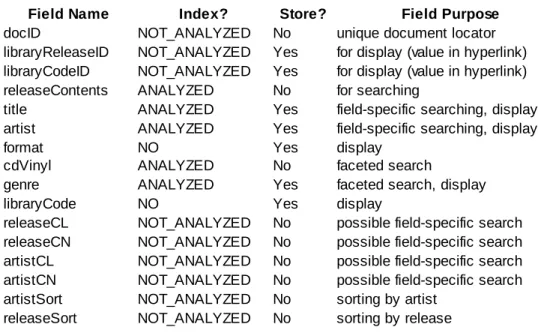
so that field-specific queries could be performed directly against that data. The table in
Figure 6 lists all of the fields that were added to each release-based document as well as
information about how the fields were indexed and/or stored.
Once this document/field structure had been determined, I wrote some code that
took a LibraryRelease object and converted it into Field and Document objects that
were ready for indexing. This “mapping” operation turned out to be quite similar to the
object-relational mapping process that must occur when data retrieved from relational
Field Name Index? Store? Field Purpose
docID NOT_ANALYZED No unique document locator libraryReleaseID NOT_ANALYZED Yes for display (value in hyperlink) libraryCodeID NOT_ANALYZED Yes for display (value in hyperlink) releaseContents ANALYZED No for searching
title ANALYZED Yes field-specific searching, display artist ANALYZED Yes field-specific searching, display
format NO Yes display
cdVinyl ANALYZED No faceted search
genre ANALYZED Yes faceted search, display libraryCode NO Yes display
releaseCL NOT_ANALYZED No possible field-specific search releaseCN NOT_ANALYZED No possible field-specific search artistCL NOT_ANALYZED No possible field-specific search artistCN NOT_ANALYZED No possible field-specific search artistSort NOT_ANALYZED No sorting by artist
releaseSort NOT_ANALYZED No sorting by release
Figure 6: Table showing fields and how they were stored or indexed
structure. I then wrote a simple batch method to create the initial Lucene index. After
retrieving all of the library release data from the database in the form of
LibraryRelease objects, this batch method iterated through these LibraryRelease
objects, converted each one into a Document, and then added the collection of
Document objects to the index using the IndexWriter. For this initial index, I created
the IndexWriter with an instance of the StandardAnalyzer class. Different
Analyzer subclasses treated text in different ways, but the StandardAnalyzer
seemed most suitable for analyzing music release metadata involving lots of proper
names and titles that did not require word stemming or support for synonyms.
My initial indexing routine went through 50,000+ library releases and generated
10.4 megabytes worth of Lucene index files. Creating this initial index would not be
library release was added to the catalog or an existing library release was modified. To
address this issue, I created some additional code that would keep the Lucene index in
sync with the permanent data store. Code that added a new library release to the database
would now also create and index a corresponding document for that new release. Code
that updated or deleted library release information would now retrieve the existing
document from the index and update it or delete it accordingly. Because a document may
need to be updated and/or deleted from the index at some point, it is especially crucial
that all documents contain a unique-ID-based field that allows them to be uniquely
singled out for updating/deletion without any of the other indexed documents being
impacted.
This need to keep the index in sync with the database does demonstrate a fairly
minor downside to the hybrid Lucene/MySQL approach. Since data is no longer stored in
only one place, there is an extra step that must be taken by the application whenever data
is created, updated, or deleted. This is likely to be a very slight and potentially
unnoticeable drag on data-modification performance, however. In the case of the WXYC
card catalog application, only the administrative operations performed by music
librarians/admins would ever incur this extra cost. Given how infrequently these
operations are performed in comparison to the more widely used search functionality, the
tradeoff makes a lot of sense if it results in faster and superior search capabilities.
With the index created, I started developing the searching code. The Query class
is the heart of Lucene's searching API, and the numerous subclasses of Query
(RangeQuery, BooleanQuery, TermQuery, FuzzyQuery) offer developers a variety
query a Lucene index. But despite the wealth of Query subclass options, I found that
almost all of the search functionality required by the card catalog application could be
obtained by using the extremely powerful QueryParser class to automatically generate
Query objects representing a search string entered by the user. Like the IndexWriter
class, QueryParser also uses an Analyzer instance to analyze the query terms, but
before that analysis stage takes place, QueryParser automatically detects Boolean
operators like AND and OR and NOT, wildcard characters like the asterisk(*), a tilde(~)
used to signify “fuzzy querying”, and even special field constraints (“artist:_____”). I
found this amazing out-of-the-box support for user-query parsing to be one of Lucene's
greatest strengths. As a developer, I would no longer need to write code to interpret
double quotes to mean “exact phrase”, and the logic that had been written to interpret
“any term”/”all terms” options could be discarded in favor of Lucene's support for
commonly understood Boolean operators. By using QueryParser, I would be able to
offer the system’s users a lot more power and flexibility; the exact syntax and specifics of
the new querying possibilities would just have to be communicated and taught to users
via training and/or a “helpful search tips” section of the search interface.
Once a Query object had been generated by the QueryParser class, querying
was a breeze. The IndexSearcher class provided an interface to the actual Lucene
index on the filesystem. A Query object could be passed in, and results would be
returned in a Hits object that served as a collection of Document objects. I again wrote
a simple mapping procedure that would translate between the returned Document objects
and a data-transfer-type object representing a library release. The application's original
and more distinct from the database-generated transfer object, I created a new
LibrarySearchResult class that simply encapsulated all of the various stored
properties that had been stored in the index. The existing “release search results” web
page was then modified to expect a collection of LibrarySearchResult objects
instead of the collection of LibraryRelease objects that it had displayed previously.
Results and Comparative Analysis
With the Lucene implementation complete, I began the testing and comparative
analysis process. It only took a few trial runs of various text queries for me to discover
that searching via the Lucene index was significantly faster than searching the MySQL
database via dynamically constructed SQL statements. Using Java code that precisely
calculated and logged the exact time of all search operations, I discovered that most
Lucene searches were completed in 35 milliseconds or less – a tremendous improvement
over the half-second, one-second, two-second, and five-second searches that had been all
too common in the MySQL-based system.
I initially questioned whether part of these performance improvements might be
attributable to the fact that the Lucene index existed on the same filesystem as the
Tomcat server itself, whereas the MySQL database was hosted on a separate database
server requiring a network hop. However, this possibility was discounted by examining
and timing other database queries that the application was making. Queries that actually
took advantage of integer-based indexes usually completed in less than 50 milliseconds.
It was only the queries that overutilized text-comparison clauses that demonstrated such
Additionally, I found that the search results generated by Lucene were of much
higher quality than the unranked results obtained from querying the MySQL database. In
the Lucene-based system, a query for “library science” brought back an album by the
group Library Science as the number one match (see Figure 7). When this same “library
science” query had been run using the MySQL-based search routine (Figure 3), the
Library Science album was just one of 52 equivalent matches returned from the database.
(It should be noted that the only reason the Library Science album appeared as high as it
did in Figure 3 was due to the fact that the results were alphabetized by Genre and
Library Code, so all releases from the Hiphop section were displayed before any Jazz,
Reggae, or Rock releases).
The Lucene API makes it easy to retrieve the actual score assigned to a document
for any given query. While this level of detail is usually not necessary from an
application development standpoint, I collected the scores for the top 12 “library science”
matches in order to help illustrate the underlying information retrieval algorithms at work
(see Figure 8). As the only release that contains both “library” and “science” amongst its
document text, the Library Science album scores far higher than the next 11 search
results. It should be noted that Lucene normalizes scores to a scale that runs from 0.0 to
1.0, so the Library Science album's 1.0 score is not indicative of a “perfect score” but
rather the highest score amongst the entire set of documents.
Score Artist (Library Code) Artist (Library Release) Title of Library Release
1.0000 Library Science Library Science High Life Honey 0.3463 On-Air Library On-Air Library On-Air Library 0.2661 Downtown Science Downtown Science Downtown Science 0.2356 The Boys' Star Library The Boys' Star Library Sugar & Water
0.2218 Mind Science of the Mind Mind Science of the Mind Mind Science of the Mind 0.2173 Downtown Science Downtown Science Room to Breathe 12" 0.2173 Chris Cutler Science Group Red Science
0.2173 Chris Cutler Science Group Science Group 0.2173 Science Kit Science Kit Seven Times Around 0.2049 various various Breakbeat Science 0.2049 Shriekback Shriekback Jam Science
0.2049 Swob Swob The Explosion of Science
Figure 8: Score of “library science” hits in Lucene-based system.
The order of the subsequent 11 search results can be easily explained by looking
terms “library” and “science”. Within the entire set of documents, the term “library”
tends to appear less frequently than the term “science”, so an occurrence of the term
“library” will weigh more for a given document than an occurrence of the term “science”,
simply by virtue of the higher IDF value for “library”. Actual term frequency within a
single document also plays a role. The self-titled On-Air Library album contains 3
occurrences of the term “library”, while the Sugar & Water release from The Boys' Star
Library only contains 2 occurrences of “library”.
Lucene's ability to generate ranked search results were clearly a benefit, but in
order to examine other potential differences between the MySQL-based and
Lucene-based search routines, I closely compared the entire set of search results that the two
systems had generated in response to the “library science” query. I found that the two sets
of results were mostly, but not entirely, overlapping - 44 releases has been found by both
systems. However, the Lucene-based search results also included three releases not found
by the MySQL-based search routine, while the MySQL-based search results included
eight releases that had not been found by the Lucene-based search routine.
Artist (Library Code) Artist (Library Release) Title of Library Release
The Album Leaf The Album Leaf on!air!library! A Lifetime or More Big Heifer Science Kit and Big Heifer Split Tour EP
Tim Berne Tim Berne and Science Friction The Sublime And [live]
A close examination of these discrepancies helps to illustrate some key functional
differences between the two systems. The three extra Lucene-derived results (see Figure
9) all had the word “library” or “science” in the “Artist (Library Release)” field but not in
either of the “Artist (Library Code)” or “Title” fields. The two artist fields are only
different in cases where the ALTERNATIVE_ARTIST_NAME database field is present,
indicating that a release has a different artist name than the artist under which it is filed.
Because this field was empty for a majority of releases, it was not being queried against
by the old MySQL-based system. The three particular results shown in Figure 9 may not
have been the closest matches to the “library science” query, but one can easily imagine a
case where users would be unable to find relevant documents if this information was not
being factored into the searching process. For instance, in the old MySQL-based system,
a search for the band “Science Kit” would not bring back the Split Tour EP by Science
Kit and Big Heifer, simply because the release had been filed under Big Heifer and not
Science Kit.
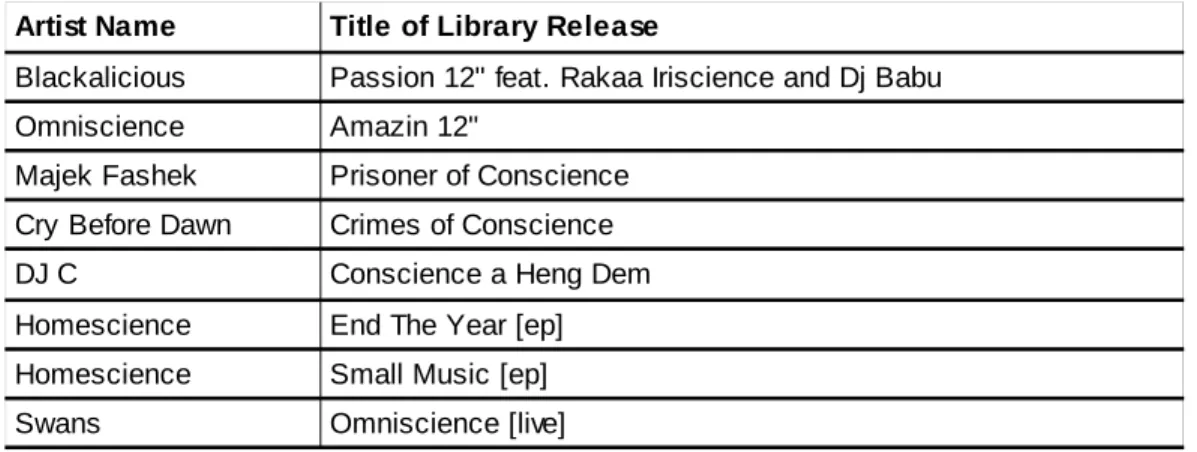
Artist Name Title of Library Release
Blackalicious Passion 12" feat. Rakaa Iriscience and Dj Babu Omniscience Amazin 12"
Majek Fashek Prisoner of Conscience Cry Before Dawn Crimes of Conscience DJ C Conscience a Heng Dem Homescience End The Year [ep] Homescience Small Music [ep] Swans Omniscience [live]
Figure 10: “library science” hits in MySQL-based system not found in Lucene-based system.
The eight extra MySQL-derived results (see Figure 10) all contained words in
“Homescience”, “Iriscience”. Because its stored text is not indexed by individual terms,
the MySQL system is forced to using a brute-force approach in its text-matching – search
terms are wrapped up in percentage signs so that the entire content of a VARCHAR field
can be examined for any occurrence of the supplied string. This method succeeds in
bringing back many of the releases that actually contain the word “science”, but it also
brings back these extra eight documents that are clearly not relevant for the supplied
query. The fact that the Lucene-based system does not find these irrelevant documents
can be seen as yet another plus.
Additional Enhancements and Challenges
The major boost in query execution speed allowed for the creation of an
extremely snappy and responsive search results display interface. In the old searching
system, both sorting and pagination had been implemented via subsequent/repeat queries
to the database. These additional requests were often no faster than the first, but given the
stateless nature of web applications, this had been the most straightforward solution. For
the new Lucene-based system, I kept this subsequent/repeat-query model, only now all
sorting operations and subsequent page requests would be just as fast as the original
query - typically less than 50 milliseconds. This allowed the new system to have the
extremely responsive feel of a desktop application.
Once I saw the usability/performance benefits that Lucene-based searching could
bring to the catalog-searching system, I started designing an additional “faceted search”
feature that would not have been feasible in the old system. Faceted search has become a
various categories/facets as a way of narrowing down search results to specific subsets
that more closely reflect the items for which they are searching. There were two obvious
facets in the music library data - format and genre.
For my initial implementation of faceted search, I chose CD and vinyl to be the
only two format facets. Many of the releases in the card catalog database have additional
size designations such as “7-inch vinyl” and “2-CD set”, but this level of detail is not
consistently stored for all releases, so I felt like the more general facets of CD and vinyl
would be the most useful. For genre, the facets were the 14 distinct genres in the WXYC
music library: Africa, Asia, Blues, Classical, Comedy, Hiphop, Jazz, Latin, OCS,
Reggae, Rock, Soundtracks, Spoken Word, and Xmas. Although genre is a more fluid
and multi-valued construct in many music classification systems, within the WXYC
music library each release is assigned one specific genre that designates the physical
section of the library where it can be found.
I decided to present these facets as a sidebar beside search result data, as this
would offer users a way of narrowing down search results by selecting a given facet. In
order to dynamically generate this sidebar, I revisited the code where Lucene search
results are iterated through and converted into LibrarySearchResult transfer objects.
I added a section of code that harvested individual facet values as they appeared in search
results and placed facet information into a data structure that would summarize the
individual facet values and how many times they appeared in the search results.
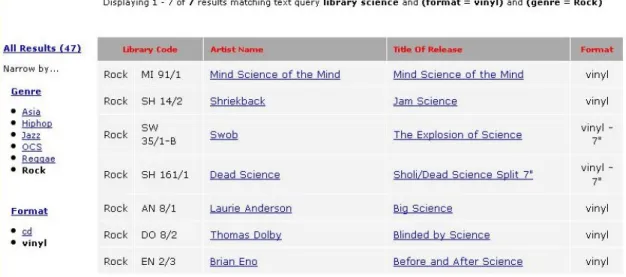
When a user selected a specific facet value link from the facet sidebar (see Figure
11), the original query would be re-submitted and the extra facet parameter would be sent
query, but simply to use the facet as a post-query filter when iterating through search
results and deciding what results would be sent back to the user for display. This allowed
the system to keep the entire list of facets available within an identical sidebar menu,
instead of forcing a user to first remove one facet filter before selecting another mutually
exclusive facet value.
Figure 11: Search results page for query “library science” with “Rock” and “vinyl” facets selected.
During my initial testing of Lucene-based sorting, I occasionally encountered
memory-related exceptions while making repeated calls to sort a large set of search
results alphabetically by artist or title. In order to prevent these memory-related
exceptions from occurring, I implemented code that limits the total number of search
results that are obtained for any given search. This type of result-limiting behavior is
strongly encouraged by the latest version of Lucene (version 2.4.0), in which the Hits
it forces the developer to set. This API change is intended to help address performance
issues caused by code that attempts to iterate through all search results.
This technical challenge serves to illustrate another key difference between the
Lucene-based search system and its MySQL-based predecessor. In the MySQL-based
“pure Boolean”-type system, all search results were equal in the sense that no one result
was considered to be any more relevant than any other. As such, all results needed to be
accessible to the user, so that the user could find the desired results, either through paging
or sorting. With a Lucene-based search system, there is not as much need to obtain all of
the matches for a given query in the event that the result set happens to be large. If a
user's query were to result in more than 500 hits, chances are pretty strong that the user
will find what he/she is looking for simply by looking through the first 100 hits, since
these have been ranked the most relevant according to the user's query. Rather than page
or sort through an excessive number of ranked search results, a user is much more likely
to either refine the text of their query in hopes of getting a different ranked order or
choose additional facets that will help narrow the results to an even smaller (but still
ranked) set. The option to sort a large collection of search results becomes a lot less
valuable once the results are already sorted by relevance in the first place. As a developer
accustomed to the set-oriented nature of relational database theory, I found myself having
to undergo a slight shift in thinking as I started writing code that operated on the top
Conclusions and Future Directions
Clearly, the Lucene-based redesign of the WXYC card catalog application offers
many substantial improvements over the original MySQL-only version. By leveraging a
high-performance information retrieval software library instead of merely relying on
text-comparing SQL queries, the redesigned application is able to deliver ranked search
results of a much higher quality than those delivered by the old system. Additionally, the
redesigned application shows a dramatic improvement in query execution speed. This
performance boost noticeably improved the overall usability of the card catalog
application, while also allowing for the implementation of an additional faceted search
feature.
Some Lucene-based systems may only use the software to index full-text
documents that are not already stored in a relational database. But the redesigned card
catalog application demonstrates that a hybrid IR/RDBMS approach can also work quite
well. The exact same pieces of data can be stored in different data structures/formats that
have distinctly different purposes: a Lucene index optimized for information
retrieval/search purposes, and a relational data store that offers long-term persistence,
data integrity/type checking, transactional support, and numerous other benefits. By
implementing a hybrid approach, a developer might need to implement extra code to
manage additions, updates, and deletes to the index whenever there are corresponding
changes to the underlying database. In my experience with the WXYC card catalog
application, these extra operations were well the overwhelming benefits provided by a
As I get ready to deploy the redesigned version of the WXYC card catalog
application, I have already begun thinking of future enhancements and extensions to the
current system. Cross-references (“See also….”) that once existed in the old paper-based
system could potentially be implemented by including the referring artist amidst the
indexed fields of a referred-to document. User-generated tags might allow for additional
facets on which to filter. And ultimately, song data could be added to the index, greatly
increasing the amount of searchable text included in release-based documents. These
changes would have been difficult to implement efficiently in the old MySQL-based
system, but the search functionality of the new Lucene-based system is a lot more
extensible.
Finally, I intend to explore the possibilities of using Apache Solr for my next
information-retrieval-related programming project. Solr is a Lucene-based search server
that harnesses the many strengths of Lucene while also adding support for faceted search,
hit highlighting, and additional enterprise-level features such as caching and replication.
Solr seems to be very well-suited for searching structured and “semi-structured” data and
I initially considered using it for the redesign of the WXYC card catalog application.
Solr’s enterprise-level server features seemed a bit unnecessary for the size of this
project, however, and I felt like Lucene’s mature Java API would be a much more
sensible fit with the WXYC application’s existing Java codebase. Now that I’ve
successfully completed this Lucene implementation and developed a solid understanding
of the core Lucene functionality, I plan on investigating Solr more closely in order to see