BRIDGING THE DIGITAL DIVIDE: A CASE STUDY OF THE SITUATION IN INDIA
by
Anita Sundaram
A Master’s paper submitted to the faculty of the School of Information and Library Science of the University of North Carolina at Chapel Hill
in partial fulfillment of the requirements for the degree of Master of Science in
Information Science.
Chapel Hill, North Carolina November, 2003
Approved by:
________________________
Anita Sundaram. Bridging the Digital Divide: A Case Study of the Situation in India. A Master’s paper for the M.S. in I.S. degree. November, 2003. 68 pages. Advisor: Paul Solomon
In the 21st century, the pace of globalization and the growth of new information technologies, such as the Internet, are fueling both economic prosperity and human advancement. The potential for social and economic inequality due to lack of access is an issue of growing concern. The issue becomes even more pressing when we look at the implications for large, developing countries such as India. While many are living in a period of tremendous prosperity, innovation, and growth, the disparity between wealth and poverty has never been greater. In this paper an attempt is made to look at the different approaches being adopted to bridge the digital divide in India.
Headings:
Digital divide
India’s technology development Poverty in India
Introduction
In the 21st century, the pace of globalization and the growth of new information technologies, such as the Internet, are fueling both economic prosperity and human advancement. The Internet itself has started to transform the way we deliver and receive information and, in turn, how we live and do business. This phenomenon has been labeled by many as nothing short of a revolution--the Information Revolution.
There is a raging debate about the information technology revolution and its impact on globalization--especially when we consider the social dimensions of information technology on a planetary scale. As is always the case with a fundamental debate, it is most often framed ideologically and cast in simplistic terms. For the prophets of technology, for the true believers in the market, everything will be fine as long as ingenuity and competition are set free. For those around the world who are not ecstatic about surfing on the Internet, but who are affected by layoffs, lack of basic social
services, crime, poverty and disruption of their lives, globalization is nothing more than a warmed up version of traditional capitalist ideology. In their view, information
The World Bank among other leading organizations now recognizes that advancement in the new Digital Age depends on being given meaningful access to new information tools, such as the Internet. The potential for social and economic inequality due to lack of access is an issue of growing concern. The fear is that the global gap between the have and have-nots, between those in the know and the know-nots, will widen. This digital divide is a multi-dimensional challenge that will require an innovative blend of creativity, capital, and commitment.
This issue becomes even more pressing when looking at the implications for large, developing countries such as India. While many are living in a period of tremendous prosperity, innovation, and growth, the disparity between wealth and poverty has never been greater. This is especially true in India. Urgent action needs to be directed towards broadening the use of such communication tools to help the underprivileged. A country that has earned its well-deserved reputation as an upcoming information technology superpower should demand no less from itself. Such ominous societal issues cannot be left to the Government alone to solve. A new approach is needed. Bolder, more
aggressive action is required. In this paper an attempt is made to look at the different approaches being adopted to bridge the digital divide in India.
Background
Information Technology
Information technology is shorthand for information and communications technology and services. Too often, the ‘technology’ aspect is overemphasized at the expense of the ‘services’. Most users are not interested in the technology as such, but only in the benefits and services it can bring. Information technology encompasses the full range of the production, distribution, and consumption of information, across all media from radio and television to satellites and the Internet. References to the ‘Information Revolution’ reflect the rapid advance in the power and speed of computers, the digitalization of information, and the convergence of once separate industries into a new amalgam of production, distribution, and consumption activities. These are typically accompanied by important organizational and commercial changes as well. Information technology and the
information technology revolution refer not only to traditional communication functions, but also to the steady introduction of computer technology into nearly every sector and activity of the economy, from health to transportation, to education.
Information technology is not the cause of the changes we are living through. However, without new information and communication technologies none of what is changing our lives would be possible. The entire realm of human activity depends on the power of information. Software development is making possible user friendly computing, so that millions of children, when provided with adequate education, can progress in their
all sorts coexist, in a creative cacophony. Certainly the diffusion of information technology is very uneven. Many regions in the world are being left behind in a technological apartheid and the situation is difficult to remedy when one third of the world’s population still has to survive on the equivalent of one dollar per day or even less. The same can be said about India. India accounts for 30% of the world’s software engineers, but also 25% of the world’s malnourished. (Mehta, and Shah, 2002)
The crucial role of information technology in stimulating development is a two-edged sword. On the one hand, it allows countries to leapfrog stages of economic growth by being able to modernize their production systems, and increase their competitiveness faster than in the past, an example being the Asian Pacific economies. On the other hand, for those countries that are unable to adapt to the new technological system, their
retardation becomes cumulative. Furthermore, the ability to move into the information age depends on the capacity of the whole society to be educated, and to be able to assimilate and process complex information. Almost 40% of the population of India is illiterate. This starts with the education system, from the bottom up. It also relates to the overall process of cultural development, including the level of functional literacy, the content of the media, and the diffusion of information within the population as a whole.
In this regard, what is happening is that regions and firms that have the most advanced production and management systems are increasingly attracting talent from around the world, while leaving behind a significant population whose education level and
support of this is the city of Bangalore in India. It is the Silicon Valley of India.
Engineers and scientists concentrate in high technology hubs like Bangalore, connected to the ‘Silicon Valleys’ of the world, while a share of the population in all countries remain in low-end, low-skill jobs, when they are lucky enough to be employed at all. Thus, there is little chance for a country or region to develop in the new economy without its incorporation into the technological system of the information age.
In sum, information and communication technology is the essential tool for economic development. It is, for the time being, unevenly distributed within India and several other countries in the world. It requires, for the full realization of its developmental value, an inter-related system of flexible organizations and information-oriented institutions. In a nutshell, cultural and educational development conditions technological development. Technological development, in turn, conditions economic development, then social development, and the feedback loop is completed as cultural and educational development is stimulated once more. There is no fixed entry point to this cycle. It depends upon the situation and the development stage of each country. This can be a virtuous cycle of development or a downward spiral of underdevelopment.
Globalization
that savings and investments in all countries, even if most of them are not globally invested, depend for their performance on the evolution and behavior of global financial markets.
Globalization of information technology can be used to enable cross-border flows of information content such as movies, CD’s, radio broadcasts, videotapes, and so on; the cross-border spread of the actual hardware is used nationally and locally to produce, distribute and consume information.
The highest tier of science and technology, the one that shapes and commands overall technological development, is concentrated in a few dozen research centers around the globe, overwhelmingly in the US, Western Europe, and Japan. Engineers from the remaining countries like India, China, Russia, etc., when they reach a certain level of scientific development, can only pursue their research by linking up with these centers. Thus, highly skilled labor is also increasingly globalized, with talent being hired around the globe when firms and governments really need the talent and are ready to pay for it.
At the same time, the overwhelming proportion of jobs and, thus, of people is not global. In fact, they are local and regional. But their fate, their jobs, their living standards
ultimately depend on the globalized sector of the national economy. This global economy is new, as only in the last couple of decades have we produced the technological
telecommunications, information systems, microelectronics based manufacturing and processing, etc.
However, if globalization reaches out to encompass the entire world--if all people and all territories are affected by its workings--not every place, or every person is directly included in it. In fact, most people and most lands are excluded, either as producers, or consumers, or both. The current globalized system links up everything that is valuable according to dominant values, while disconnecting everything that is not valuable. Similar processes of selective, segmented globalization characterize other critical instrumental dimensions of our society, including the media, science, culture and information at large.
India
India is probably the country with the largest and most diverse mixture of races. The people of India belong to diverse ethnic groups. At various periods of India's long history, successive waves of settlers and invaders including the Aryans, Greeks and Central Asians came into the country and merged with the local population. This explains the variety of racial types, cultures and languages in India.
India has about 25 major languages and 844 different dialects. Sanskrit from the Aryan settlers has merged with the earlier Dravidian vernaculars to give rise to new languages. Hindi spoken by about 45 per cent of the population is the national language. English has also been retained as a language for official communication.
Despite enormous pressures, India has been remarkably successful in accommodating cultural diversity and managing ethnic conflict through democratic institutions. This success has in large part been the product of that diversity itself, for at the national level--what Indians call "the center"--no single ethnic group can dominate. Each of the 25 states in India's federal system reflects a dominant ethnolinguistic group, but these groups are, in turn, divided by caste, sect, religion, and a host of socioeconomic cleavages.
Theory and Research
India today remains a country of stark contrasts and striking disparities. Some states and districts of India report levels of social development similar to leading industrialized countries. Other parts of India report achievement levels that are worse than the average of the poorest countries in the world. For example, there are only 39 countries in the world--and all of them by far richer which reported a lower infant mortality rate than that of the state of Kerala in 1995. At the same time, only 24 countries had a higher rate of infant mortality than the state of Orissa. The life expectancy of a girl born in the state of Kerala is around 74 years, which is 20 years more than that of a girl born in the state of Uttar Pradesh. (Dreze, Jean, and Sen, 1997) In bigger cities of India like Bombay, the rich and poor seem to live side by side. Outside huge skyscrapers, where the richest in the city might live, one can find slums housing the poorest of people.
The history of Indian telecommunication dates back to 1853, when a 33-kilometer experimental telegraph line was built between the city of Calcutta, then the capital of Imperial India, and Diamond Harbour the anchorage of the British East India Company. Telephone service began in 1882, when small exchanges were opened in Bombay, Calcutta, and Madras. Service was gradually extended to other areas, though progress was slow. At the time of its Independence from British colonial rule in 1947, India had only a rudimentary telecommunications system consisting of about 403 telephone exchanges with a capacity of 91,424 lines. By 1999, however, India operated the 10th largest telecom network in the world in terms of number of users, number of lines, geographical coverage, and traffic volume. (Aggarwal, 1999)
As of April 1999, the country had 2 telephones per 100 people. Along with the Internet backbone, the government intended to provide telephone on demand, including coverage of all villages, by 2002 and increase teledensity to 7 per 100 by 2005 and 15 per 100 by 2010. In rural areas, it intends to increase teledensity from the current 0.4 per 100 to 4 per 100 by 2010. Today, millions of Indians are connected to the Internet and are aware of the most developed technologies. (Aggarwal, 1999)
aspiration, given the impressive track record of the Information Technology industry. Today, India is well known all over the world as an important base for software development, with over 185 Fortune 500 Companies amongst its customers. Indian companies have reached a critical mass and the process of Indian software companies getting listed on NASDAQ has begun. Information Technology in India is all set to become India's leading industry with largest exports, providing employment
opportunities to millions of aspirants. The dream of India becoming a knowledge technology superpower seems to be attainable. (“Indian Scenario”, 2002)
On the other hand, in a population of over a billion (1,027,015,247 as of March 1st, 2001), it is true that around 35% of it is illiterate, (Indian Census Bureau, 2001) only 88% of the total population and 86% of the rural population has improved drinking water sources and only 31% of the total population and 14% of the rural population has adequate sanitation facilities. (Population Reference Bureau, [PRB], 1999) There are millions who don’t have access to good health services and millions who live under the poverty line. President Clinton made a statement in Hyderabad during his March 2000 visit to India: “Millions of Indians are connected to the Internet. But millions more aren’t yet connected to fresh water. Our challenge is to turn the newest discoveries into the best weapon humanity has ever had to fight poverty” (Perlez, 2000).
This paper makes an attempt to briefly portray the two contrasting scenarios and then to see what is being done to bridge the divide and to bring various applications of
Methodology
To study the digital divide that exists in India and to see what is being done to bridge the digital divide, the ideal methodology would be to make a trip to India and gather all the information first-hand and see what is actually being done. But due to lack of time and funds, this approach cannot be undertaken.
For the purpose of this study, a flexible research design has been adopted. Most of the research was conducted using existing documents. These include written documents, including government documents; documents/reports published by international organizations like the World Bank, United Nations, etc.; published journal articles; books; newspaper and magazine articles, etc. The search for these documents and data was made over the Internet. For example, various statistics about the Indian population are available in the Census Bureau of India’s web site.
Documents falling under three major categories were selected for the purpose of this study. First, there are documents dealing with poverty, illiteracy and poor living conditions in certain parts of India. Second, there are documents highlighting the
Common search engines over the Internet like Google, Altavista, MSN, Yahoo, etc., to name a few, were used to find documents relevant to the above mentioned categories. Some India specific search engines were also used like Yahoo India, Khoj, Indiatimes, Sify, MSN India, etc. Search strings like ‘poverty in India’, ‘technological development in India’, and ‘digital divide in India’ was the starting place to look for some of these documents. Based on the results of these searches, further search strategies were developed and search strings were modified. Documents from established and reliable sources, pertinent to the subject category were selected over others.
This is an indirect method of study and involved analyzing the contents of the documents and drawing conclusions based on that analysis. Instead of directly observing,
interviewing, or asking someone to fill in a questionnaire for the purpose of this study, the study is based on documents produced for some other purpose. This is an unobtrusive, non-reactive method. One disadvantage of this kind of a design is that the documentation available may be limited or partial in that available materials may not address all relevant issues.
Reliability and validity are also central concerns in this kind of a research design. The documents are written documents and hence can be subject to re-analysis, allowing reliability checks and replication studies. It is possible to validate the interpretation of themes derived from such documents. Also, the sources of information used in this research are mostly government documents, documents published by reputed
have reliable information, though it might not tell the whole story. The documents used in this research have been written for some purpose other than this research, so a strong attempt has been made to disregard the biases or distortions that this would introduce.
Also, this study does not make at attempt to verify any preconceptions. It is just an attempt to research and see what is being done to bridge the digital divide in India. To see, what is really being done to bring technology to the lives of the poor and illiterate.
Analytical Approach
This study does not follow any of the traditional methods of data analyses. The
information collected in this research is qualitative, but there is no data collection in the true sense. There is no clear and accepted set of conventions for analysis in this study.
As mentioned earlier, existing documents are analyzed in this research--documents pertaining to the poverty/illiteracy situation in India, the information technology development scenario in India, etc. For each category under consideration, several documents were selected, which were pertinent to the subject, from established sources. Detailed notes were written for each document, analyzed and then any numbers,
aided in bringing the actual details, examples, and cases together to see whether anything is being done to alleviate the situation. The process of analysis also involved citing examples of bridging the divide, to see what is being done to bring advancements in information and communications technology to the masses--to the poor and the illiterate. It also involved the analysis of some case studies.
Poverty in India
In the 1930s, when the British ruled the country, Jawaharlal Nehru described India’s situation as:
A “servile state”, with its splendid strength caged up, hardly daring to breathe freely, governed by strangers from afar; her people poor beyond compare; short-lived and incapable of resisting disease and epidemic; illiteracy rampant; vast areas devoid of all sanitary or medical provision; unemployment on a prodigious scale, both among the middle classes and the masses. (Nehru, 1936)
In 1947, independent India’s first Prime Minister, Jawaharlal Nehru, called for “the ending of poverty and ignorance and disease and inequality of opportunity.” Mahatma Gandhi had always insisted India would become truly independent only when the poorest of its people would be free from human suffering. An overwhelming concern for the poor, a multidimensional view of poverty and human deprivations, the focus on freedom, the need to expand opportunities and ensure its equal distribution are fundamental to a strong human development perspective.
Every major policy and planning document has expressed such a perspective and
richer and more varied life.” It went on to state that “it is no longer possible to think of development as a process merely of increasing the available supplies of material goods; it is necessary to ensure that simultaneously a steady advance is made towards the
realization of wider objectives such as full employment and the removal of economic inequalities.” Successive five-year plans continued to emphasize poverty eradication and the attainment of economic equality and social justice as key objectives. The Eighth Five Year Plan (1992-97) identified human development as the ultimate goal. It aimed to create jobs, contain population, eradicate illiteracy, universalize elementary education, and provide safe drinking water and primary health care facilities to all. The Ninth Five Year Plan (1997-2002) reiterated the importance of focusing on human development, and argues that there can be no two opinions about this being the ultimate goal of all public action.
Given such a strong concern for human development and a promise to eliminate the worst forms of human deprivations, what has been India’s performance on the poverty front? To what extent has poverty reduction occurred? What are some factors that have limited the expansion of human capabilities? Above all, what are the country’s prospects?
Significant Changes, Mixed Achievements
taken place in the social sphere--with affirmative action for disadvantaged communities, with the weakening of untouchability and caste discrimination, and with women enjoying by and large more freedom than ever before. On the political front, India has remained a vibrant democracy with increased participation by women and men in political decision-making.
However, in terms of achievements, India’s performance during the past 55 years has been decidedly mixed. From a human development perspective, the glass can be considered half-full or half-empty; much depends upon the eye of the beholder. The country has recorded impressive gains in many areas, significant reductions in the intensity of poverty, but there is still much ground to cover in terms of ending human deprivations.
million infants die each year, and most of the deaths are avoidable. Apart from
impressive achievements in higher education, the number of primary schools increased almost threefold--from 210,000 in 1951 to 590,000 in 1995. As a result, literacy nearly tripled during 1951-91. (“Economic Survey,” 1996) Yet 35% of the population is still illiterate as of 2001. (Indian Census Bureau, 2001) Only around 88% of the population is reported to have access to safe drinking water. (PRB, 1999) However, problems of
rapidly declining water tables, deteriorating quality and increasing contamination threaten this availability.
Displaced Concerns, Misplaced Priorities
India has always had the intention to eradicate poverty. It is one of the few issues on which there exists a strong political consensus. The real issue is not the intent, but the nature of public action. Much of it has been guided by displaced concerns and misplaced priorities.
Despite the strong articulation of a multidimensional view of human poverty, India has been overwhelmingly concerned with income poverty. The focus on income poverty began early in the 1960s when a working group of eminent economists was set up by the Government of India to assess the extent of poverty in the country. This group used a nationally desirable minimum level of consumption expenditure to define India's poverty line and based it on a standard balanced diet prescribed by the Nutrition Advisory
poverty is a challenge which no society in modern times can afford to ignore for long. It must be eradicated on humanitarian grounds and as a condition for orderly progress." It also warned that no program or policy that "fails to alleviate the conditions of the poor appreciably can hope for the necessary measure of public cooperation and political support in a mature democracy” (Pant, 1974).
The report of the working group was influential in many respects. It set the trend for defining and measuring income poverty. Subsequent studies on poverty in India continued to use either income or consumption as the basis for defining and measuring poverty. The attention of policy makers shifted to a narrow conception of poverty as income deprivation. The Planning Commission declared: "The stage has now come when we should sharply focus our efforts on providing an assured minimum income to every citizen of the country within a reasonable period of time. Progressively this minimum should be raised as development goes apace” (Pant, 1974). To this day, India's income poverty line is the monetary equivalent of a minimum daily calorie intake--2400 calories per person in rural areas and 2100 calories per person in urban areas.
34% in 1986-87 to 31% in 1994, the number of urban poor during this period remained almost the same, around 60 million. (Chandrasekhar and Sen, 1996)
Many would credit the reductions in income poverty to economic growth. A related factor is agricultural growth. India from the mid-1970s to the mid-1980s enjoyed a higher and more stable trend rate of agricultural growth. Yes, economic growth has the potential to reduce income poverty, but equating growth with income poverty reduction is too simplistic. True, there is an association between economic growth and poverty reduction, but this association is, at best, weak. (Ravallion and Datt, 1998) In the latter half of the 1980s, for example, despite rapid economic growth, income poverty did not decline much. Similarly, all states of India recorded significant declines in income poverty from the mid 1970s to the end of the 1980s even though the green revolution was limited in geographical coverage; and most states did not record any significant increase in agricultural value--added per head of rural population. (Sen, 1996)
proportion of a limited budget was spent on higher education; basic education was neglected. Land and tenancy reforms were introduced, but seldom carried out.
Centralized planning was the order of the day. Bureaucracies that administered centrally-sponsored development programs replaced village level local institutions for participatory planning and decision making. As a result, inequalities developed and have continued to persist.
Several factors mediate the conversion of economic growth into income poverty reduction. The state of Kerala, for instance, ensured maximum reductions in income poverty despite slow economic growth through political activism and a rapid expansion of equal opportunities. Improvements in infrastructure and access to assets also play an important role in income poverty reduction. (Ramachandran, 1997)
In the Indian context, effective management of buffer stocks and food prices by the government is another critical factor. (Tendulkar and Jain, 1995) During a year of bad harvests, higher purchasing power and stronger urban demand leads to a flow of food-grains to urban areas thus creating a deficit of food food-grains in rural areas; and this tends to push up food-grain prices in rural areas. The rural poor are doubly affected as a result. Not only do they face a fall in rural employment and incomes due to the bad harvest, but they now have to pay higher food-grain prices. This is where government's effective management of buffer stocks to regulate food availability and prices becomes critical. Open market prices for rice and wheat are determined to a large extent by the
and wheat are sold to consumers through the public distribution system. During the drought year of 1987-88, public action took the form of drought-relief works and depletion of public stocks to meet the demands of the public distribution system. As a result, rural food prices did not rise to that extent, and this protected the rural poor. This was not so in 1991-92 when the decline in agricultural output accentuated rural poverty. The decline in agricultural output adversely affected rural incomes, but at the same time, a steep rise in the open market prices of wheat and rice worsened their situation.
Anticipating a substantial rise in procurement prices, farmers held back stocks and private traders stepped up direct purchases. Market arrivals were greatly reduced; and public stocks of food-grains fell below the minimum specified norms. Procurement prices of rice and wheat were raised substantially, as were the central issue prices. The urban poor, beneficiaries of the universal public distribution system were hard hit by these price increases. At the same time, with low and depleting public stocks, the urban public distribution system had to be served through procurement from the below normal harvests. As a result, rural grain prices also went up. These price increases adversely affected the rural poor as well.
Public Spending
Public expenditures have played an important role in India's income poverty reduction. The period from the mid 1970s to the end of the 1980s when income poverty showed a marked reduction was also a decade when public expenditures rose phenomenally. (Sen, 1996) This also corresponded to a period when the Government introduced several new poverty alleviation programs. There was an increased political commitment to poverty eradication, which was backed by an increased allocation of resources and by a set of new pro-poor policies. Nationalized commercial banks were required to assign 40% of their lending to priority sectors--small farmers, small businesses, and artisans. New employment-creation and asset generation programs for income poverty reduction were introduced. As a result, rural non-agricultural employment increased substantially, and real wages went up sharply. But most important, between 1976 and 1990, real per capita development expenditure increased at an annual rate of 6% per annum compared with only a 3% growth in real GDP per capita. In fact, the steep rise in government spending contributed to the fiscal crisis that necessitated economic reforms in 1991. On the other hand, after economic reforms were introduced, real government expenditure per capita fell 15% during 1990-93, but increased again by 6% in 1993-94. Income poverty too worsened in the initial years of the reforms, but in 1994, showed improvement. (Tendulkar and Jain, 1995)
reducing poverty have made sizable investments in poverty alleviation programs. (Vyas and Bhargava, 1995) The size of government spending matters, but so does the efficiency of such spending. Leakage, corruption and inefficiency in management are frequently reported. Nevertheless, even with a poor record in program implementation, states that have invested heavily in poverty alleviation programs seem to do so distinctly better in income poverty reduction. This is not to suggest that efficiency of government spending does not matter. In fact, it points to the enormous potential that exists for accelerating income poverty reductions with improvements in the efficiency of spending. Improving the design, administration and management of poverty alleviation programs are urgently required. (Sen, 1996) With such improvements, overall government expenditures are likely to have larger multiplier effects and India could witness a more rapid reduction in income poverty.
Poverty Reduction: Not By Income Alone
fastest growing states in terms of per capita income. Yet, infant mortality at 68 per 1,000 live births is four times higher that in the income-poorer state of Kerala. Women in Haryana suffer systemic deprivation that gives them one of the lowest female-to-male ratios in the country--865 per 1,000 males. (Dreze et al. 1997)
Levels of affluence also fail to measure the richness--or poverty of human lives. Urban poverty rates, for instance, have been consistently lower than rural poverty rates,
nationwide and across all states. Also, urban income levels are typically higher than rural incomes. Yet visitors to India's major cities will observe that traffic congestion has increased dramatically and so has air pollution. Respiratory problems have gone up and there is a severe shortage of water and electricity. The poor, especially those living in urban slums, estimated to be around 30% in metropolitan cities, experience the decay even more: clogged drainage pipes, stagnant water, filthy public bathrooms, uncleared garbage piles, and an increasingly unhealthy environment around them. Most
significantly, infant mortality in urban areas has remained stagnant in recent years for the country as a whole, but has gone up in several states. The declining trends in urban income poverty do not capture such dangerously deteriorating living conditions.
Poverty Eradication
According to the Government of India, success in eradicating poverty will be contingent upon three factors:(a) a GDP growth rate of at least 6% per annum; (b) provisioning of at least 7 basic minimum services--universal access to safe drinking water, 100% coverage of primary health care centers, universalization of primary education, public housing assurance to all homeless families, extension of the mid-day meal throughout all primary schools, road connectivity to all villages and habitations; and streamlining the public distribution system targeted to families below the income poverty line; and (c) ensuring that the income poor and the socially disadvantaged groups receive special attention and priority. Other planned initiatives include a universal employment assurance program that will guarantee 100 days of employment for every unemployed person, and efforts to achieve universal literacy. Agricultural growth will be stepped up by improving
productivity in regions with a high concentration of poverty--which are also regions with the highest potential for growth. Efforts will be made to improve access to credit and other resources. (“Economic Survey,” 1996)
Given India's mixed record in the past, what are the chances that the political intent will translate into public action? Clearly, there is a long way to go in ending human
village. Only around 25% of all child births take place in institutions; and trained birth attendants attend to only around 42% of all deliveries. Around 85% of rural households do not have access to proper sanitation facilities. Only around 88% of households have access to electricity. (PRB, 1999)
If living conditions have to improve, what then needs to be done differently? First, India has to recognize and capitalize on the strong complementarities that exist between economic expansion and the improvements in the quality of people’s lives.
In 1960, the levels of income in Botswana and Indonesia were lower than in India. But by 1993, the situation was reversed. During this period, Botswana and Indonesia also
recorded significantly more rapid advances in health and education than India did. Again, in 1960, South Korea and India had similar levels of per capita income. By 1993, South Korea's income was nearly 8 times higher than India's. This increase in income between 1960 and 1993 coincided with a period when life expectancy in South Korea went up from 54 years to 71 years, and adult illiteracy fell from 46% to 2%. Similarly, China, Indonesia and Thailand have all achieved and sustained higher levels of per capita incomes than India because they have done much better in terms of expanding human capabilities. (UNDP, 1996) These countries recognized the strong complementarities between income expansion and social development. If human poverty has to be
Second, India needs to strike a balance in its development. This balance is not on the economic front alone--between receipts and expenditures, between imports and exports, between savings and investments. A balance is needed between economic growth and an expansion of social opportunities. (Dreze et al.1997) A balance is needed between the assurance of economic rights and political rights. A balance is needed between expansion of physical infrastructure and basic social infrastructure. The priority has to shift to basic education, to preventive health care, to assuring basic economic security and livelihood. At the same time, several imbalances need to be corrected: between men and women, between rural and urban areas, between socially disadvantaged communities and the rest of society.
Fourth, the State, instead of abdicating its responsibility for expanding social
opportunities, needs to play a more proactive role than it has in the past. The state in India often achieves what it sets out to do. (Sen, 1989) If something has not been done, it usually reflects unwillingness rather than an inability to act. For example, the state has shown dynamism in reducing controls, liberalizing the economy, and opening up the economy. The Constitutional amendment to ensure women's participation in local
governments displays an extremely progressive and proactive face. On the other hand, the state's effort at abolishing child labor and addressing the problem of AIDS reveals
shocking recalcitrance. Similarly, its unwillingness to make primary education compulsory, despite the affirmation in the Constitution of India, reveals inexplicable reluctance. For many of these matters, sustained advocacy, open debates, concerted pressure and public action are urgently needed to provoke a positive response from the state.
Finally, economic growth has to be participatory. It must be planned and managed locally by people whose lives it affects. Communities must participate actively to shape
programs, ensure that opportunities are expanded, and that the benefits are shared
equitably. For this, structures of local self-governance must be strengthened; and people's participation has to become a way of public life.
opening up. This is not just through local governments but through people's
organizations, and in particular women's groups that are frequently organized around credit, economic activities and social empowerment. At the same time, there are some causes for concern. The focus on reducing fiscal deficits is forcing major cuts in social sector spending. The pressure to pursue state minimalism is leading to an abdication of state responsibilities--as the pressure to privatize is beginning to affect people's access to basic health and education.
What does India need to do? Mahatma Gandhi had once remarked that India's salvation consists in unlearning what she has learned during the past fifty years. Similar changes are now required in thinking, in living, and in cultivating a genuine public spirit. India needs to get its development priorities right. We need to undo and unlearn. At the same time, we also need to learn and act. If human poverty has to be eradicated, attention must shift from income poverty to the poverty and inequality of opportunities--economic, social and political. India needs sustained public action to be guided by strong human development priorities.
Information Technology in India
enhancing the distribution of information. During the next century electricity, telegraph, telephone, radio and television came into use. With each subsequent discovery and invention, the distribution and flow of information increased not only in volume, but also in depth, moving from written word to audio and finally visual exchange of information. While advances were made in the transmission of information, it was not until the
development of the computer that information began to take on a value-added quality. No longer was information simply transmitted from one source to another, but now it could also be organized, and manipulated to meet the users’ specific needs. It was this
application of information through the use of technology that gave birth to the Information Age.
Over the last two decades, much of the world has been transformed by what are now termed Information and Communication Technologies. These technologies exert an impact on most aspects of our lives--in economic activities, education, entertainment, communication, travel, etc. They have also been inextricably linked with economic prosperity and power, as, through media such as the Internet, they are exerting a
“revolutionary impact on the way the world does business and, more importantly, on the way the world and its citizens communicate.”
Background of Technology Development in India
computers were mainly used in large companies in India, because of the high cost and rudimentary software. Yet in stretching these machines to the utmost, the early pioneers of software in India were responsible for creating a base of extremely skilled
programmers. The software portfolio of the seventies consisted of a large amount of in-house developed software for scientific and engineering applications, financial
applications, inventory control, manufacturing, planning, examination processing, mailing list selection and printing, utility billing, census, and a number of innovative applications.
A new environment came into being with the advent of microprocessors in India in the late 70s. The hardware industry in India had progressed rapidly. On the one hand throughout the late 70s and early 80s there was continuing acquisition of imported systems both mainframes as well as scientific mini-computers. On the other hand, on a parallel track with local development, there had been a thrust by the private sector to either develop systems equivalent to those available abroad or to collaborate technically with foreign companies to build hardware systems in India. The Government also took several initiatives to build super computers, AI (artificial intelligence) and robotic systems to stay ahead in emerging technology areas.
from India started in the late 70s, with very few companies venturing into it. The
Government of India came out with some specific steps to encourage this sector with the formulation of the computer software policy in 1980 and the economists began to analyze the potential of the Indian software industry. They said that it would be one of the fastest growing sectors of the economy and provide high quality employment for young people. Further, it would earn significant revenue from exports and would be a highly desirable industry, as it required skilled manpower, few raw materials and was not in any way causing damage to the environment.
Many scoffed at the idea of India making any significant contributions to the high
technology world of software. But, the forecasters, policy makers and analysts were right. They may even have underestimated the potential of the industry. In 2001-2002 the software industry in India was worth US$ 9 billion whereas in 1988-89 the software industry in India was not more than US$ 50 million. The best however, is yet to come, in terms of growth. According to a study conducted by McKinsey, the Indian software industry is expected to gross US$ 87 billion in 2008, with US$ 50 billion coming from exports. (“India’s Information,” 2002)
at 49.67% although there has been a consistent healthy growth in the domestic industry since then. (“Indian Software,” 2002)
Despite these growth rates, India’s share in the world software market is very low. However, in the segment of customized software services, India commands an 11.9% market share in the world. (“Indian Software”) India also enjoys an advantage over some of the other nations, which are trying to promote software exports, due to the fact that India possesses the world’s second largest pool of scientific manpower, which is also English speaking. Coupled with the fact that the quality of Indian software is good and manpower cost is relatively low, it provides India a very good opportunity in the world market.
Currently, the software industry in India employs around 500,000 people and continues to be amongst the fastest growing sectors in the Indian economy. Recognizing the potential of the software industry, it has been identified as a thrust area by the Government of India both for exports as well as for the domestic sector. After showing impressive growth in the export market, the recent trend in the industry is to give increased focus to the
domestic market, so that all possible resources may be enhanced for an ultimate quantum jump in the international market. The software industry can be viewed as the core
While the industry has been growing at above average growth rates, software development activity is not confined to a few cities in India. Software development hotspots, such as Bangalore, Hyderabad, Mumbai, Pune, Chennai, Calcutta, the Delhi-Noida-Gurgaon belt, Vadodara, Bhubaneswar, Ahmedabad, Goa, Chandigarh, and Trivandrum are all developing quickly. They boast state-of-the-art software facilities and the presence of a large number of overseas vendors. A large part of India’s success in the software sector is due to the crucial role played by the state of Karnataka in promoting and providing a boost to IT. Karnataka has emerged as the computer capital and center of high-technology industries, especially software. The city of Bangalore has for long been known as India’s answer to Silicon Valley, and this is the city where most large software companies have set up shop and operate out of state-of-the-art facilities. The Government of Karnataka has also been extremely positive about the software and services
marketplace and has helped create the relevant telecommunication and policy infrastructure conducive to the growth of this sector. (“Indian Software”)
Domestic Software Industry
The Government of India has identified software exports as a thrust area and the software export industry has performed exceptionally well in the past few years. Many experts feel that there has been an overemphasis on software exports to the extent of excluding the building of a domestic software industry base in the country. The role of having a strong home base in the overall global strategy can never be underestimated. Ultimately, a global strategy strengthens the competitive advantage created at home. Both the software industry and the Government have realized that it is necessary to create a strong domestic base for ultimate success in global exports.
For many years, the domestic software industry in India had been growing slowly and lagged behind the growth of the export industry. However, this situation is fast changing. In the past couple of years, the domestic software industry has started to show maturity and has grown at an accelerated rate. The industry players have realized that software exports are very much dependent on the size of the internal market. In 2000-2001 the domestic software industry had been estimated at US $ 2.45 billion. (“India’s
Information”)
Software Export Industry
making software the biggest component of any IT solution. (“Electronics Production,” 2003) Since software has become the major part of most computer systems, the field of software development can be expected to grow substantially in the foreseeable future. Since its inception, the worldwide computer industry has been characterized by continuous innovation, improvement, and rapid change. These developments have
resulted in the growing importance of software as a service industry. Till a few years ago, the European and Japanese software industry found it difficult to compete with the US because of a large US customer base and the homogenous nature of its market. However, this situation has rapidly changed with the growth of software industry, not only in Europe but also in Asia.
In recent years, the Indian software industry has achieved exceptional growth in both employment and revenue. India’s software capability is fast emerging as an essential ingredient in the development of a modern economy and is now seen as vital to its growth. Software and service exports are amongst the fastest growing in the Indian economy. Moreover, value addition in software exports is higher resulting in foreign exchange earnings for the country.
grown at a 40-50% annual growth rate. (“Electronics Production”) Software export as a percentage of India’s total exports is shown below in Figure 1.
Figure 1. Software Export as a percentage of India’s Total Exports
Source: NASSCOM (National Association for Software and Service Companies)
Attractiveness to Software Companies
be particularly attractive to international companies. Indian managers manage the majority of software operations in India; few overseas companies feel the need to send their management staff to India to oversee operations.
The developing infrastructure of the Indian industry, improved data communication facilities, income tax exemption for profits from software exports, massive liberalization of the Indian economy, full convertibility of the Indian currency, simplification of import and export procedures, setting up of Software Technology Parks and Electronic Hardware Technology Parks have all contributed to making India an attractive destination for software development.
Quality: The magic mantra.
Large pool of professionals.
Today, India’s strong base of skilled software manpower is a beacon for software customers. The advantages offered by this significant pool can not be overemphasized. As of March 2001, India had around 500,000 working software professionals. Out of a total of 122,000 engineers trained each year, almost 75,000 new software engineers are ready to join the industry on an annual basis. (“Indian Software”) Others migrate overseas or join end-user organizations. Local universities, as well as the prestigious Indian Institutes of Technology (IITs), are the principal sources of newly qualified personnel. In addition, thousands of other technical personnel are trained by private sector institutes.
E-Commerce, Remote Processing: Taking the front seat.
India’s strengths in the software market also lie in its pursuit of new opportunities. In fact, two key segments that have opened up for India in the last few years are
e-commerce and remote processing. Opportunities in e-e-commerce software solutions are emerging as a major area of growth in the Indian IT software and services industry. A recent study undertaken by the Boston Consulting Group for NASSCOM clearly stated that India can earn revenues of US$ 9 billion from e-business solutions by the year 2005. (“Indian Software”)
IT-enabled services, or “Remote Processing”, have emerged as the next major driver of the technology services industry. With competitive telecommunication costs, well developed infrastructure and a huge pool of English-speaking and computer literate manpower, India rates higher than many other countries as a hub for IT-enabled services. Call centers and business process outsourcing is emerging as the next wave of growth in India. A study conducted by McKinsey indicates that India will earn US$ 8 billion in revenues through these services and create additional employment of one million jobs. (“Indian Software”) Already companies like British Airways, GE Capital, American Express, and British Telecom are using Indian companies for these services.
The IT-enabled services segment currently employs around 70,000 people and accounts for 10.6% of the total IT software and services industry revenues. (“Electronics
It is evident that increasingly, Indian software companies are providing a competitive edge for their clients: through cost and quality advantages, state-of-the-art capabilities, technical trained professionals, high reliability and the ability to save time on projects.
Despite offering such competitive advantages, however, it is clear that India’s software industry has not yet reached its peak. In coming years, the Indian software industry is poised to grow by more than 50-70% annually, with even greater competitive advantages to be offered to partners and clients.
The Future
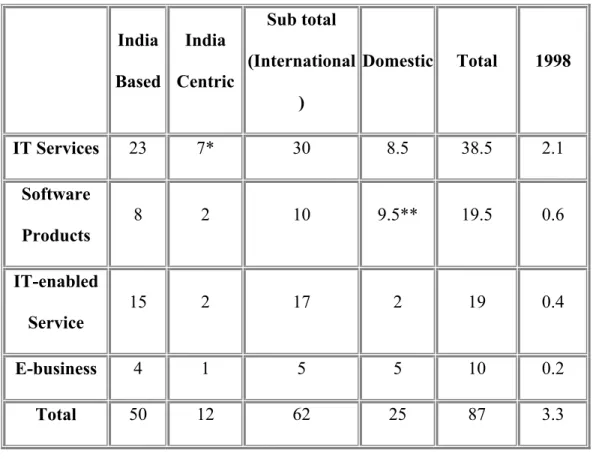
According to a NASSCOM-McKinsey report, annual revenue projections for India’s IT industry in 2008 are US $ 87 billion as shown in Table 1., and market openings are emerging across four broad sectors, IT services, software products, IT enabled services, and e-businesses thus creating a number of opportunities for Indian companies. In
addition to the export market, all of these segments have a domestic market component as well. (“Indian Software”)
Other key findings of this report are (“Indian Software”):
• Software & Services will contribute over 7.5 % of the overall GDP growth of India
• IT exports will account for 35% of the total exports from India
• IT industry will attract Foreign Direct Investment (FDI) of U.S. $ 4-5 billion
• Market capitalization of IT shares will be around U.S. $ 225 billion
Table 1. Projected 2008 Revenues in US $ Billions.
India
Based
India Centric
Sub total
(International )
Domestic Total 1998
IT Services 23 7* 30 8.5 38.5 2.1
Software Products
8 2 10 9.5** 19.5 0.6
IT-enabled
Service 15 2 17 2 19 0.4
E-business 4 1 5 5 10 0.2
Total 50 12 62 25 87 3.3
Exports of $50 billion in 2008
* Legacy/client server, ERP and package work and Internet all have different proportions of work outside India where
revenues are not export revenues.
Bridging the Digital Divide in India
“The world is on the threshold of a new revolution where time and space will no longer be barriers for communication” (Source unknown), said a scholar when the Internet was first introduced. Today, while many have access to computers, there are still quite a few who have no clue whatsoever to the so-called technological revolution. Doesn’t it mean that we live in a fragmented society?
India is the second-most populous nation in Asia, but the country’s Internet usage lags behind China, Japan, South Korea and Taiwan. The huge changes that the Internet is wreaking on many societies have largely passed by India’s poor and illiterate, many of whom have yet to make a phone call let alone set up a web account. In India, there are thought to be only 2 million computers in a country with a population of over a billion. But this may change soon. Research analysts project India will have 23 million Internet users by the end of 2003, compared with about 10 million users today, mostly urban. (Borton, 2002) The government of India is now using information and Internet based technologies in development projects designed to help the poor.
The corporate sector too is discovering that bridging this digital divide could translate into new market opportunities.
Basic Initiatives
HP Labs India, which was set up in the city of Bangalore earlier in 2002 by Palo Alto, California, Hewlett-Packard Co., is developing products appropriate for India's rural markets. "Our technological focus has been on three areas -- making information technology available to those who use Indian languages, improving the connectivity options for those outside the big cities who do not currently have satisfactory access to the Internet, and affordable devices," said Srinivasan Ramani, director of HP Labs India. "For instance, we are working to create Indian language support for an experimental PC that can be used by four users simultaneously," Ramani said. (Ribeiro)
HP Labs India is also examining ways in which digital photography can add a second revenue stream to village kiosks that provide access to computer facilities and the Internet, and is also experimenting with techniques developed by its parent lab in Palo Alto to provide low-bandwidth multimedia communication. Teachers and students can create their own stories and presentations using such a system.
Project of the National Institute of Agricultural Extension Management in Hyderabad. "Each one of the facilitators has seen a business opportunity in these initiatives, and rightly so," added Sharma. The growth of the Indian rural economy will provide a large number of customers for technology companies (Ribeiro).
Public sector projects are also looking at creative ways of building up the
communications infrastructure. Media Lab Asia (MLA), based in Mumbai, is setting up a wireless, 802.11 standard-compliant network to take Internet and voice connectivity to India's rural masses. Set up by the Massachusetts Institute of Technology (MIT)'s Media Laboratory in Cambridge, Massachusetts, in tandem with the Indian government, MLA is focused on developing and deploying technology solutions appropriate to bridging the digital divide in developing economies.
The project to evaluate 802.11 for rural connectivity is anchored by MLA's research hub at the Indian Institute of Technology (IIT) in Kanpur. Starting with four villages near Kanpur, the project plans to create an "information corridor" between Kanpur and Lucknow cities in North India, covering about 25 villages along the route. MLA plans to deploy 802.11 because of its lower cost, according to Dheeraj Sanghi, MLA scientist at the IIT Kanpur research hub. (Ribeiro)
While it is premature to evaluate the impact of the recent MLA and HP initiatives, earlier projects for providing solutions for bridging the digital divide report considerable
Chennai-based Indian Institute of Technology, has used its in-house developed corDECT Wireless Local Loop (WLL) technology to provide Internet and voice connectivity to 250 community kiosks that offer these services to over 700,000 people in rural India,
according to Ashok Jhunjhunwala, professor of the electrical engineering department at IIT Madras, and head of TeNeT. (Ribeiro) The WLL is based on the micro-cellular, DECT (Digital Enhanced Cordless Telecommunications) standard proposed by ETSI (European Telecommunications Standards Institute).
The people in rural India are overwhelmed by this kind of service. There are certain things, which they can get done online, like getting government application forms, market information, etc., without actually physically going to the government departments.
Support for Indian languages and the availability of applications appropriate to the rural masses may decide whether information technology will be viewed by the villagers as an urban intrusion or as a tool relevant to their needs. Only about 5 percent of those who buy newspapers in rural areas seem to buy English language newspapers. HP and other
companies and agencies working on bridging the rural divide are hence focusing on developing technologies that will enable India's masses to interact with computers and the Internet using their native language, usually the spoken language
relevant news is then played back to the user. The system, which uses technologies such as automatic speech recognition, VoiceXML (Voice Extensible Markup Language) to specify the dialogues, a text-to-speech engine for playback of typed in content, and multimedia, has been configured to support spoken Hindi and Telugu, two of the many languages spoken in India. (Ribeiro)
The focus of most of the projects that aim to bridge the digital divide in India is on building sustainable business models for village entrepreneurs. Although subsidies and grants are expected to give the pilot projects the necessary seed funding, the long-term objective is to evolve self-sustaining business models for rural access to information technology. Surprisingly India's government bureaucracy, usually maligned for dragging its feet on development issues, is seen as supportive of the digital divide projects.
There is clearly a great deal of seriousness on all fronts in India about taking information technology and communications to rural India, and the villagers are also receptive. It usually takes about six months for villagers to start viewing technology as a tool. In the first few months, they view it more as an object of curiosity or as a machine for the educated and urban people.
Small but Powerful Steps
at the Indian Institute of Science in Bangalore to make the Simputer technology
commercially viable. The team, led by Dr. Swami Manohar, developed a small, powerful computer called the Simputer (Simple Computer) that reads out the text found on web pages in native Indian languages. (Ward, 2001) The team hopes to help the 35% of Indians, who cannot read, find out about aid projects targeted at them. The makers are convinced that it could transform the lives of hundreds of millions of people across the country. The team has developed its own version of the web’s formatting language to turn text into understandable Indian languages like Hindi, Kannada, and Tamil.
The Simputer looks like a fatter version of the Palm handheld computer, but has more memory and a more powerful processor on board. It runs on the open-source Linux operating system. It has a high resolution LCD screen, up to 96 megabytes of RAM, 16 megabytes of flash memory, modem, and text-to-speech capability. Also, all the menus are picture driven.
The Indian government has started off many net-based projects that aim to give poor farmers access to land records and help them find new markets for produce. The Simputer team hopes that this gadget will help the rural poor make better use of these initiatives. To enable people to share one Simputer, each villager would have access to an individual “smart card” which personalizes the device and stores information about their preferences, and customizes the e-mail and browsing software on the machine for them. All for a price tag of around $200 if, as the inventors hope, production can be ramped up to a couple of hundred thousand units a year.
Although a large number of agencies including the Indian government showed interest in the Simputer both as a design achievement, and for its potential role in bridging the digital divide, there has been a delay in getting funds, according to Vijay Chandru, co-founder and director of PicoPeta Simputers. Also, to fine tune the application and the business model, these devices need to be sent into users’ hands and that requires funds as well. (Ramgopal, 2002).
Mobile Communications) and 802.11 based connectivity. The target of 100,000 Simputers in the field by the end of 2003 may still be achieved. (Ribeiro)
The Simputer project is being mirrored in other regions such as Japan, where the Morphy One is being developed and in Brazil, where a VolksComputer is being designed.
Different Initiatives, Common Objective
There are several organizations and individuals around the world, which are helping to bridge the digital divide in India by focusing on educating children and introducing them to computers. Some of these are as follows:
World links.
World Links, a Washington DC based international NGO; plans to bridge the digital divide in India by training secondary school teachers in the classroom application of IT. World Links, the lead NGO in the World Economic Forum’s Digital Divide Initiative for India, will provide school connectivity, basic computer literacy, and teacher professional development training to teachers in the state of Delhi, Karnataka, Kerala, Andhra
Pradesh, Punjab, Gujarat, and Tamil Nadu. (Patra, 2002)
on areas with infrastructure, thereby best leveraging the limited funds that they currently have. With proper financial support and private sector partnerships, they plan to take their expertise to backward states such as Bihar. In addition, the organization will use the Internet to connect Indian schools with schools across the world for collaborative learning projects.
In conjunction with its local partners, Intel and SchoolNet India, World Links will
provide a total of four phases of its teacher professional development training program to reach 1,500 teachers and 30,000 students in three years. The project in India is being partially funded by the Dutch Government and World Bank grant funds. (Patra)
Fourth R India.
Fourth R India focuses on computer education for children aged between 3 to 19 years. It has initiated a major program with the main objective of bridging the digital divide. To introduce computers to children so that they can meet the challenges of the information age in a better way, Fourth R aims to provide free computer education to one million children across the country in the next two years. (Chari, 2002)
around 50 schools around the country. (Chari) The curriculum gives equal emphasis to theory and lab modules. The students are given projects to work on and the schools have two sessions a week. The curriculum makes use of freeware software using low-end machines, so the curriculum works on any machine, even out-dated ones.
At the moment, the organization is trying to partner with NGOs in their effort to take computers to the masses. It has successfully implemented a pilot scheme for Pratham, a Delhi based NGO. If the organization is able to achieve its goal, it would help society in bridging the digital divide in India.
Schools Online India and American India Foundation.
Schools Online India (SOL) has joined hands with the American India Foundation (AIF) to bridge the digital divide. The SOL India program will now come under the banner of the AIF Digital Equalizer (DE) program, designed to provide access to digital
technology, thereby increasing economic potential and promoting global relations. (Nair, 2002)
The organization is dedicated to accelerating social and economic change in India. They believe that they can strengthen the bonds between India and the US and contribute to building an India where all people can gain access to education, healthcare and employment opportunities.
The various centers all across India have benefited tremendously from their exposure to the Internet. They have realized the impact Internet could have on their lives and how critical a tool it is in today’s life. The combined objective is to organically grow this program and reach out to as many people as possible.
The DE program is one of the foundation’s flagship programs, designed to provide people of India access to digital technology, thereby increasing their economic potential and promoting global camaraderie. Till date there are 55 centers in India, wherein 1,000 teachers and 25,000 high school students have been trained on the basic computer and Internet skills. Over 35 of the schools have set up their own websites. (Nair)
The AIF was formed in 2001 in response to the immediate needs created in the wake of the January 26, 2001 earthquake that shook the state of Gujarat. The non-profit
Project Computer Literacy.
Pradeep Lokhande is a person from the back of the beyond who entered the big bad world of city life, educated himself and, today, runs his own business as an expert, marketing fast moving consumer goods (FMCG) for several multinationals in the rural areas of the state of Maharashtra. He hasn’t forgotten those initial traumatic years in the city when he felt like an alien who had blundered into the city. He had not seen leave alone used a telephone till a good year-and-a-half after arriving in the city. (Menon, 2000)
This has made him very conscious of the great divide between the urban rich and the rural poor, which he is determined to bridge in whatever manner he can. As the rest of the world talks about e-commerce, portals and cyber money, he worries that the rapid strides in information technology will widen the gap between India’s privileged urban
population and her forgotten rural populace.
Lokhande and his team have planned ‘Project Computer Literacy’. This ambitious project will initially introduce at least one computer to each village in the state of Maharashtra. He is taking small steps towards his goal. He has targeted secondary school students in villages, as students are natural opinion and decision makers in the rural setup, since they are perceived to know more.
schools. Help has come, however from individuals and in encouraging numbers. He is convinced that the trickle will soon turn into a stream and then a deluge. He is also in the process of finding out the regulations that govern the import of used and redundant computers into India from other advanced countries.
Lokhande wants the children to actually touch the keyboard and the CPU and realize the things it can do with a few instructions. Once they actually operate it, they won’t be scared of computers and technology is his reasoning. He doesn’t believe that all these kids will end up as software millionaires. But he is sure that they will have better control of their lives if they know how to use a computer (Menon).
At the New English School at Mandardev, a tiny hamlet in Maharshtra’s Satara District, secondary school students are now owners of a 286 computer donated by an individual. Many of these students walk kilometers everyday to school and the computer is a great incentive to getting there daily. They get to use the computer every day and it is quite normal to hear them talk about CPUs, keyboards, and monitors. Who knows, one of these kids might just grow up to be India’s answer to Bill Gates! (Menon)
Reuters Foundation Digital Vision Fellowship Program.