RTS,S/AS01 malaria vaccine efficacy and its interaction with seasonal precipitation: Results from a phase 3 randomized controlled trial in Lilongwe, Malawi
Larry Han
Senior Honors Thesis Department of Biostatistics
1
RTS,S/AS01 malaria vaccine efficacy and its interaction with seasonal precipitation: Results from a phase 3 randomized controlled trial in Lilongwe, Malawi
Larry Han, Irving Hoffman, Michael Emch, Jon Juliano, Cory Keeler, Francis Martinson, Portia Kamthunzi, Gerald Tegha, Michael Hudgens
Abstract
Background: Phase 3 trials of the efficacy and safety of the candidate malaria vaccine
RTS,S/AS01 are complete, but site-specific data are limited. This study assesses the interaction of precipitation and vaccine efficacy and corresponding estimates of clinical malaria episodes averted in a seasonal-transmission region of sub-Saharan Africa.
Methods: We followed children (5-17 months of age) and infants (6-12 weeks of age) who had been randomly assigned to one of three groups: 1) a group that received 3 doses of RTS,S and a booster dose 18 months after the third dose (R3R group); 2) a group that received the same schedule without the booster (R3C group); 3) a control group –the rabies vaccine (VeroRab, Sanofi-Pasteur) was administered to children 5-17 months of age and the meningococcal
serogroup C conjugate vaccine (Menjugate, Novartis) was administered to infants 6-12 weeks of age (C3C group). Primary efficacy was defined as development of clinical malaria (fever
≥37.5°C and Plasmodium falciparum parasitemia density >5,000 parasites per microliter) for both age groups. Patients were followed passively but were told to seek medical care at a designated Health Center for any illness. Precipitation data were obtained from the Chitedze Agricultural Center in Lilongwe, Malawi (-13.97S, 33.63E, 3770 ft).
2
53.7%, P<0.0001) for the R3R group and 29.9% (95% CI 11.3%, 44.6%, P=0.003) for the R3C group. Precipitation was significantly associated with increased malaria incidence, with each 1-inch increase in rainfall per month elevating the hazard of malaria by 12.6% (95% CI 9.6%, 15.6%) among children and by 15.9% (95% CI 12.8%, 18.9%) among infants. Vaccine efficacy was not affected by seasonal variations in precipitation.
Interpretations: Policy discussions for the expanded use of RTS,S/AS01 are underway. It will be critical to determine the performance of the vaccine according to the seasonal pattern of malaria transmission. We show that vaccine efficacy does not change during the rainy or dry season in Lilongwe, Malawi, an area of mesoendemic, seasonal transmission.
3
Introduction
Globally, malaria incidence among populations at-risk fell by 37% between 2000 and 2015, with malaria death rates among children under 5 years of age reduced by 65%.1 Despite substantial financial and developmental resources directed toward reducing malaria incidence in sub-Saharan Africa, Malawi has not seen a significant decrease in malaria transmission. The
population of Malawi is under a mesoendemic transmission risk for malaria2, but it was found to be one of only two (out of 44) malaria-endemic countries that saw an increase in a population-adjusted Plasmodium falciparum parasite rate among children aged 2-10 years.3
The multi-site, Phase 3 trial of RTS,S/AS01, the most advanced candidate malaria vaccine, is complete. Across 11 study sites in seven countries in sub-Saharan Africa, administration of the vaccine in four doses was shown to reduce clinical malaria by 36.3% (95% confidence interval [CI] 31.8%, 40.5%) in children 5-17 months of age and by 25.9% (95% CI, 19.9%, 31.5%) in infants 6-12 weeks old.4 The European Medicines Agency has adopted a positive scientific opinion of the vaccine, leading to a recommendation by WHO’s Strategic Advisory Group of Experts on Immunization (SAGE) and the Malaria Policy Advisory Committee (MPAC) to implement large-scale pilot projects.1
Policy discussions for the expanded use of RTS,S/AS01 are thus underway. To inform these policy discussions it will be critical to understand the variation in vaccine efficacy over space and time. It is widely understood that RTS,S/AS01 will not serve as a panacea, and that the vaccine must be used in conjunction with other control measures such as the use of insecticide-treated nets and prompt and appropriate artemisinin combination therapies. However,
implementation of the vaccine may be particularly effective in certain environments, such as in areas where malaria transmission is high, seasonal or in elimination programs.5
Site-specific data which considers the seasonality of vaccine efficacy have been limited. An understanding of the seasonality of transmission and temporal variations in each location are critical in deploying effective pilot interventions. For example, seasonal malaria
4
seasons, and requires accurate timing within that season.6 Mathematical models have also shown that a higher proportion of cases averted and high cost-effectiveness may be possible in lower transmission regions compared to higher transmission regions.7 We undertook an analysis of the phase 3 trial of RTS,S/AS01 in Lilongwe, Malawi, to evaluate its efficacy against episodes of clinical Plasmodium falciparum malaria across seasonal variations in precipitation.
Methods
Study Design and Participants
The details of the study design have been described previously.8-10 Primary efficacy was defined as development of clinical malaria (fever ≥37.5°C and Plasmodium falciparum parasitemia density >5,000 parasites per microliter) for both age groups.8-10 Patients were followed passively but were told to seek medical care at specified health settings for any illness. Precipitation data were obtained from the Chitedze Agricultural Center in Lilongwe, Malawi (-13.97S, 33.63E, 3770 ft). The trial protocol was approved by both the institutional review board (IRB) at UNC Chapel Hill and by the Malawi National Health Sciences Research Committee. Parents or legal representatives of all participants witnessed and provided informed consent at enrollment to the study. Non-literate parents indicated consent by giving a thumbprint in place of a signature.
Randomization and Masking
5 Procedures
The treatment of malaria during the study was done in accordance with Malawi national
guidelines and detected by passive surveillance. The Lilongwe vaccine trial catchment area was identified using neighborhood location information from patients who came to the Area 18 Health Center in the previous year. We examined three different geographic data sources to identify the catchment area. To recruit participants, we conducted community-based information sessions for families with infants and children who met the enrollment age criteria. Flyers were also distributed in the identified communities.
Statistical Analysis
Our cohort included all children and infants who had received three doses of vaccine according to study protocol and for whom efficacy surveillance data were available 14 days after the third dose.
Cox proportional-hazard models were used to assess first or only malarial episodes. Vaccine efficacy against multiple malarial episodes were calculated using negative binomial regression, the Andersen-Gill model, and the Prentice-Williams-Peterson (PWP) extension of the Cox regression. In the negative binomial regression, the logarithm of follow-up time was used as offset. Events occurring within 14 days following a malaria episode meeting the primary case definition were excluded to minimize counting treatment failures as an episode resulting from a new infection.11 The 95% confidence intervals and p-values on vaccine efficacy estimates, defined as 1 minus the incidence-rate ratio or hazard ratio, were calculated.
6
Data were censored at the end of the follow-up period for each participant or at the date of emigration, withdrawal of consent, or death. Data were analyzed using SAS software, version 9.4.
Results
Study Participants
A total of 1626 participants in Lilongwe were randomly assigned to a treatment group. Among the 800 children, 261 were randomly assigned to receive C3C, 270 to R3C, and 269 to R3R. Among the 826 infants, 279 were randomly assigned to receive C3C, 275 to R3C, and 272 to R3R. A total of 1513 (93.1%) children and infants received the booster dose. Baseline
7
Table 1. Demographic characteristics at baseline and follow-up in our cohort
Children Infants
Characteristic R3R (n=236) R3C (n=260) C3C (n=244) Total (n=740) R3R (n=253) R3C (n=252) C3C (n=265) Total (n=770) Follow-up
time – mo
Median 45.4 45.1 45.5 45.3 33.8 33.9 34.4 34.1 10th-90th
percentile 20.9-49.6 19.3-49.3 21.4-49.0 19.9-49.2 20.8-40.3 20.5-40.1 25.2-40.5 21.8-40.4 Age at vaccination*
Median 12.1 11.6 11.2 11.7 7.8 7.9 8.1 7.9 Range
5.0-17.0 5.0-17.0 5.0-17.0 5.0-17.0 6.0-12.0 6.0-12.0 6.0-12.0 6.0-12.0 Sex – no. (%)
Female 116 (49.2) 134 (51.5) 116 (47.5) 366 (49.5) 115 (45.5) 122 (48.4) 133 (50.2) 370 (48.1) Male 120
8 Efficacy against the first or only malaria episode
In our cohort, 744 of 1513 (49.1%) children and infants had at least 1 episode of clinical malaria. Among children, 353 of 742 (47.5%) developed malaria – 96 of 237 (40.5%) in R3R group, 115 of 260 (44.2%) in R3C group, 142 of 245 (57.8%) in the C3C group. Among infants, 391 of 771 (50.7%) developed malaria – 107 of 253 (42.3%) in the R3R group, 123 of 252 (48.8%) in the R3C group, 161 of 266 (60.5%) in the C3C group (Table 2).
9
Figure 1a. Kaplain-Meier failure curve of time-to-first-incidence of malaria among children 5-17 months of age, n=742
10 Efficacy against all episodes
Four separate analyses were conducted to determine vaccine efficacy against all malaria
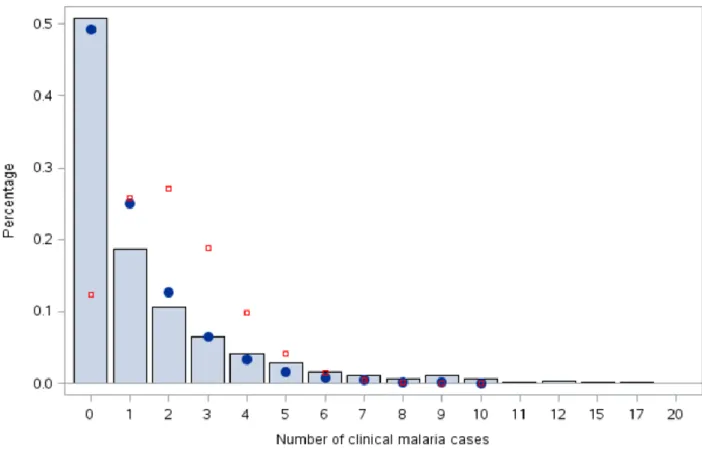
episodes. The four models were a negative binomial regression model, which fitted the observed data better than the Poisson model (-2Loglikelihood=1379.17 with 1 df by the likelihood ratio test of overdispersion, P<0.0001) (Fig. 2) and three extensions of the Cox regression model for recurrent events – the Andersen-Gill (AG), the Prentice Williams Peterson total time (PWP-TT), and the Prentice Williams Peterson gap time (PWP-GT) models. The AG model is a counting process model that assumes time increments between malaria episodes are conditionally
uncorrelated and that dependence between subsequent episodes is mediated through time-varying covariates.12 The PWP models order multiple episodes by stratification, i.e. all participants are considered at-risk for the first stratum but only those participants with an episode in the kth
stratum are considered at risk for the (k+1)th stratum.
11
12
Table 2. Event rates and efficacy of RTS,S/AS01 vaccine against episodes of Plasmodium falciparum clinical malaria
C3C R3C R3R
No. of individuals
No. of events
PYAR* Event rate
No. of individuals
No. of events
PYAR* Event rate VE (95% CI) No. of individuals No. of events
PYAR* Event rate VE (95% CI) Children First episode
245 142 489.0 0.29 260 115 596.4 0.19 33.1 (14.5,
47.7)
237 96 580.7 0.17 42.7 (25.7,
55.8)
All episodes, negative binomial
245 391 829.1 0.47 260 288 845.8 0.34 27.3 (5.0,
44.4)
237 193 787.3 0.25 48.8 (31.9,
61.5)
Infants First
episode
266 161 422.9 0.38 252 123 464.2 0.26 29.9 (11.3,
44.6)
253 107 482.1 0.22 41.8 (24.4,
53.7)
All episodes, negative binomial
266 545 735.8 0.74 252 415 675.4 0.61 14.8 (-12.2,
35.3)
253 352 679.2 0.52 30.8 (8.6,
47.7)
13
Figure 3. Mean number of clinical malaria cases among treatment and age groups
14
Table 3. Comparison of four models for estimating vaccine efficacy against all clinical malaria episodes
Model R3R v. C3C
(95% CI)
p-value R3C v. C3C (95% CI) p-value Negative Binomial 39.5% (26.1%, 50.5%)
<0.001 20.9%
(4.0%, 34.9%)
0.017
Andersen-Gill 39.2%
(22.7%, 52.3%)
<0.001 32.0%
(13.7%, 46.4)
0.002
PWP Total Time 19.9%
(8.3%, 30.0%)
0.001 14.0%
(2.3%, 24.3%)
0.021
PWP Gap Time 22.8%
(11.8%, 32.5%)
<0.001 16.2%
(4.9%, 26.1%)
0.006
Clinical malaria episodes averted
15
Discussion
It has been questioned if the performance of a malaria vaccine might vary depending on the seasonal pattern and intensity of transmission13, but this study is the first to suggest that efficacy does not change significantly across seasonal variation in precipitation and will provide valuable information for overall roll-out strategies for RTS,S/AS01. In Malawi, we showed that despite seasonal malaria transmission, the efficacy of the RTS,S/AS01 vaccine was not affected by seasonal variation in precipitation. Given that pilot programs will soon be underway to assess whether routine immunization can deliver the four-dose schedule effectively, whether the vaccine can prevent deaths, and whether the safety concerns indicated in phase 3 trials are significant, it would be a major blow to dispense with RTS,S/AS01. However, for these pilot programs to be successful, they must be implemented in a way that recognizes differences in vaccine performance across a variety of transmission intensity regions. Our study demonstrates that among seasonal transmission regions, implementation of the vaccine should not be given differential weighting based on precipitation patterns, nor should it be constrained to only certain times of year.
16
African highlands, which showed that high-resolution precipitation data could directly predict malaria incidence among children less than 15 years of age.15,16 This period of time also closely matches the theoretical vector-parasite-host cycle, which includes the growth of the Anopheles
mosquito from egg to reproductive age, the development of the Plasmodium falciparum parasite in the vector from gametocytes to sporozoites, and the incubation period in the human host from infection to onset of malaria symptoms.17
Figure 4. Seasonal precipitation and malaria incidence spike among infants and children in Lilongwe, Malawi, n=1513
17
0.57 (95% CI 0.48, 0.67, p<0.0001) by the negative binomial model. This observed difference may in part be explained by differences in naturally acquired immunity and physiological effects between the two age groups,18 which led to RTS,S/AS01-induced anti-circumsporozoite antibody titres being significantly greater in children compared to infants.19 Interestingly, despite much higher vaccine efficacy among children (48.8% [95% CI 31.9%, 61.5%]) compared to infants (30.8% [95% CI 8.6%, 47.6%]) in the negative binomial model, we observed only a slightly greater number of total cases averted among children compared to infants. Compared to the C3C group, 22.7 and 10.9 infant clinical malaria cases per 100 infants per year were averted in the R3R and R3C groups, respectively, and 23.5 and 13.2 child clinical malaria cases per 100 children per year were averted in the R3R and R3C groups, respectively. This similarity may have been due to somewhat longer follow-up times for children (median 45.3 months) compared to infants (median 34.1 months).
Despite point estimate differences observed in the models for estimating vaccine efficacy against all clinical episodes, each of the four models showed significant efficacy in both the R3R and R3C groups compared to the C3C. In each instance, the PWP models (total time and gap time) indicated lower vaccine efficacies compared to the negative binomial and Andersen-Gill models (Table 3). The PWP total time model evaluates the effect of a covariate for the kth episode since study initiation and the PWP gap time model evaluates the effect of a covariate for the kth
episode since time from the (k-1)th event. The PWP models may be more appropriate when the effects of covariates (e.g. vaccine, precipitation) are different in subsequent episodes, which is likely the case in the study of infectious diseases.12 However, the PWP models also have
limitations. Notably, the risk set for later episodes becomes very small, making vaccine efficacy estimates potentially unstable when individuals get malaria numerous times.12 Further research must be conducted to determine the limitations and advantages of each model.
18
19
Acknowledgments
This senior honors thesis is the culmination of a collaborative effort with professors and
colleagues from various backgrounds. My sincerest thank you to Michael Hudgens, not only for serving as my primary thesis advisor in the Department of Biostatistics but also for showing me how academic mentorship works best. I thank Irving Hoffman for his significant and lasting impact on my undergraduate path, from linking me to UNC Project-China during my first year to serving on my committee senior year. I look forward to spending more time on the golf course over the years to come! I thank Michael Emch for giving me the opportunity to develop into a more mature and thoughtful researcher through being a part of his Spatial Health Research Group. You have treated me as a full member of the group since Day One, and for that I will always be grateful. I thank Jane Monaco for her sound guidance and genuine conversations during my time in the program and for the years ahead. I cannot imagine where I would be without you as a steadying force. I would be remiss not to acknowledge the team at Area 18 of Lilongwe, Malawi for their hospitality and helpfulness during my visit. Lastly, I would like to thank my parents, Bajin Han and Xiaomin Li, as well as my sister, Bo Han, for serving as superb role models. There is no luckier son and brother.
Disclosure statement
20
References
1. WHO. World Malaria Report, 2015. Geneva: World Health Organization, 2015. 2. Bennett A, Kazembe, L., Mathanga, DP., Kinyoki, D., Ali, D., Snow, R., Noor, A.
Mapping malaria transmission intensity in Malawi, 2000-2010. Am J Trop Med Hyg 2013; 89(5): 840-9.
3. Noor AM, Kinyoki DK, Mundia CW, et al. The changing risk of Plasmodium falciparum malaria infection in Africa: 2000–10: a spatial and temporal analysis of transmission intensity.
The Lancet 2014; 383(9930): 1739-47.
4. RTS SCTP. Efficacy and safety of RTS,S/AS01 malaria vaccine with or without a
booster dose in infants and children in Africa: final results of a phase 3, individually randomised, controlled trial. The Lancet 2015; 386(9988): 31-45.
5. Greenwood B, Doumbo OK. Implementation of the malaria candidate vaccine RTS,S/AS01. The Lancet 2015; 387(10016): 318-9.
6. Cairns M R-FA, Garske T, Wilson AL, Diallo D, Milligan PJ, Ghani AC, Greenwood BM. Estimating the potential public health impact of seasonal malaria chemoprevention in African children. Nat commun 2012; 2(3): 881.
7. Penny MA, Verity R, Bever CA, et al. Public health impact and cost-effectiveness of the RTS,S/AS01 malaria vaccine: a systematic comparison of predictions from four mathematical models. The Lancet; 387(10016): 367-75.
8. RTS SCTP. First results of phase 3 trial of RTS,S/AS01 malaria vaccine in African children. N Engl J Med 2011; 365: 1863-75.
9. RTS SCTP. A phase 3 trial of RTS,S/AS01 malaria vaccine in African infants. N Engl J Med 2012; 367: 2284-95.
10. RTS SCTP. Efficacy and safety of the RTS,S/AS01 malaria vaccine during 18 months after vaccination: a phase 3 randomized, controlled trial in children and young infants at 11 African sites. PLoS Med 2014; 11(e1001685).
21
12. Amorim LDAF, Cai J. Modelling recurrent events: a tutorial for analysis in epidemiology. International Journal of Epidemiology 2014.
13. Series WTR. Annex 3: Guidelines on the quality, safety and efficacy of recombinant malaria vaccines targeting the pre-erythrocytic and blood stages of Plasmodium falciparum: WHO 2014.
14. Baird JK, Owusu Agyei S, Utz GC, et al. Seasonal malaria attack rates in infants and young children in northern Ghana. Am J Trop Med Hyg 2002; 66(3): 280-6.
15. Krefis AC, Schwarz NG, Kruger A, et al. Modeling the relationship between precipitation and malaria incidence in children from a holoendemic area in Ghana. Am J Trop Med Hyg 2011; 84(2): 285-91.
16. Zhou G, Minakawa N, Githeko AK, Yan G. Association between climate variability and malaria epidemics in the East African highlands. Proceedings of the National Academy of Sciences of the United States of America 2004; 101(8): 2375-80.
17. M. S. Medical Entomology for Students. 4th edition ed. Cambridge; 2008.
18. White MT, Griffin JT, Akpogheneta O, et al. Dynamics of the antibody response to Plasmodium falciparum infection in African children. The Journal of infectious diseases 2014; 210(7): 1115-22.