James E. Ensley. Latin Lexicographical Resource Selection in an Educational
Environment. A Master’s Paper for the M.S. in L.S. degree. November, 2011. 64 pages. Advisor: Claudia Gollop
There are a number of Latin dictionaries that the information professional can choose from when selecting resources for a library that serves a community that is engaged with classical education and the study of Latin. After providing a brief history of Classical lexicography and each work, this resource analyzes many of the widely available Latin lexicographical works and suggests which dictionaries are most appropriate for the various types of communities being served.
Headings:
LATIN LEXICOGRAPHICAL RESOURCE SELECTION IN AN
EDUCATIONAL ENVIRONMENT
by
James E. Ensley
A Master’s paper submitted to the faculty
of the School of Information and Library Science
of the University of North Carolina at Chapel Hill
in partial fulfillment of the requirements
for the degree of Master of Science in
Library Science.
Chapel Hill, North Carolina
November 2011
Approved by
____________________________________
Table of Contents
Chapter I Introduction 3
Chapter II Background 5
Chapter III Methodology 14
Chapter IV Discussion 17
Lewis & Short 17
Oxford Latin Dictionary 25
Cassell’s New Latin Dictionary 31
Thesaurus Linguae Latinae 39
William Whitaker’s Words 46
Perseus Online Interface of Lewis & Short 52
Chapter V Conclusion 57
Table of Figures
Figure 1: Page from Lewis and Short 20
Figure 2: Page from Oxford Latin Dictionary 28
Figure 3: Page from Cassell’s New Latin Dictionary 36
Figure 4: Page from Thesaurus Linguae Latinae 43
Figure 5: Search results in Whittaker’s Words 48
Figure 6: Search results for “beta” in Whittaker’s Words 50
Figure 7: Search interface in the Perseus Digital Library 54
Figure 8: Perseus search results for “monere” 55
Figure 9: Long entry from Lewis and Short on Perseus 56
Chapter I: Introduction
To the uninitiated the field of Classics can be a confusingly opaque discipline brimming with a host of acronyms and often-used sources dating back to the 19th century and even prior. For the newly-minted knowledge professional tasked with aiding in the education of budding classicists, whether they be studying at the secondary or higher education levels, reference questions such as “should I consult the TLL, OLD, or Lewis and Short for dictionary meanings for the verb amare for use in my research paper?” can
seem impenetrable. Similarly, for those in collection development roles, the plethora of Classics reference material can be overwhelming and as will be discussed further, some of the most useful reference material was published in the 19th century or, in one case, has not even been published in a complete format as of 2011.
This paper, in an effort to shed light on one aspect of Classics reference material, seeks to provide a systematic review of Latin dictionaries in common use at the
secondary and post-secondary levels of education, as the works needed for the two sets of users often contain the same texts. Through a qualitative analysis of each dictionary based on predetermined criteria, it is hoped that this paper will provide needed
Chapter II: Background foundation
Lexicography: Major Works & Analysis
Lexicography, the study of the creation of dictionaries, and lexicology, the study of dictionaries and their creation, are well-represented in literature. As Howard Jackson notes in the preface to his Lexicography: an introduction (2002), the field of lexicology has enjoyed a surge in popularity and in published research since the late 1980s and early 1990s, coinciding roughly with the release of the second edition of the Oxford English Dictionary (OED) published in 1989. Jackson notes the publication of the Encyclopedia
of Lexicography (Hausman et al. 1989-1991) and the Dictionary of Lexicography
(Hartmann and James 1998) as being seminal works in mapping and delineating the field; 1988 also saw the creation of the first journal devoted entirely the field, the
still-published International Journal of Lexicography. The field even had a moment on the New York Times’ Best-Seller List with Simon Winchester’s look at the rather storied
history of the Oxford English Dictionary, The Professor and the Madman.
Of particular import to the current analysis are the works published during this surge that sought to define dictionaries and the qualities that make a good dictionary. Among these works is Béjoint’s Tradition and Innovation in Modern English
Dictionaries (1994), which was reprinted as Modern Lexicography: an introduction
“psycholexicography”—where the creator of a dictionary best attempts to meet the needs of the user by attempting to look at the dictionary as a user would. Most recently Béjoint updated his overview of the field with the Lexicography of English (2010) in which he muses more openly on the direction that dictionaries are taking as a whole in the digital age and whether users or writers of dictionaries should be the ones to cope.
While Béjoint has been the leader in systematically tackling the whither and whence existential questions of lexicography, Jackson (2002) and Landau (1984; 2001) focused their notable efforts on descriptive works of the field of lexicography along with standards one could use to judge the appropriate audience and use of various dictionaries. Jackson (2002: 173) notes, “One of the crucial issues for dictionary criticism is to
establish a sound and rigorous basis on which to conduct the criticism, together with a set of applicable criteria.” The criteria Jackson selects as providing a good baseline analysis are derived from the special needs of a review of a dictionary as, unlike other reviews of literature, the reviewer should not and is most likely incapable of reading the book cover to cover. Jackson (176) suggests an analysis to take into consideration internal and external criteria of the work, internal considerations being those things the author(s) of a work say about its intended purpose and external being the reader’s view of the work. As for the external concerns Jackson (177-182) suggests the following set of criteria for reviewing a lexicographical work:
Page Layout: The amount of white space and number of columns as well as the presence
Layout of the Entries: Do the entries use only a single paragraph? Do they use a new
paragraph for each new meaning? While the latter uses more space, Jackson asserts it makes entries more readable.
Length of Entries: Does the dictionary practice nesting—the practice of placing
compounded words and phrases beneath a headword, assuming the reader will realize the compound? Jackson argues that an unnested dictionary is more attractive in its page layout thanks to shorter, more numerous entries, which creates more white space.
Abbreviation: Does the dictionary abbreviate entries? Abbreviations in entries save space,
but they also put the onus of understanding on the reader of the dictionary. Dictionaries containing large number of abbreviations are considered best for readers with a strong baseline knowledge of the field under consideration.
Range of Vocabulary: This particular criterion is pivotal for the field of Classics. Not
only are dictionaries expected to cover a geographical and lexical range of Latin, but a chronological one as well. Latin, after all, is a long-lasting language and the when is as important as the where.
Word Formation: Are words that are often found together in pairings presented in
dictionary entries? Are common suffixes and affixes presented in the entry?
Homographs: How are words that mean different things but are spelled the same way
(homographs) treated? Are they given a completely new entry or given an ordinal entry showing relative frequency of usage?
Sense Division: How are different senses of a word treated? Jackson notes the trend to
in a study of Latin dictionaries as some works are famous or notorious for level of pedantry they exert in differentiating senses of words.
Defining: How does the dictionary define words? Are the entries analytical in nature? Are
scientific terms defined in such a way that they could be confusing to the layperson? Beyond Denotation: How does the work handle synonymy and antonymy? Are words
that have collocations or words with similar definitions presented in the entry? Are entries encyclopaedic in nature? Jackson asserts these can have a large impact on the understanding of a definition.
Pronunciation: Jackson argues that a dictionary should have variable pronunciation
guides to cover a large number of possibilities. This, however, is somewhat of a moot point with regards to Latin dictionaries as Latin pronunciation is the subject of much debate and few in the field of Classics would have warrant to use pronunciation, save for stress patterns, which are useful in the study of Latin poetry. I argue that replacing this category instead with “Stress Patterns” would be more valuable to the average user. Grammar: Jackson notes that dictionaries, especially monolingual ones, typically do not
go beyond denoting transitive and intransitive verbs in their definitions, save for a few newer entries that have simplified the grammatical term to “with object” and “without object.” For bilingual dictionaries, like the majority of those under consideration, grammar is of prime importance, especially given the rather complex nature of Latin noun and verb systems.
Usage: Does the dictionary provide notes concerning the proper usage of a word?
Examples: Jackson asserts all dictionaries provide examples, but the quality of examples
should be judged. Are examples illustrative? Are examples used primarily to show common features or to provide examples of exceptions to the rules? Are examples drawn from the corpus of the language or invented?
Etymology: While one might consider etymology more pertinent to languages with a long
history of borrowing, such as English, Latin too had a history of borrowing words from Greek and to a lesser degree other languages. The presence of etymologies for Latin words could prove useful in the study of Latin poetry and prose and thus could be a valuable part of a viable lexicographical work.
Special Features: This is a wide-ranging category that includes tables and other ephemera
that the editors of a particular dictionary thought would be of value to the reader (or as Jackson asserts, help sell more books).
question in his well-known Latin Sexual Vocabulary (1982) in which he argued that essential to an understanding of many types of Latin literature from satire to poetry to epigram to invective is an understanding of sexual vocabulary. While Landau (229-231) notes that public opinion has generally shifted to being more open to lexicographical works with previously taboo words, many are still uncomfortable with the idea of such works being available in the secondary school curriculum; he writes, “Teachers would be confronted on the one hand by puzzled and titillated students and on the other hand by outraged parents.” Landau’s advice is to err on the side of caution when selecting such dictionaries for a secondary school environments advising that acts of heroics are most likely not worth such a small part of the lexical corpus. Considering that stated aim of this paper includes the possibility of these lexicographical works being used in secondary school environments, one can see the competing issues arrayed against one another: on the one hand the complete understanding of Latin terminology and on the other the concerns of parents and guardians. With an eye to this problem, this paper aims to describe the manner in which each of the dictionaries under consideration handle the subject of taboo words.
cuts, deserves at least some focus. As such, the cost will be discussed as part of the content analysis of the work.
Notably, two of the works under consideration are electronic dictionaries which bring a new set of considerations about. Many authors in the past decade and a half have wrangled with the issues surrounding the use of electronic dictionaries, their
achievements, shortfalls, and whether they can and should exist alongside paper dictionaries or replace them entirely. Béjoint has noted that e-dictionaries, as they are commonly known, can have a freeing effect as computers are not limited by the physical constraints of a book; entries can be longer and less abbreviated, and while one of the most important qualities of an e-dictionary is its only being able to show one entry at a time, the e-dictionary affords the ability for entries to be linked via hypertext (2010: 371, 375).
“involvement hypothesis” suggests that users who have an easy time retrieving
information will just as easily forget it (Leech and Nesi 1999: 298). Béjoint also suggests that though e-dictionaries are appealing, paper dictionaries will have a place for the foreseeable future thanks to their ability to be consulted without the necessities of a computer, power, or internet; he also retreats to the romanticization of physical books that has been a common refrain (2010: 375).
Classics & Lexicology
As the field of lexicology has enjoyed a revitalization since the 1980s, so too has directing a lexicological eye towards the field of Classics and its Latin and, especially, Greek dictionaries. In the single volume Studies in Lexicography (1987) P.G.W. Glare inaugurated a renewed interest in Classical lexicological works and their study with his paper on “Liddell & Scott: its background and present state.” Glare had recently come off his success as the final editor of the Oxford Latin Dictionary (1982) project, and turned his attentions to the current state of affairs of Greek lexicography. These efforts were followed by similar analyses of the state of the field of Greek lexicography in Kitchell (1988, 1989). In 2010, Christopher Stray, whose 30 years of research have been focused on the study of Classics and its history, edited a volume titled Classical Dictionaries: Past, Present, Future. The volume is notable in being the first dedicated entirely to the
Chapter III: Methodology
Primary Documents
While the literature on the state of Latin lexicography and its generalized history is somewhat lacking, there is no dearth of Latin dictionaries. Even a concise history of the Latin dictionary up to the modern era would become a book-length endeavor. As such, this paper aims to only concern itself only with dictionaries that remain in common use in secondary and post-secondary educational environments. As a guide to such works, the author has taken Fred Jenkins Classics standard, Classical Studies: a guide to the reference literature (1996) as a baseline but incomplete guide to Latin lexicographical
works. Jenkins has created broadly thorough but narrowly indeterminate work on the 667 most commonly used Classical references. Each reference is given at most 150 words in which to be discussed. From Jenkins’ “Greek and Latin Language Section” I have
selected the Latin dictionaries that are current considered to have not been superseded by another work—this rules out Forcellini’s Totius Latinitatis Lexicon, which even in 1996 Jenkins acknowledged was being superseded by the Thesaurus Linguae Latinae project. The author has also removed bilingual dictionaries in which the non-Classical language is not English as well as etymological dictionaries, which are considered to be more
specialized works—this requirement has removed both Lateinisches Etymologisches Wörterbuch and the Dictionnaire étymologique de la langue latine: histoire des mots,
both of which are excellent etymological resources yet ill-suited for the current
student use, were excluded from discussion owing to their somewhat flimsy, paperback construction and limited vocabulary. Among works of this sort are the Oxford Pocket Latin Dictionary, the New College Press Latin Dictionary, and the Collins Gem Latin
Dictionary. While the first two works are known for being perfectly satisfactory personal
student dictionaries, the Collins Gem holds a sort of legendary status among Classicists for being poorly written and in some circumstances outright wrong—one online Classics guru even notes that the book is liable to be preceded by the aspersion horribile dictu, “terrible to speak of” (Wills 1995).
With these restrictions imposed, one is left with a list of general-use
dictionaries—the bread and butter of the Classicist’s lexicographical arsenal. These works are: the Oxford Latin Dictionary, A Latin Dictionary Founded on Andrews' edition of Freund's Latin dictionary revised, enlarged, and in great part rewritten by Charlton T.
Lewis, Ph.D. and. Charles Short, LL.D.(1879) (mercifully known by its editors’ names—
Lewis & Short), and the Thesaurus Linguae Latinae (Ongoing). While this is a good
beginning to the list, the author feels that Jenkins has overlooked resources that could prove valuable in a learning environment. Notably, Jenkins passes over D.P. Simpson’s 1959 rewrite of Cassell’s New Latin Dictionary. While the volume is not mentioned in any notable published list of Classics reference material including Jenkins, the work has a popular following among teachers and gurus and was well-received in reviews (Bruere 1960; Rexine 1960; Richards 1960; Gill “Top 6 Latin Dictionaries”).
from being traditional paper-based Classics resources, these resources are popular with students and deserve at least some attention considering their ease of availability and their appealing lack of a price tag. Further, Perseus’ dictionary is completely based on Lewis and Short, lending it a certain amount reputability. Both online resources will
Chapter IV: Discussion of Resources
A Latin Dictionary… edited by Charlton T. Lewis & Charles Short. Oxford: Oxford
University Press, 1879. Pp. xiv, 2019. $255.00.
Stray (2010: 94) notes that competition prior to the publishing of Lewis and Short in 1879 was fierce; he further notes that the business of Latin dictionaries was a game of one-upsmanship where a particular press would create a new Latin dictionary ever-so-slightly different from previous versions released by other presses. As such, Latin dictionaries often developed a clear lineage from previous editions. Lewis and Short, though it became the standard Latin dictionary until the publishing of the OLD in 1982, was no different (Jenkins: 161). Lewis and Short’s lexicographical work is, in fact, a heavily edited reworking of a previous Latin dictionary by E.A. Andrews (1850); in turn, Andrew’s dictionary was a translation of the William Freund’s Latin-German dictionary Worterbuch der lateinischen Sprache (1834-1840). Freund, in turn, based his work on
Forcellini’s Totius Latinitatis Lexicon (1771), a monumental monolingual Latin dictionary that is still occasionally used for etymological research to this day.
Though Lewis and Short was the standard Latin dictionary for over 100 years, as can be seen from its lineage, it is based on older lexicographical principles and practices and never in its history of reprinting received a major update and contains many errors (Jenkins, 162). As such, in the same breath Jenkins suggests that, though widely
it was the best they had at the time, Henderson (2010, 140) notes that Lewis and Short became a sort of “byword for shoddiness” that spurred on the creation of newer dictionaries like the OLD in the 20th century.
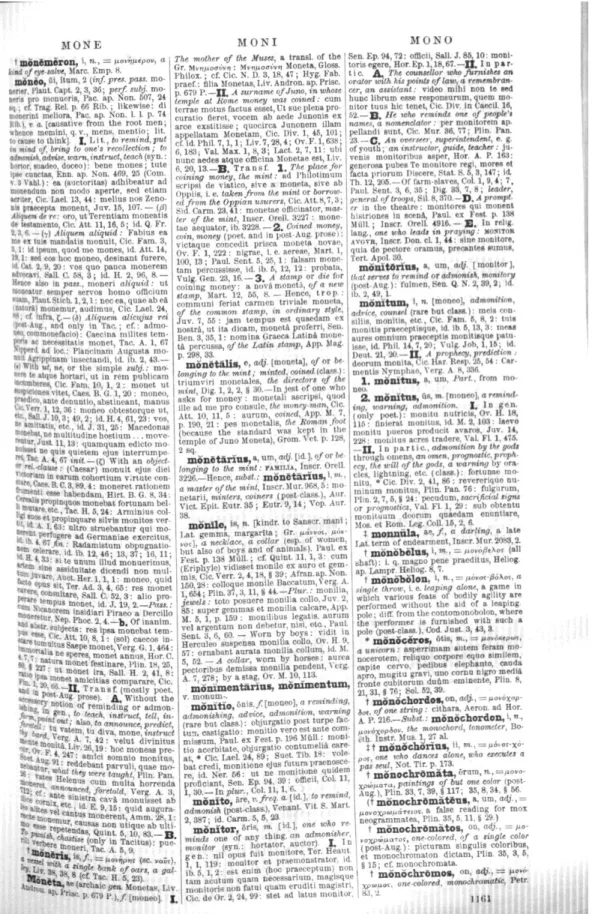
Though oft-maligned by scholars, the question remains as to whether the volume has a place in the body of works available in an educational setting. Prior to examining the work with Jackson’s criteria with the addition of treatment of taboo words and price, the author would like to present a sample page from the dictionary containing the word monere, a fairly common word that students learn early in their Classics careers (Figure
1).
Length of entries in Lewis and Short vary considerably. For example, the reproduced page showing monere displays that particular word in nearly an entire column. Yet, immediately following is the word moneris, which is given a very short, 3-line entry. Some entries like the famously polysemous word agere may run as many as three entire pages. Longer entries such as these create a somewhat difficult to navigate ‘wall-of-text.’ If the student learner is searching for a particular meaning of agere or even monere, the sheer number of entries could confuse or overwhelm the user.
Notably, even with extremely long entries for some words, abbreviations are heavily used within Lewis and Short, though the definitions for these abbreviations are thankfully given with the front matter of the book. Both attested authors and grammatical terms are given in an abbreviated format that could prove vexing to a newer student of Latin, especially those who are unfamiliar with some antiquated grammatical terms that are not used as commonly today, e.g. “plusquamperfectum” for the pluperfect tense. Jackson notes that fewer abbreviations usually means more accessibility, a feature that is often ignored by academics in dictionaries (Jackson: 178).
and may escape the notice of students. Similarly, some words are found only in inscriptions or in the old grammarians; these words are marked with a ‡.
Word formation in Lewis and Short is fairly straightforward. While Latin is fond of the addition of suffixes and affixes to words, these changes often cause notable spelling shifts (e.g. gradior and progredior) that can obscure the original word to the unfamiliar. Luckily, Lewis and Short breaks up entries with suffixes and affixes
completely, so that the word loquor, “to talk” appears in a completely different location than proloquor “to speak out.” The work does, however, provide a separation of the suffixes and affixes from the words so as to give clues as to their formation; thus, proloquor is rendered “pro-loquor.”
Lewis and Short, again, assumes a relatively high-level of learning for students
when it comes to sense divisions. Take as an example the definition for monere. While the sense divisions are plentiful, the way they are explained could prove confusing to some newer students of Latin. For example, the note with II.A. “Without the accessory notion of reminding or admonishing.” followed by a grouping of definitions. Other such notes in that particular definition include “only in Tacitus”, “Mostly poet. And in post-Aug. prose”, and “With an object or rel. clause” among others. While these sorts of definitions demonstrate a preciseness of defining that is difficult to match and that could be useful to the astute undergraduate or graduate student, such grammatical and literary markers could prove difficult for the new acolytes of Latin.
Definitions in Lewis and Short are for the most part clear. Note in the definition of monere that the authors choose to list the definitions and then give examples of the word
being used in this way in Latin that require some amount of understanding on the part of the user. Further, Lewis and Short uses a system whereby similar words are often given in the definition; note the entry monile from Figure 1 wherein the Latin words gemma and margarita are given in their Latinate forms, though no mention is explicitly made to their
synonymity, again requiring the user to have some understanding of the words in the first, or the willingness to maneuver to those words to ascertain their definitions. Jackson further suggests that definitions can go “beyond denoting,” meaning the definitions provide encyclopedic insight as to the words particular meaning to language (Jackson, 160). Lewis and Short does this regularly with terms that are particular to Roman culture; for instance, words like censor and lictor and many others are given a highly
Stress patterns are presented quite clearly in Lewis and Short, with the standard long and short vowel markers ˇ and ˉ being used above the letters of a word’s entry, making this work conducive for us by a student studying Latin poetry.
Presentation of grammar in Lewis and Short is copious with many sense divisions in the work being created based on definitions taking a differing grammatical part of speech, like the dative or the genitive. Genders of nouns are clearly designated by an m., f., or n. while grammatical subsets of nouns known as declensions are given by the
lexicographically standard genitive ending immediately following the entry of the word—e.g., the word moneris in Figure 1 is shown to be a third declension noun via the “is” shown directly after.
Usage notes in Lewis and Short are somewhat restricted. Frequently
accompanying entries are notes like “post-Aug.,” “post-Clas.,” or “In Tacitus Only.” These notes limit the time period of particular words or a particular sense meaning in a word. These denotations, however, require the reader to be familiar with what exactly constitutes “post-Classical” or “post-Augustan” works or who Tacitus was and when he wrote. Particularly noteworthy in this vein is that words that would commonly be associated with speech are often demarcated by being found in Plautus, Terrence, or Cicero’s Epistles, meaning that the student must be aware that these authors (and Cicero in these particular works) are associated with a more colloquial writing style than is often used in Latin literature.
aid the reader. Lewis and Short, in this manner, purports to be authoritative rather than pedagogical in its outlook.
Etymologies in Lewis and Short are given in a succinct format. As per the abbreviations section, words that are directly taken from Greek have a † in front of their definition, like monochordos from Figure 1. Also, note that Lewis and Short have provided the Greek version of the word for the reader in its non-transliterated format. Etymologies for other languages to which Latin is related, like Sanskrit, are also provided where appropriate. In the abbreviations section Lewis and Short notes that that brackets also show possible relations to other words—for example, the authors feel monition is related to the verb moneo as it is set in brackets within the definition. While this system of etymological reference certainly saves space, it can create somewhat cluttered
definitions as well as confuse readers who have not taken the time to read the sections of the dictionary that explain what the codes mean.
Special features in Lewis and Short are not extant, with the entirety of the front matter being devoted to a denotation of the abbreviations used in the book and the sources from which entries are taken.
Taboo words in Lewis and Short deserve special mention. Using the words irrumare and pedicare as tests—as they both appear in Catullus poems that are
higher level students intent on doing actual Classics research, that some definitions are obscured to adhere to the sensitivities of the time.
At $255.00 for the single volume hardbound edition, Lewis and Short is somewhat expensive and could be a burden on some reference budgets; the work, however, is now outside of copyright protection and available for free in an online environment on the Perseus Digital Library website, as will be discussed further. Upon closer analysis it does seem that Jenkins’ analysis stands in that the volume is based on antiquated principles and could prove difficult for new learner, though some of its heavily sourced definitions could be of great use to a higher-level student of the language.
Oxford Latin Dictionary, edited by P.G.W. Glare. Oxford: Oxford University Press,
1983. Pp. 2150. $365.00.
Jenkins’ quote concerning the OLD still rings true some 28 years after the publication of the dictionary: “This is now the standard Latin-English dictionary” (161). Though thought of as the standard Latin dictionary today, the status of the work as a publishing venture was questioned from its beginnings in 1931 when the Delegates of the Press asked for a completely new Latin dictionary based upon a completely new
examination of the language independent from any previous work, including the
published parts of the TLL and Lewis and Short (Glare: A2). Henderson (2010) notes the complete boondoggle that the early years of the work were, noting a completely
mixed with some preferring Lewis and Short, even with its faults (Dyer 1972). Most reviewers, however, were satisfied with the results of the research and came to embrace the clean appearance and ease of use of the OLD, which was based upon the principles set about in the creation Oxford English Dictionary (Mueller 1985; Luck 1984).
Referring to the reproduced page containing the definition of monere, note that the page layout of the OLD even resembles that of the OED. Unlike the OED, however, the OLD is a single-volume work, roughly 30% smaller than Lewis and Short (Figure 2). White space on the page is copious and unlike Lewis and Short, which can appear like an
impenetrable wall of text, the OLD uses varying font sizes to differentiate parts of entries. Bolded headwords and a small area of white space between entries make the page
attractive and approachable, though the work uses a three-column format.
Note as well that entries are arranged in such a way as to make the definition accessible. New section of a definition are bolded and white space used to separate within the entry. Indentations are used to set apart differing sense meanings of a word and the use of tildes in the example texts allow the eye to jump between uses fairly easily. Much like Lewis and Short, abbreviations are given at the beginning of the book for both authors and grammatical terms that are used. The work again calls upon the user to familiarize him or herself with the terms prior to use, which could be an impediment to thoughtful use of the work by some students.
down to roughly 150CE. The cutoff is not entirely clean as some critical texts that ran over into the early 3rd century CE are included as well, while any texts of the early church from the same period are excluded. This exclusion means that anyone interested in late Latin or the early church will need to look elsewhere for a dictionary, most likely Lewis and Short.
Suffixes and affixes in the OLD, as in Lewis and Short, form completely different words and are not mentioned in the entries. The dictionary does, however, note when some words are derived from another entry, which could be of aid to some students; for an example of this note the entry for monita in the reproduced page. The OLD denotes that the word is derived from moneo, monere.
Homographs are presented in the same manner as Lewis and Short. The different numbers show when a word takes on a new meaning. One also notes that sense divisions, while as copious as those in Lewis and Short (and based upon more up to date
lexicographical principles), are not as copious as those in the TLL. Though one may well question the necessity of myriad sense divisions for most students excluding graduates.
Definitions in the OLD are outstandingly clear. Note in the reproduced page the manner in which definitions are presented in clear English with their corresponding grammatical parts of speech. Subdivisions within each definition allow the reader to quickly reference the sorts of grammatical construction that a word may use, and
While significantly more terse in its encyclopedic definitions, the OLD does provide a good deal of background information on geographical definitions as well as those definitions pertaining to Roman culture and practices.
Unlike Lewis and Short, the OLD does not provide the stresses for every word and only provides stress marks for those words that might give a reader pause. The OLD thus expects a certain level of competency with the Latin language on the part of the user with regards to stress patterns.
In a move that makes the OLD infinitely easier on the eyes than most other dictionaries, grammatical notes are placed in parentheses within definitions. This action on the part of the work’s editors means that though grammar is copious, it does not infringe on the reader’s ability to read a definition.
Etymologies, as in Lewis and Short, are presented in brackets. Words of uncertain origin are given the term [dub.] for dubious. Greek words are given by the abbreviation Gk. Followed by the word in the Greek alphabet. The editor’s preface also notes that these etymologies are quite cursory and that if a student has a real interest in the etymology of the words he or she should consult one of the etymological dictionaries. The OLD has no special features so to speak, though the front matter author index with abbreviations does give a synopsis of the authors’ works as well as the times during which they wrote.
Taboo words are covered in the OLD, but in way that belies a certain
squeamishness on the part of the authors that is somewhat odd for a 20th century work. The verb irrumare has a highly circular definition pattern, sending the reader first to irrumator and then irrumatio before giving up a highly clinical definition that does not
capture the vulgar nature of the word in the Latin language. The same goes for pedicare, which is presented in such clinical terms as to make it sounds like a procedure one might have in an out-patient clinic. While the definitions show the professionalism of the editors of the work, without usage notes the spirit of the words is lost to the reader, which could prove problematic to some later students of the Latin language.
give them the opportunity to do their own research on words and how they are used. Obviously, the work is indispensable for those at a post-secondary level, but there is also much to be said for having a copy in the library of a secondary school with a Latin program.
Cassell’s New Latin Dictionary: Latin-English, English-Latin, edited by D.P.
Simpson. New York: Funk & Wagnalls, 1968. Pp. xviii, 883. $24.95.
As previously mentioned, Jenkins passes over Cassell’s New Latin Dictionary in his annotated bibliography of Classical Studies. It is an unfortunate oversight as
Cassell’s, as the work is often known, fills a gap in the pedagogical tools of a Classical
Studies program. While not containing the plethora of examples and variety of definitions and scholarship that Lewis and Short, the TLL, or the OLD do, Cassell’s offers a level of scholarship not commonly available in beginner’s dictionaries yet presents this
information in a way easily accessible to new students.
Cassell’s, like most of the dictionaries under consideration, has a long history,
methods of learning Latin in the United States, as they are derivative of the English system of Classical learning, require some amount of English to Latin prose composition either in a structured classroom setting at the post-secondary level or in exercises as seen in such student textbooks as Ecce Romani, Wheelock’s Latin, and the Cambridge Latin course.
At the original time of its publishing, Cassell’s was roughly two-thirds the size of its present iteration. It went through many revisions over the course of the late 19th
century, though the specifics of these revisions are unclear due the loss of the publisher’s records during the Blitz. What is known is that the work became codified in 1892 and remained in that state until D.P. Simpson of Eton was asked to overhaul the work completely in 1953. As for his reworking of Cassell’s, Simpson writes, “My aim has been to conform to the fashions of the present day, both in English idiom and Latin spelling; to introduce fresh material from various sources; and in matters of explanation and arrangement to go part of the way back to the simplicity of the first edition”
(Simpson: vii). If reviews of the overhauled edition are any indication, Simpson performed his work admirably.
undergraduates in colleges ought also to use Lewis and Short, so that they can check the references when in doubt” (Richards 1960). Richards hits upon what makes Cassell’s so valuable in a learning environment: it provides a quick, easily accessible reference tool without the difficulty of consulting the sometimes labyrinthine entries of the TLL, Lewis and Short, or the OLD, though this ease of access is made by sacrificing many of the
scholarly trappings of the three larger dictionaries.
The first notable characteristic of Cassell’s is that the book itself and thus the pages are smaller than the OLD, Lewis and Short, and much smaller than the TLL. Though small in size, Cassell’s has a double-columned format with ample white space. As seen in Figure 3 different entries are accentuated by a hanging margin as well as bold type. Within the entry itself sections are delineated by an indentation. Within definitions, sense differences are delineated by the presence of a boldface I in parentheses.
Abbreviations, as in the previously critiqued dictionaries, are used and available in the front matter of the book—though the number of abbreviations is less than in some of the other works like the TLL. Finally, in terms of page layout, the entries themselves are somewhat truncated as compared to those found in the three larger dictionaries. Note that monere, which in other dictionaries warranted a rather large entry, takes up only a third
of a column. Overall, the page layout is attractive and the eye is guided with relative ease to the important divisions within entries, making this dictionary particularly accessible to users.
graduate curriculum, the selection should suffice with very limited auxiliary considerations of other works.
As entries are relatively uncluttered for a Latin dictionary, suffixes and affixes are not included in the entry. Interestingly, however, possibly due to its target audience of students and teachers of Latin, Cassell’s does nest common words derived from a
grammatical form of the entry in the definition. Note, for instance, the insertion of monita in bold type at the end of the entry for monere. Note, as well, that Simpson has chosen to express these derivative words via a paragraph mark affixed in the indentation, a useful means of drawing the eye. Homographs are handled through the use of numbers within the entry itself. Sense divisions are handled in a clear manner in Cassell’s, as they are delineated by the presence of the numerals 1,2, etc. within the entry, but also labeled as figurative or literal. Note, for instance, the entry momentum, which contains “LIT.” for an entry based upon a literal reading of the word as well as “TRANSF.” which stands for transferred—a meaning derived from the literal meanings often used in a metaphorical sense. In other parts of the work, Simpson also uses “FIG.” to show figurative or poetic uses of words. These clear delineations of differing usage allow the user to clearly garner the sense of how words are used in sentences and are a valuable asset to new student of Latin.
nice to have such peculiar usages shown to the student, the lack of clear transcontinental English could be cause of some translation errors. Occasionally, as is the case for some proper names and for Roman offices or items relating to Roman culture, there are
encyclopedic definitions given, though they are limited in length as compared to those of Lewis and Short. Examples of such words are: consul, censor, and fascis.
Accentuation of words has been marked with the typical symbols where appropriate. Simpson notes in the front matter that the presence of stress marks is “wherever they would be most helpful” (Simpson: viii). On a similar note, grammar is presented in the entries in a manner that is more explained than in the larger dictionaries designed for scholars. For instance, note in monere, the presence of “with acc. of person.” Rather than simply saying “acc.” as would be more common in the larger dictionaries; Simpson has chosen to elaborate the grammatical principles allowed with certain words for the sake of clarity for learners. Overall, these features make Cassell’s the dictionary under consideration with the clearest indications of usage. Figurative and literal senses are given along with clear grammatical notes even though entries are somewhat shorter than other dictionaries considered.
Etymology is sparse in Cassell’s as compared to the larger dictionaries. Only words with links to Greek are given etymological consideration. If a word is borrowed from Greek, the Greek word is given in the Greek alphabet following the entry in
parentheses. The lack of etymologies allows for more space in entries and helps declutter the page somewhat. Simpson, also, suggests that students more interested in etymology ought to consult one of the etymological dictionaries he suggests (Simpson: vii). Special features in Cassell’s are more plentiful than in the other dictionaries surveyed. The first, most obvious special feature is the book’s indented tabs. The tabs allow the user to quickly flip to the letter in the dictionary that he or she wants to use—this feature is peculiar to Cassell’s and is mentioned in many of the reviews as a notable feature. Additionally, the front matter of the work includes a number of useful features. Among them are an “Advice to the User” section (a feature lacking in the other works); this section delineates the manner in which the dictionary is arranged as well as how one can use the work most effectively. Besides the seemingly standard list of Latin authors and grammatical terms, there is a list of common abbreviations in Latin, a subject that can be difficult for a new student of the Language. Additionally, there is a guide to and a chart for the somewhat unintuitive Roman calendar. Finally, Simpson has provided an “Additional Bibliography” section that attempts to point the student to other sources of information in Classical studies, including atlases, more in-depth dictionaries, and
Language guides—though the list is somewhat dated at this point, having been published half a century ago.
Cassell’s is notable in the survey for completely eschewing taboo words.
would be considered taboo. On the one hand, this ensures that one can feel certain as an information professional that there is little ground on which to challenge such a work; on the other hand, one can almost be certain that certain authors like Martial, Plautus, and Statius will send the students looking for another dictionary.
At $24.95, Cassell’s is one of the most economically priced Latin dictionaries of substance. The work is perfect for quick consultation and the sort of everyday use that one is sure to see in a Latin program at a secondary or post-secondary level. Yet, one should keep in mind that such a work can and should not serve as the sole Latin
dictionary for all but the most basic Classics programs found in secondary schools. Upper level undergraduates and, at particularly strong secondary schools, high schoolers may find the need to consult one of the three larger works for more obscure words or for words that Cassell’s chooses not to cover. On the whole, however, Cassell’s is a useful work that should find use on almost any Classical library shelf.
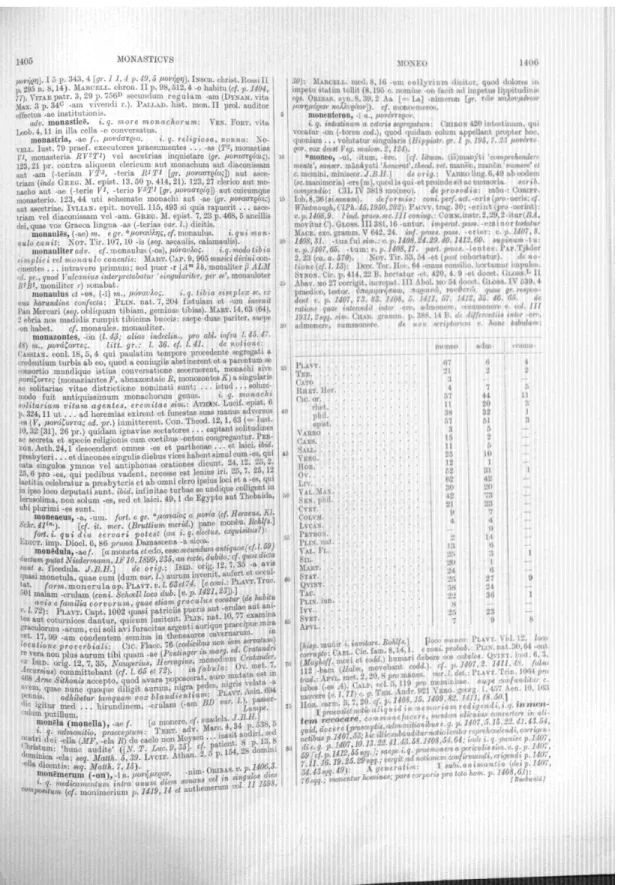
Thesaurus Linguae Latinae. $13,935 (Online). ~$12,000 (Print, Nine Volumes plus
Index).
According to the Encyclopaedia Britannica the TLL, as this work is commonly known, is “probably the most scholarly dictionary in the world” (Encyclopaedia
Britannica 2011). This assertion is based on the dictionary’s goals of creating a complete
record of the Latin language from its beginning to roughly 150CE with further
consideration given to texts handpicked by specialists down to 600CE (Introduction to the Thesaurus Linguae Latinae: 25). Work began on the dictionary in 1894 and it is still
end date of the work was intended to be 1912, subsequently 1930, and currently an estimated completion of 2030, making this work one of if not the greatest lexicographical undertaking in history. The dictionary is based upon a complete analysis of Latin texts and the introduction further notes that the library of “slips,” the pieces of paper
researchers use to keep track of the words to be put in the dictionary now reaches 10 million—though much of the corpus research now takes place in a digital environment (27).
Perhaps the most intriguing aspect of the TLL is its status as a monolingual Latin dictionary. The entries are written in Latin and require a good deal of Latin knowledge to understand. One notes that the only portion of the TLL published in English (and several other languages) is the Introduction book, though it too has its first language as Latin. The TLL has been the focus of much lexicographical interest over its lifetime, due in part to the fact that the publication is an ongoing project. Corbeill (2007) analyzed the
dictionary’s shift in defining style from one of simply listing instances to a more
thorough analysis of sense division. Baraz (2007) noted the high level of scholarship that takes place in the TLL, noting the use of specialists, and discussed the great intricacy required in creating just one entry. Hay (2007) writes of how TLL has attempted to keep abreast of changes to the field of lexicography through a shift of practices in defining and notes the improving quality of each new volume. Hillen (2007) addressed the question of the TLL moving forward in the digital age and how the process of using electronic methods has made the process of writing the TLL more efficient.
bound version, which is produced in a folio sized volume. Thus, the volumes take up a large amount of shelf space. The page layout, however, as can be seen from the page containing the first column of the entry for monere, is rather attractive with a simple two column per page design, ample margins, and the benefit of a set of numbers to mark the lines where one is reading (Figure 4). Note as well that some more common entries, like monere, are broken up by the use of charts denoting authors who used the word and the
manner in which they used them.
Entries are laid out in a manner similar to Lewis and Short with new information not typically being given a new line. Note the manner in which information is somewhat packed into each paragraph.
Entries in the TLL are enormously long as compared to Lewis and Short. Note that the entry for monere runs for over seven columns. The length of the entry, however, is not based on nesting of compounded words as is common in many dictionaries, but rather based in the thoroughness of the dictionary, which has recorded every use of the word in Latin literature. The sheer length of such an entry, however, could prove daunting to all but the most skilled Latin researcher.
Much like Lewis and Short, the TLL relies heavily on a set of abbreviations in its definitions. Notably, the abbreviations are given in the front matter, but only Latin, making interpreting entries somewhat difficult. Authors are abbreviated as well as some Latin phrases, like i.q. or id quod “that is.”
admirably at this, though everything beyond the letter P, as well Q and N (due to their rather notable number of words in Latin) are still missing in this dictionary, which will send the user looking for help from the OLD or Lewis and Short.
As in Lewis and Short, prefixed and suffixed words are not given mention in the definitions section as in Latin prefixes and suffixes often change the meaning of a word in a drastic way. Also as in Lewis and Short, homographs are treated by being given a different section under the headword with a corresponding Roman numeral. Under the Roman numerals for the homographs, sense divisions are made via a letter system (A, B, C, etc.) and variances under that with an Arabic number, so that a typical entry has an hierarchy of Roman numeral to letter to Arabic numeral. As Jenkins (165) notes, sense divisions are exhaustive and the researchers at the TLL have attempted to record ever meaning of a word as well an example of it being used in such a manner.
Definitions in the TLL are second to none. While they are given in Latin, negating the use of this work by all but the most astute undergraduates, some graduates, and
professors, they are exhaustive and have attempted to encompass all meanings of every word in the Latin language. As noted previously in the journal articles, the editors of the TLL have striven to keep abreast of lexicographical changes and later volumes, like the
the publication and will allow the reader to investigate the credentials of whoever wrote the entry.
Interestingly, as compared to Lewis and Short, the TLL avoids encyclopedic entries. The dictionary seemingly assumes that those using it have a basic grasp of Roman history, culture, and offices, offering only cursory explanation and instead focusing on instances when the words itself was used.
Stress patterns in the TLL also assume a good deal of knowledge of the language as individual stresses are not written unless they show a particular oddity. Thus, monere is not written with any stress marks, but one will note that in the world monela the “e” shows a long stress sign as this is somewhat abnormal in typical stress pattern.
Again, the TLL assumes a good knowledge of Latin grammar with terms and abbreviations being given in Latin. Definitions are grammar intensive with many sense divisions using differing grammatical constructions.
Following the pattern of assuming a good knowledge of both Latin and Roman culture and history, usage notes have been coopted into the definition by the use of author citations. A reader is expected to know the author or source abbreviations and glean the appropriate time period from that citation. Citations and their accompanying examples are unrivaled in the world of Latin lexicography in that the examples are exhaustive of the entirety of Latin literature.
of the expert, “J.B.H.” Words that are borrowed directly from Greek have their Greek equivalent written out in the Greek alphabet, as in monazontes, from the reproduced page. The notable special feature that the TLL contains might be said to be less a special feature and more a necessity for the vast array of sources that the work uses. The number of citation abbreviations is vast and some extent confusing, even to someone familiar with the language. The dictionary has a separate index volume that includes an alphabetized and cross-referenced table that tells the dates each author is associated with as well as those works that are attributed to him or her.
Taboo words deserve special note for the TLL. Though it is highly unlikely a student for whom the obscenity of such words would be an issue would have the skills to use such an advanced dictionary, the words tend to use the denotation vox obscaena or “obscene word” at the beginning of the entry. Definitions, though in Latin, are quite literal and to the point, much clearer than those provided by Lewis and Short.
Yet, for all its positive qualities and superlatives that are lavished upon, perhaps the greatest issue with the attainment of the TLL is the price. With a price tag of over $10,000 for the portion that has thus been completed, the scholarly weight of the TLL with quite a price tag—a price tag perhaps too great for all but the largest research libraries. While new fascicles or updates to the computerized version do not come regularly, they do represent a commitment to the upkeep of the work in the future. For any librarian analyzing the benefits of this work, it is important to ask who would be using it. Ostensibly, only researchers and graduate students would have need of such a specialized work and it is quite imaginable that unless one has a sizable Classics
nature and Latinate definitions make the work ill-suited for everyday use except at the highest levels of scholarship.
Words by William Whitaker. Available via the Notre Dame Archives website at
http://lysy2.archives.nd.edu/cgi-bin/words.exe
Words is perhaps the most unlikely Latin dictionary under critique—unlikely in
that it is the work of one man: William Whittaker. Whittaker, who passed away in 2010, was not even a professional Classicist, but rather an amateur enthusiast who had excellent skills in computer programming honed while working at DARPA as an Air Force
Colonel (Midland-Reporter Telegram, 2010).
Whittaker’s dictionary was an ongoing project from 1993 until his death; Notre Dame now hosts an online version of the freeware program he created. The program is still available in a downloadable format from Whittaker’s website—a format that allows it to run without internet access in a format the same as that available online. Beginning with a 5,000 word list based off an elementary Latin course word list, Whittaker grew his corpus to over 39,000 words—the OLD only has around 35,000. Yet, Whittaker was somewhat mysterious about the source of his words, never clarifying if definitions were borrowed from other works or whence his research came. Although, he does claim to have checked the entries against the OLD and found the definitions to be serviceable. The most striking characteristic one notes when navigating to Notre Dame’s version of Words is the simplicity of the site. Users are simply asked to “Input Latin and press
trial and error, Words allows the user to enter any word in any grammatical form. Entering the word monere retrieves the result seen in Figure 5. Note that entry shows both a definition as well as three lines at the beginning of the entry that show the possible grammatical forms of the word under consideration. The second notable feature of the page layout is the simplicity and fact this particular online dictionary shows the word on its own page without any navigation to skip to the next or previous entry. This makes for a very clean user experience where the user is able to see exactly what he or she wanted, but it also removes the ability of the user to see nearby words in the dictionary.
Additionally, it removes the requirement of the student to parse the word grammatically, allowing the student to be unfamiliar with grammar and overly reliant on the word study tool.
Figure 5: Search results in Whittaker’s Words
entries as short as possible with only the most basic grammatical information presented and the definitions given pride of place.
Whittaker intended for the range of vocabulary in Words to encompass a greater date range than the OLD as shown by his references to searching Medieval Latin in the program. Whittaker is also proud of some of the achievements of the range of vocabulary in Words. He notes that the dictionary achieved a 99% success rate in Caesar, i.e. if one were to input any word from all of Caesar’s writings in the dictionary, one could expect a positive return from the dictionary on that word 99% of the time. While on other authors, Whittaker noted that returns fell to 94% to 97%. A number Whittaker felt was far too low as users tend to search obscure words, rather than common words. Yet, for the purpose of a learner, the ability to search even common words is a valuable asset (Statistical
Information Retrieved from Words user information document).
turned up a slightly encyclopedic definition, “(highest elected Roman official – 2/year).” While the first part of the definition is true, the brevity of the section portion leads to a certain amount of confusion—are there two per year? Were they elected twice per year? Did they serve consecutively?
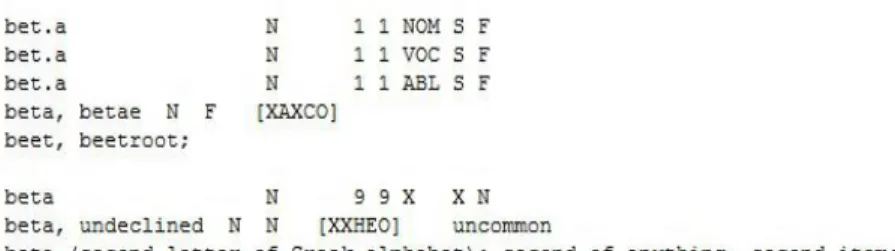
Though there are considerable shortfalls in the area of defining, homographs are handled in a very useful manner. Take for instance the Latin word beta which can mean both beet or the Greek letter β. A search for the word returns the result seen in Figure 6; note that the search retrieved both homographs for the word beta and displayed though there is no separation between the definitions, which could lead to confusion over the definitions being from the same entry. This feature of Words is very valuable in that if a student were to find a word that confuses him or her, the student could then ascertain all possible definitions and use context skills to choose the best fit.
Figure 6: Search results for “beta” in Words
The presentation of grammar in Words is interesting as was previously noted a student finds the exact grammatical characteristics of any form of a Latin word by entering it into the search engine—though the student would have to be familiar with the abbreviations presented to understand the grammatical parts. At the same time, Words expects a baseline understanding of Latin grammar from its users as only peculiar grammatical characteristics of words are noted. Take for instance the case of the verb imperare. The word, unlike ‘normal’ Latin verbs can take a grammatical case known as
the dative, whereas most Latin verbs take the case known as accusative. Whittaker notes this in the definition by adding (W/DAT) at the end of the sense. Again, due to the brevity of the definitions, the note could be misunderstood or even go completely unnoticed by the user.
Interestingly, Whittaker sporadically uses usage notes for words. Among those that show up with regular frequency are “Early,” “Late,” “Medieval,” “Rude,” and “Uncommon.” Though sometimes these notes were unused, as is the case with pedicare, which lacks a note for rude. While the notes are helpful, they should be taken with a certain amount of trepidation as to their accuracy.
author under consideration is using the same word in the same, or a slightly different manner.
A surprising feature of Words, is that words with a Greek origin are shown with the note “(Greek).” Though, unlike the other dictionaries considered, Words does not show the word from which the Latinate form derives its origin.
Though already mentioned, the special features of Words are the morphological grammar analyzer previously mentioned and an English to Latin feature that could prove useful on some exercises that secondary students and early post-secondary students.
As previously noted, taboo words are presented in Whittaker’s Words and given the most blunt and straight-forward treatment of any dictionary under consideration. These words are sometimes noted as rude, as is the case with irrumare but not the case with pedicare. This brings about an interesting set of characteristics where Words is wildly inappropriate for use by upper level post-secondary students and graduate students, but has the clearest definitions of any dictionary they might encounter.
Similarly, the younger students and early undergraduates likely to use this work will have free access to these terms.
encouraged to parse very difficult sentences, a word of caution should be given that students not become reliant on a system that does the grammar for them. Another major concern with Words is the lack of scholarly emphasis that the work has. While the dictionary is fantastic for grabbing a quick definition, it lacks a survey of who used the word and in what manner he or she used it. Serious students would be wise to use Words in conjunction with another of the dictionaries under consideration.
Perseus Digital Library’s Online Version of A Latin Dictionary by Charlton Lewis and Charles Short. Available at
http://www.perseus.tufts.edu/hopper/resolveform?redirect=true&lang=Latin
Perseus, as this particular interface is often known by Classicists, is notable as it is a website-based platform for accessing the exact same Lewis and Short that was analyzed previously. Thus, in terms of content, most of what was said still stands as does Jenkins’ assertion that the work is best used with a modicum of caution.
Perhaps Perseus’ most notable feature, other than it being digital, is its lack of a price tag. Perseus is entirely free and easy to access from a Google search or through the URL above. Gone are the somewhat packed pages of Lewis and Short, replaced with rich text displays complete with hyperlinks.
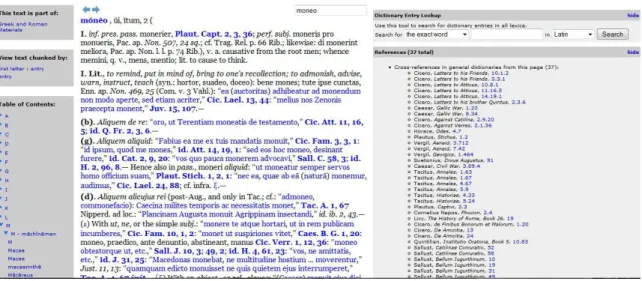
phrase. Note that Perseus encompasses a large number of materials and the drop-down menu allows for the searching of other languages like Arabic, Greek, and Old Norse. Much like Words, Perseus allows the user to enter a Latin word and it will retrieve all grammatical possibilities for that word along with a dictionary definition. Perseus, however, is more robust than Words in that it gives you the option of looking at a
dictionary entry from Lewis and Short in addition to a simplified definition on the search screen.
Figure 7: Search Interface, Perseus Latin Dictionary
outset are truncated, like those in Words. Yet the user can select a hyperlink to show the entry in Lewis and Short.
Figure 8: Perseus Search Results, “monere”
Selecting this option presents the user with the complete text of the Lewis and Short entry of the word as shown in Figure 9. Note that the entry contains a plethora of
Figure 9: Long entry from Lewis and Short in Perseus
Figure 10: Perseus separate window for dictionary entry
Perseus is notable in that it brings together the scholarly acumen inherent in Lewis and Short, and combines it with the features of Words that make it attractive to learners.
Chapter V: Conclusion
As can be seen from the above works, there are many choices to be made by the information professional who is contemplating works to use in the reference interview or to add to a growing collection. The online resources explored are appealing on the basis of being free, but come with a nagging caveat that they could hinder the pedagogical merit of having students be abundantly familiar with grammar. Nevertheless, it seems appropriate to be able to suggest these resources for students or even, perhaps, having Words installed locally on computers in the information institution.
REFERENCES
Adams, J. N. (1982). The latin sexual vocabulary. London: Duckworth.
Baraz, Y. (2007). ‘Revelations of lexicography: the daily learning at the thesaurus.’ Transactions of the American Philological Association (137) 2: 497-501.
Béjoint, H. (1994). Tradition and innovation in modern English dictionaries. Oxford; New York: Clarendon Press; Oxford University Press.
Béjoint, H. (2000). Modern lexicography: an introduction. Oxford; New York: Oxford University Press.
Béjoint, H. (2010). The lexicography of English. Oxford; New York: Oxford University Press.
Bruère, R. T. (1960). Review of Classical Philology, 55(4), pp. 291-292.
Cassell's new Latin dictionary. Latin-English, English-Latin (1959). Simpson D. P. (Ed.),
New York: Funk & Wagnalls.
Classical dictionaries : Past, present and future (2010). Stray C. (Ed.). London:
Corbeil, A. (2007). ‘Going forward: a diachronic analysis of the Thesaurus Linguae Latinae.’ Transactions of the American Philological Association (137) 2: 469-489.
dictionary. (2011). In Encyclopædia Britannica. Retrieved from
http://www.britannica.com/EBchecked/topic/162272/dictionary
Dyer, R. R. (1972). Review of The Oxford Latin Dictionary. Classical Journal, 68(1), pp. 89-91.
Geeraerts, D. (2000). ‘Adding electronic value. The electronic version of the grote van Dale.’ In Heid et al. (eds.): 75-84.
Gill, N. S. (2011). ‘Top 6 Latin Dictionaries.’ Retrieved from:
http://ancienthistory.about.com/od/latindictionaries/tp/aatplatindict.htm
Hartmann, R. R. K. (1998). In James G. (Ed.), Dictionary of lexicography. London ;New York: Routledge.
Hays, G. (2007). ‘Latin from A to P: the TLL in the 20th
Century.’ Transactions of the American Philological Association (137) 2: 483-490.
Hillen, M. (2007). ‘Finishing the TLL in the Digital Age: opportunities, challenges, risks.’ Transactions of the American Philological Association (137) 2: 491-495.
Henderson, J. (2010). ‘A to Zythum: Domimina nustio illumea, or out with the OLD (1931-1982.’ In Stray (ed.)
Jenkins, F. W. (1996). Classical studies : A guide to the reference literature. Englewood: Libraries Unlimited.
Jenkins, F. W. (2006). Classical studies : A guide to the reference literature. Westport: Libraries Unlimited.
Kitchell, K. (1988). ‘How the right parts wrote Scott, and the wrong parts wrote Liddell.’ Classical Journal (84) 1: 47-52.
Kitchell, K. (1989). ‘In Response to Kenneth F. Kitchell, Jr., “How the wrong parts wrote Scott, and the right parts wrote Liddell.”’ Classical Journal (84) 3. 266-268.
Landau, S. I. (1984). Dictionaries : The art and craft of lexicography. New York: Scribner.
Landau, S. I. (2001). Dictionaries : The art and craft of lexicography. Cambridge; New York: Cambridge University Press.
Laufer, B. (2000). ‘Electronic dictionaries and incidental vocabulary acquisition: does technology make a difference?’ in Heid et al. (eds): 849-854.
Leech, G. and Nesi, H. (1999). ‘Moving towards perfection: The learners’ (electronic) dictionary of the future.’ In Herbst and Popp (eds): 295-306.
Luck, G. (1984). Review of The Oxford Latin Dictionary. The American Journal of Philology, 105(1), pp. 91-100.
Mueller, J. M. (1985). Review of The Oxford Latin Dictionary. Modern Philology, (83) 2: 223-225.
Nesi, H. (2000). ‘Electronic dictionaries in second language vocabulary comprehension and acquisition: the state of the art.’ In Heid et al. (eds): 839-847.
Obituary of Whilliam Whitaker. Midland Reporter-Telegram. December 21, 2010. Retrieved from:
http://www.legacy.com/obituaries/mywesttexas/obituary.aspx?n=william-whitaker&pid=147336402
Oxford latin dictionary (1982). Glare P. G. W. (Ed.). Oxford; New York: Clarendon
Press; Oxford University Press.
Rexine, J. E. (1960). Review of Cassell’s New Latin Dictionary. The Modern Language Journal, 44(8), p. 372.
Richards, J. F. C. (1960). Review of Cassell’s New Latin Dictionary. The Classical World, 53(8), p. 266.
Ring, A. (2005). ‘Electronic Latin Texts with Instant Glossing.’ Meeting the Challenge: European perspectives on the teaching and learning of Latin. Cambridge, United
Kingdom. Retrieved from:
Siegel, M. E. A. (2007). ‘What do you do with a dictionary? A study of undergraduate dictionary use.’ Dictionaries. (28): 23-47.
Studies in lexicography (1987). Burchfield R. W. (Ed.). Oxford: Clarendon Press; Oxford
University Press.
Thesaurus linguae latinae (1900). Lipsiae: In aedibus B.G. Teubneri.
Wills, J. (1995). Review of The Pocket Oxford Latin Dictionary. Bryn Mawr Classical Review. Retrieved from: http://bmcr.brynmawr.edu/1995/95.03.29.html
Winchester, S. (1998). The professor and the madman : A tale of murder, insanity, and the making of the oxford english dictionary. New York: HarperCollins.