Running head: Fragile X and Autism
Social Communication and Interactions Symptoms in Fragile X Syndrome: The Underlying Comorbidities of Autism Spectrum Disorder and Anxiety
Stephanie B. Krider
University of North Carolina at Chapel Hill Spring 2015
A thesis presented to the faculty of The University of North Carolina at Chapel Hill in partial fulfillment of the requirements for the Bachelor of Arts degree with Honors in Psychology.
Advisor________________________ Dr. Anne Wheeler
Faculty Advisor________________________ Dr. Jennifer Arnold
Reader________________________ Dr. Elizabeth Pungello
Acknowledgements
First and foremost, I would like to thank the members of my committee. I have completed this thesis under the guidance of Dr. Anne Wheeler and my graduate mentor, Adrienne Villagomez. I would like to thank them both for their continuous support and encouragement throughout this endeavor and throughout my career at the University of North Carolina at Chapel Hill. They have both been an integral part of my success and I appreciate all their contributions to my thesis and my college career. I thank Dr. Jennifer Arnold for her willingness to be my faculty advisor and all advice she offered throughout my project. I thank Dr. Elizabeth Pungello for agreeing to be on my honors committee and making herself available on short notice.
Secondly, I thank the individuals with fragile X syndrome and their families for taking the time to complete assessments for this project. I thank the Decisional Capacity for Informed Consent in FXS project (which was funded by the NICHD - National Institute of Child Health and Human Development - 1R01HD071987-01A1 and I thank the team members of the
decisional capacity project for all of their hard work and contributions to my project. I thank the team members for working diligently to collect and enter data. I also thank team members for listening to my practice defense and offering helpful suggestions.
Thirdly, I thank my family and friends for their confidence and encouragement in me throughout my thesis work. I am especially grateful for Mark and his willingness to read and edit my paper. I thank my parents, for listening to my practice defense and for their constant support throughout my college career.
Abstract
Fragile X syndrome (FXS) is the most common inherited cause of intellectual disability. The genetic syndrome is often accompanied by high rates of comorbid autism spectrum disorder (ASD) and anxiety. Many symptoms of FXS and ASD overlap, and symptoms of anxiety may appear to be symptoms of ASD. Further, changes in DSM-5 ASD criteria may affect the
Social Communication and Interactions Symptoms in Fragile X Syndrome: The Underlying Comorbidities of Autism Spectrum Disorder and Anxiety
Fragile X syndrome (FXS) is characterized by cognitive deficits and a diverse set of behavioral outcomes (Boyle & Kaufmann, 2010). There is great variability in the phenotypes presented; yet virtually all phenotypes include impairments in social communication and interactions. In the past, many of the social impairments observed in FXS were attributed to comorbid autism spectrum disorder (ASD). With the recent changes in the Diagnostic and Statistical Manual of Mental Disorders, 5th edition, (DSM-5) however, it is becoming evident that not all social impairments are a result of ASD. Some researchers have suggested that autism symptoms observed in FXS may be a result of severe cognitive deficits (Rogers, Wehner, & Hagerman, 2001). Other researchers suggest that social communication symptoms of ASD are actually a result of anxiety (Wheeler et al., 2014). At this time, it is unclear the extent to which anxiety affects the social communication symptoms observed in individuals with FXS. Thus, research on the relationship and impact of anxiety on individuals with FXS is needed. Fragile X Syndrome
The biological mechanisms underlying FXS are caused by a mutation of the fragile X mental retardation 1 gene (FMR1), which is located on the X-chromosome (Pieretti et al., 1991). The mutation is a product of a repeat of the Cytosine-Guanine-Guanine (CGG) trinucleotide sequence. Typically, individuals have a CGG trinucleotide sequence of less than 55 repeats (Tsiouris & Brown, 2004). However, individuals with full mutation FXS have a CGG expansion, which repeats 200 or more times (Oostra & Willmsen, 2003).
Expansion of the CGG sequence of FMR1 results in methylation of the FMR1 gene, which halts the production of the fragile X mental retardation protein (FMRP; Coffee et al., 2009). FMRP is essential in typical brain formation and has been associated with synaptic development, including synaptic maturity and plasticity, as well as experience-dependent
learning (Hagerman, Ono, & Hagerman, 2005). With such implications, the reduction or absence of FMRP can have negative consequences for individuals in terms of cognitive functioning and contributes to intellectual disability. Reduced FMRP production can cause a variety of cognitive deficiencies including learning and memory deficits (Crum-Bailey, Dennison, Weiner, &
Hawley, 2013). Indeed, individuals with FXS are characterized as having weak spatial short-term memory, difficulty processing sequential information, and trouble directing and sustaining attention (Freund & Reiss, 1991).
Intellectual Ability in Individuals with Fragile X Syndrome
contrast, only 25-33% of females with FXS have an IQ at 70 or below. The average IQ for females is between 70-90. The higher IQ observed in females is due to the genetic
characteristics of FXS. Because FXS is an X-link disorder, females are less severely affected due to the presence of a second X-chromosome (Center for Disease Control and Prevention [CDC], 2013).
Although there is variability in overall IQ scores, the profile of specific strengths and weakness appear to be consistent. Findings from Van der Molen et al. (2010) support this notion. In the study, researchers divided 43 adult males, 18-48 years of age, across three subgroups - high, intermediate, and low functioning. Subgroups were assigned based on the participant’s performance on neuropsychological and intelligence testing. Results indicated that although the extent of the strengths and weakness varied depending on level of functioning, all groups
displayed similar cognitive characteristics such as strengths in visuo-perceptual recognition and weaknesses in verbal reasoning.
Although there is great variability in the presentation of symptoms, there are many characteristics that are present in a majority of the FXS population. Some of the most common behaviors observed in individuals with FXS include shyness, social avoidance, social anxiety, hyperactivity, impulsivity, inattention, tantrums, aggressiveness towards others, self-injurious behavior and destructiveness during explosive outbursts (Tsiouris & Brown, 2004). It is likely that the behavioral problems observed in individuals with FXS are a result of low cognitive abilities and limited communication abilities.
Communicationin Individuals with Fragile X Syndrome
FXS have been characterized to have a relative strength in receptive language – the ability to understand spoken words, they often have difficulty in the realm of expressive language – which is defined by Abbeduto, Brady, and Kover (2007) as the number of different words spoken by an individual Deficits in expressive language contribute to difficulties in social situations for individuals with FXS. Because individuals with FXS experience difficulty expressing themselves, communication with others is impaired. The expressive language impairment is largely displayed in the domain of pragmatic (i.e., social) language impairment.
Pragmatic language - a type of expressive language – is defined by the American Speech-Language-Hearing Association( 2014) as involving three major communication skills: using language, changing language, and following rules. Pragmatic language involves the use of language in social context to express oneself or convey needs, interest, or intentions (Abbeduto et al., 2007). Proficiency of pragmatic language largely relies on one’s ability to use verbal and nonverbal signals, give background information that is relevant to the conversation, and
understand societal conventions for communication. With deficits in expressive language, individuals with FXS experience challenges in communicating verbally and nonverbally. In addition, individuals with FXS have difficulty with topic maintenance, selection of appropriate words, and modifying language to match the expectations of the communicative partner (Klusek, Martin, Losh, 2014). Similar to expressive language impairments, pragmatic language skills are not fully acquired by individuals with FXS due to deficits in cognitive functioning.
Comorbidities
associated with FXS. Bailey, Raspa, Olmsted, and Holiday (2008) conducted a survey on comorbid conditions associated with FXS and found that 70% of males and 56% of females with FXS had co-occurring anxiety. The same study found that comorbid autism occurred at a rate of 46% in males and 16% in females. These comorbidities greatly influence the characteristics and capabilities of individuals with FXS. Anxiety and ASD are both commonly linked with social communication deficiencies and when combined with the cognitive impairments of FXS, the effects on social communication ability are exacerbated.
Autism Spectrum Disorder
ASD is one of the most severe behavioral abnormalities observed in FXS. ASD is a common neurodevelopmental disorder and is marked by persistent deficits in social
communication and social interactions as well as repetitive or restricted behaviors and interest (American Psychiatric Association [APA], 2013). The hallmark of autistic-like features is social impairment (National Institute of Neurological Disorders and Stroke [NINDS], 2014). Some common social abnormalities observed in ASD are gaze aversion, inability to interpret social cues, lack of empathy, repeating or echoing words, and difficulty expressing needs (NINDS, 2014; CDC, 2014). Individuals with ASD have a relative weakness in pragmatic language and as a result are often unable to engage in typical conversations. In addition to social deficits, individuals with ASD often engage in repetitive movements. Some common repetitive movements observed in ASD are rocking, biting, head banging, repetitive actions, hypo- and hyper-reactivity to sensory input, and fascination with a narrow range of topics (NINDS, 2014; CDC, 2014).
was reported in 48.9% (Talisa, Boyle, Crafa, & Kaufmann, 2013). The same study found the prevalence of ASD in adolescent and adults males with FXS to occur at a rate of 41.2%. Studies have even shown that individuals with FXS who do not meet full diagnostic criteria for ASD will often display some of the milder symptoms implicated with the disorder. Up to 90% of males with FXS display autistic-like features such as perseveration, repetitive speech, and poor eye contact (Hagerman, 2002). Research also suggests that cognitive deficits may amplify autism symptoms (Hall, Lightbody, Hirt, Rezvani, & Reiss, 2010).
However, ASD, unlike the more objective FXS genetic diagnosis, is behaviorally defined. In order to be diagnosed with ASD, an individual must display a specified number of autistic-related symptoms across multiple contexts. The DSM-5 (2013) defines the behavioral criteria for ASD as:
1. Criterion A: “Persistent deficits in social communication and social interaction, … as manifested by:”
a. Deficits in social emotional reciprocity
b. Deficits in nonverbal communicative behavior
c. Deficits in developing, maintaining, and understanding relationships 2. Criterion B: “Restricted, repetitive patterns of behavior, interest, or activities, as
manifested by at least two of the following:” a. Stereotyped or repetitive motor movements
b. Insistence on sameness, inflexible adherence to routines, or ritualized patterns of verbal or nonverbal behavior
c. Highly restricted, fixated interests that are abnormal in intensity or focus
the environment
These criteria have recently changed. With the publication of DSM-5 in 2013, the APA tightened the diagnostic criteria for ASD. The most notable change was the converging of the two, previously separate, DSM-IV-TR categories, impairments in social interactions and impairments in communication, into Criteria A (APA, 2013). The new singular category, as described above, includes deficits in social-emotional reciprocity, nonverbal communication, and developing relationships. With the changes, individuals must display symptoms in each of the three SCI criteria to meet criteria for ASD.
Changes made to the DSM-5 have the potential to significantly impact the diagnosis of ASD in individuals with FXS. A survey on autistic behaviors was conducted with 751
caregivers of individuals with full-mutation FXS (Wheeler et al., 2014). The researchers found that of the males who met overall DSM-IV-TR diagnostic criteria for Autistic Disorder, just under half also met for ASD based on DSM-5 criteria. The same study found that of the females who met Autistic Disorder criteria from DSM-IV-TR, only 37.5% also met ASD criteria for DSM-5. Results from Wheeler et al., (2014) suggest that fewer individuals with FXS will meet diagnostic criteria for ASD based on DSM-5. This is a major change because prior to the publication of DSM-5, nearly half of individuals with FXS were also diagnosed with comorbid ASD.
and females with FXS and comorbid ASD exhibit weaker communication and social skills, greater behavioral problems, and greater cognitive impairments than males with FXS only or males with idiopathic autism (Bailey, Hatton, Mesibov, Ament, & Skinner, 2002; Kaufmann et al., 2004; Rogers et al., 2001). Research on the cognitive, language, and social-cognitive skills of individuals with FXS suggest that children with comorbid FXS and ASD (FXS+ASD) were more likely to achieve the lowest possible standard score on the Stanford-Binet, 4th Edition (Thordike, Hagen, & Sattler, 1986) than were children with FXS only (Lewis et al., 2006). Lewis et al. (2006) described cognitive impairments as more substantial in individuals with FXS+ASD as opposed to individuals only diagnosed with FXS. Results also indicated that individuals with FXS+ASD were more impaired than individuals with FXS only in the realms of receptive language and theory of mind. Losh et al. (2012) found similar results: Deficits in pragmatic language and theory of mind were restricted to individuals with FXS+ASD. In individuals with FXS only, receptive language is typically described as a relative strength. The results from both studies support the notion that FXS+ASD represents a distinct behavioral profile within FXS: a profile that places individuals at a high risk for problems with nonverbal cognition, language comprehension, and theory of mind (Lewis et al., 2006).
scores on the ADAMS compared to boys with idiopathic ASD (Thurman, McDuffie, Hagerman, & Abbeduto, 2014). These results indicate that symptoms of ASD in FXS are distinguishable
from symptoms of idiopathic ASD, thus suggesting that ASD in FXS may not be true ASD. In addition, there has been debate concerning the etiology of symptoms observed in
individuals with FXS and comorbid ASD. It has been suggested that ASD symptoms observed in FXS are a result of more severe impairments and intellectual disability overall (Rogers et al., 2001). Reduction in the ASD prevalence in FXS potentially provides support for this theory. With the publication of DSM-5 and the tighter ASD criteria, the prevalence of ASD in FXS has the potential to be reduced. This possibility is evident in data of Wheeler et al. (2014) who found more individuals with FXS met criteria for Autistic Disorder based on DSM-IV-TR, than met for ASD based on DSM-5. Based on DSM-5 ASD criteria, many individuals in the Wheeler et al., (2014) sample were sub-threshold for ASD criteria regardless of their level of cognitive
impairment, which has led researchers to hypothesize that another comorbidity, such as anxiety, is increasing the rates of ASD.
Anxiety and FXS
The rate of anxiety in individuals with FXS is three times greater than the rate in the general population. In individuals with FXS, anxiety is observed in 70% of males 56% of females (Bailey et al., 2008). More than half of FXS individuals affected by anxiety disorders have been diagnosed with multiple conditions (Cordeiro, Ballinger, Hagerman, & Hessl,
2011). Cordeiro et al., (2011) examined the rates of anxiety disorders in FXS and found the most common anxiety disorders associated with FXS to be specific phobia, which occurs at a rate of 64.9% in males and 51.4% in females, social phobia which occurs at the rate of 34.5% in males and 39.5% in females, and selective mutism occurring at a rate of 28.1% in males and 25.3% in females.
Co-occurring anxiety in FXS creates great difficulty in the realms of communication and social interaction. Due to the cognitive impairments and communication challenges that are present in individuals with FXS, anxiety diagnoses are challenging to make (Boyle & Kaufmann, 2010). Therefore, many of the findings about anxiety in FXS have come from parent-report data. Many parent-report questionnaires have indicated high rates of social withdrawal in children with FXS (Cordeiro et al., 2011). Social withdrawal and social avoidance have a negative
Anxiety can impair the social skills of individuals to a point where they are uncomfortable, and in some cases, unable to communicate with others.
Study Rationale
The comorbid and co-occurring conditions, ASD and anxiety, often accompany FXS and largely contribute to the social communication deficits observed in the genetic syndrome. In the past, social communication symptoms observed in FXS were attributed to comorbid ASD. With the changes made to ASD criteria, however, it is becoming increasingly evident that social communication symptoms in FXS may be a result of a condition other than ASD. In regards to the debate concerning the etiology of ASD symptoms in FXS, it has been hypothesized that the social-communication symptoms used in diagnosing ASD in FXS may be more of a result of anxiety, as opposed to core deficits in social communication and interaction (Lewis et al., 2006).
With the overlap of symptoms between ASD and anxiety it is often difficult to distinguish etiology: without careful consideration of the differential diagnosis, anxiety symptoms could easily be viewed as a reflection of autism (Wheeler et al., 2014). Due to the limited knowledge of the relationship between anxiety and FXS, the role anxiety plays on social communication symptoms within FXS is unclear. It is also unclear how and if the interaction between anxiety and ASD impacts social communication outcomes within the FXS population. Thus, research on the relationship and impact of anxiety in FXS is important in understanding the overlap of social communication symptoms within the FXS population.
Present Study
In the present study, social communication symptoms in individuals with full mutation FXS are investigated. The primary aims of the study were:
diagnostic assessments and criteria.
Question 1. What is the frequency of individuals who met ASD criteria based on multiple diagnostic assessments and criteria?
Question 2. What is the frequency of individuals who met criteria across the two broad ASD criteria (Social Communication and Interaction – SCI and Repetitive or Restricted
Behaviors or Interest – RRBI) and each of the three SCI criteria (A1 – Social emotional reciprocity; A2 – Communicative Behavior; A3 – Relationships with Others)?
Question 3. Are there differences in the frequency of those who meet criteria based on the two broad ASD criteria and each of the three SCI criteria based on age or gender?
Question 4. Are there differences by age or gender in the severity of each of the three SCI criteria?
Aim 2: Examine the relationships among parent-reported anxiety scores, age, nonverbal IQ, the three SCI criteria, and the diagnosis of ASD as determined by different diagnostic criteria.
Question 5. Which DSM-5 criteria are most strongly correlated with anxiety symptoms? Question 6. After controlling for age and nonverbal IQ to what extent do parent-reported anxiety scores predict scores on the three SCI criteria and an ASD diagnosis as defined by diagnostic criteria?
In order to further understand how symptoms of autism align with various ASD diagnostic methods, I also examined the frequency of individuals with FXS who met criteria based on multiple variables of ASD. The frequency of individuals who met ASD criteria based on the diagnostic methods were examined for variability and analyzed for differences in
examined for frequency and to see which has most strongly correlated with parent-reported anxiety scores. I hypothesized that the frequency of individuals meeting criteria based on SCI would be lower than the percentage of individuals meeting criteria based on RRBI. Based on the changes made in DSM-5, this study also examined the extent to which parent-reported anxiety scores predict SCI symptoms on the Autism Diagnostic Observation Schedule, 2nd edition (ADOS-2; Lord et al., 2012) as well as an ASD diagnosis as defined by different diagnostic criteria. I hypothesized that parent-reported anxiety would significantly predict SCI scores and a diagnosis of ASD as defined by either diagnostic criteria. Further, I hypothesized that all SCI criteria would be correlated with anxiety scores. Age, nonverbal IQ and parent-reported anxiety scores were used to predict scores on the SCI criteria and an ASD diagnoses as determined by different diagnostic criteria.
Methods
Participants
included in the analysis. As seen in Table 1, the average age of the participants was 22.00 (SD = 7.20). The average age for males was 22.17 (SD = 7.45) and the average age for females was 21.70 (SD = 6.88; see Table 2). There was no significant difference in the age of the participants based on gender, t(72) = 0.27, p = 0.79 (See Table 2).
Data were collected from an NICHD funded RO1, Decisional Capacity for Informed Consent in Fragile X Syndrome. The decisional capacity study is a collaboration between Research Triangle Institute (RTI) and the University of North Carolina at Chapel Hill (UNC). Participants for the decisional capacity study were recruited using a variety of sources, including recruiting families who had participated in previous longitudinal studies the FX research registry maintained by UNC, and announcements on the National Fragile X Foundation web site.
The decisional capacity study assented and consented both minors and adults, some of whom have legal guardians, to participate in the study. Individuals who were nonverbal were excluded from the study due to the likelihood that they would experience difficulty completing the assessment battery. Data for the current study were collected between July 2013 and December 2014.
Measures
experience with individuals with FXS and other disabilities. The measures in the present study were standardized and have strong psychometric properties.
Demographics. Caregivers completed a demographic questionnaire used to collect family information (e.g., who lives in the home), caregiver education level, race/ ethnicity, income, and parental marital status. For the current study, only questions related to
race/ethnicity, income, gender, and age were examined.
Intellectual ability. The Stanford Binet Intelligence Scales-5th edition (SB5; Roid, 2003) is a norm-referenced measure of intelligence and cognitive ability. The SB5 includes ten
subtests which consist of verbal and nonverbal scores on each of the five neurocognitive factors; Fluid Reasoning, Knowledge, Quantitative Reasoning, Visual-Spatial Reasoning, and Working Memory. The five factors have been revised to provide more accurate assessment of
low-functioning children as well as adults with intellectual disabilities. All examiners were trained to administer the SB5. Due to the limited verbal abilities of individuals with FXS, the current study only examined nonverbal IQ. Visual inspection of nonverbal IQ revealed a negatively skewed distribution with a larger cluster of IQ scores near the floor (Standard Score = 40; see Figure 1). Due to the cognitive deficits in individuals with FXS, a floor effect for nonverbal IQ, as measured by the SB-5, was observed. In order to address the floor effect, nonverbal IQ scores were transformed based on the algorithm described in Sansone et al., (2014). Each participant’s nonverbal IQ subtest scores were rescaled based on an age-dependent z-score
transformation. The formula used for the individual i falling into the jth age band was:
zij =
where rij is the subtest raw score, μ j and σj represent the mean and standard deviation from the corresponding age band and subtest from the standardized sample. Once all 5 subtest scores were transformed, the subtest scores were averaged to obtain one overall transformed nonverbal IQ score. The transformed nonverbal IQ score was then rescaled using a mean of 100 (SD = 15) in order to compare the transformed nonverbal IQ scores to the normative sample.
After all nonverbal IQ scores were transformed; the data was reassessed for normality and outliers. One outlier with a transformed NVIQ score of 3 was identified and removed from the data set. Distribution of the transformed NVIQ scores appeared normal (see Figure 2).
Autism spectrum disorder symptoms. Due to discrepancies in the field about the most effective way to evaluate ASD, the complex nature of the disorder, and the exacerbated ASD symptoms due to FXS, this study examined ASD symptoms in multiple ways using different diagnostic assessments and criteria. The four methods used to assess ASD symptomology were 1) based on scores on the Social Communication Questionnaire, 2) based on scores on the Autism Diagnostic Observation Schedule, 2nd Edition, 3) based on the study definition of diagnostic determination, and 4) based on DSM-5 criteria (See Table 3). Each diagnostic method is detailed below.
Social Communication Questionnaire. The Social Communication Questionnaire is a
parent-report measure used to assess autism symptomology (SCQ; Rutter, Bailey, & Lord, 2003). The SCQ is a 40-item screening measure that asks parents yes/no questions about their child’s behavior. The SCQ was designed as a companion for the Autism Diagnostic Interview-Revised (ADI-R) and evaluates communication skills and social functioning in children who may have autism or ASD. The decisional capacity study used the lifetime form of the SCQ, which
that is interpreted in relation to specific cutoffs. Parent responses are converted to a score of 1 or 0, corresponding to “yes” or “no” depending on the question. A score of 1 indicates the presence of autism and a 0 reflects the lack of autism. Individuals with SCQ scores above fifteen are recommended for further diagnostic assessment.
Autism Diagnostic Observation Schedule- 2nd Edition. The Autism Diagnostic
Observation Schedule- 2nd Edition (ADOS-2; Lord et al., 2012) is a revision of the original ADOS. Revisions include updated protocols, revised algorithms, a new Comparison Score, and an additional Toddler Module.
Similar to the original ADOS, the ADOS-2 is a semi-structured standardized assessment of communication, social interaction, play, and restricted and repetitive behaviors. The ADOS-2 uses semi-structured activities and questions to provide opportunities to observe social
communication and other symptoms of ASD. The ADOS-2 provides cutoff scores for autism and autism spectrum classification as well as Comparison Scores. Individuals receiving a score of 6 or lower on the ADOS-2 are not considered to be on the autism spectrum. An individual who receives a score of 7 or 8 on the ADOS-2 is considered to be on the autism spectrum and individuals receiving a score of 9 or above are considered to have autism.
Diagnostic Determination. The gold standard for an ASD diagnosis includes
identifications of the behavioral symptoms (e.g., social communication deficits) as can be observed using the ADOS-2, and parent-reported symptoms and developmental history such as the SCQ. For the present study, a diagnostic determination of ASD was made if participants had scores above the autism cut-off for ASD on both the ADOS-2 (assessing the current observable symptoms of autism) and the SCQ (assessing symptoms of autism that happened in the past). Thus “diagnostic determination” is the term used to indicate the most conservative diagnostic method, and the one used by the larger decisional capacity study to determine autism status in the sample. However, because of the focus in this study on the different ways autism is presented, the ADOS-2, SCQ, and DSM-5 were all used to examine ASD status.
Diagnostic and Statistical Manual of Mental Disorders, Fifth Edition. Items from the
ADOS-2 were mapped onto DSM-5 ASD criteria to create an algorithm to determine whether individuals met ASD criteria based on DSM-5 (See Table 4). The algorithms used by ADOS-2 provide a Comparison Score that does not match directly with DSM-5 criteria (See Table 5). Item mapping was necessary in order for algorithms to represent the current ASD criteria. Item mapping was adapted from Huerta, Bishop Duncan, Hus, and Lord (2012) who had mapped the original ADOS onto proposed DSM-5 criteria. Revisions to item mapping included checking the proposed criteria by Huerta et al., (2012) with published DSM-5 criteria, comparing items on the first edition of the ADOS to items on the ADOS-2, and having an expert diagnostician review and confirm the validity of the item mapping (see Table 4).
demonstrate the psychometric properties of the ADAMS (Esbensen, 2003). The ADAMS is a 28-item measure that asks questions regarding manic/ hyperactive behavior, depressed mood, social avoidance, general anxiety, and obsessive/ compulsive behaviors. Each item is rated on a 0 (not a problem) to 3 (severe problem) scale, with scores indicating the frequency and severity with which a symptom or behavior occurs. For the present study only questions assessing social avoidance and generalized anxiety were examined. Social avoidance was assessed by 7 of the 28 items. Scores were calculated by summing the totals of each of the 7 items. Generalized anxiety was assessed by 7 of the 28 items. Scores were calculated by summing the totals of each of the 7 items (see Appendix 1 for specifics regarding social avoidance and generalized anxiety
measures). Procedures
Participants were scheduled for a data collection visit in the participant’s home or school determined by the family’s preference. Two weeks prior to the visit, the participant and/or their primary caregiver were sent a packet with consent and assent forms and self-report/parent report rating scales and questionnaires. On the day of the evaluation, participants completed all
measures in the neurocognitive battery. For those whose parents did not have legal guardianship, their consent was requested to have their parents/caregivers answer questions about their history. Individuals with FXS received $60 and their parents/caregivers received $60 for study
participation. Statistical Analysis
FXS and to examine social communication and interactions symptoms. Analysis and reasoning for each aim are detailed below.
Aim 1: Examine the variability in the frequency of ASD diagnoses based on multiple diagnostic assessments and criteria.
Question 1. What is the frequency of individuals who met ASD criteria based on multiple diagnostic assessments and criteria?
Descriptive statistics (i.e., frequencies) were calculated to identify the number of individuals who met ASD criteria based on each diagnostic method.
Question 2. What is the frequency of individuals who met criteria across the two broad ASD criteria (SCI and RRBI) and each of the three SCI criteria (A1 – Social Emotional
reciprocity; A2 – Communicative Behavior; A3 – Relationships with Others)?
Descriptive statistics (i.e., frequencies) were calculated to identify the number of
individuals who met criteria across the two broad ASD criteria and each of the three SCI criteria. Question 3. Are there differences in the frequency of those who meet criteria based on the two broad ASD criteria and each of the three SCI criteria based on age or gender?
Separate chi-squared test for independence were calculated to examine differences between those who met criteria based on the two broad ASD criteria and each of the three SCI criteria based on age and gender.
Question 4. Are there differences by age or gender in the severity of each of the three SCI criteria?
Aim 2: Examine the relationships among parent-reported anxiety scores, age, nonverbal IQ, the three SCI criteria, and the diagnosis of ASD as determined by different diagnostic criteria.
Question 5. Which DSM-5 criteria are most strongly correlated with anxiety symptoms? Correlations were run to examine the relationship between each DSM-5 criteria and anxiety symptoms.
Question 6. After controlling for age and nonverbal IQ to what extent do parent-reported anxiety scores predict scores on the three SCI criteria and an ASD diagnosis as defined by diagnostic criteria?
Regression analyses were conducted to examine predictors of scores on the three SCI criteria of DSM-5 and an ASD diagnosis in individuals with FXS. An ordinary least squares regression was conducted to examine predictors of scores on each the three SCI criteria. Separate logistic regressions were conducted to examine predictors of ASD diagnosis as determined by diagnostic determination and DSM-5 criteria.
Results
Data was analyzed using IBM SPSS Software (version 22.0). Scatterplots and histograms were examined for normality and outliers. Analysis revealed that the ages of the participants were not distributed evenly amongst adolescents and adults (see Figure 3). Due to the large cluster of older adolescents (M = 14.65, SD = 1.74) and younger adults (M = 25.69, SD = 5.96), age was examined as a continuous variable.
Initial analysis revealed a positive correlation between ADAMS social avoidance scores and ADAMS generalized anxiety scores. In order to reduce the number of variables and
subscale and ADAMS generalized anxiety subscale were averaged to obtain one singular anxiety score. Both anxiety subscales had 7 items from the ADAMS and were on the same 0-3 scale, allowing them to be combined. Combining the two anxiety subscales allowed for including symptoms of social avoidance and generalized anxiety, both of which are hypothesized to be related to impairments in social communication.
Nonverbal Intellectual Ability
The average nonverbal IQ was moderately impaired or delayed (M = 55.15, SD = 20.20) for the sample, yet the range was covered a wide margin (range = 16-102; see Table 1). An independent samples t-test revealed that, on average, males had a lower nonverbal intelligence score (M = 44.34) than females (M = 74.69), t(72) = -8.85, p < 0.001 (see Table 2).
Aim 1: Examine variability in the frequency of autism spectrum disorder (ASD) diagnoses based on multiple diagnostic assessments and criteria.
Question 1. What is the frequency of individuals who met ASD criteria based on multiple diagnostic assessments and criteria?
Autism Diagnostic Observation Schedule, 2nd Edition. Based on the algorithms used to identify symptoms suggestive of an autism spectrum disorder, 33 (46%) individuals met criteria based on the ADOS-2. Chi-squared test revealed that more males (94%) met criteria based on the ADOS-2 than females (6%), χ2
(1, N = 74) = 23.79, p < 0.001. The average age of the individuals who met ADOS-2 criteria was 21.49 (SD = 7.40; see Table 6). There was no significant difference in the ages of the individuals who met criteria and the ages of the
Social Communication Questionnaire. Based on the parent-reported SCQ scores, 30 individuals (41%) had a score higher than 15, indicating possible ASD. The average SCQ score for the entire sample was 12.95 (SD = 7.02; Range = 0-28; see Table 7). There were more males who met SCQ criteria (77%) than females (23%), which approached significance, χ2
(1, N = 74) = 3.77, p = 0.052. The average age of individuals who met SCQ criteria was 20.20 (SD = 3.76). Age did not differ significantly between individuals who met SCQ criteria and individuals who did not. Nonverbal IQ scores were significantly lower for individuals who met SCQ criteria (M = 45.13) than for individuals who did not meet SCQ criteria (M = 62.14, t(72) = -3.87, p = 0.001).
Diagnostic Determination. Based on the decisional capacity project’s definition of diagnostic determination (a score higher than 15 on the SCQ and autism classification based on the ADOS-2), 20 individuals (27%) met criteria. More males met diagnostic determination criteria (90%) than females (10%), χ2
(1, N = 74) = 8.297, p = 0.004. The average age for individuals who met diagnostic determination was 19.10 (SD = 5.55; see Table 8). Individuals who met diagnostic determination criteria were younger (19.10) than individuals who did not meet criteria (M = 23.06), t(72) = -2.16, p = 0.034. On average, the individuals who met criteria for diagnostic determination had a lower nonverbal IQ (M = 42.87) than individuals who did not meet criteria (M = 59.78, t(72) = -3.42, p = 0.003. Table 9 displays descriptive statists for the measures used to determine diagnostic determination (SCQ and ADOS-2). There were 10 individuals who met SCQ criteria but not ADOS-2 and 13 individuals who met ADOS-2 but not SCQ. There were 31 individuals who did not meet criteria based on either assessment.
DSM-5 ASD Status. Based on the item mapping of the ADOS-2 onto DSM-5, 27
individuals (36%) had symptoms that were consistent with DSM-5 ASD criteria. Chi-squared test revealed that more males met DSM-5 ASD criteria (93%) than females (7%), 2
= 15.51, p < 0.001. The average age of individuals who met DSM-5 ASD criteria was 21.30 (SD = 6.88; see Table 10). Age did not differ significantly between individuals who met criteria and individuals who did not meet criteria. On average, the nonverbal IQ was lower (M = 43.69) for individuals who met criteria than the nonverbal IQ of individuals who did not meet criteria (M = 61.88), t(72) = -4.10 p = 0.001.
Overlap between diagnostic methods. Table 11 displays descriptive statics of each classification system used to assess autism status (SCQ, ADOS-2, Diagnostic Determination, and DSM-5). There were 16 (22%) individuals who met criteria based on all autism diagnostic methods and 30 (41%) individuals who did not meet criteria for any of the autism diagnostic methods. Examinations of the individuals who met criteria based on some, but not all autism diagnostic methods, are detailed below.
Of the 20 individuals who met ASD criteria based on diagnostic determination, 16 (80%) also met ASD criteria based on DSM-5 (see Figure 4). DSM-5 ASD status was determined based on the item mapping of the ADOS-2 onto DSM-5 (see Table 4). Table 12 displays case studies for the 4 (20%) individuals who met ASD criteria based on diagnostic determination, but did not meet ASD criteria based on DSM-5. Of these 4 individuals, 3 were male. Visual
Of the 27 individuals who met DSM-5 ASD criteria, 16 (59%) also met ASD criteria based on diagnostic determination (see Figure 4). Table 12 displays case studies for the 11 (41%) individuals who met DSM-5 ASD criteria, but did not meet based on diagnostic
determination. Of these 11 individuals, 10 were male. Visual inspection of their data revealed that the majority (9; 82%) failed to meet diagnostic determination due to scores below the autism cutoff on the SCQ, the 1 female failed to meet diagnostic determination because of a score below the autism cutoff on the ADOS-2, and 1 individual failed to meet diagnostic determination because of a score below the autism cutoff on the SCQ and scores below the autism cutoff on the ADOS-2 (see Figure 5).
Question 2. What is the frequency of individuals who met criteria across the two broad ASD criteria (SCI and RRBI) and each of the three SCI criteria (A1 – Social Emotional
reciprocity; A2 – Communicative Behavior; A3 – Relationships with Others)?
Based on the item mapping of the ADOS-2 onto the DSM-5, 40 individuals (54%) displayed symptoms on the ADOS-2 that were consistent with the SCI criteria of the DSM-5. Fewer individuals (n = 30; 41%) displayed symptoms on the ADOS-2 that were consistent with the RRBI criteria of the DSM-5 (see Table 14).
RRBI Criteria. Based on the item mapping of the ADOS-2 onto DSM-5, 46 individuals (62%) displayed at least one symptom that was consistent with the ‘stereotyped behaviors’ criterion (B1) of DSM-5; 6 individuals (8%) displayed at least one symptom that was consistent with the ‘insistence on sameness’ criterion (B2) of DSM-5; 23 individuals (31%) displayed at least one symptom that was consistent with the ‘restricted interest’ criterion (B3); and 20 individuals (27%) displayed at least one symptom that was consistent with the ‘reactivity to sensory input’ criterion (B4) of DSM-5 (see Table 16 for descriptive statistics; see Appendix 2 for detailed information on DSM-5 ASD criteria).
Question 3. Are there differences in the frequency of those who meet criteria based on the two broad ASD criteria and each of the three SCI criteria based on age or gender?
SCI Criteria. Based on the item mapping of the ADOS-2 onto DSM-5, 40 individuals (35 males, 75%; 5 females, 19%) displayed symptoms on the ADOS-2 that were consistent with the SCI criteria of the DSM-5 (see Table 14). As expected, a chi-square test revealed that more males (88%) met SCI criteria than females (12%), χ2
(1, N = 74) = 21.62, p < 0.001. There was no significant difference between the age of individuals who met SCI criteria and the age of the individuals who did not meet criteria (see Table 15). The nonverbal IQ was lower (M = 44.29) for individuals who met SCI criteria than for individuals who did not meet SCI criteria (M = 67.61), t(72) = -6.00, p < 0.001.
significant difference in the age of individuals who met criterion A1 and the age of individuals who did not meet criterion A1 (see Table 15). On average, individual who met criterion A1 had lower nonverbal IQ scores (M = 52.51) than individuals who did not meet criterion A1 (M = 67.34), t(72) = -2.49, p = 0.015.
Communicative Behaviors (A2) Criterion. Based on the item mapping of the ADOS-2 onto DSM-5, 55 individuals (40 males, 85%; 15 females, 56%) displayed at least one symptom on the ADOS-2 that was consistent with criterion A2 of DSM-5 (see Table 14). A chi-squared test revealed that more males met criterion A2 (73%) than females (27%), χ2
(1, N = 74) = 7.85, p = 0.012. The individuals who met criterion A2 were about 22.16 years old (SD = 7.28). The age of individuals did not differ significantly between individuals who met criterion A2 and individuals who did not. Nonverbal IQ scores were significantly lower for individuals who met criterion A2 (M = 50.57) than individuals who did not meet criterion A2 (M = 68.16), t(72) = -3.51, p = 0.001 (see Table 15).
Relationships with Others (A3) Criterion. There were 47 individuals (39 males, 83%; 8 females, 30%) who displayed at least one symptom on the ADOS-2 that was consistent with criterion A3 of DSM-5 (see Table 14). A chi-squared test revealed that more males met criterion A3 (83%) than females (17%), χ2
(1, N = 74) = 21.06, p < 0.001. The average age of the individuals who met criterion A3 was 20.85 (SD = 6.83). There was no significant difference between the age of individuals who met criterion A3 and those who did not. The average nonverbal IQ was lower for individuals who met criterion A3 (M = 45.51) than individuals who did not meet criterion A3 ((M = 71.57), t(72) = 6.79, p < 0.001 (see Table 15).
RRBI criteria of DSM-5 (see Table 14). More males met RRBI criteria (87%) than females (13%), χ2
(1, N = 74) = 11.76, p = 0.001. Individuals who met RRBI criteria were about 21.23 years old (SD = 6.65). The age of individuals who met RRBI criteria did not differ significantly from the age of the individuals who did not meet criteria. Nonverbal IQ scores were
significantly lower for individuals who met RRBI criteria (M = 46.02) than the nonverbal IQ scores of individuals who did not meet RRBI criteria (M = 61.52), t(72) = -3.46, p < 0.001 (see Table 16).
Stereotyped Behaviors (B1) Criterion. There were 46 individuals (39 male, 83%; 7
female, 26%) who displayed at least one symptom on the ADOS-2 that was consistent with criterion B1. A chi-squared test reveled that more males (85%) met criterion B1 than females (15%), χ2(1, N = 74) = 23.732, p < 0.001 (see Table 14). The mean age for individuals meeting criterion B1 was 20.98 (SD = 6.46; see Table 16). There was not a significant difference in the age of individuals meeting criterion B1 and individuals not meeting criterion B1. On average, nonverbal IQ scores were lower for individuals meeting criterion B1 (M = 47.74) than
individuals not meeting criterion B1 (M = 67.76), t(72) = -4.63, p < 0.001.
Insistence on Sameness (B2) Criterion. A small number of individuals displayed
symptoms on the ADOS-2 that were consistent with criterion B2 (n = 6; 5 males, 11%; 1 female, <1%). Because of the limited number of individuals meeting criterion B2 no further analyses were completed.
Restricted Interest (B3) Criterion. Based on the item mapping of the ADOS-2 onto the
meeting criterion B3 was 22.70 (SD = 7.78). The age of the individuals did not differ significantly between individuals who met criterion B3 and individuals who did not. The nonverbal IQ scores did not differ significantly between individuals who meet criterion B3 and individuals who did not meet criterion B3 (see Table 16).
Reactivity to Sensory Input (B4) Criterion. There were 20 individuals (15 males, 32%; 5
females, 19%) who displayed at least one symptom on the ADOS-2 that was consistent with criterion B4. There was no significant gender difference between individuals who met criterion B4 and individuals who did not (see Table 14). Individuals who meet criterion B4 were, on average, 22.55 years old (SD = 7.29). Age did not differ significantly between individuals who meet criterion B4 and individuals who did not. There was no significant difference in nonverbal IQ scores between individuals who met criterion B4 and individuals who did not meet criterion B4 (see Table 16).
Question 4. Are there differences by age or gender in the severity of each of the three SCI criteria?
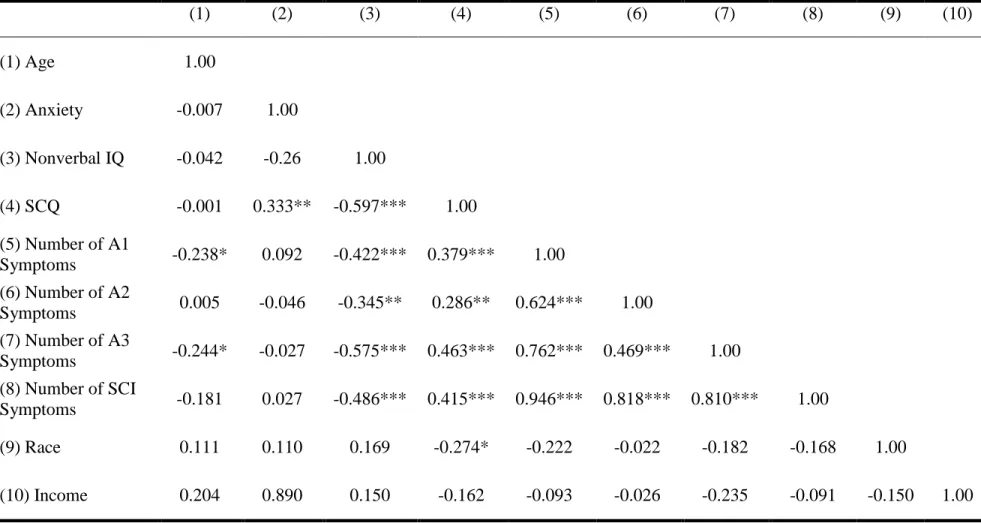
To examine severity, the number of symptoms each participant displayed in each of the three SCI criteria was calculated (see Table 17). An independent samples t-test revealed that males displayed more symptoms consistent with SCI criteria (M = 6.83) than females (M = 3.41), t (72) = 3.82, p < .001 (see Table 18). There was not a correlation between the age of the
Social Emotional Reciprocity (A1). Males displayed more A1 symptoms (M = 3.19)
than females (M = 1.56), t (72) = 3.29, p = .002 (see Table 18). There was a weak negative correlation between the age of the participant and the number of symptoms displayed that are encompassed under criterion A1 r(72) = -0.238, p = 0.041( see Table 19); indicating that as the age of the participant increases the number of symptoms displayed that are encompassed under criterion A1 decreases. There was a weak negative correlation between the age of male
participants and the number of symptoms displayed that are encompassed under criterion A1, r(72) = -0.30, p = 0.042; indicating that as the older males had fewer symptoms that met criterion A1 (see table 20). The age of female participants did not correlate with the number of symptoms encompassed under criterion A1, r (72) = -0.20, p = 0.319 (See Table 21).
Communicative Behavior (A2).As can be seen in Table 18, males displayed more A2 symptoms (M = 2.23) than females (M = 1.41), t (72) = 2.32, p = .023. There was not a
significant correlation between the age of the participant and the number of symptoms displayed that are encompassed under criterion A2, r(72) = 0.005, p = 0.966 (see Table 19). This was true for males r(72) = 0.04, p = 0.792 and females, r(72) = -0.07, p = 0.734 (see Tables 20-21).
participants and the number of symptoms displayed that are encompassed under criterion A3, r(72) = -0.16, p = 0.426 (see Table 21).
Aim 2: Examine the relationships among parent-reported anxiety scores, age, nonverbal IQ, the three SCI criteria, and the diagnosis of ASD as determined by different diagnostic criteria.
Question 5. Which DSM-5 criteria are most strongly correlated with anxiety symptoms? Based on the item mapping of the ADOS-2 onto DSM-5, the number of symptoms displayed that were encompassed under SCI criteria did not correlate with the ADAMS combined anxiety scores, r(72) = 0.027, p = 0.821, the same was true for the social emotional reciprocity criterion (A1), r(72) = 0.092, p = 0.436, the communicative behavior criterion (A2), r(72) = -0.046, p = 0.697, and the relationships with others criterion (A3), r(72) = -0.027, p = 0.822 (see Table 19).
Question 6. After controlling for age and nonverbal IQ to what extent do parent-reported anxiety scores predict scores on the three SCI criteria and an ASD diagnosis as defined by diagnostic criteria?
Social Emotional Reciprocity (A1). As can be seen in Table 22, an Ordinary Least
Squares Regression Analysis revealed that anxiety did not significantly predict scores on criterion A1 (B = 0.025, t(70) = 0.228, p = 0.820) when controlling for age and nonverbal IQ. Both age (B = 0.250, t(70) = 2.291, p = 0.025) and nonverbal IQ scores (B = 0.558, t(70) = -3.272, p = 0.002) were significant predictors of social emotional reciprocity scores.
significant predictors of communicative behavior scores, B = -0.297, t(70) = -2.578, p = 0.012 (See Table 23).
Relationships with Others (A3). As can be seen in Table 24, an Ordinary Least Squares
Regression Analysis revealed anxiety did not significantly predict scores on criterion A3 (B = 0.002, t(70) = 0.024, p = 0.981) when controlling for age and nonverbal IQ. Both age (B = -0.331, t(70) = -3.568, p = 0.001) and nonverbal IQ (B = -0.571, t(70) = -6.139, p < 0.001) did significantly predict scores on the relationships with others criterion.
Diagnostic Determination ASD Criteria. A logistic regression revealed anxiety was not
a significant predictor of ASD as determined by diagnostic determination (a score higher than 15 on the SCQ and autism classification based on the ADOS-2). Age and nonverbal IQ did
significantly predict an ASD diagnosis as determined by diagnostic determination (See Table 25).
DSM-5 ASD Criteria. As can be seen in Table 26, a logistic regression revealed that
anxiety did not significantly predict an ASD diagnosis as determined by DSM-5 criteria. The same was true for age. Nonverbal IQ did significantly predict a diagnosis of ASD based on DSM-5 criteria.
Discussion
ASD is difficult to diagnosis. Previous research has suggested that ASD symptoms may be a result of the cognitive impairments in individuals with FXS (Rogers et al., 2001). In addition, there are many overlapping symptoms between ASD and anxiety (e.g., gaze aversion, difficulty in social situations), which make it difficult to distinguish between the two psychopathologies (Wheeler et al., 2014). Thus, this study sought to examine the prevalence of ASD through multiple diagnostic methods in attempt to gain a better understanding of the nature of ASD in FXS. The use of multiple diagnostic methods allowed for the examination of ASD
symptomology through parent-reported and observational measures. Variability based on Diagnostic Methods
The first aim of this study was to examine the variability in the frequency of ASD diagnosis. Results of this study show that 22% of individuals met ASD criteria based on all diagnostic methods used to assess autism in the present study and 40% of individuals did not meet ASD based on any of the diagnostic methods (e.g., SCQ, ADOS-2, Diagnostic
Determination, and DSM-5). Based on the stringent study diagnostic determination criteria, 27% of the sample met ASD criteria. More individuals (36%) met based on DSM-5 diagnostic
because they are untrained and may be unaware of how ASD symptoms are actually displayed (Wheeler et al., 2014). Thus, symptoms reported may have been due to a comorbid disorder or due to a skewed parental reference point as to what autism symptoms look like.
There were 4 (5%) individuals who meet ASD criteria based on the ADOS-2 only. The nature of the ADOS-2 administration may explain this occurrence. The ADOS-2 is an
observational test and was conducted by a trained clinician. The semi-structured administration of the ADOS-2, with an unfamiliar adult, may have caused stress to the participant and caused anxiety symptoms that are similar to symptoms of ASD (e.g., unusual facial expressions, difficulty communicating). Such symptoms have been described in previous studies and are thought to occur because of the combination of low verbal capabilities and social withdrawal (Tonnsen et al., 2013). These symptoms may not surface at home because individuals with FXS are more comfortable with their families and will use a wider range of social skills while at home (Wheeler et al., 2014). Thus, during the ADOS-2 administration, the participant may have appeared more socially impaired than he or she typically would.
A small percentage of individuals (5%) met ASD criteria based on diagnostic
items). Thus, individuals had a higher chance of displaying a symptom consistent with SCI criteria then RRBI criteria.
Results from the present study do not support the hypothesis that fewer individuals would meet criteria for SCI than RRBI criteria, due to the changes in DSM-5 (Wheeler et al., 2014). Previous literature suggests that the combination of the two previously separate DSM-IV-TR criteria social interaction and communication caused a reduction in the number of individuals who meet SCI criteria (Wheeler et al., 2014). A diagnosis of ASD as defined by the DSM-5 requires that individuals have symptoms in each of the three SCI criteria (i.e., social emotional reciprocity, communicative behaviors, and relationships with others) as well as the two
symptoms in the RRBI criteria (i.e., stereotyped behaviors, insistence on sameness, restricted interests, and reactivity to sensory input). As a result, it was hypothesized that fewer individuals would meet for SCI criteria than would meet for RRBI criteria. Because DSM-5 RRBI criteria only requires individuals to have two symptoms out of the four possible RRBI criteria it was expected that fewer individuals would meet for more stringent SCI criteria than RRBI criteria. Additionally, previous research showed that a higher percentage of individuals failed to meet DSM-5 criteria due to SCI criteria, not RRBI (Huerta et al., 2012). Results from Wheeler et al., (2014) found similar results in that more individuals met RRBI criteria than SCI. Based on parent-reported symptoms of ASD in FXS based on the DSM-5, Wheeler et al., (2014) found that the majority of males (86.4%) and over half of females (61.7%) met DSM-5 RRBI criteria, whereas less than one third of males (29.4%) and females (13.0%) met DSM-5 SCI criteria. When SCI criteria were relaxed (only requiring 2 SCI symptoms as opposed to 3) the rate of ASD nearly tripled (Wheeler et al., 2014). One possible explanation for this discrepancy
non-FXS sample of individuals aged 2-17 years 11 months and Wheeler et al., (2014) used different ASD diagnostic methods. Huerta et al., (2012) did not identify individuals with FXS for the study and only included individuals who had been previously diagnosed with ASD. Thus, the results from Huerta et al., (2012) did not encompass core deficits observed in individuals with FXS and may not be generalizable to the FXS population. Additionally, since only individuals previously diagnosed with ASD were included in the analysis, the sample likely did not include individuals with moderate ASD symptoms (e.g., the individuals in this study who met ASD criteria for some diagnostic methods but not all). Thus, the individuals of interest for the current study were likely not included in the Huerta et al., (2012) sample. Contrastingly, the Wheeler et al., (2014) sample included individuals with FXS, but this study was limited to parent-report. Because parents are not trained to recognize and know ASD symptoms, their report may not have been as accurate. Data for the current study were based on observable behavior (e.g., ADOS-2) and reports on the SCQ. Thus, the combination of observation and parent-report may have given a more accurate picture of ASD status in the current study.
Additionally, the difference between previous research and results of the current study could be because DSM-5 ASD status was based on the item mapping of the ADOS-2. Because the ADOS-2 is a structured assessment with a stranger, individuals with FXS may have
displayed more SCI symptoms during the 2 administration than they typical. The ADOS-2 also allowed more opportunity for the observation of SCI symptoms than RRBI symptoms. The combination of the assessment environment and increased opportunity to display SCI
criteria for DSM-5 (37%) than diagnostic determination (28%). The percentage of individuals who meet ASD criteria based on diagnostic determination was in line with previous reports (Bailey et al., 2008). It was expected more individuals would meet DSM-5 criteria than diagnostic determination criteria because diagnostic determination was designed to be a more stringent ASD criteria than DSM-5 criteria. Because individuals had to meet ASD cutoff scores on both the SCQ and ADOS-2 to be considered to have ASD based on diagnostic determination, it was expected that fewer individuals would meet for diagnostic determination than DSM-5.
In addition, the nature of the two diagnostic methods may have caused fewer individuals to meet for diagnostic determination than DSM-5. The SCQ portion of diagnostic determination was parent-reported and drew on current symptomology as well as developmental history. DSM-5 diagnoses were determined based on the item mapping of the ADOS-2 onto DSM-5 criteria. Therefore, DSM-5 diagnoses were based on observation during the ADOS-2 and did not take into account parent-report or developmental history. Parent-reports may have provided information that was unavailable for the DSM-5 diagnostic criteria. Without parent-reports, autism-like symptoms are attributed to ASD. Thus, the number of individuals meeting criteria for DSM-5 may have been higher because there were no parent-reports to give additional information or developmental history.
Variability by Gender
More males met criteria based on all ASD diagnostic methods (ADOS-2, SCQ,
Diagnostic Determination, and DSM-5) than females. These findings are in line with previous prevalence estimates of ASD (Bailey et al., 2008) and were expected as FXS affects males more severely than females (Tsiouris & Brown, 2004).
Previous research suggests that autism status and symptoms are more severe and
expressive language will continue to develop (Abbeduto et al., 2007). Thus, older individuals may have less impaired language skills thus may have fewer social communication symptoms.
The second aim of this study was to examine relationships between parent-reported anxiety scores, nonverbal IQ, each of the three SCI criteria and age. Contrary to expectations, results suggest that parent-reported anxiety did not predict ASD as determined by any of the possible ASD diagnostic strategies available for this analysis. Further there were no significant relationships between parent-reported anxiety and any of the three SCI criteria. The data did not support the hypothesis that parent-reported anxiety would predict SCI scores or a diagnosis of ASD. Based on previous research that autism may have its origin in anxiety (Lewis et al., 2006), it was hypothesized that parent-reported anxiety scores would predict ASD diagnoses. Instead, results revealed that nonverbal IQ scores and age were more strongly predictive of SCI scores and ASD diagnosis. It is likely that the low nonverbal abilities of the participants coincided with lower receptive and expressive language skills (Boyle & Kaufmann, 2010). Thus, the deficits in language abilities may have exacerbated symptoms of ASD. Further, previous research has found that impairment in IQ may amplify autism symptomology (Hall et al., 2010). It could be the case that the low nonverbal IQ of individuals in this sample was the driving force behind ASD symptoms. Alternatively, a “third” variable may affect both nonverbal IQ and ASD symptomology. Although it was hypothesized that anxiety could be the “third” variable, results did not support that hypothesis. The lack of support for anxiety affecting ASD symptoms could be due to the way anxiety was measured for the current study. Anxiety was only examined by one, parent-reported, measure. Because caregivers are uneducated in terms of anxiety
understood and secondary mutations resulting from FXS could be the cause of ASD symptoms (Losh et al., 2012).
Further research is needed to help identify additional factors associated with increased ASD symptoms in FXS. Additional predictors could include cognitive and behavioral correlates as well as genetic mutations. Additionally, why some individuals with FXS clearly meet ASD criteria, some clearly do not, and others meet criteria based on some, but not all, diagnostic methods is an important area for future research. Because a diagnosis of ASD is an important factor in qualification for specific school/ community based services measurement issues, as well as learning more about the nature of ASD in FXS, may impact services.
Limitation and Future Direction
For the current study, anxiety was assessed using the ADAMS. The ADAMS has been established as a valid measure for assessing anxiety in individuals with intellectual disability (Esbensen et al., 2003). Although the ADAMS is valid, it is parent-reported and may not have accurately measured anxiety symptoms for the current study. Caregivers are often untrained and lack knowledge about how to accurately report anxiety symptoms. Additionally, caregivers typically only observe the anxiety symptoms of their child. Thus, without others to compare symptoms to, caregivers may exaggerate or underreport the anxiety symptoms of their child. Relying solely on a parent-reported measure for anxiety does not give the opportunity for trained clinicians to make judgments about the true nature of anxiety-like symptoms.
Even for the ADOS-2, where a clinician observed behaviors and gave a score based on his or her judgment, no clinical evaluation was collected for this study. Only the algorithm based on the presence or absence of symptoms was examined. However, this study did examine ASD from multiple diagnostic assessments and criteria. By using parent-reported data (SCQ), observational data (ADOS-2), stringent ASD criteria (diagnostic determination), and diagnostic criteria (item mapping of ADOS-2 onto DSM-5) this study was able examine multiple dimensions of ASD.
References
Abbeduto, L., Brady, N., & Kover, S. T. (2007). Language development and fragile X syndrome: Profiles, syndrome-specificity, and within-syndrome differences. Mental Retardation & Developmental Disabilities Research Reviews, 13(1), 36-46.
doi:10.1002/mrdd.20142.
Abbeduto, L., McDuffie, A., & Thurman, A. J. (2014). The fragile X syndrome-autism comorbidity: What do we really know? Frontiers in Genetics, 5, 1-10.
American Psychiatric Association. (2013). Diagnostic and Statistical Manual of Mental Disorder 5th Edition. Arlington, VA: American Psychiatric Publishing.
American Speech-Language and Hearing Association. (2014), Pragmatic Language. Retrieved from ASHA: http://www.asha.org/slp/PragLangDis/.
Bailey, D. B., Hatton, D. D., Mesibov, G. B., Ament, N., & Skinner, M. (2000). Early
development, temperament, and functional impairment in autism and fragile X syndrome. Journal of Autism and Developmental Disorders, 30, 557–567.
Bailey, D. B., Raspa, M., Olmsted, M., & Holiday, D. B. (2008). Co-occurring conditions
associated with FMR1 gene variations: Findings from a national parent survey. American Journal of Medical Genetics Part A, 146A (16), 2060-2069. doi:10.1002/ajmg.a.32439. Boyle, L., & Kaufmann, W. E. (2010). The behavioral phenotype of FMR1 mutations. American
Journal of Medical Genetics Part C: Seminars in Medical Genetics, 154C(4), 469-476. doi:10.1002/ajmg.c.30277
Coffee, B., Krayton, K., Albizua, I., Malone, T., Mowrey, J., Sherman, & Warren, S. T. (2009). Incidence of fragile X syndrome by newborn screening for methylated FMR1 DNA. The American Society of Human Genetics, 85, 503-514.
Cordeiro, L., Ballinger, E., Hagerman, R., & Hessl, D. (2011). Clinical assessment of DSM-IV anxiety disorder in fragile X syndrome: Prevalence and characterization. Journal of Neurodevopmental Disorders, 3, 57-67.
Crawford, D. C., Acuna, J. M., & Sherman, S. L. (2001). FMR1 and the fragile X syndrome: Human genome epidemiology review. Genetics in Medicine, 3 (5), 359-371.
Crum-Bailey, J. M., Dennison, D. H., Weiner, W. J., & Hawley, J. S. (2013). The neurology and corresponding genetics of fragile X disorders: Insights into the genetics of
neurodegeneration. Future Neurology, 8 (2), 225.
Esbensen, A. J., Rojahn, J., Aman, M. G., & Ruedrich, S. (2003). Reliability and validity of an assessment instrument for anxiety, depression, and mood among individuals with mental retardations. Journal of Autism and Developmental Disorders, 33 (6) 617- 629.
Farzin, F., & Koldewyn, K. (2014). Fragile X syndrome and autism. Comprehensive Guide to Autism, 2743-2754
Freund, L. S., & Reiss, A. L. (1991). Cognitive profiles associated with fra(X) syndrome in males and females. American Journal of Medical Genetics, 38, 542-547.
Hagerman, R. J. (2002). Fragile X syndrome: Diagnosis, treatment, and research (Vol. 3). (R. J. Hagerman, & P. J. Hagerman, Eds.) Maryland, Baltimore: John Hopkins University Press. Hagerman, R. J., Ono, M. Y., & Hagerman, P. J. (2005). Recent advances in fragile X: A model
Hagerman, P. J. (2008). The fragile X prevalence paradox. Journal of Medical Genetics, 45(8), 498-499. doi:10.1136/jmg.2008.059055.
Hall, S. S., Lightbody, A. A., Hirt, M., Rezvani, A., & Reiss, A. L. (2010). Autism in fragile X syndrome: A category mistake? Journal of American Academy of Child and Adolescent Psychiatry, 49 (9), 921-933.
Huerta, M., Bishop, S. L., Duncan, A., Hus, V., & Lord, C. (2012). Application of DSM-5 criteria for autism spectrum disorder to three samples of children with DSM-IV diagnoses of pervasive developmental disorders. American Journal of Psychiatry, 169 (10), 1056-1064.
Kaufmann, W. E., Cortell, R., Kau, A. S., Bukelis, I., Tierney, E., Gray, R. M., … Stanard, P. (2004). Autism Spectrum Disorder in Fragile X Syndrome. American Journal of Medical Genetics , 129A, 225-234.
Klusek, J., Martin, G., & Losh, M. (2014). A comparison of pragmatic language in boys with autism and fragile X syndrome. Journal of Speech, Language, and Hearing Research. Lewis, P., Abbeduto, L., Murphy, M., Richmond , E., Giles, N., Bruno, L., Schroeder, S. (2006).
Cognitive, language and social-cognitive skills of individuals with fragile X syndrome with and without autism. Journal of Intellectual Disability Research, 50 (7), 532-545. Lord, C., Rutter, M., DiLavore, P.C., Risi, S., Gotham, K., & Bishop, S.L. (2012). Autism
Diagnostic Observation Schedule, Second Edition (ADOS-2) Manual (Part 1): Modules 1-4. Torrance, CA: Western Psychological Services.
National Institute of Neurological Disorders and Stroke. (2014). Autism fact sheet. Retrieved from NIH: http://www.ninds.nih.gov/disorders/autism/detail_autism.htm
Oostra, B. A., & Willemsen, R. (2003). A fragile balance: FRM1 expression levels. Human Molecular Genetics, 12 (3), 249-257.
Pieretti, M., Zhang, F., Fu, Y., Warren, S. T., Oostra, B. A., Caskey, C. T., & Nelson, D. L. (1991). Absence of expression of the FMR-1 gene in fragile X syndrome. Cell, 66(4), 817-822. doi:http://dx.doi.org/10.1016/0092-8674(91)90125-I.
Rogers, S. J., Wehner, E. A., & Hagerman, R. J. (2001). The behavioral phenotype in fragile X: Symptoms of autism in very young children with fragile X syndrome, idiopathic autism, and other developmental disorders. Journal of Developmental and Behavioral Pediatrics, 22 (6), 209-417.
Roid, G. H. (2003). Stanford-Binet Intelligence Scales, Fifth Edition, Examiner’s Manual. Rolling Medows, IL: Riverside Publishing.
Rutter, M., Bailey, A., & Lord, C. (2003). Social Communication Questionnaire, Manual. Torrance, CA:Western Psychological Services.
Talisa, V. B., Boyle, L., Crafa, D., & Kaufmann, W. E. (2014). Autism and anxiety in males with fragile X syndrome: An exploratory analysis of neurobehavioral profiles from a parent survey. American Journal of Medical Genetics Part A, 1-6. doi:10.1002/ajmg.a.36468. Thorndike R. L., Hagen E. P. & Sattler J. (1986). Stanford- Binet Intelligence Scale, 4th ed.
Riverside Publishing Co., Chicago, IL.
Tonnsen, B. L., Malone, P. S., Hatton, D. D., & Roberts, J. E. (2013). Early negative affect predicts anxiety, not autism, in preschool boys with fragile X syndrome. Journal of Abnormal Child Psychology, 4 (2), 267-280.
Tsiouris, J. A., & Brown, W. T. (2004). Neuropsychiatric symptoms of fragile X syndrome: Pathophysiology and pharmacotherapy. CNS Drugs, 18 (11), 687-703.
Van der Molena, M. J. W., Huizingaa, M., Huizingaa, H. M., Ridderinkhofa, K. R., Van der Molena, M. W., Hamel, B. J. C., ... Ramakers, G. J. A. (2010). Profiling fragile X syndrome in males: Strengths and weaknesses in cognitive ability. Research in Developmental Disabilities, 31 (2), 426-439.
Wheeler, A. C., Mussey, J., Villagomez, A., Bishop, E., Raspa, M., Edwards, A., … Bailey, D. B. Jr. (2014). DSM-5 changes and the prevalence of parent-reported autism spectrum