The Effect of Psychological Stress, Training Load, and Energy Availability on the Prevalence of Athletic Amenorrhea in NCAA Division I and Division III Distance Runners
Deanna Babcock
A thesis submitted to the faculty of the University of North Carolina at Chapel Hill in partial fulfillment of the requirement for the degree of Master of Arts in the Department of Exercise
and Sport Science (Exercise Physiology).
Chapel Hill 2012
Approved by:
Anthony C. Hackney, Ph.D., D.Sc.
Elizabeth Hedgpeth, Ph.D.
ii ABSTRACT
DEANNA BABCOCK: The Effect of Psychological Stress, Training Load, and Energy Availability on the Prevalence of Athletic Amenorrhea in NCAA Division I and Division III
Distance Runners
(Under the direction of Anthony C. Hackney, PhD, DSc)
iii
ACKNOWLEDGEMENTS
iv
TABLE OF CONTENTS
LIST OF TABLES ... vii
LIST OF ABBREVIATIONS ... viii
I. BASIS OF STUDY ... 1
Introduction ... 1
Purpose ... 2
Significance of study... 3
Research questions ... 4
Hypotheses ... 4
Delimitations ... 5
Limitations ... 5
Definitions of terms ... 6
II. REVIEW OF LITERATURE... 7
Introduction ... 7
Definition of athletic amenorrhea ... 8
Negative health effects of amenorrhea ... 8
Prevalence estimates ... 10
Causes ... 14
Training load ... 14
v
Psychological stress ... 20
Synergism between causes ... 22
Prevalence of athletic amenorrhea in DI and DIII athletes ... 24
Summary and conclusions ... 26
III. METHODOLOGY ... 29
Subjects ... 29
Survey measurements ... 29
Subject characteristics ... 30
Athletic amenorrhea ... 30
Training load ... 30
Energy availability ... 31
Psychological stress ... 33
Data analysis ... 34
IV. RESULTS ... 36
Response rate ... 36
Subject characteristics ... 37
Prevalence of athletic amenorrhea in DI and DIII athletes ... 37
Training load ... 38
Energy availability ... 39
Psychological stress ... 40
Synergism between causes ... 40
V. DISCUSSION ... 42
vi
Energy availability ... 44
Psychological stress ... 46
Synergism between causes ... 48
Prevalence of athletic amenorrhea in DI and DIII athletes ... 49
Overall ... 49
Differences between divisions ... 49
Conclusion ... 50
Limitations ... 51
Future directions ... 52
APPENDICIES ... 54
Appendix A: Survey ... 55
Appendix B: Calculation of Training Load ... 71
Appendix C: Calculation of Energy Availability... 73
vii
LIST OF TABLES Table
1. Participant physical characteristics (n=98) ... 37
2. Mean training load, time spent cross training, and time spent running in athletes from both NCAA divisions. Within a row, lower case letters
indicate significant differences between divisions (α = 0.01). ... 38
3. Logistic regression model predicting risk of amenorrhea using weekly
running mileage. ... 39
4. Mean daily energy expenditure, caloric intake, and energy availability in DI and DIII athletes. Within a row, lower case letters indicate significant
differences between divisions (α = 0.01). ... 39
5. Mean PSS scores by division ... 40
6. Logistic regression model predicting risk of amenorrhea using mean PSS
score. ... 40
7. Full model predicting risk of amenorrhea using PSS score, training load,
viii
LIST OF ABBREVIATIONS atu arbitrary training units
BMI body mass index
cm centimeters
d days
DI National Collegiate Athletic Association division I DIII National Collegiate Athletic Association division III
d/wk days per week
EDI eating disorder inventory
EE energy expenditure
FFQ food frequency questionnaire
FHA functional hypothalamic amenorrhea
ft feet
h/d hours per day
h/wk hours per week
in inches
kcal/d kilocalories per day
km kilometers
kg kilograms
km/d kilometers per day
lbs pounds
m meters
MET metabolic equivalent
mi miles
mi/wk miles per week
min minutes
min/wk minutes per week
mo months
NCAA National Collegiate Athletic Association
PSS perceived stress scale
SCL Hopkins symptom checklist
wk week
CHAPTER 1 BASIS OF STUDY Introduction
Amenorrhea, the absence of menses for three or more consecutive months (1), occurs more frequently in some sub-populations of female athletes than in the general population of healthy females (2, 3). Although athletic amenorrhea has been viewed by some athletes as a convenient side effect of training that is indicative of overall fitness, this is incorrect. According to Pauli and Berga (4), athletic amenorrhea is a type of functional hypothalamic amenorrhea (FHA) in which the dominant stressor is exercise. In addition to exercise stress, low energy availability and psychological stress also appear to play a role in the development of athletic amenorrhea (5, 6).
A number of deleterious health effects are associated with athletic amenorrhea. Relative to eumenorrheic athletes, amenorrheic athletes develop reduced peak bone mineral density (1). Low bone mineral density is associated with a greater risk of bone fracture and osteoporosis both early and late in life (1, 7). Recent evidence also indicates that athletes with amenorrhea have reduced endothelial function similar to that observed in cardiovascular disease patients (1). Reduced endothelial function is a precursor to the formation of
atherosclerotic plaque and serves as a predictor of future cardiovascular events (8).
2
Estimates of the prevalence of athletic amenorrhea vary throughout the literature for several reasons. One reason is that some researchers opt to include females currently taking oral contraceptives (9), while others exclude subjects who have recently taken oral contraceptives (10). Additional reasons for variable estimates of the prevalence of amenorrhea include differences in the definition of amenorrhea, competition level of athletes surveyed, and training type and volume associated with different sports (11).
The prevalence of amenorrhea is known to be greatest among athletes participating in sports emphasizing a lean physique, such as distance running (11). Estimates of the
prevalence of amenorrhea among distance runners of varying competition levels range from 5.3-35% (2, 12, 9, 13, 10). Data on the prevalence of amenorrhea in collegiate distance runners are lacking. Few studies have been performed in which only collegiate athletes were sampled. More commonly, researchers have included athletes from multiple competition levels (i.e., both collegiate and non-collegiate runners) (13, 9, 2). To date, researchers who have sampled only collegiate athletes have failed to specify which National Collegiate Athletic Association (NCAA) division the sample was taken from (12, 10), even though the current NCAA divisional structure has been in place since 1973 (14). It appears that no research has specifically examined potential differences in the prevalence of amenorrhea between NCAA division I (DI) and NCAA division III (DIII) athletes.
Purpose
3
amenorrhea, the predictive value of training load, low energy availability, and psychological stress in the development of athletic amenorrhea were examined using logistic regression. Significance of study
Most studies on the prevalence of athletic amenorrhea to date (2, 9, 13) have used mixed sample populations that included combinations of high school athletes, collegiate athletes, elite athletes, or club athletes. Only one study (12) has examined the prevalence of athletic amenorrhea in collegiate distance runners in the previous ten years. It is important to have current, reliable estimates of the prevalence of athletic amenorrhea so that health
interventions may be appropriately guided.
It is necessary to study both NCAA DI and DIII athletes because there are differences between the divisions that may affect the prevalence of amenorrhea. First, though it may seem reasonable to believe that DI runners train more because they are faster than DIII runners, there is currently no evidence in the literature to support this. Nonetheless, the number of recent studies explicitly stating the mean weekly training mileage in collegiate distance runners at different divisional levels appears to be few (15, 16, 17, 18), and the possibility of differences in weekly training volumes at different divisional levels should not be ruled out.
Another possible difference between DI and DIII athletes is the amount of
4
A confounding factor, however, is that DI coaches report greater usage of formal, athlete monitoring protocols and also have more resources in place to address amenorrhea than DIII coaches (21). Thus, although DIII athletes may have similar training volumes and experience less competition stress (19) compared to DI athletes, they may actually have a higher prevalence of amenorrhea. Estimating the prevalence of athletic amenorrhea in both DI and DIII athletes is important because, although approximately 3.4 times more female athletes compete at the DI level than the DIII level (22), athletes at all competition levels should be entitled to resources that ensure they are able to train and compete safely. Research questions
1. Does the prevalence of amenorrhea differ between NCAA DI and DIII distance runners? 2. Are increased levels of psychological stress associated with amenorrhea?
3. Is low energy availability associated with amenorrhea? 4. Is training load associated with amenorrhea?
5. How do psychological stress, low energy availability, and training load simultaneously explain the development of athletic amenorrhea?
Hypotheses
1. The prevalence of athletic amenorrhea will be greater in NCAA DI distance runners than DIII distance runners.
2. There will be a positive association between psychological stress and amenorrhea. 3. There will be a negative association between energy availability and amenorrhea. 4. There will be a positive association between training load and amenorrhea.
5 Delimitations
1. Only healthy, collegiate distance runners training to compete in race distances of 1500 m or greater were surveyed.
2. National Collegiate Athletic Association division II athletes were excluded.
3. Only athletes attending colleges and universities in the United States were surveyed. 4. Only athletes participating in the 2012 track and field season were surveyed.
5. Athletes must have been training to compete in distance running at their current NCAA divisional level for at least one full academic semester.
Limitations
1. Data was gathered using a convenience sample of collegiate athletes. Though efforts were made to enhance homogeneity, sampling was not truly random.
2. Self-reported surveys were used to gather all data. Although the survey questions were worded to minimize subjective interpretation, both random and systematic measurement error may have occurred.
3. Recollection of past menstrual cycles may be inaccurate (11), leading to inaccuracies in the diagnosis of amenorrhea. However, the diagnosis of amenorrhea is relatively
straightforward using the definition proposed below, and it is expected that the number of inaccurate diagnoses was low.
6
5. The food frequency questionnaire (FFQ) is a convenient tool that provides reasonably accurate quantitative and qualitative estimates of individual intake (23). Though similar tools have been validated for use in athletic populations (23), the FFQ used in this study was not validated for use in an athletic population.
Definitions of terms
1. Amenorrhea: the absence of menses for three or more consecutive months after menarche (1).
2. Athletic amenorrhea: non-organic amenorrhea that occurs in individuals who regularly perform strenuous exercise (6, 1).
3. Eumenorrhea: menstrual cycles of 25-38 d occurring monthly for three or more consecutive months (24).
4. Distance runners: athletes who train to compete in running race distances of 1500 m or greater.
5. Low energy availability: negative balance between calories consumed and energy expended through daily activity, including exercise (25).
6. Exercise stress: all stress associated with exercise except the energy cost (25).
CHAPTER 2
REVIEW OF LITERATURE Introduction
The health benefits of exercise are well known. Exercise decreases the risk of heart disease and some types of cancer and mitigates the health problems associated with obesity and diabetes (27). Despite these benefits, females participating in sports emphasizing a lean physique appear to be at a greater risk for some health problems, including eating disorders, osteoporosis, and menstrual dysfunction (3). Although much research focuses on the female athlete triad, a syndrome including disordered eating, osteoporosis, and amenorrhea, current research indicates that amenorrhea may have negative health effects even when occurring alone (1).
8
In studies examining amenorrhea in distance runners, prevalence estimates ranged from 5.3-35% (2, 12, 9, 13, 10). Few studies to date have surveyed only collegiate distance runners (12, 10). Of the studies that included only collegiate distance runners, both
Thompson (12) and Feicht et al. (10) failed to specify which NCAA division the athletes competed in, making generalizations about the prevalence of athletic amenorrhea across all NCAA divisional levels invalid. Furthermore, it appears that no research has specifically examined potential differences in the prevalence of amenorrhea between NCAA DI and DIII athletes.
Definition of athletic amenorrhea
Secondary amenorrhea is conservatively defined as the absence of menses for three or more consecutive months in women who were previously cyclic (1, 24). Athletic
amenorrhea has been defined as non-organic amenorrhea occurring in individuals who regularly perform strenuous exercise (1, 6). Organic causes of menstrual dysfunction include tumors, thyroid problems, or polycystic ovarian syndrome, and must be diagnosed by a physician (1). Following the elimination of pregnancy or other organic causes of altered menses, a clinical diagnosis of athletic amenorrhea is determined after measurement of reproductive hormones over time (1). For the purpose of this research, athletic amenorrhea was defined as the non-organic absence of menses for three or more consecutive months after menarche in individuals who perform regular exercise training with the intent of improving distance running performance.
Negative health effects of amenorrhea
9
grown. As will be discussed below, athletic amenorrhea is known to be associated with low bone mineral density and vascular dysfunction.
Amenorrheic athletes have reduced bone mineral density relative to eumenorrheic athletes (1). Low bone mineral density has both short- and long-term health effects. In a sample of track and field athletes (mean age 20.4 yr, n=46 females), those who suffered a clinically-diagnosed stress fracture in a single training season reported significantly fewer menses in the previous year than athletes without stress fractures (28). Barrow and Saha (29) also reported significant associations between menstrual irregularity and stress fractures. In a self-report survey of 241 collegiate distance runners (800 m to 10 km), runners with 10-13 menses per year reported reduced incidence of stress fractures throughout their running career relative to runners with 6-9 or 0-5 menses per year (29%, 39%, and 49%,
respectively). Additionally, runners who were classified as amenorrheic (0 menses per year) were more likely to have recurrent stress fractures than eumenorrheic runners (10-13 menses per year) (29). Reduced bone mineral density, in addition to increasing the likelihood of injury during training, also presents long-term health concerns. Failure to achieve adequate bone mineral density as a young adult may be predictive of osteoporosis and fracture risk later in life (7).
10
difference that could lead to increased risk of endothelial dysfunction (1, p. 444). In addition to the effects of estrogen on lipid metabolism and cholesterol, estrogen appears to increase the bioavailability of nitric oxide, an important vasodilator (1). Hoch et al. (31) measured the brachial artery vasodilatory response to reactive hyperemia in 32 women (mean age 20.9 yr) who ran at least 25 mi/wk. Women were classified as amenorrheic (absence of menstruation by age 16 yr or absence of six or more consecutive menstrual cycles after menarche),
oligomenorrheic (cycles greater than 38 d for at least 2 yr), and eumenorrheic (menstrual cycles 28-30 d for at least 1 yr). Hoch et al. found that the brachial artery vasodilatory response was significantly lower in amenorrheic runners (1.08%) compared to controls (6.38%) and oligomenorrheic (6.44%) runners. The reduced endothelial function in amenorrheic athletes is alarming because vascular dysfunction has been linked to atherosclerosis, hypertension, and heart failure (31).
Prevalence estimates
The prevalence of amenorrhea is known to differ between sports and to be highest in sports emphasizing a lean physique or low bodyweight, such as distance running (2, 11). Prevalence estimates of amenorrhea vary among distance runners due to differences in the inclusion or exclusion of athletes taking oral contraceptives, the definition of amenorrhea, and the competition level of the sample population (11). Most studies to date have used mixed samples that included combinations of high school athletes, collegiate athletes, elite athletes, or club athletes (2, 9, 13). It appears that only one study has examined the
11
that included collegiate distance runners for at least part of the sample population are discussed below.
In one of the earliest studies to document the prevalence of athletic amenorrhea in collegiate athletes, Feicht et al. (10) surveyed 128 cross country and track and field athletes from 12 colleges (NCAA division unspecified). Amenorrhea was defined as three or fewer menstrual cycles per year in postmenarchal women, and athletes who had taken birth control within the past 6 mo were excluded. Among 54 middle-distance runners, the self-reported prevalence of amenorrhea was 35%. The term “middle-distance runner” was not well-defined by Feicht et al. but appeared to refer to athletes competing in running race distances of 800-1500 m (p. 1145).
Sanborn et al. (13) mailed questionnaires to swimmers, cyclists, and runners to examine the correlation between weekly training mileage and the prevalence of amenorrhea across multiple sports. Runners included those who had competed in the 1977 United States Collegiate championships (sport and NCAA division unspecified) as well as age-matched marathon runners. Subjects with primary amenorrhea or those who had used birth control within the previous 6 mo were excluded. Amenorrhea was defined as three or fewer cycles per year; athletes not classified as amenorrheic were automatically classified as
eumenorrheic. Among the 237 runners who completed and returned the surveys, the prevalence of amenorrhea was 25.7%.
12
excluded, and all subjects were at least one year post menarche. Of the 254 athletes surveyed, 83 athletes (mean age unspecified) were classified as distance runners, athletes competing in running race distances of 1500 m or greater. In classifying menstrual dysfunction, Carlberg et al. did not distinguish between oligomenorrhea, less than four periods in the previous year, and amenorrhea, the absence of menstruation for the previous 3 mo. The prevalence of oligo/amenorrhea in distance runners was 18%. Because amenorrhea and oligomenorrhea were lumped into a single category, the prevalence reported by Carlberg et al. may have overestimated the actual prevalence of amenorrhea.
Robinson et al. (9) used self-report surveys to examine the effects of menstrual dysfunction on bone mineral density in runners, gymnasts, and controls (n=60, mean age 20.4 yr). The 20 runners included in the study competed in race distances ranging from 800 m to 26.2 mi, had trained for at least the last year, ran a minimum of 4 d/wk, and ran at least 30 mi/wk. Fourteen of the 20 runners belonged to a NCAA DI team; six others were United States nationally ranked distance runners. Amenorrhea was defined as 0-2 cycles per year with zero in the past 6 mo; oligomenorrhea was defined as 3-6 cycles per year at intervals greater than 36 d. Of the 20 runners surveyed, 15% were classified as oligomenorrheic and 15% were classified as amenorrheic. Because the definition of amenorrhea used by
Robinson et al. (absence of menses for six or more months) is more restrictive than that proposed by De Souza and Williams (1) (absence of menses for three or more months), the actual prevalence of amenorrhea in distance runners may be greater than estimated by
13
menstrual irregularity (3), failing to exclude athletes using oral contraceptives may also have deflated the estimated prevalence of amenorrhea in the sample population.
In the most recent study quantifying the prevalence of amenorrhea in distance
runners, Thompson (12) surveyed 300 collegiate cross country runners (NCAA division I, II, and III; mean age 19.6 yr; 90% Caucasian) from 44 states and 1 foreign country using self-report surveys. Thompson did not state whether athletes using oral contraceptives were included or excluded, a major study limitation. Amenorrhea was defined as the absence of menses for six or more months; oligomenorrhea was defined as a 42 d cycle; and
eumenorrhea was defined as 25-35 d cycles. Approximately 5% of runners reported
amenorrhea and 17.7% of runners reported oligomenorrhea. Thompson’s study presents the lowest prevalence estimate of amenorrhea in runners, perhaps due to the conservative definition of amenorrhea (6 mo vs. 3 mo) and the possible inclusion of subjects using oral contraceptives.
14
researchers did not attempt to influence the ratio of amenorrheic to eumenorrheic subjects that participated in the study, as additional subjects volunteered for the study but did not meet the inclusionary criteria. Marcus et al. found that 11 of the 17 subjects included in the study, or 65%, were amenorrheic. Though the prevalence estimate of Marcus et al. cannot be included in literature-based estimates due to the unspecified sampling methodology, their study indicates that athletic amenorrhea could be more prevalent than previously thought. Causes
According to Pauli and Berga (4), athletic amenorrhea may be viewed as a type of FHA, a condition in which acute or chronic stress disrupts the hypothalamic-pituitary-ovarian axis, resulting in menstrual dysfunction (6). The stressors related to the development of amenorrhea may be broken into three categories: low energy availability, exercise, and psychological (6). Regardless of the type or types of stressors, a total stress load that exceeds the body’s ability to cope results in the alteration of homeostasis in an effort to adapt to the allostatic load (4). The total stress load required to trigger allostatic adaptation varies from individual to individual; some individuals are more resistant to FHA than others (4). The possible roles of exercise training load, low energy availability, and psychological stress in the development of athletic amenorrhea will be discussed further.
Training load
15
have attempted to separate the effects of exercise stress from the effects of low energy availability (25). Instead, most studies have focused on training volume alone, failing to account for the possibility of increased exercise energy expenditure with increasing training volume.
An additional limitation of the current literature is failure to account for exercise intensity and duration. Because exercise stress is related to both training duration and
intensity (33), training volume alone may not strongly predict overall exercise stress. A final limitation of the current literature is that most studies examining the relationship between training volume and amenorrhea have employed simple correlation. As sample size increases, small correlation coefficients are more likely to be found significant (34), and correlation alone is not indicative of causation. Despite these limitations, studies relating training volume to the incidence of amenorrhea are discussed further.
Feicht et al. (10) surveyed 128 collegiate track and field and cross country athletes. Amenorrhea was self-reported and defined as three or fewer periods in one year. Though a significant correlation between weekly training volume (mi/wk) and the incidence of amenorrhea was found, the magnitude of the correlation was unreported. Additionally, Feicht et al. did not control for variables that may have affected amenorrhea, such as body weight and caloric intake. Thus, although it may be concluded that the incidence of amenorrhea increases as weekly mileage increases, few other conclusions may be drawn based on Feicht et al.
16
the past 6 mo. Amenorrhea was defined as three or fewer menstrual periods per year, and eumenorrhea was defined as four or more menstrual cycles per year. Like previous work (10), a significant, positive correlation was found between training volume (mi/wk) and the prevalence of amenorrhea. When controlling for body weight by classifying athletes as low, medium, and high body weight, the positive correlation between amenorrhea and training volume remained. Like Feicht et al. (10), however, Sanborn et al. did not report the magnitude of the correlation and failed to adequately control for energy availability; few conclusions can be drawn.
17
Torstveit and Sundgot-Borgen (11) examined factors related to present menstrual dysfunction by surveying 669 elite Norwegian athletes (mean age 21.3 yr) from 66 sports or events. Present menstrual dysfunction was defined as primary amenorrhea (absence of menarche by age 16 yr), secondary amenorrhea (absence of three or more consecutive cycles), oligomenorrhea (cycles of 35 d or more), or short luteal phase (menstrual cycle less than 22 d). Training volume (h/wk) was defined as weekly mean training volume during the previous year’s training and competition period. Using binary logistic regression, Torstveit and Sundgot-Borgen found that age, age at menarche, body mass index, body dissatisfaction, and nulliparity were significantly associated with present menstrual dysfunction in athletes from multiple sports, but training volume was not. The results of Torstveit and Sundgot-Borgen differ from those of other authors perhaps because Torstveit and Sundgot-Sundgot-Borgen included athletes from multiple sports in their analysis. Sanborn et al. (13) found that the prevalence of amenorrhea in swimmers and cyclists did not increase as weekly training mileage increased.
Energy availability
18
exercise training (energy expenditure). Low energy availability occurs when an athlete’s energy intake is less than energy expenditure. Chronic caloric deficiency triggers a central suppression of reproductive function (1), including menstruation, in an attempt to adjust to the allostatic load (3). The specific pathways by which chronic energy deficiency may suppress reproductive function and cause menstrual dysfunction are discussed further by Meczekalski et al. (6). Few direct studies have been performed on energy availability and athletic amenorrhea in humans due to ethical concerns; however, there is evidence for a causal role of low energy availability in the development of amenorrhea.
Kopp-Woodroffe et al. (37) examined the role of low energy availability in the development of amenorrhea in case studies of four amenorrheic athletes. The subjects were recreationally active or collegiate athletes, ranged in age from 18-25 yr, and exercised more than 7 h/wk. Amenorrhea was defined as fewer than 3-4 periods during the previous year or no period within the last 3 mo and was confirmed with basal measurements of reproductive hormones. Energy intake was calculated using 7-day weighed food logs, and energy
expenditure was calculated using 7-day activity logs in which activity was recorded in 15-30 min intervals. Subjects were found to eat 300-1200 kcal less than their estimated daily energy needs. Following a 20-week intervention in which dietary intake was increased by 360 kcal/d and training volume was decreased, the magnitude of energy deficiency was decreased by 17-69% and menstrual function was restored in three of four subjects.
19
amenorrhea, training volume was held constant but daily caloric intake was increased such that daily caloric intake exceeded daily energy expenditure. Subsequent to the dietary intervention, amenorrhea was reversed in four primates by increasing dietary intake by an average of 58%. The speed of menstrual cycle restoration was proportional to the magnitude of increased dietary intake. Because increased caloric intake restored menstrual function while exercise volume was maintained, the authors concluded that amenorrhea was due to low energy availability rather than exercise stress.
20
athletes training to enhance performance, exercise bouts typically vary in both duration and intensity. Secondly, based on mean lean body mass in the exercising group, daily exercise caloric expenditure during the intervention was 1377 kcal/d. This likely represents a more severe calorie deficit than would typically be induced in a single training day, even in collegiate distance runners. Lastly, the exercise intervention lasted only 4d, and habitually sedentary subjects were used. Exercise stress could affect trained individuals differently, and the chronic effect of exercise stress may be different than the acute exercise stress (33).
Psychological stress
Periods of severe psychological stress have been associated with amenorrhea in healthy women (20); thus, it seems plausible that psychological stress may play at least some role in the development of athletic amenorrhea. Cortisol, a stress hormone, is elevated in amenorrheic women relative to eumenorrheic women (20, 4), and non-athletic women with FHA report greater difficulty coping with daily life stress, feelings of insecurity, and lack of control than eumenorrheic women (39).
21
Differences in SCL scores did not appear to be a function of or related to weekly training mileage, as the prevalence of amenorrhea did not differ between groups when runners were stratified by weekly mileage.
Unlike Galle et al. (40), Schwartz et al. (41) found that the psychological profiles and stress associated with running did not differ significantly between amenorrheic and
eumenorrheic long distance runners. As part of a larger study, Schwartz et al. surveyed 70 runners (mean age 29.7 yr) recruited from running races, local running clinics, posted signs, and other runners. Of the 70 runners surveyed, 34 were classified as eumenorrheic long distance runners (> 30 mi/wk) and 12 were classified as amenorrheic runners (no menses for at least 4 mo prior to study). The two groups did not differ significantly in total weekly running mileage. Runners completed four psychological tests to “assess factors most likely to influence menstrual dysfunction” (p. 663) and were asked to rank the stress associated with running on a scale from 1-10. Schwartz et al. found that the psychological profiles of both groups of runners fell within “normal” ranges. Additionally, eumenorrheic long distance runners did not report running to be more stressful than amenorrheic runners.
The relative importance of psychological stress in the development of athletic
amenorrhea remains unclear. Although severe psychological stress may cause amenorrhea in otherwise healthy, non-exercising women (20), the types of major life events known to cause such extreme psychological stress are generally rare in college students (42, 43) and may not play a significant role in the development of athletic amenorrhea. Instead, the bulk of stressors reported by college students are relatively minor daily hassles (43). Though psychological stress may not play a significant role in the development of athletic
22
the possible role of stress in the development of athletic amenorrhea warrants further examination.
Synergism between causes
Williams et al. (44) argue that minor psychological stressors may synergistically interact with minor stressors related to low energy availability to cause FHA. To test this, Williams et al. manipulated both metabolic (exercise plus low energy availability) and psychosocial stress and measured reproductive hormones in monkeys. Monkeys were placed into three treatment groups who were exposed to either metabolic stress (n=9), psychosocial stress (n=8), or metabolic and psychosocial stress concurrently (n=10). Metabolic stress was induced by 1 h/d of treadmill running at roughly 80% of maximal oxygen uptake coupled with 20% caloric restriction. Psychological stress was induced by a change in housing location, an event previously shown to be a minor psychological stressor. Baseline measures of menstrual cycle length and hormonal profiles were recorded for two menstrual cycles. Near the end of the baseline menstrual cycles, interventions were imposed, and intervention effects on the menstrual cycle were measured for two cycles then compared to baseline. When menstrual abnormalities were analyzed in each group across time, neither the psychosocial stressor nor the metabolic stressor alone caused the frequency of menstrual abnormalities to differ from baseline. In contrast, the frequency of menstrual abnormalities in the exercise plus metabolic stressor group was significantly greater than during baseline. The proportion of monkeys experiencing menstrual abnormalities in the exercise and
23
stressors (metabolic and psychosocial) interacted synergistically to compromise reproductive function.
Further evidence for synergism among several stressors causing amenorrhea is provided by Berga et al. (45). Sixteen women (mean age 24 yr) with FHA, confirmed by hormonal measurements, were recruited. Subjects were excluded if they had organic
anovulation, an Axis I psychiatric disorder (any psychiatric disorder other than a personality disorder), were underweight, ran more than 10 mi/wk, or exercised more than 10 h/wk. Subjects were randomly divided into either a control or cognitive behavior therapy group. The cognitive behavior therapy group received 16 individual counseling sessions over a period of more than 20 wk. Topics covered included healthy eating and exercise patterns, body image, weight regulation, problem solving techniques, and life coping skills. Hormonal measurements were taken over 20 wk in both groups in order to observe changes. Women were classified as fully recovered from FHA if they had resumed ovulation and unrecovered if estradiol and progesterone levels remained low. Berga et al. found that more women receiving cognitive behavior therapy resumed ovulation (75%) than in the control group (13%). The authors concluded that cognitive behavior therapy may be beneficial in treating FHA by addressing the psychological traits that lead to unhealthy eating, metabolic
imbalance, and elevated psychological stress.
24
Prevalence of athletic amenorrhea in DI and DIII athletes
Athletic amenorrhea may be caused by the interaction of exercise stress, low energy availability, and psychological stress. Variation in the stress load contributed by each of these factors in different environments may lead to disparities in prevalence of amenorrhea in athletes competing in different athletic environments. There are several differences in the athletic environment between DI and DIII schools that may affect the prevalence of athletic amenorrhea.
First, though it may seem reasonable to believe that DI athletes train more because they are faster than DIII athletes, there is not strong evidence in the literature to support this notion. Nonetheless, the number of recent studies explicitly stating the mean weekly training mileage in collegiate distance runners at different divisional levels appears to be few (15, 16, 17, 18), and the possibility of differences in weekly training volumes at different divisional levels should not be ruled out.
In addition to possible differences in training load, energy availability may also differ between DI and DIII distance runners. Picard (19) surveyed DI athletes (n=38), DIII athletes (n=40), and non-athlete controls (n=31) and found that athletes at higher levels of
25
coaches report more monitoring, management behaviors, and resources available to treat athletes with eating disorders than coaches in other divisions (21). Whether or not DI and DIII athletes experience differences in energy availability leading to differences in the prevalence of amenorrhea has not been directly studied.
Lastly, athletes competing at the DI and DIII levels may be exposed to different levels of psychological stress during their collegiate athletics career. Although research shows that students attending colleges and universities of all sizes experience similar stressors (46), the athletic environment differs greatly between DI and DIII. Picard (19) surveyed athletes from multiple sports and found that DI athletes experienced more pressure to perform than DIII athletes. The higher level of pressure felt by DI athletes may be related to the greater emphasis on athletics at DI schools than DIII schools. For example, DI athletes are typically awarded scholarships based on athletic performance, but DIII athletes do not receive athletic scholarships (47).
26 Summary and conclusions
Athletic amenorrhea, the non-organic absence of menses for three or more
consecutive months after menarche in individuals who perform regular exercise training, is associated with health problems including low bone mineral density and vascular dysfunction (1). Estimates of the prevalence of athletic amenorrhea vary throughout the literature due to differences in the definition of amenorrhea, competition level of athletes surveyed, and training type and volume associated with different sports (11). The prevalence of
amenorrhea differs between sports and is highest in sports emphasizing a lean physique or low bodyweight, such as distance running (2, 11).
Estimates of the prevalence of amenorrhea among distance runners of varying competition levels range from 5.3-35% (2, 12, 9, 13, 10). Possible explanations for the high variability of estimates observed in the literature include differences in inclusionary criteria, definitions of amenorrhea, and competition levels of athletes surveyed (11). Only one study has examined the prevalence of athletic amenorrhea exclusively in collegiate distance runners in the last 10 yr (12). Additionally, despite differences in the athletic environment between NCAA divisions, it appears that no study has attempted to examine potential differences in the prevalence of athletic amenorrhea between divisions.
27
Several studies have attempted to examine the relationship between training volume and amenorrhea. In general, research has found a positive association between training mileage and menstrual dysfunction (10, 13, 35). However, in a well-controlled experimental study, Hilton and Loucks (25) found that, when controlling for energy availability, increased exercise volume alone did not alter the diurnal rhythm of leptin, a hormone affecting the release of luteinizing hormone. Thus, the effects of training load on menstrual dysfunction remain unclear.
Low energy availability, or caloric expenditure in excess of caloric intake, has also been associated with amenorrhea. Though few experimental studies have been performed in humans due to ethical concerns, there is evidence for a causal role of low energy availability in the development of amenorrhea. For example, in heavily-exercising primates, amenorrhea has been reversed following the introduction of a eucaloric diet (38). Additionally, Hilton and Loucks (25) found that exercise training alone did not affect leptin (permissive for
luteinizing hormone), though low energy availability was associated with leptin suppression. Lastly, psychological stress may play a role in the development of athletic
28
CHAPTER 3 METHODOLOGY Subjects
Subjects were collegiate distance runners currently training to compete at the DI or DIII level. Distance runners were defined as athletes who train to compete in running race distances of 1500 m or greater. Individuals who were pregnant or breastfeeding or
individuals who had taken birth control within the last 6 mo were excluded. Individuals who had been diagnosed with an eating disorder, tumor, thyroid problems, or polycystic ovarian syndrome were also excluded. Subjects were recruited from colleges and universities across the United States through solicitation via email, with permission from coaches. The NCAA directory was used to verify that only coaches at DI and DIII schools were contacted. Participants self-classified their current NCAA divisional level and must have been competing at their most recent divisional level for at least one full academic semester in order to be included. All participants were age 18 yr or older and were required to
understand and sign a consent form in English. A university-approved informed consent was obtained prior to study participation.
Survey measurements
30
directed to the end of the survey; incomplete surveys were not analyzed. In addition to a brief health history, subject height, weight, age, current NCAA divisional classification, menstrual status, training load, psychological stress, and energy availability were assessed. All data were self-reported. The survey may be viewed in Appendix A.
Subject characteristics
Subjects were asked to record current age (yr, mo), height (ft, in), weight (lbs), duration of weight maintenance (49), NCAA division, and length of time they had been competing in their current division. Survey data was reported in United States customary units in order to improve subject understanding. Prior to analysis, data reported in United States customary units were converted to international system units. Body mass index (BMI) was calculated from the height and weight reported for each subject using the following formula: mass in kg / (height in m)2.
Athletic amenorrhea
Athletic amenorrhea was defined as the non-organic absence of menses for three or more consecutive months after menarche in individuals who perform regular exercise training with the intent of improving distance running performance (1, 6). Subjects who reported the absence of menstruation for three or more consecutive months were classified as amenorrheic. Subjects who reported menstrual cycles of 25-38 d occurring monthly for three or more consecutive months were classified as eumenorrheic. Subjects who reported neither amenorrhea nor eumenorrhea as defined above were excluded from the analysis.
Training load
31
mean weekly mileage (mi/wk) and estimated mean time spent running or cross-training (min/wk), respectively. In order to estimate mean training intensity, survey respondents were asked to estimate the percentage of their weekly training time falling into one of ten
categories of the Borg CR-10 scale (51).
Survey responses measuring parameters related to training load (weekly running mileage, weekly time spent running or cross training) were reviewed for accuracy. Apparent errors in time spent cross training were corrected based on subject-provided, journal
descriptions of the mode, duration, and intensity of cross training. Then, using a method similar to Foster et al. (26), mean weekly training load was calculated by summing the product of the number of minutes spent training in each Borg category and the magnitude of that Borg category (Appendix B). Training load was reported in arbitrary training units (atu).
Energy availability
32
records, 65-80% of FFQ-based caloric estimates were within 500 kcal or less of individual caloric intakes estimated using the 6-day food record (54).
The FFQ was adapted for online completion. The online FFQ interface appeared slightly different from, but was functionally similar to, the original FFQ. The food list presented online was identical to the food list in the original FFQ, with the exception of two additional food items. Both sports drinks and soy milk were added in an effort to make the food list more applicable to the survey population (35). Nutrition information for sports drink and soy milk was obtained from manufacturer websites. Unlike the original FFQ, the online FFQ allowed for partial, as well as whole, servings of foods to be recorded. For example, if an online respondent consumed half a cup of skim milk, they could record ½ serving of skim milk. Using the original FFQ, the respondent would have had to omit the partial milk serving or round up to a whole serving of milk. Including portion-size flexibility may improve the accuracy of estimated caloric intake from foods that generally come in natural units such as slices of bread and pieces of fruit (55) but is unlikely to change the validity of caloric estimates on the whole (56).
Subjects were presented with a list of 115 similar food groups (Appendix A) and directed to select the number of servings typically consumed. Total number of servings was reported either as servings per day or servings per week depending on frequency of
33
Mean daily caloric intake for each athlete was calculated by summing caloric intake across 1 wk and dividing by seven.
Daily energy expenditure was estimated using the Harris and Benedict equation for resting metabolic rate and corrected for activities of daily living (57). Energy expended through daily physical activity, not including running or cross-training, was calculated as the product of resting metabolic rate and a coefficient of physical activity (1.3) for adults who are sedentary and engage in typical daily living activities (58).
Mean daily energy expenditure due to running was estimated using American College of Sports Medicine equations (59) based on reported training data. Mean daily caloric expenditure from cross-training was estimated using metabolic equivalent (MET) values provided by the Diet Analysis Plus software program (version 7.0.1, Thompson Corporation) and American College of Sports Medicine equations (59). Energy availability was calculated as the difference between estimated mean daily caloric intake and estimated mean daily energy expenditure. These equations may be found in Appendix C.
Psychological stress
34
higher scores indicative of greater perceived stress (60). Scoring of the PSS was performed as described by Cohen et al. (42).
Data analysis
Data analysis was performed using SPSS statistical software (SPSS version 19, LEAD Technologies, Inc., Chicago, IL, USA). Mean and standard deviations for height, weight, age, and BMI were calculated. The χ2 test of independence was used to test the null hypothesis that the prevalence of amenorrhea does not differ between NCAA DI and NCAA DIII athletes. A series of independent-samples t-tests were conducted to determine if subject characteristics (age, body mass, height, BMI), variables related to training load (time spent running, time spent cross training, weekly running mileage, weekly training load), PSS score, and variables related to energy balance (energy expenditure due to running, energy
expenditure due to cross training, total daily energy expenditure, energy availability, and daily caloric intake) differed between divisions. Family-wise error rates were controlled using the Bonferroni adjustment (α = 0.05 divided between a maximum of six, family-wise comparisons), and the null hypothesis was rejected if p≤0.01.
35
CHAPTER 4 RESULTS Response rate
Head track and field coaches at 556 colleges and universities across the United States were contacted for permission to include their athletes in the research study. Of the 556 coaches contacted, 75 coaches (28 DI, 47 DIII) in 27 states agreed to allow their athletes to participate. Because most coaches chose to forward the survey directly to their athletes via email rather than to share email addresses, the exact number of athletes contacted to participate is unknown.
Of the athletes contacted to participate, 471 athletes accessed the survey online and 439 athletes completed questions designed to assess eligibility. Approximately 50% (n=221) of athletes screened were eligible to participate. In general, the number of athletes who continued to answer survey questions declined across each portion of the 20 minute survey. Thus, out of 221 eligible subjects, only 130 subjects completed the survey from start to finish. In addition to incomplete surveys (n=123), two completed surveys were discarded because of non-sensical, unverifiable responses to questions designed to assess type and volume of cross training. In total, out of 471 survey attempts, 128 complete and accurate surveys were obtained.
37
amenorrheic or eumenorrheic based on their survey responses were excluded from further analysis. After discarding the surveys of women who were neither amenorrheic nor
eumenorrheic (n=30, 23% of survey responses), 98 complete and accurate surveys remained, 20.8% of total surveys attempted.
Subject characteristics
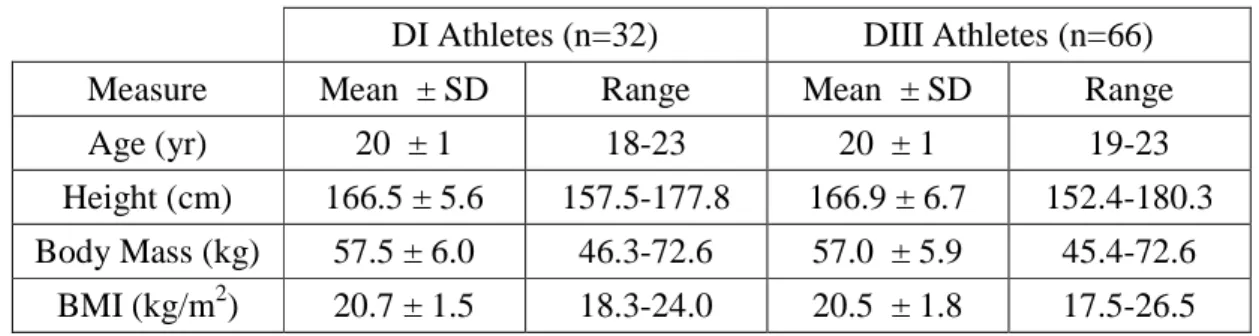
Of the 98 distance runners classified as either amenorrheic or eumenorrheic, 33% (n=32) were DI athletes and 67% (n=66) were DIII athletes. All subjects had been competing at their current divisional level for at least one whole academic semester. Self-reports indicated subjects had not taken birth control within the last 6 mo, and no subjects had a history of eating disorder, tumor, thyroid problems, or polycystic ovarian syndrome. No subjects were pregnant or breastfeeding. Age, height, body mass, and BMI did not differ between NCAA divisions (p≥0.541 for all comparisons). Subject characteristics are
summarized in Table 1.
Table 1. Participant physical characteristics (n=98)
DI Athletes (n=32) DIII Athletes (n=66)
Measure Mean ± SD Range Mean ± SD Range
Age (yr) 20 ± 1 18-23 20 ± 1 19-23
Height (cm) 166.5 ± 5.6 157.5-177.8 166.9 ± 6.7 152.4-180.3 Body Mass (kg) 57.5 ± 6.0 46.3-72.6 57.0 ± 5.9 45.4-72.6
BMI (kg/m2) 20.7 ± 1.5 18.3-24.0 20.5 ± 1.8 17.5-26.5 Prevalence of athletic amenorrhea in DI and DIII athletes
Eumenorrhea, defined as having a menstrual cycle once every 25-38 d for the past 3 consecutive months, was reported by 80% (n=78) of the 98 survey respondents who could be classified as either amenorrheic or eumenorrheic. Amenorrhea, defined as lack of
38
respondents. The percentage of athletes classified as amenorrheic did not differ between divisions, though approached significance (p=0.064). The prevalence of amenorrhea among DI athletes was 31% (n=10), while the prevalence of amenorrhea among DIII athletes was 15% (n=10).
Training load
Time spent cross training (p=0.877), time spent running (p=0.146), and training load (p=0.131) did not differ between DI and DIII athletes (Table 2). However, DI athletes had significantly greater weekly running mileage than DIII athletes (p<0.0005, Table 2).
Table 2. Mean training load, time spent cross training, and time spent running in athletes from both NCAA divisions. Within a row, lower case letters indicate significant differences
between divisions (α = 0.01).
DI Athletes DIII Athletes
Measure Mean ± SD Range Mean ± SD Range
Cross Training (min/wk) 143 ± 108 0-450 148 ± 140 0-645 Running (min/wk) 485 ± 124 210-780 426 ± 211 60-1680 Training Load (atu)1 1139 ± 909 270-5280 881 ± 721 300-4140 Running Mileage (mi/wk) 46 ± 14 a 10-80 36 ± 11 a 5-55 1. atu = Arbitrary training units
39
Table 3. Logistic regression model predicting risk of amenorrhea using weekly running mileage.
Parameter β Exp[β]1 P-Value
Total Weekly Running Mileage 0.042 1.043 0.045
Constant -3.092 0.045 0.001
1. Exp[β] is an odds ratio that may be interpreted two ways. First, if weekly running mileage increases one unit, the odds of successfully predicting a case of amenorrhea increase by a factor equal to Exp[β] (when other variables are controlled). Secondly, a one unit increase in running mileage increases the odds of developing amenorrhea by Exp[β] (when other variables are controlled).
Energy availability
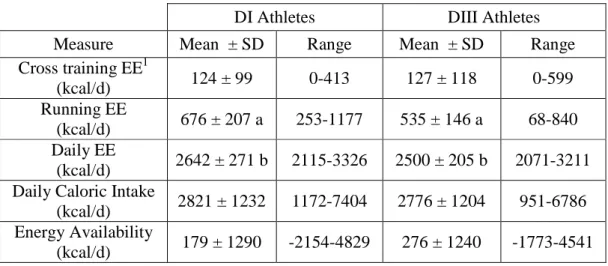
Mean daily energy expenditure due to cross training did not differ between DI and DIII athletes (p=0.918). However, DI athletes had significantly greater daily energy expenditure due to running (p<0.0005) and significantly greater total daily energy
expenditure than DIII athletes (p=0.005). Despite differences in energy expenditure between divisions, neither mean daily caloric intake (p=0.863) nor energy availability (p=0.722) differed between DI and DIII athletes (Table 4).
Table 4. Mean daily energy expenditure, caloric intake, and energy availability in DI and DIII athletes. Within a row, lower case letters indicate significant differences between
divisions (α = 0.01).
DI Athletes DIII Athletes
Measure Mean ± SD Range Mean ± SD Range
Cross training EE1
(kcal/d) 124 ± 99 0-413 127 ± 118 0-599
Running EE
(kcal/d) 676 ± 207 a 253-1177 535 ± 146 a 68-840 Daily EE
(kcal/d) 2642 ± 271 b 2115-3326 2500 ± 205 b 2071-3211 Daily Caloric Intake
(kcal/d) 2821 ± 1232 1172-7404 2776 ± 1204 951-6786 Energy Availability
40
Total daily energy expenditure (p=0.213), energy expenditure due to running (p=0.088), and energy expenditure due to cross training (p=0.750) did not predict the presence or absence of amenorrhea. Daily caloric intake (p=0.943) and energy availability (p=0.759) were also unrelated to the presence or absence of amenorrhea.
Psychological stress
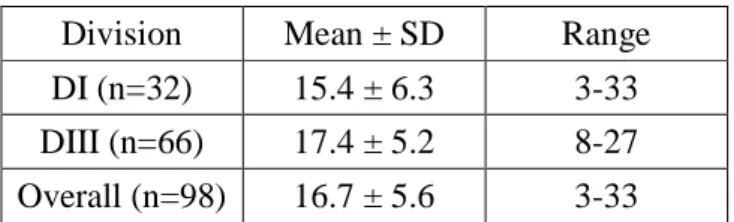
Psychological stress, as measured by the PSS (42), did not differ significantly between divisions (p=0.100, Table 5). Mean PSS score was predictive of the presence or absence of amenorrhea (Nagelkerke R2 = 0.073, correct overall classification percentage = 79.6%, Table 6).
Table 5. Mean PSS scores by division
Division Mean ± SD Range
DI (n=32) 15.4 ± 6.3 3-33 DIII (n=66) 17.4 ± 5.2 8-27 Overall (n=98) 16.7 ± 5.6 3-33
Table 6. Logistic regression model predicting risk of amenorrhea using mean PSS score.
Parameter β Exp[β]1 P-Value
Mean PSS score -0.104 0.901 0.040
Constant 0.281 1.324 0.725
1. Exp[β] is an odds ratio that may be interpreted two ways. First, if PSS score increases by one unit, the odds of successfully predicting a case of amenorrhea increase by a factor equal to Exp[β] (when other variables are controlled). Secondly, a one unit increase in PSS score increases the odds of developing amenorrhea by Exp[β] (when other variables are controlled).
Synergism between causes
41
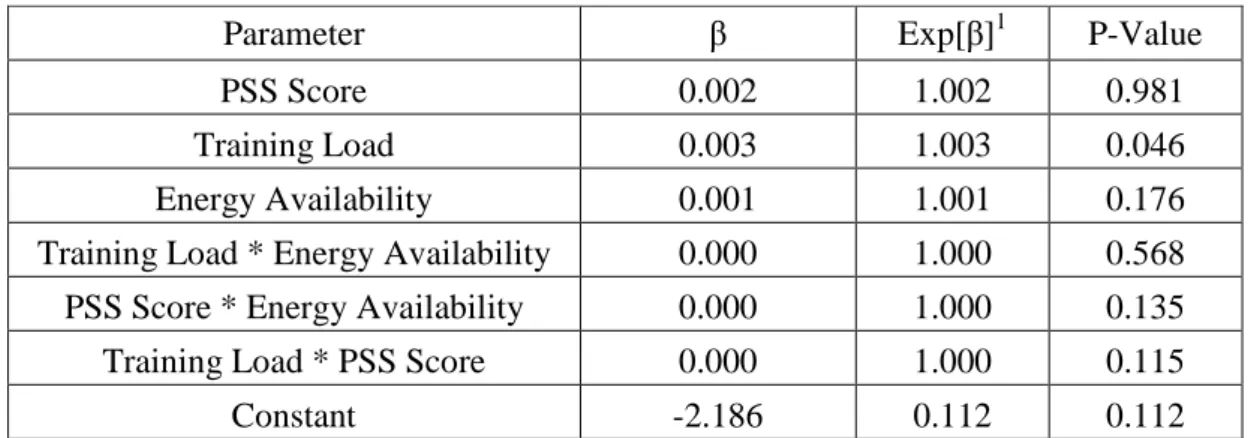
significantly related to the risk of amenorrhea (p=0.046). There were no significant interactions between training load, energy availability, and PSS score.
Table 7. Full model predicting risk of amenorrhea using PSS score, training load, energy availability, and their interactions.
Parameter β Exp[β]1 P-Value
PSS Score 0.002 1.002 0.981
Training Load 0.003 1.003 0.046
Energy Availability 0.001 1.001 0.176
Training Load * Energy Availability 0.000 1.000 0.568 PSS Score * Energy Availability 0.000 1.000 0.135
Training Load * PSS Score 0.000 1.000 0.115
Constant -2.186 0.112 0.112
CHAPTER 5
DISCUSSION
The purpose of this research was to examine differences in prevalence of athletic amenorrhea between NCAA DI and DIII distance runners and to determine the predictive value of training load, energy availability, and psychological stress in the development of athletic amenorrhea. It was hypothesized that the prevalence of athletic amenorrhea would be greater in NCAA DI distance runners than DIII distance runners and that the risk of amenorrhea would increase as psychological stress and training load increased; the risk of amenorrhea was expected to decrease as energy availability increased. These hypotheses were evaluated using a self-completed survey of 98 distance runners. The survey evaluated study eligibility, menstrual function, psychological stress, training load, and energy
availability. Training load
43
runners (10-13 menses per year). Barrow and Saha found that mean weekly training mileage in the regular runners was 41.2 mi/wk, while mean weekly training mileage in very irregular runners was 47.9 mi/wk.
A similar, positive association between run training mileage and the risk of
amenorrhea was found in the current study. The estimated slope constant (β) for the logistic regression analysis predicting the incidence of amenorrhea using run training mileage was 0.042. In binary logistic regression, a slope estimate of zero indicates that the independent variable (run training mileage) has no predictive value for the dependent variable (incidence of amenorrhea). A significant, positive slope estimate indicates that the risk of developing amenorrhea increases as running mileage increases. The exponentiated slope constant (Exp[β] = 1.043) indicates that each 1 mi/wk increase in running mileage is expected to increase the odds of developing amenorrhea by approximately 1.043.
Paradoxically, although weekly running mileage was associated with the risk of developing amenorrhea, weekly time spent running and cross training were not. Because training load was calculated, in part, using weekly time spent running and cross training, it is unsurprising that training load was also not associated with menstrual dysfunction. The lack of association between training time and menstrual dysfunction in the present study is in agreement with Torstveit and Sundgot-Borgen (11), who reported that, among members of the Norwegian national team (66 different sports), training time (hr/wk) was not related to menstrual dysfunction.
44
function (25). However, current research in both humans and primates supports the notion that low energy availability, secondary to exercise training, rather than exercise training alone, is the more probable cause of exercise-associated menstrual dysfunction (25, 38).
The lack of association between variables related to training time (total time spent running or cross training, total training load) and menstrual dysfunction may lend further support to the premise that menstrual dysfunction is a function of low energy availability, secondary to exercise training, rather than exercise training itself. Due to differences in exercise intensity between individuals, running mileage is likely more proximally related to exercise energy expenditure than time-based parameters such as time spent running, time spent cross training, and training load.
If some property inherent to exercise training caused menstrual dysfunction, it seems likely that all variables related to exercise training (run mileage, time spent running and cross training, training load) would be significantly associated with menstrual dysfunction.
Instead, only run mileage was predictive of menstrual dysfunction, perhaps because of the close association between run mileage and energy expenditure. However, this last point is only a speculation and is in need of research clarification.
Energy availability
Calculations of energy availability were based on energy expenditure due to running (mean miles run and total time spent running), cross training (mode, time, and intensity), and mean daily energy expenditure (excluding exercise). Some subjects neglected to provide a sufficient description of the mode and intensity of cross training performed weekly, making calculations of calories utilized due to cross training impossible. In cases where the
45
responses, calorie expenditure due to cross training was estimated. For this procedure, average calories expended per minute spent cross training was calculated based on complete responses (n=97) of all subjects who met the basic inclusion criteria (n=128), rather than subjects who met the basic inclusion criteria and could also be classified as either
amenorrheic or eumenorrheic (n=98), in order to improve the estimation quality by
increasing sample size. An estimated total caloric expenditure was calculated as the product of total minutes of cross training and mean caloric expenditure per minute of cross training.
Mean daily caloric intake across both divisions was approximately 2500-2600 kcal/d, well above the minimum of 1800-2000 kcal/d (30 kcal/kg fat-free mass/day) that Rodriguez et al. (58) suggest is necessary to maintain energy balance and preserve neuroendocrine function in female athletes. Mean energy availability, which was approximately 180-280 kcal/d in athletes from both divisions, indicated that the athletes, in general, appeared to consume adequate calories to meet their daily energy needs. Based on the Harris and Benedict equation and physical activity coefficients of 1.6-1.89 (58), the mean daily energy requirement of the athletes sampled was estimated to be 2253-2660 kcal/d, further supporting the notion that, on the whole, energy balance was adequate.
46
A possible explanation for the lack of association between measures of energy balance and menstrual status is that energy expenditure was approximately well-balanced with energy intake in the athletes sampled. The slightly positive mean energy availability in both DI and DIII athletes supports this position. However, it is also possible that the
measures used to calculate energy expenditure and daily caloric intake were not sensitive enough to capture the variations in energy balance across the sampled athletes, obscuring the true relationship between energy balance and menstrual function. Indeed, examination of the standard deviation of energy availability shows large variability across both divisions. The coefficient of variation was in excess of 400% in DIII athletes and more than 700% in DI athletes.
The large variation in energy balance found in the present study may have been due to inaccurate survey responses. Magkos and Yannakoulia reported that athletes may omit foods considered undesirable, falsely report foods considered desirable, and inaccurately report serving sizes (23). While such errors are, to a certain extent, inherent in self-reported dietary intakes (23), FFQs are, nonetheless, useful for the estimation of usual dietary intakes of large groups (53). Despite the ease of use of FFQs for self-reported assessment of usual dietary intake (23), reducing measurement error, perhaps by using a more sensitive measure of energy balance would likely improve estimation of mean energy availability and improve statistical power (61).
Psychological stress
While some researchers have speculated that collegiate athletes face greater
47
effect of sport participation on mental health (62). Data from the current study appears to indicate that the athletes sampled do not experience greater psychological stress than the general undergraduate population. Roberti et al. (60) sampled 225 female undergraduates at three universities in the southeast United States and found that the mean PSS score was 18.4 ± 6.5, while Massimini and Peterson (63) surveyed 300 male and female undergraduates at a Mid-Atlantic university and found that the mean PSS score was 17.98 ± 5.59. The mean PSS score of the athletes sampled in the current study was 16.7 ± 5.6. Conversion of the mean PSS score to a z-score based on the findings of Roberti et al. and Massimini and Peterson suggest no difference between the mean PSS scores of athletes and non-athletes (z = -0.26 and -0.23, respectively).
Research has shown that high levels of psychological stress can cause menstrual dysfunction in otherwise healthy females (20). An association between mean PSS score and menstrual dysfunction was also found in the current study; however, the direction of the relationship between stress and menstrual dysfunction was opposite from what was expected. The slope constant (β = -0.104) and exponentiated slope constant (Exp[β] = 0.901) for the relationship between PSS score and menstrual dysfunction indicate an inverse relationship. Specifically, as PSS score increased by one unit, the odds of developing amenorrhea
decreased by 0.901. Stated alternatively, a one unit increase in PSS score increases the odds of an athlete being eumenorrheic by 1.109.
The divergent relationship between mean PSS score and menstrual dysfunction in the current study may indicate that psychological stress does not play a large role in the
48
DIII athletes, who reported a lower incidence of menstrual dysfunction, had higher mean PSS scores.
As indicated by Schwartz et al. (41), it appears that other factors, such as weekly running mileage, may be more important than psychological stress in the development of athletic amenorrhea. When controlling for weekly running mileage, Schwartz et al. found that 34 eumenorrheic runners and 12 amenorrheic runners both had normal psychological profiles and did not differ in their perception of stress associated with running.
Synergism between causes
Synergism is an increase in the likelihood of a measured outcome (such as amenorrhea) greater than that expected based on individual factor inputs (training load, energy availability, and psychological stress). Although athletic amenorrhea may be caused by either low energy availability (38) or psychological stress (20) independently, there is also evidence that marginally low energy availability and psychological stress may synergistically increase the risk of menstrual dysfunction (44).
49
Prevalence of athletic amenorrhea in DI and DIII athletes
Overall
The prevalence of athletic amenorrhea in 98 female distance runners who could be classified as either amenorrheic or eumenorrheic was 20%. This is in relatively close
agreement with other studies that excluded subjects due to birth control usage. For example, Robinson et al. (9) found that 15% of the 20 distance runners sampled were amenorrheic (absence of menses for 6 mo or longer). Carlberg et al. (2) found that 18% of the 83 distance runners sampled were oligo/amenorrheic (less than four periods in the previous year or the absence of menstruation for the previous 3 mo). Lastly, Sanborn et al. (13) found that 25.7% of 237 collegiate and age-matched, non-collegiate distance runners were amenorrheic (3 or fewer periods per year).
Differences between divisions
The incidence of amenorrhea, though approaching statistical significance, did not differ between divisions (p=0.064). The prevalence of amenorrhea among DI athletes was 31%, while the prevalence of amenorrhea among DIII athletes was 15%. Weekly running mileage, energy expenditure due to running, and total daily energy expenditure, however, were found to differ between divisions in the present study. Though anecdotal evidence suggests that DI athletes train more than DIII athletes, there is not strong evidence in the literature to suggest this (15, 16, 17, 18). The results of the present study indicate that DIII athletes run about 10 mi/wk, or 22%, less than DI athletes. Because DI and DIII athletes did not differ in energy expenditure due to cross training or daily caloric intake, energy
50
Mean PSS scores did not differ significantly between divisions, though approached significance (p=0.100). Division III athletes tended to have slightly higher perceived stress levels than DI athletes. These results are somewhat surprising, as Picard (19) reported that DI athletes experience more pressure to perform than DIII athletes, and the athletic
performance of DI athletes, but not DIII athletes, is associated with the potential gain or loss of athletic scholarships (47). The PSS measures only general life stress and is not designed to distinguish between sporting and non-sporting stressors. It is possible that DI athletes experience more stress directly related to athletics and DIII athletes tend to experience more non-sporting stressors; however, this is speculation.
Of the variables of interest found to approach a difference between divisions, only PSS score and weekly running mileage were also significantly related to the risk of amenorrhea. As discussed previously, however, the direction of the relationship between mean PSS score and the risk of amenorrhea was opposite than expected, rendering the predictive value of PSS in the development of athletic amenorrhea dubious. Thus, in the present set of data, differences in weekly running mileage between DI and DIII athletes appear to best explain the trend of somewhat higher risk of amenorrhea in DI athletes compared to DIII athletes.
Conclusion