TEACHER ATTUNEMENT: SUPPORTING STUDENTS’ PEER EXPERIENCES IN THE EARLY ELEMENTARY CLASSROOM
Abigail S. Hoffman
A dissertation submitted to the faculty of the University of North Carolina in partial fulfillment of the requirements for the degree of Doctor of Philosophy in the School of
Education
Chapel Hill 2012
ABSTRACT
ABIGAIL HOFFMAN: Teacher Attunement: Supporting Students’ Peer Experiences in the Early Elementary Classroom
(Under the direction of Dr. Jill V. Hamm)
TABLE OF CONTENTS
LIST OF TABLES……….vii
Chapter I. INTRODUCTION...1
Conceptual Framework...3
The Need for Teacher Attunement to Peer Group Memberships During Early Elementary School……….…….6
The Concurrent and Longitudinal Significance of Teacher Attunement………..8
Children’s Peer Experiences………..10
Teacher Attunement and Children’s Peer Experiences……….13
Summary………17
Research Hypotheses……….………19
II. LITERATURE REVIEW………..22
Historical Roots of Teacher Attunement to Peer Group Memberships………..23
Teacher Attunement During the Early Elementary Grades……….……26
Teacher Attunement and Children’s
Peer Acceptance.………30
Teacher Attunement and Students’ Social Network Centrality………..32
The Current Study………..34
III. METHODS………..39
Sample………40
Students………..40
Teachers……….41
Procedures………..…41
Intervention Condition………...42
Study Measures………..…...…….43
Dependent Measures………...48
Data Reduction………...50
Data Analysis Strategy………...51
Interpreting Coefficients………55
IV. RESULTS………...60
Descriptive Analyses……….…61
Teacher Attunement and Student Popularity……….….62
Teacher Attunement and Leadership Reputations………..…67
Teacher Attunement and Students’ Social Centrality………...………….72
Summary………..…………79
IV. DISCUSSION………..81
Low Teacher Attunement………83
Creating Contexts Through Teacher Attunement………85
Teacher Attunement and Peer Experiences………...…………89
Implications for Classroom Practices………91
Strengths, Limitations and Future Directions………93
Concluding Statement……….…..97
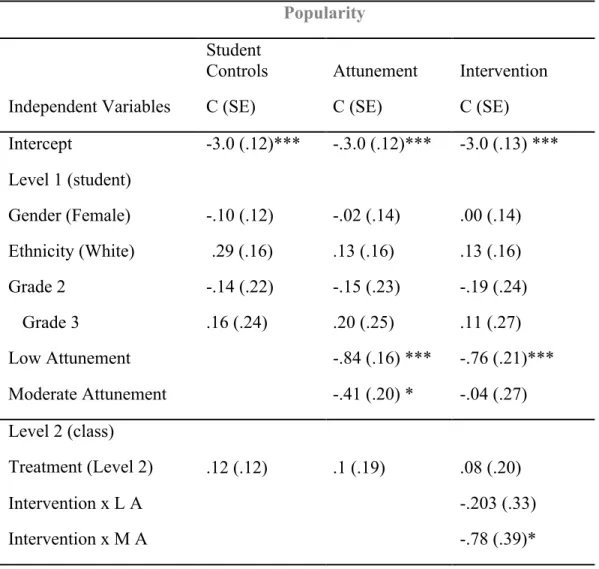
LIST OF TABLES Table
1. Teacher Attunement Means and
Standard Deviations for Fall and Spring………...99 2. Teacher Attunement Frequencies in Fall and Spring………..100 3. Teacher Attunement Groups………...………101 4. Fall Means, Standard Deviations (S.D.),
Skewness, and Kurtosis of Peer Experiences……….102 5. Spring Means, Standard Deviations (S.D.),
Skewness, and Kurtosis of Peer Experiences……….103 6. Frequencies for Social Network Centrality……….104 7. Longitudinal Correlations Between Variables………105 8. Fall Fixed Effects Estimates for
Concurrent Models Predicting Popularity………..…106 9. Spring Fixed Effects Estimates for
Concurrent Models Predicting Popularity………..107 10. Fall Fixed Effects Estimates
Predicting Spring Popularity……….108 11. Fixed Effects Estimates for
Concurrent Models Predicting Fall Leader……….…….109 12. Spring Fixed Effects Estimates
for Concurrent Models Predicting Leader……….……...110 13. Fall Fixed Effects Estimates
Predicting Spring Leader……….….111 14. Fixed Effects Estimates for Concurrent
Models Predicting Fall Social Network Centrality……….…….112 15. Fixed Effects Estimates for Concurrent
16. Fall Fixed Effects Estimates Predicting
Spring Social Network Centrality………..……...114 17. Fixed Effects Estimates for Concurrent
Models Predicting Fall Social Acceptance………..…….115 18. Fixed Effects Estimates for Concurrent
Models Predicting Spring Social Acceptance………..………116 19. Fall Fixed Effects Estimates Predicting
CHAPTER 1
INTRODUCTION
During the early elementary grades, developing positive peer relationships with classmates is important to young children’s social adjustment. Early classroom
relationships have the potential to support or exacerbate children’s social adjustment (Ladd, 1990; Ladd & Burgess, 2001), thus, it is important that these experiences are positive and productive. Given the considerable amount of time children spend engaged in peer interactions, the peer groups that emerge are particularly important to children’s adjustment (Cairns, Xie, & Lueng, 1998; Rodkin, 2004). For the purposes of this research, peer groups refer to informal groups of children who voluntarily and regularly interact within natural settings such as classrooms (Cairns & Cairns, 1994). The peer group connections that occur among children serve as important proximal settings for children’s social interactions and development at school (Cairns et al., 1998; Rodkin, 2004) and are a pathway for children to meet a fundamental human need for relatedness and acceptance (Cairns & Cairns, 1994; Baumesister & Leary, 1995). Further, scholars agree that during elementary school, psychological processes associated with children’s peer interactions become salient developmental pathways for children that have a long-term impact. That is, fitting in and being accepted, valued, and included by peers takes on special significance during middle childhood (Osterman, 2000).
to benefit fully from positive social relationships. A central responsibility of elementary teachers is to organize the classroom environment in ways that best attend to children’s developmental needs, including their need to form connections with their peers (Cairns & Cairns, 1994; Doll, Song, & Siemers, 2004; Hamre & Pianta, 2010; Skinner & Belmont, 1993). In fact, how teachers organize features of the classroom environment to meet students’ social needs impacts their social interactions and relationships beyond the early elementary grades (Hamre & Pianta, 2010).
A substantial body of research demonstrates that children’s adjustment is supported when teachers create classroom contexts that address students’ basic psychological need to feel valued, important, and accepted in their relationships with significant others including their peers (e.g., Furrer & Skinner, 2003; Osterman, 2000;Wentzel, 2002; Wentzel, 2010). In order for teachers to create supportive
teachers organize classrooms that facilitate and sustain accepting, supportive, and productive peer associations.
Consistent with this depiction of teacher attunement in relation to students’ social adjustment, recent research demonstrates that middle school teachers with higher
attunement more effectively manage classroom social dynamics. In addition, teacher attunement predicted improvement to adolescents’ perceptions of the school social-affective context and bullying context during the middle school transition year (Hamm et al., 2011). However, teacher attunement is not a well-studied construct, especially within the early elementary school years. The proposed study begins to fill this gap in
understanding the role of teacher attunement to peer group membership in supporting children’s social adjustment during first through third grades.
Conceptual Framework
Two perspectives underscore the significance of teacher attunement to student adjustment: a developmental science framework, and a conceptualization of teacher influence that connects dimensions of teacher involvement to aspects of children’s peer experiences through effective teaching practices such as network-related teaching and teacher warmth (Bierman, 2011; Chang, 2003; Chang, Liu, Wen, Fung, Wang, & Xu,
students’ social adjustment (Cairns & Cairns, 1994). Furthermore, peer group
memberships are an integral aspect of the classroom context to which teachers attend during teachable moments and when planning day-to-day activities (Cairns & Cairns, 1994; Farmer, Lines, & Hamm, 2011; Kindermann, 2011). It is likely that a reciprocal relationship exists between the peer and teacher contexts in the classroom. However, as the primary adult and leader of the class, early elementary teachers may exert a greater influence in children’s social experiences in the classroom than peers (Cairns & Cairns, 1994; Farmer et al., 2011).
positive and productive relations with their peers (Bierman, 2011; Cairns & Cairns, 1994; Farmer et al., 2011; Rodkin & Gest, 2010).
Skinner and Belmont’s (1993) conceptualization of teacher involvement and its influence on student adjustment is drawn from Connell and Wellborn’s (1991) model of student engagement. According to this model, student adjustment is optimized to the degree that teachers create classroom environments that satisfy children’s basic needs for competence, autonomy, and relatedness (Connell & Wellborn, 1991; Skinner & Belmont, 1993). Within this framework, students’ need to form meaningful social connections with others is particularly significant to their willingness to internalize socialization processes important to the teacher (Furrer & Skinner, 2003; Skinner & Belmont, 1993; Wentzel, 2010). Moreover, teacher involvement may be an important construct that provides teachers with tangible ways to create contexts that satisfy this basic psychological drive (Hamm et al., 2011; Skinner & Belmont, 1993; Wentzel, 2002).
Teacher involvement includes teacher affection and liking, attunement to and knowledge of students, and time and energy spent on students, and addresses students’ basic need to feel related and connected in the classroom context (Skinner & Belmont, 1993). From this broader definition, teacher attunement to children’s peer group
memberships represents a dimension of a teacher’s overall involvement with students and may be a particularly relevant skill that allows teachers to intentionally foster positive and productive social relationships that meet students’ need for acceptance, inclusion, and relatedness (Hamm et al., 2011).
responsive to teachers’ socialization practices in contexts in which children have the opportunity to form warm and accepting social relationships (Doll et al., 2004; Chang, 2003; Wentzel, 2002; 2003). Teacher attunement to peer group affiliations may serve as a resource for children, by supporting their positive social relationships in the classroom context. It may be essential for teachers to identify peer group memberships accurately, to more effectively support positive social processes in the classroom (Cairns & Cairns, 1994). Understanding peer group memberships is an integral dimension of teacher attunement (Hamm et al., 2011) and may be an important skill informing how teachers organize the classroom to be relationally responsive and supportive environments. This may be especially relevant for children in the early elementary grades. Thus, this study examines the role of teacher attunement to children’s peer group membership in supporting students’ social adjustment in first through third grades.
The Need for Teacher Attunement to Peer Group Memberships During Early
Elementary School
propinquity (Cairns & Cairns, 1994), which suggests the importance of school and classroom factors in determining children’s peer group affiliations within a school year and from year to year (Hamm & Zhang, 2010). That is, children’s pool of potential affiliates is limited first, by classroom placement and then by teacher decisions in the classroom.
Peer group affiliations among students do not form outside of or independent from the adult world in the classroom. That is, peer group affiliations are embedded in the classroom social processes that the teacher arranges (Doll et al., 2004; Cairns & Cairns, 1994; Farmer, 2000; Farmer et al., 2011; Rodkin & Hodges, 2003). While children themselves are expert participant-observers into this complex social world that develops among the students (Cairns, Leung, Gest, & Cairns, 1995; Gest, 2006), teachers are privy to aspects of the social dynamics of the classroom, albeit as outside observers (Gest, 2006; Neal et al., 2010; Pittinsky & Carolan, 2007). Moreover, early elementary teachers may be in an advantageous position to attune to children’s peer group
memberships, as these teachers stay with the same group of students throughout the school year. Scholars have long advocated for teachers to develop an objective
understanding of their students’ social relationships in the classroom (Gronlund, 1959; in Rodkin, 2004). Yet, researchers have only recently begun to consider the significance of this kind of teacher cognition about children’s social experiences for student adjustment and few studies have been conducted in elementary schools.
By attending to children’s peer group memberships, teachers may more
2006). For example, a teacher may assign a student to a small group for a selected activity to promote a prosocial affiliation and a more productive reputation. When teachers are aware of children’s peer group memberships, they may purposefully arrange opportunities that afford children the opportunity to be accepted or held in higher regard by their classmates. Understanding the extent to which teacher attunement to children’s peer group membership is associated with students’ peer experiences during the early elementary grades may contribute to effective classroom practices.
The Concurrent and Longitudinal Significance of Teacher Attunement
As the primary adult in elementary classrooms, teachers contribute to children’s behaviors and the relationships children engage in with their peers contemporaneously and over the course of the school year (i.e., Hamre & Pianta, 2001; Hughes & Chen, 2011; Hughes, Cavell, & Willson, 2001). In addition, teachers organize the classroom environment to reinforce existing interaction patterns among classmates and create opportunities for new interaction patterns to emerge (Farmer et al., 2006). Making distinctions between the concurrent and short-term longitudinal role that teachers have in students’ peer experiences is important especially for teacher practices that target
children’s peer relationships (Bierman, 2011; Gest & Rodkin, 2011). This is important in order to clarify what teachers can do to shape students’ peer experiences.
spring (Farmer, et al., 2010; Neal, et al., 2009; Pearl et al., 2007). For example, at the beginning of a school year, teachers may help their young students to access a peer group before the classroom dynamics become entrenched. By the end of the school year, peer group memberships may be easier for teachers to decipher, but they may be harder for teachers to penetrate as the groups have had most of the school year to consolidate. Thus, the concurrent association between teacher attunement and children’s peer experiences may be more apparent at the beginning of the year than at the end of the school year. On the other hand, when teachers have an accurate understanding of children’s peer group memberships in the fall, children’s peer experiences later in the school year may likely benefit. Teacher attunement early in the school year may provide students with a stronger foundation from which peer associations support socially competent behaviors and interaction patterns which, in turn, support positive and productive peer experiences later in the school year.
attunement in the fall and children’s peer experiences in the spring after accounting for children’s demographics and baseline scores on the dependent measures.
Children’s Peer Experiences
Classroom-based peer experiences include children’s social reputations as popular and as leader, children’s peer acceptance, and children’s social network centrality. These peer experiences represent key dimensions of children’s interpersonal adjustment and are grounded in Moreno’s (1939) articulation of sociometry (for reviews see Asher &
McDonald, 2009; Cairns, et al., 1998; Parker & Asher, 1989; Parker, Rubin, Price, & De Rosier, 1995). Scholars agree that these dimensions of children’s interpersonal
experiences emerge and are sustained through direct and observed peer exchanges in classrooms (i.e., Hughes et al., 2001; Dodge, 1983; Coie & Kupersmidt, 1983).
Children’s peer experiences may be especially important during early elementary grades. As children carve out their roles and reputations, whom they like, and their peer affiliations (Ladd, 2005), concerns related to fitting in begin to take on an added
significance (Osterman, 2000). The developmental significance of children’s peer
can lead children to feel devalued and unimportant, which may inhibit children’s social engagement. In turn, negative or undesirable peer experiences may interfere with
children’s adaptive behavior and learning. When children are afforded the opportunity to experience peer acceptance, peer regard, or peer group membership, they more likely engage and participate in classroom activities and internalize prosocial behaviors (Doll, Zucker, & Brehm, 2004; Birch & Ladd, 1996).
Social reputations as popular and as leader. For the present study, children’s
social reputations include children’s reputation as popular and children’s reputation as a leader. Research has documented that Popular-Leader reputations during middle
childhood positively predict social competencies during emerging adulthood (Gest, Sesma, Masten, & Tellegen, 2006).
nominations received for the popular role signifies a greater agreement among classmates that a child is well known and has many friends.
Peer nominations for leader represent group attitudes about children’s role as an individual who is considered to have influence over classmates. Scholars have suggested that children’s social characteristics and associations with classmates inform their reputations as a leader (Lease, Kennedy, Axelrod, 2002). A leadership reputation advantages children by positioning them to set social rules that other children follow which may support feelings of self-worth and importance (Lease, Kennedy, & Axelrod, 2002). A leadership reputation is based on the number of peer nominations for the leader that child receives. Greater numbers of peer nominations for leader reflect greater
consensus among classmates that a given child is a leader.
Peer acceptance. Peer acceptance refers to group sentiments about student
likeability. Scholars agree that peer acceptance makes significant and unique
used to determine peer acceptance (Coie, Dodge, & Coppotelli, 1982). Higher sores reflect being liked by many and disliked by few.
Social network centrality. Social network centrality refers to the extent to which
children are integrated into the peer group system of their classroom (Cairns et al., 1998). Scholars have suggested that consideration of children’s peer experiences that do not take peer group dynamics into account is incomplete (Cairns et al., 1998). As a marker of affiliative success (Gest et al., 2001), a central position in the social network may afford children with a stronger social footing in the classroom (Xie & Cairns, 1999). Social network centrality is measured via Social Cognitive Mapping procedures and denotes children’s participation in small informal social groups within the classroom social network (Cairns et al., 1998; Gest, et al., 2001). The more times children are named as a member of a peer group, the higher the social network centrality score they receive; higher scores reflect a greater integration in the social network.
Teacher Attunement and Children’s Peer Experiences
success in interpersonal relationships later in life (Gest et al., 2006). However, studies have not examined the teachers’ role in children’s early peer experiences. Gaining a clearer picture about teachers’ influence in students’ peer experiences during early elementary school may be important for research and classroom practices. Thus, this study includes an examination of the links between teacher attunement and discrete markers of children’s peer experiences including children’s social reputations as popular and as a leader, children’s peer acceptance, and children’s social network centrality during the early elementary school years.
Teacher attunement and children’s social reputations. Conceptualizations of
teacher practices and children’s peer relationships propose that teachers influence both peer experiences at the individual level and at the group level (Bierman, 2011; Gest & Rodkin, 2011). At the individual level, Hughes and colleagues (2001) suggest that in the absence of direct experiences, children rely on their indirect experiences with classmates, such as students’ reputations. This indicates that managing children’s reputations is an important factor for teachers to consider when guiding the classroom context to be supportive and nurturing (Farmer et al., 2011; Gest & Rodkin, 2011). Teachers may support children’ positive and productive reputations through their social management practices (Farmer, et al., 2006). For example, when teachers have knowledge of
more fluid and not only based on student academic skills, teachers may arrange groups to advantage particular students by providing them with the opportunity to be seen in a more favorable light by peers. In addition, using diverse criteria to group students may ensure that all students have more occasions to enact a variety of roles with many different classmates. This grouping strategy, for example, may enable teachers to support
students’ social reputations such as being popular or being a leader (Farmer, et al., 2006). Teacher attunement may be important for such social management practices to be
successful (Gest & Rodkin, 2011).
In addition, attuned teachers may create an environment in which classmates engage in adaptive peer processes that afford children more opportunity to develop a reputation as popular or a reputation as leader (Kochenderfer-Ladd & Pelletier, 2008; Farmer, 2000; Rodkin & Hodges, 2003). As a first step, teachers may group students in ways that minimize bullying episodes. This can take the form of ensuring that vulnerable students are placed in groups where their liabilities are minimized and their strengths are maximized which requires teacher attunement to children’s peer group memberships (Gest & Rodkin, 2011; Hamm et al., 2011). In such environments, bullying may be less acceptable and all students may have more opportunities to enact socially competent behaviors (Hamm et al., 2011). In particular, vulnerable students may have more
experience being popular or being a leader an accurate assessment of children’s peer group memberships is required (Bierman, 2011; Gest & Rodkin, 2011).
Teacher attunement and peer acceptance. Perspectives on teacher involvement
(i.e., Connell & Wellborn, 1991; Furrer & Skinner, 2003; Skinner & Belmont, 1993; Wentzel, 2002; 2010) propose that classrooms in which teachers’ relationships are accepting, supportive, and caring more likely motivate students to adopt and internalize prosocial behaviors and attitudes (Skinner & Belmont, 1993; Wentzel, 2002; 2003; 2010). From this perspective, a key aspect of teachers’ influence is conceptualized in terms of the extent to which students experience acceptance in their classroom
relationships (Chang, 2003; Furrer & Skinner, 2003; Wenzel, 2002; 2003; 2010).
Middle school teachers’ socialization goals for students include being responsible, helpful, and cooperative (in Wentzel, 2010). There is little reason to believe that
elementary school teachers value different social behaviors than their counterparts teaching in middle schools.
the role of teacher attunement to children’s peer group memberships in children’s peer acceptance especially during the early elementary grades. With this in mind, the current study investigates the extent to which teacher attunement to students’ peer group
memberships is related to children’s peer acceptance.
Teacher attunement and social network centrality. How teachers understand,
organize, and respond to the classroom ecology is foundational to the opportunities children have to engage in direct and regular interactions with their peers (Farmer, 2000; Gest & Rodkin, 2011; Rodkin & Hodges, 2003). Supportive peer relationships are believed to emerge out of repeated and enjoyable social interactions (Doll, Song, et al., 2004). When teachers structure classroom groups that bring compatible classmates together, productive peer connections that may not have naturally emerged may be encouraged (Doll, Song, et al., 2004; Rodkin & Hodges, 2003). When teachers are attuned to peer group memberships they may be better able to accurately identify potentially healthy connections between and among students, (Farmer, 2000; Rodkin & Hodges, 2003) and intentionally organize classroom activities to be engaging, supportive and inclusive. Teacher knowledge of children’s peer group memberships may be a basic step for teachers to successfully support children’s group affiliations among classmates and, thus, their social network centrality (Bierman, 2011; Gest & Rodkin, 2011). Thus, this study will examine the association between teacher attunement and children’s social network centrality.
Summary
with their peers, including their reputations as popular and as a leader, children’s peer acceptance and social network centrality. The concurrent associations between teacher attunement and children’s peer experiences may vary in relation to the time of year (i.e., at fall versus at spring). In addition, teacher attunement early in the school year may support children’s positive and productive peer experiences later in the school year. In either case, teachers may reinforce existing interaction patterns or create opportunities for new interaction patterns. The current study examines the concurrent and short-term longitudinal associations between teacher attunement and children’s social experiences. Distinguishing between the concurrent associations from the short-term longitudinal associations is important in terms of informing research and practice related to teacher influence on children’s peer experiences.
Based on conceptual models suggesting teachers organize and manage
opportunities in the classroom for students to engage in competent peer exchanges that support children’s productive reputations (i.e., Bierman, 2011; Cairns & Cairns, 1994; Farmer, 2000; Farmer, et al., 2011; Farmer et al., 2006), the first aim of the present study is to examine the extent to which teacher attunement to children’s peer group
memberships was associated with children’s social reputations as popular and as a leader concurrently and across the school year. Such findings will extend research and theory on teacher influence to include the role of teacher attunement in supporting children’s productive social reputations.
students’ peer group memberships may attend to students’ basic psychological need to feel connected to others and establish supportive classroom environments. Children are more likely to enact prosocial behaviors that undergird peer acceptance in classroom environment that are supportive (Wentzel, 2010). The second aim of the present study is to examine the extent to which teacher attunement was associated with children’s peer acceptance. Findings will build upon recent research by Hamm and colleagues (2011) and suggest a skill (teacher attunement) elementary teachers can employ to support peer acceptance in the classroom.
Theory suggests teachers support and constrain children’s peer affiliations (i.e., Cairns & Cairns, 1994; Hamm & Zhang, 2010); teacher attunement to children’s peer group memberships may be related to children’s social integration into peer groups in the classroom. The third aim of the present study is to examine the extent to which teacher attunement was associated with children’s social network centrality. Such findings will extend theory and research on children’s peer groups to include the role of the teacher, and, in particular, the role of teacher attunement in fostering children’s integration in peer groups.
Research Hypotheses
Hypothesis 1a: Teacher attunement will be associated concurrently with students’
Hypothesis 1b: Teacher attunement in the fall will be associated with students’ reputations as popular in the spring after accounting for children’s gender, minority status, grade, and fall nominations for popular.
Hypothesis 1c: Teacher attunement will be associated concurrently with students’ reputations as leader in the fall and spring after accounting for children’s gender, minority status, and grade.
Hypothesis 1d: Teacher attunement in the fall will be associated with students’ reputations as leader in the spring after accounting for children’s gender, minority status, grade, and fall nominations for leader.
Hypothesis 2a: Teacher attunement will be associated concurrently with students’
peer acceptance scores in the fall and spring after accounting for children’s gender, minority status, and grade.
Hypothesis 2b: Teacher attunement in the fall will be associated with students’
peer acceptance scores in the spring after accounting for children’s gender, minority status, grade, and peer acceptance in the fall.
Hypothesis 3a: Teacher attunement will be associated concurrently with
Hypothesis 3b: Teacher attunement in the fall will be associated with children’s
CHAPTER 2
LITERATURE REVIEW
Elementary school children look to their peers for acceptance and support as concerns related to fitting in become more central (Osterman, 2000) and they continue to rely on their teachers to successfully navigate the complexities involved in the classroom social system (Farmer et al., 2011). This may be particularly relevant to children during the early elementary grades as they transition into middle childhood. During these early grades in elementary school, teachers may have a unique opportunity to support and guide children’s peer experiences to be positive and productive.
Peer group memberships are an aspect of the classroom context to which teachers attend when organizing and managing the classroom environment to support children’s competencies that underlie productive peer experiences (Cairns & Cairns, 1994; Farmer et al., 2011; Hamm et al., 2011). Teacher attunement to children’s peer group affiliations is a component of the teachers’ invisible hand (Cairns & Cairns, 1994), a metaphor used to conceptualize an aspect of the teacher’s influence in students’ social experiences. The significance of teacher attunement to peer group memberships in children’s social
In order for teachers to create contexts in the classroom that support productive peer experiences, teachers may need to be attuned to children’s peer group memberships. Teacher attunement may facilitate teachers’ ability to arrange the classroom social
environment to foster positive and productive peer experiences. Teachers who are attuned to children’s peer group memberships may be more effective at using aspects of the peer social dynamics to create and manage opportunities for children to engage in early peer experiences that promote student adjustment. Thus, this study investigates the role of teacher attunement in distinct dimensions of children’s peer experiences including children’s social reputations as popular and as a leader, children’s peer acceptance, and children’s social network centrality.
In the following sections, the historical origins of teacher attunement are
discussed, the importance of teacher attunement during early elementary school years is reviewed, and the literature that substantiates the role of teachers in enhancing and inhibiting children’s productive social experiences in the classroom is examined. To demonstrate the role of teachers in children’s peer experiences, literature that supports the association between teacher attunement and children’s social reputations as popular and leaders is discussed first. Next, literature that supports a relationship between teacher attunement and students’ experiences with peer acceptance is presented. Finally, the literature that emphasizes the potential for a link between teacher attunement and children’s social network centrality is reviewed.
Historical Roots of Teacher Attunement to Peer Group Memberships
network measurement tools such as Social Cognitive Mapping provide information on structural aspects of group connections as well as group dynamics in affiliation patterns (Cairns, Gariepy, Kindermann, & Leung, 1996). In particular, Social Cognitive
Mapping methods yield information on peer group affiliations including who hangs around together; the centrality, or embeddedness of an individual within a peer group; the number of these subgroups making up the larger social network; and the individuals who do not belong to any group (Cairns et al, 1996). Such methods provide information regarding the functions of and the dynamics involved in affiliation patterns and group influence.
A handful of recent studies suggest that teachers’ actions function as an invisible hand to guide students’ opportunities for competent and successful peer interaction (i.e., Chang et al, 2007; Gest & Rodkin, 2011; Hamm et al., 2011; Hughes & Chen, 2010; Luckner & Pianta, 2011) through such skills as their attunement to students’ peer group memberships and the classroom social dynamics. This renewed attention to teacher influence takes a new direction, by focusing on teachers’ knowledge of children’s participation in friendship and peer group networks (i.e., Gest, 2006; Neal et al., 2010; Pearl et al., 2007; Pittinsky & Carolan, 2008). Underlying this focus on teacher attunement are empirical findings that demonstrate the significant role of peer group social dynamics to children’s social and emotional adjustment in the classroom and school (i.e., Cairns et al., 1988; Estell et al., 2002; Estell et al., 2003; Farmer, 2000; Farmer et al., 2007; Hamm & Faircloth, 2005).
in supporting children’s classroom-based social experiences. However, this more recent research on teacher attunement has not taken into account the extent to which teacher attunement is a skill that helps early elementary teachers create contexts that support students’ social experiences. The present study fills this gap by examining the extent to which teacher attunement relates to aspects of children’s peer experiences, including children’s social reputation as popular and as a leader, children’s peer acceptance, and children’s social network centrality.
Teacher Attunement during the Early Elementary Grades
Teachers of the early elementary grades may be in an ideal position to develop an accurate understanding of children’s peer group memberships and classroom social dynamics given that classrooms are largely self-contained settings in which students interact with the same classmates and stay with the same teacher across a school year. Moreover, early elementary grade teachers may be particularly advantaged given the focus on social adjustment during the early elementary grades (Howes & Ritchie, 2002). However, elementary school teachers tend to possess only a moderate accuracy in
identifying their students’ peer group memberships, which suggests that teachers in 2nd -5th grade may miss important connections among classmates (Gest, 2006; Neal et al., 2010; Pearl et al., 2007). This deficit in teacher attunement to peer group memberships is particularly evident at the beginning of the school year but continues to persist during the latter part of the school year as well (Pearl et al., 2007).
contacts and support established peer connections at the beginning of the school year, students’ social adjustment is enhanced (Ladd, 1990). Highly attuned teachers may be in a better position to take advantage of evolving peer groups so as to foster children’s opportunities in productive peer contacts and, thus, promote positive social experiences in the classroom. For example, when seating charts take into account peer dynamics, peer acceptance as well as new affiliations among classmates can be positively affected (van den Berg, Segers, Cillessen, 2011; Gronlund, 1959). It stands to reason that a lack of knowledge about important aspects of the classroom dynamics such as children’s peer group memberships may make it more difficult for early elementary teachers to
successfully structure and manage such social arrangements. However, little is known about the concurrent relationships between teacher attunement and children’s peer experiences in the fall and spring. Even less is known about the extent to which teacher attunement at the beginning of the school year is associated with children’s social experiences in the classroom at the end of the school year, including children’s social reputations as popular and as leaders, their peer acceptance, and their social network centrality.
Teacher Attunement and Students’ Social Reputations
White & Jones, 2000). For example, a popular and a leader reputation can positively bias children’s evaluations of classmates (Adler & Adler, 1998; Estell et al., 2002; Gest et al., 2006; Lease, Musgrove, Axelrod, 2002). Social reputations such as being considered popular or a leader are productive in that they are a signal that children are mastering the developmental task of fitting in with their peer group (Gest et al., 2006; Lease, Musgrove, & Axelrod, 2002).
Similarly, young students may depend on their teachers to organize and manage social opportunities in which children’s chances of having a popular reputation or children’s chances of being a leader are increased. Teacher attunement may enable teachers to create an environment in which children are more likely to experience being nominated as popular or being nominated as a leader. To this point, Hamm et al. (2011) found that teachers who participated in professional training that included attention to social dynamics processes and adolescent development were rated as having more successful classroom management of social dynamics and evidenced greater attunement to students’ peer group affiliations. In turn, students reported they would enact
Teacher Attunement and Children’s Peer Acceptance
A long line of developmental research underscores the significance of children’s behavior and peer acceptance in the classroom (i.e., Asher & Parker, 1989; Parker et al., 1995). Students who experience acceptance tend to exhibit cooperative, helpful, and kind social behaviors in classrooms (i.e., Asher & McDonald, 2009). Researchers suggest that students in classrooms that promote accepting and warm relationships may be more open to adopting and internalizing prosocial stances endorsed by the teacher (Chang et al., 2007; Wentzel, 2002b). In turn, positive feelings about classroom relationships can foster students’ liking and enjoyment of school (Gest, Welsh, & Domitrovich, 2005).
Studies suggest that aspects of teacher-student relationships are associated with children’s peer acceptance (Howe et al., 1994; Hughes et al., 2001). For example, Hughes et al (2001) found that students who had negative relationships with their
teachers were less likely to be accepted by their peers after taking into account the impact from children’s aggressive behavior. In addition, when teachers express a high level of warmth and support for students, the negative experiences aggressive students have with peer acceptance are attenuated (Chang, 2003). The suggestion is that teacher-student relationships that teachers model to students may promote peer acceptance in the classroom.
Teacher Attunement and Students’ Social Network Centrality
How teachers’ organize the classroom may narrow or broaden the pool from which children’s peer affiliations develop and are sustained (Cairns & Cairns, 1994; Hamm & Zhang, 2010). When teachers have an understanding of children’s peer group memberships, they may more effectively identify potentially productive peer affiliations. The effectiveness of grouping strategies that promote new friendships, sustain established peer affiliations, or even separate unhealthy connections depend on teacher awareness of children’s peer group memberships (Rodkin & Gest, 2010; 2011). By taking children’s peer group memberships into account, teachers may more likely coordinate social opportunities among classmates that promote children’s social integration into healthy and sanctioned peer affiliations (Farmer, 2000; Rodkin & Hodges, 2003). This may be particularly important for younger students who rely more on and are more open to adult intervention, including identifying potential affiliates and creating opportunities to engage in interactions that support group connections (Ladd, 1990). Teacher attunement is one class of cognition that teachers develop, which may impact aspects of children’s peer affiliations (Hamm et al., 2011; Neal et al., 2010; Pearl et al., 2007; Pittinsky & Carolan, 2008). However, research has not focused on teacher cognitions in relation to children’s social network centrality, which is a key dimension of students’ peer
experiences as it represents children’s integration within peer groups.
dynamics into their grouping decisions, that is, by separating students with behavior problems, the overall rate of peer acceptance increased in the classroom. Teaching practices such as separating students with behavior problems or encouraging friendships requires teachers to attune to students’ peer group memberships (Gest & Rodkin, 2011). When teachers incorporate information about children’s peer group memberships into their teaching decisions including their grouping practices, children may have more success in their peer interactions which may support children’s social integration and participation in a peer group.
Other studies suggest that children who are in classrooms that offer greater opportunity for interaction among a wide array of classmates are more sociable (van den Oord & Rossem, 2002). Similarly, van den Berg et al. (2011) found that there were significant changes in with whom children wanted to affiliate from pre-test to post-test when seating arrangements were adjusted to reflect less distance between students with mutual liked least nominations in contrast to the non-significant changes in children’s desired affiliations in control classrooms where seating arrangement were not altered. It stands to reason that teacher attunement to children’s peer group memberships would enable teachers to organize opportunities for children to successfully interact (Rodkin & Hodges, 2003). Together, these research studies point to the possibility that teacher practices that require attunement to students’ peer group memberships may inhibit
is proposed that teacher attunement will be associated with students’ social network centrality concurrently in the fall and spring and longitudinally from fall to spring. The Current Study
The potential for teachers to support productive peer interactions has a long history in the literature and continues to be an important topic in recent research (see, for instance, Journal of Applied Developmental Psychology, special issue, 2011). Cairns and Cairns (1994) conceptualized the teacher’s role in shaping children’s peer adjustment with the metaphor of a teacher’s “invisible hand.” One element of the teacher’s “invisible hand” may be teachers’ accurate understanding of children’s peer group memberships, referred to as teacher attunement to children’s peer group memberships. Teacher attunement is a skill that enables teachers to take advantage of children’s peer group memberships to promote children’s positive peer experiences in the classroom (Hamm et al., 2011). When teachers are attuned to their students’ peer group memberships, they may be in a better position to create responsive and supportive classroom contexts in which children’s peer experiences are adaptive and positive. Early elementary school is a time when children look to their peers to feel liked and part of a group and, at the same time, turn to their teachers for guidance in navigating the social demands presented in the classroom. However, research is under-developed regarding the role of teacher
attunement in the social transactions that involve children’s peer affiliations in early elementary classrooms.
Thus, this study addresses the following research questions and hypotheses: Question 1: Is teacher attunement to peer group memberships associated with
Social reputations are a source of information that children use to make judgments about their classmates (Hymel et al., 1990; White & Jones, 2000). A social reputation as popular and as a leader affords social prestige and may be an indication that students are successfully affiliating with their peers (Lease, Kennedy, et al., 2002; Gest et al., 2006). Research demonstrates that teacher’s affective and behavioral responses to young
children’s behaviors impact students’ social reputations (i.e., Chang et al., 2007; White & Jones, 2000). Likewise, young children may look to their teacher to organize and
facilitate opportunities for students to be perceived as popular or as a leader. Teacher attunement to children’s peer group memberships may represent a pathway that teachers can utilize, intentionally or unintentionally, to influence children’s social reputations as popular and as leader. To date, no studies have examined the role of teacher attunement in facilitating children’s reputations as popular or as a leader.
Hypothesis 1a: Teacher attunement will be associated concurrently with students’
reputations as popular in the fall and in the spring after accounting for children’s gender, minority status, and grade.
Hypothesis 1b: Teacher attunement in the fall will be associated with students’ reputations as popular in the spring after accounting for children’s gender, minority status, grade, and fall nominations for popular.
Hypothesis 1c: Teacher attunement will be associated concurrently with students’ reputations as leader in the fall and spring after accounting for children’s gender,
Hypothesis 1d: Teacher attunement in the fall will be associated with students’ reputations as leader in the spring after accounting for children’s gender, minority status, grade, and fall nominations for leader.
Question 2: Is teacher attunement to children’s peer group memberships
associated with children’s peer acceptance?
Prosocial behaviors underlie children’s peer acceptance (i.e., Asher & McDonald, 2009). However, elements of the classroom environment shape children’s experiences with peer acceptance (i.e., Osterman, 2000). As the primary adult in early elementary classrooms, teachers may have a unique opportunity to create a classroom environment that promotes peer acceptance (i.e., Farmer et al., 2011). Teachers who are responsive to and involved in students’ experiences create contexts in which supportive and caring relationships emerge (Furrer & Skinner, 2003; Gest et al., 2005; Murray & Greenberg, 2000; Skinner & Belmont, 1993; Wentzel et al., 2010). Teacher-student relationships may represent one pathway through which teachers influence children’s peer acceptance (i.e., Chang et al., 2007), but teacher attunement may embody an alternative means through which teachers affect peer acceptance. When teachers accurately attune to students’ peer group memberships, teachers may make use of children’s affiliation patterns to organize the classroom environment to encourage acceptance among
classmates. However, little is known about the extent to which teacher attunement during the early elementary grades enables students to experience greater peer acceptance.
Hypothesis 2a: Teacher attunement will be associated concurrently with students’
Hypothesis 2b: Teacher attunement in the fall will be associated with students’
peer acceptance scores in the spring after accounting for children’s gender, minority status, grade, and peer acceptance in the fall.
Question 3: Is teacher attunement to peer group memberships associated with
students’ social network centrality?
Social network centrality, which is based on children’s affiliations within the broader peer group system, is a marker of the extent to which students are embedded into the classroom social network (Gest, 2006). Although children develop group affiliations via direct social interactions (i.e., Dodge, 1983; Snyder, et al., 1996), teachers’ decisions in the classroom place further constraints on with whom children affiliate (Cairns & Cairns, 1994; Hamm & Zhang, 2010). Moreover, studies demonstrate that classroom practices such as children’s seating charts or placement in groups impact their peer experiences (Gest & Rodkin, 2011; van den Berg, et al., 2011). Scholars suggest that the extent to which teachers are attuned to children’s peer group memberships may be critical for the success of such teaching practices (Gest & Rodkin, 2011). Teacher attunement to children’s peer group memberships may enable teachers to arrange direct social
Hypothesis 3a: Teacher attunement will be associated concurrently with
children’s social network centrality in the fall and spring after accounting for children’s gender, minority status, and grade.
Hypothesis 3b: Teacher attunement in the fall will be associated with children’s
CHAPTER 3
METHODS
The proposed study is part of a larger research intervention project, Whole Schools (funded by the U.S. Department of Education, Institute for Education Sciences), aimed at raising teacher awareness about the developmental implications of classroom social dynamics for children’s social adjustment for which data have already been collected. The project followed a randomized controlled trial design. Matched pairs of schools were randomly assigned to intervention or control condition. Teachers in intervention condition schools received a brief professional development session at the beginning of each year which was then followed up as needed with individual and small group consultations with project intervention staff. Teachers in control schools were offered the program materials after the completion of the project. Preliminary multilevel analyses were conducted to test for intervention differences in the proposed hypotheses. This included testing for intervention main effects and intervention by teacher attunement interactions. There was one main effect for intervention found and a few intervention by teacher attunement differences found in the analyses. To account for significant
differences between intervention and control classrooms, intervention condition as a class-level variable was included in all of the analytic models and when significant are reported in the results chapter.
experiences; information on children’s peer group memberships was obtained from student and teacher reports.
The current study examined the associations of teacher attunement with selected dimensions of children’s peer experiences, including children’s social reputations as popular and as a leader, children’s peer acceptance, and children’s social network centrality. Multi-level modeling techniques including Hierarchical Generalized Linear Modeling (HGLM) and Hierarchical Linear Modeling (HLM) procedures were used to examine concurrent and longitudinal associations between teacher attunement and children’s peer group memberships and children’s peer experiences in first through third grades.
Sample
Data collection began in the spring of 2006 and extended through the spring of 2009. For the current study, data associated with a single academic year, from the fall 2006 (Time 1) and spring 2007 (Time 2), were analyzed.
Students
graders, 120 second graders, and 83 third graders. Two hundred nine were White (75%), 33 were African American (12%), 21 were Hispanic (7.6%), and 13 were other (4.7%). Minority students (24.3% of the sample) were collapsed into one group. Survey
completion rates were 98% for students. Teachers
Twenty- eight teachers in first through third grade participated in the research study during the 2006-2007 school year. The survey completion rate was 93% for teachers. Teacher-generated peer group data was missing for 8 teachers at Time 1 and 5 teachers at Time 2. Peer group data was available from 20 teachers for both time 1 and time 2. There were 6 first grade teachers, 8 second grade teachers, and 6 third grade teachers. Nine teachers participated in the intervention. The majority of the teachers were female and White.
The statistical analyses reported in this study were based on usable peer group data from 20 teachers and 276 consented students.
Procedures
Following a well-established research protocol, data were collected in the fall of 2006 near the beginning of the school year and in the spring of 2007 near the end of the school year. Informed consent was obtained from students’ parents or legal guardians via letters sent home in both English and Spanish, where appropriate. All consented
accompanied first grade participants from their classrooms to the library, and
administered the interview at a private table. Second and third grade consented students reported to the cafeteria as a group, and were assigned alternating seats at predetermined lunch tables. A trained administrator read the instructions for completing the survey aloud, while trained graduate assistants circulated and assisted students individually, as needed.
Teachers completed brief student assessments for each consented student in their classroom. Teachers were financially compensated, and students received a pencil with the logo of the university for participating in this study.
Intervention Condition
meetings. Dummy codes were applied to the intervention condition; a score of “1” was assigned to teachers in intervention schools and a score of “0” was assigned to teachers in control schools. For the current study, the intervention condition was included as a
predictor variable in the modeling techniques described below to account for possible intervention effects on the outcome variables of interest.
Study Measures
Social cognitive mapping. Social Cognitive Mapping (SCM) procedures were
used to measure two constructs in this study: teacher attunement and students’ social network centrality scores. Student- and teacher-generated data on student’s peer group affiliations were used to determine teacher attunement; student-reported data on students’ peer group affiliations were used to determine social network centrality (see below for further explanation). SCM procedures were used with students to identify student peer group memberships in each classroom (student SCM). The student-generated SCM data were used as the basis for determining how accurately teachers identified students’ peer groups (teacher SCM).
one group. For the current study, only primary group memberships were used. Study participants and study non-participants could be reported as members of peer groups. Non-participants were included in the initial SCM calculations, but were excluded from the data analyzed for the present study. In addition, if students were nominated into a peer group but did not appear on the class rosters, school staff were contacted about any discrepancies. If students were nominated who did not match up-to-date roster
information, who were from another class, grade, or were only identified by first name, they were excluded from the SCM procedures. This rarely happened.
The student procedures included asking students to report on peer group affiliations within their classrooms, not just for their own peer group. The underlying assumption is that an individuals’ grasp of the social structure reaches beyond their own direct experiences. In fact, asking individuals to report on the social structure outside of their own personal circles generates highly similar results across participants (Cairns & Cairns, 1994). Participating students were asked to limit their nominations of individuals and groups to students in their classroom, because children in elementary schools are members of self-contained classrooms and rarely change teachers or interact with different classes or grade levels (Farmer & Cairns, 1991). Following the same
procedures as used for students, teachers were also asked to only report on the peer group memberships of students in their classrooms.
to create an overall picture of the student generated peer groups. Research has found that when student reports are aggregated, reliable and valid representations of group
affiliation patterns is generated (Cairns et al. 1996). Parallel procedures were used for student- and teacher-generated data, but the teacher-generated data were not aggregated across teachers and student SCM nominations and teacher SCM nominations were never combined to determine one report of peer group affiliations in one classroom.
Third, the SCM 4.0 program was used to process the student-generated data. The program yields three matrices (the recall matrix, the co-occurrence matrix, and the correlation matrix), a list of peer groups, and the total number of nominations for each
peer group member received. In the recall matrix the clustering of individuals is
reported. This report provides information on who nominated specific students into each peer group. In the co-occurrence matrix, the number of times a person is nominated with every other student in the classroom is presented. SCM-determined peer groups are also presented in the co-occurrence matrix. In the correlation matrix, the likelihood of a student being nominated with every other possible student in the class is reported. Researches indicate that correlations r ≥ .40 are significant and were used in the present study to help determine peer group memberships (Cairns, Perrin, & Cairns, 1985). What results is a report of the student-SCM determined peer groups. As recommended as part of the SCM procedures (Cairns et al., 1998), SCM reported peer groups were evaluated by the author to confirm SCM-determined peer groups. For the teacher-generated data, the SCM program yields a list of the teacher-identified peer groups.
Cairns, Leung, Buchanan, & Cairns, 1995; Gest, Farmer, Cairns, & Xie, 2003;Rodkin et
al., 2000). High short-term test-retest stability of peer groups (90% of members remain in peer groups over this time period) has been found (Cairns et al., 1995). Research
comparing data derived via SCM procedures with other well-established methods for determining social organization, affiliation, and centrality has demonstrated the validity of SCM procedures. In addition, peer groups have been shown to remain similar from one year to the next (Cairns et al., 1995).
Teacher attunement. The first phase in assessing teacher attunement followed
the procedures outlined in Hamm et al. (2011). Student-generated SCM data were used as the gold standard from which to compare the teacher generated SCM groups. These comparisons were used to determine two agreement scores: a teacher attunement to peer group index and a teacher attunement to individual student’s peer group membership
score.
The teacher attunement to peer group index. The teacher attunement to peer
group index is the proportion of students in each student-generated peer group a teacher
index, children in the same peer group received identical teacher attunement to peer group scores. This attunement score corresponded to how accurately the teacher
identified the members of each student-identified peer group. This score ranges from 0 to 1.00. This index was used to calculate the teacher attunement to individual student’s peer group measure used in the present study.
Teacher attunement to individual student’s peer group score. The teacher
attunement to peer group score was used to calculate a teacher attunement to individual
student’s peer group membership score. Procedures outlined by Leung (personal
communication, December 15, 2010) were followed to calculate a teacher attunement to individual student’s peer group membership score. A teacher attunement to individual
student’s peer group membership score was defined as the total number of membership
connections the teacher accurately identified for each pair of students in each generated SCM peer group divided by the total number of students in that student-generated peer group minus 1. A teacher attunement to individual student’s peer group membership score was calculated for each member of a student-generated peer group.
Children in the same peer group could receive different teacher attunement to individual student’s peer group membership scores. This score ranges from 0.0 to 1.0. For example,
if a student-generated peer group consisted of 4 members, each member would have the potential of being identified with three peers (the total-1). If the teacher accurately identified a connection between two of those students and missed the peer associations of the other two members, the students who were accurately identified would receive a teacher attunement to an individual student’s peer group membership score of 1/3 or .33
reflected how accurately a teacher identified each student’s membership in that student’s peer group. The teacher attunement to an individual student’s peer group membership score was used as the teacher attunement variable.
Dependent Measures
Social network centrality. Social cognitive mapping procedures were used to
derive social network centrality scores. After the student-generated peer groups were identified, students’ individual social network centrality scores were derived. Individual centrality was used as the index for a student’s classroom social network centrality.
Individuals are categorized as having nuclear, secondary, or peripheral network centrality status. An individual’s social network centrality score was calculated for each participant from the total number of times a child was named to any peer group and was standardized within classrooms and by sex. The more times an individual was named to any group, the higher the individuals’ social network centrality. Since children categorized as secondary or peripheral are not central, it is conceptually reasonable to collapse these two groups into one group that reflects not being central while the nuclear group reflects centrality. Thus, for analyses, scores for this indicator were dichotomously coded. A score of “1” was assigned to students who had nuclear social network centrality to reflect centrality and a score of “0” was assigned to students with secondary or peripheral social network centrality to reflect not central.
Peer acceptance. Peer acceptance was measured following well-established
classrooms. Like Least (LL) nominations were summed and standardized within classrooms. A peer acceptance score was calculated for each participant by subtracting the standardized Liked Least nomination scores from the standardized Liked Most score. This yields a continuous measure of peer acceptance where high scores reflect being liked by many and disliked by few and low scores reflect being liked by few and disliked by many.
Test-retest stability has been shown to be acceptable and comparable to other rating methods (Terry & Coie, 1991). Research has shown that the short-term reliabilities range between .60 and .90 (Bukowski & Newcomb, 1984). Moderate to high long-term stability and good test-retest reliability has been verified in a meta-analysis of studies that used sociometric status methods (Jiang & Cillesen, 2004).
Social reputations as popular and as leader. Students’ perceptions of
classmates’ social reputation as popular and as leader were measured using a peer nomination procedure outlined by Farmer, Rodkin, Pearl, and Van Acker (1999). Students were provided with descriptor items that were designed to enhance
were calculated: the count and the proportion scores. The count measure was defined as the total number of nominations participants received for each behavioral descriptor assessed. The proportion measure was defined as the total number of nominations participants received for each item on the peer behavioral assessment divided by the total number of possible nominators (all participants in class). Because children receive few nominations, this calculation yields a small number. A linear transformation is
performed and scores are multiplied by 1000. This linear transformation does not change the meaning of the score; it makes the numbers easier to interpret (Estell, Farmer, & Cairns, 2007; Estell et al., 2008). Moderate to high three-week test-retest reliability (e.g., .72-.93) have been found with individual nomination items (Farmer et al., 1999).
Data Reduction
Given the negatively skewed nature of the teacher attunement variable (included in the descriptive section in the results chapter), each student’s teacher attunement scores were classified according to the level of a teacher’s attunement to a student’s peer group memberships in relation to the average teacher attunement score. Extending past
research in which children were classified into groups using a similar criteria (i.e., Farmer et al. 2002), teacher attunement scores that were half a standard deviation below the mean were identified as Low Teacher Attunement, and scores that were half a standard
primary aim of the present study was to examine variation in children’s peer experiences as a function of teacher attunement.
Each student received a single teacher attunement score; each teacher may have had a range of attunement scores indicating a higher attunement to some students’ peer group memberships than to other students’ peer group memberships. Descriptive information about the recoded attunement score is included in the Results chapter. Data Analysis Strategy
Classrooms are social contexts in which students’ social reputations and positions of social status develop. Differences in teacher practices can create variation within and between classroom contexts that support or inhibit the development of a child’s
reputation and social position within the classroom network. Children’s social reputations and social status in the classroom are not independent observations and represent a nested data structure that can vary within and between teachers. Multilevel modeling procedures were employed in this study to account for the shared variance within teachers by
separating the total variance of each dependent variable into between- and within teacher components. Hierarchical Generalized Linear Modeling (HGLM) for the nomination and dichotomized outcomes (i.e., peer nominations of popularity, peer nominations of leader, and social network centrality) and Hierarchical Linear Modeling (HLM) for continuous dependent variables (i.e., peer acceptance) were used to account for the nested structure of the data.
HGLM procedures. The following hypotheses requiring HGLM analytic
Teacher attunement will be associated concurrently with students’ reputations as
popular in the fall and in the spring after accounting for children’s gender, minority
status, grade, and intervention condition.
Teacher attunement in the fall will be associated with students’ reputations as
popular in the spring after accounting for children’s gender, minority status, grade, fall
nominations for popular, and intervention condition.
Teacher attunement will be associated concurrently with students’ reputations as
leader in the fall and spring after accounting for children’s gender, minority status,
grade, and intervention condition.
Teacher attunement in the fall will be associated with students’ reputations as
leader in the spring after accounting for children’s gender, minority status, grade, fall
nominations for leader, and intervention condition.
Teacher attunement will be associated concurrently with children’s social
network centrality in the fall and spring after accounting for children’s gender, minority
status, grade, and intervention condition.
Teacher attunement in the fall will be associated with children’s social network
centrality in the spring after accounting for children’s gender, minority status, grade, fall
social network centrality scores, and intervention condition.
A series of concurrent and longitudinal analyses employing multi-level modeling